
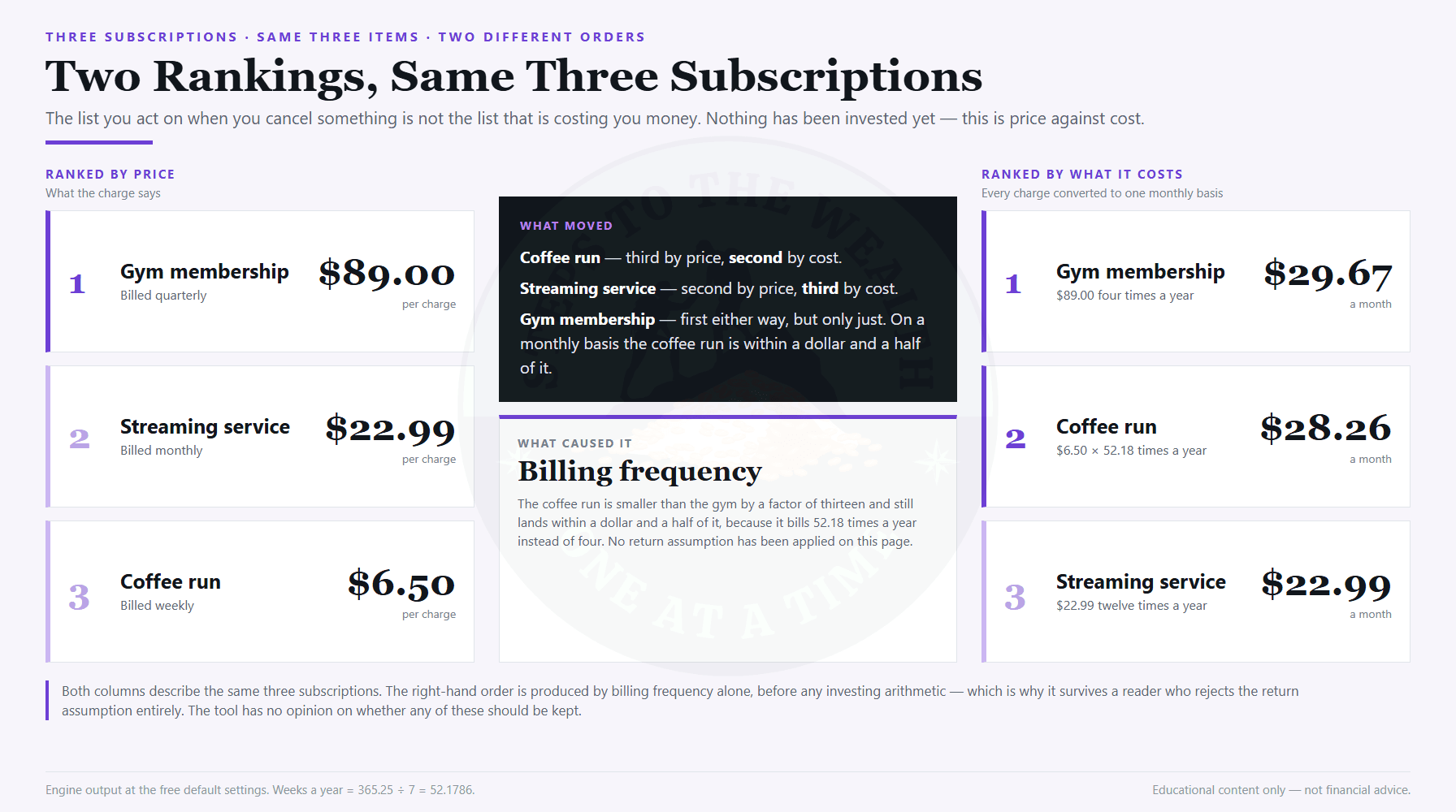
Here are three subscriptions. Before you read on, decide which one is the expensive one.
- A gym membership: $89.00, billed quarterly
- A streaming service: $22.99, billed monthly
- A coffee run: $6.50, billed weekly
Almost everyone picks the gym, because $89 is the biggest number on the page. The gym does come first — but only just, and not for the reason anyone guesses. And the answer to “which one should I cut” is almost certainly not the one you are about to cut.
This is not an article about spending less. It is an article about a ranking being wrong.
People cancel the wrong subscription for a reason that has nothing to do with price. Auto-renewing plans are governed by rules like the FTC’s Negative Option Rule, but no rule tells you which of your own subscriptions is the expensive one. That is a ranking problem, and the ranking most people carry is wrong.
The conversion nobody does
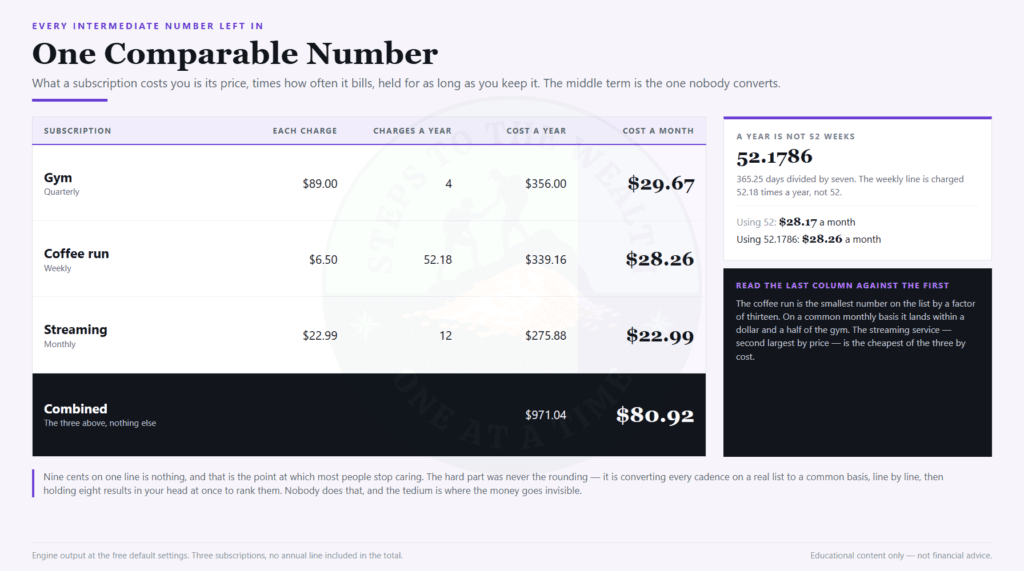
What a subscription costs you is not its price. It is its price, times how often it bills, held for as long as you keep it. The middle term is the one nobody converts.
Here is the whole calculation for those three, with every intermediate number left in:
| Subscription | Each charge | Charges a year | Cost a year | Cost a month |
|---|---|---|---|---|
| Gym, quarterly | $89.00 | 4 | $356.00 | $29.67 |
| Coffee run, weekly | $6.50 | 52.18 | $339.16 | $28.26 |
| Streaming, monthly | $22.99 | 12 | $275.88 | $22.99 |
| Combined | $971.04 | $80.92 |
Read the last column against the first one.
The coffee run is the smallest number on the list by a factor of thirteen. On a common monthly basis it lands within a dollar and a half of the gym. The streaming service — second largest by price — is the cheapest of the three by cost.
Two rankings, same three items:
By sticker price: gym, streaming, coffee.
By what it actually costs: gym, coffee, streaming.
Those are not the same list. That is the entire point.
The flip happens before any market assumption
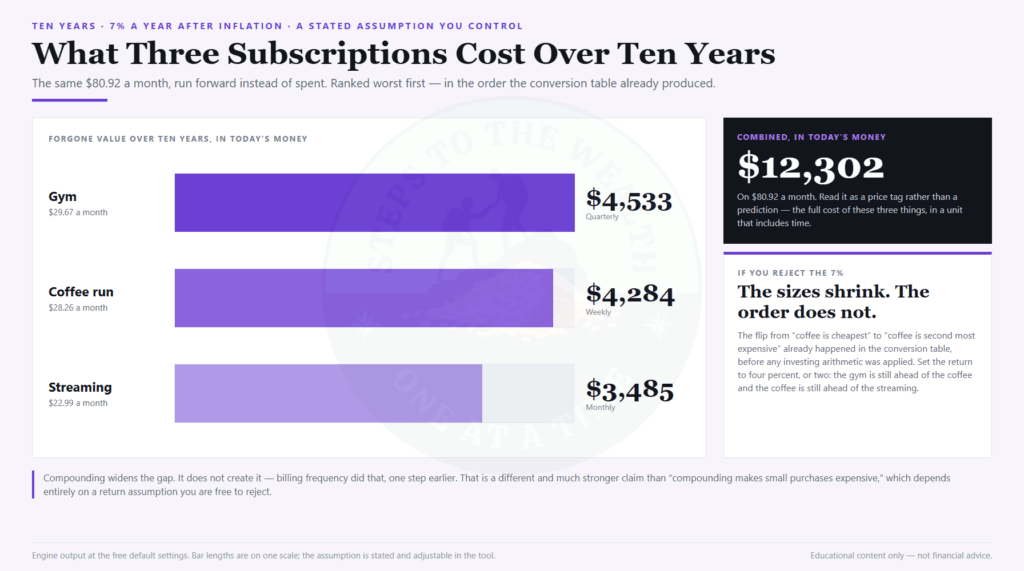
Now run the money forward. If you had invested the same amounts instead, at 7% a year after inflation over ten years, the forgone value is:
- Gym: $4,533
- Coffee run: $4,284
- Streaming: $3,485
Combined, $12,302 in today’s money, on $80.92 a month.
The reasonable objection here is immediate and I want to deal with it before anything else: you got that result by assuming 7%, and if I change the assumption I change the answer.
Half right. Change the assumption and the sizes change. The order barely moves — and the reason is visible in the table above. The flip from “coffee is cheapest” to “coffee is second most expensive” already happened in the fourth column, before any investing arithmetic was applied at all. It is caused by billing frequency alone. Compounding then widens the gap. It does not create it.
So set the return to four percent, or two. The forgone figures shrink. The gym is still ahead of the coffee, and the coffee is still ahead of the streaming. The finding survives the disagreement, which is the only reason it is worth putting in front of anyone.
That is a different and much stronger claim than “compounding makes small purchases expensive.” That claim is the standard one, and it depends entirely on a return assumption you are free to reject. This one does not.
A year is 52.18 weeks, not 52
One detail in that table is easy to skip past. The weekly coffee is charged 52.18 times a year, not 52 — because a year is 365.25 days and 365.25 divided by seven is 52.1786.
Use 52 and the coffee comes out at $28.17 a month. Use the real figure and it is $28.26. Nine cents.
Nine cents on one line is nothing. That is the point at which most people stop caring, and it is the wrong point to stop. Across eight subscriptions on four different billing cycles, tracked over a decade, it stops being nine cents — and more importantly, the rounding is not the hard part. The hard part is that doing this properly across a real list means converting four cadences to a common basis, line by line, and then holding all eight results in your head at once to rank them.
Nobody does that. Not because it is difficult — every row above is arithmetic you could do on paper — but because it is tedious. And that tedium is precisely where the money goes invisible.
This is the same structural problem as saving rate versus return rate: the lever that matters most is the one that is least interesting to look at.
Why you cancel the wrong subscription first
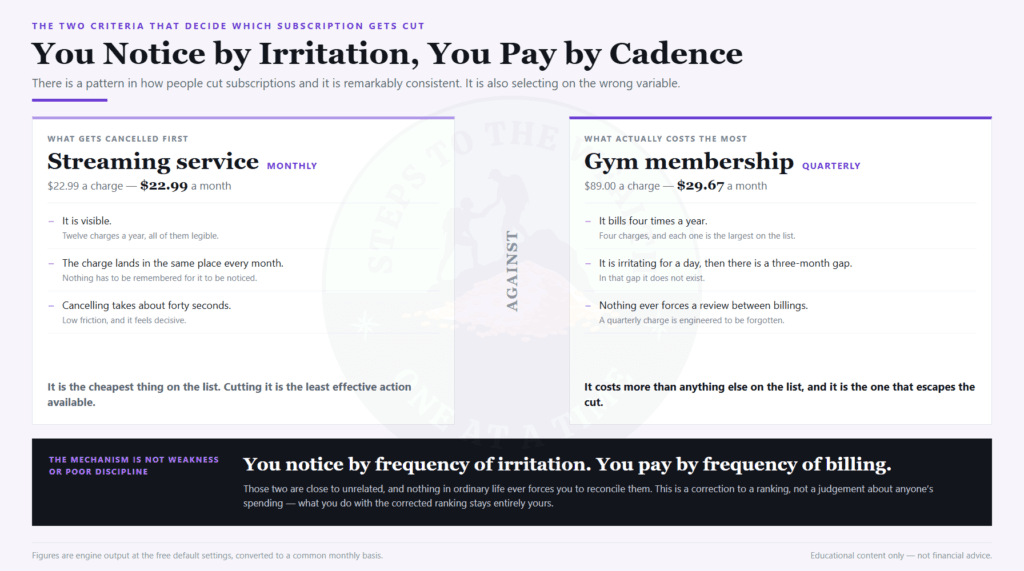
There is a pattern in how people cut subscriptions and it is remarkably consistent.
The streaming service goes first. It is visible, it is monthly, the charge lands in the same place every month, and cancelling takes about forty seconds. It feels decisive.
In the example above, streaming is the cheapest thing on the list. Cutting it is the least effective action available.
Meanwhile the quarterly gym bills four times a year. It arrives, it is irritating for a day, and then there is a three-month gap in which it does not exist. It costs more than anything else on the list.
The mechanism is not weakness or poor discipline. It is that the things you notice and the things that cost you are selected on completely different criteria. You notice by frequency of irritation. You pay by frequency of billing. Those two are close to unrelated, and nothing in ordinary life ever forces you to reconcile them. A quarterly charge is engineered — deliberately or not — to be forgotten between billings.
This is the same failure mode as lifestyle creep. Not one large bad decision. A structural blind spot that compounds quietly while your attention is somewhere legible.
What this is not
The coffee lecture deserves the contempt it gets. It is usually moralising dressed up as arithmetic — someone with a spreadsheet telling you that if you had skipped a latte since 1997 you would own a house, which is both false and insulting.
So look carefully at what the numbers above actually said. They did not say stop drinking coffee. They said the coffee run and the gym membership cost within $250 of each other over ten years, and that both cost more than the streaming service you were about to cancel instead.
That is a correction to a ranking, not a judgement about your life. What you do with the corrected ranking is entirely your business — and “keep the coffee, cut the gym” is a perfectly good reading of it. So is “keep all three, now I know what they cost.” The number is not an instruction.
There is a real difference between a tool that tells you what something costs and a tool that tells you how to feel about it. Almost everything in this category is the second kind.
If the investing frame does not work for you
The strongest objection to any calculation like this is not about the rate. It is this:
“I would not have invested that money anyway. Cancel the gym and the $89 becomes something else I spend on. It does not become a contribution. So the ten-year figure is fiction.”
That is probably true, and it is the best argument on the page. Most cancelled subscriptions turn into other spending, not into invested capital. People are generally right about their own behaviour.
Two things hold anyway.
Read the figure as a price tag rather than a prediction. It is not a forecast of your net worth. It answers a narrow question: what is the full cost of this thing, expressed in a unit that includes time? That is worth knowing before you renew something for another decade, and it is a different question from “what will my portfolio be worth.” The same distinction runs through the time value of purchases tool, which measures the money side of a one-off purchase and the delay it adds to a goal.
Or drop the investing frame entirely. Take the annual cost and divide by your hourly rate. That $971.04 becomes a number of hours you worked to pay for those three things. No counterfactual, no return assumption, nothing to disagree with — just what you traded. Dollars are abstract. Hours are not, and in my experience the hours figure is the one that changes behaviour when the dollar figure does not.
The annual plan is the same trap, doubled
The three cadences above stop at quarterly. There is a fourth, and it is the strongest version of the effect.
An annual subscription bills once. It is irritating for one day out of 365, and then it is structurally invisible for the rest of the year — twelve months in which nothing on any statement reminds you it exists. By the frequency-of-irritation ranking that every household runs by default, an annual plan is the cheapest thing you own. By cost it is frequently among the most expensive things on the list.
The “save 15% by paying yearly” offer sits directly on top of that. The discount is real, and it is not the whole trade. Paying monthly gives you twelve decision points a year, eleven of which you can use to leave. Paying yearly gives you one, and it arrives at the moment you are least likely to be thinking about it. You are not only buying a discount. You are selling eleven opportunities to change your mind, and the price of those does not appear on the invoice.
That is a perfectly reasonable trade for something you are certain you will use all year. It is a poor one for anything you are trialling, anything attached to a habit you have not yet established, and anything whose value depends on a living arrangement that might change. A gym membership is all three of those at once, which is a large part of why gyms sell annual plans.
The ones you forgot you had
Everything above assumes you already know what your list is. Most people do not, and the reason is the same billing-frequency problem wearing a different costume.
The standard audit is to scan last month’s card statement. That catches every monthly charge and misses, by construction, every quarterly, semi-annual and annual one. A thirty-day window cannot see a bill that arrives every ninety days. So the audit returns the cheap end of your list, you cut from what it found, and the expensive end survives untouched. It is one more mechanism by which people cancel the wrong subscription and come away feeling they have dealt with the problem.
Scan thirteen months instead of one. Thirteen rather than twelve, because an annual charge that landed early in the month can sit just outside a twelve-month window. Do it on every card and every account, including the one you opened for a free trial and the one attached to an app store, because that is where the forgotten ones concentrate.
Then look for what is still billing for something you no longer use at all. Not something you use less than you meant to — that is a different and far more forgivable category — but the actively dead ones: the service replaced by another service, the tool for a project that ended, the plan attached to a device you no longer own. Those are pure loss with no consumption on the other side of them, and they are the only line items in this entire article where cancelling has no trade-off at all.
Inaction is a purchase
One structural thing separates subscriptions from every other kind of spending, and it explains most of what is above.
With a one-off purchase, the default is no. Money moves only when you decide it should. Doing nothing costs nothing, which is why a purchase gets a moment of attention — however brief — before it happens.
With a subscription, the default is yes. The money moves unless you intervene. Doing nothing is a decision to keep buying, renewed on a schedule you did not choose, at a price the seller can raise with notice you will not read. Every other category of spending requires an act to spend. This one requires an act to stop.
That asymmetry is the business model, and it is why the ranking matters more here than anywhere else. A wrong ranking on a one-off purchase costs you once. A wrong ranking on a subscription list costs you every billing cycle for as long as the ranking stays wrong, which on the evidence is years.
So the useful discipline is not an annual purge. It is a diary entry: one date a year on which every recurring charge has to justify itself as though you were signing up today. Would I start paying this, at this price, now? If the answer is no and you keep it anyway, that is a decision, and decisions are fine. The version worth avoiding is the one where nobody ever asks.
Run your own list
The total is not the interesting part. Most people are within about twenty percent on their annual subscription spend already — you probably know roughly what you pay.
The order is the interesting part, and the order is what almost nobody has right, because getting it right means converting four billing cycles to a common basis across eight or nine line items and no one does that in their head.
I built a free calculator that does the conversion: Subscription Vampire. Type in what bills you, set the cadence for each, and it returns the list ranked worst first by what each one actually costs — plus the running annual total, the hours-worked figure, and how much sooner you would reach a savings goal without them. No account, no email, nothing stored. It runs in the page and forgets you when you leave.
It has no opinion about whether you should keep any of these. It does the arithmetic and hands you the ordering. The decision stays yours, which is the only honest place for it to sit.
Ninety seconds settles it. If your list comes back in the order you expected, you have lost ninety seconds and gained a fact. That is a good trade.
The free version models three subscriptions over ten years, which is enough to answer the question this article asks. Pro takes it to twenty subscriptions and the full fifty-year horizon, lets you set your own inflation and fee assumptions, computes the return basis from real price history, and adds image, CSV and clipboard export. Pro is $29, paid once — not a subscription and not a bundle. The checkout is here. If three subscriptions already told you what you needed, you do not need it.
Educational content only — not financial advice. The figures in this article are produced by the calculator on its free default settings and are illustrative. The tool models a stated assumption that you control; it is not a prediction, a recommendation, or a projection of what any investment will return. Past performance does not indicate future results.