Now in early access●14 days free●$9 / month or $90 / year
S Steps To The Wealth Weekly
Issue / Upgrade
The Paid Edition · Sundays

Stop guessing what to do each week.

Read the same system every Sunday.

Steps To The Wealth Weekly is a risk-first investing framework for working professionals. The free Sunday email gives you the lesson and the reading preview. The paid edition gives you the full work — the four inputs behind each reading, the tactical “what to do this week,” the deep-dive, and the noise filter.

Every Sunday. Same structure. Same five assets. Built so you can read it in 10 minutes and walk away knowing exactly what the framework says to do.

●  14 days free  ·  no charge until day 14  ·  cancel anytime
01 · The edition

What you get every Sunday

One email. Same structure every week. Read it in ten minutes, walk away with the framework's call — and the work behind it.

01 / Readings

The full readings — with the four inputs underneath each.

For BTC, ETH, SPX, QQQ, and Gold: price extension, sentiment, underlying signal, and macro context. Not just a label — the analysis behind the label.

02 / Tactical

The tactical layer.

“What to do this week” — which entry/exit rungs trigger, which positions hold, what to watch for. The specific actions the framework prescribes, not generic advice.

03 / Deep-dive

A weekly deep-dive.

One of the five tracked assets goes under the lens each Sunday. Why this week's reading is what it is. What would change it next. The structural lens underneath the label.

04 / Q & A

A subscriber question, answered.

Real questions from real subscribers, answered through the framework. The kind of question you wish someone would just answer directly.

05 / Filter

The noise filter.

What to ignore this week. The headlines, the social-media buzz, the narratives the framework explicitly filters out — with the reasoning.

02 · Subscribe

Two ways to subscribe

Both plans start with 14 days free. Same content, same Sunday cadence. Choose the cadence that fits how you like to pay.

Plan A
Monthly
$9/ month

The flexible option.

Cancel anytime.

Plan B
Annual
$90/ year
Save $18 · two months free

The committed option.

Two months free vs monthly.

Both plans: 14 days free. · No charge until day 14. · Cancel anytime from your subscriber dashboard.
03 · Fit

Who this is for

Working professionals who already understand the basics of investing and want a system they can actually run — not predictions, not picks, not “wait and see.”

A good fit if

You'll get value on day one
  • You have money invested across stocks, crypto, or both
  • You don't have time to watch markets all day
  • You've tried following framework-based investing on your own and want a weekly anchor
  • You want the discipline of a system, not the noise of more content

Not a fit if

Try the free email first — or pass
  • You're looking for stock picks or “next 10x” calls
  • You want daily updates or real-time alerts
  • You're brand new to investing (start with the free Sunday email and the Dynamic DCA Blueprint first)
04 · Honesty

What it's not

Clarity up front so you know what you're buying — and what you're not.

N° 01

Not financial advice.

Everything in the newsletter is educational. Your decisions are yours.

N° 02

Not stock picks.

The framework tracks five assets and tells you what the risk readings say — not what to buy specifically.

N° 03

Not real-time.

One Sunday email per week. The whole point is that you don't have to watch markets between issues.

N° 04

Not a community.

Just the email. (Community is on the roadmap for later — when there are enough subscribers to make it valuable.)

05 · FAQs

Questions you'll probably ask

The things people email about most. Anything missing? [email protected].

Q · 01 Can I cancel during the trial? +
Yes — anytime in the first 14 days, no charge. Cancel from your subscriber dashboard (link in the welcome email) or email [email protected].
Q · 02 What's the difference between the free and paid editions? +
The free Sunday email has the lesson and a reading preview (labels only — BTC: HIGH, etc.). The paid edition has the same lesson plus the four inputs behind each reading, the tactical layer, the deep-dive, the subscriber question, and the noise filter.
Q · 03 Is there a refund after the trial? +
The 14-day trial is when you decide. After day 14, billing starts. We don't offer post-trial refunds for partial periods — but you can cancel any time, and you won't be billed for future cycles.
Q · 04 Will the price ever change? +
Locked-in pricing: if you subscribe at $9/month or $90/year, that's your price as long as you stay subscribed.
Q · 05 Do you offer team or institutional pricing? +
Not yet. If you're interested, email [email protected].
Q · 06 What if I'm new to investing? +
Start with the free Sunday email first. Subscribe at stepstothewealth.com/newsletter — you'll also get the Dynamic DCA Blueprint, a one-page reference. After a few weeks, decide if the paid edition is right for you.
06 · One more thing

The paid edition is the discipline anchor.

The hardest part of investing with a framework isn't learning it — it's running it consistently for years. The Sunday cadence is what holds the discipline in place when the rest of your life is noisy.

That's the trade. $9 a month for a weekly system reminder that keeps you aligned with the framework you said you wanted to follow.

$9 / month·$90 / year·14 days free
Educational content only — not financial advice. Always do your own research before making investment decisions.
© Steps To The Wealth · 2026
01 — The work under the label

The free email gives you the label. The paid edition gives you the work.

Every Sunday the free email prints one of four risk labels for each of five assets. The paid edition prints what produced that label, and what the framework says to do about it this week. That is the whole difference, and it is worth being exact about it.

A label on its own is a verdict without the evidence. The paid edition puts the four inputs under every reading: price extension, how far price has run from where the framework expects it; sentiment, whether the crowd is fearful or greedy; the underlying signal, the structural measure that carries the most weight; and macro context, what liquidity and rates are doing to all five assets at once. Four lines, five assets, twenty short readings a week.

Then the tactical layer. The free email tells you the reading moved. The paid edition tells you which rung of the entry or exit ladder that movement triggers, which positions simply hold, and what would change the call before next Sunday. It is the difference between knowing risk is high and knowing that the second exit rung applies to one asset and nothing applies to the other four.

The deep-dive takes one of the five assets each week and explains its reading properly: why it is what it is, what would move it, and what the same inputs looked like the last time they lined up this way. The subscriber question answers a real reader through the framework rather than around it. And the noise filter names what to ignore this week — the headline, the narrative, the chart doing the rounds — with the reason.

None of that is more content for its own sake. The paid edition is built to be read in ten minutes, and the structure is identical every Sunday so that after a month you read it straight to what changed. The market risk indicator explains the reading itself in full, if you want the mechanism before the subscription.
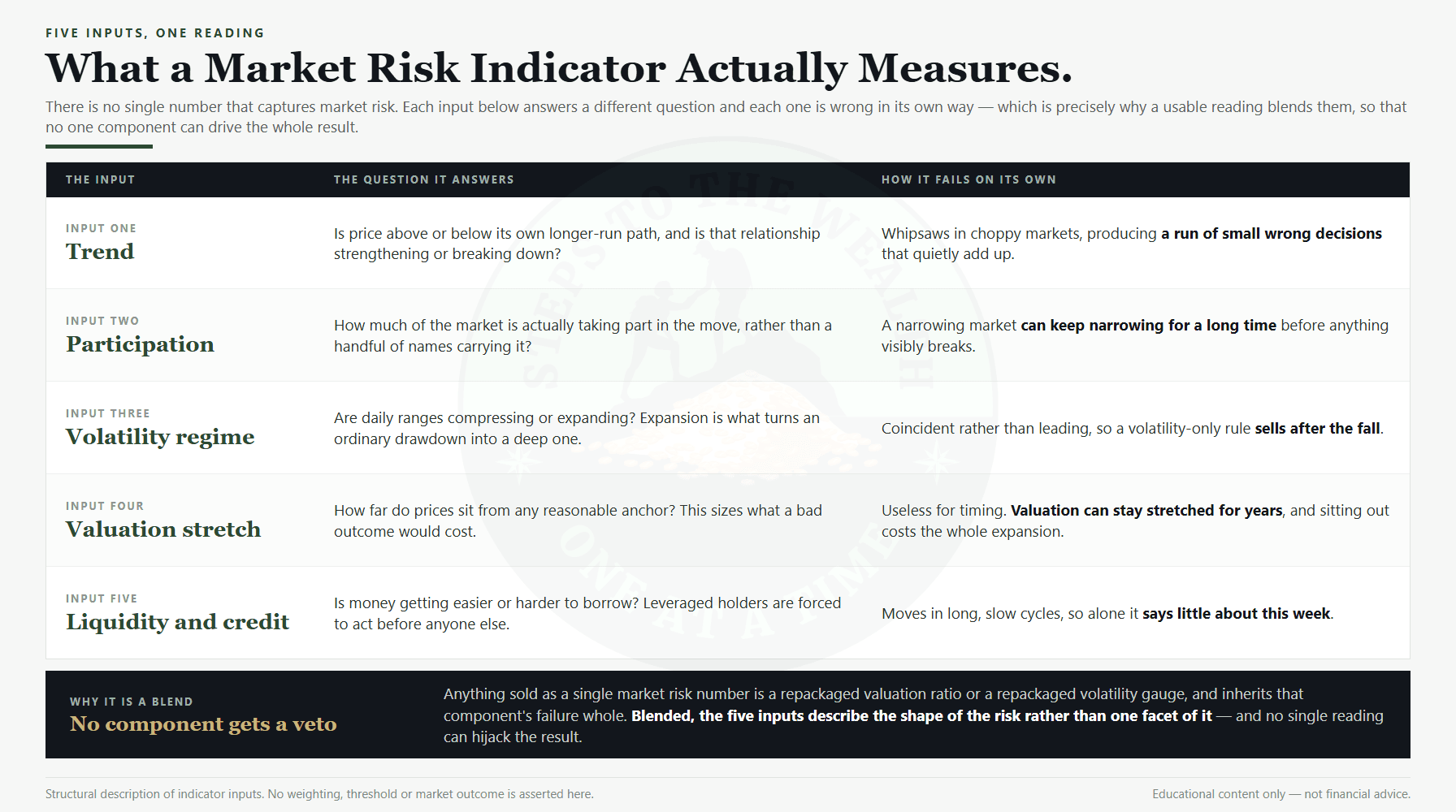
What the paid edition prints under each reading: trend, participation, volatility regime and valuation
The layer the paid edition adds under every label: the inputs, not just the verdict.

02 — The arithmetic

What the paid edition costs, stated in full.

Two plans, one product. The numbers are on this page rather than behind a checkout, and the small print is here rather than in a footer.

Step one

Fourteen days free

Both plans open with 14 days at no charge. Nothing is billed until day 14, and cancelling inside the window from the subscriber dashboard means nothing is billed at all. The trial is the whole paid edition, not a preview of it.

Step two

Monthly, $9

Billed monthly, cancelled any time from the dashboard, and you are never charged for a cycle after the one you cancel in. This is the plan to pick if you want to decide again in a month.

Step three

Annual, $90

Billed once a year. Twelve months for the price of ten, which is the $18 the page calls two months free. This is the plan to pick if you already know a Sunday habit is the thing you are buying.

Step four

Locked pricing

The price you subscribe at is your price for as long as you stay subscribed. If the paid edition costs more later, it costs more for people who join later, not for you.

What is not included, so that nothing is discovered after paying

There are no refunds for partial periods after the trial. Day 14 is the decision point, and the dashboard cancels in one click, so the honest arrangement is to use the two free weeks as the test rather than the first paid month. Cancel and you keep everything already sent, and you are never billed again.

There is no team or institutional pricing yet, no community, no real-time alerts and no stock picks. The paid edition is one email a week that tells you what a rules-based framework says about five assets. Where the law in your own location gives you a withdrawal right, that right stands regardless of anything on this page.

A fee-only planner will stress-test one plan once for a few hundred dollars. The paid edition is $9 a month for a system re-read every week. That comparison is fair only if you actually read it on Sundays, which is why the free email exists first: find out whether the habit sticks before you pay for the fuller version of it.
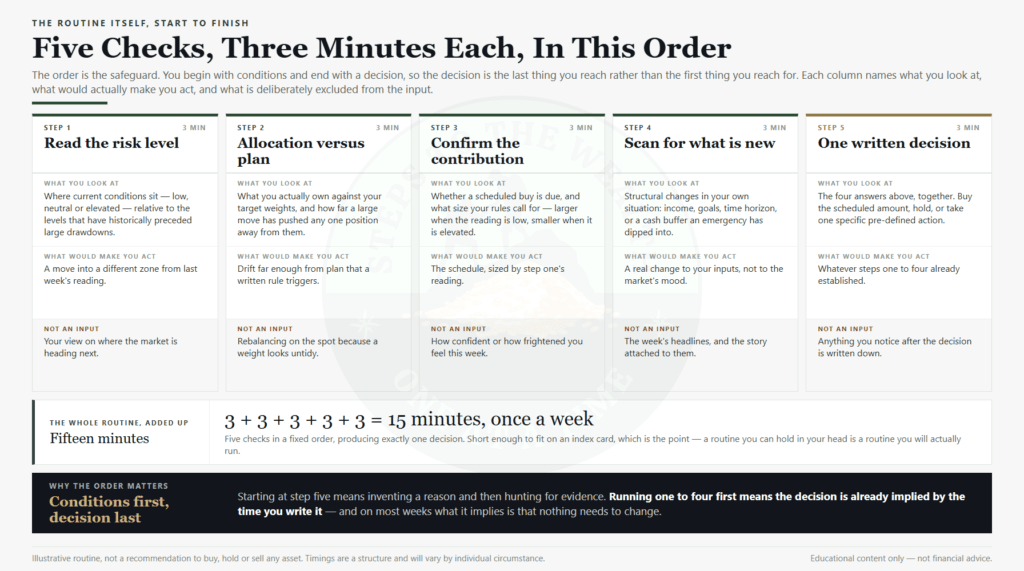
The five-step Sunday routine the paid edition is built around: read the risk level, check the allocation, act or hold, and close the tab
The Sunday routine the paid edition is written for. Ten minutes, the same five steps every week.

03 — Who this is for

The paid edition is a discipline anchor, not more content.

The hardest part of running a framework is not learning it. It is still running it in year three, in the weeks when the market is boring and the weeks when it is frightening. That is what the paid edition is for, and it is not for everyone.
It fits if

  • You already read the free Sunday email and find yourself wanting the reasoning under the labels rather than only the labels.
  • You hold some mix of the five tracked assets and want the rung, not the mood — the specific ladder step a reading triggers, or the confirmation that nothing does.
  • You have tried running a rules-based plan on your own and drifted, and you want a weekly anchor that says the same thing the same way every Sunday.
  • You would rather pay $9 a month for one email you act on than nothing for ten you skim.

It does not fit if

  • You want stock picks, entry alerts or a view on what happens next. The paid edition reports readings and ladder rungs; it never predicts.
  • You want real-time coverage. The paid edition arrives on Sunday and is silent until the next one, on purpose, because the framework has nothing to say in between.
  • You are new to investing. Start with the free email and the Dynamic DCA Blueprint, and read rules-based investing first — the paid edition assumes the framework is already familiar.
  • You are hoping the paid edition will make you trade more. It is built to make you act less, and only on a reading.
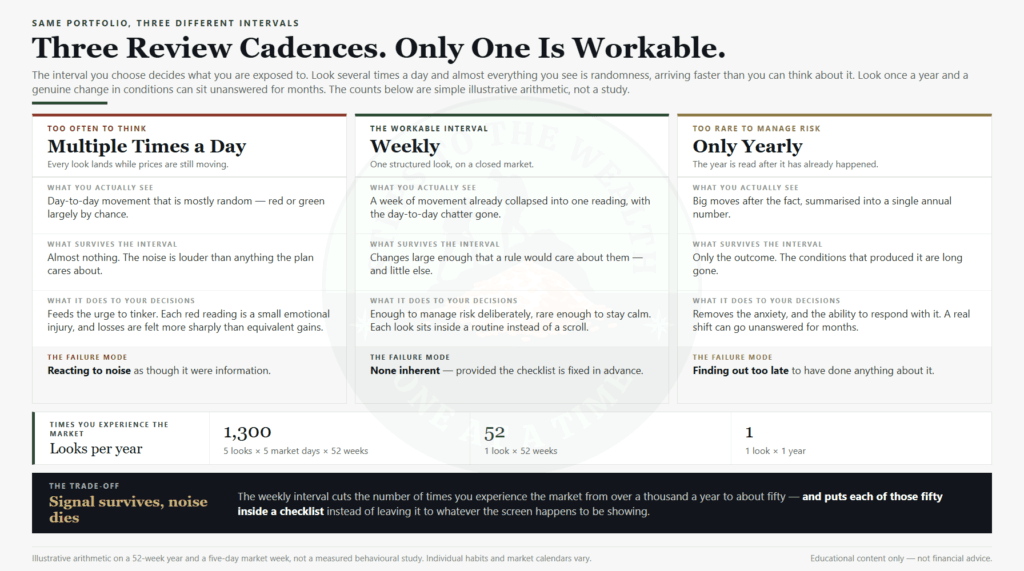
Daily, weekly and yearly review frequency compared: why the paid edition arrives once a week and never in between
Why the paid edition arrives weekly and never in between: daily reviews cost attention, yearly ones miss the readings.

04 — Questions

What people ask before they start the paid edition.

Answered against what the paid edition actually is, not against what would be convenient to claim.

What does the paid edition include that the free email does not?

Five things. The four inputs under each of the five readings, the tactical layer that names which ladder rung this week’s readings trigger, a weekly deep-dive on one asset, a subscriber question answered through the framework, and the noise filter that says what to ignore and why. The lesson and the reading labels are in both editions.

Nothing in the free email is cut down to make the paid edition look better. The label per asset is the same label; the paid edition is the work underneath it.

Can I cancel the paid edition during the trial?

Yes, at any point in the first 14 days, with no charge. The subscriber dashboard is linked in the welcome email and cancels in one click; an email to the address on the checkout does the same. Nothing is billed until day 14.

After day 14 the plan bills, monthly or annually, and you can still cancel any time; you are simply not refunded for the part of a period already paid for.

How long does the paid edition take to read?

About ten minutes, against about five for the free email. The structure never changes — readings with their inputs, the tactical layer, the deep-dive, the question, the filter — so it is read the way a dashboard is read, straight to what moved.

If an issue routinely takes you longer than that, you are studying it rather than acting on it, and the honest advice is to read the deep-dive and skip the rest until Sunday.

Does the paid edition tell me what to buy?

No. It tells you what a rules-based framework says about Bitcoin, Ethereum, the S&P 500, the Nasdaq 100 and gold, and which rung of a written ladder each reading triggers. Which of those you hold, in what size, and whether you act at all remains your decision.

Everything in the paid edition is educational. It is not financial advice and it does not know your circumstances. Educational content only — not financial advice.

Will the price of the paid edition go up?

Not for you. Pricing is locked at the rate you subscribe at, $9 a month or $90 a year, for as long as you stay subscribed. A later price rise applies to later subscribers.

The annual plan is the same locked rate paid once, at twelve months for the price of ten.

Is there a community or a chat with the paid edition?

No. The paid edition is the email and nothing else. A community is on the roadmap for when there are enough subscribers for it to be worth anyone’s time, and it will be a separate decision when it arrives.

If what you want is a place to talk about the readings, the paid edition is not that yet, and this page will not pretend otherwise.