Free Sunday email · For working professionals

Read the market each Sunday.
Hold the rest of the week.

The market is noise.
Sunday is signal.

A risk-first system.
Delivered every Sunday.

Investing without becoming an investor.
Every Sunday.

A risk-first investing newsletter, delivered weekly.

Steps To The Wealth Weekly is a free Sunday email for working professionals who want a system, not predictions. Read it in five minutes. Walk away knowing what the framework says — and what to do this week, if anything.

Sundays, no spam Unsubscribe in one click
01 · The lead-in

A one-page reference you'll pin somewhere visible.

The Dynamic DCA Blueprint is the framework distilled to a single printable page. Built so a working professional can absorb the whole system in two minutes — and re-check it any Sunday morning without re-reading a thirty-page guide.

  1. 01
    The four phases.

    LOW · MEDIUM-LOW · MEDIUM-HIGH · HIGH — what each reading means, in one line.

  2. 02
    The entry ladder.

    How to size positions when risk drops. Rung-by-rung sizing math.

  3. 03
    The exit ladder.

    How to trim positions when risk rises. The same mechanic, in reverse.

  4. 04
    The five tracked assets.

    BTC, ETH, SPX, QQQ, Gold — and what gets excluded, and why.

  5. 05
    The “what to do at each reading” cheat sheet.

    The decision table that turns a label into action.

Print it. Pin it. Reference it on Sundays. It's the one page you'll come back to.

02 · The weekly habit

One inbox. One Sunday morning. Same shape every week.

Every Sunday at 09:00 IST, the email lands. Read it in five minutes. The structure is identical week to week — so you learn to read it fast and trust the system to surface what changed.

01 / Lesson

The lesson.

A 400-700 word teaching section. One principle from the framework, applied to what the market is actually doing this week. Across a year, you'll see all the core principles unpacked through real situations — not abstract theory.

02 / Reading preview

The reading preview.

The framework's call on each of the five tracked assets, in a label you can read in three seconds:

  • BTC[LOW / MEDIUM-LOW / MEDIUM-HIGH / HIGH]
  • ETH[reading]
  • SPX[reading]
  • QQQ[reading]
  • Gold[reading]

That's the free email. The full work — the four inputs behind each reading, the tactical “what to do this week,” the weekly deep-dive, the noise filter — lives in the paid edition. (More on that below — no pressure.)

03 · Fit

Who this is for.

Working professionals who want a system, not predictions. If any of these sound like you, the Sunday email will earn its place in your inbox.

A good fit if

You'll get value on day one
  • You have money invested across stocks, crypto, or both
  • You don't have time to watch markets all day
  • You've tried “just DCA” approaches and want a system that actually responds to risk
  • You're tired of bold predictions and want the discipline of rules

Not a fit if

Try a different newsletter — or just pass
  • You want stock picks or “next 10x” calls
  • You want daily updates, real-time alerts, or trade signals
  • You believe the right move is timing the market
04 · The cadence

Sundays are for reading. The rest of the week is for your life.

Why one day, why this day, and why most weeks the right move is to do nothing.

Markets close Friday afternoon. By Sunday morning, the week has settled. New economic data is digested. Sentiment has reset. Friday's panic looks different in Sunday light. The framework can give you a clean read on where things stand — and the action to take this week, if any.

Most weeks, the action is nothing. The system says hold. You read the email in five minutes, close your inbox, and get back to your week. That's the design. No alerts. No “urgent” pushes. One Sunday email. Built for an inbox you already have.

05 · Honesty

What it's not.

Clarity up front so you know what you're subscribing to — and what you're not.

N° 01

Not financial advice.

Everything in the newsletter is educational. Your decisions are yours.

N° 02

Not stock picks.

The framework tracks five assets and tells you what the risk readings say — not what to buy specifically.

N° 03

Not real-time.

One Sunday email per week. The whole point is that you don't have to watch markets between issues.

N° 04

Not a guru newsletter.

No bold predictions, no “I called it” energy, no urgent signal alerts. A written system, sent on Sundays.

07 · Subscribe

One email. Every Sunday. That's all.

Subscribe and you'll get the Dynamic DCA Blueprint within sixty seconds, and the first Sunday email this week. No spam. No daily updates. No alerts. Unsubscribe any time you want — and the unsubscribe link works on the first click.

Sundays, no spam Free forever Read by working professionals
01 — What a reading is

A newsletter that prints one label per asset, and means it.

Every Sunday the newsletter states where each of five assets sits on a four-step risk scale. That sentence is the whole product, so it is worth being exact about what a reading is and what it is not.

A reading is a position on a scale, not a forecast. The scale has four steps — LOW, MEDIUM-LOW, MEDIUM-HIGH and HIGH — and each asset gets one of them every week. The newsletter does not say where price goes next. It says how much risk is in the price today, measured the same way it was measured last week and the week before.

The five assets are fixed: Bitcoin, Ethereum, the S&P 500, the Nasdaq 100 and gold. They are not chosen because they are the best things to own. They are the five that a working professional is most likely to already hold, and the five where a risk reading changes a real decision. The newsletter does not add a sixth when something is in the news.

The reading exists so that the decision is mechanical. At LOW the framework says build, one rung at a time. At HIGH it says trim, one rung at a time. In between it mostly says hold. Most Sundays the newsletter’s honest summary is nothing changed, do nothing — and a newsletter that can say that without inventing urgency is the one worth keeping.

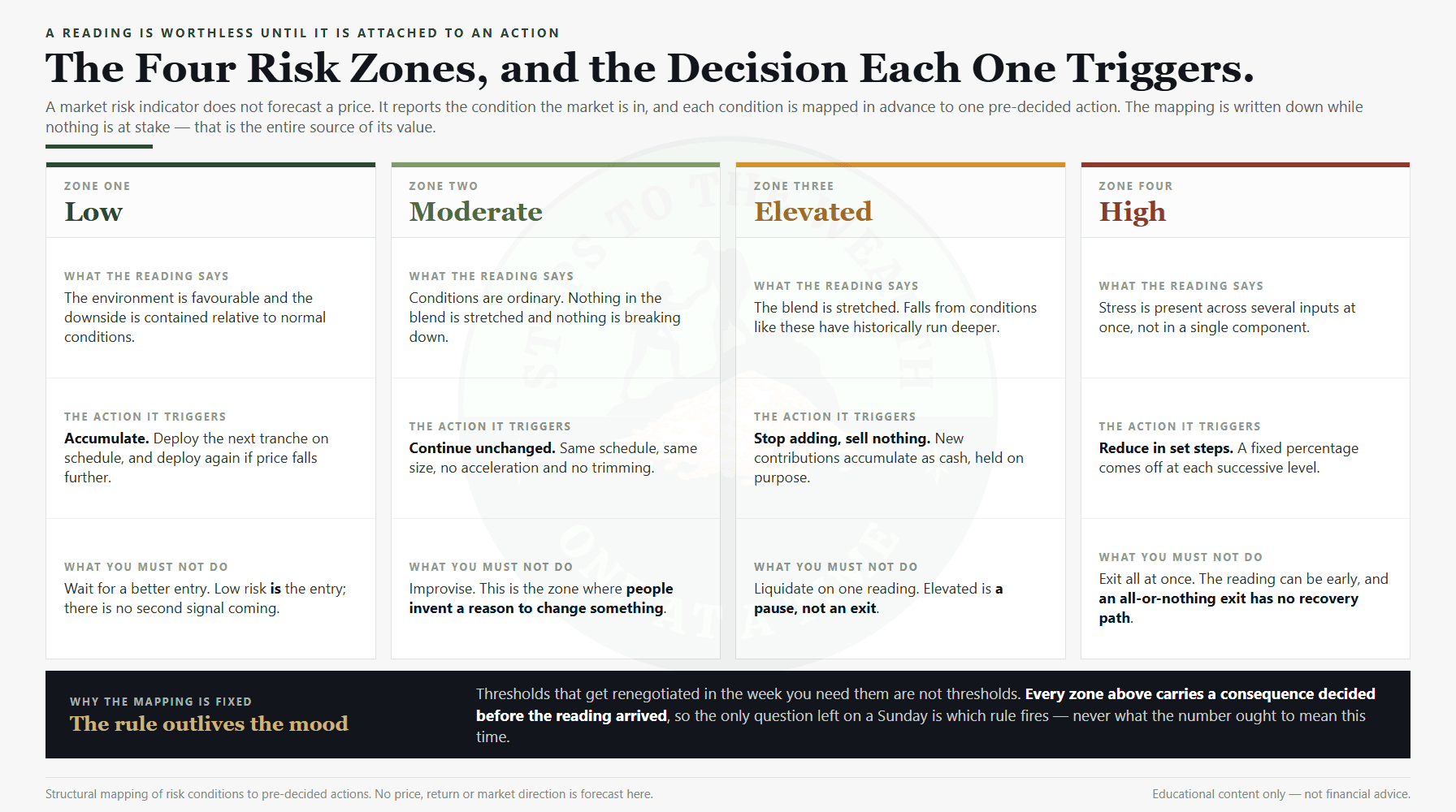
The four risk zones from the market risk indicator write-up, low to high, and the action each one triggers, the same scale the newsletter reads
The four zones from the market risk indicator write-up. The newsletter reads the same scale under the Blueprint’s names: LOW, MEDIUM-LOW, MEDIUM-HIGH and HIGH.

02 — The arithmetic

Two ladders, four rungs each. The newsletter tells you which rung.

The Dynamic DCA Blueprint you receive with the newsletter — dollar-cost averaging with the amount set by the reading — fits on one page because the mechanics fit on one page. Here they are in full, so nothing about the Sunday email is a black box.

The entry ladder has four rungs of 25% each. When an asset’s reading drops to LOW, the first rung is deployed: a quarter of the capital you had set aside for that asset. If risk stays low, or price falls further, the next rung follows. Four rungs is a full position. The rungs exist so that being early costs a quarter of a mistake, not the whole one.

The exit ladder runs the other way, and it is deliberately not symmetrical: 20%, then 25%, then 30%, then 25%. As the reading climbs into HIGH, position is trimmed in those steps. The first cut is the smallest because the first HIGH reading is the one most likely to reverse; the third is the largest because by then the evidence has stacked up. The newsletter names the rung that applies this week.

Both ladders act on the reading, never on a price target or a date. That is the difference between this newsletter and a newsletter of opinions: the rule is written down, the rung is the output, and you can check the arithmetic on the Blueprint the moment the email lands. If the reading does not move, no rung triggers, and the honest instruction is to hold.

One more thing the arithmetic makes plain. A full position built at LOW and trimmed at HIGH never needs the top or the bottom to be called. It needs a reading that is measured consistently and a reader who acts on it in order. The newsletter supplies the first. You supply the second, once a week, in about five minutes.
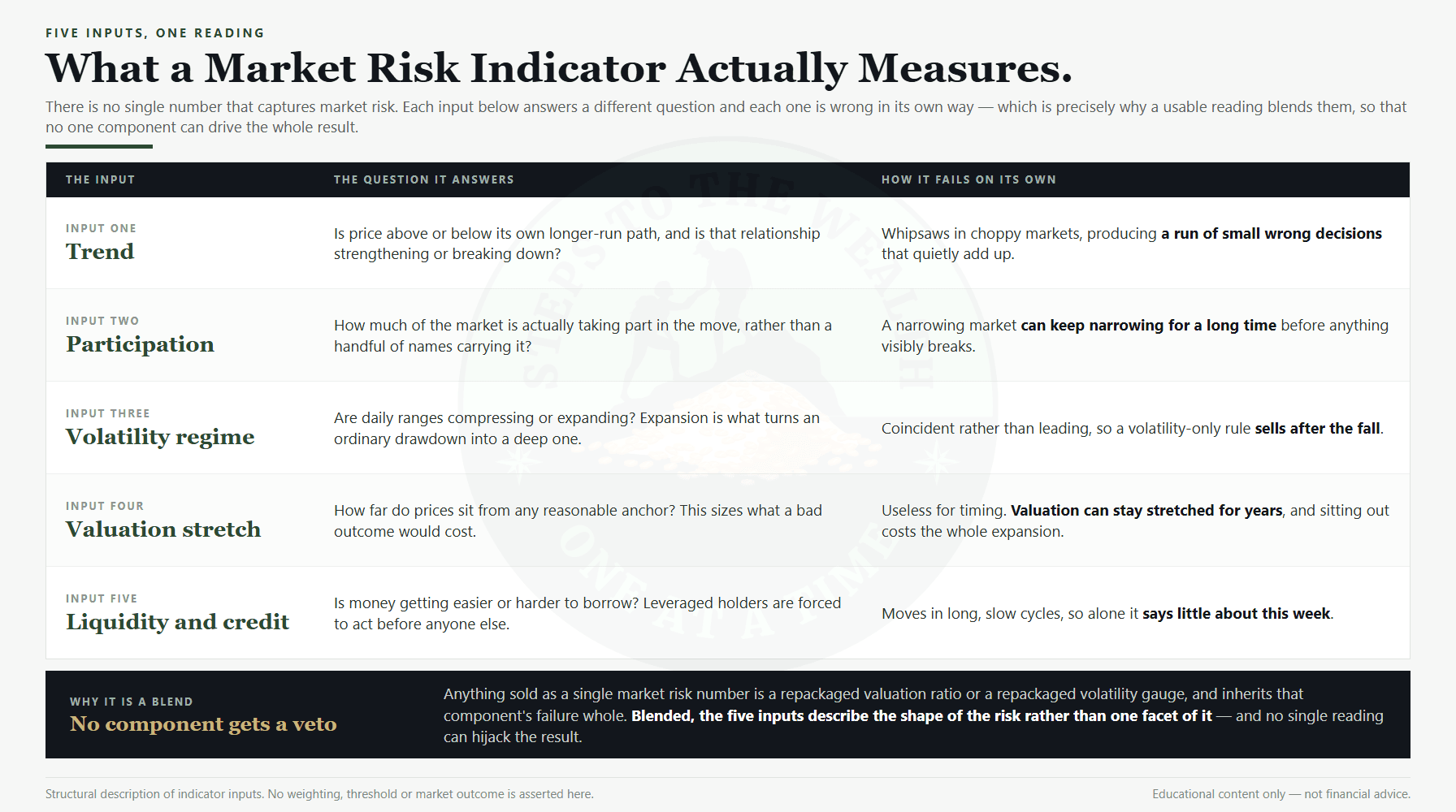
What the newsletter's risk reading measures: trend, participation, volatility regime and valuation
What sits underneath a reading. The free newsletter prints the label; the paid edition prints these inputs.

03 — How a Sunday issue is built

How the newsletter is put together, and how to read it in five minutes.

The structure never changes. That is on purpose: a newsletter you read the same way every week is one you learn to read fast, and one where the only thing that stands out is what actually changed.

Step one

The lesson

Four hundred to seven hundred words on one principle from the framework, applied to what the market did this week. Over a year the newsletter works through every core principle against real situations, not abstract theory.

Step two

The reading preview

The label for each of the five assets — LOW, MEDIUM-LOW, MEDIUM-HIGH or HIGH — in a form you can read in three seconds. This is the free newsletter’s whole readout, and for many readers it is enough.

Step three

The paid layer

The four inputs under each label — price extension, sentiment, the underlying signal and macro context — plus the tactical what to do this week, one deep-dive, a subscriber question and the noise filter. That is the paid edition, $9 a month or $90 a year after 14 days free.

Step four

Close the tab

Read it, check the rung on the Blueprint, do the one thing it says or nothing, and go back to your week. The newsletter sends no alerts between Sundays because the framework has nothing to say between Sundays.

Why Sunday, and why 09:00

Markets close on Friday. By Sunday morning the week’s data has been published and digested, sentiment has reset, and Friday’s panic reads differently. A newsletter written on Sunday is written from a settled picture rather than from inside the noise, which is the only time a risk reading is worth taking.

The time matters less than the cadence. What the newsletter is really selling is a weekly habit that fits inside a life: one email, one reading, one decision or none. Everything about the format — the fixed structure, the five assets, the four steps — exists so that the habit survives the years when the market is boring and the years when it is not. The 15-minute Sunday review lays the full routine out.

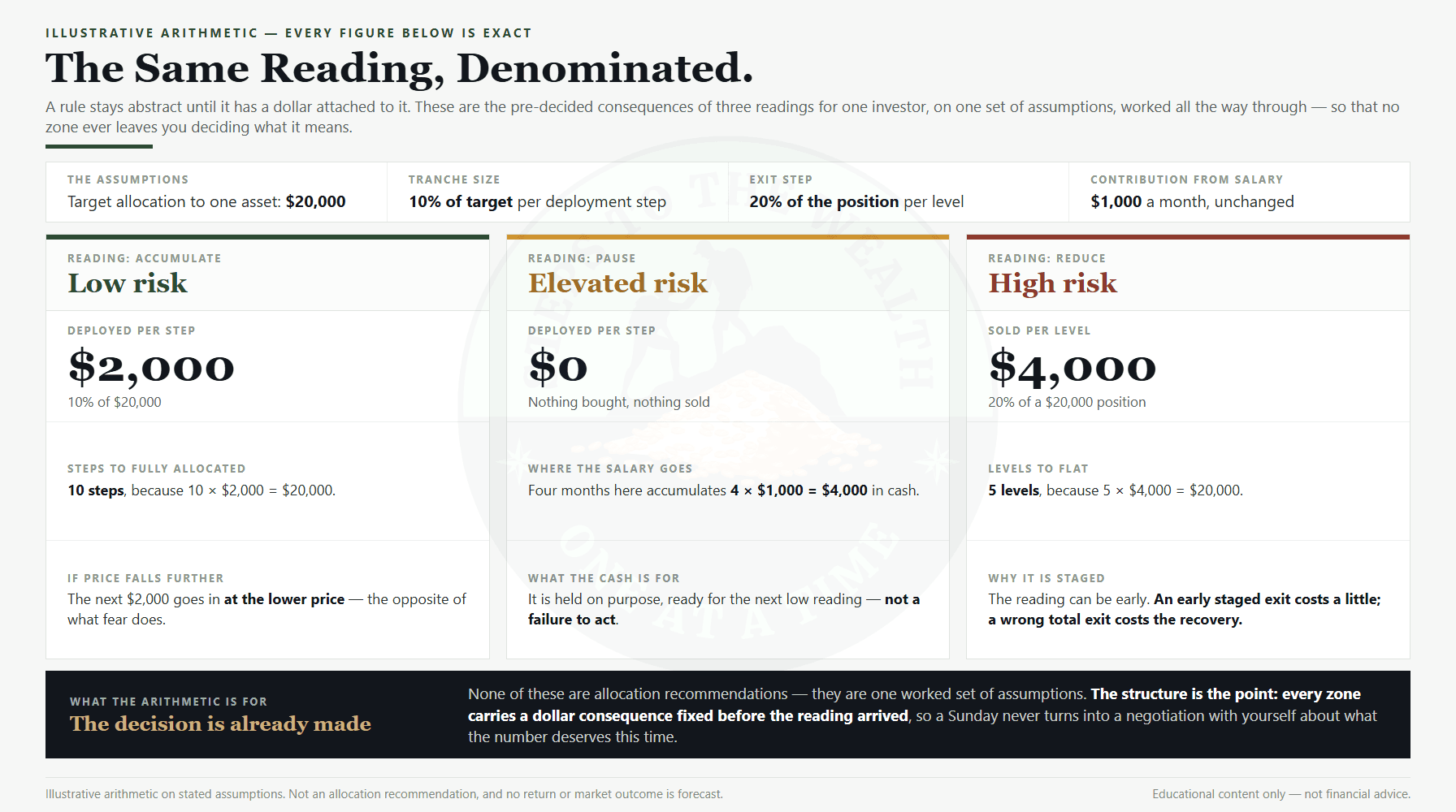
A newsletter reading denominated in dollars: what a fixed amount per step deploys at low risk and at high risk
The same reading in dollars: a fixed amount per rung at low risk, nothing at high risk. The ladder, not a forecast.

04 — Questions

What people ask before they subscribe to the newsletter.

Answered against what the newsletter actually does, not against what would be convenient to claim.

Is the newsletter really free?

Yes. The Sunday newsletter is free, with no trial and no card. It carries the lesson and the reading preview for all five assets every week, and the Dynamic DCA Blueprint arrives within a minute of subscribing. The paid edition is a separate choice, made later or never.

There is no cut-down version of the free newsletter. The label per asset is the same label the paid edition prints; what the paid edition adds is the work underneath it and the tactical layer.

How is this newsletter different from a market newsletter?

A market newsletter tells you what someone thinks will happen. This newsletter tells you where five assets sit on a fixed four-step risk scale, measured the same way every week, and which rung of a written ladder that reading triggers. There is no prediction anywhere in it.

The practical difference shows up in the boring weeks. A newsletter of opinions has to say something every week. This one is allowed to say nothing changed, and most weeks it does.

Which assets does the newsletter cover?

Five, and always the same five: Bitcoin, Ethereum, the S&P 500, the Nasdaq 100 and gold. They are the assets a working professional is most likely to already hold, and the ones where a risk reading changes a real decision.

Nothing is added when something is trending. If the newsletter started covering whatever was in the headlines, the readings would stop being comparable week to week, and the whole point is that they are.

What is in the Dynamic DCA Blueprint?

One printable page: the four phases and what each means in one line, the entry ladder, the exit ladder, the five tracked assets and what is excluded, and a decision table that turns a reading into an action. It is the framework the newsletter runs on, distilled so that it can be pinned somewhere visible.

It is the reference you check the Sunday email against. Once you have it, the newsletter never has to re-explain the mechanics, which is why an issue can be read in five minutes.

How long does the newsletter take to read?

About five minutes for the free edition and about ten for the paid one. The structure is identical every week — lesson, then readings — so after the first few Sundays you read it the way you read a dashboard, straight to what changed.

That is the design constraint. A newsletter that took half an hour would be read on the weeks it was convenient and skipped on the weeks it mattered.

Is the newsletter financial advice?

No. Everything in the newsletter is educational. It reports what a rules-based framework says about five assets and leaves every decision with you. It does not know your situation, your tax position or your horizon, and it does not recommend buying or selling anything.

The disclaimer is not a formality here. The whole method rests on you running a system you understand, which is the opposite of taking instructions from an email. Educational content only — not financial advice.