
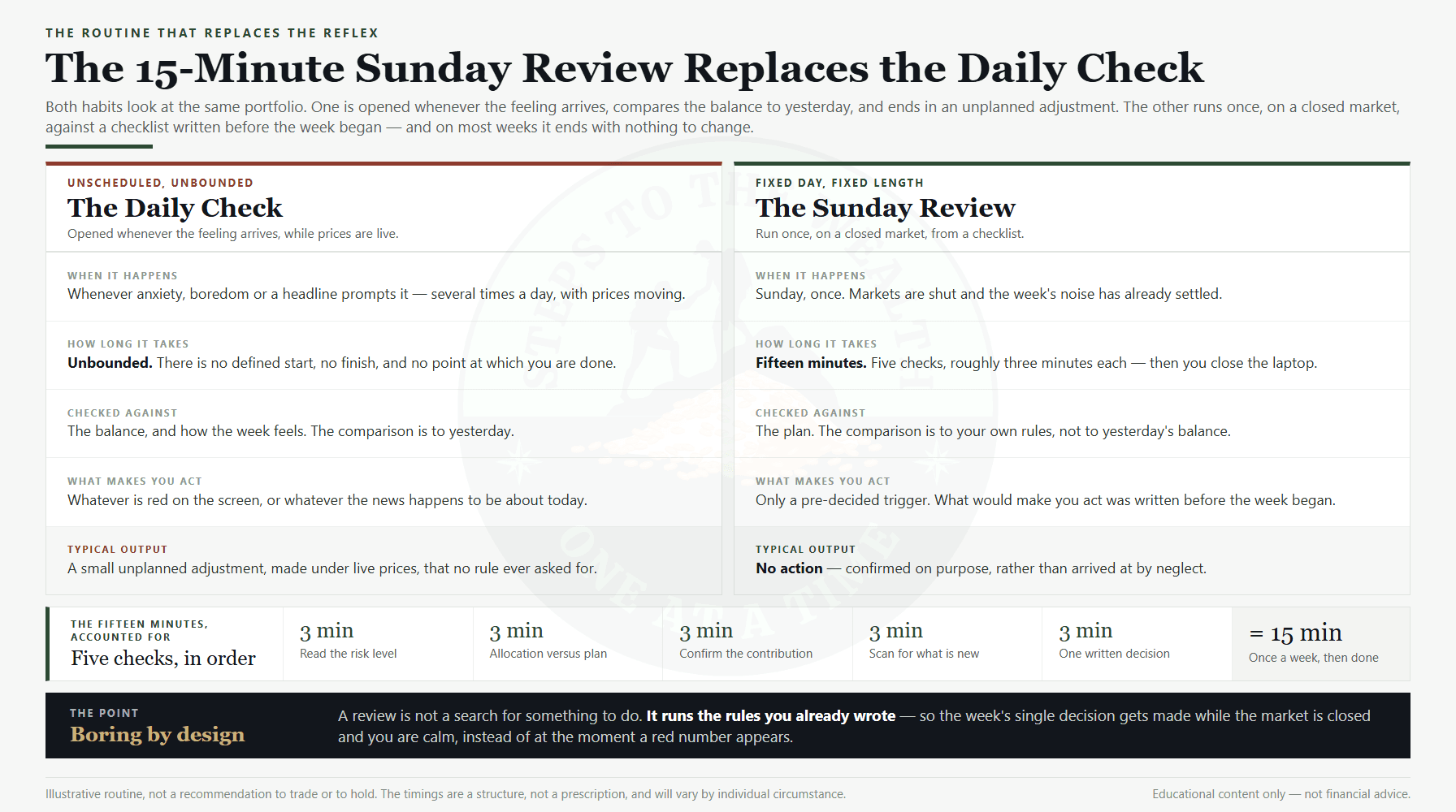
A good weekly investment review takes about fifteen minutes and produces almost no action most weeks. That last part is the point. The purpose of a weekly review is not to find something to do — it is to confirm that your system is still running as designed, and to make a single, calm decision about the week ahead.
Most investors do the opposite. They check their portfolio five times a day, react to every red number, and never sit down to actually think. A fifteen-minute Sunday investing review replaces all of that noise with one deliberate read. Done consistently, it is the difference between managing a system and being managed by a screen.
Educational content only. Not financial advice.
What is a weekly investment review?
A weekly investment review is a short, fixed-time routine — around fifteen minutes, on the same day each week — where you check your portfolio against your plan rather than against your emotions. You are not looking for trades. You are answering a small set of pre-decided questions: has anything changed that my rules care about, and does the plan tell me to do anything this week? Then you close the laptop.
The word that matters there is pre-decided. A review only works if you know in advance what you are checking and what would make you act. Otherwise it becomes another opportunity to react to a scary headline. The routine exists to convert a vague, anxious relationship with the market into a structured, scheduled one. Fifteen minutes, once a week, with a checklist — that is the whole idea. Its power is entirely in its boredom.
Why review weekly instead of daily or yearly?
You review weekly because daily is too often to think clearly and yearly is too rare to manage risk — a week is the interval that lets a system breathe without letting anxiety drive. Check daily and you are reacting to noise; the market’s day-to-day movement is mostly random, and staring at it just feeds the urge to tinker. Check once a year and you can miss a genuine shift in risk conditions that deserved a response months earlier.
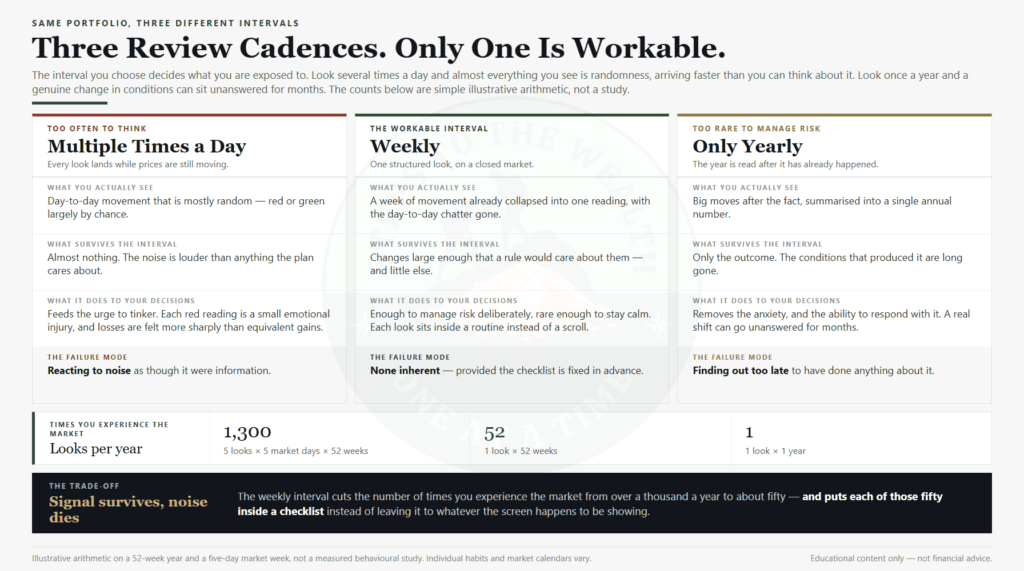
The problem with frequent checking is not the information — it is the frequency. The more often you look, the more losing days you see, and losses are felt more sharply than equivalent gains. That is what turns normal volatility into a stream of small emotional injuries. It is at its worst in a fast drawdown: during the 2020 COVID crash, the S&P 500 fell 33.9% in 33 days, which is a great many red screens for anyone watching several times a day.
A weekly cadence cuts the number of times you experience the market from over a thousand a year to about fifty, and it puts each look inside a structured routine instead of a doom-scroll. You see enough to manage risk. You do not see so much that you sabotage yourself.
| Review frequency | What you actually see | What it does to your decisions |
|---|---|---|
| Multiple times a day | Random noise, mostly red or green by chance | Feeds the urge to tinker; converts volatility into stress |
| Weekly | Real signal with the noise filtered out | Enough to manage risk, calm enough to think |
| Only yearly | Big moves after the fact | Too rare to respond to a genuine change in conditions |
Weekly is the interval where signal survives and noise dies.
What should a 15-minute Sunday review cover?
A fifteen-minute review should cover five things in order: the market’s risk reading, your allocation versus plan, any scheduled contribution, anything genuinely new, and a single decision for the week. Five checks, roughly three minutes each. The order matters — you start with conditions, end with a decision, and never skip to the decision first.
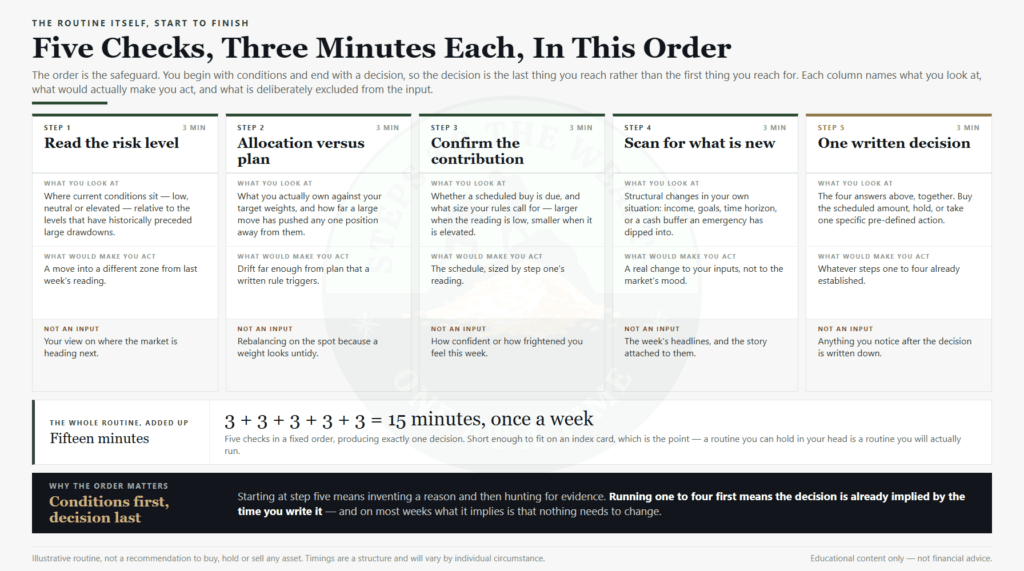
Here is the routine itself.
- Read the risk level (3 min). Start with the market’s current risk reading — is it in a low, neutral, or elevated zone relative to the levels that historically precede large drawdowns? This is the anchor for everything else. If you do not yet have a way to read this, running a portfolio stress test is the place to start: it shows you what a bad set of conditions would do to what you actually own.
- Check allocation versus plan (3 min). Look at what you actually own versus your target. Has a big move pushed one position well above its intended weight? You are not rebalancing on the spot every week — you are noting whether you are drifting far enough from plan that a rule should trigger.
- Confirm the contribution (3 min). Is a scheduled buy due this week? Under a risk-adjusted approach, the size of that buy depends on the risk reading from step one — more when risk is low, less when it is elevated. Confirm the amount your rules call for.
- Scan for anything genuinely new (3 min). Not headlines — structural changes. A change in your income, a new goal, an emergency that dipped your cash buffer, a life event that changed your time horizon. Real inputs, not market drama.
- Make one decision and write it down (3 min). Buy the scheduled amount, hold, or take a specific pre-defined action. One line. Then you are done until next Sunday.
Five checks at three minutes each is fifteen minutes, and the whole thing fits on an index card. That is deliberate. A routine you can hold in your head is a routine you will actually run.
What should you NOT do in a weekly review?
You should not use the review to trade on impulse, to check performance for reassurance, or to react to news — the review is for executing a plan, not inventing one. The single fastest way to ruin the routine is to let it become a search for action. If you sit down looking for a reason to do something, you will always find one, and most of those somethings will cost you money.
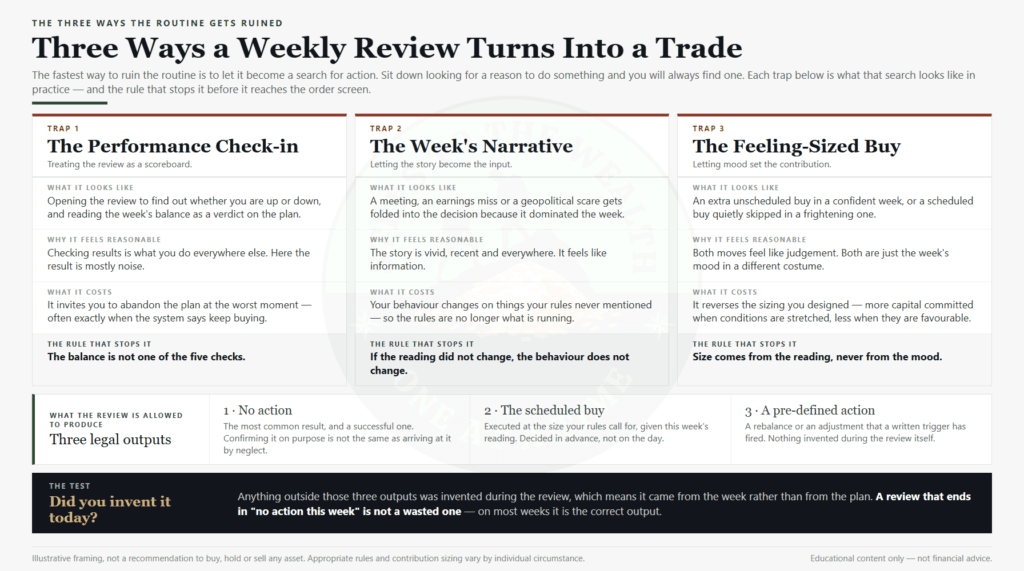
Three traps to name directly:
- Do not treat it as a performance check-in. The question is never “am I up or down.” A down week under low risk is often exactly when the system says keep buying. Judging the week by the balance invites you to abandon the plan at the worst possible moment — and the worst moments are long. From its peak of 1,565 on 9 October 2007, the S&P 500 took 517 days to reach its low of 677 on 9 March 2009, a fall of about 57%. That is 517 ÷ 7, or roughly 73 weekly reviews in a row, every one of them showing a loss. Anyone treating that period as a weekly verdict on their plan had 73 consecutive invitations to abandon it.
- Do not react to the week’s narrative. Every week has a story — a Fed meeting, an earnings miss, a geopolitical scare. The story is not an input. The risk reading is. If your rules did not change, your behavior does not change.
- Do not add unscheduled buys because you feel confident, or skip scheduled buys because you feel scared. The whole value of a fixed routine is that it takes the feeling out of the sizing. Sizing a contribution to conditions is a rule, not a mood — and confusing the two is where most myths about dollar-cost averaging begin.
A review that produces “no action this week” is not a wasted review. It is a successful one. Most weeks, doing nothing is the correct output — and confirming that on purpose is far better than defaulting to it out of neglect.
How does the Sunday review fit a rules-based system?
The Sunday review is the weekly execution layer of a rules-based system — it is the moment you translate your standing rules into one concrete decision, using current conditions as the input. The rules do the thinking in advance; the review just runs them. That division of labour is the entire point of a risk-first framework: you decide how you will behave before the market moves, so that when it does, you are executing a plan instead of improvising under stress.
This is also why Sunday works so well as the anchor. Markets are closed, the week’s noise has settled, and you can read conditions without the pressure of live prices ticking in front of you. You make the call for the week ahead when you are calm, then let it run. It is the same logic behind building a system that fits around a full-time job — scheduling your attention so the market does not schedule it for you. The weekly review is simply the smallest, most frequent loop in that system, and the one that does the most to keep you out of trouble.
A worked example: one Sunday, five checks
Abstract routines are easy to agree with and hard to run. Here is the same fifteen minutes with numbers attached, so you can see what “no action this week” actually looks like on the page.
Assume a $60,000 portfolio with a target split of 70% equity and 30% cash and bonds — $42,000 and $18,000 at plan. The standing contribution is $800 a month, and the rules say to scale it with conditions: 1.25× when the risk reading is low, 1× when it is neutral, 0.75× when it is elevated. The rebalance band is 5 percentage points either side of target. All of that was decided months ago, on a calm afternoon. None of it gets renegotiated on a Sunday.
Now assume the market has fallen and the equity side is down 20%.
- Step 1, risk reading (3 min). Prices have fallen a long way relative to their own history and the reading comes back low. Note it. Do not interpret it.
- Step 2, allocation (3 min). Equity is worth $42,000 × 0.80 = $33,600. Cash and bonds are unchanged at $18,000, so the portfolio is $51,600 and equity is 33,600 ÷ 51,600 = 65.1%. That is 4.9 points below the 70% target, inside the 5-point band. No rebalance.
- Step 3, contribution (3 min). A buy is due. The reading was low, so the size is 1.25 × $800 = $1,000, into equity.
- Step 4, anything new (3 min). Income unchanged, cash buffer intact, horizon unchanged. Nothing.
- Step 5, the decision (3 min). One line, written down: “Buy $1,000 equity. No rebalance — drift 4.9pts, inside band.”
That $1,000 lifts equity to $34,600 of a $52,600 portfolio, or 65.8% — the contribution has quietly pulled the allocation back toward target without a single sell. This is what a working system looks like on the week that feels worst: one arithmetic check, one scheduled buy, one sentence. The drawdown did not require a response, because the response was written down before the drawdown happened.
What happens when you miss a Sunday?
You will miss one. Illness, travel, a bad week, a Sunday that simply got away from you. The honest answer is that missing a single review costs you almost nothing — and that the instinct to catch up costs you more than the miss did.
There is no such thing as a double review. Do not run last week’s checks and this week’s back to back. Last week’s risk reading is stale, and acting on stale conditions is worse than not acting at all. Skip the missed one and run the current week normally.
The one thing that does carry forward is a missed contribution. If a scheduled buy did not happen, it is still owed — and it is sized to today’s reading, not to the reading it would have had last week. A skipped buy is a plan item. A skipped review is just a missed appointment.
The wider point is worth stating plainly, because it is where most routines die. The value of a weekly investment review is in adherence, not perfection. Forty-five reviews a year run calmly beats fifty-two run anxiously, and both comfortably beat a system so demanding that you quietly abandon it in month three. Build the version you will still be running next year, not the version that looks most rigorous on paper.
Where a fifteen-minute review is not enough
This routine is built for one specific situation: an accumulating investor with a diversified portfolio, a steady contribution, and a long horizon. That describes most people most of the time, and what a full year of those Sundays actually contains — how many of the fifty-two readings turn into anything — is set out in the average investing year. It does not describe everyone, and pretending otherwise would be exactly the kind of one-size advice worth avoiding.
Four cases need more than fifteen minutes, and the decisions that belong to a slower cadence are routed in the investor calendar.
- You are drawing down rather than paying in. In retirement the central question flips from “how much do I buy” to “how much do I sell, and from where” — and the order you sell in during a bad stretch matters enormously. That needs a written withdrawal policy, not a contribution rule.
- You hold a concentrated position. Employer stock, one oversized holding, or a business you own are not diversified risk, and no allocation band manages them properly. They need their own plan, usually with a scheduled, unemotional reduction.
- You are investing in a taxable account with specific lots. Rebalancing then carries a tax cost, and the cheapest rebalance is often to steer new contributions rather than to sell anything. The SEC’s investor education office covers the mechanics of asset allocation and rebalancing in plain language.
- You are not ready to be investing yet. If the emergency buffer is thin or high-interest debt is still outstanding, a weekly portfolio review is premature. Those come first, and no review cadence changes that.
None of these break the routine. They sit alongside it. The fifteen minutes still runs every Sunday — it just is not the whole system, and it was never meant to be.
Anchor your Sunday review to a real risk reading
The routine only works if step one — the risk read — is something you can actually see. That is the piece most people are missing, and it is the piece we deliver.
Steps To The Wealth Weekly lands every Sunday with a plain-English risk reading across five major assets — the exact input your fifteen-minute review is built around.
No predictions. No hype. Just the one reading your weekly routine needs, read for you before the week begins.
Frequently asked questions
How often should I review my investment portfolio?
For most long-term investors, once a week is the right cadence. Daily checking exposes you to random noise and feeds the urge to tinker, while reviewing only once a year is too infrequent to respond to a real change in risk conditions. A weekly investment review filters out the noise while still letting you manage risk deliberately.
What should a weekly investment review include?
Five checks in order: the market’s current risk reading, your allocation versus your target plan, any scheduled contribution and its correct size, anything genuinely new in your own situation, and one written decision for the week. Roughly three minutes each — about fifteen minutes in total.
Why is checking my portfolio every day a bad idea?
Because daily prices are mostly random noise, and the more often you look, the more losing days you see. Losses are felt more sharply than equivalent gains, so frequent checking steadily erodes your discipline and pushes you toward reactive trading that works against a long-term plan.
Should I make trades during my weekly review?
Only pre-planned ones. The review is for executing rules you set in advance — such as a scheduled, risk-adjusted contribution — not for inventing new trades on impulse. Most weeks the correct output is “no action,” and confirming that on purpose is a successful review.
Why do the review on Sunday specifically?
Markets are closed, the week’s noise has settled, and you can read conditions calmly without live prices pressuring you. Making the week’s single decision while the market is quiet keeps emotion out of it — and pairs naturally with a risk reading published for the week ahead.
Educational content only — not financial advice. Examples and historical figures are for illustration and do not predict future results.