
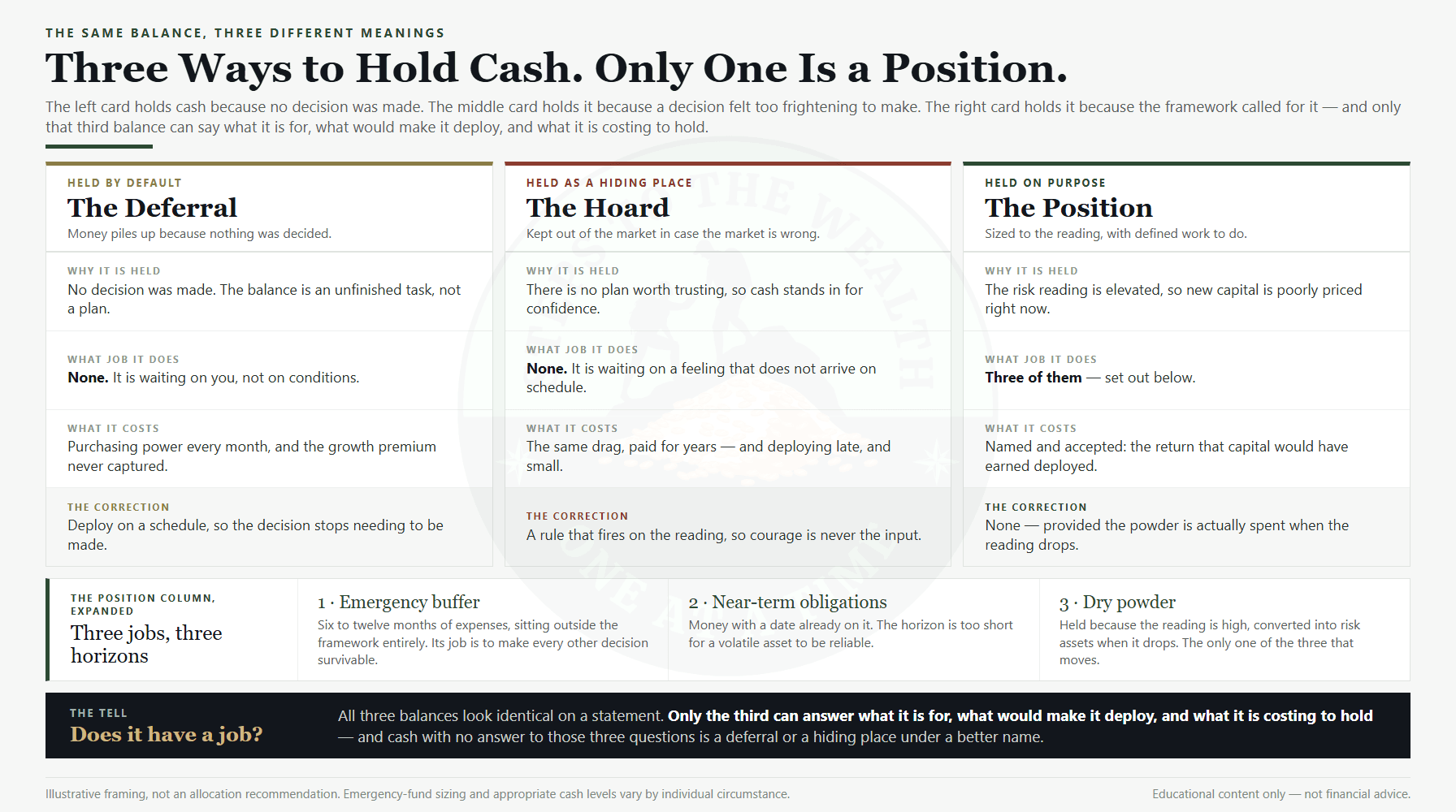
Most working professionals hold cash for one of two bad reasons — and neither of them starts from the idea that cash is a position in its own right, with a job to do.
The first group holds cash by accident. Money piles up in the checking account because they haven’t decided what to do with it. It’s not a strategy — it’s a deferral. The cash sits there losing purchasing power while they intend to “figure out investing soon.”
The second group holds cash out of fear. They’ve been burned, or they’re scared of being burned, so they keep most of their money out of the market and tell themselves they’re being prudent. The cash isn’t doing a job either — it’s hiding.
Both groups have something in common: they treat cash as the absence of a decision. The opposite of investing. The thing you hold when you’re not doing the real work.
That framing is wrong, and it’s expensive in both directions. Held by accident, cash quietly bleeds you. Held in fear, it keeps you from ever deploying when conditions are good.
There’s a third way to hold cash — as a deliberate, sized, framework-driven position with a specific job. That’s what this article is about.
Educational content only. Not financial advice.
The two failure modes, stated precisely
Before the reframe, it’s worth being honest about the cost of each bad pattern, because they’re opposite mistakes and they need opposite corrections.
Accidental cash is the saver who never deploys. Their problem isn’t risk — it’s drift. They lose to inflation every year (cash earns roughly 0% real over long periods, and the cost of waiting compounds against them the whole time) and they never capture the growth premium that builds wealth. Their correction is to start deploying systematically.
Fearful cash is the saver who deploys too little, too late, and bails at the first drawdown. Their problem is also not the cash itself — it’s that the cash is a substitute for having a plan they trust. Their correction is a framework that tells them when to deploy, so they don’t have to summon courage they don’t have.
Neither of these is cash as a position. Both are cash as an excuse. The reframe only works once you’ve named which excuse you’re personally prone to, because the discipline you need is different.
Why cash is a position, not the absence of one
A position has a job. Equities have a job: capture the growth premium over decades. Bonds have a job: stability and a different driver from equities. Gold has a job: a hedge against real-rate and currency stress. This is the ordinary logic of asset allocation — every holding is there for a stated reason.
Cash, held deliberately, has a job too. Three of them, actually.
Job one: the emergency buffer. This is non-negotiable and sits outside the investing framework entirely. Six to twelve months of expenses in cash, untouchable, so that a job loss or a medical event never forces you to sell investments at the worst possible time. It is the one holding a portfolio stress test can’t substitute for — diversification changes how far you fall, not whether you’re forced to sell on the way down. This isn’t an investment decision. It’s the thing that makes every other investment decision survivable.
Job two: known near-term obligations. A down payment in eighteen months. Tuition next year. A planned purchase you’ve already committed to. Money you’ll need on a defined timeline doesn’t belong in a volatile asset, no matter how bullish you are. The horizon is too short for the growth premium to reliably show up, and the downside of being forced to sell into a drawdown is real.
Job three — the interesting one: dry powder. This is cash held specifically because the framework says risk is currently elevated, and you are waiting for risk to drop before you deploy. This cash is not idle. It’s loaded. It’s the ammunition that lets you buy heavily when the reading finally turns favorable.
Jobs one and two are widely understood, even if widely neglected. Job three is the one almost nobody frames correctly, and it’s where the risk-first framework changes how you think.
Dry powder is a position, not a timing bet
Here’s the objection, and it’s a fair one: “Isn’t holding cash to deploy later just market timing? And doesn’t market timing lose?”
The distinction matters.
Market timing, in the way it usually fails, is a prediction. “I think the market will drop, so I’ll sell and buy back lower.” It requires you to be right about the future twice — once on the way out, once on the way back in. The evidence that retail investors can’t do this reliably is overwhelming, and it’s the root of most of the myths about dollar-cost averaging that circulate in its place.
Holding dry powder under a risk framework is not a prediction. It’s a response to current, measurable conditions. The framework doesn’t say “the market will drop.” It says “risk is currently high — valuations stretched, sentiment euphoric, price extended — so the expected risk-adjusted return on new capital is poor right now.” Those are descriptions of the present, not forecasts of the future.
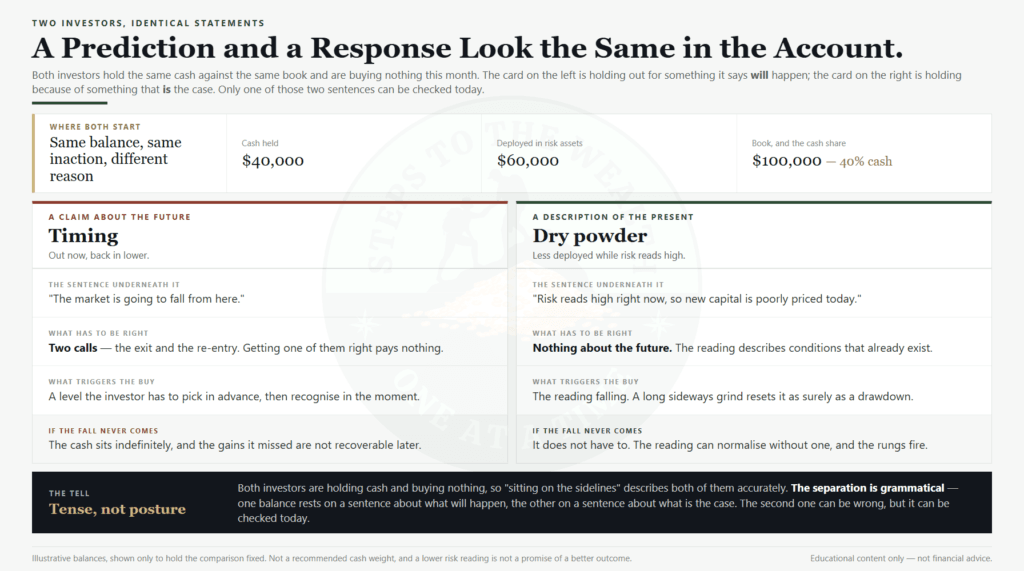
The difference shows up in what you do next. A market timer who’s wrong sits in cash indefinitely, waiting for a crash that doesn’t come, missing years of gains. A framework-driven investor doesn’t wait for a crash. They deploy as soon as the reading improves — which can happen through a sideways grind or a modest pullback, not just a crash. The trigger is the risk reading normalizing, not the market falling a specific amount.
That’s why dry powder, held this way, isn’t a bet on a crash. It’s a position sized to the current risk level, that converts into other assets when the level changes.
How much cash, and when
Under a risk-first framework, your cash allocation isn’t a fixed number. It moves inversely with how much risk the framework sees.
The rough shape:
When risk reads low — depressed sentiment, compressed valuations, price well off its highs — cash should be near its minimum. The framework is calling for heavy deployment. Holding large cash here is the expensive mistake, the one fearful investors make. Low risk is when you spend the dry powder, not when you accumulate it.
When risk reads high — stretched valuations, euphoric sentiment, extended price — cash naturally builds. You’re not deploying new capital into expensive conditions, and your exit rungs may be trimming existing positions back to cash. This is when dry powder accumulates on purpose. When it eventually deploys, it deploys as a block rather than a drip — which puts you squarely in the lump sum versus DCA trade-off, on the side the framework has already chosen for you.
When risk reads medium, you’re deploying at a normal cadence and cash sits at a middle level.
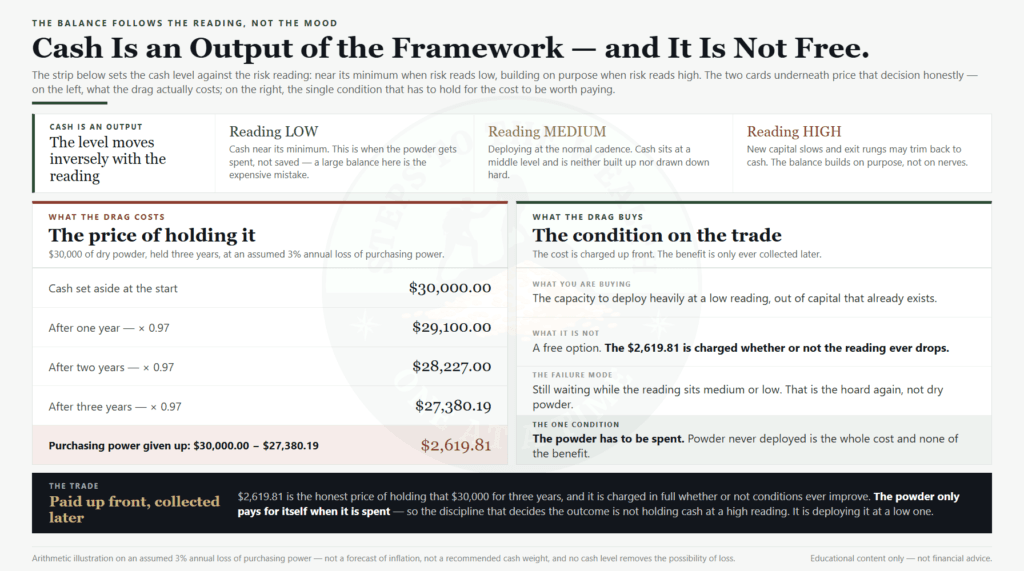
The key reframe: the cash balance is an output of the framework, not a feeling. You don’t hold 40% cash because you’re nervous. You hold a higher cash level because the readings are elevated, and you’ll hold less when they normalize. The number is downstream of the risk reading, which means it isn’t subject to your mood.
This also solves the fearful investor’s problem without asking them to be brave. They don’t have to “feel confident” to deploy. The reading drops to low, the rung fires, they deploy the prescribed amount. The framework supplies the courage they couldn’t manufacture on their own.
The cost of cash, named honestly
None of this means cash is free. It isn’t, and pretending otherwise is how the fearful investor rationalizes hoarding.
Cash has a real, ongoing cost: it earns roughly nothing in real terms, so every month you hold it, it loses a little purchasing power. Take $30,000 of dry powder and assume purchasing power slips 3% a year. After one year it buys what $29,100.00 buys today; after two, $28,227.00; after three, $27,380.19. That’s $2,619.81 of purchasing power given up to hold one position for three years — and over longer horizons the drag is severe. A portfolio that sits 50% in cash for a decade because the investor is perpetually nervous will badly underperform one that’s appropriately deployed, even accounting for drawdowns avoided.
So the honest framing is a trade-off, not a free option. Dry powder costs you the return that capital would have earned if deployed. You hold it anyway when the framework says expected risk-adjusted returns on new capital are poor — because the optionality of being able to deploy heavily at low risk is worth more than the modest return you’d capture deploying into high risk.
That trade-off only pays off if you actually deploy when the reading turns. Dry powder you never spend isn’t dry powder. It’s just fearful cash wearing a framework costume. The discipline to deploy at low risk is the price that makes holding cash at high risk worthwhile. Skip the deploy and you’ve paid the cost of cash without ever collecting the benefit.
A working example
Walk through how this plays out over a cycle, in plain terms.
Risk reads high for an extended stretch. The investor isn’t deploying new contributions into stretched conditions, and exit rungs have trimmed some winners. Cash has built to a meaningful share of the portfolio. To an outside observer — and to the investor’s own anxious gut — this looks like “sitting on the sidelines.”
It isn’t. It’s a loaded position, waiting.
The market does what markets eventually do: conditions shift. Maybe a drawdown, maybe just a long grind that lets valuations and sentiment reset. The risk reading drops toward low. Now the dry powder has a job to do. The entry ladder fires, and the accumulated cash deploys into the assets the framework favors — heavily, because risk is low and the framework calls for it.
The investor didn’t predict the shift. They didn’t call the top or the bottom. They held cash because the reading was high and deployed it because the reading dropped. The cash was a position the entire time, doing exactly what it was supposed to do: preserving capital and optionality until the conditions justified converting it into risk assets.
That’s the whole mechanic. Boring, mechanical, and far more reliable than trying to be brave at the bottom or disciplined at the top through willpower alone.
Where does dry powder actually sit?
Calling cash a position raises a question the framing usually skips: where do you keep it? “In cash” is not a location, and the choice matters more than it looks.
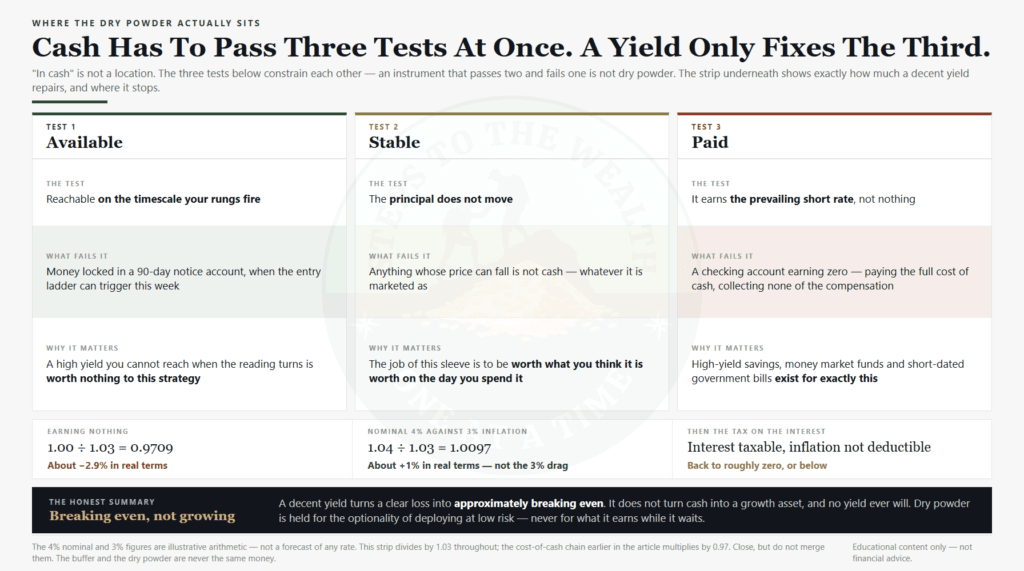
Dry powder has to satisfy three conditions at once, and they constrain each other.
- It has to be available on the timescale your rungs fire. If your entry ladder can trigger this week, money locked in a 90-day notice account cannot fund it. A high yield you can’t reach when the reading turns is worth nothing to this strategy.
- The principal has to be stable. Anything whose price can fall is not cash, whatever it is marketed as. The entire job of this sleeve is to be worth what you think it’s worth on the day you spend it.
- It should earn the prevailing short rate rather than nothing. Money sitting in a checking account earning zero is paying the full cost of cash and collecting none of the compensation. Instruments built for exactly this — high-yield savings, money market funds, short-dated government bills — exist precisely to hold stable, liquid balances at the going short rate.
That third point improves the arithmetic above, and it’s worth being precise about how much. If the balance earns a nominal 4% while purchasing power slips 3%, the real drag is not 3% — it’s 1.04 ÷ 1.03, or about +1% in real terms. Better than the $2,619.81 figure suggests. But interest is usually taxable and inflation is not deductible, so the after-tax real return on the same balance can land back at roughly zero or below. The honest summary: a decent yield turns a clear loss into approximately breaking even. It does not turn cash into a growth asset, and no yield ever will.
One boundary worth keeping firm: the emergency buffer and the dry powder can live in the same kind of account, but they are not the same money. If a market drop and a job loss arrive in the same month — which is exactly how recessions work — you need the buffer intact while the powder deploys. Track them as two balances even when they share a login.
The rule that stops dry powder becoming hoarding
The article above draws the line between a loaded position and fearful cash, but a line you can only judge by introspection is not much of a line. Fearful investors do not experience themselves as fearful. They experience themselves as prudent, and they can always name a reason to wait one more month. So the rule has to be written down in advance, when nothing is at stake.
Three components make it enforceable.
- A written trigger. Before you hold a dollar of dry powder, write the condition that spends it — the specific reading, and the amount that deploys when it hits. Decided in advance, it’s a rule. Decided in the moment, it’s a mood.
- A ceiling that ignores the reading. Set a maximum for dry powder as a share of the investable portfolio — excluding the buffer and any near-term obligation, which are never part of this calculation. Whatever number you pick, it caps how wrong the position can be if the conditions you’re waiting for take years to arrive.
- A default-deploy clause. If the reading has sat at medium or low for several consecutive readings and the powder is still unspent, the excess above target deploys on the next scheduled buy regardless of how you feel about it. This is the clause that does the actual work, because it fires precisely when your judgement has quietly stopped being judgement.
Note what all three have in common: they are written when you have no position at stake, and they take the decision away from the version of you who does. That is not a lack of confidence in yourself. It’s an accurate reading of how everyone behaves when real money is on the line.
When this doesn’t apply to you
Dry powder is a layer that sits on top of a functioning financial base. If the base isn’t there, the whole discussion is premature, and four situations override it entirely.
- You don’t have the emergency buffer yet. Then there is no dry-powder conversation. Every spare dollar has one job until job one is finished. Holding “dry powder” without a buffer is just an unfunded emergency fund with a better name. And if the income has already stopped, the buffer is the only position that matters — the sequence for that is investing after job loss.
- You’re carrying high-interest debt. Cash held while a balance compounds at 20% isn’t earning the short rate — it’s costing you 20% a year, because paying the balance down is a guaranteed, tax-free return at exactly that rate. No risk reading justifies holding powder against that.
- The money is in a workplace pension. Contributions there are usually fixed, automatic and hard to hold in cash on purpose, and any employer match makes deferring them expensive. Leave that layer running mechanically. Dry powder is a decision you make with the money you actually control.
- You’re drawing down rather than accumulating. In retirement the cash sleeve’s job changes completely: it stops being optionality and becomes the buffer that lets you fund a year or two of spending without selling into a fall. Same asset, different job — and the sizing follows your withdrawals, not the risk reading.
In every one of these, cash is still a position with a job. The job is simply not the one described above — which is the point of naming the job at all.
What this isn’t
This isn’t a license to hoard. If you find yourself perpetually “waiting for better conditions” while the risk reading sits at medium or low, you’re not holding dry powder — you’re back to fearful cash, and the framework would tell you to deploy.
It also isn’t a reason to abandon systematic investing. For most working professionals, the bulk of wealth-building is still steady dollar-cost averaging of income as it arrives — see how to invest while working full time for the systematic layer that sits underneath all of this. Dry powder is the dynamic layer on top, the part that responds to risk readings, not a replacement for the discipline of consistent investing.
And it isn’t personalized advice. Your emergency buffer size, your near-term obligations, and your appropriate cash levels depend on your income stability, your family situation, and your own risk capacity — not on a generic rule.
Closing: give your cash a job
Cash isn’t the opposite of investing. Held by accident, it’s a slow leak. Held in fear, it’s a hiding place. But held deliberately — sized to the current risk reading, with a defined job — cash is a position like any other.
The emergency buffer keeps you solvent. The near-term reserve keeps you from forced selling. And the dry powder keeps you loaded, so that when the framework says risk is finally low, you have something to deploy.
The investors who build wealth across cycles aren’t the ones who are always fully invested, and they aren’t the ones who are always scared. They’re the ones who hold the right amount of cash for the conditions — and who actually spend it when the conditions turn.
Give your cash a job. Then make it do the job.
Educational content only. Not financial advice. Cash needs, emergency-fund sizing, and appropriate allocations vary by individual circumstance. Work with a qualified financial professional to apply these frameworks to your specific situation.