
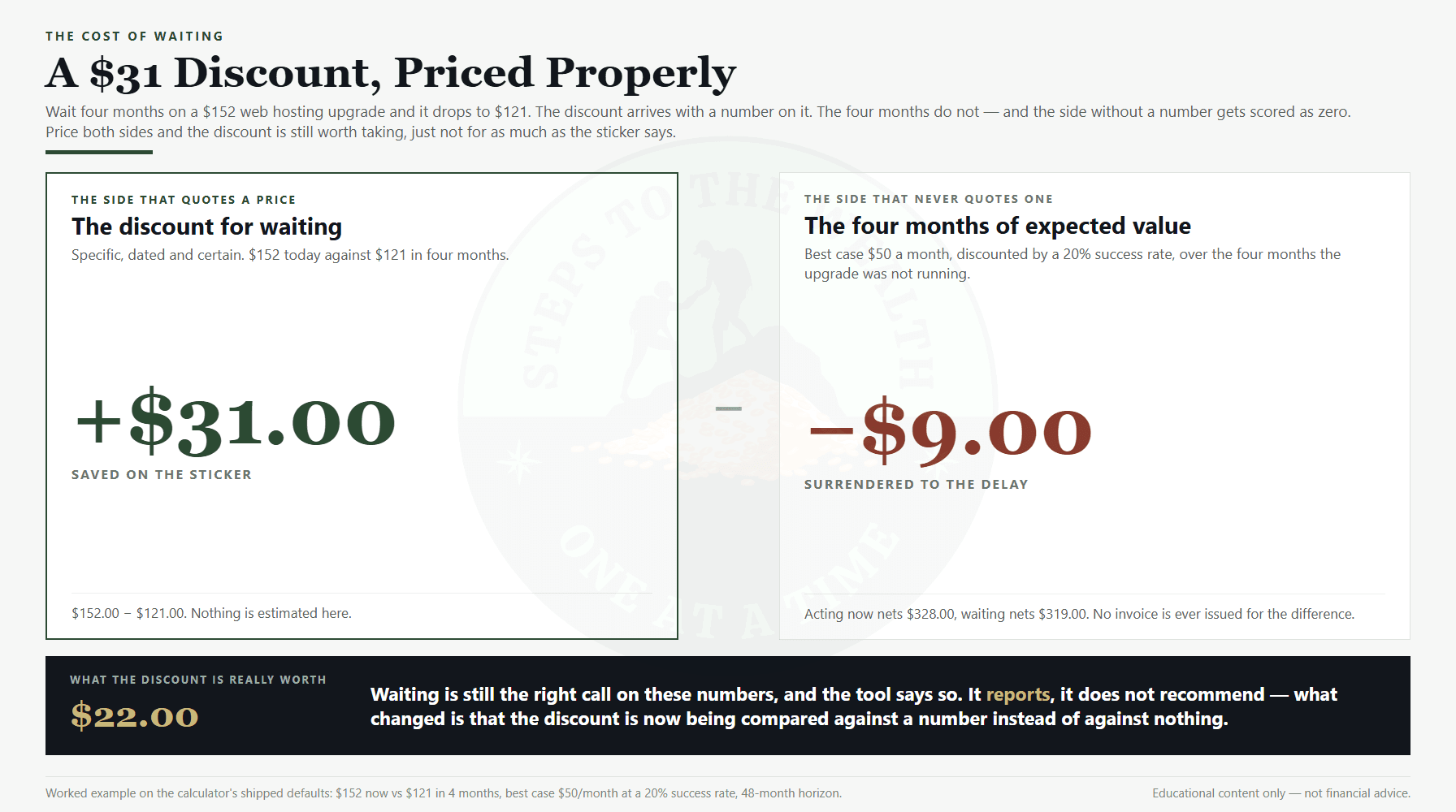
Someone offers you a deal. The thing you want costs $152 today. Wait four months and it drops to $121. That is $31 back in your pocket for doing nothing except being patient, which everyone agrees is a virtue.
So you wait. And the reasoning felt airtight, because on one side of the decision there was a specific, dated, certain $31, and on the other side there was nothing at all.
That is the problem. Not the waiting — the nothing. The cost of waiting is the one number in that comparison nobody ever quotes, and a number nobody quotes gets scored as zero.
Educational content only — not financial advice.
Delay is the only option that never quotes a price
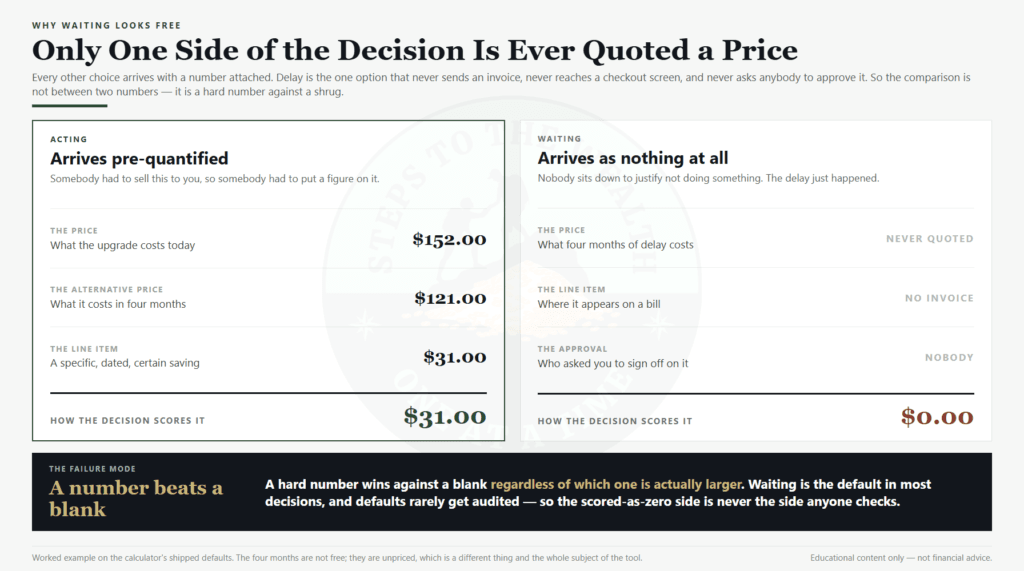
Every other choice you make comes with a number attached. Buy the thing, it costs $152. Take the discount, it costs $121. Hire someone, there is a rate. Switch providers, there is a fee.
Waiting arrives with no invoice. There is no line item, no checkout screen, no moment where somebody asks you to approve the cost of four months. So when you weigh the discount against the delay, you are not comparing two numbers. You are comparing a hard number against a shrug.
And a hard number beats a shrug regardless of which one is actually larger.
This is not a story about impatience. It is the opposite. Waiting is the default in most decisions, and defaults rarely get audited. Nobody sits down to justify not doing something. The discount had to be sold to you; the delay just happened.
Every month you spend waiting is a month the thing was not running. That is not a feeling or a motivational slogan. It is a quantity, and quantities can be estimated.
Put a number on the other side
Take the same $152 hosting upgrade, and this time price both columns.
Say the upgrade, if it works, makes you $50 a month. That is the best case, and you should be optimistic here on purpose, because the next step is what keeps it honest.
Now discount it for risk. A niche blog is not a sure thing. Call it a 20% success rate — a blunt round number, and we will come back to how much that assumption is carrying. A best-case $50 a month at a 20% success rate is an expected $10 a month.
Then run both timelines over the same horizon:
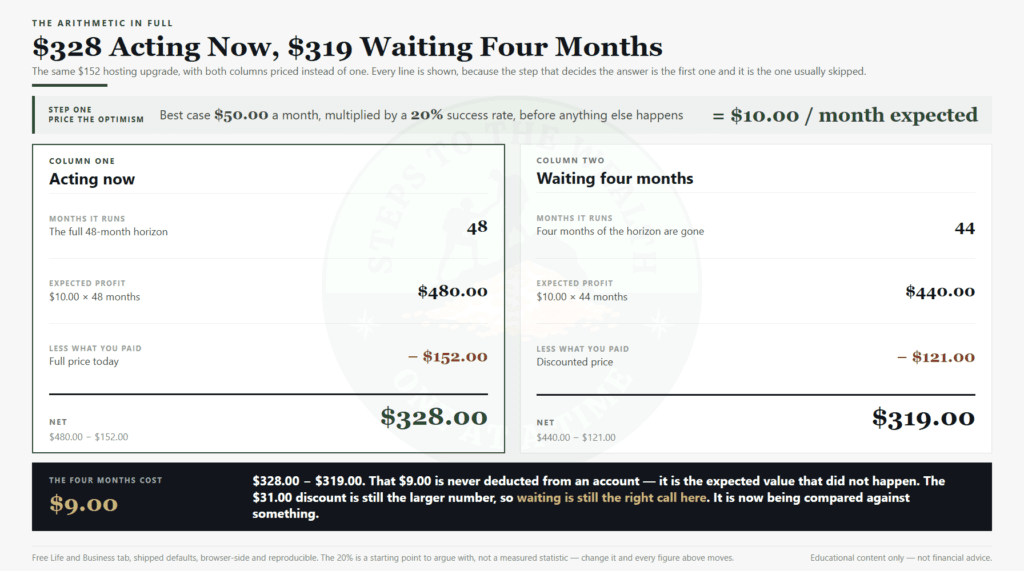
Acting now. $10 a month for 48 months is $480 of expected profit, less the $152 you paid. Net: $328.
Waiting four months. $10 a month for 44 months is $440 of expected profit, less the discounted $121. Net: $319.
Subtract. The four months cost you $9.
That $9 never appears on a bill anywhere. It is not deducted from your account. It is simply the four months of expected value that did not happen, and until you write it down it does not exist as a number at all.
The discount still wins, and that is the point
Here is where most tools in this category would push you toward acting now. This one does not, because the arithmetic does not support it.
The $31 discount is real. The $9 of forgone value is also real. Net, the discount is worth $22.
Twenty-two dollars, not thirty-one. Waiting is still the right call on these numbers, and the honest thing to do is say so plainly.
That result was not engineered to be flattering. It is what the default settings return. A tool that always concluded “act now” would be a sales pitch with a calculator bolted onto it, and it would be worthless precisely when you needed it — because you could never tell the difference between a real finding and a nudge.
What changed is not the verdict. What changed is that the discount is now being compared against a number instead of against nothing. The honest version of the question was never “should I wait?” It is “the delay costs roughly this much — is the discount bigger than that?”
Most people have never seen the first figure. So they have never actually answered the second.
The risk discount is the part doing the work
Notice what happened in step one, because it is where almost every version of this reasoning goes wrong.
Anyone can talk themselves into a delay by quoting the best case at full price on both sides of the comparison. And anyone can talk themselves out of one exactly the same way. If you run $50 a month through both columns instead of $10, every number in that table inflates and the delay looks five times more expensive than it is.
Multiplying the upside by a blunt success rate before anything else happens means the optimism gets priced once, at the start, where you can see it.
That 20% is not a measured statistic about your blog. It is a starting point you are supposed to argue with. If you think your odds are better than the category — consulting with skills you already have is a very different bet than a niche blog — type your own number and the whole model moves with it.
That is the entire design. It is a calibration instrument. It is only as good as the estimate you feed it, and its main job is showing you exactly which estimate is carrying the answer.
How to pick a success rate you can defend
The 20% is doing the heavy lifting, and saying so raises a fair question: where is anyone supposed to get a better number?
Not from a study. There is no published base rate for your specific upgrade on your specific site, and anyone quoting you one is quoting a different situation. What you can do is make the estimate harder to fool yourself with. Three cheap ways, in the order they are worth doing.
Write it down before you run the model. Once you have seen an answer you like, every estimate after that quietly drifts toward keeping it. Pick the success rate first, in a sentence, and leave it there while the arithmetic happens around it.
Ask the ten-times question. If you made this same bet ten times over — same effort, same budget, same conditions — how many of them come off? Three out of ten is 30%. One in ten is 10%. Most people find counts far easier to answer honestly than percentages, and the count is the same estimate wearing different clothes.
Then check it against what you have actually done. If you have shipped four projects like this one and one of them worked, you have a personal base rate, and it beats any figure you could look up. If you have never done anything like it, that is itself information: use a lower number, and understand that you are paying for the uncertainty rather than pretending it is not there.
None of that makes the estimate true. It makes it defensible, which is the most any input to a model like this can be. The design point is that a bad estimate shows up as a bad estimate, out in the open at step one, instead of hiding inside a total where nobody can see which assumption produced the answer.
The same cost of waiting, in compound units
Expected profit is one currency for a delay. Compounding is another, and it is where the numbers stop being small.
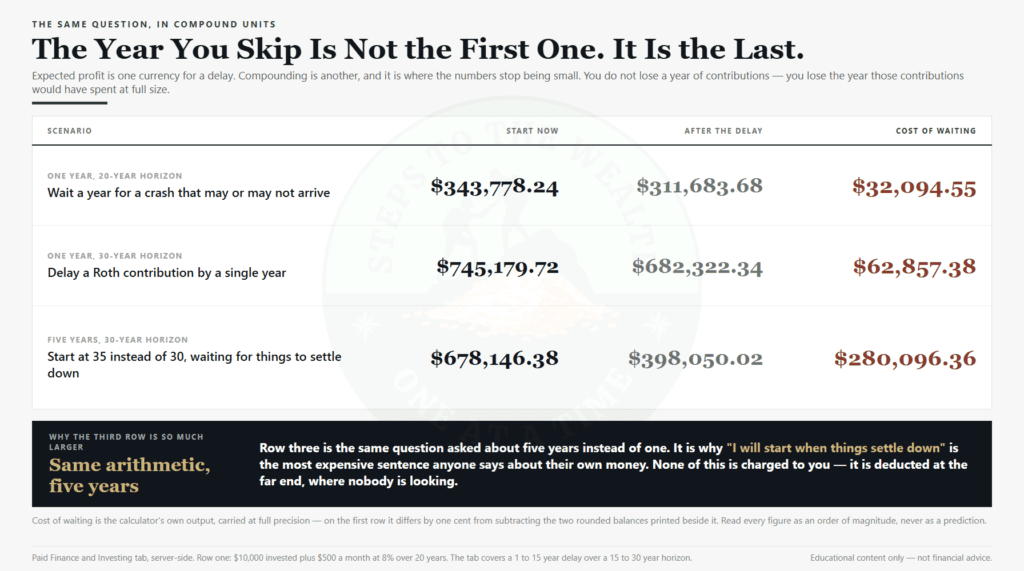
Take $10,000 already invested plus $500 a month at 8% over twenty years. Start now and you land at $343,778.24. Wait one year for a crash that may or may not arrive, and you land at $311,683.68.
One year of hesitation: $32,094.55.
That figure surprises people, and the reason is worth understanding. The year you skip is not the first year. It is the last one — and the last one is the largest. You do not lose a year of $500 contributions. You lose the year those contributions would have spent at full size. If the shape of that is unfamiliar, the SEC runs a plain compound interest calculator on investor.gov that shows it with no product attached to it.
Push it out further and the pattern holds:
| Scenario | Start now | After the delay | Cost of waiting |
| Wait one year for a crash, 20 yr | $343,778.24 | $311,683.68 | $32,094.55 |
| Delay a Roth by one year, 30 yr | $745,179.72 | $682,322.34 | $62,857.38 |
| Start at 35 instead of 30, 30 yr | $678,146.38 | $398,050.02 | $280,096.36 |
One note on reading that table honestly: the cost column is the calculator’s own output carried at full precision, so on the first row it comes back a cent under what you get by subtracting the two rounded balances printed beside it. Treat all three as orders of magnitude rather than as figures accurate to the penny.
That third row is the same arithmetic asked about five years instead of one. It is why “I will start when things settle down” is the most expensive sentence anyone says about their own money.
None of these are charged to you. They are deducted from you, at the far end, where nobody is looking.
And notice that the two halves of this article disagree. On the hosting upgrade, waiting is correct. On the twenty-year portfolio, waiting is expensive. That is not a contradiction the tool needs to resolve — it is the honest outcome of asking the same question about two different things, and it is why the verdict is arithmetic rather than advice.
The objection that is largely right
The strongest complaint about this approach is that expected value is the wrong frame for a single decision. That objection is correct and it deserves a straight answer rather than a deflection.
Expected value describes the average of many repetitions. You are making this decision once. A 20% shot does not pay out 20% — it pays out fully or it pays out not at all. There is no version of this where you receive $10 a month.
So the number is not a forecast. It is a unit of measurement.
What it is good for is comparison. It gives the waiting side a magnitude so it stops being scored as zero, which is the only failure mode that matters here. You are not trying to predict your outcome. You are trying to stop one half of the decision from being invisible.
Treat the output as an order of magnitude, never a prediction. If the difference between two paths comes down to $9 either way, the honest read is that the decision is close and you should choose on something other than the arithmetic.
What the delay is actually buying
There is a version of waiting the expected value calculation cannot see, and it is worth naming before you let a number overrule you.
Sometimes the delay is buying information. Four months from now you may know something you do not know today — whether the traffic holds, whether the client renews, whether the thing you were going to build is still the thing you want. That knowledge has real value, and none of it appears in either column. A model that prices only the forgone profit will report that the wait cost $9 and stay completely silent about the fact that it also bought you a decision made on better facts.
Sometimes the delay is buying capacity. If you install the upgrade today and have no attention left to use it, the $10 a month was never going to arrive on the schedule the model assumes. Both columns take it for granted that the thing starts working the moment you pay for it. That is usually the most optimistic assumption in the entire calculation, and it is almost never the one people argue about.
And sometimes the delay is buying nothing at all. That is the case worth catching. If four months from now the situation will be identical — the information is not coming, the capacity was never the constraint, nothing resolves in the meantime — then the wait is pure cost and the number really is the whole story.
So read the figure as a floor rather than a verdict. It tells you what the delay costs in the one currency it can measure. Whether the delay is buying something worth more than that is a question you answer, not one the calculator answers for you.
Where this does not apply
Plenty of delays are correct, and some of them will never show up in a model like this one.
If the delay is not really about money — capacity, health, a decision that is not yours to make alone — then pricing it in expected dollars answers a question you were not asking. The model does not know about any of that, and it will confidently return a number anyway. That is a limitation of the instrument, not a hidden truth about your situation.
It also will not manufacture urgency, and it should not be asked to. An honest number is a poor substitute for actually wanting the thing. If you run your own figures and the answer is that waiting is fine, that is a perfectly good outcome.
The worst use of this is running it on a purchase you have already decided to make, to produce a number that agrees with you. It will happily do that. You will have learned nothing.
What is free, and what the paid tab costs
The Life and Business version — the whole first half of this article, the $152 upgrade and the $9 — is free and always will be. It runs entirely in your browser on live sliders. No account, no email, nothing stored: the figures arrive, get calculated on, and are handed straight back.
The Finance and Investing tab is the compound version, and its compute runs on the server, so that half is the paid one. It covers a delay of one to fifteen years over a fifteen to thirty year horizon — the second table above is what it returns. That is the whole of the split, stated here rather than discovered halfway through.
Pro is $29, paid once — not a subscription and not a bundle. The checkout is here. If the free tab already answers your question, and for a single purchase decision it usually does, you do not need it.
Price it, then decide
The delay does not have to be wrong. It only has to be priced before you choose it, which, for most decisions, is the one thing that never happens.
You can run the free version yourself on the cost of waiting calculator. Every number in the first half of this article is what it returns on the settings it loads with. Change one slider and watch which side flips.
You may well decide to wait. Decide it with the number.
If this way of pricing a decision is useful, the same habit applied to time rather than money is in the opportunity cost of time, and applied to a single purchase in what that purchase actually cost. For the specific case of a lump sum you are sitting on, lump sum versus dollar-cost averaging runs the same comparison on market data.
Educational content only — not financial advice.