
Educational content only — not financial advice.
There is a number on every receipt, and it is not the price of the decision.
The receipt records the money. It does not record the decade that money was going to spend growing, and it does not record how much later that decade pushes everything else you were saving for. Two things left your hands at the till. One of them got written down.
The true cost of a purchase is not the price tag and it is not a moral question. It is an opportunity cost: what the same money would have become had it stayed invested. This piece works that number out for three ordinary purchases, with the arithmetic shown.
This is not a morality piece about spending less. It is about a specific piece of arithmetic that almost nobody does, for a reason that has nothing to do with discipline.
A receipt records one of the two things you spent
Every purchase is two decisions at once: what you get, and what that money stops being.
The second one is invisible at the counter, because it does not resolve for years. By the time it does, the receipt is long gone and there is nothing left to compare it against. You cannot feel a forgone compounding curve. You can feel a phone.
The chain runs like this:
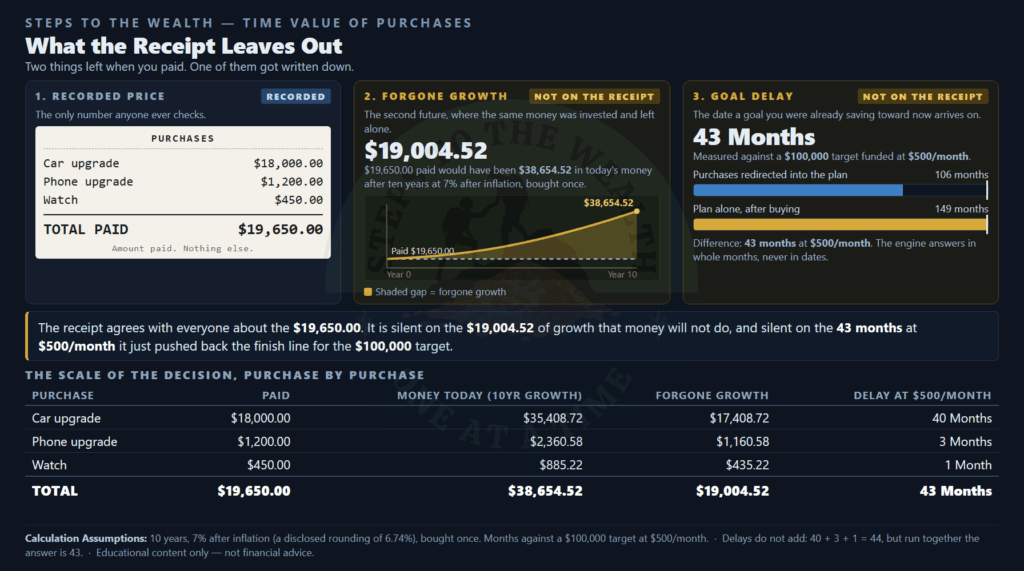
Step one. You hand over an amount. The receipt says that amount. Everyone agrees on it, and it is the only number anyone ever checks.
Step two. That money had a second future — invested and left alone. That future keeps compounding whether or not you think about it.
Step three. You were already saving toward something. The money that went to the counter was going to arrive there too, and now it arrives later.
The distance between what you paid and what that money would have become is the real price of the decision. It appears on no receipt, no statement, and no budget.
Three months for a phone
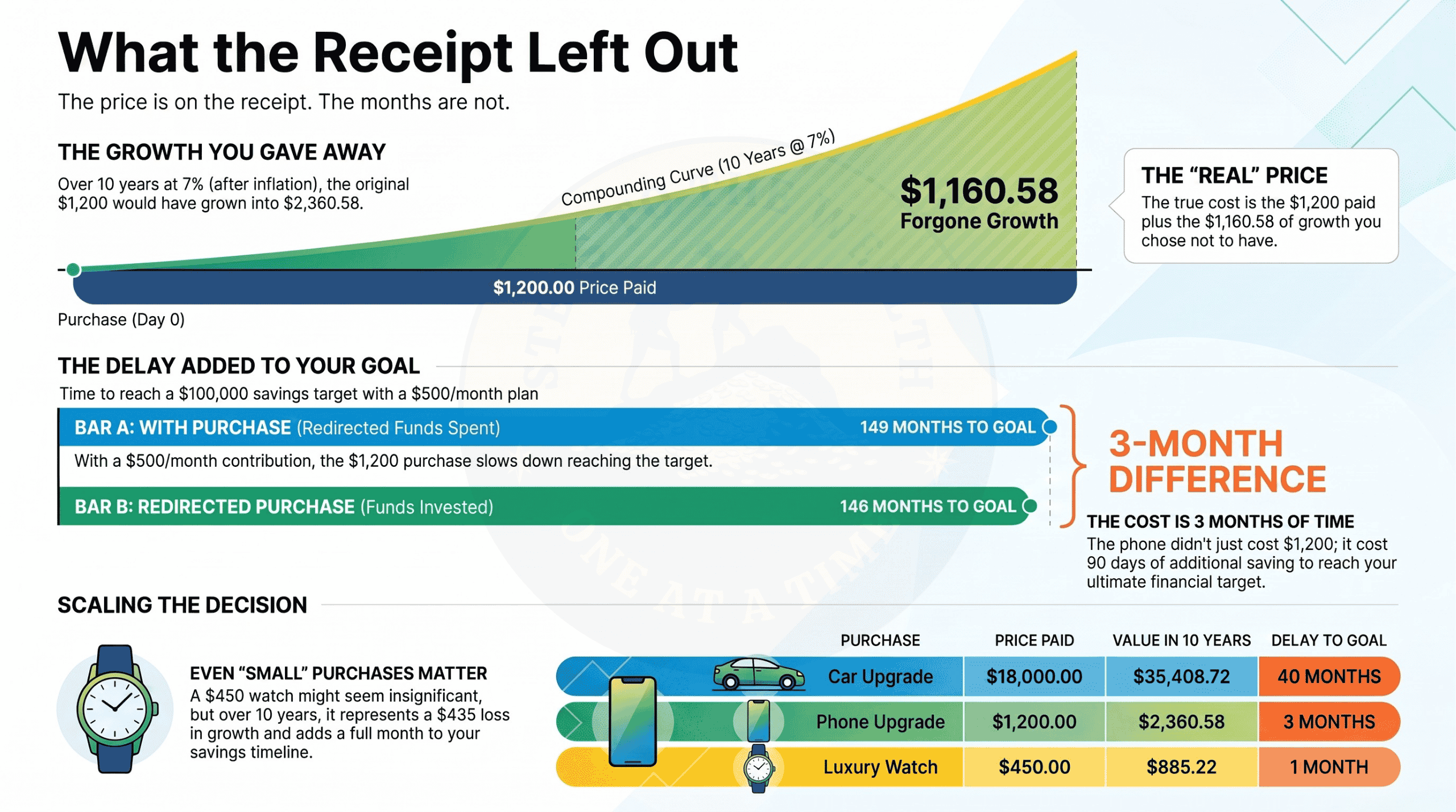
Take an ordinary example. A phone upgrade: $1,200, once, ten years ago.
At seven percent after inflation, that $1,200 would be worth $2,360.58 today, stated in today’s money. You paid $1,200 to not have $2,360.58. The forgone part is $1,160.58 — very close to the price again.
That is the version most people have heard. Here is the version that actually changes a decision.
Say you are putting $500 a month toward a $100,000 target, same seven percent after inflation. On its own, that plan gets there in 149 months. Redirect the $1,200 into it instead of the phone and it gets there in 146.
The phone cost three months.
I want to be careful here, because this is exactly where this kind of writing usually goes wrong. That is not an argument for never buying a phone. You needed a phone. You still need a phone. It is an argument that the number you used to decide — $1,200 — was not the number that mattered, and you had no practical way to compute the one that did.
That last part is the whole point. Nobody skips this arithmetic because they do not care about money. They skip it because it is genuinely fiddly.
The true cost of a purchase, with nothing hidden
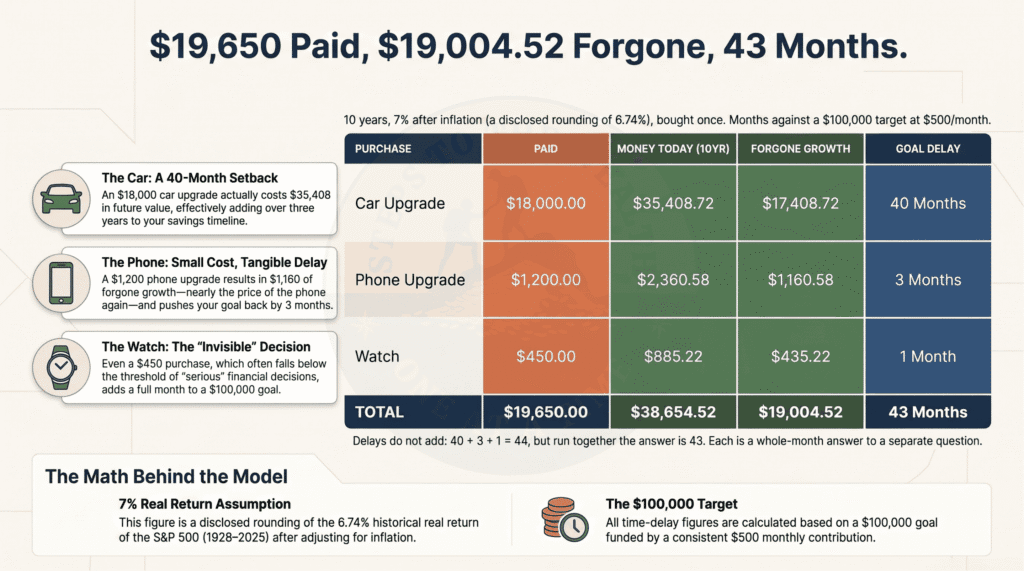
Doing this properly means four steps, and there is a trap in each one.
One — the rate. You want a return stated after inflation, because that is the only kind you can reason about. But compounding needs a nominal rate. So seven percent real at three percent inflation converts first: (1.07 × 1.03) − 1 = 10.21% nominal. Not 10%. The cross term matters.
Two — the growth. Ten years at 10.21% nominal, one contribution at the start and nothing after it: 1.1021^10.
Three — back to today. Deflate by ten years of three percent inflation, so the answer lands in money you recognise: ÷ 1.03^10.
Four — the delay. This one is not a formula, it is two runs of the same calculation: how long your existing plan takes on its own, and how long it takes with the purchase redirected into it. The difference is the delay. It needs one thing the first three do not — that you are already saving toward something.
Steps two and three net out to 1.07^10 = 1.9671513, which is the tidy way to say it. But you only get to skip to the tidy version if you already know the two steps cancel — and the people most likely to run this calculation by hand are the ones most likely to compound the real rate directly and quietly overstate the whole thing.
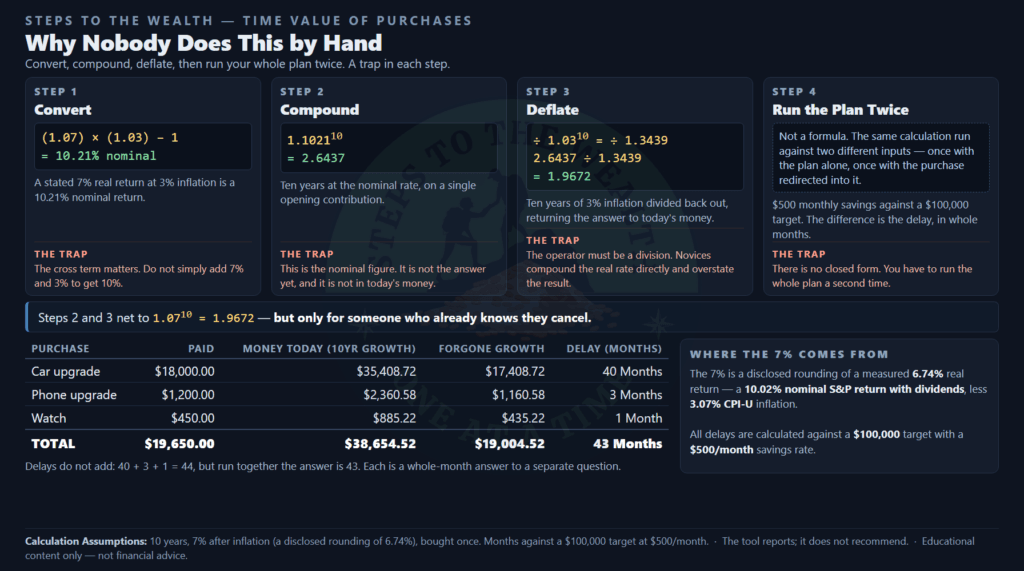
Here are three ordinary purchases with the working shown. Ten years, seven percent after inflation, bought once. The delay column is against that same $100,000 target at $500 a month:
| Purchase | Paid | Money today | Forgone | Delay |
|---|---|---|---|---|
| Car upgrade | $18,000.00 | $35,408.72 | $17,408.72 | 40 months |
| Phone upgrade | $1,200.00 | $2,360.58 | $1,160.58 | 3 months |
| Watch | $450.00 | $885.22 | $435.22 | 1 month |
| Total | $19,650.00 | $38,654.52 | $19,004.52 | 43 months |
Nineteen thousand six hundred and fifty dollars of ordinary, defensible purchases. Ten years on, the money would have been thirty-eight and a half thousand.
One thing worth flagging, because it looks like an error and is not: the three delays are 40, 3 and 1, and the total is 43, not 44. Delays do not add. Each one is a whole-month answer to a separate question, and the combined run reaches the target a month earlier than stacking the parts suggests. If you want the number for several purchases, run them together rather than adding them up.
The watch is the interesting row
The car is the big number, and big numbers are easy to dismiss. Everybody already knows a car is expensive.
The watch is the one worth sitting with. Four hundred and fifty dollars is the kind of figure that does not feel like a financial decision at all. It is a Saturday. It is below the threshold where most people stop and think.
Over ten years it is a four-hundred-and-thirty-five-dollar one, and it is a month.
Not ruinous. Nobody’s retirement turns on a watch. Just bigger than it looked — which is the only claim any of this makes, and it is a smaller claim than it first appears. The tool is not trying to talk you out of the car. It is trying to make the second number visible while you can still act on it.
The objections, which are mostly correct
Four complaints come up. All four are fair, and I would rather answer them than route around them.
“By this logic you never buy anything.”
That is a real failure mode, and it is a bad way to live. Every purchase has a forgone-growth number attached, including the ones that are obviously worth it — a bed, a decent coat, a holiday you still remember in fifteen years.
The calculation does not say the number is too big. It says here is the number. Deciding it was worth paying is a perfectly good outcome, and it is a better one than not knowing.
“Seven percent is not guaranteed.”
Correct. It is not a promise, it is an assumption, and it is the assumption doing the most work — which is exactly why it belongs in an editable field rather than in the fine print.
To be precise about where it comes from: the measured real figure over 1928–2025 is 6.74% — a 10.02% nominal S&P return with dividends, less 3.07% CPI-U inflation. The default rounds that up to seven percent and rounds inflation down, and it should say so rather than dress the rounding up as history. Seven percent is a disclosed rounding, not “the historical average.”
Run it at four percent. At four percent that $1,200 phone is $1,776.29 instead of $2,360.58, and the forgone figure drops from $1,160.58 to $576.29 — half the claim, gone, on one assumption. If a conclusion flips under that, it was never robust, and you have learned something more useful than the original answer.
“The goal and the monthly amount are your numbers, not mine.”
They are, and the delay is the one figure here that is entirely hostage to them. Both are fields. Put your own target and your own monthly contribution in and the months change accordingly.
If you are not currently saving toward anything, the delay does not compute at all — and it shouldn’t. A delay is a comparison between two paths to the same target, and with no existing path there is nothing to compare. The tool leaves it blank rather than inventing one. The forgone-growth figure still works and needs nothing from you but the amount.
“This is just guilt with a chart on it.”
It would be, if it only ever ran backwards over things you already own. Used that way it is archaeology, and archaeology has no decision in it.
It earns its keep before the purchase, on the thing you are still deciding about — where the number is an input rather than a verdict. Past purchases are for calibration, not for self-flagellation. Run three things you already bought, get a feel for the scale, and then use it on the next one.
Which purchases are worth running
Running this on everything would be its own kind of pathology, and it is not what the tool is for. Three markers decide whether a purchase deserves the arithmetic at all.
Size against what you save, not against what you earn. A $450 watch is a rounding error next to most salaries and it is most of a month’s contribution next to a $500-a-month plan. The second comparison is the one that produced the one-month delay. Price a purchase against your savings rate rather than your income and the ones worth checking sort themselves out fast.
Repeatability. A one-off that will never recur is a single row in a table. A purchase you make on a cycle is the same decision made several times over, and the true cost of a purchase you repeat is not the row sitting in front of you.
Reversibility. If the money is recoverable — you can return it, resell it, cancel inside a month — the forgone-growth figure is close to irrelevant, because nothing has actually been committed yet. The calculation earns its keep on decisions that are hard to undo, which is also where regret concentrates.
What survives those three filters is usually a short list: a handful of decisions a year. That is the intended workload. The point was never to audit your spending. It is to make sure the four or five decisions a year that actually move the number get made with both figures visible instead of one.
The purchase you make again
The $1,200 phone in that table is priced as though it happened once. Almost nothing of that shape happens once. A phone is a cycle. So is a car, and so is the annual upgrade of whatever you upgrade annually, and the cycle is where the money actually is.
The temptation is to take the single answer and multiply it — three phones across the decade, three times the delay. That is wrong for the same reason the 40, 3 and 1 in the table come to 43 rather than 44. Delays are whole-month answers to separate questions and they do not add. Each purchase lands at a different point in the plan with a different amount of compounding still ahead of it, and the later ones have less runway left to matter. Multiplying overstates the result, and overstating is exactly how a useful calculation turns into the kind of scolding nobody listens to twice.
So run the cycle as a recurring purchase rather than as a one-off multiplied. The tool takes a monthly cadence for precisely this, and it computes the combined run instead of stacking the parts.
Then there is the second thing a cycle does, which no calculator will ever show you. It takes a decision you made once, deliberately, and converts it into a default you stop examining. The first upgrade was a decision. The fourth one is a habit with a receipt attached. That is not an arithmetic problem, there is no field for it, and it is where the largest version of this number quietly lives.
Where this does not apply
A few places, stated plainly:
It does not price what you still own. This calculation is entirely about the money — what you paid against what that money would have become. It does not know or ask what the car is worth today. If the thing holds its value, or gains it, the honest cost of owning it is lower than the forgone figure alone suggests, and you will have to hold that part in your head. The tool does not model it and does not pretend to.
Things you would never have invested anyway. The whole model assumes the alternative was investing the money and leaving it alone. If the honest alternative was that it sat in a current account, the comparison is against a lower bar and the number is smaller than the tool shows.
Purchases that produce income or save money. A tool that earns, a repair that prevents a larger repair, a course that changes what you can charge. This model does not see the return side of those at all, and it will overstate their cost.
Anything where the point was not financial. Most of the good ones.
Run your own
The calculator is free and it runs the whole thing: what you paid, what the money would have become, and what the purchase does to a goal you are already saving toward — for a one-off or a monthly purchase over ten years.
stepstothewealth.com/time-value/
Free is capped, not crippled. A ten-year answer on a one-off purchase is the case most people actually have, and it is computed with the same engine and the same disclosure about its assumptions as anything else. There is no blurred-out number and no account to create.
Every figure in this article is reproducible on the free tier. The money columns come back on the default settings with nothing touched; the delay column needs two optional fields, the target and what you already put in monthly, and the ones used here are stated above. Nothing in this piece needs the paid tier.
There is a paid tier — $29, once, no subscription — for longer horizons, weekly and annual cadences, editable inflation and fee drag, driving the return off a real asset’s measured history instead of a typed-in rate, and exporting the result. It is at the bottom of the page if you want it. Most people will not need it, and I would rather say that here than have you find out after paying.
Start with the free one. Run something you already bought, so you can calibrate against a decision you already understand. Then run the thing you are actually thinking about.
You do not regret the price. You regret the months.
Educational content only — not financial advice. Figures are illustrative outputs of a calculator run on stated assumptions, not forecasts or recommendations.