About · Steps to the Wealth

Steps To The Wealth.

Investing education for working professionals who want to grow their wealth without becoming full-time traders.

Ariel Founder · Steps To The Wealth

Everything here is built around one idea: you should not have to quit your job or watch charts all day to build real wealth.

I'm Ariel. I have spent years learning investing the hard way — courses, communities, losses, wins, and a lot of spreadsheets. What came out of that process is a systematic, risk-based framework that tells me when to invest and when to wait. No predictions. No gut feelings. Just rules and data.

The framework does the thinking. You do the living.

01 - What you will find here

Three things, built on the same idea.

A tool, a newsletter, and a library of education - all running on the same risk-first framework. Use one, all three, or just lurk in the inbox.

02 - What this is not

A "get rich quick" operation.

  • I do not sell stock picks.
  • I do not promise returns.
  • I do not predict the future.

Everything published here is educational - not financial advice. Past performance is not indicative of future results.

What you will find instead is a framework, the math behind it, and a small set of tools that make running it on real money feel like maintenance instead of guesswork.

You are still the one making the decisions. The framework is here to make sure those decisions are systematic instead of emotional.

If you want a systematic approach to investing that respects your time and your intelligence, you are in the right place.

03 - One last thing

You do the living. The framework does the thinking.

- Ariel
Questions?

Reply to any email, or write to the desk.

stepstothewealth.com ->
01 — The framework in ninety seconds

What this site is about, in one rule.

Everything published here runs on one idea, so the honest way to introduce Steps To The Wealth is to state the idea and let you decide whether it is worth your time.

Most investing content is about what to buy. This site is about when. A rules-based framework reads how much risk is in the price of five assets — Bitcoin, Ethereum, the S&P 500, the Nasdaq 100 and gold — every week, on a four-step scale from LOW to HIGH. At LOW the rules say build a position, a rung at a time. At HIGH they say trim, a rung at a time. In between, mostly, they say hold.

That is the whole of it. Buy ten percent of an asset when risk is low; add if price falls further; hold at a full position and wait for high risk; sell a set percentage at each step as risk rises. It is dollar-cost averaging with the amount set by a reading instead of by the calendar, which is why it is called Dynamic DCA, and it is written down on one page so nothing about it has to be remembered under pressure.

It is not a forecast. Nothing here predicts where a price goes next, and the framework is careful about what it cannot do: it cannot call a top or a bottom, and it does not try. What it can do is turn a frightening week into a mechanical decision, which is what a working professional actually needs from an investing system. Rules-based investing makes the full case; the Dynamic DCA strategy works the rules through.
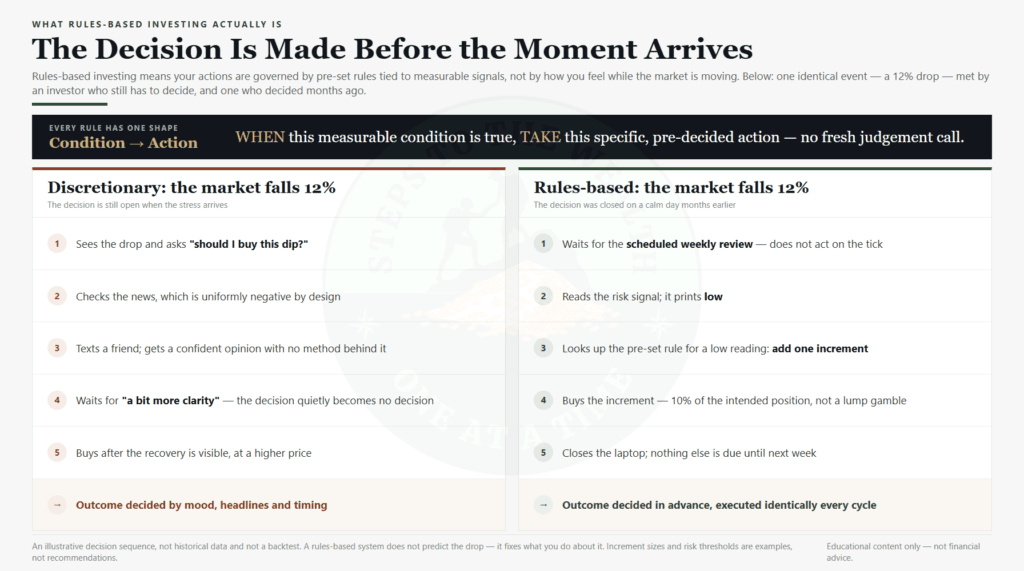
What rules-based investing is: pre-set rules tied to risk replacing emotional decisions, the idea this page is about
The idea everything here is about: pre-set rules tied to a risk reading, in place of a decision made in the moment.

02 — About Ariel

Founder, researcher, and the person who is wrong in public when the data says so.

A site about honesty should be honest about who runs it. This is the short version, with the parts a sales page would leave out.

Step one

The background

A computer science degree and years across private, public and government roles, then a long stretch building websites and running a marketing agency. The thread through all of it was investing, learned the hard way: courses, communities, losses, wins, and a great many spreadsheets.

Step two

The mistakes

Every one an early investor can make, including running fixed DCA into a real bear cycle and quitting near the bottom. That failure is the reason the framework exists; a system that had been running would have bought the bottom instead of selling it.

Step three

The edge

Being honest. Deep enough in the space to spot the hype instantly, and convinced of one thing: if people can make money lying, it is possible to make it by telling the truth. That conviction is what this site is about, and it is the standard every page is held to.

Step four

The job now

Steps To The Wealth full time: the framework, the newsletter, the tools, and the articles that show the working. No client work, no affiliation with any broker’s recommendations, and no personalised advice — Ariel is not a financial adviser and says so on every page.

What that means for what gets published

Every claim about a product is checked against the product before it is written. Every figure in an article is built from source data and rendered as a chart you can read, not generated as an illustration. Every tool prints its assumptions and shows its arithmetic. When a piece is wrong, it is corrected on the page rather than quietly replaced, because a site about a rules-based framework has to run by rules itself.

It also means the tone. Operator to operator, no exclamation marks, no rocket ships and no manufactured urgency. If something on this site is not for you, the page says so and lets you leave. That walk-away permission is not a flourish; it is the difference between an educator and a salesman, and the site is about being the first.

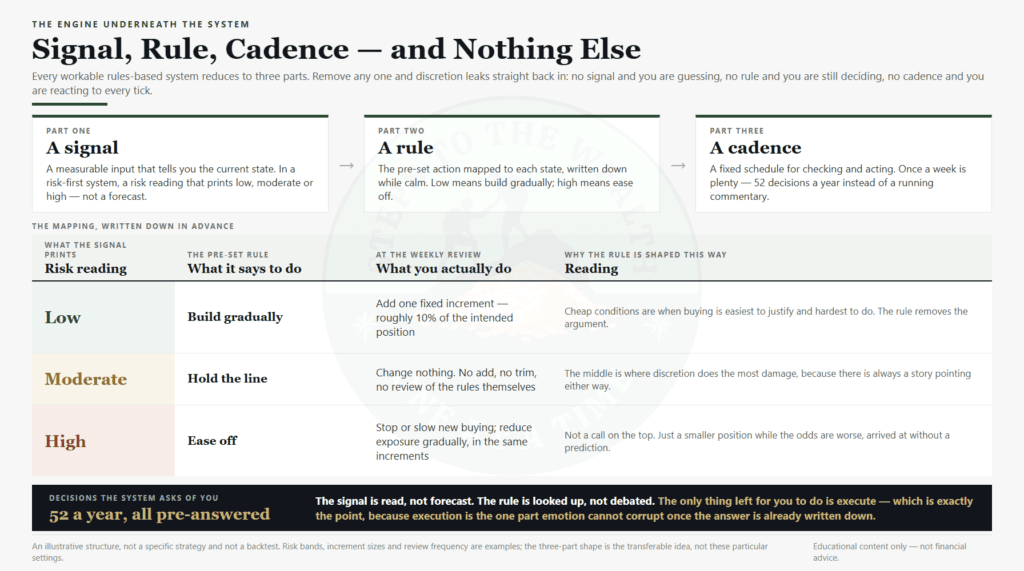
The three parts of a rules-based system: a signal, a rule and a fixed cadence, which is what Steps To The Wealth is about
A signal, a rule and a cadence. The newsletter is the signal, the Blueprint is the rule, and Sunday is the cadence.

03 — What is built here

Three products, sixteen free tools, one framework. What each one is about.

Nothing here exists on its own. The newsletter reads the framework, the tools price the decisions around it, and the course is about the person who has to run it for decades.

The Sunday newsletter is free, and it is the anchor product. One email every Sunday morning with the risk reading for the five tracked assets and one lesson from the framework. The paid edition, $9 a month or $90 a year after 14 days free, adds the four inputs under each reading, the tactical layer, a deep-dive, a subscriber question and the noise filter. The newsletter page is about what a reading is and how the ladders work.

The DCA simulator runs an exact recurring-buy plan against real price history: 250 crypto assets and three engines free, and DCA Simulator Pro for all 816 assets, ten engines, Monte Carlo and every start date, at $9 a month, $90 a year or $249 once. It was built because the framework was fine and the spreadsheet was not.

The Operator’s Mindset is a 15-lesson, $99 course about the half of wealth-building no calculator reaches: the goals, the decision speed, the defaults and the environment of the person running the system. The free Operator’s Audit is the seven-question diagnostic that says which of those gaps is yours.

The tools are sixteen free calculators and readings on one page, grouped by the question you are asking: whether a plan is enough, whether it survives a crash, what a purchase costs, and what the money supply underneath every asset is doing. Two of them carry a $49 Pro tier that adds history or expiries; none of them is cut down to sell it.

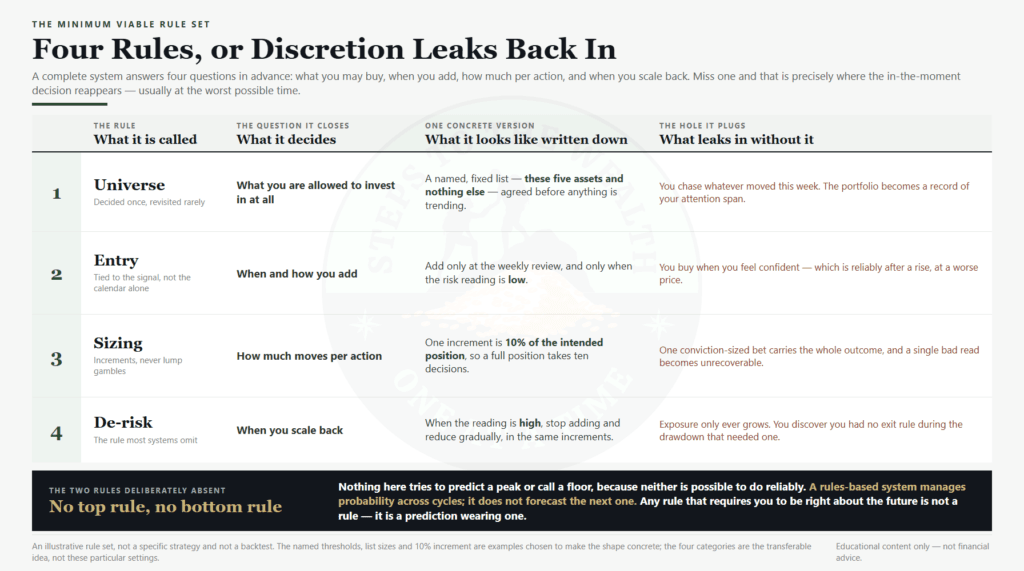
The four rules of a complete system, universe, entry, sizing and de-risk, and what Steps To The Wealth publishes about each
Universe, entry, sizing, de-risk. Four rules, all written down, which is what a system is about.

04 — Who this is for

Built for people who are excellent at their jobs and want investing to run in the background.

The site has a specific reader in mind, and the honest thing to say about the reader is who it is not.

It fits if

  • You are a working professional — an engineer, an accountant, a doctor, a developer, a consultant — comfortable with logic, data and systems, and with no wish to become a full-time trader.
  • You have been burned by buying at a peak, selling at a bottom or freezing in the middle, and you would rather have a rule than a feeling next time.
  • You want the arithmetic shown, the assumptions stated, and permission to disagree. Everything about this site assumes you will check the working.
  • You can give it fifteen minutes on a Sunday and then get on with your life. That is the whole cadence, and it is the point.

It does not fit if

  • You want stock picks, the next big coin or a prediction about next quarter. There are none here, on any page, and adding them would undo what the site is about.
  • You want daily updates, alerts or a community to trade in. The framework has nothing to say between Sundays and the site does not pretend otherwise.
  • You want a guarantee. No outcome is promised anywhere here; a rules-based framework changes how decisions are made, not what markets do.
  • You want personalised advice. Ariel is not a financial adviser, nothing here knows your circumstances, and every page carries the same line: educational content only — not financial advice.

What the site asks of you

Fifteen minutes on a Sunday: read the reading, check the ladder, act if a rung triggers, close the tab. The rest of the week is yours, and the site is built so that nothing in it needs you between Sundays. The 15-minute Sunday review lays the routine out step by step.

It also asks you to check the working. Every article carries its arithmetic, every tool prints its assumptions, and every figure can be reproduced from the source data. A reader who takes the numbers on trust is using the site the way a guru would want, which is not what it is about.

05 — Questions

What people ask about the site.

Answered against what the site actually does, not against what would be convenient to claim.

What is Steps To The Wealth about?

A rules-based, risk-first way of investing for working professionals who do not want to watch markets all day. The site publishes a weekly risk reading for five assets, the one-page framework that turns a reading into an action, sixteen free tools that price the decisions around it, and a course about the person who has to run it.

The short version: most investing content is about what to buy. This site is about when.

Who runs the site?

Ariel, the founder. A computer science background, years of building websites and running a marketing agency, and investing as the constant thread through all of it, including the mistakes. The move to running Steps To The Wealth full time is about doing one thing honestly rather than many things for clients.

Ariel is not a financial adviser and does not give personalised advice. What is published is a framework and the evidence behind it.

Is anything on the site financial advice?

No. Everything here is educational. The newsletter reports what a framework says about five assets; the tools price the choices you describe; the articles show their working. Every decision remains yours, and every page says so.

That line is not a formality. The whole approach is about you running a system you understand, which is the opposite of taking instructions from a website.

What does it cost?

The Sunday newsletter, the Dynamic DCA Blueprint, the sixteen tools and the articles are free, with no account and no email wall on the tools. The paid edition of the newsletter is $9 a month or $90 a year after 14 days free. DCA Simulator Pro is $9 a month, $90 a year or $249 once. The Operator’s Mindset is $99 once. Two tools carry a $49 Pro tier.

Every price is on the product page, in full, with the small print beside it rather than under it.

How is the content produced?

From source data, checked before it is written. Product claims are verified against the product. Figures are built as charts from the numbers rather than generated as pictures. Tools print their assumptions and show their arithmetic. When something is wrong it is corrected in place, which is about the only way a site that preaches rules can keep its own.

The voice is deliberate too: operator to operator, no hype, no urgency, and explicit permission to walk away when a page is not for you.

Why only five assets?

Because they are the five a working professional is most likely to already hold, and the five where a risk reading changes a real decision: Bitcoin, Ethereum, the S&P 500, the Nasdaq 100 and gold. A framework that added a sixth whenever something was in the news would stop producing readings that can be compared week to week.

The tools cover a far wider universe — the DCA simulator alone holds 816 assets — but the weekly reading stays at five on purpose. Consistency is what a reading is about.

Does Steps To The Wealth have a community?

Not yet. The site is the newsletter, the tools, the course and the articles, and a community is on the roadmap for when there are enough subscribers for it to be worth anyone’s time. When it arrives it will be a separate decision, described as plainly as everything else here.

In the meantime, replies to the Sunday email are read and often answered in the next issue. That is the closest thing to a conversation the site has, and it is about the framework rather than about picks.

Where do the numbers in the articles come from?

From public sources that are named in the piece: price history from the same feeds the tools use, central-bank balance sheets from published series, household figures from the Federal Reserve’s survey, long-run return figures from published academic datasets. Where a claim cannot be sourced it is not made, and where a figure is an assumption it is labelled as one.

The crash case studies — 2008, the COVID crash, the 2022 Bitcoin bear market — are worked from daily closing prices, and the arithmetic sits in the article so the result can be checked. That is what an article here is about: the working, not the verdict.

How do I get in touch?

Reply to any newsletter email, or write to the desk through the contact page. Everything is read. Questions about the framework are often answered in the Sunday issue, with the question anonymised.

For anything about a purchase, the product pages carry the cancellation and refund terms, and the same address handles those.