Free Self-Diagnostic

Find The One Pattern Costing You A Decade Of Wealth-Building

A 7-question self-diagnostic that surfaces the specific structural gap in your wealth-building practice — and the single next move that closes it.

Take the free audit. Find the gap. Run the next move.

No spam. Unsubscribe anytime. You’ll also get the weekly Steps To The Wealth newsletter — one substantive email a week, the same operator-level frameworks applied to the current market and your situation.

The Core Issue

Why most working professionals stay stuck — and how this audit names the reason

You’re not stuck on wealth-building because you don’t know what to do.

You’ve read the books. You can explain dollar-cost averaging at a dinner party. You know what a Sharpe ratio is. You understand — intellectually — that the boring, systematic investor with a forty-year horizon almost always beats the smart person who keeps refining their approach.

And yet.

You’re still not running a real system. Not one you’d defend out loud to someone who knows what they’re talking about. Not one you’ve stuck with through a full market cycle. Not one that’s produced the kind of result you’d put on a slide if anyone asked.

You don’t have a wealth problem. You have an operator problem.

The operator is the person actually pulling the trigger week after week, year after year, through earnings reports, geopolitical noise, family pressure, lifestyle drift, and the constant pull of newer, shinier strategies. The operator is the part of you that has to override the perfectly normal human urge to change course every time the wind shifts.

Most working professionals have studied the system. Almost none have built the operator.

This audit names which specific operator-level gap is dominant in your wealth-building practice right now.

The Diagnostic

What you’ll find inside

  • → 7 structural questions, each calibrated to a specific operator-level failure mode
  • → A scoring framework that surfaces which gap is dominant for you specifically (not generic advice)
  • → The exact next move that closes each gap — the one thing to do this week, not a vague aspiration
  • → Your dominant investor archetype — which recurring operator profile you fall into, and what people in that profile usually do next
  • → Where The Operator’s Mindset course picks up, if you decide your highest-leverage gap is worth closing faster
The Audience

Built for working professionals

If you have a real job — engineering, accounting, medicine, software, design, consulting, or anything else that pays well but consumes the bulk of your week — this audit is built for you specifically.

If you’ve already retired, or you’re trying to get rich quick from a single bet, or you have $500K+ in a stable portfolio that’s been compounding correctly for a decade — the audit isn’t going to surface much you don’t already know.

The Sweet Spot:

Working professionals with stable income, between $5K and $200K of investable capital, who’ve been trying to build wealth for 1-10 years and feel like the results don’t match the effort.

Who I am

I’m Ariel — founder of Steps To The Wealth. I’ve spent years developing and refining a risk-based investing framework specifically for working professionals who don’t have time to watch markets all day.

Before that, I made every mistake an early investor can make — including running fixed DCA into a real bear cycle and quitting near the bottom. Eventually I built the system I wish someone had handed me ten years ago.

Steps To The Wealth exists to teach that system, and the operator standard underneath it, to working professionals — clearly, systematically, and without the hype that pollutes most “investing education” online.

I’m not a financial advisor. I do not give personalized financial advice. What this audit gives you is a framework — built, tested, and refined across multiple real cycles — that you can adapt to your own situation.

What happens after you take it

You’ll answer 7 questions and enter your email. The moment you finish, you’ll see your dominant investor archetype on-screen — the specific operator-level gap that’s costing you most right now, and the single next move that closes it.

Over the next two weeks, you’ll get a short series of follow-up emails — each one expanding on a specific framework from the audit and pointing toward the work that compounds. No upsell drumbeat. No artificial scarcity. Just useful content.

After that, you’re on the Steps To The Wealth weekly newsletter cadence — one substantive email per week, plus occasional updates when new resources are published.

Unsubscribe at any point. Your result is yours to keep regardless.

Find the gap. Run the next move.
Start this week.

Take The Audit →
Educational content only — not financial advice. By taking the audit, you agree to receive your result and follow-up emails. Unsubscribe at any time.
01 — What the audit measures

The Operator’s Audit tests the operator, not the knowledge.

Seven questions, none of them about what you know. Every one of them is about what you actually did the last time it mattered, because that is where an operator problem shows up and a knowledge test never finds it.

Knowledge tests are easy to pass and useless here. A working professional who has read three investing books can define dollar-cost averaging, explain a drawdown and describe a rules-based plan. The Operator’s Audit assumes all of that and asks a different question: what did you do when the plan said one thing and the week said another?

So the seven questions are behavioural. What you did with contributions in the last real fall. How long a $1,000 decision takes you against a $100,000 one. Whether the goal you would state out loud and the plan you are actually running produce the same number. Whether your allocation is one you would show someone who knows what they are looking at. None of it can be answered from a book.

This is also why the Operator’s Audit is short. Seven behavioural questions answered honestly say more than forty knowledge questions answered well, and a diagnostic that takes an evening is a diagnostic that gets abandoned at question twelve. The whole thing is built to be finished on a lunch break and acted on the same week.

Each question is calibrated to one operator-level failure mode, and the scoring does not add them into a grade. It finds the dominant one — the single gap doing the most damage right now — because a list of seven things to fix is a list nobody fixes. The Operator’s Audit returns one gap, one archetype and one next move.
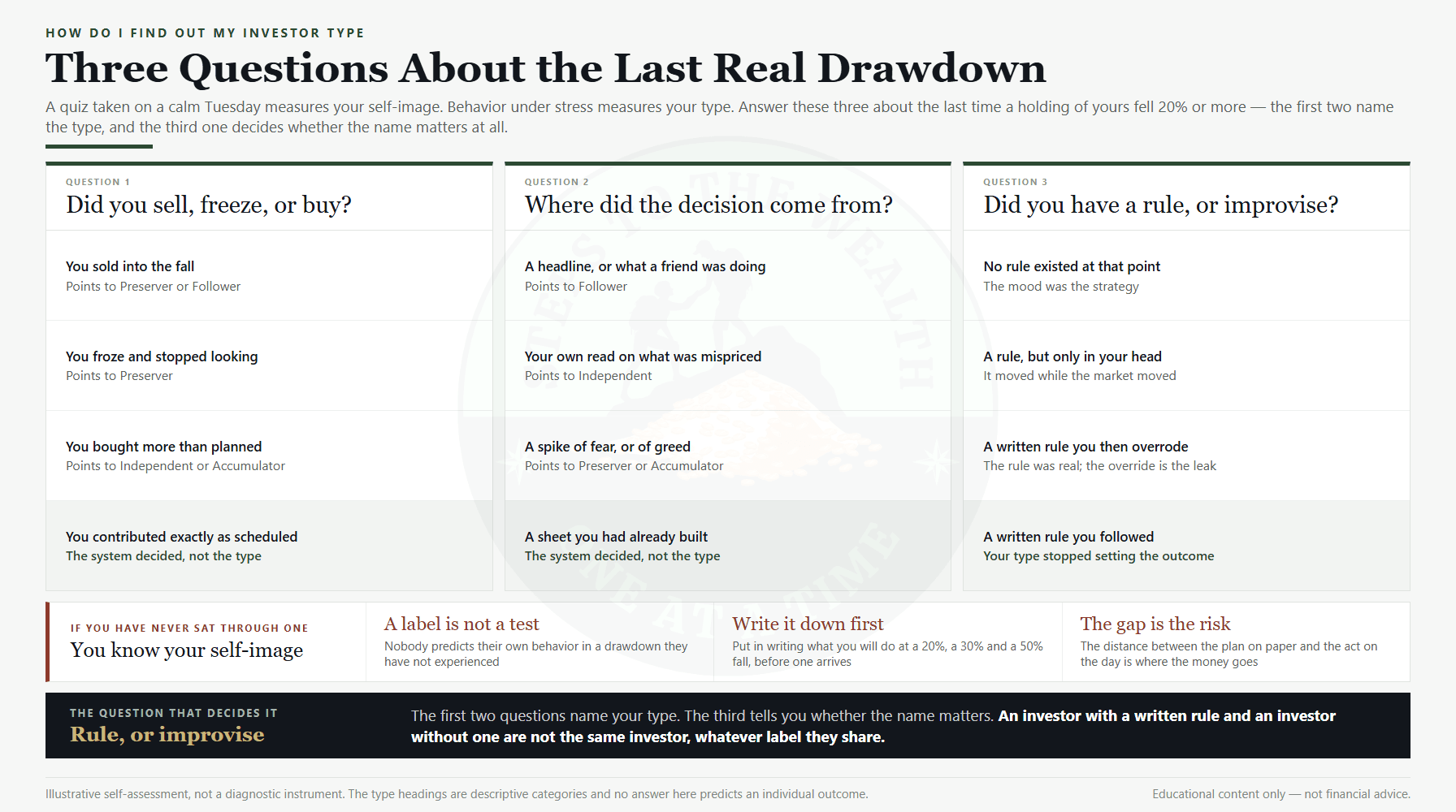
Three questions about the last drawdown that reveal an investor type, the kind of question the Operator's Audit asks
The kind of question the Operator’s Audit asks: what you did in the last drawdown, not what you would do in the next one.

02 — The arithmetic of a gap

Why one operator gap costs a decade, and why the Operator’s Audit prices it that way.

The headline on this page says a decade. That is not a figure for effect; it is what the four common gaps do to a compounding plan when they run unattended, and each one can be worked through with a pen.

Step one

Goal and plan do not match

A goal of financial freedom at 50 on a plan that arrives at 75 is a 25-year gap that nobody has measured, because the two numbers live in different rooms. The Operator’s Audit asks whether you have ever put them side by side. Most people have not.

Step two

The permanent research phase

Ten weeks of reading before a first contribution is ten weeks of compounding that never starts, and the phase repeats every time a new strategy appears. Across a working life the research phase is the most expensive habit on this list and the least visible.

Step three

The allocation you would not show

An allocation you know is wrong and have not touched for two years is two years of a plan you are not running. The Operator’s Audit does not ask what the right allocation is. It asks whether you are avoiding the account, which is a different and more honest question.

Step four

Pausing until it settles

Contributions stopped in a fall and restarted eighteen months later miss the recovery and buy back higher. It is the single most common way a correct plan produces a poor result, and it is entirely an operator decision.

How the result is built

Each answer maps to one of the failure modes above, and the scoring surfaces the one with the most weight in your answers rather than averaging them. That gap is paired with an investor archetype — the recurring operator profile it usually belongs to, and what people in that profile tend to do next — and with a single next move you can run this week.

The archetype is not a personality type. It is a description of a default: how you decide, how fast, and what you reach for under pressure. What kind of investor am I works through the same idea in the open, if you want to see the reasoning before you take the Operator’s Audit.

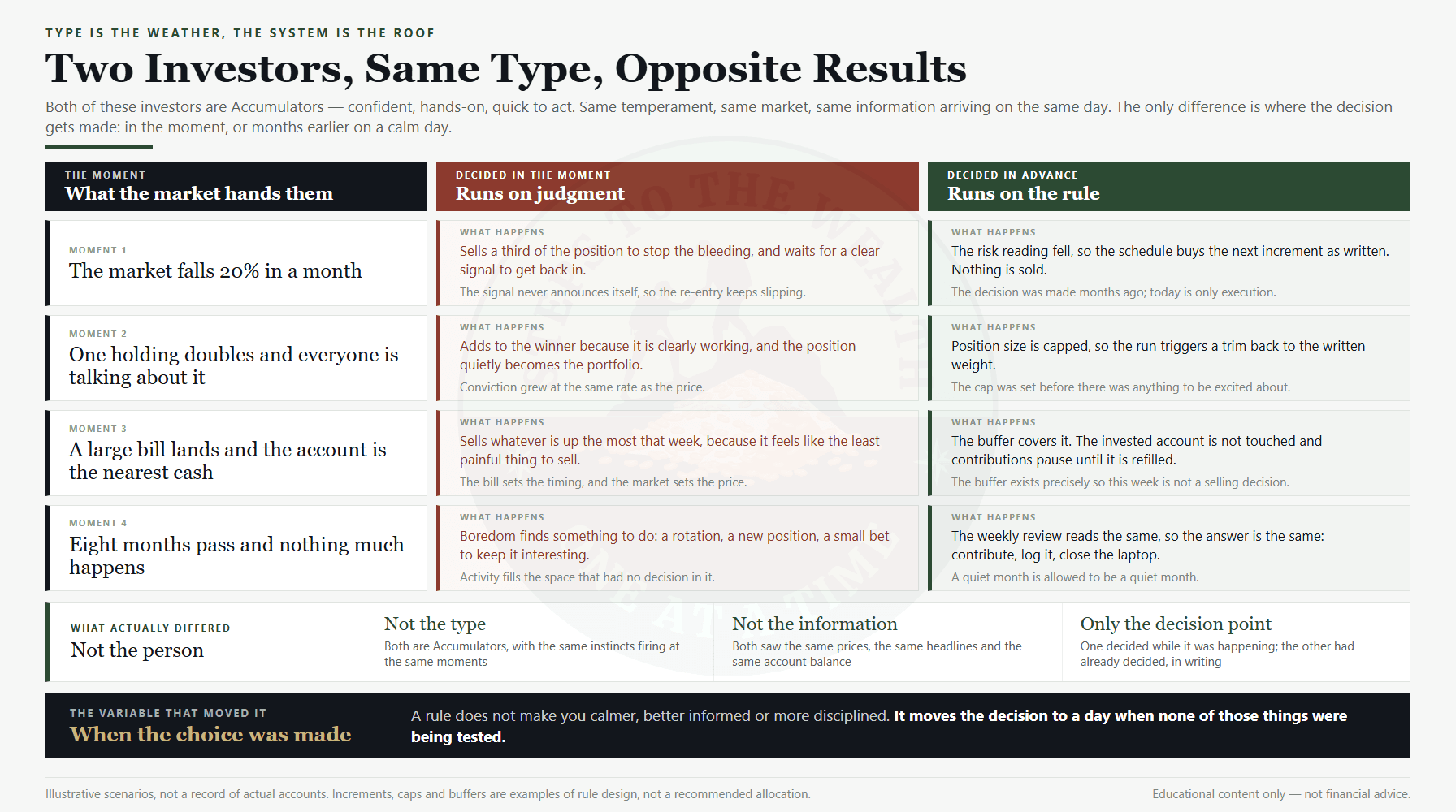
Two investors of the same type facing the same four market moments, one deciding in time and one not, the gap the Operator's Audit measures
Same type, opposite results. The Operator’s Audit is built to find the operator gap, not the knowledge gap.

03 — What happens after

Seven questions, one result, and then the Operator’s Audit stops.

The result is on screen the moment you finish. What arrives afterwards is stated here in full, because a free diagnostic that turns into a sales sequence is the pattern this site exists to avoid.

What you get

  • You answer seven questions and enter an email. Your dominant gap, your archetype and your next move appear immediately; the Operator’s Audit does not hold the result back for a later email.
  • Over the following two weeks, a short series of emails expands on the frameworks behind the audit. Each one is a piece of work you can do, not a countdown.
  • After that you are on the weekly newsletter cadence: one substantive Sunday email, plus a note when a new tool or resource is published.
  • Where The Operator’s Mindset picks up from your gap is named in the result. It is a $99 course you can ignore; the audit and its result are yours regardless.

What you do not get

  • No artificial scarcity, no closing-soon timers, no upsell drumbeat. The Operator’s Audit is a diagnostic first and a funnel second, and the emails are written that way.
  • Nothing about your answers is sold or passed to anyone. The result and the follow-ups are the only thing your email is used for, and every email unsubscribes in one click.
  • It is not a financial plan and it is not advice. The Operator’s Audit names a behavioural gap and a next move; it does not know your accounts, your tax position or your horizon.
  • It is not for everyone. If you have already retired, or you are chasing one large bet, or a stable portfolio has been compounding correctly for a decade, the audit will confirm what you already know and not much else.
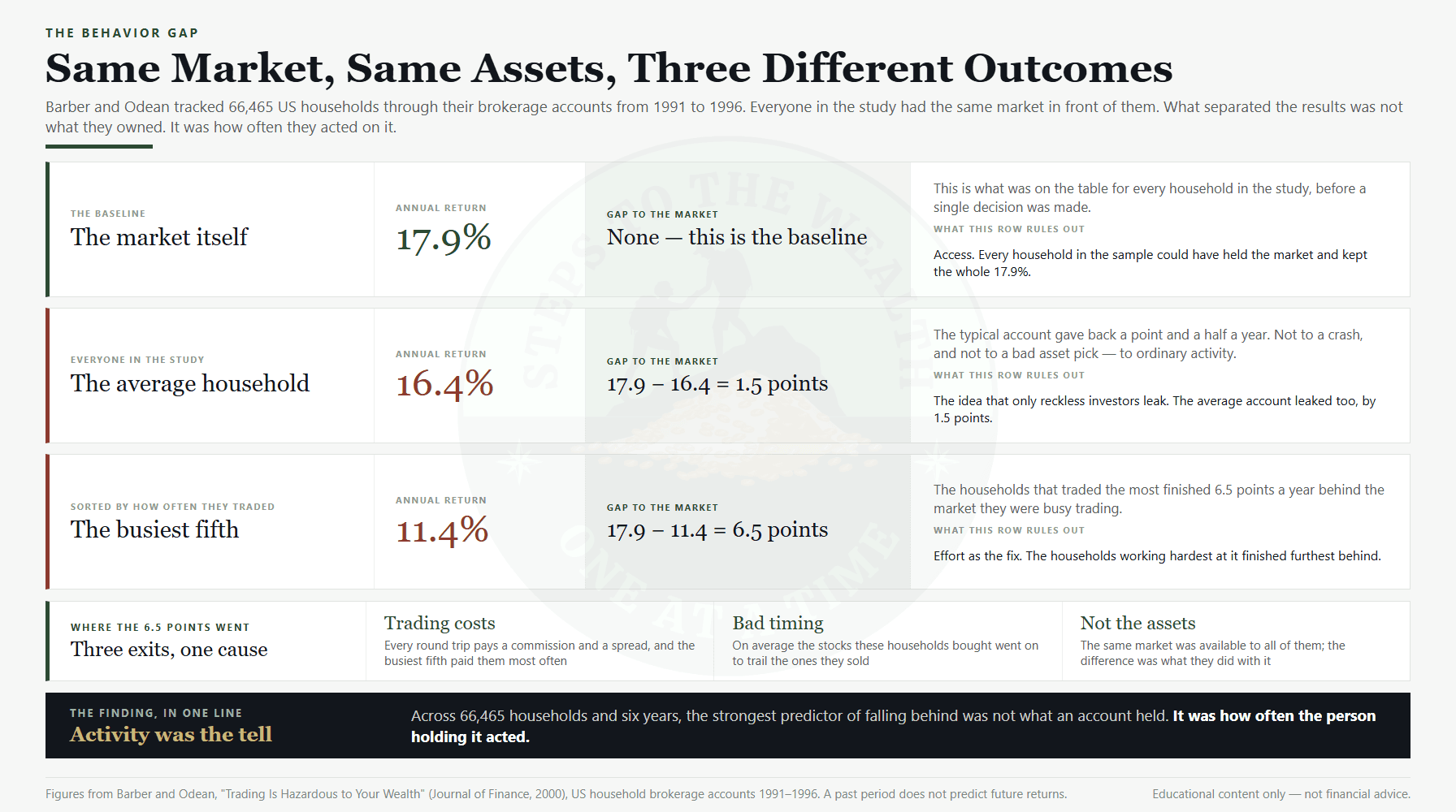
The behaviour gap measured: the market's return against the average investor's, the cost the Operator's Audit is designed to name
The behaviour gap, measured. It is the cost of an operator problem, and the Operator’s Audit exists to name yours.

04 — Questions

What people ask before they take the Operator’s Audit.

Answered against what the audit actually does, not against what would be convenient to claim.

What is the Operator’s Audit?

A free seven-question self-diagnostic for working professionals who understand investing and still are not running a system they would defend. It finds the single operator-level gap doing the most damage to your wealth-building, names the investor archetype it belongs to, and gives you one next move to run this week.

It is not a knowledge quiz. Every question is about what you actually did the last time a plan met a real market.

How long does the Operator’s Audit take?

A few minutes. Seven questions, one email field, and the result appears on screen as soon as you finish. Nothing is held back for a later email.

The follow-up series runs over two weeks and each email is short. The work it points at — the goal-plan reconciliation, the decision-speed audit — takes longer, and is the point.

Who is the Operator’s Audit built for?

Working professionals with stable income, somewhere between $5,000 and $200,000 of investable capital, who have been trying to build wealth for one to ten years and feel the results do not match the effort. Engineers, accountants, doctors, developers, consultants: people whose job takes most of the week and who want a system that runs in the background.

If that is not you, the honest answer is that the audit will not surface much. It is calibrated for one population and it says so.

Is the Operator’s Audit financial advice?

No. It names a behavioural gap and a next move; it does not recommend an asset, an allocation or a trade, and it does not know your circumstances. Ariel, who wrote it, is not a financial adviser and does not give personalised advice.

Everything on this page and in the result is educational. Educational content only — not financial advice.

What is the difference between the Operator’s Audit and The Operator’s Mindset?

The audit is the diagnosis and it is free. The Operator’s Mindset is a 15-lesson, $99 course that works through the operator layer in full: goals, decision speed, identity, defaults and environment. The result of the audit tells you which lesson your gap lives in.

You do not need the course to act on the audit. The next move in your result is a complete instruction on its own, and the two weeks of follow-ups expand on it without asking for anything.

What are the seven questions about?

Behaviour under pressure, not theory. In broad terms: what you did with contributions in the last real fall, how long a large decision takes you against a small one, whether your stated goal and your actual plan land on the same number, whether your allocation is one you would show, what you reach for when a new strategy appears, how you decide when the plan and the week disagree, and what has actually changed in your practice in the last year.

Each maps to one operator-level failure mode. The Operator’s Audit does not score you on the answers; it scores the pattern across them and returns the one that dominates.

Can I take the Operator’s Audit more than once?

Yes, and there is a reason to: the dominant gap moves. Close the goal-plan mismatch and the research habit is often what surfaces next. Taking the Operator’s Audit again after running the next move for a quarter is a fair way to check whether the operator actually changed or only the intention did.

The result you got the first time stays yours. Nothing about a second run overwrites it.

Is the Operator’s Audit the same as the Investor Profile quiz in the DCA Simulator?

No. The simulator’s two-minute quiz routes you to the simulation strategy that fits how you behave — equal buys, dynamic buys, buying the dip — and it is about which engine to run. The Operator’s Audit is about whether you will run any engine at all: the goal, the decision speed, the allocation you avoid, the contributions you pause.

They sit at different layers and both are free. If you want the strategy question answered, use the DCA simulator; if you want the operator question answered, take the audit.

Do I have to give an email to take the Operator’s Audit?

Yes, because the result and the follow-ups are delivered to it, and because the audit is also the way onto the free Sunday newsletter. You can unsubscribe at any point and keep your result.

Your answers are not sold, shared or used for anything except the result and the emails described on this page.