

Most people asking “what kind of investor am I” are trying to name a personality: cautious, aggressive, follower, contrarian. The framework below — four behavioral investor types drawn from CFA research — will hand you that label in about two minutes. The label is the least useful part of it. What actually decides your returns is not your type. It is whether the system you invest with can survive your type on your worst day.
What kind of investor am I? The four behavioral investor types
There are four widely used behavioral investor types, defined by CFA charterholder Michael Pompian: the Preserver, the Follower, the Independent, and the Accumulator. Each one describes a default reaction to risk and uncertainty — how you behave when money is actually on the line, not how you think you behave when the market is calm.
Pompian’s framework, from Behavioral Finance and Wealth Management, sorts investors along two axes: whether you are driven more by emotion or by cognition, and whether your risk tolerance is passive or active. That produces four types.
| Type | Core driver | Default behavior | The failure mode |
|---|---|---|---|
| Preserver | Fear of loss (emotional, passive) | Holds cash, avoids risk, moves slowly | Never invests enough, for long enough, to compound |
| Follower | Wanting to be positioned like everyone else (cognitive, passive) | Chases what is popular, copies what is working | Buys near the top, sells near the bottom, one cycle late |
| Independent | Own analysis (cognitive, active) | Contrarian, does the research, holds a firm view | Overconfidence — mistakes a strong opinion for an edge |
| Accumulator | Confidence and control (emotional, active) | Aggressive, hands-on, high conviction, acts often | Overtrades and oversizes until one call decides everything |
Read that last column again. That is the part that costs money. The type names are a vocabulary; the failure modes are a bill. And notice that two of the four failure modes are failures of inaction and two are failures of action — which is the first clue that “be more disciplined” is not a fix that works on everybody.
How do I find out my investor type?
You find your type by looking at what you actually did during the last real drawdown, not by taking a quiz on a calm Tuesday. Behavior under stress is the only honest signal. Ask yourself three questions about the last time a holding of yours fell 20% or more.
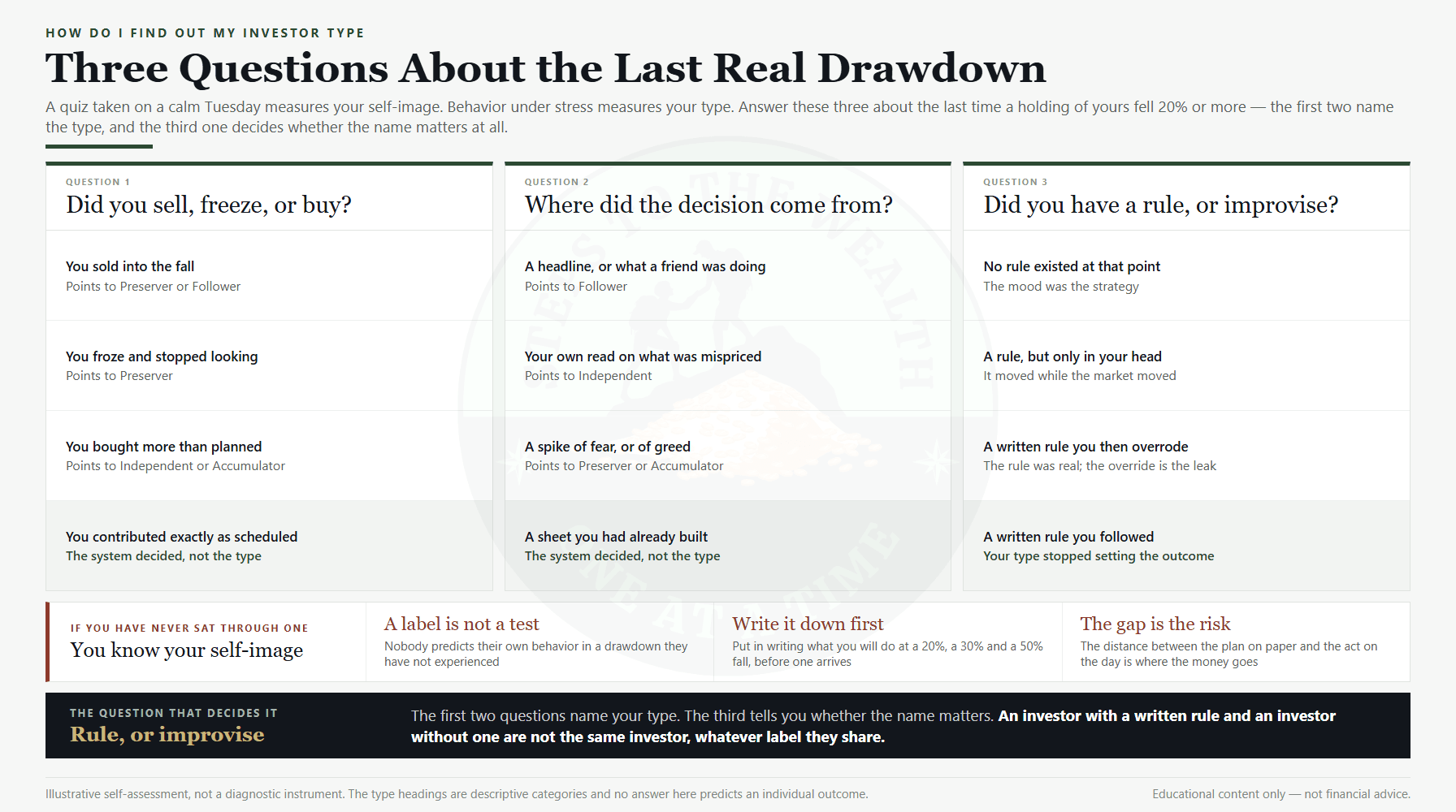
- Did you sell, freeze, or buy? Selling into the fall points to Preserver or Follower. Freezing and not looking points to Preserver. Buying more than you had planned to points to Independent or Accumulator.
- Where did the decision come from? A headline or a friend’s position (Follower), your own read on what was mispriced (Independent), or a spike of fear or greed (Preserver or Accumulator). If it came from a sheet you had already built, the system decided and your type never got a vote.
- Did you have a rule, or did you improvise? This is the one that matters most, and we will come back to it.
If you have never sat through a real drawdown, you do not know your type yet — you know your self-image. Those are different things, and the distance between them is exactly where money gets lost. The cheapest substitute is to read what a real one looked like from the inside: the S&P 500 through the 2008 financial crisis, the same index through the COVID crash of 2020, and bitcoin through the 2021–2022 bear market. Read the depth and the duration, then write down what you would have done in month nine. That written answer is worth more than any personality label.
There is a second-best test that costs nothing: run your actual allocation through a historical stress test and look at the number at the bottom. Not the percentage — the dollar figure. The percentage is abstract. The dollar figure is the one your stomach will be reacting to.
Does your investor type actually determine your returns?
No. Your investor type predicts how you will make mistakes, not how you will perform. Two people with the identical type get opposite results depending on one variable: whether they invest through a rules-based system or through their own judgment in the moment. The type is the weather. The system is whether you built a roof.
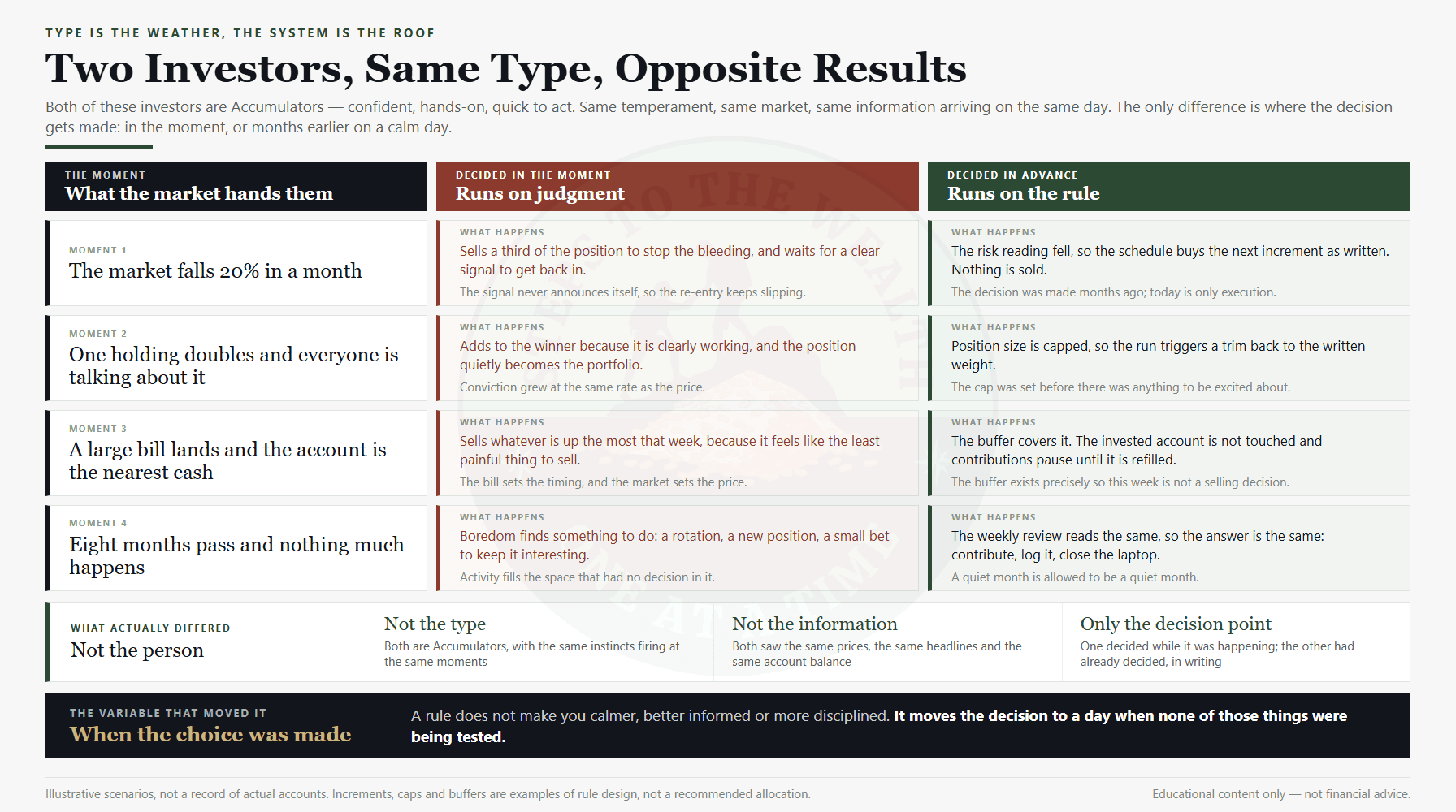
This is where most “what kind of investor are you” content stops. It hands you a label and a flattering paragraph and sends you off feeling seen. That is the guru move: sell you an identity, skip the mechanics. Every cycle it is the same trick. Someone names your “money personality” and never mentions that the personality is the problem to be managed, not a strategy to be followed.
Here is the logic chain that actually matters. To build wealth consistently you have to survive the drawdowns. To survive the drawdowns, your decisions cannot depend on how you feel during them. And to take feeling out of the decision, you need a rule you set in advance — when risk is high you do not add and you scale out; when risk is low you buy gradually. Your type never enters the equation. That is the entire point.
Two objections usually arrive here, and both are worth answering. The first is “surely a good investor can just be disciplined.” Discipline is a resource that depletes under stress, which is precisely when you need it, so a plan that spends it is a plan with a fuel gauge. The second is “a rule will make me miss things.” It will. It will also make you miss the mistakes, and the arithmetic of what fixed and dynamic buying schedules actually do is a better guide to that trade than a feeling about it.
What is the behavior gap, and how big is it?
The behavior gap is the difference between what investments return and what investors actually earn — the money lost to buying high, selling low, and overtrading. It is the most direct evidence that behavior, rather than asset selection, is what quietly drains returns.
The clearest measurement comes from Brad Barber and Terrance Odean’s study Trading Is Hazardous to Your Wealth, published in the Journal of Finance in 2000. They tracked 66,465 US households through their brokerage accounts from 1991 to 1996. The market returned about 17.9% annually over that window. The average household earned roughly 16.4%. The households that traded the most earned just 11.4%.
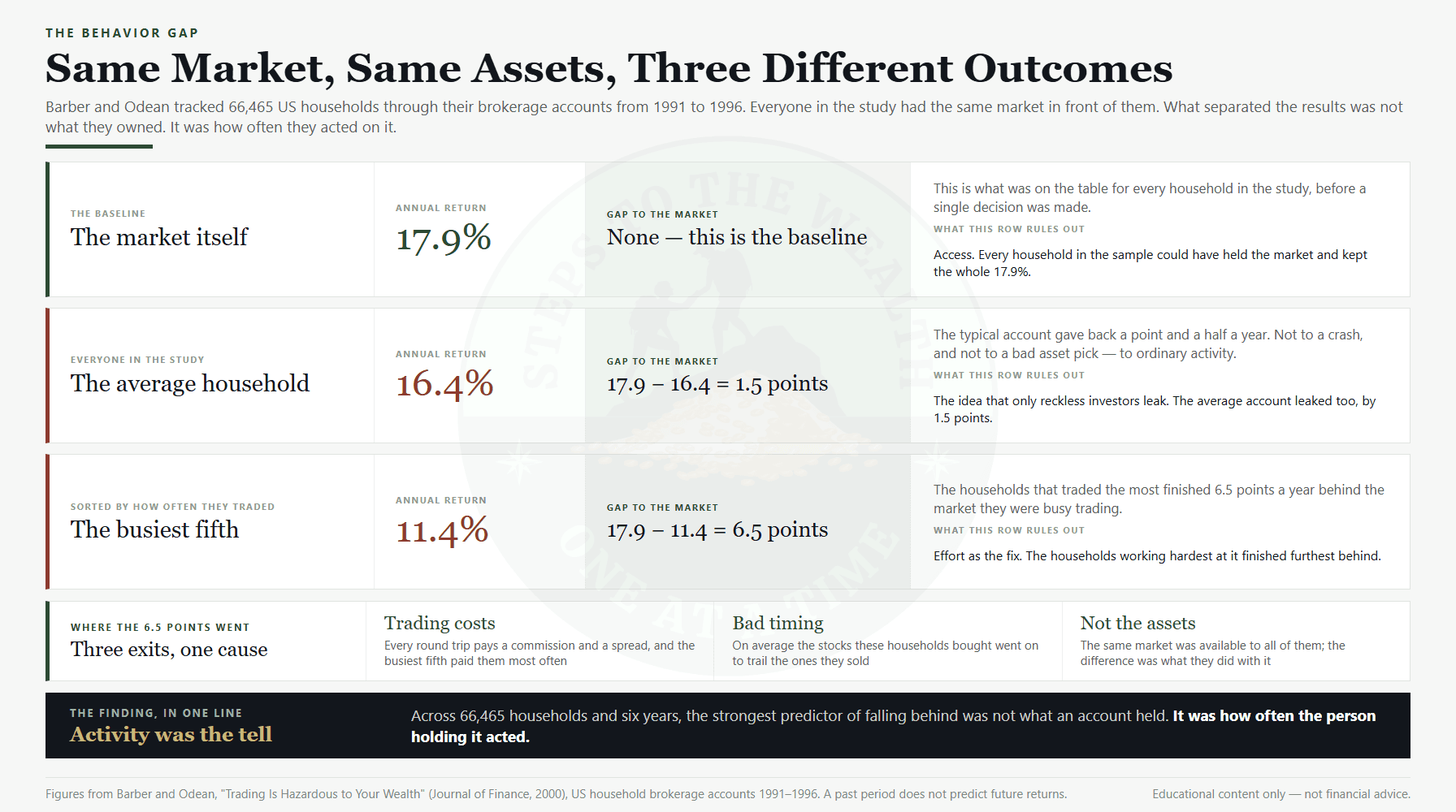
Same market. Same assets available to everybody in the sample. 17.9 − 16.4 = 1.5 points given back by the typical account, and 17.9 − 11.4 = 6.5 points given back by the busiest fifth. That is your investor type showing up in the results — the Accumulator overtrading, the Follower chasing, the Preserver sitting out the recovery.
Two honest caveats, because the number gets quoted badly. Part of that gap is trading costs, not just bad timing, and commissions in the early 1990s were higher than they are now. And 1991–1996 was one specific six-year window, not a law of nature. What survives both caveats is the direction and the mechanism: the households that acted most finished furthest behind, and they were not choosing from a different menu of investments than everybody else. Compounded across a working life, a gap of that order is the difference between reaching the balance you were aiming at and arriving somewhere short of it.
What does the behavior gap cost on a real contribution schedule?
Percentages do not frighten anybody. Put the same gap on a working professional’s actual schedule and it reads differently.
Take $1,000 a month for 25 years — $300,000 of contributions, roughly the shape of a normal career. At 7% a year that compounds to about $810,000. Apply the typical household’s 1.5 point gap and the same schedule, the same market and the same $300,000 of savings land at about $642,000. The gap costs $168,000, and it never appears as a loss on any statement. It appears as an account that is quietly smaller than it should have been.
Run the busiest quintile’s 6.5 point gap through the identical schedule and the number lands near $319,000 — barely above the $300,000 that was contributed. Twenty-five years of saving, with almost nothing to show for it beyond the saving itself.
Be precise about what that does and does not prove. The 7% baseline is illustrative rather than a forecast, and what is applied to it is the study’s gap, not its 17.9% market return; the early 1990s were not a normal decade and nobody should plan around them. What survives the caveat is the shape of the thing: a small annual gap in behavior compounds into a six-figure difference across a career, while one good year of asset selection does not. That asymmetry is the reason this article is about your system rather than your holdings.
How do you build a system that survives your investor type?
You build one by moving every high-stakes decision out of the emotional moment and into a rule you set in advance, while you are calm. The system’s job is not to predict the market. Its job is to make your investor type irrelevant. Four principles do most of the work.
- Decide the rule before you need it. Write down, in advance, what you will do when the market drops 30%. A rule set on a calm day survives a frightening one. A decision made mid-panic almost never does.
- Let a risk reading drive the action, not headlines. Define what “high risk” and “low risk” mean in measurable terms, and tie your buying and easing off to those readings rather than to how the news felt that week. This is the mechanic behind a risk-first approach to starting at all, and it is the reason fear stops being a reason to stay out.
- Size positions mechanically. Do not go all in and do not sit frozen. Build in fixed increments — 10% at a time — so no single decision carries the weight your type will fumble. If you are holding a lump sum and arguing with yourself about it, the comparison between deploying it at once and spreading it out is the version of that argument with numbers attached.
- Make the review a ritual, not a habit of checking. One scheduled review a week. Read the risk, act on the rule, walk away. The Accumulator cannot overtrade a portfolio he only touches on Sunday, and the Preserver cannot postpone a contribution that has already left the account. If your week is full, a system built around a full-time job is the shape this takes in practice.
Notice what this does. The Preserver gets forced to keep investing on a schedule instead of hoarding cash. The Follower gets a rule that overrides the crowd. The Independent gets a written cap on his own conviction. The Accumulator gets a limit on how often he can act. One system, four types, and it neutralizes the failure mode of each. That is the idea behind Steps To The Wealth Weekly — a Sunday risk reading you act on in fifteen minutes, then close the laptop.
One thing the system cannot fix is the size of the input. A perfect rule applied to a contribution that never grows is still a small outcome, which is why what happens to your savings rate when your income rises does more for the end number than any refinement of the rule itself. The same goes in the other direction: the money the Accumulator spends on the way through has a cost that is not the price on the tag, and assets that fall in value while you hold them make that gap between owning and investing wider every year.
Which investor type is the best one to be?
None of them. There is no best investor type — every type has a failure mode, and the belief that yours is the good one is itself a risk. The Accumulator who thinks his aggression is an edge overtrades his way into the behavior gap. The Preserver who thinks caution is a virtue underinvests his way out of the returns he needed, and the price of that particular delay is measurable rather than theoretical. The Follower who thinks he is just staying informed is buying the consensus at consensus prices. The Independent who thinks he is early is often just alone.
It is also worth saying that a type is not a fixed identity. Temperament is fairly stable; behavior is not. And no household is one type. If you are investing alongside a partner, you are running two types through one balance sheet, which is a structural problem rather than a compatibility one — the distance between two people’s money defaults is a thing you can measure and design around, not a verdict on the relationship.
That reframe is the whole game. Stop asking “what kind of investor am I” as though the answer is a strategy. Start asking “does my system survive the investor I actually am when it is ugly.” The first question flatters you. The second one funds the account. And the cost of leaving that question unanswered is not zero — delay has a price that compounds quietly in the background, whichever of the four types you turn out to be.
Where the four-type framework breaks down
Three honest limits, because the model gets treated as more precise than it is.
Nobody is only one type. Most people run one failure mode while the market is rising and a different one at the bottom — an Accumulator on the way up and a Preserver at the low is the most common pairing there is, and also the most expensive. If two of the four descriptions fit you, that is the model behaving normally, not you being unclassifiable.
The framework was built for advisers profiling clients, not for self-diagnosis. Pompian’s types were designed to be applied by somebody sitting across the table from you, who can watch what you do rather than listen to what you say you do. Turned inward, the model inherits every bias it was built to catch.
Your memory of the last drawdown is not evidence. Ask almost anybody what they did in March 2020 and you get a story assembled afterwards to fit how the market resolved. The fix costs ten minutes: open your brokerage transaction history, filter to the worst quarter you have actually lived through, and read the dates and amounts. Contributions that stopped, a sale you have since edited out of the story, a purchase three times your usual size — the statement remembers accurately and you do not.
None of which makes the four types useless. It makes them a hypothesis to test against your own records, rather than a result to accept because it sounded like you.
Find out which failure mode is costing you — in 2 minutes
You now know the four types and their failure modes. The faster way to find yours — and to see the specific behavior most likely to drain your returns — is the Steps To The Wealth Investor Quiz. It maps your default reaction to risk, names your failure mode, and shows you the rule that neutralizes it.
No email wall to see your type. No “money personality” fluff. Just the one behavioral leak sitting between you and a system that runs itself.
Frequently asked questions
What are the 4 types of investors?
The four behavioral investor types defined by CFA charterholder Michael Pompian are the Preserver (risk-averse, emotional), the Follower (chases trends, cognitive), the Independent (contrarian, cognitive), and the Accumulator (aggressive, emotional). Each is defined by its default reaction to risk and by its characteristic mistake, not by how much money it has.
How do I know what kind of investor I am?
Look at what you did during the last market drop of 20% or more, not at how you describe yourself when the market is calm. Whether you sold, froze, or bought — and whether you followed a rule set in advance or improvised — reveals your true type far better than any personality label.
Is my investor type fixed, or can it change?
Your underlying temperament is fairly stable, but your behavior is not. A rules-based system changes what you do without requiring you to change who you are, which is why two investors of the same type can end up with very different results.
What is the behavior gap in investing?
The behavior gap is the difference between market returns and what investors actually earn, caused by buying high, selling low, overtrading and the costs of all that activity. Barber and Odean’s 2000 study of 66,465 US households found the most active traders earned 11.4% annually from 1991 to 1996 while the market returned 17.9% — a 6.5 point annual gap.
What is the best type of investor to be?
None of them. Every type has a failure mode, and assuming yours is the “good” one is itself a risk. The objective is not to become a better type but to run a process mechanical enough that your type stops determining your returns.
Does knowing my investor type improve my returns?
Only if you use it to choose a rule. Knowing your type tells you which mistake you are most likely to make, which tells you which part of your system needs to be automatic. On its own, the label changes nothing.
Educational content only — not financial advice. Examples and historical figures are for illustration and do not predict future results.