
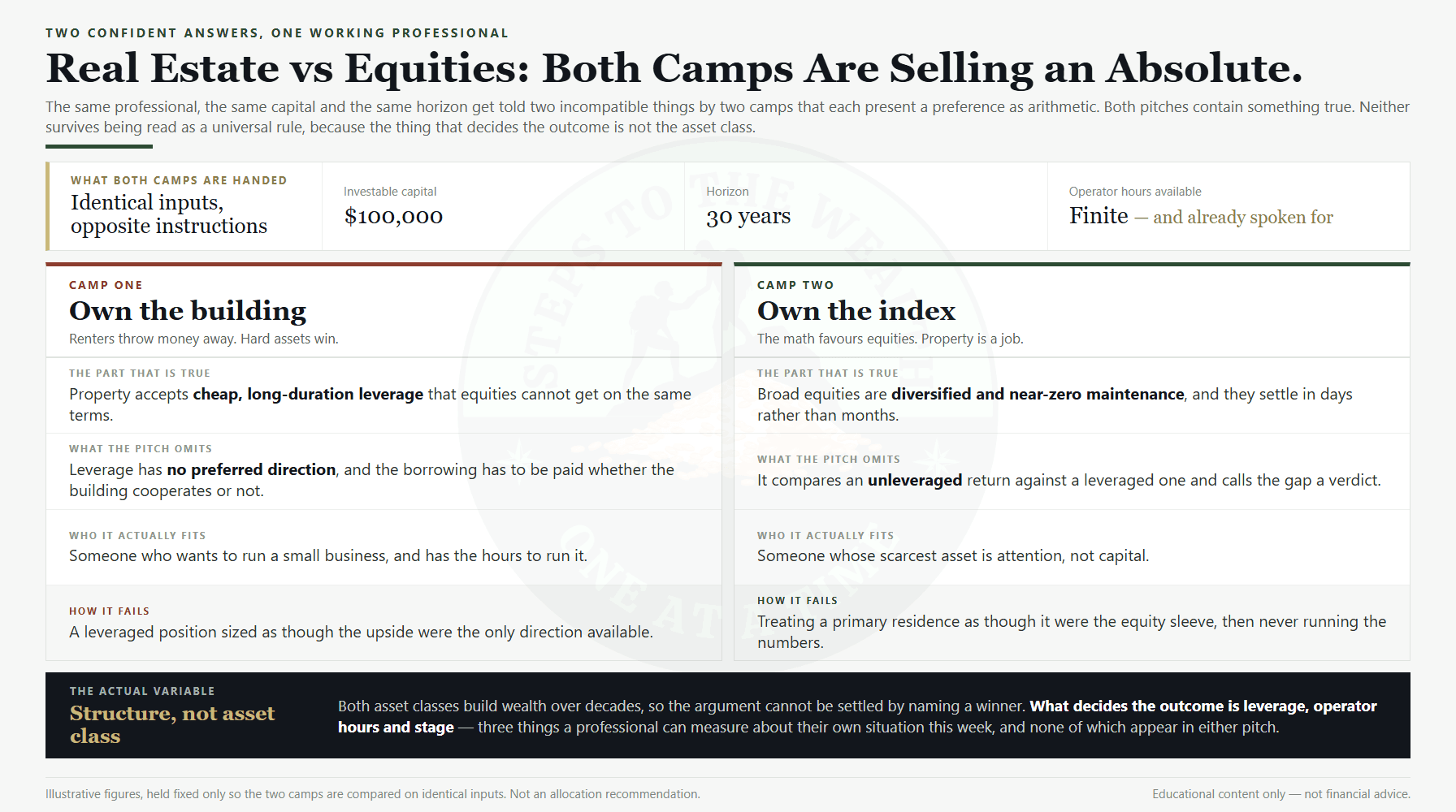
Two camps, both completely certain, and both selling the same product.
The property camp says renters throw money away, that the wealthy own hard assets, and that you should buy before prices move again. The index camp says property is illiquid and management-heavy, that the math favours equities, and that time in the market beats any landlord’s spreadsheet.
Read them side by side and something becomes obvious. Real estate vs equities is not really being argued at all. Each camp presents a preference as arithmetic, and each compares its own best case against the other’s worst. A professional listening to both ends up either fully committed to one side on the strength of a story, or stuck for years waiting for the argument to settle itself.
It does not settle. Both asset classes have built serious wealth over multi-decade periods, and neither is categorically better than the other. What separates a good outcome from a bad one is not the asset class. It is three things you can measure about your own situation this week: how much leverage sits in the structure, how many hours it costs you to run, and which stage you are actually at.
This article runs the arithmetic on all three. Nothing in it is a forecast.
Both camps are selling certainty, not analysis
Certainty is the product. It is what gets shared, and a hedged position gets no engagement, so the incentive runs in one direction for both sides.
The property pitch is built on a real structural advantage and then stretched into a universal rule. The index pitch is built on a real structural advantage and stretched exactly the same way. Both leave out the same category of information: what the other side is actually good at, and what it costs the specific person listening.
The tell is in the comparison itself. When a property advocate quotes a return, it is almost always a leveraged return. When an index advocate quotes a return, it is almost always unleveraged. Those two numbers are not comparable, and putting them next to each other without saying so is the single most common distortion in this entire debate.
You do not need to pick a camp. You need to know which of the structural differences below is the one actually binding you, because that is the one that decides your answer.
Real estate vs equities: the five structural differences
These five differences are structural. They hold regardless of what any particular market did last year, which is what makes them worth reasoning from.
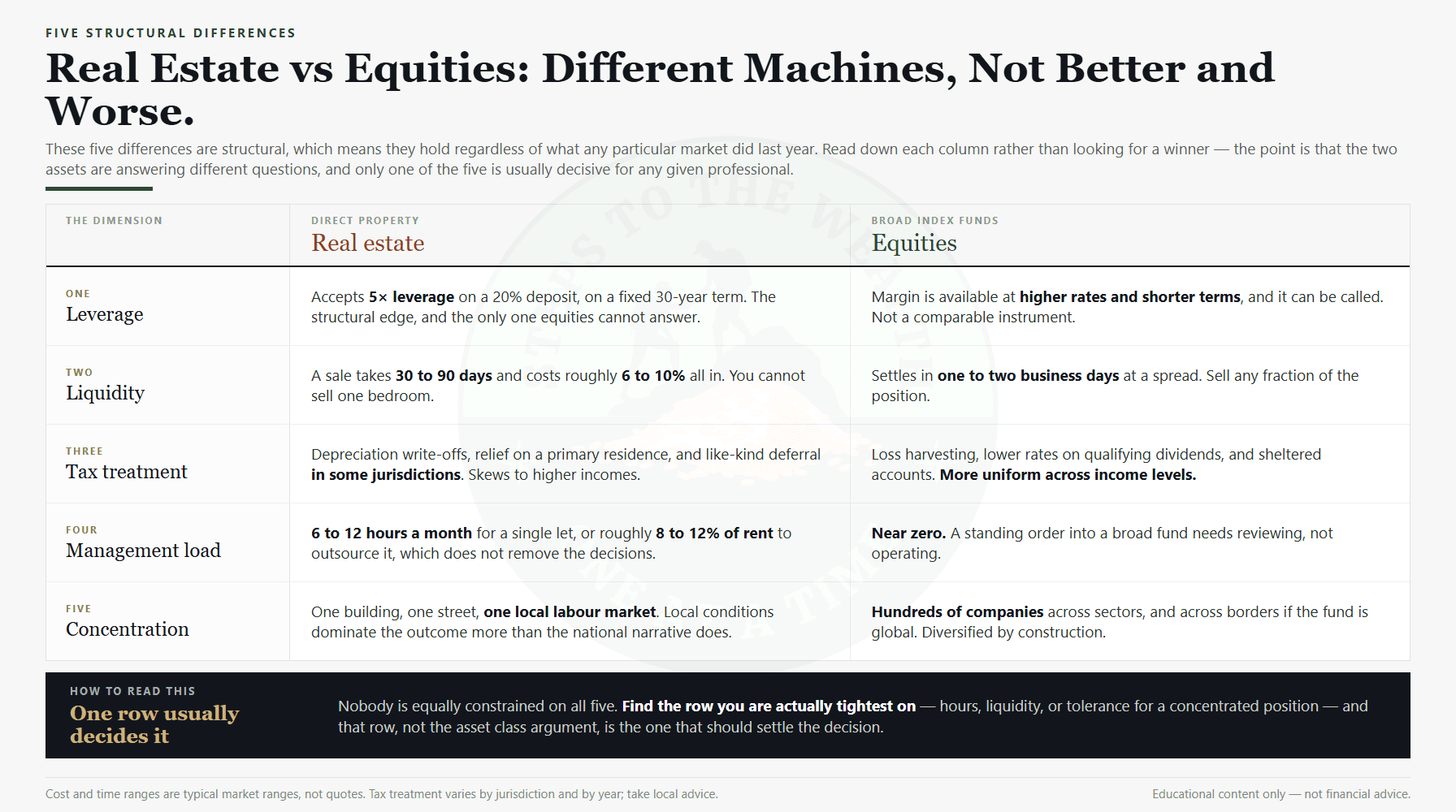
Leverage. Property uniquely accepts cheap, long-duration borrowing. A 20% deposit controls the whole asset, which is 5x exposure, on a fixed term measured in decades. Equities can be margined, but at higher rates, on shorter terms, and with the possibility of a call. They are not comparable instruments. This is real estate’s genuine structural edge and the only one of the five that equities have no answer to.
Liquidity. Equities settle in one to two business days, and you can sell any fraction of the position. A property sale takes 30 to 90 days and costs roughly 6 to 10% all in once agent fees, legal costs and transfer taxes are counted. You cannot sell one bedroom to cover a bad quarter.
Tax treatment. Property attracts specific reliefs in many jurisdictions: depreciation write-offs, relief on a primary residence, and deferral on like-kind exchanges in some places. Equities have their own: loss harvesting, lower rates on qualifying dividends, and sheltered accounts. The property reliefs tend to be worth more at higher incomes, because deductions scale with the rate you pay. The equity reliefs are more uniform. All of this varies by jurisdiction and by year, so treat it as a category to investigate locally rather than a fact to assume.
Management load. A broad index fund needs reviewing, not operating. A single let needs 6 to 12 hours a month across tenant relations, maintenance, vacancies, rent collection and compliance. You can outsource most of it for roughly 8 to 12% of rent, which reduces the return without removing the decisions, because a manager still escalates the ones that matter.
Concentration. One building sits on one street in one local labour market. Local conditions will dominate your outcome far more than any national narrative does, which is why buying on a national story is a category error. A broad fund holds hundreds of companies across sectors, and across borders if it is global. It is diversified by construction rather than by effort.
Nobody is equally constrained on all five. Work out which row you are actually tightest on, and let that row settle it. If you want a neutral primer on how allocation decisions get framed in the first place, the regulator’s own introduction to asset allocation is a reasonable place to start.
Leverage is the whole argument, and it runs both ways
Almost every disagreement about these two asset classes is really a disagreement about leverage. So it is worth running the multiplication properly, in both directions, on one fixed structure.
Take a $400,000 property bought with an $80,000 deposit and $320,000 of debt. That is 5.0x exposure: every dollar of your equity is controlling five dollars of asset.
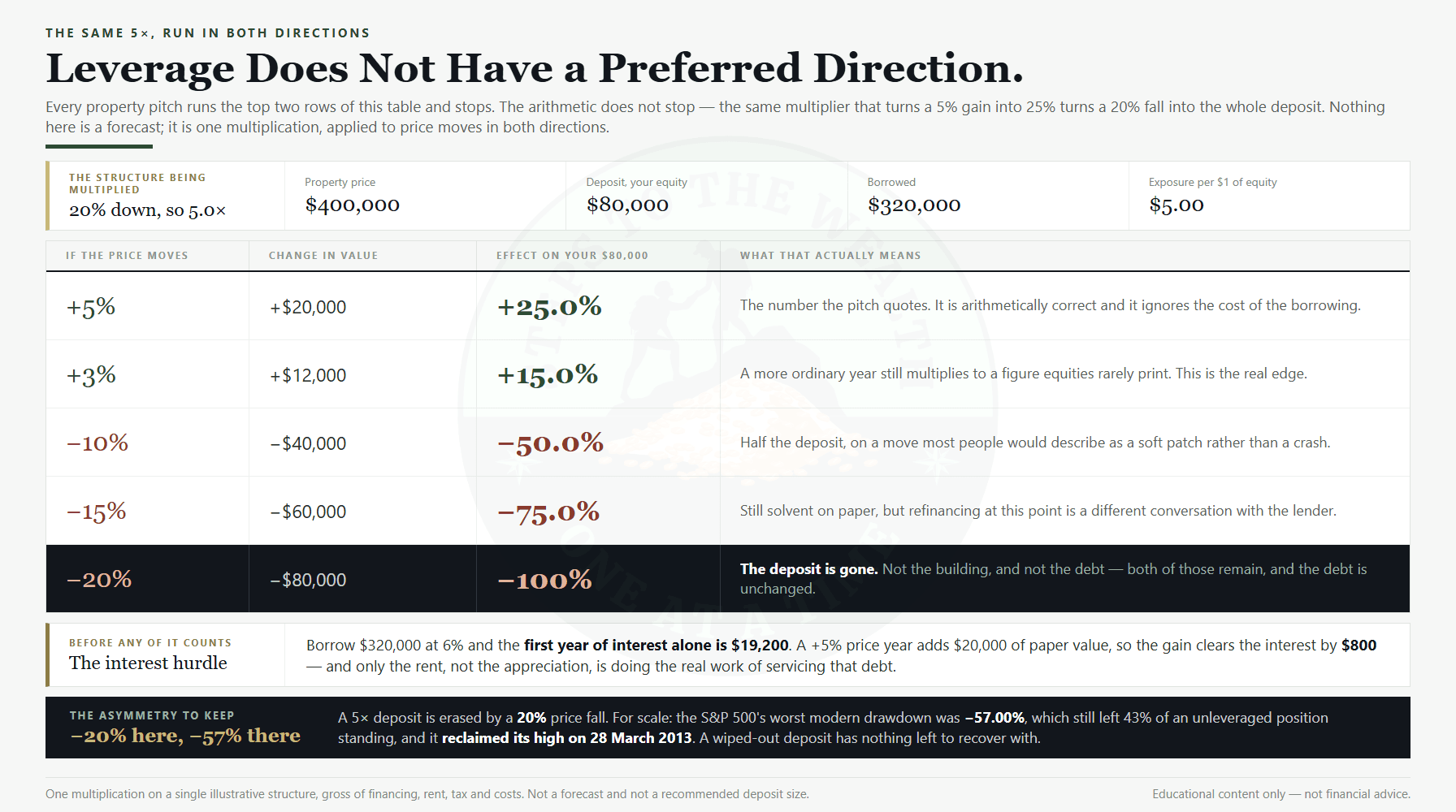
A 5% price rise adds $20,000 to the asset. Against your $80,000 that is a 25.0% gain, and this is the number the pitch quotes. It is arithmetically correct. A more ordinary 3% year still produces 15.0%, which is a figure broad equities rarely print. That is a real edge and it should not be waved away.
Now keep going, because the multiplier does not know which direction you were hoping for. A 10% fall costs $40,000, which is 50.0% of your deposit, on a move most people would call a soft patch rather than a crash. A 15% fall costs 75.0%. And a 20% fall costs exactly $80,000 — the entire deposit, gone. The building remains and the debt remains, unchanged, because debt is not sympathetic to your equity position.
There is also a hurdle before any of the upside counts. Borrow $320,000 at 6% and the first year of interest alone is $19,200. A +5% price year adds $20,000 of paper value, so the appreciation clears the interest by $800. It is the rent, not the price move, doing the real work of servicing that debt — which is why a property that does not rent reliably is a fundamentally different proposition from one that does.
Hold that 20% figure next to an equity drawdown for scale. The S&P 500’s worst modern fall was 57.00%, and it needed a 132.56% gain to get back, which it managed by 28 March 2013. That was brutal, and it still left 43% of an unleveraged position standing to recover with. A wiped-out deposit has nothing left to recover with at all. If you want to see how a portfolio behaves when it is put under that kind of pressure deliberately, running it through a portfolio stress test is more instructive than reasoning about it in the abstract.
Leverage is not the villain here. It is structurally favourable when it is sized deliberately. The failure is treating it as though it only had one direction.
Three mistakes that show up again and again
Counting the primary residence as the property allocation
Your home is partly an investment and mostly a consumption decision. Whether owning beats renting depends on local price-to-rent ratios, the mortgage rate, the opportunity cost of the deposit, and how long you will stay — a calculation that has very little to do with investing and which we work through in detail in rent vs buy: the payment is not the cost.
The practical error is different, though. Professionals who mentally file their home under “my property allocation” often find, when they finally run the numbers, that they are far more concentrated in property than they believed, and that the equity in the home is not producing the return they had assumed it was. Separate the two decisions. The home is a consumption and financing trade-off. Investment property is a portfolio allocation. Conflating them hides the concentration.
Leaving the time cost out of the return
“It only takes a few hours a month” is the most expensive sentence in this whole discussion, because it is true and it is still misleading.
Six to twelve hours a month, sustained for thirty years, is 2,160 to 4,320 hours. The equity equivalent, at five to ten hours a year, is 150 to 300. The gap is somewhere between 1,860 and 4,170 hours of your working life, and it is not spread evenly — it clusters exactly around vacancies, repairs, and refinancing, which is to say around the moments you have least slack.
Price those hours at whatever your professional time is genuinely worth before deciding the property return is the bigger one, and treat the opportunity cost of time as a real line item rather than a rhetorical one. For anyone running this alongside a demanding job, the binding constraint is usually the calendar rather than the capital, which is the same conclusion we reach in investing while working full time.
Assuming the building holds its condition for free
A physical asset consumes money to stay in the same place. Roofs, boilers, kitchens and compliance work are not optional and they do not scale down when the market is soft. Appreciation figures quoted without a maintenance reserve are quoting a gross number as though it were net, which is the same arithmetic mistake as ignoring the interest — and it is why comparing an asset that decays against one that compounds needs the upkeep in the model from the start.
The honest math on the same $100,000
Put the same capital into each structure and hold the horizon fixed, because a comparison that moves both is not a comparison.
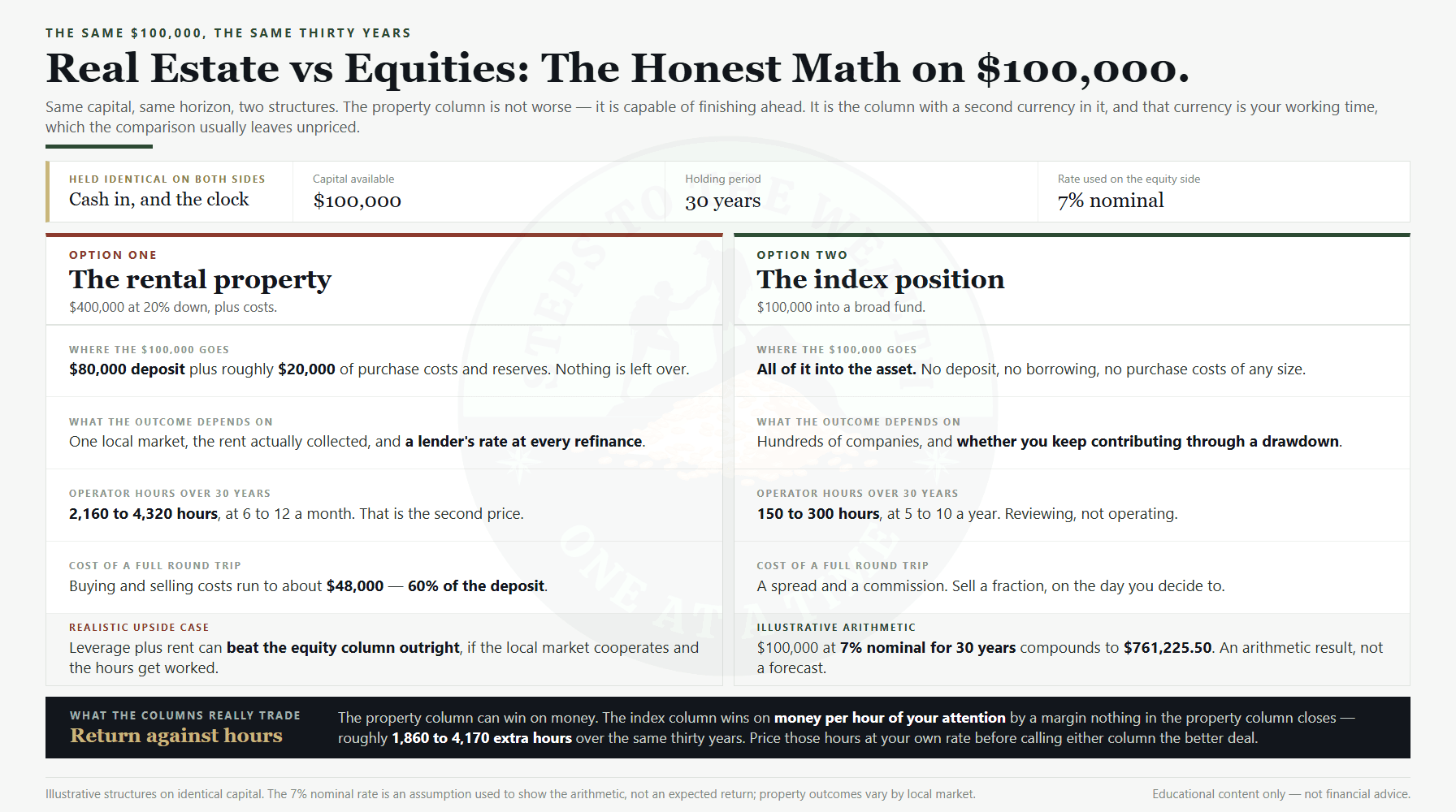
On the property side, $100,000 goes in as an $80,000 deposit plus roughly $20,000 of purchase costs and reserves. Nothing is left over. The outcome then depends on one local market, the rent you actually collect, and a lender’s rate at every refinance. A full round trip in and out costs about $48,000 once buying and selling are both counted, which is 60% of the deposit — a number that makes short holding periods structurally unattractive no matter what prices do.
On the equity side all $100,000 buys the asset. At 7% nominal, held for thirty years, the arithmetic gives $761,225.50. That is a multiplication, not a prediction, and the actual path will look nothing like a smooth curve. Getting anywhere near it depends far more on whether you keep contributing through a drawdown than on the entry price, which is the substance of the lump sum versus dollar-cost-averaging question.
The honest verdict: the property column can beat the index column outright. Leverage plus rent is a powerful combination when the local market cooperates and the hours get worked. What the property column cannot close is the gap in return per hour of your attention. That is the trade being made, and it is a legitimate trade in either direction — provided you make it on purpose.
A stage-based framework, not a verdict
Stage one: the only question is your own home
Early on, there is no investment property decision to make. There is a rent-or-own decision about where you live, and it is answered locally. Buy if the price-to-rent ratio supports it, you expect to stay put for seven years or more, you can fund the deposit without draining your investments, and being geographically anchored does not damage your career options. If any of those fail, rent and put the capital into equities. Nothing is lost by waiting here.
Stage two: the first investment property becomes a real question
Once your housing is stable, the question is whether property earns a place in the portfolio. Answer these honestly rather than aspirationally: do you have 6 to 12 hours a month that genuinely exist; are you suited to landlording, including the conflict; is your local market actually favourable, or are you projecting a national story onto it; can you fund the deposit without breaking other targets; and could you service the debt through a long vacancy?
For most professionals, 0 to 15% of investable assets in direct property is defensible if those check out. Above 15%, you should be able to write down why in a sentence that does not appeal to what property “always” does.
Stage three: scaling is a business decision
If a first property has worked for three years or more, scaling is worth considering. The framework is simple and uncomfortable: property scales when it is run as a deliberate business, not as a passive allocation. One to three properties is a side business with real hours. Run that way, the returns can be excellent. Run while insisting it is passive, it tends to produce below-potential returns and a background level of stress. Both choices are fine. Pretending you have made one while making the other is not.
Stage four: exposure without the operations
At larger portfolio sizes, listed property funds start to look more attractive for anyone who wants the asset class rather than the job. You give up the leverage and the control, and you get the diversification and roughly none of the hours. Direct ownership still makes sense for people who actually want to operate. Where you sit on that will also depend on how far along you are, which is worth reading against what portfolios typically look like by age.
What this framework will not tell you
It will not tell you what your local market is going to do. Nothing can, and the concentration point in the fifth structural difference means that unknowable local outcome carries more weight in a single-property decision than every general principle in this article combined.
It will not price your own temperament. Some people find a difficult tenant call mildly annoying and some find it ruins a fortnight. That difference is real, it does not appear in any spreadsheet, and it is a legitimate reason to choose the lower-maintenance structure even when the numbers lean the other way.
And the 5x arithmetic above is not a claim about how much leverage anyone should use. It is one multiplication on one illustrative structure, shown in both directions because the pitch usually shows one. Your own deposit, rate, rent and reserves will produce different figures, and the only version that matters is the one built from your actual numbers.
One thing to do this week
Audit the property exposure you already have, before deciding whether to add more.
Start with your home. What percentage of your net worth is sitting in its equity? If it is above 50%, you are more concentrated in property than most people who describe themselves as equity investors, whatever your brokerage account looks like.
If you own an investment property, calculate the actual return on your invested capital over the last 24 months, with every cost included: interest, taxes, maintenance, vacancy and management. Compare it against what the same capital would have done in a broad fund. If it comes out ahead, the strategy is working and you now have evidence rather than a belief. If it comes out behind, that is information too — either the property is underperforming or your situation has changed since you bought it.
If you are considering a first purchase, write down four numbers before anything else: expected return, monthly hours, total leverage, and what the same capital would do in equities. If you cannot produce those four, you are working from a narrative rather than a framework, and the fix is arithmetic rather than conviction.
Frequently asked questions
Is real estate or the stock market the better investment?
Neither, categorically. Over long periods both have built substantial wealth, and the spread between outcomes within each asset class is wider than the average gap between them. The decision turns on leverage, the hours you can give it, and your stage — not on which asset class wins in general.
Does leverage make property automatically better than equities?
It makes the returns larger in both directions. At 5x, a 5% rise lifts your deposit 25.0% and a 20% fall erases it completely. Leverage also has to clear its own cost first: $320,000 at 6% is $19,200 of interest in year one, which a 5% price rise beats by $800.
How much of my portfolio should be in real estate?
Anything specific would be advice rather than education, and it depends on your situation. As a framing device, many professionals find 0 to 15% of investable assets in direct property defensible once the hours and the local market check out, with anything higher requiring a reason they can articulate. Count your home’s equity when you measure this, because leaving it out is what hides most over-concentration.
Are REITs a reasonable substitute for owning property directly?
The full comparison of REITs against direct ownership has its own article; in brief, they deliver the asset-class exposure with a fraction of the operational load, and they diversify across many buildings instead of one. What you give up is the cheap long-duration leverage and the control, which are precisely the reasons some people want direct ownership. If you want the exposure and not the job, they are worth investigating.
Educational content only — not financial, tax or real estate advice. Property decisions depend on your individual situation, local market conditions, jurisdiction-specific tax treatment and the time you actually have available. All figures shown are illustrative arithmetic on stated assumptions, not forecasts or expected returns. Consult suitably qualified professionals before acting.