
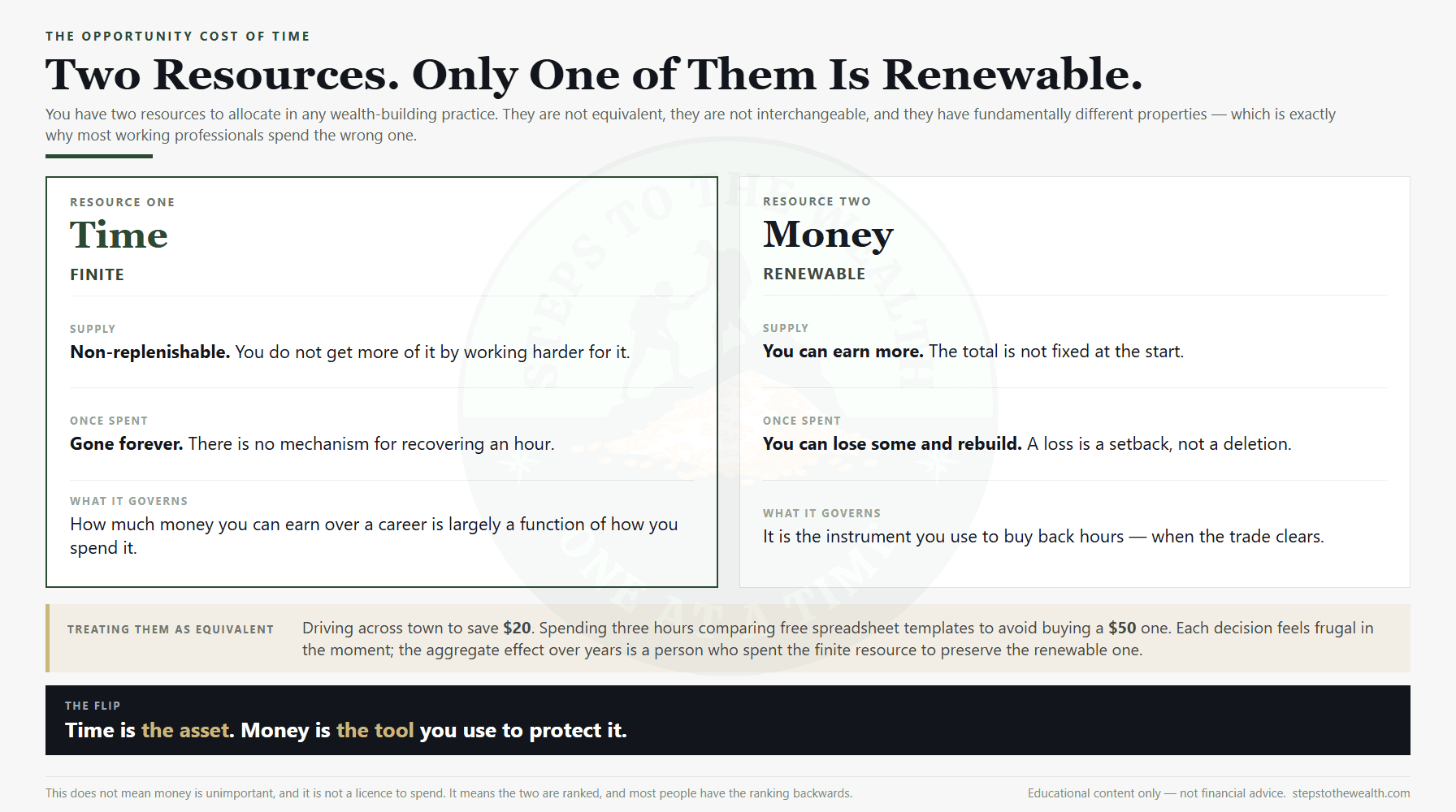
You have two resources to allocate in any wealth-building practice.
Time. Finite. Non-replenishable. You don’t get more by working harder for it. Once spent, gone forever.
Money. Renewable. You can earn more. You can lose some and rebuild. The total available to you over a career is largely a function of how you spend your time.
The opportunity cost of time is the same idea as any other opportunity cost, applied to the one input you cannot buy more of. If you want the money version of the same arithmetic first, the opportunity cost calculator runs it. This piece is about the two thresholds that decide when paying someone else is the cheaper option.
These are not equivalent resources. They are not interchangeable. They have fundamentally different properties.
But most working professionals treat them as if they were equivalent — or worse, treat money as the more valuable one. They drive across town to save $20. They spend three hours comparing free spreadsheet templates to avoid buying a $50 one. They handle their own yard work, plumbing, taxes, and routine errands because “hiring it out is expensive.”
Each decision feels frugal in the moment. The aggregate effect, over years, is a person who spent their most valuable asset (time) to preserve a renewable one (money).
This article is Lesson 4 of The Operator’s Mindset, reshaped for the blog. The flip is the mindset shift: time is the asset. Money is the tool you use to protect it.
The opportunity cost of time most people refuse to calculate
Imagine you spend an hour mowing your own lawn. Your inputs: the mower (capital you already own — sunk cost), the hour of your time, the physical effort.
Most people categorize this as “free.” They didn’t pay anyone. No money changed hands. They feel like they saved money.
Now do the actual math.
If your professional time is worth $50/hour (a typical working professional rate), an hour of mowing cost you $50 of foregone earning capacity. If a lawn service charges $40 to do it for you, you lost $10 by doing it yourself. Plus the physical effort. Plus the time you didn’t spend with family or on a side project that compounds.
If your time is worth $100/hour, you lost $60 by mowing it yourself. If your time is worth $200/hour — the rate working professionals approach when they’re seriously building income — you lost $160.
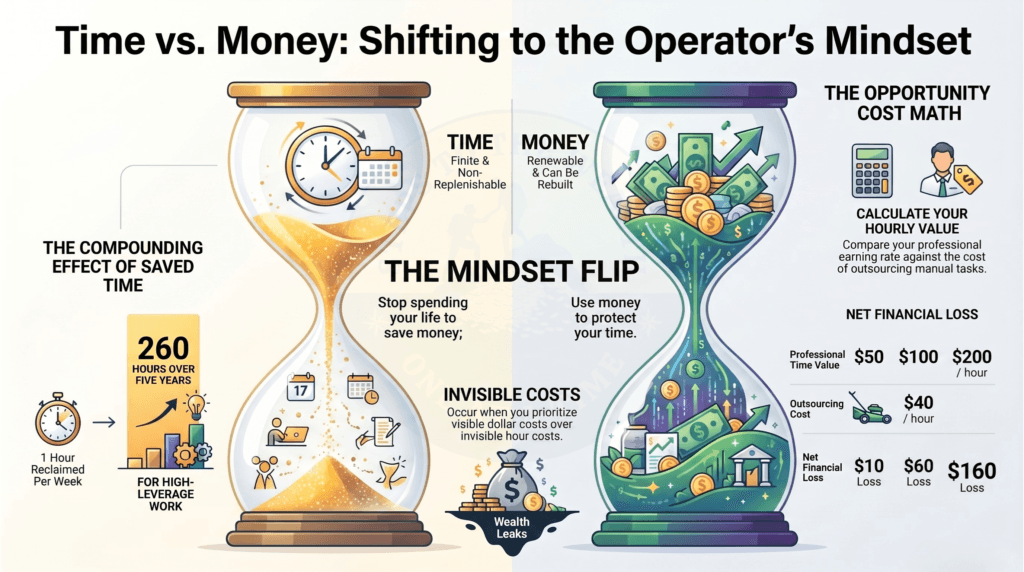
This is opportunity cost. The “free” thing wasn’t free. It was paid for in the most valuable currency you have.
The math gets sharper when you scale it. An hour saved each week from outsourced lawn care is 52 hours per year. 52 hours that can go to high-leverage activity — building a side income, deep work on your main business, learning a new skill, growing your network. Over 5 years, that’s 260 hours. The compounded value of those hours, properly used, is dramatically higher than the cost of paying someone $40-100 per session.
This is the structural failure most working professionals make. They optimize for visible cost (dollars going out) and ignore invisible cost (hours going out). The invisible cost is where wealth actually leaks.
Three reasons people reject this math
The math itself isn’t complicated. The resistance to applying it is.
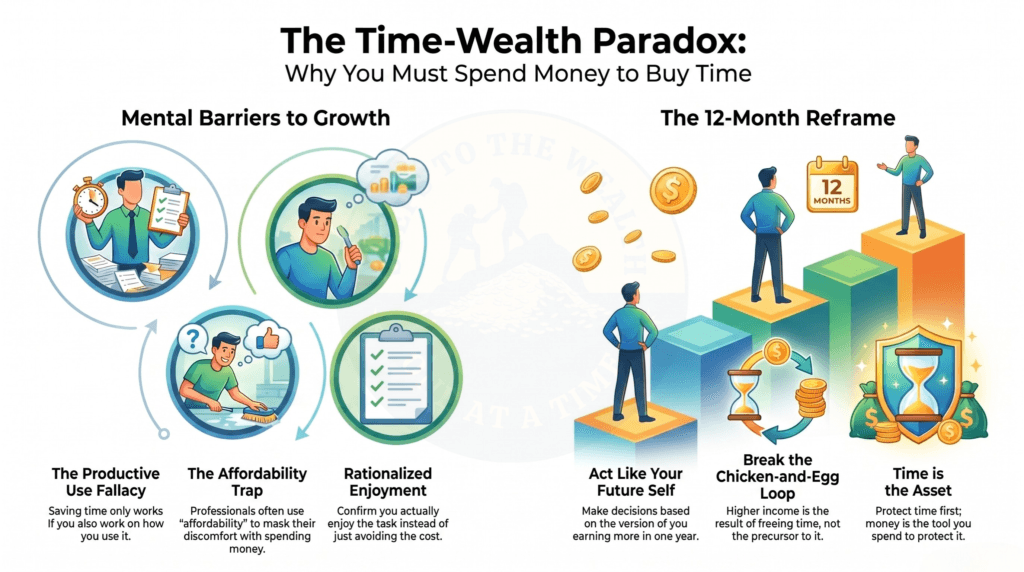
“I’m not actually using that time productively anyway.”
Partial truth: most “saved” hours don’t go directly to high-leverage work. If you outsource lawn care, you might spend that hour watching TV instead of building income.
Structural error: that’s a separate problem. If you’re going to use the freed hour poorly, work on the use of the hour. Don’t use that as a reason to spend the hour on yardwork instead. The right move is to free the hour AND deploy it well.
“I can’t afford to outsource.”
Partial truth: at very low income levels, the math genuinely shifts. If your time is realistically worth $15/hour and lawn care is $40, doing it yourself can be right.
Structural error: most working professionals aren’t at that income level. They earn enough that the opportunity cost calculation is obvious — they just haven’t applied it yet. “I can’t afford to outsource” often masks “I’m uncomfortable spending money,” which is the actual issue.
“I enjoy doing it myself.”
This one is genuinely valid for some activities. If you enjoy mowing the lawn and it’s your form of stress relief, the time isn’t being stolen from wealth-building — it’s being deployed to recovery, which is also valuable.
But honest self-check: are you doing it because you enjoy it, or because you’re saving money? Most “I enjoy it” answers are post-hoc rationalizations of “I don’t want to spend money on it.”
The 12-months-from-now framing
Useful reframe: don’t make spending decisions based on your current circumstances. Make them based on where you want to be 12 months from now.
If 12 months from now you’re earning meaningfully more, owning more time-saving infrastructure, and operating closer to the operator standard — act now like the version of you in 12 months would act. Spend money to save time the way that future version would. Operate at that standard before you’ve fully grown into it.
Specifically:
The version of you in 12 months doesn’t drive across town to save $20. The version of you in 12 months doesn’t spend three hours comparing free tools when a $50 paid version solves the problem in 10 minutes. The version of you in 12 months doesn’t handle every household task personally because “I might as well save the money.”
That version makes faster, more confident money decisions because they understand the trade-off. They protect time first. Money is what they spend to protect it.
If you wait to make these decisions until you’ve grown into them, you’re stuck in a chicken-and-egg loop. You can’t grow into the higher-income version without freeing the time. You can’t free the time without making spending decisions that feel uncomfortable now.
The way out is to act like the future version first. The income catches up. It always does, when the time is properly deployed.
Pattern-breaking is the most uncomfortable part
If you currently make $5K/month and have $15K in savings, $50 feels like a lot of money. Spending $50 on something that “saves you an hour” feels excessive. The mental friction is real.
The structural problem: as long as $50 feels like a lot of money to you, you’ll continue to act like the version of you who finds $50 to be a lot. Which means you’ll continue to make decisions that produce a financial life where $50 is a lot.
The pattern doesn’t break by waiting for income to grow. The pattern breaks by acting like the version of you for whom $50 is incidental — even before that version exists in your bank account.
This isn’t reckless. It’s calibrated. You don’t spend $5,000 you don’t have to prove you’re not afraid of money. The pattern-break is at the boundary — the specific decisions where the $50 you’re hesitating on is also the $50 that, properly deployed, accelerates your trajectory.
A $50 spreadsheet tool that saves you 10 hours of building it yourself: pattern-break decision.
A $200 course that compresses 18 months of trial-and-error into 3: pattern-break decision.
A $100/month service that handles a recurring task you currently spend 4 hours on: pattern-break decision.
Each of these is uncomfortable to spend on at lower income. Each is exactly the kind of decision that produces the higher-income version of you faster.
The framework: when a spending decision is at the edge of your comfort zone AND it freely deploys time toward your wealth-building practice, that’s the spend you should usually make. Not always. But more often than your current default would suggest.
When to spend money to save time
| Time saved | Cost relative to current income | Decision |
|---|---|---|
| Significant (5+ hrs) | Low (under 1% of monthly income) | Spend immediately |
| Significant (5+ hrs) | Moderate (1-5%) | Spend if it deploys to high-leverage |
| Modest (1-5 hrs) | Low | Spend |
| Modest (1-5 hrs) | Moderate | Spend selectively |
| Negligible (<1 hr) | Any | Skip |
| Significant | High (10%+) | Pause, run math carefully |
Most working professionals operate as if every spending decision falls in the right column (“expensive, skip”). The framework reveals that most decisions are actually in the upper-left quadrant — significant time savings at low relative cost — and those should be near-automatic spends.
The honest test: when you hesitate on a $50 spending decision, ask whether the hesitation is grounded in the math or in the discomfort of breaking the pattern. Most of the time, it’s the latter.
“If you’re not spending money, you’re spending your life”
Read that line carefully.
Time and money trade off in both directions. When you handle something yourself instead of paying, you spent time instead of money. When you delay a productivity tool to “save” the cost, you spent time instead of money. When you research for hours to avoid a paid course, you spent time instead of money.
The trade-off happens whether you account for it or not. Most people don’t account for it. They feel like they “saved” — saving money — but the time wasn’t free. The time was the price.
Once you internalize the trade-off, every “I’ll just do it myself” decision changes shape. You see what you’re actually paying. You ask whether the price is worth it. Sometimes yes. Often no.
The line is sharp: if you’re not spending money, you’re spending your life. And life is the one resource you can’t earn back.
What your hour is actually worth
Everything above runs off an hourly figure, and this article has been quietly assuming you know yours. Most people do not, and the usual shortcut is wrong in a way worth naming.
The shortcut is salary divided by 2,000 working hours. For a salaried employee that number describes your average hour, not your marginal one, and the outsourcing decision is entirely about the marginal hour. If your employer pays you the same whether you work forty hours or forty-one, the hour you free up on a Saturday does not convert into salary. It converts into whatever you actually do with it, and that is the honest price.
So there are three rates, and you should know which one you are using.
The billable rate. If you can genuinely sell more hours — you are self-employed, you have a side business with more demand than capacity, you are paid for overtime — your marginal hour has a market price. Use it. This is the only case where the arithmetic above works exactly as written.
The trajectory rate. You cannot sell the hour today, but it reliably compounds: it goes into a business you are building, a skill that changes what you can charge, or a network that produces opportunities. There is no invoice for this and it is not zero. It is the hardest of the three to price honestly and by far the easiest to overstate.
The recovery rate. The hour goes to rest, to family, or to something you value for its own sake. That is not a lower use of the hour, it is a different one, and it does not belong in a wealth calculation at all. Which is fine. You are allowed to buy time back for reasons that have nothing to do with money.
The opportunity cost of time only produces a usable number once you have picked one of those three and can defend the choice out loud. Reaching for the billable rate because it is the largest, when you have no actual route to sell the hour, is how this framework turns from a discipline into a licence to spend.
The tasks that do not outsource
The table above will happily recommend outsourcing things that should not be outsourced. Three categories where it gives the wrong answer.
Where the doing is the point. Understanding your own finances is the clearest case. You can pay somebody to build the spreadsheet. You cannot pay them to have looked at the numbers. Any task whose real output is a decision only you can make has a component that does not transfer, and outsourcing it produces a tidy document that nobody has read.
Where supervision costs more than the task. Every outsourced task carries overhead: specifying it, checking it, and fixing it when it comes back wrong. On a task that takes you an hour, forty minutes of overhead turns an impressive weekly saving into a marginal one. That overhead does fall as the arrangement settles, which means the first month of any outsourcing is the worst version of it — and the first month is exactly when most people quit and conclude the idea does not work.
Where you have not yet learned it. Doing something badly for a while is how you find out what competent looks like, and knowing what competent looks like is what lets you judge the person you hired. Outsource a task you have never attempted and you cannot tell good work from expensive work, which is the most reliable way to pay twice.
Outsourcing is a recurring decision
One last structural note, because it is the most common way this goes wrong after it has gone right.
Almost everything on an outsourcing list recurs. The service at $100 a month, the weekly lawn care, the cleaner — these are subscriptions, and they behave like subscriptions. They clear the threshold once, at the income you had on the day you signed up, and then they are never tested again. Income moves, the task stops being worth an hour, the charge quietly continues, and a decision that was correct in year one is still running in year four on assumptions nobody has rechecked.
So put the list on the same annual review as everything else that bills you, with two questions against each line. Does this still save the hours it saved when I started? Is it still under the threshold at what I earn now? Both answers move over time, and they move in both directions. This is a test to re-run, not a verdict to file.
One thing to do this week
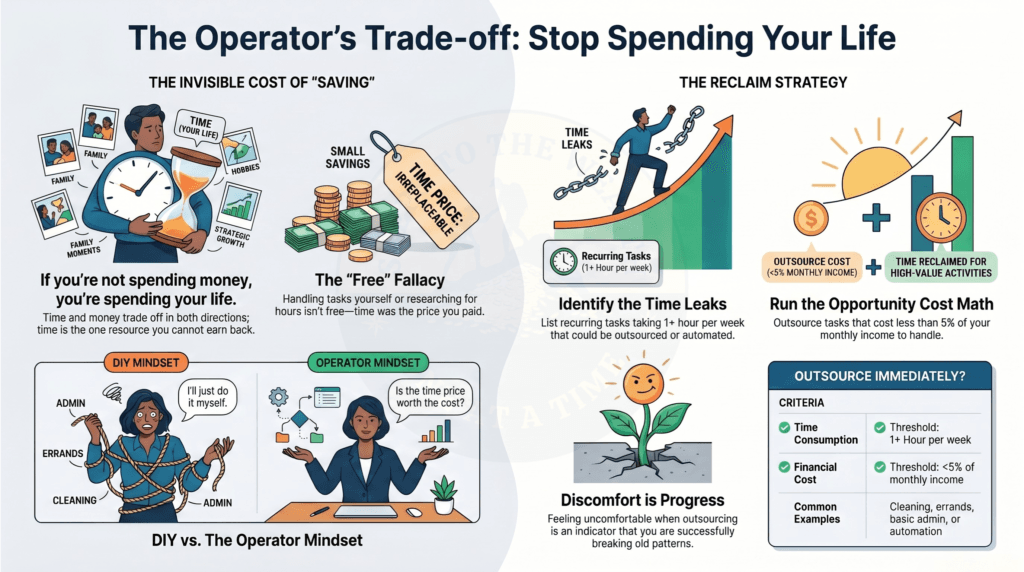
Make a list of every recurring activity in your life that takes 1+ hour per week and could be outsourced for under 5% of your monthly income. Lawn care. Cleaning. Errands. Basic admin. Repetitive tasks at work that automation tools could handle.
Pick the top one. Run the opportunity cost math.
Outsource it this month — even if it feels uncomfortable.
The discomfort is the indicator that you’re pattern-breaking. That’s the work.
Where this fits
This is one lesson of fifteen in The Operator’s Mindset. Earlier lessons covered goal-plan alignment, decision speed, and the operator standard. This one resolves the spending-vs-saving trade-off that working professionals get most consistently wrong. Later lessons handle capital allocation, inherited beliefs, environment, and network strategy.
Educational content only — not financial advice. The opportunity cost framework is a behavioral discipline tool; specific spending decisions depend on your individual financial situation.