

Ask a landlord whether listed property trusts or direct ownership is the better route and you will get a long answer about leverage. Ask an index-fund purist the same question and you will get a long answer about liquidity. Both answers are sincere. Neither is calibrated to the person asking.
The argument over REITs vs direct real estate is usually run as though it were a question about which asset class wins. It is not. Both routes buy exposure to the same asset class. What separates them is what you hold, who does the operating, what you are allowed to borrow against it, and how quickly you can undo the decision if your life changes.
Those are structural differences, not matters of taste, and they do not point the same way for everybody. This piece walks them honestly, and then gives you a rule that selects a route from the constraints you already have rather than from the one you find more appealing.
Educational content only — not financial advice.
Both tribes are answering a question you have already settled
Notice what the usual argument assumes. It assumes you are still deciding whether property belongs in your portfolio at all. That is a real question, and it is a different one: it turns on your stage, your housing situation, and whether the concentration is worth the leverage. It deserves its own answer before this one, and that prior question — whether property belongs in the portfolio at all — is real estate against equities.
Assume you have settled it, and that some property exposure is going in. What is left is a vehicle decision, and the vehicle decision is where the operational consequences live. Get it wrong and you can spend a decade of weekends running a small business you did not intend to start, or hold an unlevered position while believing you own the levered one.
REITs vs direct real estate: what each vehicle actually is
Direct ownership means you hold title to a building. You are the counterparty for the mortgage, the tenant, the insurer, the contractor and the tax authority. Rent arrives, costs leave, and whatever remains is yours. So is the vacancy, the boiler, and the decision about the tenant who has stopped answering the phone.
A real estate investment trust is a company that owns and operates property and distributes most of its income to shareholders. You buy shares in the company. Its staff do the operating. Your claim is on a portfolio of buildings rather than on one, and it trades on an exchange like any other listed share. The regulator’s own primer on real estate investment trusts is a reasonable place to check the structure before you buy one.
One caveat belongs here rather than in a footnote. Not everything sold as a REIT is listed. Non-traded and private property vehicles carry the same name, different liquidity, and frequently higher fees. Almost every advantage described below belongs to the listed version. If a product is being sold to you as a REIT and you cannot see a live price for it, it is a different instrument wearing the same word.
The one advantage that does not transfer
Property uniquely accepts cheap, long-duration borrowing. A 20% deposit controls the whole asset, which is 5.0x exposure on a term measured in decades. Take a $400,000 property with an $80,000 deposit: a 5% price rise adds $20,000 to the asset, which is 25.0% against the equity you put in. That is arithmetically correct, and it is a genuine structural edge.
The multiplier runs both ways, though, and it does not know which direction you were hoping for. On that same structure, a 20% fall costs $80,000 — the entire deposit. The building remains, and so does the debt. There is also a hurdle before any of the upside counts: $320,000 borrowed at 6% costs $19,200 in year-one interest, so a +5% price year clears the interest by $800. It is the rent, not the price move, doing the real work of servicing that debt.
Listed trusts do not replicate this. You can margin shares, but margin is dearer, shorter, and callable at the worst possible moment, which makes it a different instrument rather than a substitute. If you want to see how a levered position behaves when it is put under deliberate pressure, running it through a portfolio stress test is more useful than reasoning about it in the abstract.
So the honest summary of this row is that direct ownership wins it outright, and the win is large. It is also the only row where that is true.
Five rows, and why a three-two tally means nothing
The five rows that actually separate the routes are leverage, hours, liquidity, concentration and tax treatment. It is tempting to count them, find three pointing one way, and call it settled. That is a mistake, because the rows are not the same size and they are not the same size for you.

Liquidity is decisive for somebody who may need the capital back inside a few years and close to irrelevant for somebody who will not touch it for thirty. Tax treatment is worth a great deal at a high marginal rate and nothing at all if the reliefs go unclaimed. Concentration is survivable if the building is a small share of your assets and structural if it is most of them.
The useful exercise is not to tally the rows. It is to work out which row your own situation is tightest on, and let that row settle the decision by itself. Everybody is constrained somewhere. Almost nobody is constrained everywhere.
The hours are the row that decides it for most professionals
A single let takes six to twelve hours a month across tenant relations, maintenance, vacancies, rent collection and compliance. Multiplied out, that is 72 to 144 hours a year, every year you hold it. Held for a decade it is 720 to 1,440 hours — a figure that never appears on any statement and never gets subtracted from any quoted return.

Two things about those hours matter more than the total. First, they are not spread evenly: they cluster around vacancies, repairs and refinancing, which is to say around the weeks you had least slack in. Second, they are not fully delegable. A manager charging 8 to 12% of rent — $1,920 to $2,880 a year on $24,000 of rent — removes most of the hours and none of the decisions, and the decisions that reach you arrive pre-urgent.
The listed route asks for nothing of its own. The position joins the portfolio review you already run, five to ten hours a year, and adding it changes what you read rather than how long the reading takes. At its narrowest the gap is 72 hours against 10. At its widest it is 144 against 5.
None of that makes the hours illegitimate. Plenty of people are glad to work them, and the returns can justify them handsomely. But an hour you spend on a building is an hour you did not spend on the thing that actually pays you, which is why the opportunity cost of time belongs in the comparison as a real line item. For anyone running this alongside a demanding job, the binding constraint is usually the calendar rather than the capital — the same conclusion that governs investing while working full time.
What the listed route costs you, honestly
Anti-guru cuts both ways, so here is the other column’s bill.
Distributions are frequently taxed as ordinary income rather than at a qualifying dividend rate. Put an illustrative 4.0% yield against a 35% rate and 1.40 points of the position go in tax each year; at a 15% rate it is 0.60 points. The gap is 0.80 points a year, every year, and it is the single most under-discussed cost of the listed route. Sheltered accounts mitigate it where you have the room. Jurisdictions differ, and this is a category to check locally rather than a number to assume.
You also give up control entirely. The company decides what to buy, what to sell, how much debt to run and when to cut the distribution. You are buying somebody else’s operating judgement along with the buildings, and you cannot overrule it. The compensation is that their judgement is full-time and yours would be a weekend activity.
And listed trusts price like equities in the short run even though they own an illiquid asset. Your quoted value will move on days when nothing whatsoever happened to any building. That is the cost of a live price, and it is only a real cost if it makes you sell. Deploying into that volatility raises the same question as deploying into any market, which is the substance of the lump sum versus dollar-cost-averaging decision.
Four questions that select the vehicle for you
Here is the rule. Answer four questions about the situation you are actually in, not the one you intend to be in next year.
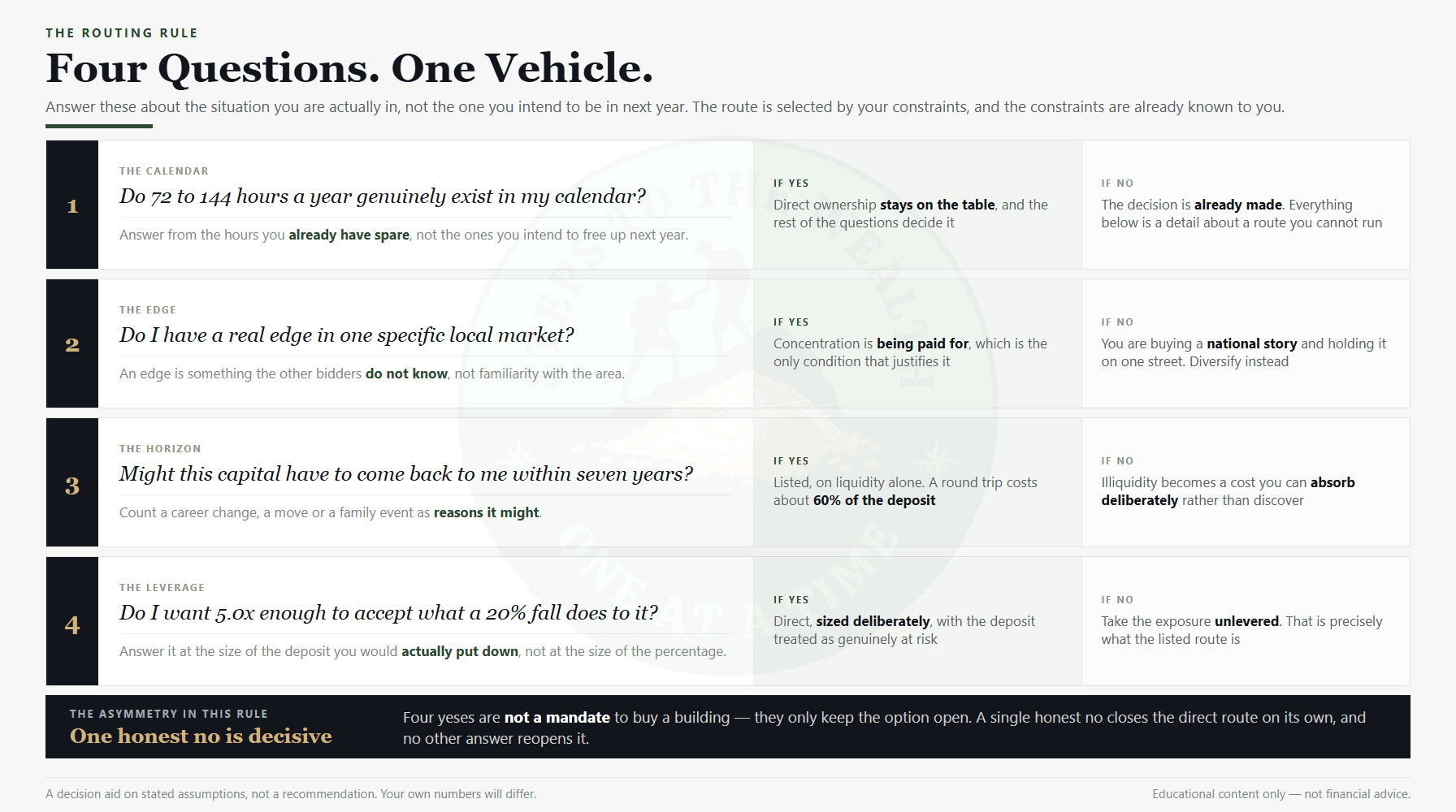
First, do 72 to 144 hours a year genuinely exist in your calendar? Answer from the hours you already have spare. Second, do you have a real edge in one specific local market? An edge is something the other bidders do not know; living nearby is familiarity, which is not the same thing. Third, might this capital have to come back to you within seven years? A full round trip in and out of a property costs roughly 60% of the deposit, so a short hold is structurally expensive whatever prices do.
Fourth, do you want 5.0x enough to accept what a 20% fall does to it? Answer that one at the size of the deposit you would actually put down, not at the size of the percentage.
The rule is deliberately asymmetric. Four yeses are not a mandate to go and buy a building; they only keep the option open. A single honest no closes the direct route on its own, and no other answer reopens it. That asymmetry is the point: the direct route is the one with an operational failure mode, so it should have to clear a higher bar.
The mix most professionals actually land on
Framing this as all-or-nothing is itself a mistake. Most working professionals end up holding property in more than one mode, and the deliberate version of that mix looks like this: a primary residence, a listed allocation, and optionally one direct property if the four questions genuinely clear.
The home is doing something different from the other two and should be counted differently. It is mostly a consumption and financing decision, which is why whether owning beats renting turns on local price-to-rent ratios and how long you will stay rather than on anything a portfolio would recognise — the arithmetic we work through in rent vs buy: the payment is not the cost. Filing it mentally as “my property allocation” is how people discover they are far more concentrated in property than they believed.
The listed allocation then does the portfolio work: exposure to the asset class, diversified across many buildings, with no hours attached. And the optional direct property adds the leverage where it is genuinely justified, sized so that a bad outcome on one street is survivable. How much of each is reasonable depends on where you are in the sequence, which is worth reading against what portfolios typically look like by age.
Where either route sits inside the framework
Whichever vehicle you pick, it is a position, and positions get the same treatment as every other position: a sized ceiling, an entry ladder, and an exit rule written before you need it. That discipline is the whole of the risk-first framework, and property does not get an exemption from it for being made of bricks.
The listed route fits that machinery cleanly. You can ladder in over months, trim a fixed percentage when your risk reading calls for it, and rebalance without a solicitor. The direct route fits it badly, and honesty requires saying so: you buy one indivisible lump, you cannot trim 8% of a building, and the exit takes 30 to 90 days at 6 to 10% of the price. That is not an argument against direct ownership. It is an argument for sizing the position at purchase, because sizing is the only control you will get.
One more thing the framework insists on. A building consumes money to stay in the same condition — roofs, boilers, kitchens, compliance — and none of it scales down when the market is soft. An appreciation figure quoted without a maintenance reserve is a gross number wearing a net number’s clothes, which is the same category error as comparing an asset that decays against one that compounds without putting the upkeep in the model. If you want the general framing for how allocation decisions get made in the first place, the regulator’s introduction to asset allocation is a neutral starting point.
What this will not tell you
It will not tell you what your local market is going to do. Nothing can, and the concentration row means that unknowable local outcome carries more weight in a single-property decision than every general principle here combined.
It will not price your temperament. Some people find a difficult tenant call mildly irritating; others lose a fortnight to it. That difference is real, it appears in no spreadsheet, and it is a legitimate reason to take the lower-maintenance route even when the arithmetic leans the other way.
And the 5.0x structure used throughout is one illustration on stated assumptions, not a recommendation about how much leverage anyone should carry. Your own deposit, rate, rent and reserves will produce different figures, and the only version that matters is the one built from your actual numbers. Waiting for perfect conditions has its own price, which is worth understanding before you decide to sit out a year — we put a number on it in what the cost of waiting actually is.
One thing to do this week
Answer question one honestly, in writing, before you touch anything else.
Open your calendar for the last three months. Not your intended calendar — the real one. Find the hours that were genuinely uncommitted, total them, and divide by three. If the monthly figure is comfortably above twelve, the direct route is operationally available to you and the remaining three questions decide it. If it is below six, you have your answer already, and the rest of this article is a description of a route you cannot currently run.
If it lands in between, run the next month deliberately: track what you would actually have had available, then decide. That is a week of attention spent to avoid a decade of the wrong structure, and it is the cheapest thing on this page. The full cost of any purchase includes what it asks of you afterwards, which is the principle underneath the true cost of a purchase.
Frequently asked questions
Are REITs a substitute for owning property directly?
For the asset-class exposure, largely yes: you get property income and property risk, diversified across many buildings, with no operational load. For the leverage and the control, no. Those two things are precisely what direct ownership is for, and they do not transfer to a listed vehicle.
Which is better for a working professional, REITs vs direct real estate?
Neither, categorically. The route is selected by whichever row you are tightest on. For most professionals with a demanding job that row is hours, and hours point at the listed route. For someone with genuine spare capacity and a real local edge, direct ownership can be the better structure.
Do REITs go up and down with the stock market?
They are listed shares, so in the short run they can move with equities even though the underlying buildings did not change. Over longer periods the returns are driven by rents, occupancy and the price of debt. Treat the short-run correlation as a fact about the wrapper rather than about the asset.
How much of a portfolio should be in property?
Anything specific would be advice rather than education, and it depends on your situation. As a framing device: count your home’s equity when you measure it, because leaving it out is what hides most over-concentration, and be able to write down in one sentence why any allocation above a modest share is the right size for you.
Educational content only — not financial, tax or real estate advice. Property structures, tax treatment and borrowing terms vary substantially by jurisdiction and change over time. All figures shown are illustrative arithmetic on stated assumptions, not forecasts or expected returns. Consult suitably qualified professionals before acting.