
Most investing mistakes are not wrong decisions. They are right decisions made at the wrong speed.
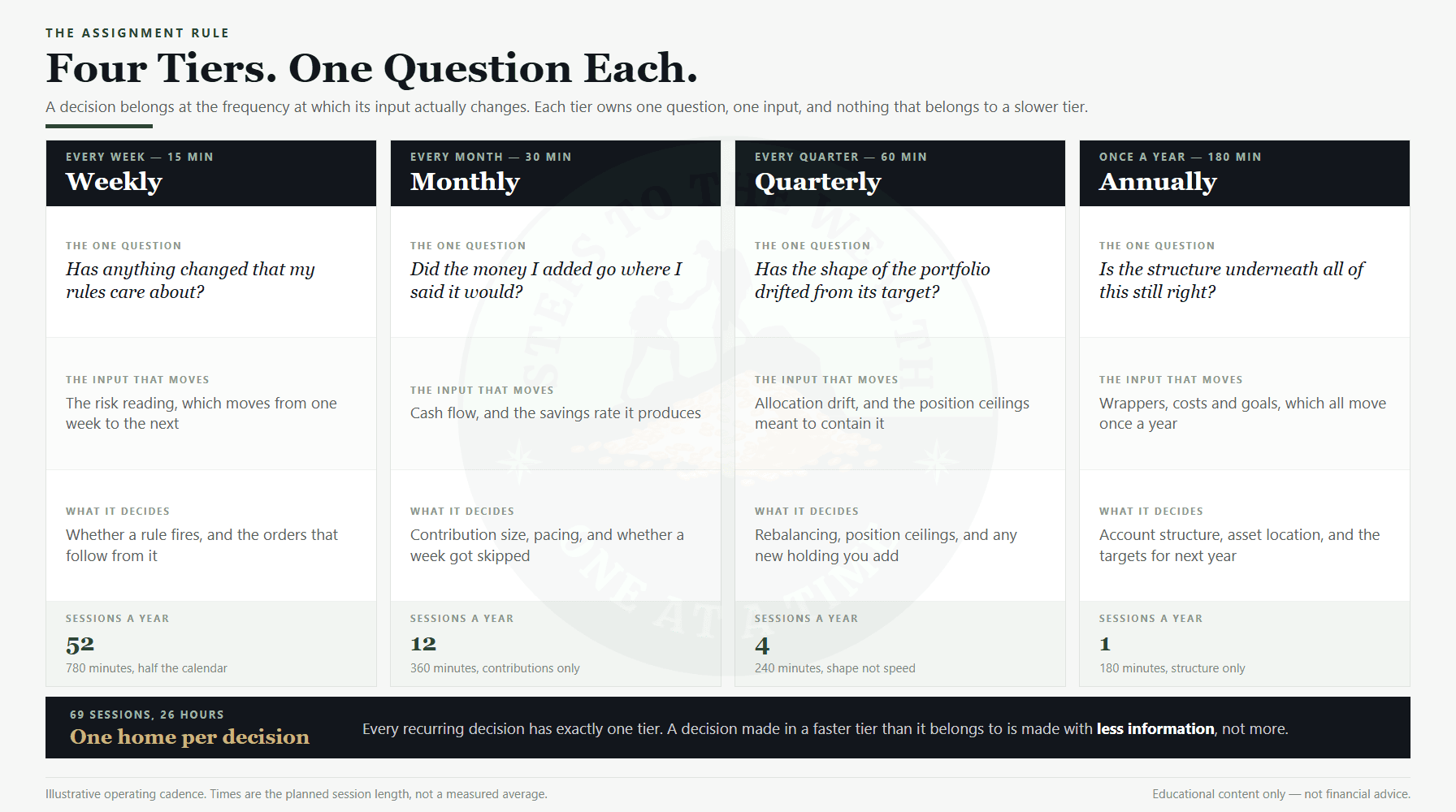
An investor calendar fixes that by assigning every recurring decision to exactly one cadence and leaving it there. Execution belongs to the week. Contributions belong to the month. Allocation belongs to the quarter. Structure belongs to the year. Nothing gets decided twice, and nothing gets decided on a Tuesday because the market was red.
This is the operating layer underneath a strategy rather than the strategy itself. If you already know what you own and why, the remaining question is when each type of review happens — and that question is what quietly separates people who run a system from people who own one on paper. For anyone investing around a full-time job, it is also the only version of the work that survives a busy quarter.
What follows is the whole calendar: four cadences, sixty-nine sessions a year, twenty-six hours, and the rule that decides which decision goes where.
Educational content only. Not financial advice.
What an investor calendar actually is
An investor calendar is a fixed schedule that says which investing decisions get made weekly, monthly, quarterly and annually, so that each one is made once, on a set date, with the right amount of information in front of you.
It is not a to-do list and it is not a trading schedule. It is an assignment. Every recurring decision in a portfolio has an input that drives it, and that input changes at its own natural speed. Risk readings move week to week. Your savings rate moves month to month. Allocation drift accumulates over a quarter. Your account structure, your wrappers and your goals move about once a year, if that.
The rule that builds the whole calendar is this: a decision belongs at the frequency at which its input actually changes. Check something faster than its input moves and you are reading noise. Check it slower and you are reacting to a change that happened months ago.
That single rule does more work than any individual review checklist, because it tells you not only what to do this Sunday but what you are explicitly not allowed to do this Sunday.
Why frequency is the decision most people never make
Almost nobody chooses their review frequency deliberately. It gets chosen for them by their phone. The portfolio app is open, so the portfolio gets checked, and every check invites a decision that the underlying inputs did not ask for.
The cost of that is measurable. Barber and Odean’s study of 66,465 US households from 1991 to 1996 found the market returned 17.9% annually while the average household earned 16.4% — a gap of 1.5 points. The busiest fifth of those households, the ones who traded most, earned 11.4%. That is 6.5 points a year behind the market, and it did not come from picking worse assets. It came from acting too often. The full paper is available free from Berkeley Haas.
Activity has a price and the price is charged in return. A calendar is the cheapest available control on activity, because it removes the decision about whether to decide.
There is a second cost that shows up in how you feel rather than in the numbers. Look at a portfolio three times a day and you will see roughly half of those looks in red, because that is what daily price movement does. Look once a week and you see about fifty snapshots a year instead of a thousand. Same portfolio, same returns, an entirely different experience of owning it — and a much smaller supply of moments in which you might do something regrettable.
The cost of running the investor calendar: 69 sessions, 26 hours
Here is the arithmetic in full, because a cadence you cannot afford is not a cadence.
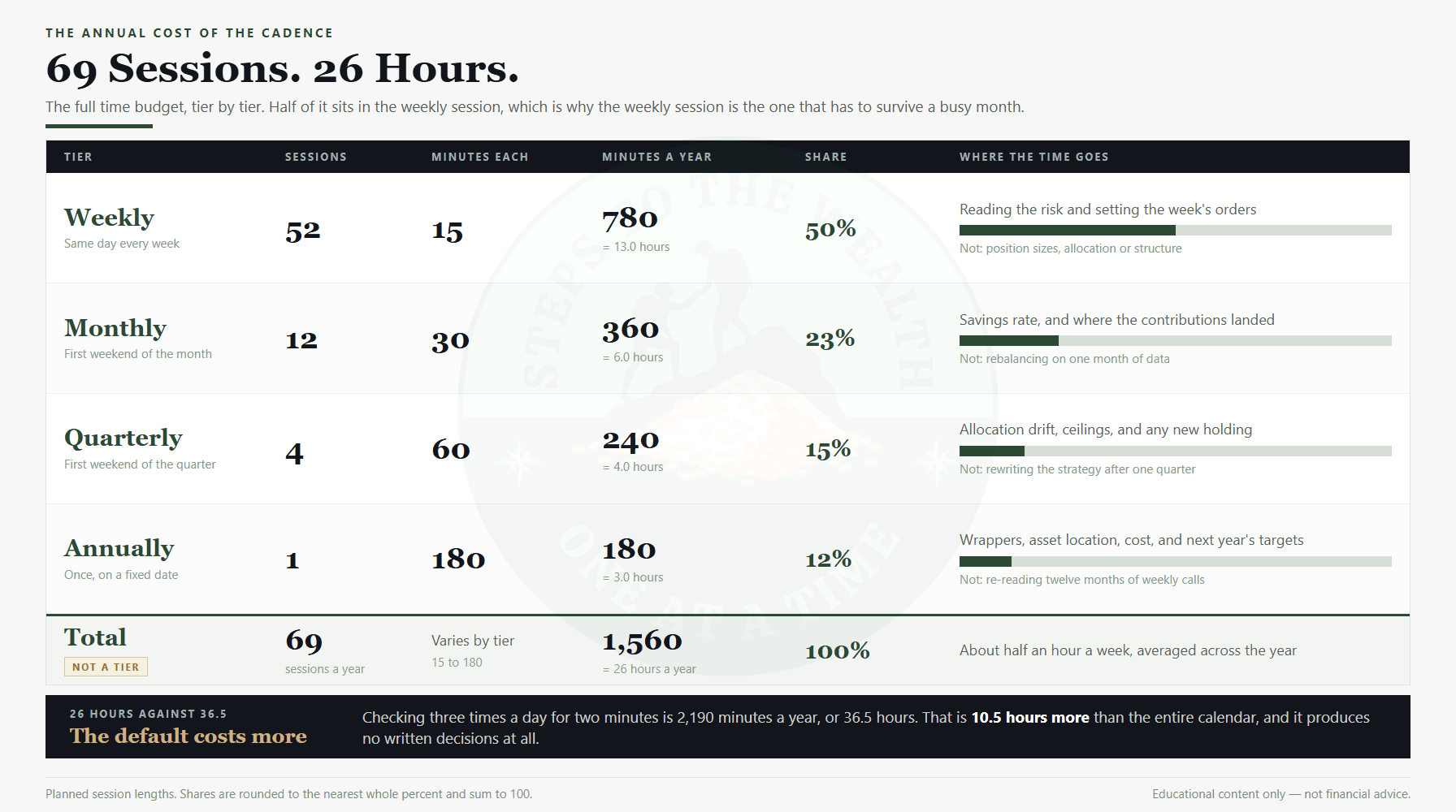
Fifty-two weekly sessions at fifteen minutes is 780 minutes. Twelve monthly sessions at thirty minutes is 360 minutes. Four quarterly sessions at sixty minutes is 240 minutes. One annual session at 180 minutes is 180 minutes. Add them: 69 sessions and 1,560 minutes, which is 26 hours a year.
Two things fall out of that total. The weekly tier is 780 of the 1,560 minutes — exactly half the calendar — which tells you where the discipline has to live. And 26 hours is about half an hour a week averaged across the year, which is less than most people spend on a single evening of market news.
Compare it to the default. Checking a portfolio three times a day for two minutes is six minutes a day, 2,190 minutes a year, 36.5 hours. The unstructured habit costs 10.5 hours a year more than the entire calendar and produces no decisions at all, because none of those checks ends in a written action.
Weekly: fifteen minutes to read the risk and set the week
Time: 15 minutes, same day every week. Input that changes at this speed: the risk reading.
The weekly session exists to answer one question: has anything changed that my rules care about? A risk-first framework produces a reading, the reading maps to an action that was agreed in advance, and you either execute that action or you confirm there is nothing to do.
Three things happen. You produce the current reading for each position you actively track. You compare where you are against where the reading says you should be. You set whatever orders follow from that gap, and then you close the laptop until next week.
Most weeks the answer is that nothing changed and nothing is due. That is the normal outcome, not a wasted session. The value of the weekly tier is not the actions it produces; it is the actions it absorbs, because a decision that has a scheduled home stops leaking into the other six days.
What does not belong here: changing a position size, adding a holding you have not pre-vetted, or revisiting your allocation because one line is down. Those inputs did not move this week. They are somebody else’s job.
Monthly: thirty minutes on the money you add
Time: 30 minutes, first weekend of the month. Input that changes at this speed: your cash flow.
The monthly session is about contributions, not positions. It asks what you actually saved last month, where that money went, and whether the answer matches what you said you would do.
Four checks cover it. What was the real savings rate, income against what was invested. Did the contributions land where the plan said. Are you on pace to fill any annual contribution limits, which is the most commonly missed free money in a working professional’s finances. And did you run all four weekly sessions, or did one get skipped and why.
That last one is the diagnostic that matters most. A skipped week is information. A pattern of skipped weeks in falling markets is a much bigger finding than anything in your returns, and it will not show up anywhere else.
The monthly tier is also where lifestyle creep becomes visible, because a savings rate that has quietly slipped two points looks like nothing in a single month and like a different retirement over a decade. And if contributions are the engine, it helps to know which assumptions about dollar-cost averaging are load-bearing and which are folklore.
What does not belong here: rebalancing the portfolio on one month of data, or selling something because it had a bad four weeks.
Quarterly: sixty minutes on shape, not speed
Time: 60 minutes, first weekend of the quarter. Input that changes at this speed: allocation drift and position ceilings.
A quarter is roughly how long it takes for allocation to drift far enough to matter. Under it, you are mostly measuring noise; over it, a position can grow into a concentration you never chose.
The quarterly session covers four things. Drift, measured against your target allocation, with anything past a pre-set threshold flagged for action. Position ceilings, because the maximum you are willing to hold in one line should be reviewed as your circumstances change rather than as prices change. New positions, which get evaluated, sized and laddered here and nowhere else. And a check that your current shape still matches your stated goals.
Rebalancing decisions made here are also where tax friction gets managed, so the order matters: adjust inside tax-advantaged wrappers first, where the move is free. The SEC’s investor education material on asset allocation is a reasonable neutral reference for how drift accumulates and why a target only means something if it gets restored.
This is also the right cadence for deployment questions. If cash has built up and needs to go to work, whether it goes in as a lump sum or on a schedule is a quarterly-sized decision, not a weekly impulse.
What does not belong here: rewriting the strategy because of one quarter’s performance, or adding six new holdings in a single sitting because you have been reading.
Annually: three hours on structure
Time: 180 minutes, once. Input that changes at this speed: your structure, your wrappers and your goals.
The annual session is the only one that can change the shape of the whole system, which is exactly why it happens once and is scheduled well in advance. It splits cleanly in two: the structural audit asks whether what you own is deliberate, and the process grade asks whether you followed your own rules.
What the annual session owns
Wrapper and account structure: whether the right assets sit in the right account types, and whether any available tax-advantaged capacity went unused. Cost: what the whole structure charges you in fees, spreads and avoidable tax. Resilience: whether the portfolio would survive the drawdown it is actually exposed to, which is what a portfolio stress test is for. Trajectory: whether the current savings rate and allocation are tracking toward the target, benchmarked against something concrete like retirement savings by age. And administration nobody enjoys, such as beneficiaries, which is invisible until it is not.
What it does not own
Anything the faster tiers already handled. The annual session is not a place to re-litigate twelve months of weekly readings one at a time, and it is not where you decide whether last year’s calls were sound — that is a separate exercise with its own rules. Nor is it a licence to redesign the framework annually. A structure that changes every January was never a structure.
One boundary worth stating plainly: between annual sessions, the correct number of structural reviews is zero. If a structural question feels urgent in March, write it down and let it wait. It is almost always the market talking, not the structure.
Three ways the calendar breaks
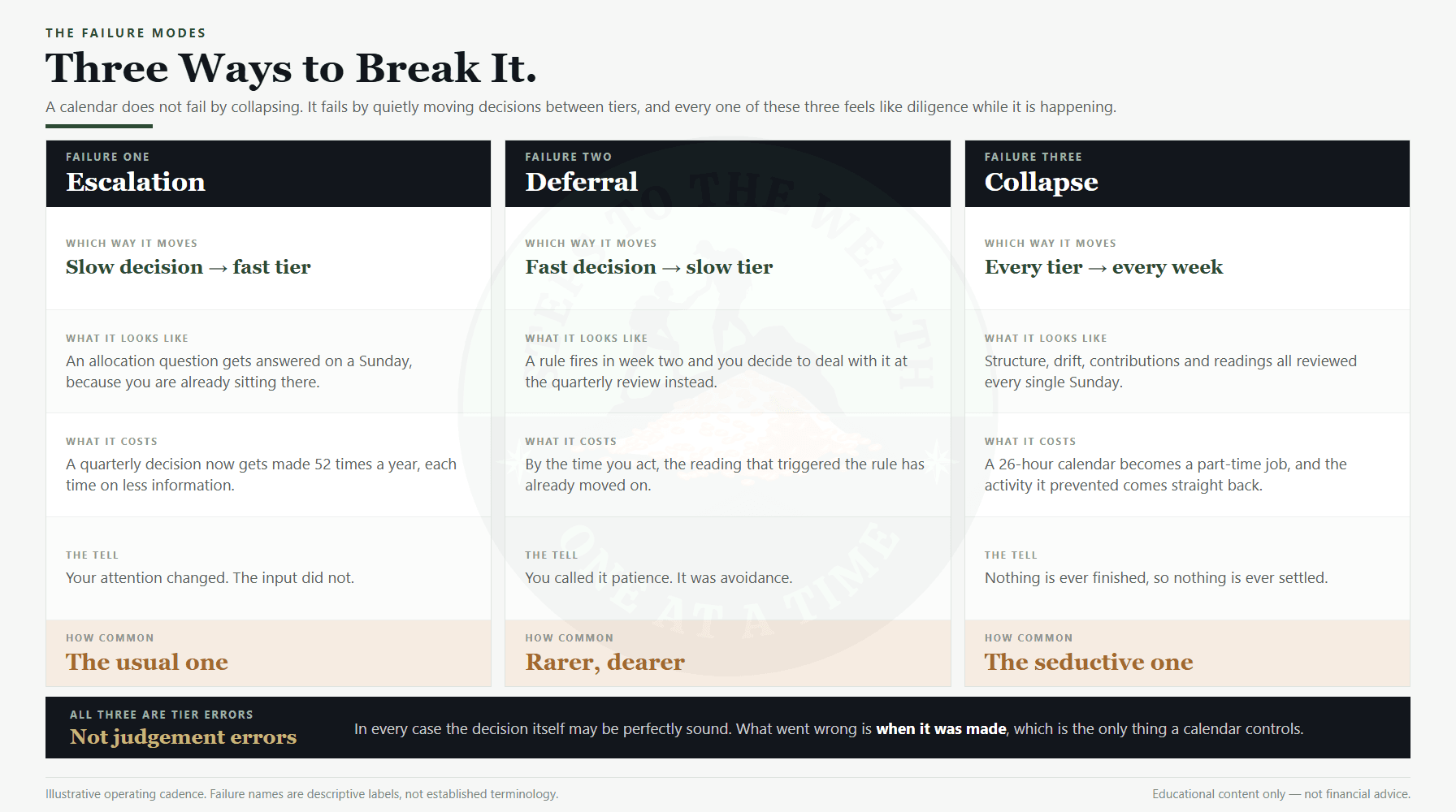
The calendar fails in three specific ways, and all three are worth recognising by name because each one feels responsible while you are doing it.
Escalation: pulling a slow decision into a fast tier
This is the common one. An allocation question arrives on a Sunday and gets answered on that Sunday, because you are already sitting there and it seems efficient. The input did not change; only your attention did. Escalation is how a quarterly decision gets made thirteen times a year, each time with less information than the scheduled version would have had.
Deferral: letting a fast trigger wait for a slow session
The inverse, and rarer, but more expensive when it happens. A rule fires in week two and you decide to handle it at the quarterly review, by which point the reading that triggered it has changed and the action no longer fits. If a rule fires in a weekly session, it executes in that weekly session. Waiting is itself a decision, and it is the cost of waiting in miniature.
Collapse: running every tier every week
The most seductive failure, because it looks like unusual diligence. You review allocation, contributions, structure and readings every Sunday, which means you now make structural decisions fifty-two times a year on inputs that moved once. Collapse turns a 26-hour calendar into a permanent part-time job and reproduces exactly the over-activity the calendar existed to prevent.
Where a real decision lands
The test of any calendar is whether it can route an actual decision without argument. Six common ones, and the cadence each belongs to, are laid out below.
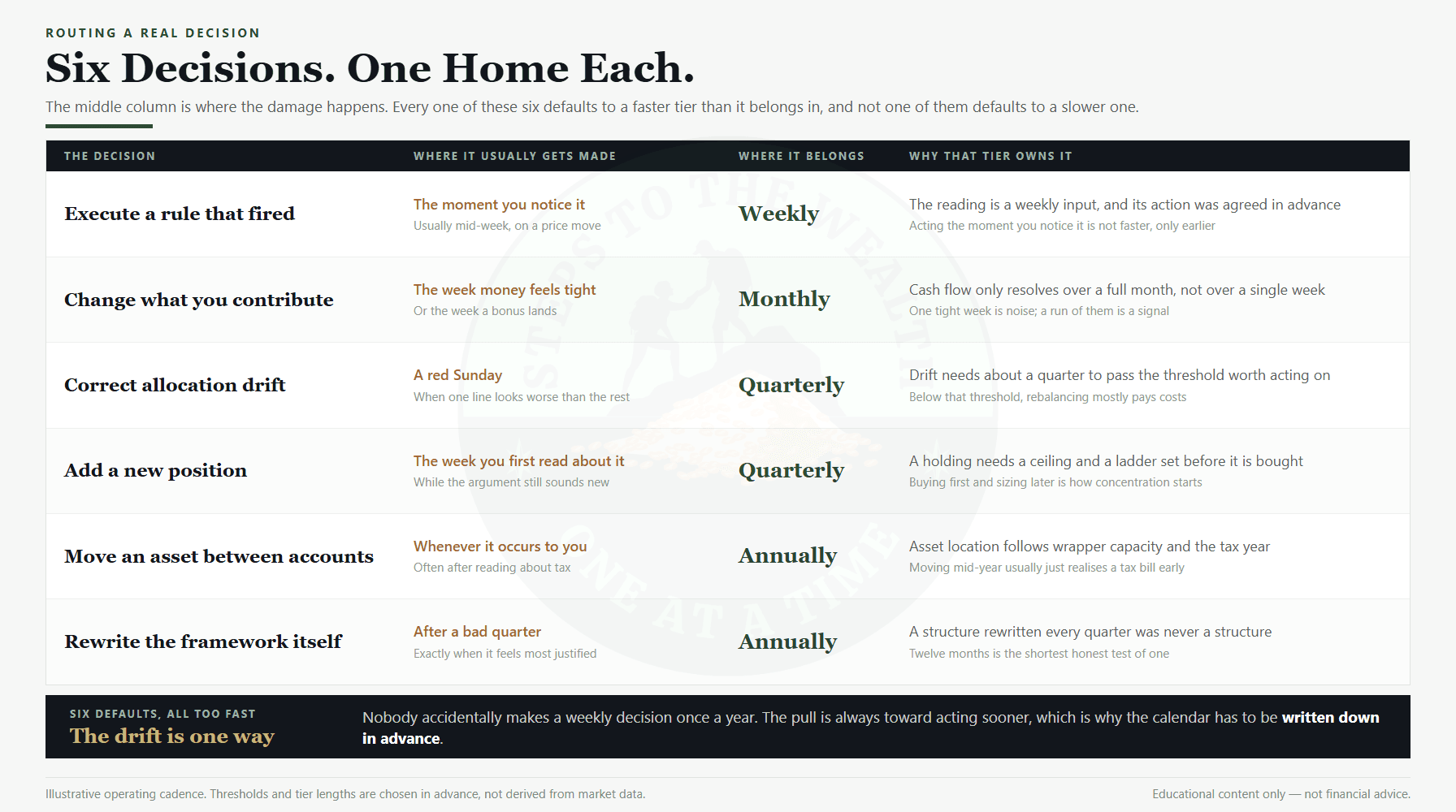
Notice the pattern in the middle column. Every one of those decisions defaults to a faster tier than it belongs in, and none of them defaults to a slower one. That asymmetry is the whole reason the calendar has to be written down in advance rather than assembled in the moment.
Behavioural research on investor types describes the same tendency from a different angle — Morningstar’s work on four behavioural investor types maps how different temperaments break their own rules, and the failures cluster around acting sooner than the plan intended.
What the investor calendar is not
It is not a guarantee of anything. Returns come from what you own and what markets do; the calendar only governs when you are allowed to change your mind.
It is not a trading schedule. Nothing here is designed to increase activity, and if running it produces more transactions than you had before, it is being run wrong.
It is not jurisdiction-specific. Tax-year boundaries, wrapper types and contribution limits differ everywhere, so the annual session in particular has to be anchored to your own tax calendar rather than to January.
And it is not a substitute for professional advice once a situation gets genuinely complex. A calendar organises decisions. It does not tell you which decisions are right for your circumstances.
What it is: an operating manual for the cadence at which each type of investing decision should be made. Weekly for execution. Monthly for contributions. Quarterly for shape. Annually for structure. Sixty-nine sessions, twenty-six hours, and one home for every decision.
Frequently asked questions
How much time does an investor calendar take each week?
About half an hour a week averaged across the year. The literal weekly session is fifteen minutes; the monthly, quarterly and annual sessions add another 780 minutes spread across the year, for 26 hours in total. Most weeks you only do the fifteen, and what those fifteen minutes actually contain is the Sunday review itself. Across a whole year they resolve to far less action than anyone expects, which is the average investing year.
What happens if I miss a session?
Run the next one on schedule rather than doubling up. A missed weekly session costs almost nothing because the rules did not change while you were away. A missed quarterly session matters more, so move it to the next available weekend rather than rolling it into the following quarter. Record the miss in the monthly session, because the pattern of misses is more useful than any single one.
Can I just run everything monthly instead?
You can, and it is a reasonable simplification if a weekly cadence is not realistic for you. The trade is that risk readings move faster than a month, so rule-triggered actions will sometimes execute late. Running a monthly-only calendar consistently beats running a four-tier calendar that you abandon in March.
Does the calendar change during a crash?
No, and this is the point at which it earns its keep. During the 2020 COVID crash the S&P 500 fell 33.9% in 33 days, which is precisely the environment in which people abandon their cadence and start checking hourly. The actions a crash calls for were already written into the weekly tier before the crash started. What changes is the size of the numbers, not the schedule.
Do I need software to run this?
No. A calendar app for the dates and one document for the log covers it. The log matters more than the tooling: a one-line entry per session, recording what the reading said and what you did, is what turns five years of sessions into something you can actually learn from.
Which session should I start with?
The weekly one, on its own, for three months. It is half the calendar’s total time and it is the tier that absorbs the impulse to act. Add the monthly session once the weekly one has stopped feeling like an obligation, and let the quarterly and annual sessions arrive when the calendar reaches them.
Educational content only. Not financial advice. The cadences described here are how I think about running the operational layer of a portfolio — they are not personalised to your situation and do not constitute a recommendation about any specific asset, allocation or strategy.