
Pull up your income from five years ago and your income now. For most working professionals on a career track, it’s up substantially — raises, promotions, a job change or two. Now ask the harder question: is your savings rate up by anything close to the same amount?
For most people, the honest answer is no. The income climbed and the savings barely moved, because something quietly absorbed the difference. That something has a name: lifestyle creep. And it’s the single most common reason high earners don’t build the wealth their income should produce.
The national picture is consistent with that: the US personal saving rate stood at 2.7% in June 2026, against an average of roughly 6% across 2015–2019. A national average says nothing about your own number — it only means the pattern is common.
Here’s how it works, why it’s sneakier than overspending, and the structural fix that actually beats it.
Educational content only. Not financial advice.
What lifestyle creep actually is
Lifestyle creep — or lifestyle inflation — is the slow, almost invisible process where your spending rises to match every increase in income. The raise comes in, and within a few months a slightly nicer apartment, a better car, more convenient takeout, a few more subscriptions, and a generally upgraded baseline have quietly absorbed it. Nothing felt extravagant. Each upgrade was small and reasonable. But collectively they ate the raise.
The result is the treadmill so many high earners are stuck on: more money in, more money out, the gap between them — the part that actually becomes wealth — stubbornly flat. You can earn two or three times what you used to and save roughly the same percentage, which means the raises made your lifestyle nicer and your future barely different.
Be careful with what “flat” means here, because it’s the detail that hides the damage. If your savings rate stays at 10% while your take-home rises from $6,000 to $9,000 a month, you are genuinely investing more: $600 a month becomes $900, and $7,200 a year becomes $10,800. Nothing was stolen. But the other $2,700 a month became permanent spending, and permanent spending is what your retirement number is a multiple of — so the amount you need invested moves from $1,620,000 to $2,430,000. Your annual contributions went up by $3,600. Your target went up by $810,000.
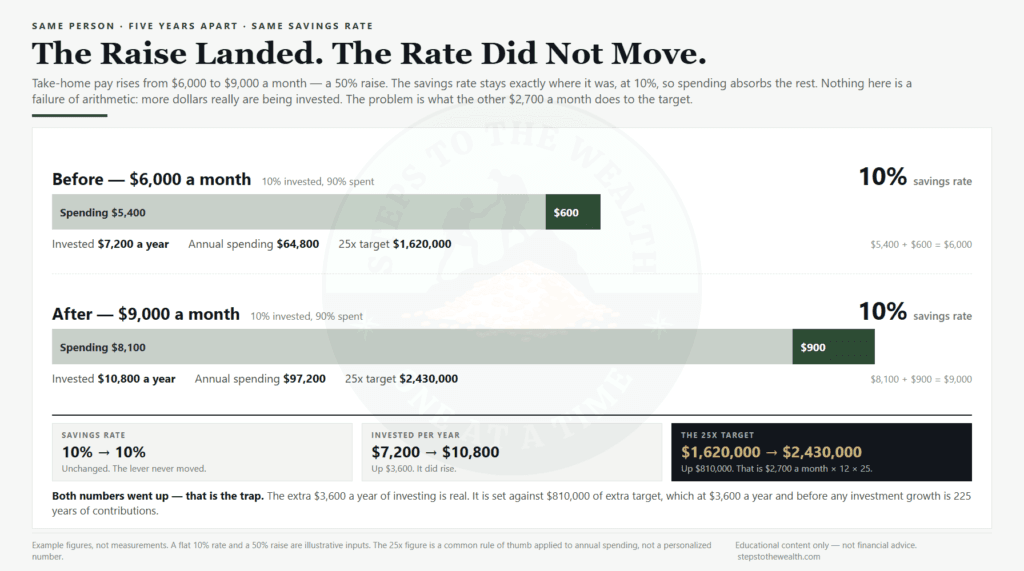
That’s the shape of the problem. The lever you actually control — the percentage — never moved, and the two numbers that did move went in opposite directions relative to each other.
Why it’s wired into you
This isn’t a discipline failure; it’s another piece of human wiring, called hedonic adaptation. We adjust shockingly fast to improvements. The upgrade that felt luxurious in month one becomes the unremarkable baseline by month six — and then it doesn’t feel like an upgrade anymore, it feels like normal, and going back feels like deprivation.
So each lifestyle bump delivers a short burst of satisfaction and then resets to neutral, leaving you needing the next bump to feel the same lift. Your spending ratchets up and almost never ratchets down, because down feels like loss (and you already know how the brain weights losses). The treadmill speeds up; the felt happiness stays flat.
Creep is not the same as your costs going up
Before the penalties, a boundary worth drawing, because getting this wrong is what makes people quit the exercise in the first week.
If your rent went up because rents went up, that is not lifestyle creep. That is the price level moving underneath you, and you did not choose it. Lifestyle creep is the part of your baseline that rose because you decided it should: the upgrade, the subscription, the shorter commute you paid for.
The two feel identical from inside your bank account. Both show up as spending more than you used to. Only one of them is a decision.
There is a rough way to separate them. Take your spending five years ago and your spending now, and compare the change to the price level over the same window. US CPI rose 22.9 percent between June 2021 and June 2026, about 4.2 percent a year. If your spending is up roughly 23 percent across that stretch, you have not crept at all. You have stood still while the currency moved. If it is up 45 percent, then about half of the increase is yours.
That is a reference line, not a verdict. CPI is a national basket and it is not your basket. If you rent in a tight market, or you carry the kind of insurance that has repriced hard, your personal inflation ran above the headline. Adjust the line upward for yourself, and be honest about by how much.
Use the same five-year window this article opened with, not a twelve-month one. Twelve months is mostly noise. One house move, one medical bill, one insurance renewal, and the comparison tells you nothing. Creep is slow by definition, and it only becomes visible on the timescale it actually operates on.
Run the comparison on take-home, not gross. Tax changes, pension contributions and payroll deductions all move the gross number without ever reaching your baseline, and including them tells you about your employer rather than about your spending.
The reason to bother with the split is not accounting. It is that shaming yourself for inflation does not work and does not last. People who audit their spending, find a number that is mostly the price level, and conclude they are undisciplined tend to abandon the whole idea within a month. People who find the actual discretionary slice, which is usually smaller than they feared and more fixable than they expected, tend to act on it.
One more distinction inside that slice, because it changes what you do next. A one-off purchase and a recurring commitment are not the same animal. A $3,000 holiday costs $3,000. A $250-a-month upgrade costs $3,000 a year, every year, and it moves the number you need to retire. When you go looking for creep, look at the lines that repeat.
The rest of this piece is about the discretionary slice. The inflation part is real, it is a genuine squeeze, and it is not what this is measuring.
The double penalty nobody mentions
Here’s the part that makes lifestyle creep genuinely dangerous rather than just a missed opportunity. Every permanent lifestyle upgrade hits you twice.
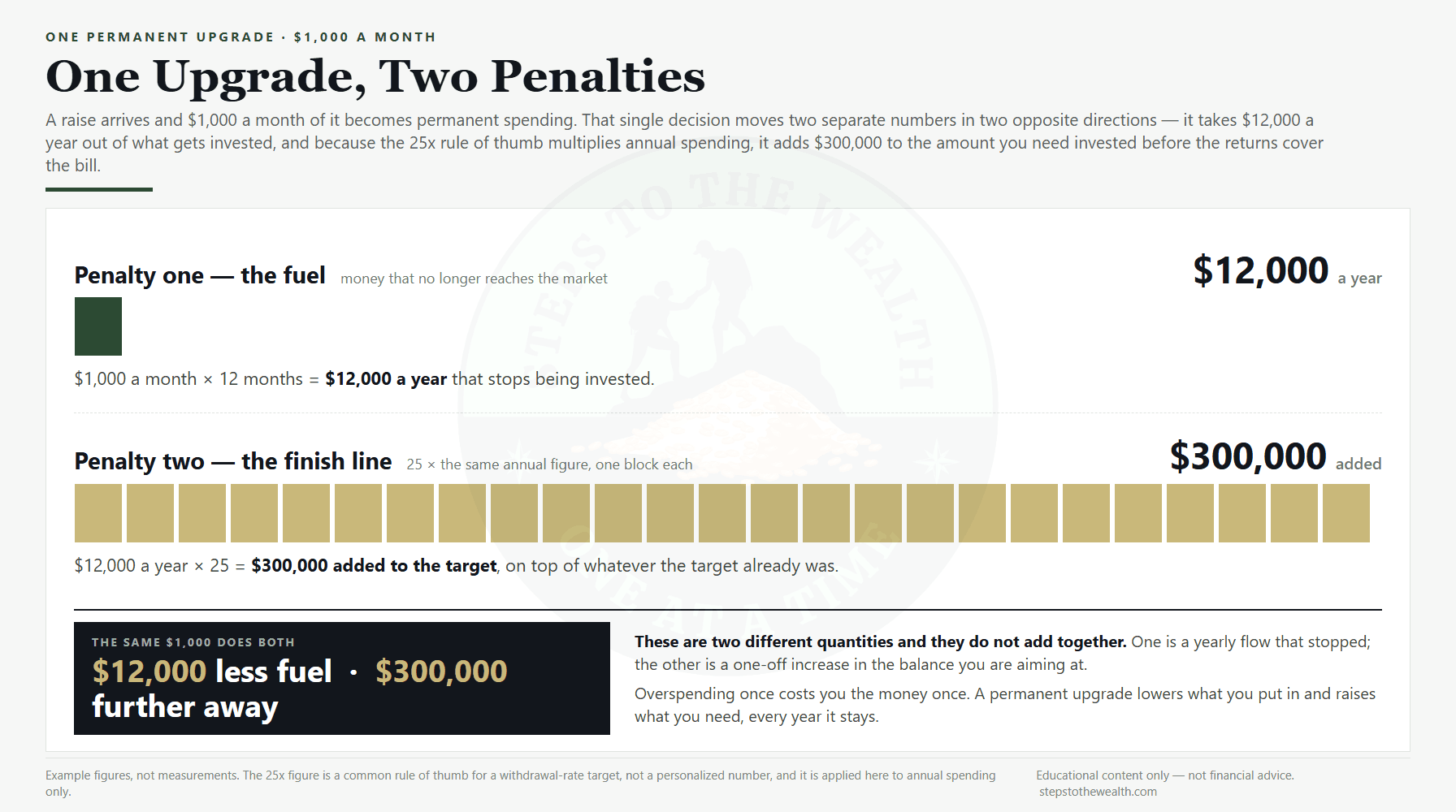
Penalty one: it lowers what you invest now. The money that went into the upgraded baseline is money that didn’t go into the market. That’s the obvious cost.
Penalty two — the brutal one: it raises the number you need to retire. This is what people miss. Your “financial independence” target is a multiple of your annual spending. The rough rule of thumb is that you need roughly 25 times your annual expenses invested to live off the returns. So every $1,000/month of permanent lifestyle creep doesn’t just cost you $1,000/month of investing — it adds roughly $300,000 to the pile you need to accumulate before you’re free. You simultaneously save less and move the finish line further away.
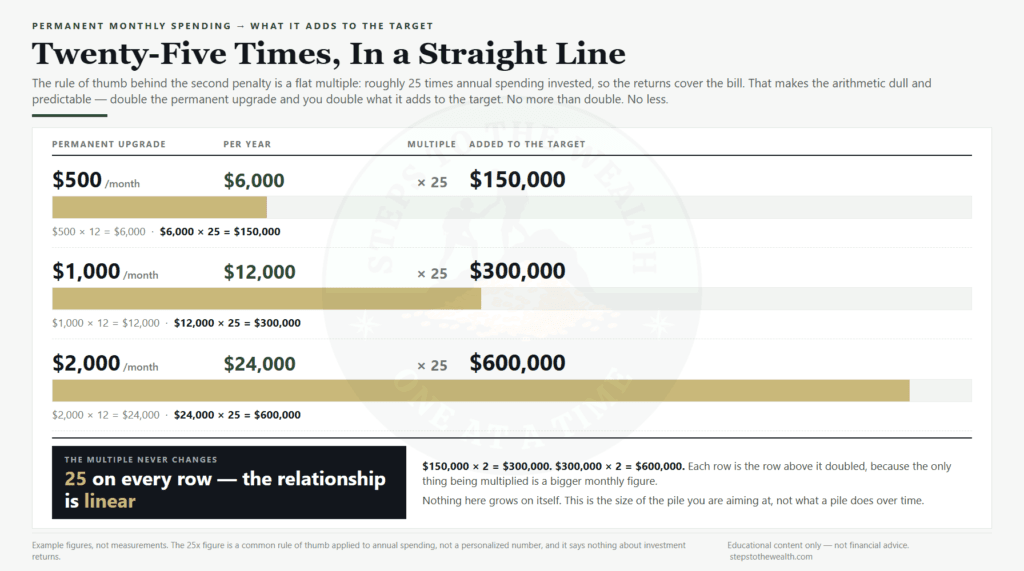
The arithmetic is deliberately dull, and worth sitting with, because the multiple never changes:
| Permanent upgrade | Per year | Added to the 25x target |
|---|---|---|
| $500/month | $6,000 | $150,000 |
| $1,000/month | $12,000 | $300,000 |
| $2,000/month | $24,000 | $600,000 |
Note what that table is and isn’t. Double the upgrade and you double what it adds — no more than double, no less. The relationship is linear, not accelerating: nothing here is growing on itself, because this is the size of the pile you’re aiming at, not what a pile does over time. That’s what makes it so easy to wave away in the moment. A $500/month upgrade doesn’t feel like a $150,000 decision, and there’s no statement anywhere that tells you it was one.
Few money decisions attack both sides of the equation at once. That’s why two people with identical incomes can end up in completely different places: the one who let lifestyle absorb the raises is running toward a finish line that keeps retreating, with less fuel to get there.
If you want to see the same logic applied to a single purchase rather than a permanent baseline, the time-value calculator measures what one outlay costs and how far it pushes a goal back. What a purchase actually costs covers the same ground in prose.
Why “just budget better” misses it
The usual advice is to track expenses and cut back. Useful, but it fights the symptom. Lifestyle creep happens at the moment of the raise, not at the moment of the purchase — it’s a decision about where the new money defaults to. Budgeting after the fact means clawing back upgrades you’ve already adapted to, which feels like deprivation and rarely sticks.
The operator move is upstream: decide where raises go before they arrive, so the new money never establishes a new baseline in the first place. You can’t feel deprived of a lifestyle you never adopted.
The fix: pay the future first, on every raise
The structural defense is simple and almost foolproof if you automate it.
Pre-commit a split for every future raise. Decide now — in calm, in advance — that some fixed share of every future raise goes straight to investing before it ever touches your spending. A common rule: half the raise to your future, half to your present. Get a $1,000/month raise, $500 of it is automatically invested and you “feel” a $500 raise. You still get to enjoy rising income. You just stop letting all of it evaporate into a baseline you’ll adapt to in a month anyway.
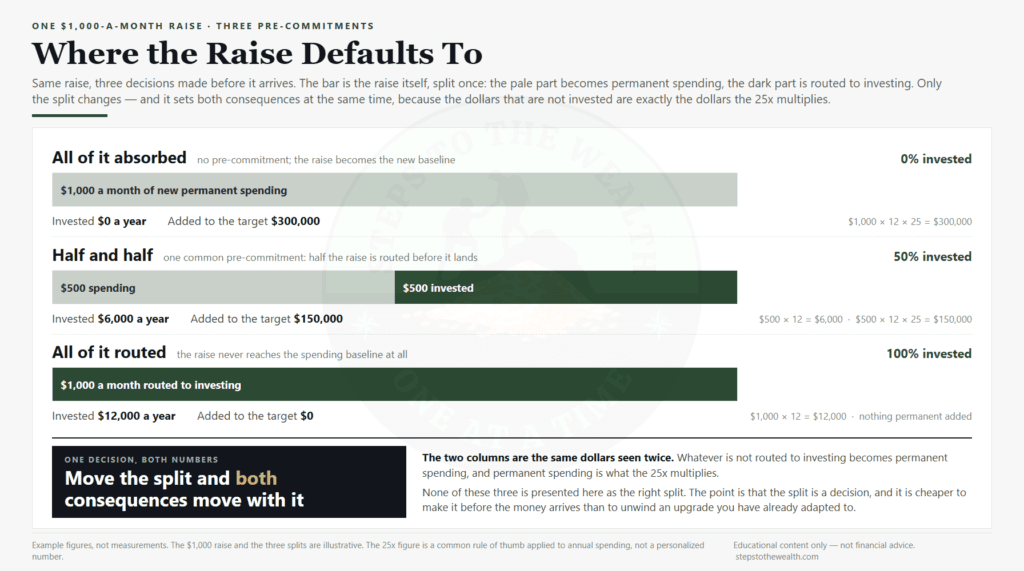
The split is doing two jobs at once, which is the whole point. Absorb the full $1,000 and you invest nothing extra while adding $300,000 to your target. Split it in half and you invest $6,000 a year while adding $150,000. Route all of it and you invest $12,000 a year and add nothing at all. There’s no separate lever for “save more” and “need less” — it’s one decision, and it sets both.
Automate it so it’s not a recurring decision. The instant a raise hits, the pre-committed portion should route to investments automatically. The standing order itself needs the same treatment, because increasing your contributions on a fixed annual schedule is the version that does not wait for a raise to trigger it. If reinvesting your raise requires a monthly act of willpower, hedonic adaptation will win. Make the productive choice the default and the lazy path the wealthy one.
Separate “deserved reward” from “new baseline.” It’s fine — healthy, even — to mark a promotion with something nice. The danger isn’t the one-time reward; it’s converting the raise into a permanent recurring cost. Celebrate with one-offs, not with subscriptions and fixed obligations that ratchet your baseline up forever.
This is really an application of a bigger idea: for the first stretch of building wealth, your savings rate — not your return rate — is the dominant lever. Lifestyle creep is the specific mechanism that keeps that lever pinned down exactly when you finally have the income to move it.
Recurring costs are where this does the most quiet damage, because a subscription or a fixed obligation is a permanent baseline by definition. Why you cancel the wrong subscription is about picking which of those to unwind, and the subscription audit tool puts numbers on the ones you already carry. If you want a checkpoint on where the target itself sits, retirement savings by age is the benchmark piece.
If the raise already landed
The fix above assumes a raise you have not received yet. For most people reading this, the raises landed years ago and the baseline has already absorbed them. Routing money you were never going to see is easy. Reversing a baseline you have been living inside for three years is a different job, and pretending otherwise is where advice stops being useful.
Start with the honest asymmetry. It is much harder to cut a commitment than to never take it on. That is not a character flaw. It is the same adaptation that made the upgrade feel normal within a month of buying it. Plan around it instead of arguing with it.
Three things that actually move.
Go after recurring lines, not one-offs. A single purchase costs you once. A recurring line costs you every month and raises the pile you need to accumulate, because the target is a multiple of your annual spending. Cancelling one $200-a-month commitment does more to that target than skipping six weekends out.
Apply one question to each recurring line, and only one. Would I sign up for this today, at this price, knowing what it actually delivers? Not whether you can afford it. You can, which is exactly why it is still there. Cancel the clear noes. Leave the clear yeses completely alone, without guilt. A cut you resent gets reversed inside two months and you will have spent the willpower for nothing.
Then stop cutting. The point of the audit is not to find the smallest life you can tolerate. It is to remove the lines you would not choose again, and then leave the rest where it is.
One caution on the audit itself. Do it once, properly, with the actual statements open rather than from memory. Memory systematically underestimates recurring spending, which is precisely why the baseline drifted without anyone noticing. The number you remember and the number on the statement are usually a few hundred a month apart, and that gap is the whole subject of this article.
The lever you still control is the next increase. Whatever the last five years did to your baseline, the next raise has not arrived yet, and the pre-commitment costs nothing to set up today. Decide the split now, in writing, while the money is still abstract and you have no feelings about it. When it lands, the decision is already made and you never see it as spendable.
That is the whole recovery path. One pass over the recurring lines, no shame budget, and a rule waiting for the next raise. It is slower than the version where you never crept. It is the one available to people who already did.
The takeaway
As your income rises, your spending quietly rises to meet it, your felt happiness resets to neutral, and the gap that becomes wealth stays flat. That’s lifestyle creep — and it punishes you twice, by lowering what you invest now and raising the number you need to be free later.
You won’t beat it by budgeting after the fact, because you’ve already adapted to the upgrades. You beat it upstream: pre-commit a share of every raise to your future, automate it so it never becomes a decision, and keep rewards as one-offs instead of permanent baselines. Let your income rise. Just don’t let all of it disappear into a lifestyle you’ll stop noticing by next quarter.
Where this fits
Deciding where a raise defaults to is upstream work — it happens once, in advance, and then runs on its own. The Dynamic DCA Blueprint lays out the risk-first system for putting that routed money to work, mechanically, without a monthly decision. It’s free.
If this isn’t for you, no hard feelings — the pre-commitment above works on its own, with or without a system behind it.
Educational content only — not financial advice. Rules of thumb (such as the 25x guideline) are simplifications for illustration, not personalized targets. Your situation depends on many factors; consult a qualified professional. Past performance does not predict future results.