
Most couples find out they disagree about money in the worst possible setting: mid-decision, with real money on the table, when one of them has already emotionally committed to an answer.
The market drops thirty percent and one of you wants to move to cash while the other wants to buy more. A $10,000 bonus lands and one of you has already spent it in their head while the other has already invested it in theirs. Neither reaction is wrong. Both are honest. And the argument that follows isn’t really about the market or the bonus — it’s about a difference in defaults that was there the whole time and never got said out loud.
I built a tool for that, and building it forced me to change what I thought the output should be.
Financial compatibility is not a score you pass or fail, and it is not the same thing as financial infidelity. It is a list of conversations, and the order you have them in matters more than any number at the end.
The obvious design is a compatibility score. Two people answer, you produce a percentage, high is good, low is bad. Every quiz on the internet works this way. It’s also close to useless, and it took me a while to work out exactly why.
Financial compatibility in eight questions, and no right answers
The tool asks each partner the same eight questions, separately. Each answer is a position on a 1-to-5 scale, with 3 as the honest middle for people who genuinely sit there.
The eight are the ones that actually move money over a marriage:
- Risk in a downturn — the market drops 30% the year you were going to invest: move to safety, or buy more?
- Debt philosophy — avoid it wherever possible, or a tool to use deliberately?
- Now vs later — enjoy more of it now, or bank it for a bigger later?
- Security vs growth — stable and predictable, or high growth even if bumpy?
- Windfall reflex — an unexpected $10,000 lands: save it all, or enjoy most of it?
- Everyday spending — frugal and questioning most buys, or comfortable and spending easily?
- Open vs separate — mostly separate accounts, or fully joint and open?
- Decision style — research and deliberate, or decide fast and adjust?
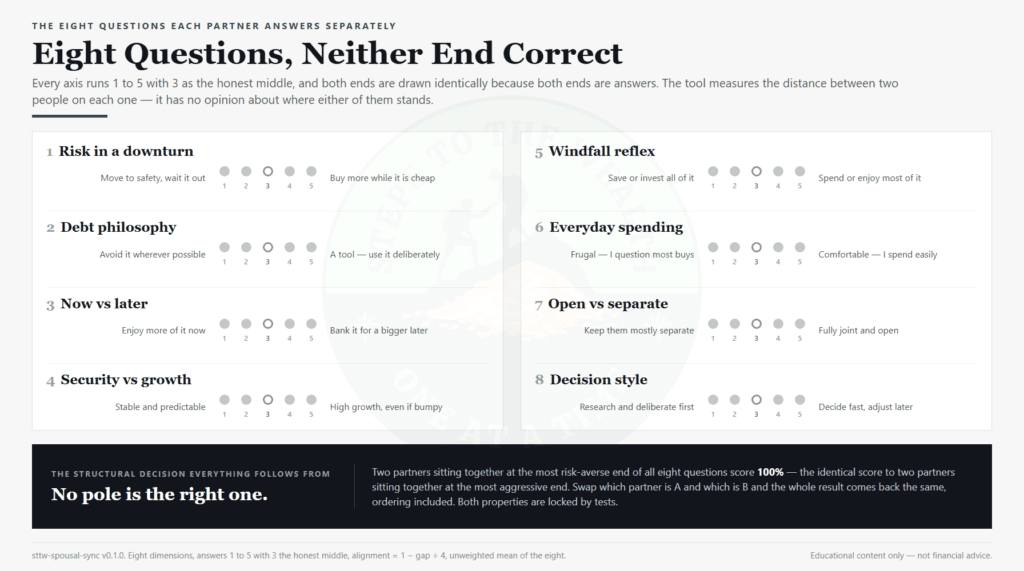
Here is the structural decision that everything else follows from: there is no correct end of any of those scales.
The tool never rewards the growth pole over the security pole. It doesn’t think buying the dip is more mature than moving to safety, and it doesn’t think frugal beats comfortable. It measures the distance between two people, and it grades neither of them.
That isn’t a diplomatic dodge. It’s arithmetic you can check. Two partners who both sit at the most risk-averse end of all eight questions score 100% — the same score as two partners who both sit at the most aggressive end. Swap which partner is A and which is B and the entire result comes back identical, down to the ordering. Both of those properties are locked by tests, because a tool that quietly preferred one answer would just be my opinions wearing a percentage sign.
What a gap of three actually means
Each dimension produces a gap: the distance between the two answers, from 0 to 4. Alignment on that dimension is one minus the gap over four. That’s the whole per-dimension calculation, and you can do it in your head.
The gaps sort into three bands:
- Gap 0 or 1 — aligned. Same instinct, or one notch off. No couple avoids being one notch off, and treating that as a problem would manufacture conflict where none exists.
- Gap 2 — mixed. A real difference, usually negotiable, worth knowing about.
- Gap 3 or 4 — a flashpoint. The two of you are on opposite sides of the midpoint. This is where money arguments actually start.
Three is the threshold because it’s the point where you’re no longer describing a difference of degree. At a gap of three, one partner’s instinct is not a milder version of the other’s — it’s the other direction. When the event finally arrives, you don’t negotiate. You collide.
The couple in the example
Take a specific pair. Partner A leans growth: buy the dip, bank it for later, invest a windfall, frugal day to day, researches before deciding. Partner B leans security: move to safety in a crash, spend most of a windfall, comfortable spending, decides fast.
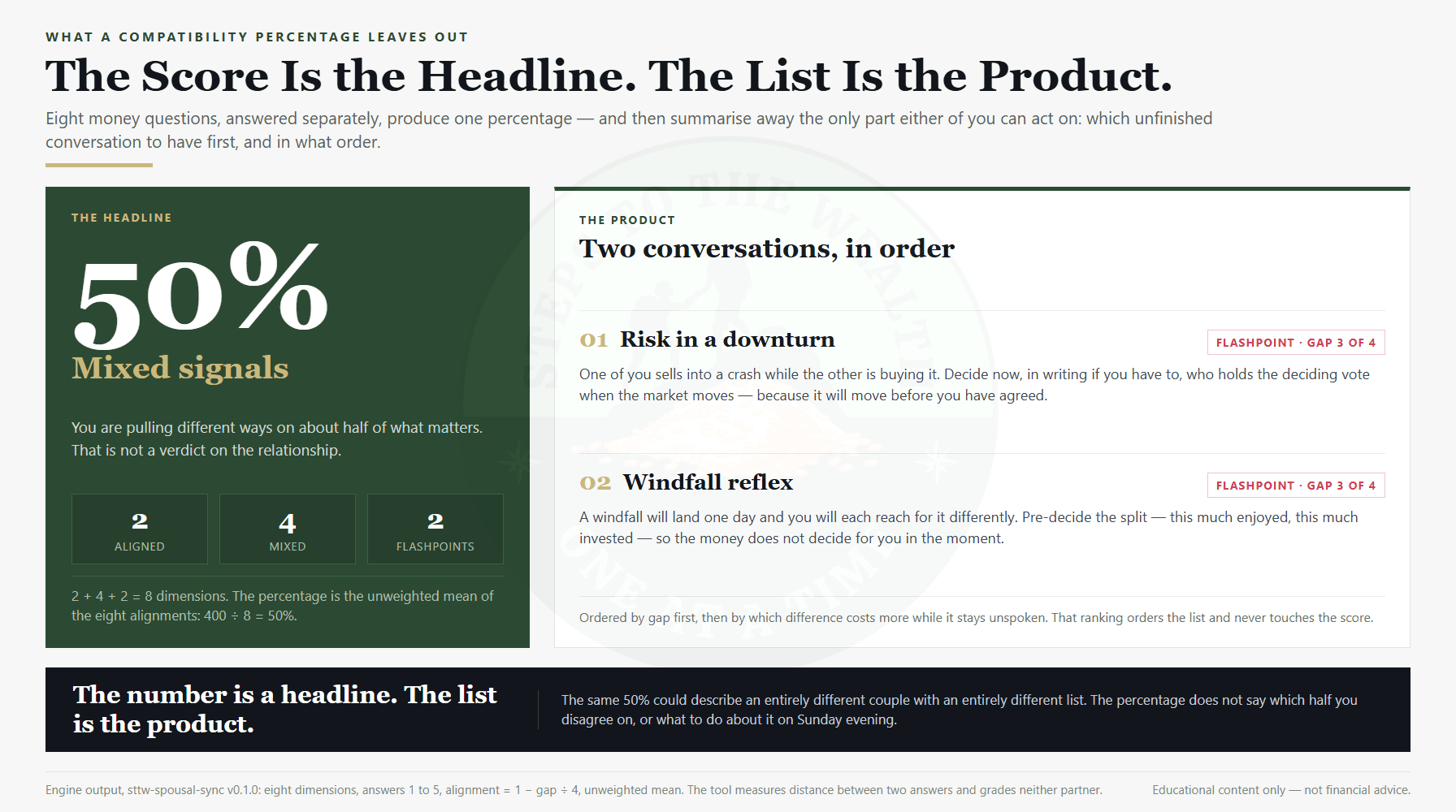
The tool scores that pair at 50%, which lands in the band it calls “Mixed signals.” The read it gives is not a verdict on the relationship — it’s this: you are pulling different ways on about half of what matters, and that’s a list of conversations the two of you have not finished having.
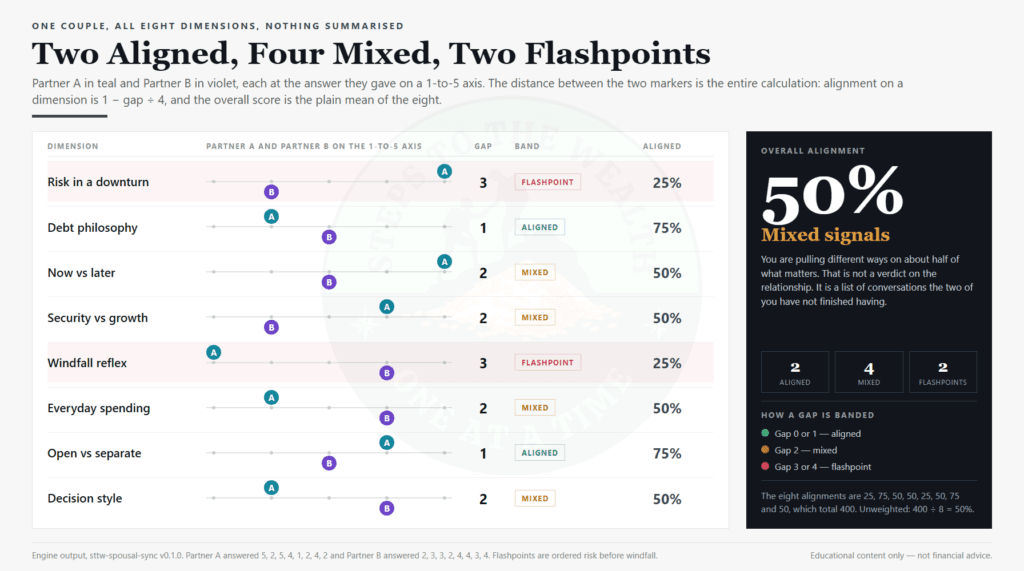
Underneath the number, the eight dimensions break down as two aligned, four mixed, and two flashpoints. The flashpoints are risk in a downturn and the windfall reflex — the two places where these particular partners are pointed in opposite directions.
Now notice what the 50% told you. Almost nothing. It didn’t tell you which half. It didn’t tell you what to do on Sunday evening. It’s a summary of a thing you’d rather have in full.
The order is the actual product
The two flashpoints don’t come back as a list of complaints. They come back as the specific decision each one calls for, while it’s still hypothetical and cheap:
On the risk gap — one of you sells into a crash while the other is buying it. Decide now, in writing if you have to, who holds the deciding vote when the market moves, because it will move before you have agreed.
On the windfall gap — a windfall will land one day and you will each reach for it differently. Pre-decide the split, this much enjoyed and this much invested, so the money does not decide for you in the moment.
And they arrive in an order, which is the part I care most about. Flashpoints sort by gap first — widest disagreement first — and ties break toward the dimension that costs more money if it stays unspoken. Risk sits at consequence rank 1, debt at 2, horizon at 3, all the way down to decision style at 8. Two equally wide disagreements, and the one that moves more money over a decade surfaces first.
That ranking is used only to order the list. It never touches the score. I’ll come back to why.
Because the honest answer to “we have six differences” is not “fix them all.” Nobody does that. The honest answer is “have this one first,” and the tool’s job is to be right about which one.
The average lies, and here’s exactly how
The overall score is an unweighted mean of the eight alignments. No importance weighting. That was a deliberate refusal: every weighting scheme is a value judgement I have no standing to make. Is debt philosophy more important than transparency? For whom? A hidden weight is a thumb on the scale, and I’d rather ship a number you can reproduce by hand than one you have to trust me about.
But an unweighted mean has a specific, demonstrable failure mode, and it’s the strongest argument against the score I’m about to hand you.
Take a couple who agree perfectly — gap zero — on seven of the eight questions, and sit at maximum opposition on the eighth. Total disagreement about risk in a downturn. One of them is buying into a crash while the other is liquidating.
That couple scores 88%, and the tool labels them “Strongly aligned.”
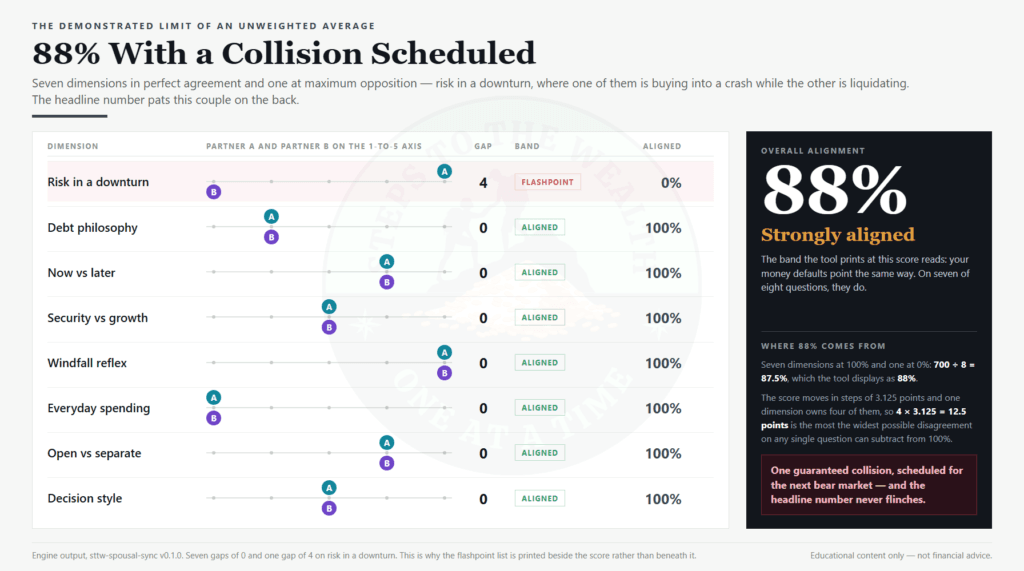
Which is, in the only sense that matters, wrong. They have one guaranteed collision scheduled for the next bear market, and the headline number is patting them on the back. Because there are eight dimensions, the widest possible disagreement on any single one can only move the total by 12.5 points — the score moves in steps of 3.125 points, and one dimension owns four of them at most.
I’m telling you this rather than hiding it, because it’s the reason the flashpoint list exists and the reason it appears with the score rather than under it. The number is a headline. The list is the product. If you take one thing from the tool, take the list, and treat the percentage as a conversation opener with your partner rather than a result.
That is also why consequence rank orders the list but never adjusts the score. Weighting the number would let me bury this problem instead of naming it. I’d rather the score stay dumb and honest, and the list be smart.
When a flashpoint does not resolve
Most of the differences on that list are negotiable once they have been named. Some are not. A gap of four on risk is two people with opposite instincts about the same event, and no amount of calm Sunday-evening discussion turns one of them into the other.
The useful move there is not agreement. It is a rule that does not require agreement. Three that work:
Split the decision. The portion neither of you is calm about gets managed the way the more cautious partner wants, and the rest the way the other wants. Nobody wins the argument, and both of you are held to something.
Name a deciding vote per domain, in advance. One of you holds the vote on market moves, the other on spending. The vote gets honoured when it is inconvenient, which is the only time it counts for anything.
Write it down while the money is hypothetical. A rule agreed over an imaginary $10,000 costs nothing to agree. The same rule proposed the week a real one lands reads as a move in an argument.
None of that resolves the difference, and it is not supposed to. It removes the requirement that the difference get resolved under pressure, which is the actual failure mode. Couples rarely come apart because they disagree about risk. They come apart because they disagree about it for the first time at the exact moment a decision is due.
Financial compatibility is a reading, not a property
The eight answers describe one day. They move, and the ones that move most are the ones that cost the most.
Somebody who has never held an equity portfolio through a bear market is answering the downturn question theoretically. After they have watched a real account fall by a third and stayed in it, they answer from experience, and the answer frequently changes — sometimes toward more risk, more often toward less. The windfall answer moves when a mortgage appears. The horizon answer moves when a child does, and again when retirement stops being an abstraction. Financial compatibility measured at 29 says very little about the same two people at 44.
So treat the reading as perishable. Re-run it after anything that changes the balance sheet — a job change, a house, a birth, an inheritance, the first real crash either of you has held through — and at least once a year in the absence of any of those. It is eight questions and it costs nothing. Comparing the new flashpoint list against the old one is more informative than either list on its own, because the direction a gap moves tells you whether the two of you are converging or quietly drifting.
One caveat that applies to all of it. These are stated preferences. What a person says they will do in a 30 percent drawdown and what they actually do at the bottom of one are different data, and only one of them is available before the fact. Read the result as what the two of you believe about yourselves today, which is the best information on offer and still not the same thing as evidence.
Why there’s no account to log into
The mechanic is deliberately two-party, and it’s the piece of engineering I’m happiest with.
Partner A answers the eight questions. Nothing is saved. The tool packs A’s answers into a link and A sends it to B — a text, an email, whatever. B opens the link, answers the same eight questions without ever seeing A’s, and the results appear on B’s screen. B sends the link back, or screenshots it, or you sit down together.
The link is the storage. There is no account, no login, no shared workspace, and no row in a database with your marriage in it. A’s answers travel inside the link itself, the score is calculated on the server so the maths stays a single tested authority rather than a JavaScript copy that drifts, and nothing is written down at either end.
There’s a hard-nosed reason for that beyond privacy theatre: this tool asks two people to be honest about spending, debt and secrecy in the same session. If either of them suspects the answers are being kept, the answers stop being honest, and an alignment score built on flattering answers is worse than no score at all.
One consequence worth knowing: a tampered or truncated link is rejected outright rather than quietly repaired. A vector with the wrong number of answers, or an answer outside 1 to 5, throws instead of clamping. A clamped answer is a different answer than the person actually gave, and the entire tool is a claim about what they gave.
What the tool does, and where it stops
It takes sixteen answers, eight from each of you, and returns an alignment percentage, a band, the eight dimensions laid out side by side with each gap visible, and the specific conversation each flashpoint calls for — ordered by which one costs the most if it stays unspoken.
Free covers all of that: the score, the full matrix, every flashpoint conversation, and the shareable link. No account, nothing stored. Gating the shared link would have broken the only mechanic that makes the tool work, so it isn’t gated.
The paid tier widens the report rather than unlocking the basics. It adds the conversation for every mixed dimension too, not just the sharp ones — for the couple above, that’s four more differences the free view counts but doesn’t open. It adds a short note on each dimension you already agree on, aimed at what to protect rather than what to fix. And it adds the image and CSV export for people who want the thing on paper. Pro is $29, paid once — not a subscription and not a bundle. The checkout is here. If the free matrix and the flashpoint conversations already gave you the conversation to have, you do not need it.
Where it stops is worth being blunt about. This is eight money questions at one point in time. It is not relationship advice, it does not predict how anything turns out, and it has no opinion on whether either of you is right. It cannot see your history, your incomes, your families, or the reasons behind any answer. Two people can score 44% and run a perfectly solid partnership — plenty do — when the differences are named and managed on purpose instead of discovered mid-argument. That is the entire claim.
Run it here: the Spousal Sync alignment tool
Answer honestly rather than diplomatically — a flattering answer produces a flattering score and a useless list. Then send the link. The worst outcome is that you find out you agree on more than you thought. The best outcome is that you have the argument now, in a calm kitchen, over a hypothetical $10,000, instead of in eighteen months over a real one.
Educational content only — not financial advice.