
You have three tabs open. One is comparing two index funds whose expense ratios differ by seventeen hundredths of a percentage point. One is a forum thread arguing about whether weekly contributions beat monthly ones. The third is a broker comparison table you have now read four times. The money is still sitting in the current account, where it has been for eleven months.
That is analysis paralysis, and it is not a character flaw. It is a rational response to a decision that has been presented badly. Every option in front of you is defensible, the differences between them are real, and nothing tells you which ones matter. So you keep researching, because researching feels like progress and choosing feels like risk.
The way out is not more willpower. It is a ranking. Take one ordinary plan, change exactly one decision at a time, and measure what each change does to the ending number. Some of those decisions move the outcome by tens of thousands of dollars. Some move it by a few hundred. Once you can see which is which, the research problem stops being a research problem, because most of the tabs close themselves.
Every number below is closed arithmetic from the inputs stated on the page. No forecast, no backtest, nothing you cannot reproduce on a spreadsheet in ten minutes.
What analysis paralysis actually is, and what it is not
It is worth separating two things that look identical from the outside and have completely different fixes.
The first is fear. You understand the choice perfectly well, and you do not act because you are afraid of losing money. That is a risk-tolerance problem, and it responds to smaller position sizes and a defined downside — the approach worked through in the risk-first framework for nervous investors.
The second is analysis paralysis proper. You are not especially afraid. You simply cannot rank the options, so no option ever clears the bar. Add another comparison and the problem gets worse, not better, because each new fund or platform or contribution schedule adds a dimension without resolving one.
The tell is what happens when someone hands you a decision. Ask a person who is afraid to invest $500 and they will negotiate the amount down. Ask a person in analysis paralysis and they will ask which fund, and then whether it should be that fund or the near-identical one, and then whether now is the right entry.
This matters because the two failures have opposite remedies. Fear is treated by shrinking the stake until acting is tolerable. Paralysis is treated by shrinking the decision — by proving that most of the choices in front of you are not worth the deliberation they are receiving. That proof is arithmetic, and it is the rest of this article.
One more distinction. Paralysis is not the same as deliberately waiting for a better entry price. That is a timing decision with its own cost, priced out in what waiting actually costs. Paralysis has no thesis. Nobody in it can tell you what they are waiting for.
One plan, seven decisions, one ranking
Here is the test plan. It stays identical in every scenario below except for the single input being changed.
- $500 a month, contributed at the end of each month.
- 25 years, which is 300 contributions and $150,000 of your own money.
- 7% a year, nominal, applied as an effective annual rate.
Run untouched, that plan ends at $391,521. Every figure that follows is the same plan with exactly one thing altered, measured against that baseline.
Two honesty notes before the numbers. The 7% is an assumption, not a promise — no return is a dial you get to set. And because the contributions are fixed in nominal dollars, the correct rate to compound them at is the nominal one, so every ending figure here is in nominal dollars and buys less than it looks like it buys. Neither caveat changes the ranking, which is the only thing this exercise is for.
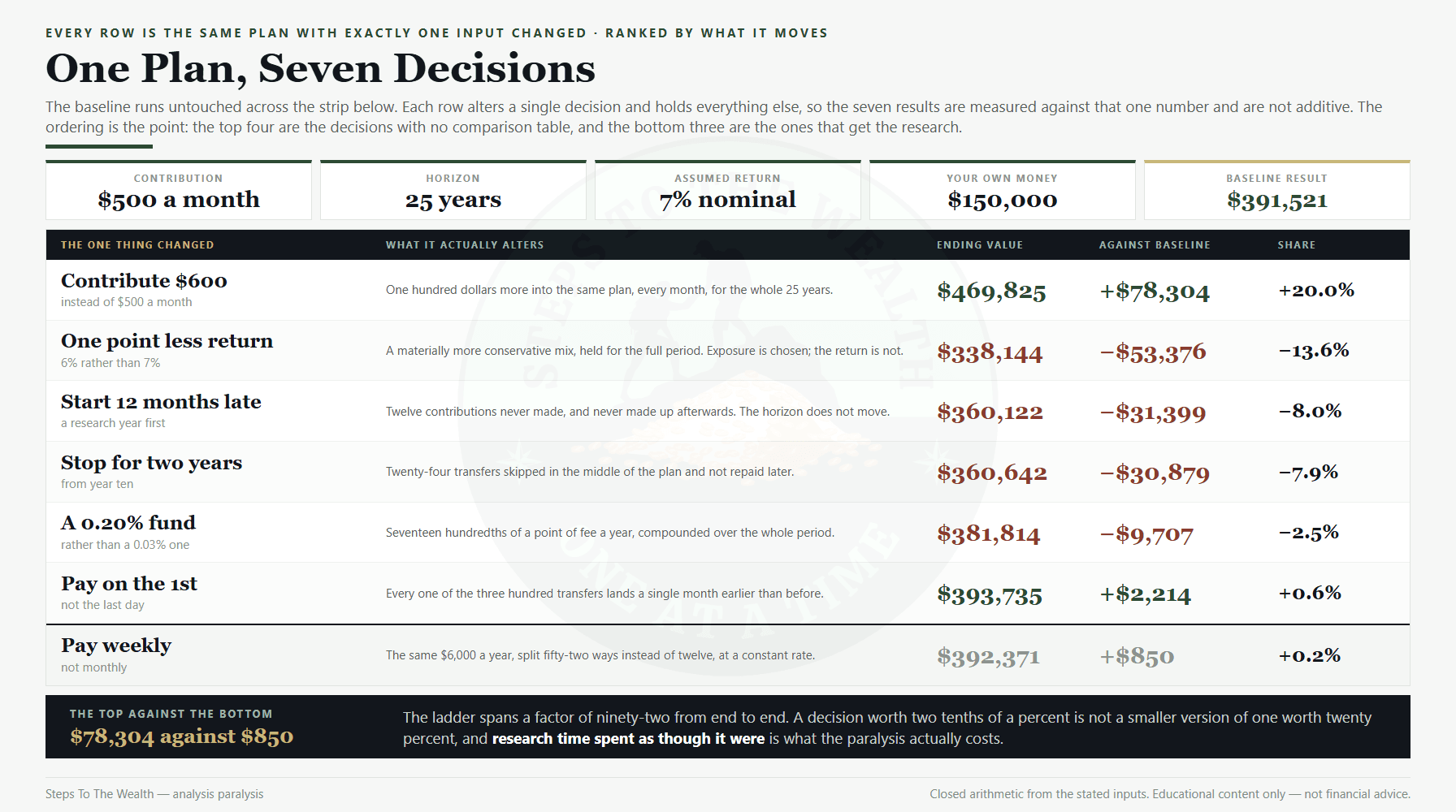
The spread is the finding. The top of the ladder moves the ending value by seventy-eight thousand dollars. The bottom moves it by eight hundred and fifty. These are not different sizes of the same decision. They are different categories, and treating them as comparable is what keeps the tabs open.
The three decisions that move the number
How much goes in. Raising the contribution from $500 to $600 a month lifts the ending value from $391,521 to $469,825. That is $78,304, and it is the largest single number on the ladder by a wide margin. The relationship is not subtle either: contributions and ending value scale together exactly, so twenty percent more money in is twenty percent more money out, every time, at any rate.
This is the decision that almost never gets a spreadsheet. It gets a shrug, because it feels like a fact about your salary rather than a choice. It usually is not. The gap between what you contribute and what your goal requires is arithmetic you can solve directly rather than hope about, which is the entire job of the goal-plan mismatch calculation, and the money for the increase is most often already inside your spending, in the pattern described in lifestyle creep and the savings rate.
The coarse allocation. Dropping the assumed return from 7% to 6% — roughly what a materially more conservative mix would do — takes the ending value down to $338,144. That is $53,376 gone, 13.6% of the outcome, from one percentage point.
Be careful with what that number means. You are not choosing a return. You are choosing an exposure, and the return is what the market pays that exposure over the period, which nobody controls.
What the arithmetic shows is the sensitivity: a single point of long-run return is worth more than every fund-selection and scheduling decision on the ladder combined. The split between broad asset classes is where that point is won or lost, and the mechanics are in how diversification actually reduces risk. The regulator’s plain-language version is worth reading too: the SEC’s investor education arm publishes a primer on asset allocation that takes about six minutes.
Whether it keeps going. Stopping contributions for two years in year ten, and never making them up, ends at $360,642. That is $30,879, from twenty-four transfers that did not happen. Starting twelve months late costs a nearly identical $31,399. Continuity is worth roughly what a full year of research costs, which is not a coincidence — both are the same event. Money that was going to be invested was not invested.
The four decisions that barely register
Now the tabs. Each of these is a real difference, correctly identified. Each is also worth a fraction of the three above.
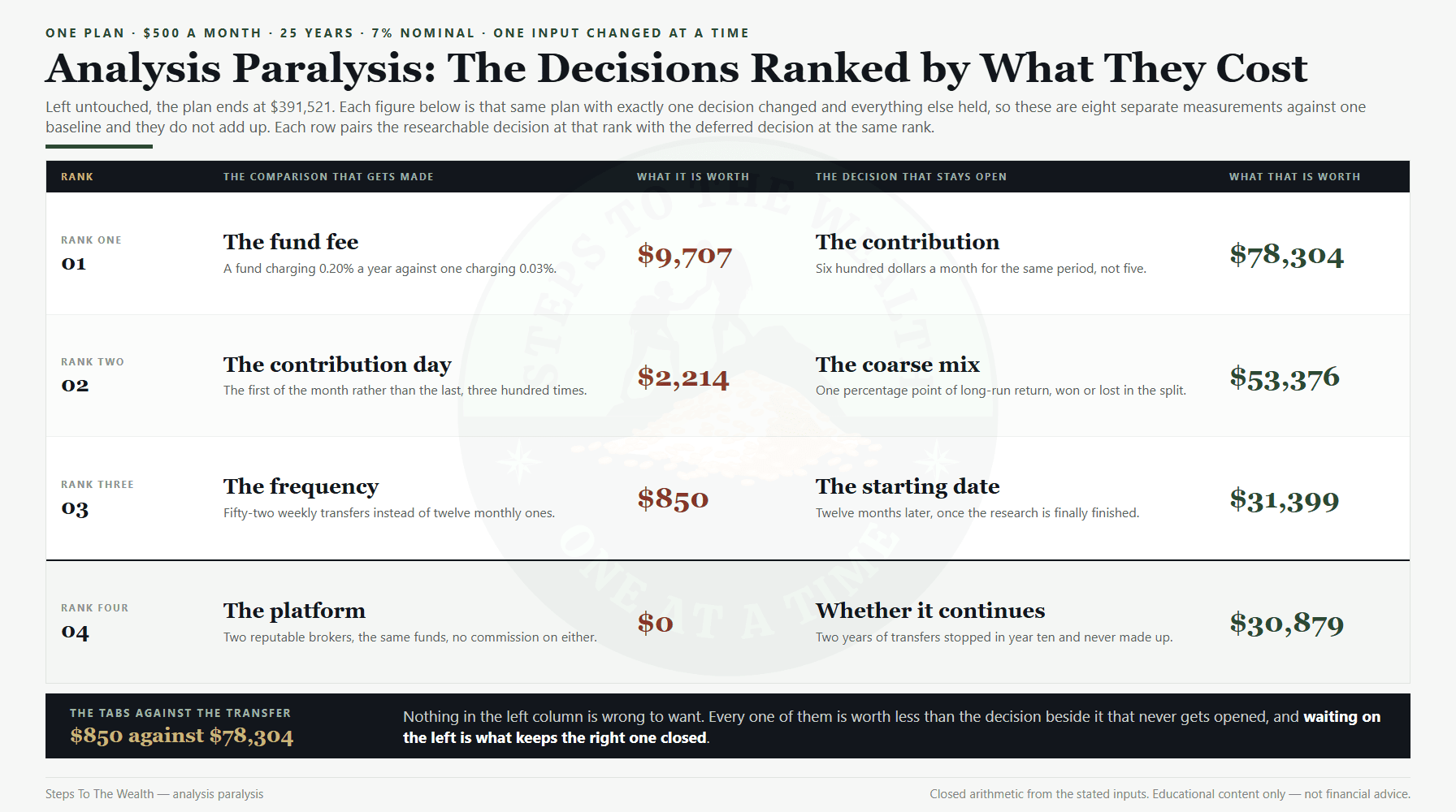
The fund fee. Holding a fund charging 0.20% instead of one charging 0.03% costs 0.17 percentage points a year. Over the full 25 years that is $9,707, or 2.5% of the outcome. Real money, worth taking if it is free to take — and it usually is, which is why the correct handling is a five-minute check rather than a five-week comparison. The wider case for watching costs is in the hidden cost of investment fees, and the reason two funds tracking the same index still diverge is in index fund tracking error.
The contribution day. Moving every contribution from the last day of the month to the first — 300 transfers, each landing one month earlier — is worth $2,214, or 0.6%. That is the entire prize for a decision that gets argued about at length.
The contribution frequency. Splitting the same $6,000 a year into 52 weekly transfers instead of 12 monthly ones is worth $850 across the whole 25 years, or 0.2%, and that is under a constant-growth assumption that flatters it. With real prices the difference is noise in both directions, which is the answer already given in the dollar-cost averaging myths.
The platform. Between two reputable brokers with the same funds available and no commission on the trade, the difference in ending value is zero. There are real reasons to prefer one over another — available account types, transfer mechanics, whether it will still be there in twenty years — and none of them are the return.
Add those four together and they are still smaller than raising the monthly transfer by $100. That is the whole argument, and it survives every reasonable change to the assumptions.
The better fund, chosen twelve months late
The ladder compares decisions one at a time. The trade nobody makes explicitly is the one where researching causes the delay, so it is worth pricing directly.
Two investors, same $500 a month, same 25-year window.
- Investor A starts this month in the mediocre fund, the one charging 0.20%. Net 6.83%.
- Investor B spends twelve months researching, finds the genuinely better fund at 0.03%, and starts in month thirteen. Net 7.00%, for 288 contributions instead of 300.
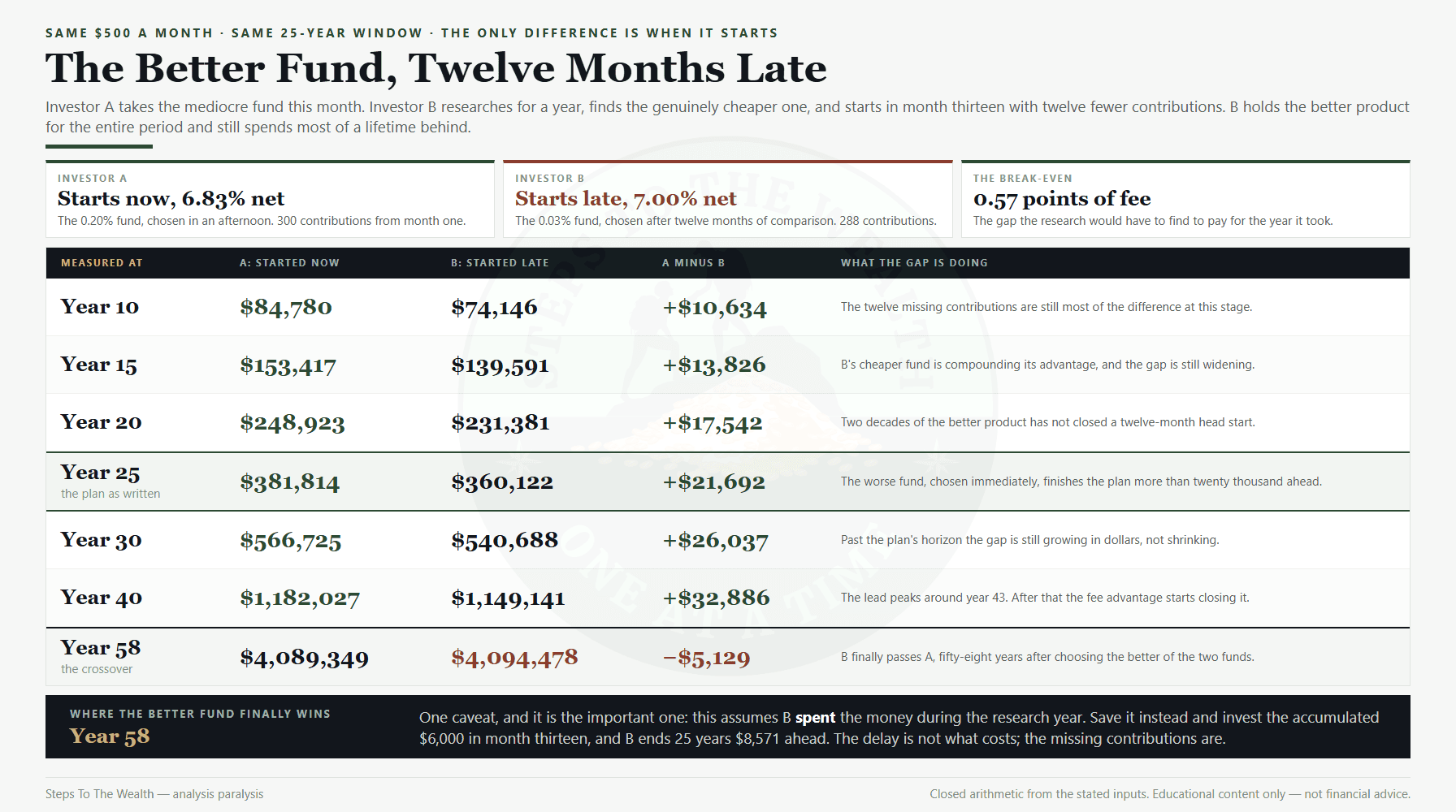
At the 25-year mark, A holds $381,814 and B holds $360,122. The investor who chose worse, immediately, is ahead by $21,692.
The lead is not temporary either. Extending both plans forward, B does not overtake A until year 58. The better fund is genuinely better and compounds its advantage every year, and it still spends most of a lifetime behind, because the twelve missing contributions had a fifty-eight-year head start to make up.
Turn the question around and it gets sharper. How large would the fee gap have to be to make the twelve months of research worth it over 25 years? The answer is 0.57 percentage points. That is not the difference between two index funds. That is the difference between an index fund and something with a sales load attached.
The objection that is right, and what it exposes
There is a real hole in the argument above, and it is worth opening rather than hiding.
Investor B did not spend that money. If B saves the $500 a month during the research year and invests the accumulated $6,000 as a lump in month thirteen, the ranking flips. B ends at $390,385 and beats A by $8,571. The break-even fee gap collapses from 0.57 percentage points to 0.02, which is small enough that almost any real fee difference justifies the wait.
So the honest version of the finding is narrower than the usual advice, and more useful. Deliberating is close to free, as long as the money is being set aside while you deliberate. What costs $21,692 is not the thinking. It is that the contributions during the thinking never happened.
Which is the thing worth knowing about paralysis, because that is exactly how it behaves in practice. The money does not sit in a labelled account waiting for the decision. It sits in the current account, where it is indistinguishable from spending money, and it gets spent. Twelve months of research produce a better fund choice and no capital to put in it.
Paralysis is a savings problem wearing a research costume
Every number so far points the same direction. The cost of not deciding is not the cost of the worse decision. It is the contributions deleted while the decision was open.
That reframes the fix completely. You do not need to decide faster. You need the saving to be independent of the deciding, so the two stop being connected at all.
It also explains why paralysis is so hard to argue someone out of. The small decisions genuinely are the researchable ones. A fee comparison has two numbers, a right answer, and a satisfying end. “Should I be contributing more?” has no comparison table, no clean answer, and no moment where it feels finished. Attention flows to the tractable question, and the intractable one — the one worth $78,304 — stays open indefinitely. That is not stupidity. It is the same coherence-seeking machinery catalogued in the seven investing biases, doing precisely what it does everywhere else.
It compounds with a second effect: every hour spent comparing funds feels like risk management, so it discharges the anxiety that would otherwise force the bigger decision. The research is not a step toward acting. It is a substitute for it.
The protocol: separate the transfer from the decision
The fix is mechanical, it takes one afternoon, and it works because it removes the dependency rather than the deliberation.
Step one, and it is the only urgent one. Set up an automatic transfer of whatever amount you are confident about, into the account where investments will eventually be made, starting this month. Not into a fund yet. Into the account. The transfer is now running whether or not the fund is chosen, which means the research year, if you take one, costs nothing. Setting that up is a twenty-minute job, covered step by step in how to invest while working full time.
Step two. Give every remaining decision a written default and a deadline. A default is a choice you have pre-made for the case where the analysis does not produce a clear winner — which, for decisions worth 0.2% of the outcome, is most of the time.
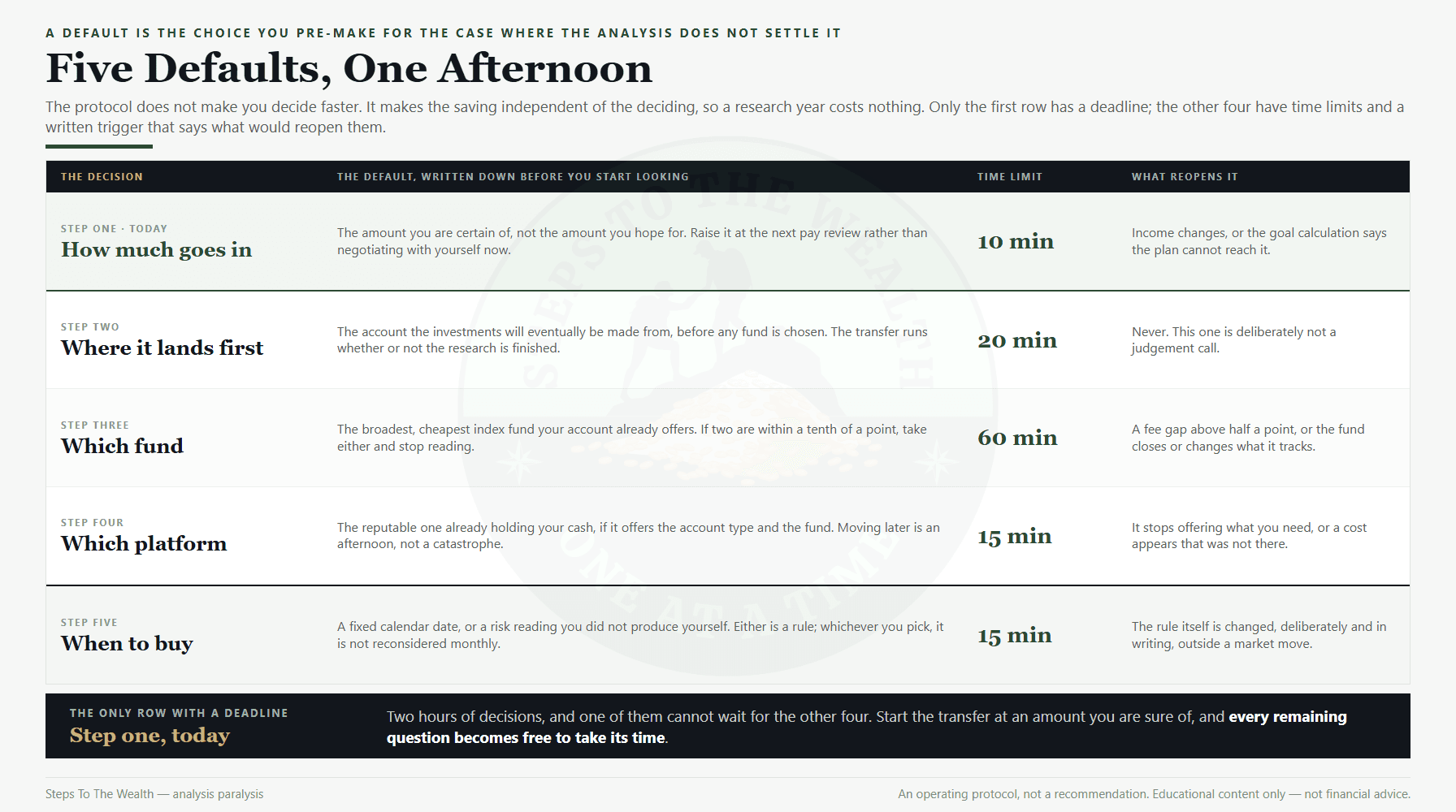
Step three. Write down what would make you revisit each one. A decision with no review trigger gets silently reopened every time you read something; a decision with a stated trigger stays closed until the trigger fires. This is the ordinary discipline of rules-based investing applied to the setup rather than to the trades.
What the protocol buys you is not speed. It is that the expensive decision — how much, and does it continue — gets made on day one, while the cheap decisions get however long they need without costing anything. That is the correct order, and it is the reverse of what paralysis does naturally.
If the question underneath all of it is really when to put the accumulated money to work, that is a separate and answerable question, and it does not need to be resolved before the transfers start: see is now a good time to invest.
Where this does not apply
Four cases where the ranking above genuinely changes, and one where it does not but people think it does.
When the decision is irreversible. Everything on the ladder can be changed later at low cost. Locking money into a product with an exit penalty, a multi-year commitment, or a tax consequence on the way out is a different class of decision, and it deserves every week of research it takes. The ranking here applies to reversible choices, which is most of a working investor’s setup and not all of it.
When the fee gap is not a fee gap. The 0.17-point comparison assumed two broadly similar index funds. Products carrying an upfront load, a platform charge, or an annual advice fee sit well past the 0.57-point break-even, and there the research pays for itself several times over.
When you have no emergency fund. The whole ladder assumes contributions that continue. A plan funded from money you will need back is the two-year stop, dressed up, and it costs the $30,879 shown in the figure. The sequencing question is worked through in emergency fund versus investing.
When the paralysis is actually fear. If you can rank the options perfectly well and still cannot press the button, no amount of arithmetic about fund fees will help, because that is not the blocked decision. Go back to the first section.
And the case people wrongly think is an exception: a small starting amount. The ranking is scale-free. Every figure here moves proportionally with the contribution, so the ordering of the seven decisions is identical at $50 a month and at $5,000. Smaller numbers make the low-leverage decisions less worth arguing about, not more.
What to do this week
Three things, in this order, and the first one is the only one with a deadline.
Set the transfer running at an amount you are sure of, into the account, today, before any fund is chosen. Then work out what the goal actually requires you to contribute, so the largest number on the ladder gets decided deliberately instead of by default — the Plan Gap calculator solves it backward and tells you the contribution the target needs, against the one you are making now. Then give every remaining decision a default and a deadline, and close the tabs.
If it helps to see how the plan behaves against real historical periods rather than a flat 7%, the DCA Simulator runs an exact contribution schedule through actual market history, including the drawdowns. And if the part you keep getting stuck on is when rather than what, the weekly risk reading in the Sunday newsletter is the version of that decision that has already been made mechanical.
The takeaway
Analysis paralysis is not indecision. It is a misallocation of attention: the decisions that are easy to research get all of it, and the decisions that move the outcome get none.
The ranking is not close. Contributing $100 more a month is worth $78,304 over 25 years. Getting the fund fee right is worth $9,707. Getting the contribution day right is worth $2,214. Weekly versus monthly is worth $850. An investor who spends a year picking the better fund and does not save during that year hands back more than the fund choice will ever return, and stays behind for 58 years.
None of which means the small decisions are wrong to make. It means they are wrong to make first, and wrong to let block the one that matters. Start the transfer. Default the rest. Revisit on a trigger, not on a mood.
Educational content only — not financial advice.