
Educational content only. Not financial advice.
Investing biases are seven versions of one mistake
Behavioural finance is usually taught as a list. Here are the biases, here is what each is called, try to notice them. That is why almost nobody acts on it: a list of seven things to watch for is seven things to forget under pressure.
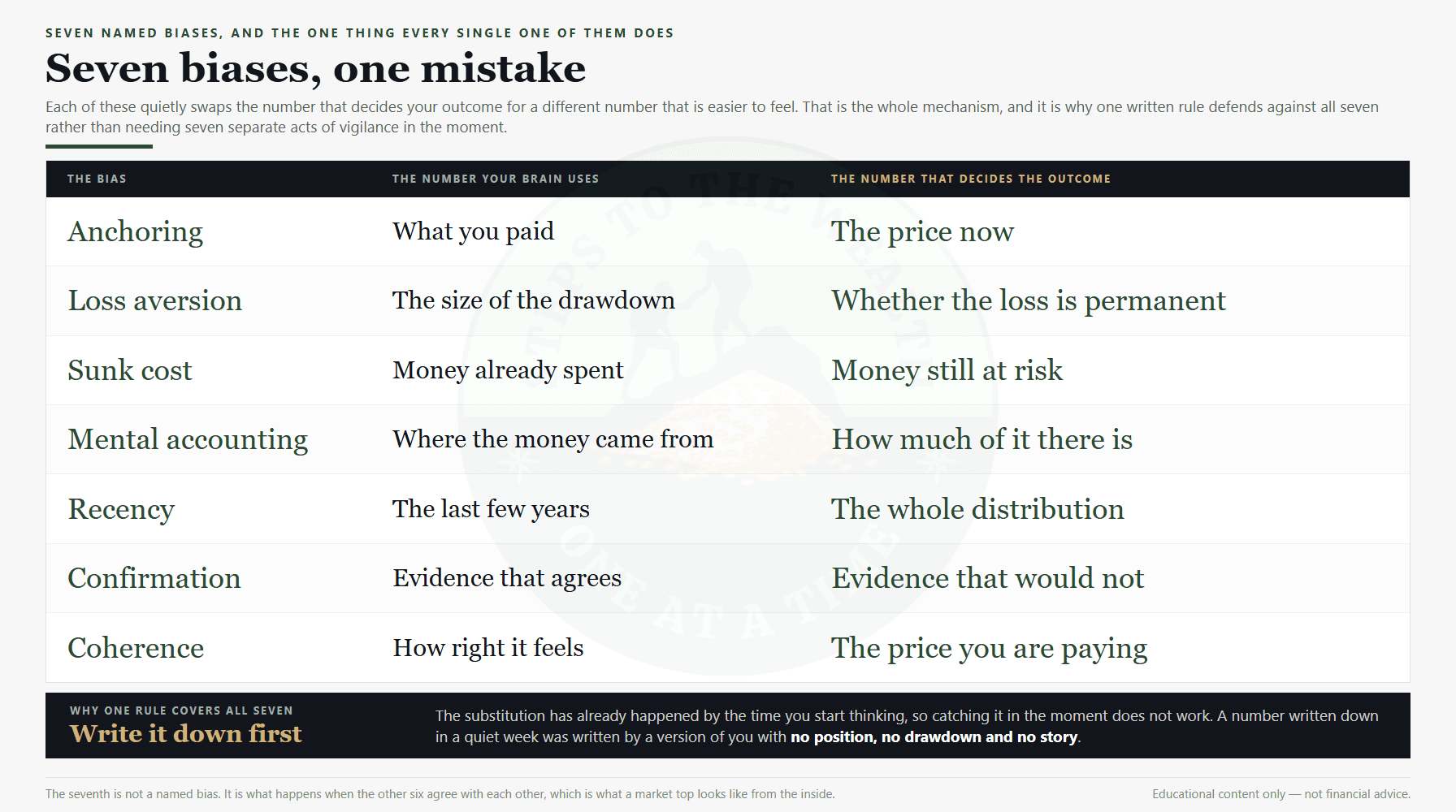
There is a shorter way in. Every one of these investing biases does the same thing. It quietly swaps the number that decides your outcome for a different number that is easier to feel.
Your cost basis instead of the price. Money already spent instead of money still at risk. Where the money came from instead of how much of it there is. The last three years instead of the distribution. Evidence for instead of evidence against.
Once you see the substitution, the defence stops being vigilance and becomes arithmetic. You do not have to catch yourself in the act. You write the correct number down in advance and check against it.
This is about the mechanism. What the resulting leaks actually cost you in money is a separate piece of arithmetic, and worth reading alongside this one.
Anchoring: the price you paid is not in the formula
Two people own the same stock, trading today at $60. One bought at $100 and is down 40%. The other bought at $30 and is up 100%.
From today, their returns are identical. Whatever the stock does next, it does to both of them equally. The purchase price appears nowhere in the calculation of what happens from here, because the calculation only contains the price now and the price later.
Yet the first person will hold to get back to $100 and the second will sell to protect a gain, and they will describe those as analysis.
The substituted number is your cost basis. It is a fact about your history, not about the asset. The market has no record of it and no obligation to it.
Two other prices do the same job. The high you saw once and now measure against, and any round number the price is near. Both feel like levels. Neither is one.
The test is short: if I held no position at all, would I buy this today at this price? If the answer is no, the position is being held by its purchase price rather than by a reason.
Loss aversion: the feeling is right about the arithmetic
The standard telling is that losses hurt about twice as much as equivalent gains feel good, and that this is irrational. Half of that is wrong.
Losses genuinely are worse than gains of the same size, and the reason is arithmetic. A 20% fall needs a 25% rise to get back. A 30% fall needs 42.86%. A 50% fall needs the survivors to double.
The asymmetry is real, it is not a feeling, and anyone who tells you loss aversion is simply irrational has not run the numbers.
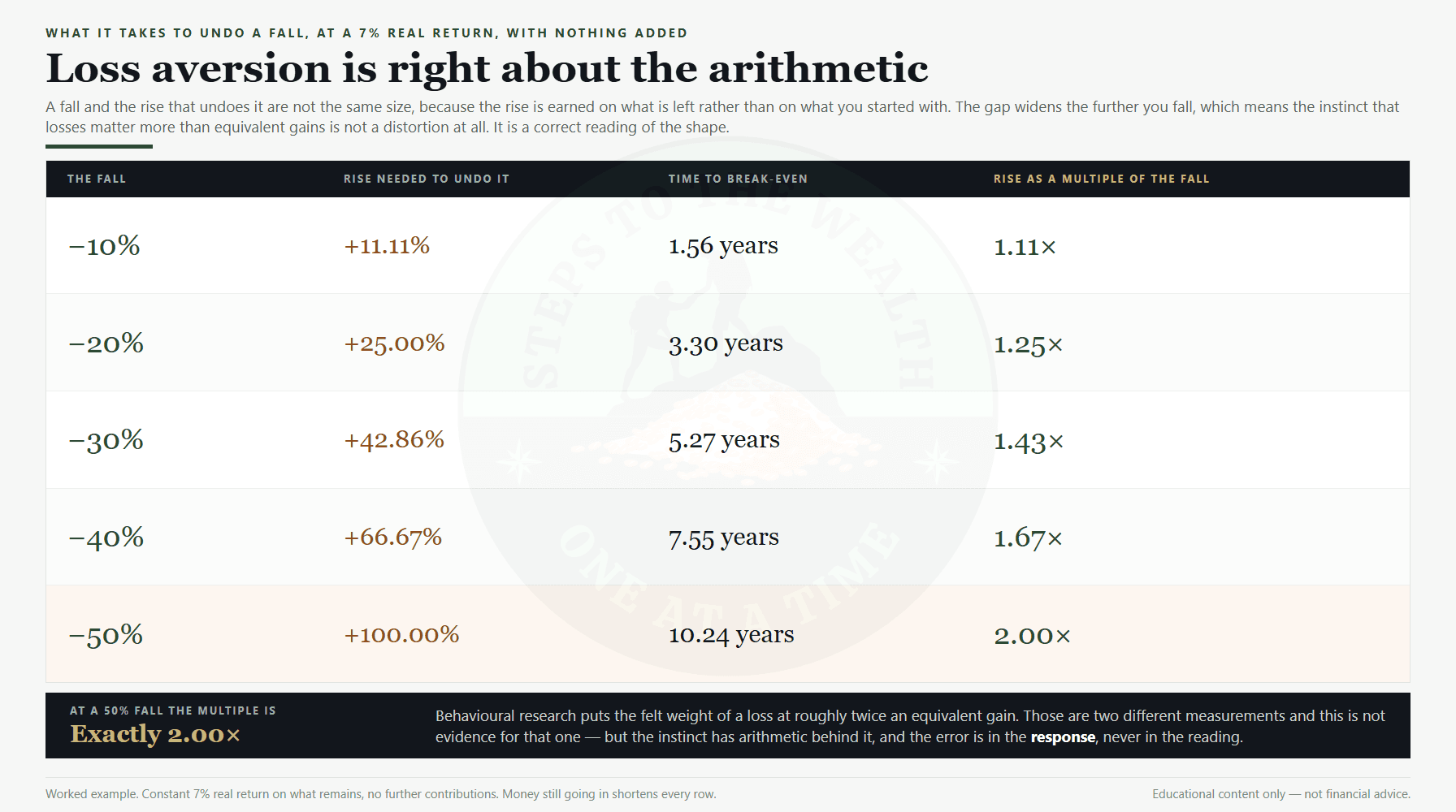
So the instinct is correct about the shape of the problem. What it gets wrong is the response, and it gets it wrong in two directions at once.
It makes people sell after a fall, which converts a price movement into the permanent loss the arithmetic was warning about. It also makes people refuse to sell a position they have decided is broken, because selling makes the loss official.
The substituted number is the current drawdown, standing in for the probability that the loss is permanent. Those are different questions, and the difference between them is most of what risk means.
The structural answer is to decide the response before the fall, because the arithmetic that makes a loss expensive is the same arithmetic that argues for capping how much any single position can take from you in the first place.
Sunk cost: averaging down halves the recovery and raises the loss
This one deserves numbers because both sides of it are true and people only ever hear one.
You own 100 shares bought at $100. That is $10,000 in, and the price has halved to $50, so the position is worth $5,000. To get back to what you paid, the price has to return to $100 — a 100% rise from here.
Now average down. Put in another $5,000 at $50 and you own 200 shares at an average cost of $75. The position is worth $10,000 against $15,000 in. Break-even is now $75, which is a 50% rise from here rather than 100%.
That is a real effect and it is why averaging down feels like the disciplined choice. It halves the climb.
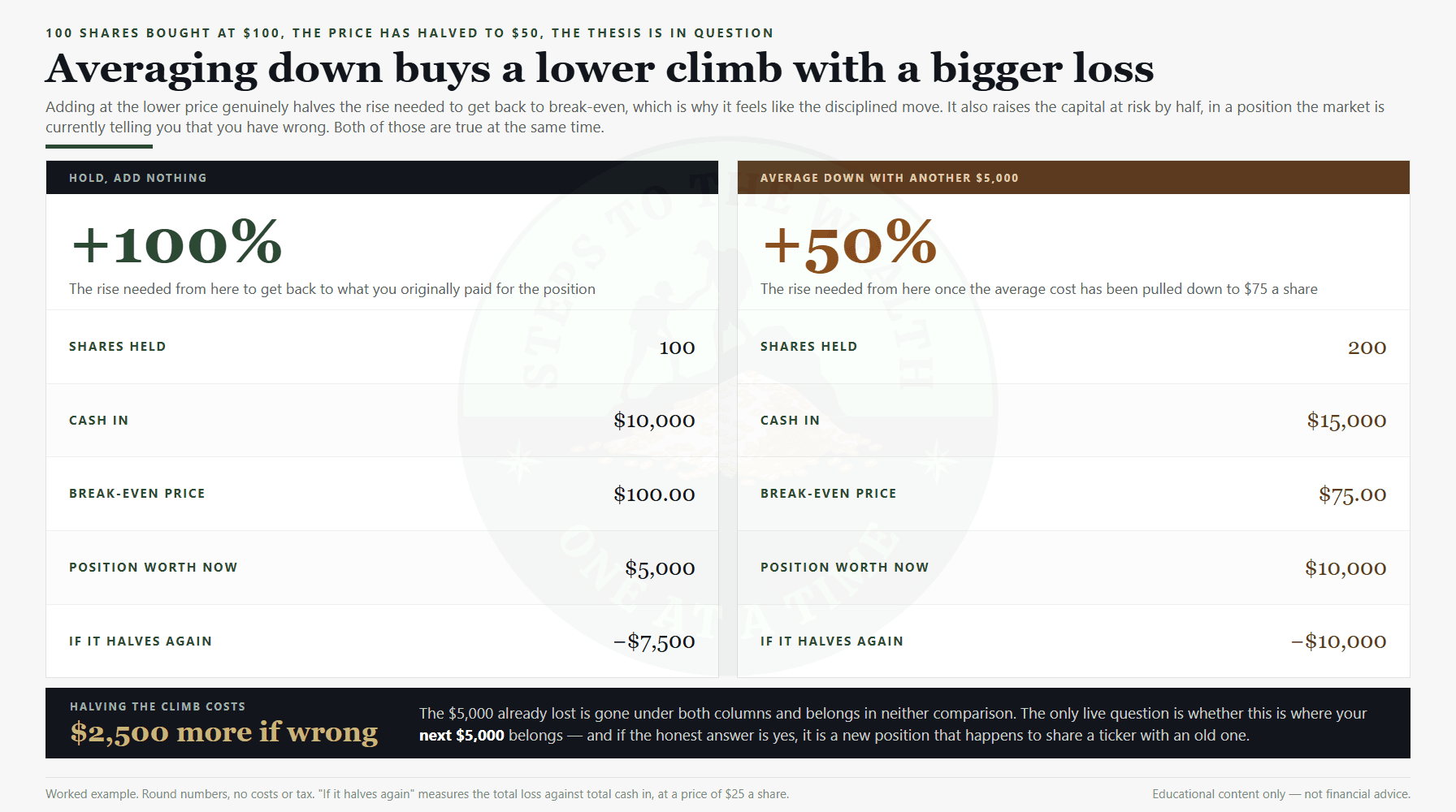
Here is the half nobody quotes. Your capital at risk went from $10,000 to $15,000, a 50% increase, in a position you are currently being told you are wrong about.
If the price halves again to $25, holding only would have lost you $7,500. Having averaged down, you lose $10,000. You bought a lower break-even with a larger maximum loss.
Neither number is the sunk cost. The $5,000 you have already lost is gone under every option and belongs in no comparison. The substituted number is exactly that: money already spent, standing in for money still at risk.
The question that cuts through it is the anchoring question wearing different clothes. If I held nothing here, would this be where I put my next $5,000? Sometimes yes. When the answer is yes, it is not averaging down — it is a new position that happens to share a ticker with an old one, and it gets sized on the same written rules as anything else.
Mental accounting: the portfolio does not know where the money came from
Money is fungible. Every dollar buys the same things as every other dollar. Your brain refuses to believe this and files money by origin instead of by amount.
Gains become “house money” and get risked in ways the original capital never would be. A bonus becomes discretionary in a way that salary is not. A tax refund is treated as found money rather than as your own money returned.
The substituted number is the money’s history, standing in for its size.
The clean test is whether your rules survive relabelling. If a position would breach your cap using salary, it breaches your cap using gains, because the cap is a statement about the portfolio and the portfolio cannot read the labels.
This is also the most common way a carefully built allocation drifts without anyone deciding to change it. Nobody increases their speculative allocation on purpose. They just keep the winnings there, because the winnings feel like they belong there.
The same error runs backwards. Holding cash you have earmarked for something while carrying an expensive obligation elsewhere is the same relabelling in the other direction, and a scheduled review is what catches both.
Recency: the last thing that happened becomes the model
Recency bias substitutes the recent past for the distribution. What makes it hard to see is that it flips direction at both ends and feels like judgement in both.
Near a top, several good years read as evidence that good years are what markets do. Near a bottom, several bad ones read as evidence that the rules have changed. Same mechanism, opposite conclusions, identical confidence.
Two drawdowns in the same index make the point. In 2007 to 2009 it fell 56.78%, needed 131.35% to get back, and did not reclaim the old high until 28 March 2013. In 2020 it fell 33.9% and had reclaimed the high by 18 August 2020 — a round trip of 181 days.
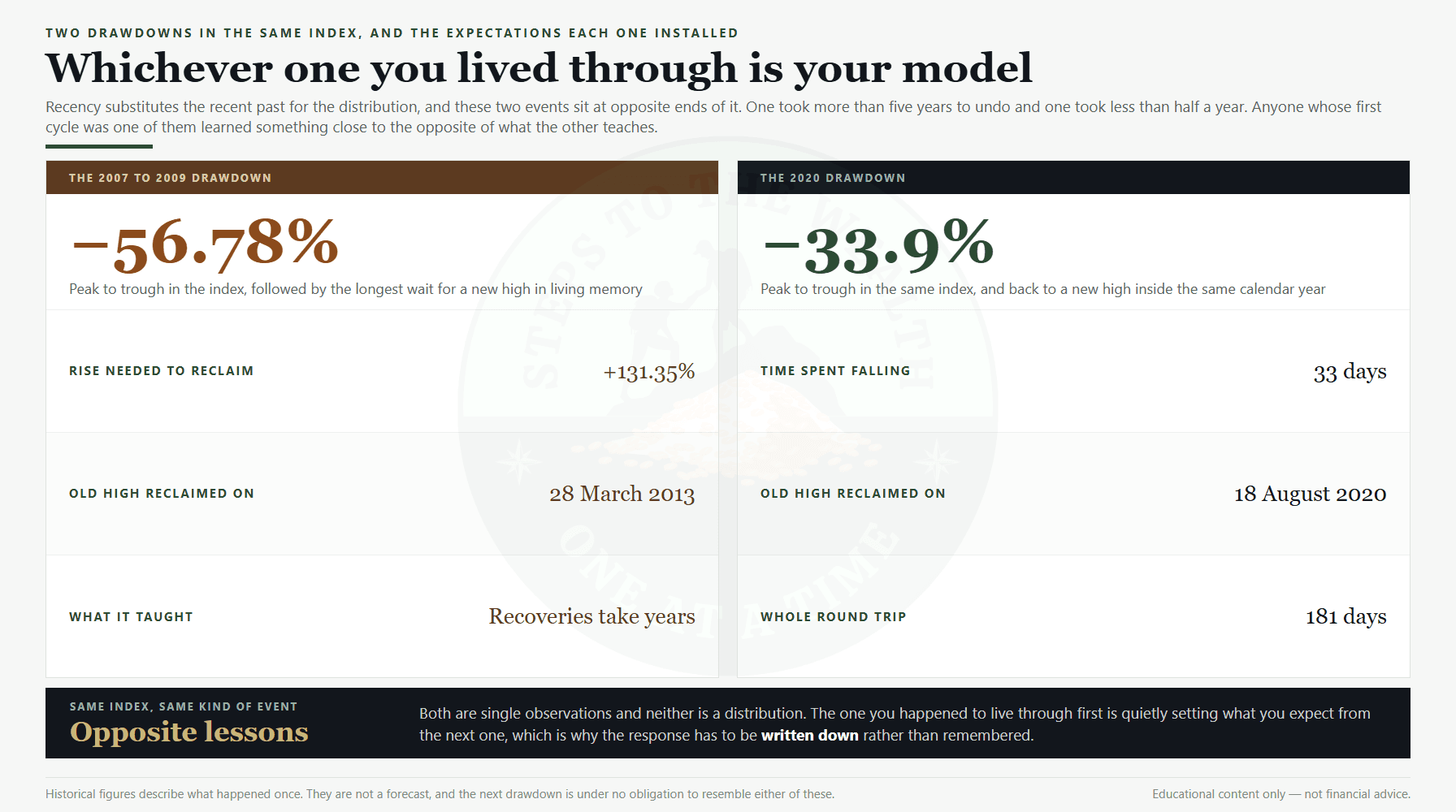
Whichever of those you lived through first is doing quiet work on what you expect from the next one. Someone whose first cycle was 2020 has learned that drops are fast and recoveries are faster. Someone whose first cycle was 2008 has learned something almost opposite.
Both are drawing a distribution from one observation. What each experience actually did was install a default, and the defaults do not announce themselves as beliefs.
Experience does not fix this. Longer experience means more cycles, but the most recent one is still the loudest, which is why the defence has to be written rather than remembered.
Confirmation bias: research that can only agree with you
Confirmation bias is not a failure to do research. It is what research becomes when you already hold the position.
Once you own something, the search terms change. You look up the company’s name rather than its problems. You read the bullish thread to the end and the bearish one to the second paragraph. You count the sources that agree and dismiss the ones that do not as uninformed.
Doing more of this makes it worse, not better. Volume of research is not evidence of quality of research when the search itself is filtered, and it produces conviction rather than accuracy — conviction that then gets used as an input to sizing, which is where it becomes expensive.
The substituted number is the count of confirming evidence, standing in for the strength of the case.
The only defence that works is asking a different question. Not “why is this a good position” but “what would have to be true for this to be a bad one, and how would I know”. If you cannot state what would change your mind, you do not have a thesis; you have an attachment.
Curating inputs honestly is the other half. A feed assembled entirely from people who agree with you is a machine for manufacturing certainty, and deciding in advance what you will ignore is more useful than trying to consume everything.
Coherence is why smart people buy at the top
The seventh is not a bias with a name. It is what happens when the other six agree with each other.
At the top of a cycle, everything is coherent. The price is rising, which confirms the story. The story is everywhere, which confirms the price. People you respect are participating. Recent returns are excellent. Every input agrees.
That coherence is not evidence. It is a description of what a top looks like from the inside, and it is exactly why intelligence offers no protection — a better analyst builds a better-constructed version of the same conclusion from the same filtered inputs.
The emotional inversion is the tell. Buying feels safest when it is most expensive and most dangerous when it is cheapest, because comfort tracks the recent past and price tracks expectations. When a position feels obviously right and requires no argument, that is information about the crowd rather than about the asset.
This is the case for a mechanical reading rather than a considered one. Not because judgement is worthless, but because judgement at the top is downstream of six other things that have already gone wrong.
Why knowing about them changes nothing
You can read this article, agree with all of it, and make every one of these errors next quarter. That is the normal outcome, and it is worth understanding why before reaching for a fix.
The substitution is not a conclusion you arrive at. It has already happened by the time you start thinking. The wrong number arrives feeling like the obvious one, and what follows is not a decision but a justification of something already decided.
That is why “be aware of your biases” fails as advice. Awareness operates on the slow, effortful part of the process, and the substitution happens upstream of it. You cannot catch a step that finished before you started watching.
It is also why the failure clusters at exactly the wrong moment. Every one of these gets stronger under time pressure, under a large drawdown, and when a position is big enough to matter — the three conditions that always arrive together and are always present when the decision is expensive.
There is a second-order version worth naming. Knowing the vocabulary makes you better at explaining why the bias does not apply to you this time. “I know about sunk cost, and this is different” is a sentence produced by the fallacy, not a defence against it.
So the goal is not to think better in the moment. It is to have fewer decisions available in the moment, which is a design problem rather than a discipline problem, and it is the reason a short scheduled review beats attentive watching.
One defence, applied seven ways
Every one of these has the same fix, which is the only reason this is a single article rather than seven.
Write the deciding number down before it matters. A rule made in a quiet week is made by a version of you with no position, no drawdown and no story. That is the version you want deciding.
Notice what that does to each of the seven. Anchoring loses its grip when the cap and the exit are set on the asset rather than on your entry. Loss aversion loses its grip when the response to a fall was decided before the fall. Sunk cost dies to a written sizing rule, because the rule cannot see what you already put in.
Mental accounting dies to a cap expressed as a percentage of the total, which cannot read labels. Recency dies to a written process that outlives the current weather. Confirmation dies to a pre-committed falsifier. And coherence dies to any input that is not a story.
One rule, written once, defeats all seven — not because it makes you unbiased, but because it moves the decision to a moment when the substitution has not happened yet.
You will still feel every one of these. That is not the failure mode. Acting on them is, and the gap between feeling and acting is exactly where a written rule sits. If you would rather have yours named than guess at it, the Operator’s Audit maps which pattern is most likely to be costing you.
What this does not fix
Three honest limitations.
A written rule can be wrong. Removing the emotion from a decision does not make the decision correct; it makes it consistent. Consistency is what lets you find out whether the rule was any good, which is worth more than it sounds and is not the same as being right. There are also conditions where a mechanical reading misleads, and knowing them is part of using one.
Rules get rewritten under pressure. The same mind that substitutes numbers will happily amend a rule at the exact moment the rule becomes inconvenient. The only real defence is that the rule was written down where you can see the amendment happening, which is a much weaker defence than it sounds, and still the best one available.
None of this is a claim about returns. Removing a bias does not add a percentage. It removes a class of self-inflicted error, and what is left is whatever your actual strategy earns. If the strategy is poor, a disciplined version of it is a poor strategy executed reliably.
Run this on your own positions this week
An hour, once, and then it becomes part of a review you already do.
Step one. List every position with its current price and what you paid. Then cover the second column. Ask, for each one, whether you would open it today at today’s price with no history. Note the answers before you uncover anything.
Step two. For every position you would not open today, write the actual reason you are holding it. If the reason contains the words “back to”, the deciding number is your cost basis.
Step three. For each position, write the largest fall you think is genuinely possible and what you would do at that level. Do it now, in writing. The point is not accuracy about the fall; it is that the response exists before the day it is needed.
Step four. Check whether any position is oversized because it grew there or because gains were left in it. That is mental accounting with a price tag, and it is measurable against a real drawdown rather than a matter of opinion.
Step five. For your largest conviction position, write one sentence: what would have to happen for me to conclude I am wrong. If nothing would, size it as the attachment it is.
None of this requires you to stop feeling any of it. It requires the numbers to be written down somewhere a feeling cannot quietly edit them. If the harder part turns out to be doing it rather than knowing it, that gap is what The Operator’s Mindset is built around: fifteen lessons, $99 one-time.
The research on this is worth reading first-hand. Barber and Odean’s study of 66,465 households is the standard reference on what acting on these instincts costs, and Morningstar’s four behavioural investor types is a reasonable way to find which of the seven is most likely to be yours.
Related reads
- What the small leaks actually cost
- What a position cap costs and what it buys
- Recovering from a big loss
- Which kind of investor you are
- All the calculators, in one place
Educational content only — not financial advice. Worked examples use round numbers for clarity and ignore costs and tax, which are set by the jurisdiction in which you live. Historical drawdown and recovery figures describe what happened once and are not a forecast. Past performance does not predict future results.