
Position sizing in a bull market is the hardest sizing problem there is, and it is hardest for a reason almost nobody warns you about. A crash is difficult in an obvious way: prices fall, fear rises, and the framework asks you to keep buying anyway. A long bull is difficult in a hidden way. It rewards, month after month, the exact behaviour that will eventually cost you the most.
Here is the shape of it. In a sustained uptrend, every decision to hold looks brilliant in hindsight. You held through the wobble in the spring and you were right. You did not trim in the summer and the position ran another 20%. You ignored the cautious voices and the cautious voices kept being wrong. The lesson the market appears to teach, over and over, is that holding more, for longer, with less caution would have made you more money.
By the time you are deep into a bull you have been trained. Conviction is at its highest, because it has been validated dozens of times in a row. Discipline is at its lowest, because every instinct toward caution has been punished by an asset that simply kept going up. That is the setup: maximum conviction, minimum discipline, arriving at precisely the moment the framework is about to ask you to do the uncomfortable thing.
Educational content only. Not financial advice.
Nobody decided to concentrate
Start with the part that happens while you are doing nothing at all.
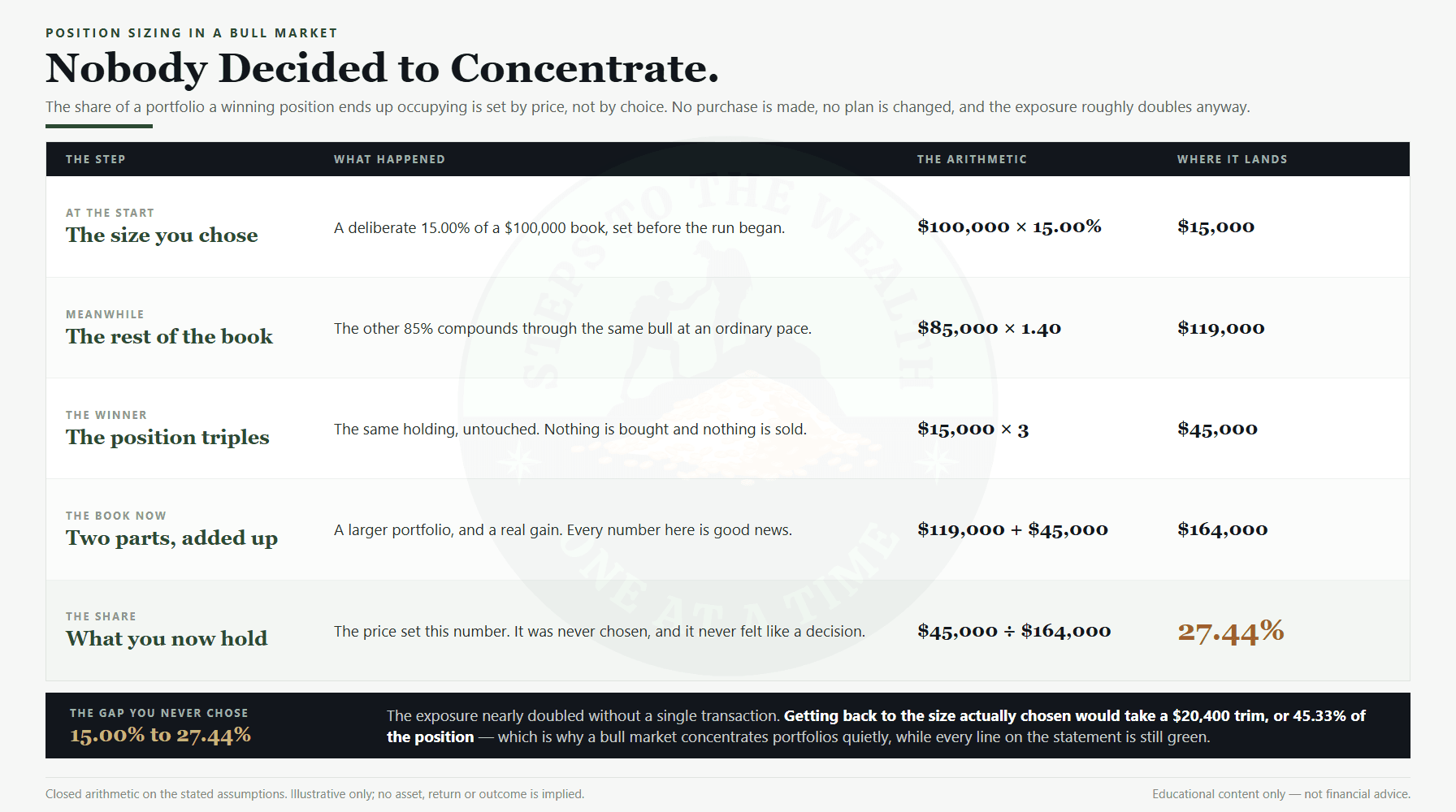
Say you sized a position at a deliberate 15.00% of a $100,000 portfolio. Over the run the other $85,000 compounds at an ordinary pace and reaches $119,000. The position you sized triples, from $15,000 to $45,000. Nothing was bought. Nothing was sold. The plan was never changed.
The portfolio is now $164,000, and that single position is $45,000 of it. Divide one by the other and it is 27.44%. You chose 15.00% and you are carrying 27.44%. Getting back to the size you actually picked would take a $20,400 trim, which is 45.33% of the position.
Read that last line again, because it is the whole problem in one number. Nearly half the position would have to go just to return to the exposure you consciously selected. And at no point did a decision get made. Every line on the statement is green. The concentration arrived dressed as success.
This is the first of two things a bull changes without asking. The second is your judgement. The longer a trend runs, the more your brain treats “up” as the natural state of the world, and a sustained rally is the ideal habitat for that bias. You start extrapolating. An asset that has compounded for two years feels like it will compound for two more, not because conditions support it, but because that is the only recent experience you have.
Put the two together and you get the core of it: in a long bull, your actual exposure rises at the same time your perceived risk falls. The position gets bigger and the danger feels smaller. Where those two lines cross is where working professionals do the most damage to themselves, and they do it feeling clever rather than frightened.
Conviction is the most expensive input you own
There is a word that shows up everywhere in a bull market: conviction. “I have conviction in this position.” “High-conviction bet.” It sounds like a virtue. As a sizing input it is a liability.
Conviction is a feeling about the future. It is the sense that you know how this plays out. The trouble with using a feeling as a sizing input is that the feeling is strongest exactly when it is least reliable: at the end of a long run, after a streak of validation, when sentiment is crowded and everyone around you holds the same view.
A risk-first framework has no field for conviction. It reads conditions: valuation extension, sentiment, price extension relative to trend, and the underlying signal. None of those inputs ask how strongly you believe. They describe the present. In a sustained bull those conditions are usually saying something conviction does not want to hear.
The evidence on what conviction does to real portfolios is not new. Barber and Odean’s study of 66,465 households over 1991 to 1996 found the market returned 17.9% a year while the average household made 16.4%, and the busiest fifth of traders made 11.4%. That is 1.5 points lost by the average investor and 6.5 points lost by the most active. Their full paper is public, and the mechanism it describes is conviction converted into activity.
Morningstar’s work on behavioural investor types makes a related point from another angle: the failure modes are stable and predictable per person, which is exactly why a rule beats a judgement call in the moment.
The reframe is simple and it is uncomfortable. Your job in a bull is not to act on conviction. It is to notice that high conviction is itself a signal to check your sizing, not to increase it.
Position sizing in a bull market is an output, not a reward
Under a rules-based framework, position size is not something you choose based on how a position has performed. It is an output of where the risk reading currently sits.
That distinction carries the entire argument, so here it is made concrete.
The losing approach sizes off the streak. “This has been my best performer, so I will let it run and maybe add on strength.” The size grows because the asset has been winning. That is momentum dressed as strategy, and it concentrates the portfolio into precisely the asset that is most extended.
The framework approach sizes off the reading. As an asset runs and conditions stretch, the reading climbs. Higher readings call for less exposure, not more. So as the bull matures, the framework is steadily reducing the allocation it wants you to hold, in increments, through the exit ladder. The streak is irrelevant to the decision.
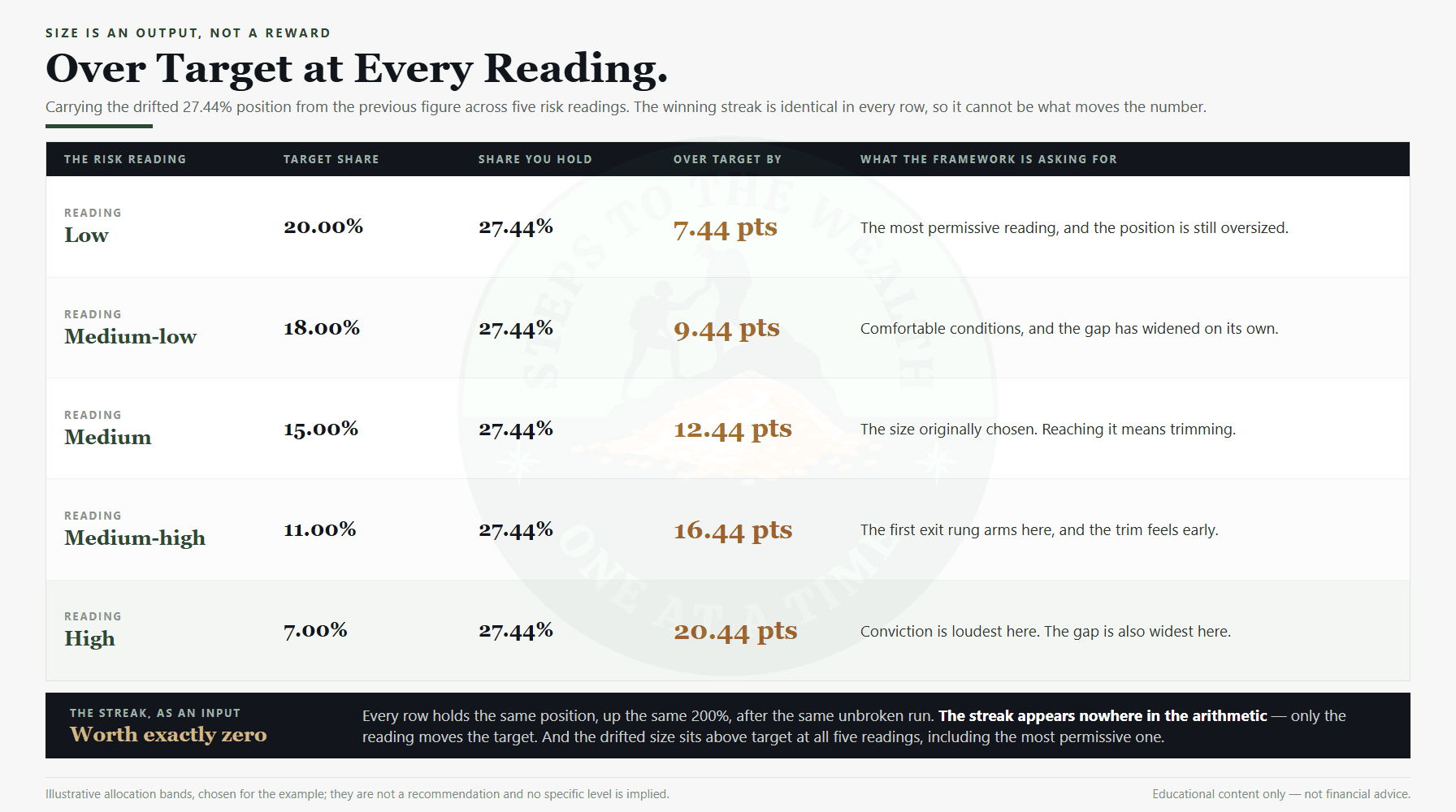
Carry the drifted position from the first figure across the whole risk range and something worth sitting with appears. At a LOW reading, the most permissive setting there is, the target might be 20.00% and the position is 7.44 points over it. At MEDIUM, the size originally chosen, it is 12.44 points over. At HIGH it is 20.44 points over.
There is no reading at which that position is correctly sized. Not one. And a streak column would read the same in every row, because the streak is not part of the arithmetic anywhere.
Here is the part that feels backwards and is the actual point: the better a position has done, the more likely the framework wants you trimming it rather than adding. Not because winning is bad, but because a long run is usually what produces a high reading in the first place. Strong performance and elevated risk are frequently the same phenomenon seen from two angles.
Trimming a winner is not a prediction that it is over
The single biggest objection to trimming in a bull: “If I trim and it keeps going up, I have made a mistake. I left money on the table.”
That frame is wrong, and it is worth dismantling carefully, because it is the thought that keeps people fully exposed straight through a top.
Trimming under a framework is not a prediction that the asset is finished. You are not calling the top. You are reducing risk that has grown beyond what the reading supports. Those are different actions, even though they look identical from the outside.
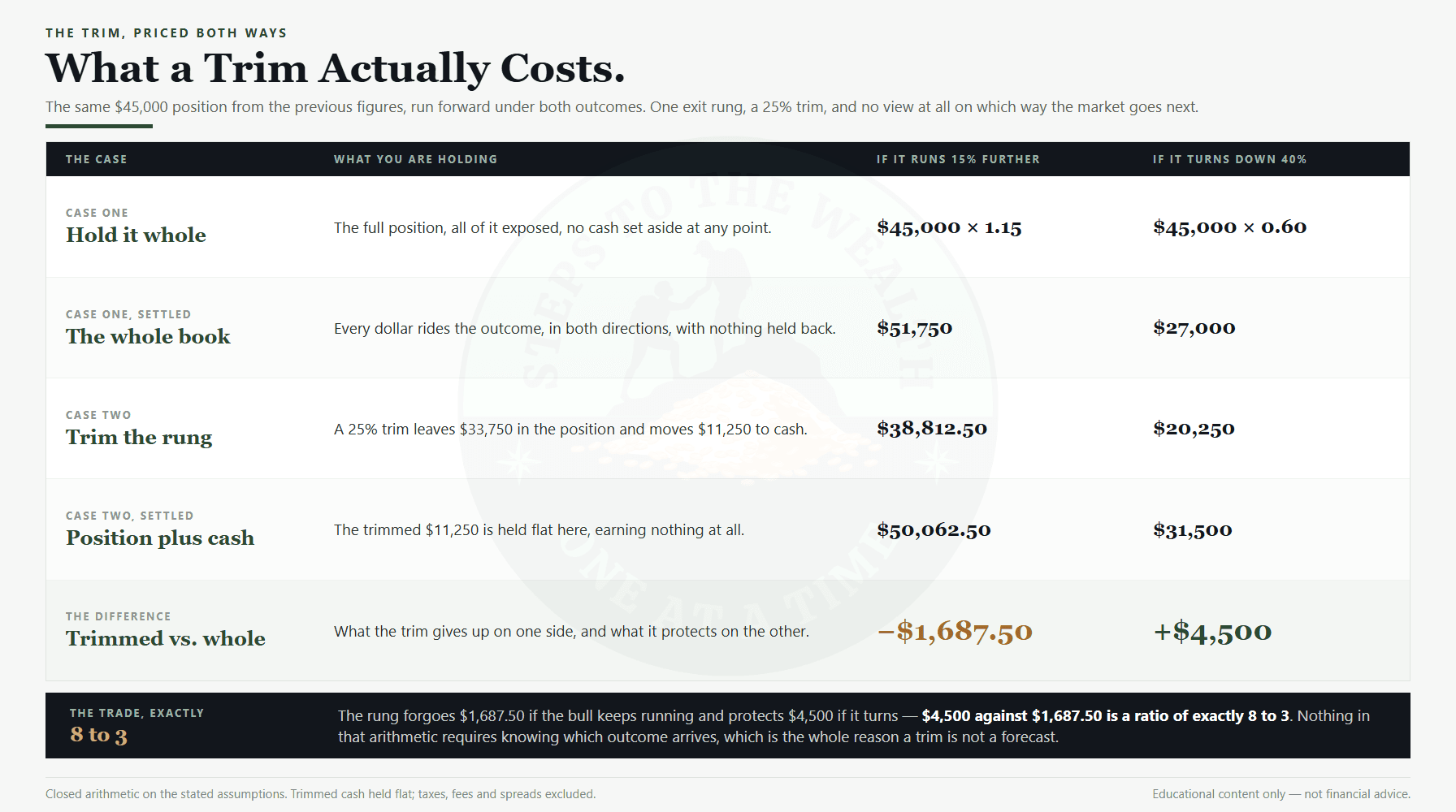
Price it. The position is $45,000 and the first exit rung calls for a 25% trim: $11,250 to cash, $33,750 left invested.
If the bull runs another 15%, the whole position would have been worth $51,750. The trimmed book is worth $38,812.50 plus $11,250 in cash, or $50,062.50. You gave up $1,687.50.
If the market turns and the asset falls 40%, the whole position would be worth $27,000. The trimmed book is worth $20,250 plus $11,250, or $31,500. You protected $4,500.
So the trade is $4,500 against $1,687.50, which is a ratio of exactly 8 to 3. And the trimmed cash is held completely flat in that comparison, earning nothing, which understates the case rather than flattering it.
The “money on the table” complaint only works if the alternative were free. It is not. Holding full exposure into a stretched reading buys upside with a much larger downside, on a position that is already bigger than the plan called for. The trim is not a cost. It is the price of not being catastrophically exposed when the run ends, and runs always end, even if nobody can say when.
Nothing in that arithmetic requires knowing which outcome arrives. That is the whole reason a trim is not a forecast.
The discipline tax of a long bull
Every bull market collects a discipline tax, and the longer it runs, the higher the rate.
Early on, sizing discipline is easy. Readings are low, the framework says deploy, and deploying feels good because the asset is rising. Your incentives and the framework’s instructions point the same way. There is no tension at all.
The tension builds as the bull matures. Now the framework says trim into strength, and every trim feels premature because the asset keeps proving you early. The discipline required rises every month, because every month adds another data point to the pile saying holding more would have been better.
This is the mirror image of the problem in a drawdown. There, the framework asks you to buy when it feels terrible, which is the pattern behind the recoveries in the 2008 financial crisis and the 2020 COVID crash. Here, it asks you to trim when it feels unnecessary. Both work against your conditioning. The bull is just sneakier, because the conditioning feels like wisdom rather than fear.
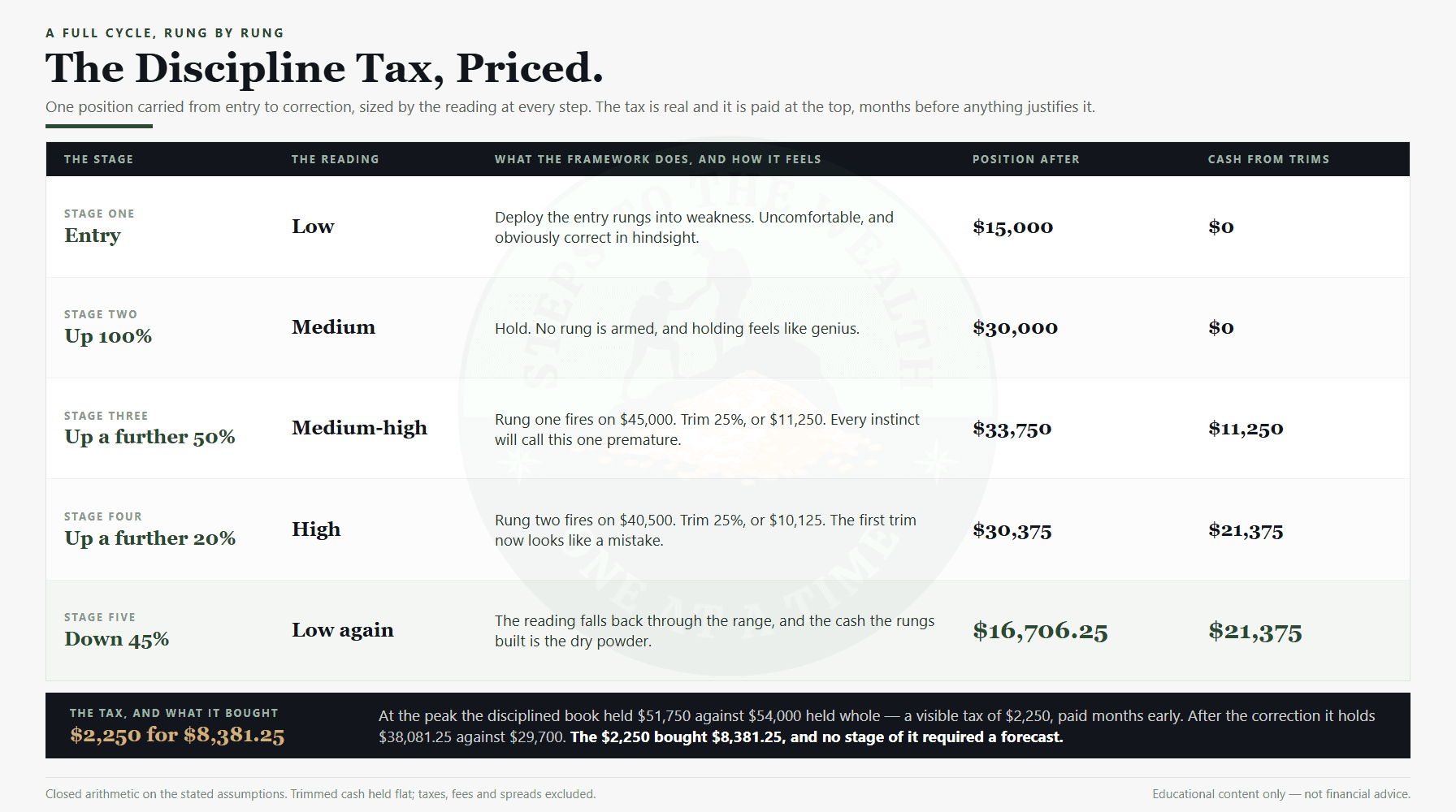
Run the whole cycle and the tax becomes visible. A $15,000 entry at a LOW reading doubles to $30,000 at MEDIUM, with no rung armed and nothing to do. It runs another 50% to $45,000, the reading hits MEDIUM-HIGH, and rung one trims $11,250. It runs another 20% to $40,500, the reading hits HIGH, and rung two trims $10,125.
At that peak the disciplined book is worth $51,750 against $54,000 if you had held it whole. The tax is $2,250, and it is real. You paid it months before anything justified it, and you felt it every single month.
Then the asset falls 45%, the way runs eventually do. The disciplined book holds $16,706.25 in the position plus $21,375 in cash, or $38,081.25. Held whole, it is $29,700. The $2,250 tax bought $8,381.25 and a cash pile that is now dry powder at a low reading.
No stage of that required a forecast. The size tracked the reading the entire way, larger when risk was low and smaller when risk was high, instead of tracking the winning streak.
The structural defence is the same one that makes investing while working full time workable in the first place: move the decision off your in-the-moment judgement and onto the reading. You do not decide each week whether the bull has more room. You read the level, you execute the rung the level calls for, and you close the app.
The investors who give back the most in a correction are rarely the ones who never had a plan. They are the ones who had a plan and abandoned it three-quarters of the way up, because by then the plan had been “wrong” so many times that following it felt foolish. The discipline tax is highest right before it pays off.
Five rules for sizing while the bull runs
None of these require a view on where the market goes next. That is deliberate.
- Measure the drift before you judge the position. Once a quarter, divide each position by the current portfolio total and compare it to the number you chose. If the chosen number was never written down, that is the first job, not the sizing.
- Treat high conviction as a prompt to check, not to add. When a position feels obviously right, that is the moment to look at the reading rather than the chart. Conviction is downstream of price action, and price action is the thing that is stretched.
- Size to the reading, in increments. Rungs exist so you never have to call a top. A trim of 20% to 25% at a rung leaves most of the position running and still moves your risk materially.
- Price the trade both ways before you skip a rung. Write down what the trim gives up if the run continues and what it protects if it does not. When the second number is a multiple of the first, the decision stops being about nerve.
- Never override a rung on the strength of a streak. A winning streak is not information about the future. If a rule is going to be broken, the reason has to be a change in the inputs, not a change in how you feel.
If you want to see how the mechanics behave over real historical periods rather than in the abstract, the DCA simulator runs contribution schedules against actual price history, and the paid edition adds exit strategies and drawdown statistics. The black swan replay does the complementary job: it shows what a given allocation did through crashes that already happened, which is the honest way to think about the downside a stretched position carries.
What this is not
This is not an argument for trimming early and often out of nervousness. The framework does not ask you to start cutting the moment a position turns profitable. It asks you to size to the reading, which in the lower half of the range means staying fully invested even while you are up. Trimming at a low reading because something has “done well” is the fearful mistake in reverse. The reading governs, not the gain.
It is also not a system for maximising returns at the top. You will leave some upside behind by trimming into a bull. That is not a flaw, it is the explicit trade: a little less upside in exchange for not being over-exposed when the cycle turns. If the goal is to extract the absolute maximum from every rally, this is the wrong framework. If the goal is to compound across many cycles without a catastrophic drawdown resetting you, the trim is how you get there.
It is not a diversification argument either. Spreading a stretched position across several correlated assets does not reduce the exposure that matters, which is the point of a proper portfolio stress test. The US Securities and Exchange Commission’s investor education material on asset allocation is a reasonable plain-language starting point if the vocabulary is new.
It is not an argument about timing your entries, either way. Whether you deploy in one go or over months is a separate question, covered in lump sum versus DCA and in the myths about dollar-cost averaging. Sizing is what you do with a position once you already hold it.
And it is not confined to equities. The same drift happens faster in anything volatile, which is why a single crypto position can dominate a book inside a year. The 2021 to 2022 bitcoin drawdown is the cleanest recent example of what an unmanaged size does on the way back down.
Finally, it is not personalised advice. How much to hold in any single asset, how aggressively to trim, and how to handle the tax consequences of trimming in a taxable account all depend on your situation, not on a generic rung size.
The moment the framework earns its keep
The hardest sizing decisions do not happen in the crash. They happen three-quarters of the way up a long bull, when you are up big, your past restraint looks like timidity, and every trim feels like a mistake you will regret by Friday.
That is the moment the framework earns its keep. Conviction is peaking and it is the least reliable input you have. Your position has grown past what you chose and it never felt like a decision. The reading is climbing while the danger feels like it is shrinking.
Size to the reading, not the streak. Take the rungs even when the trim feels premature, and especially then. You are not predicting the end of anything. You are refusing to let a winning position quietly grow into a risk you never agreed to take.
The cost of that discipline is small and visible. The cost of skipping it is large and arrives all at once, which is the same asymmetry that makes waiting and the opportunity cost of time so expensive at the other end of the cycle. If you are tracking whether you are on pace at all, retirement savings by age and lifestyle creep against your savings rate are the two numbers that move it most, and neither is helped by carrying a position twice the size you meant to.
The bull rewards the behaviour that eventually hurts you. A framework is what stops you learning the wrong lesson from it.
If you want the sizing and risk work as it happens rather than after the fact, the newsletter is where it goes out.
Educational content only. Not financial advice. Position sizing, trim levels and tax treatment vary by individual circumstance. Work with a qualified financial professional to apply any of this to your specific situation.