
Negotiating equity compensation is, for most working professionals at a growth-stage or listed employer, the largest single financial decision they will make in a given year. It is larger than the fund they pick, larger than the account they pick, and in most cases larger than the amount they manage to save out of salary. And it is the one decision they routinely accept as presented.
The pattern is consistent. The recruiter names a grant value. The candidate pushes on base salary, because base salary is the number they know how to argue about. The equity number is accepted whole, because it arrives wearing the language of a gift rather than the language of pay. Six months later the same person discovers that a colleague who joined the same month, at the same level, has a materially different package — and the difference is almost never the headline number. It is the terms attached to it.
What equity compensation actually is
Equity compensation is deferred pay, denominated in something you cannot spend, on a schedule you do not control, at a price nobody can quote you. That is the whole definition, and every useful move in the negotiation follows from it.
The three common forms behave differently. Restricted stock units are a promise of shares once a vesting condition is met; there is no purchase decision and, at a listed company, usually no liquidity problem. Options give you the right to buy shares later at a price fixed today, which means they can be worth a great deal or exactly nothing.
Incentive stock options and non-qualified stock options are both options but sit in different tax treatments, which the IRS sets out in Topic No. 427, and the SEC’s plain-language glossary entry on employee stock options is a reasonable place to start if the vocabulary is new. Investopedia’s explainer on restricted stock units covers the RSU side in similar depth.
Say the definition out loud before the call, because it changes what you ask for. “Thank you for the ownership opportunity” and “let us calibrate the deferred portion of the package” lead to two entirely different conversations, and only one of them gets you anything.
Why negotiating equity compensation is harder than negotiating salary
Three structural reasons, and none of them is about your nerve.
The number has no public anchor. Base salary has benchmarks a candidate can cite in a sentence. An equity grant has at least six dimensions, each of which changes what the headline is worth, and no external source publishes the combination for your level at your employer. You are arguing about a figure only one side of the table can price.
The information sits entirely on the company’s side. They know the band for your level, the last round’s valuation, the expected dilution over the next two rounds, and whether refresh grants are policy or favour. You know one number: yours. That is not a negotiation, it is a quote.
The framing suppresses the ask. Equity is presented as participation in something rather than as compensation for something. Pushing back on a gift feels ungracious. Pushing back on deferred pay does not. Nothing about the underlying instrument changes when you reframe it — only your willingness to price it does.
The fix is not to push harder. It is to push on the dimensions that move, in language the other side recognises as informed. This is the same discipline that makes the rest of a professional’s financial life work: decide the rules before the moment arrives, so the moment does not decide for you. It is the approach behind investing while working full time, and it applies here with more money attached.
The nine levers, and how far each one actually moves
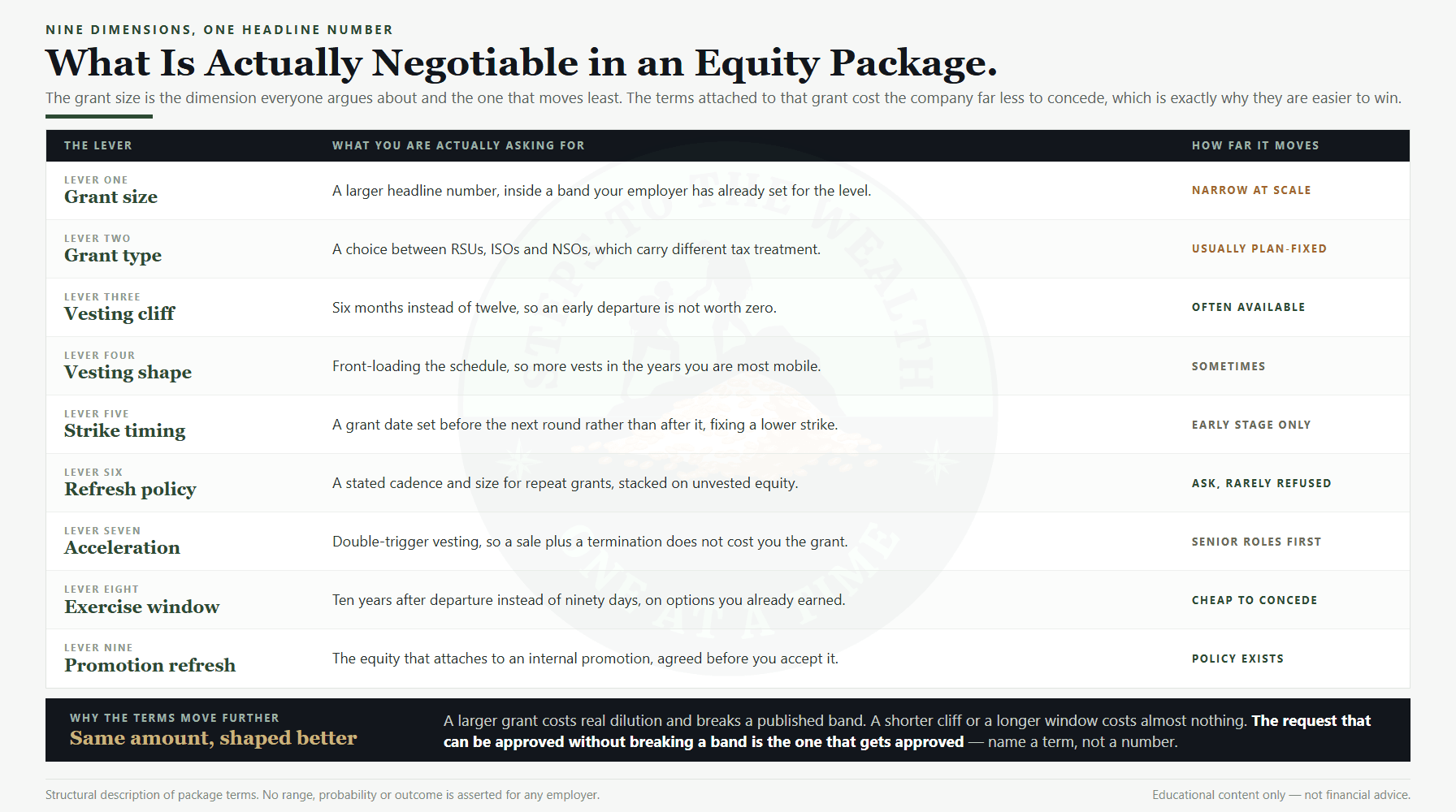
Almost everyone treats the negotiation as one-dimensional. It has nine dimensions, and the one everybody fights over has the narrowest range.
1. Grant size. The visible number. Real but banded, especially at larger employers, where the range at your level may be plus or minus 10 to 20 per cent and genuinely capped by policy. At earlier-stage companies the range is much wider. Ask for it, but do not spend the entire conversation there.
2. Grant type. RSUs, ISOs or NSOs. Frequently fixed by plan at a listed employer; sometimes genuinely open at an early-stage one. Where there is a choice, the tax difference is not cosmetic.
3. The vesting cliff. The most under-negotiated term in the entire package, and the one with the cleanest arithmetic. Covered in dollars below.
4. The vesting shape. Four years, monthly after a one-year cliff, is a convention rather than a law. Front-loading — 30 per cent in year one instead of 25 — is occasionally available and is worth real money if you are mobile.
5. Strike price timing. For options, the strike is set by the valuation in force on the grant date. A grant dated before a funding round carries a lower strike than the same grant dated after it. Start dates and grant dates are administrative, and administrative things can be moved.
6. Refresh policy. The largest equity outcomes over a career come from repeat grants, not the first one. Almost nobody asks about refresh at offer stage, which is why almost nobody knows whether their employer stacks refreshes on top of unvested equity or lets them replace it.
7. Acceleration. Single-trigger vests on a change of control; double-trigger vests on a change of control plus termination. Double-trigger is close to standard for senior roles and obtainable more often than people assume below that, particularly where an acquisition is plausible inside your vesting window.
8. The post-departure exercise window. Ninety days is the default and it is brutal at a private company. Ten-year windows exist. This is the second lever with clean arithmetic, and it is also below.
9. Promotion refresh. What the equity does when you are promoted internally. There is usually a policy. It is usually not volunteered.
Levers 3, 5, 6, 8 and 9 cost the company far less than a grant increase and are therefore easier to get. That is the whole insight. You are not asking for more; you are asking for the same amount, shaped better.
What the vesting cliff is worth in dollars
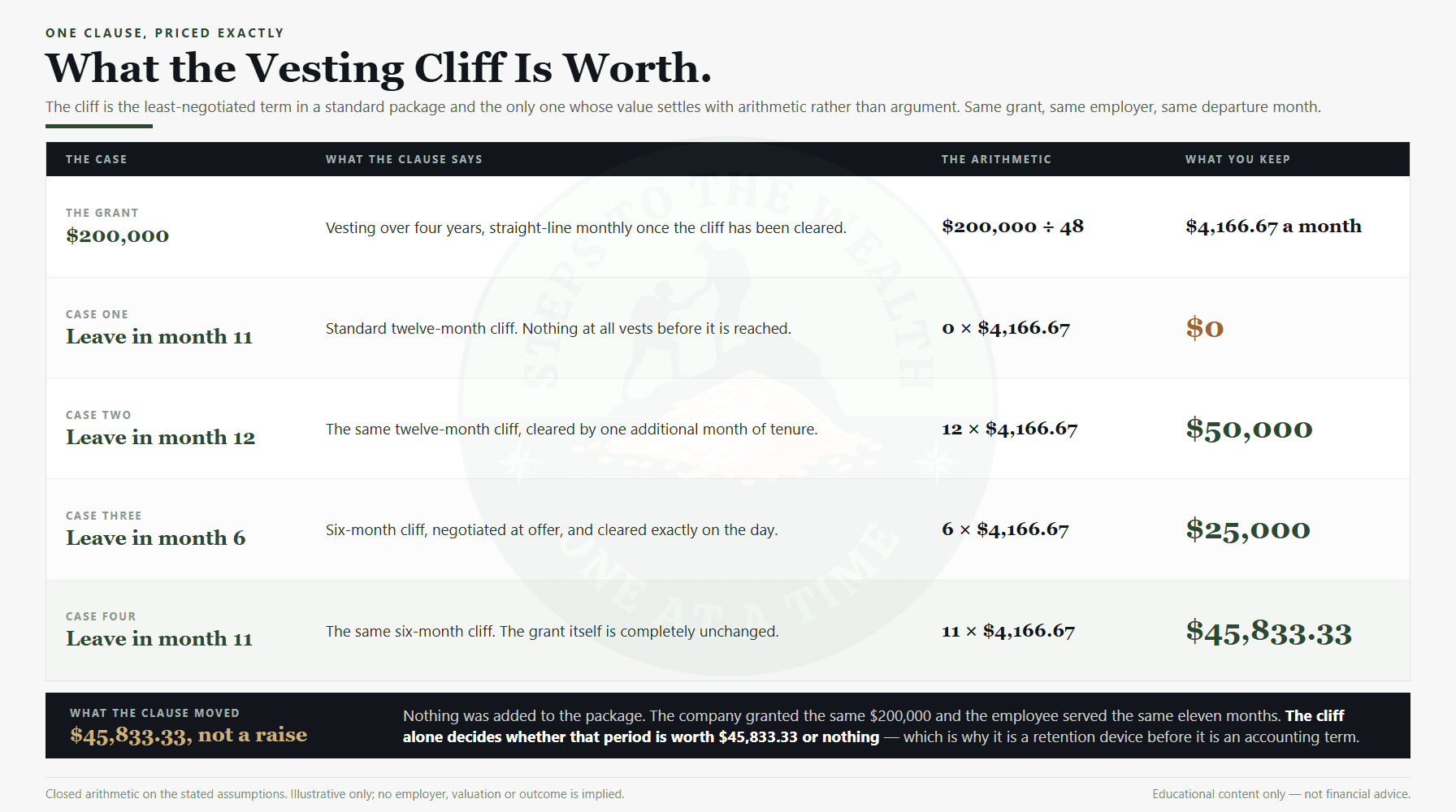
Take a $200,000 grant vesting over four years, straight-line monthly once the cliff is cleared. That is $200,000 ÷ 48 = $4,166.67 of value accruing every month you are there.
Under a standard one-year cliff, an employee who leaves in month 11 receives nothing. An employee who leaves in month 12 receives 12 × $4,166.67 = $50,000. One month of tenure is worth $50,000, and that discontinuity is the entire point of the term — it is a retention device, priced in your money.
Negotiate the cliff down to six months and the same month-11 departure produces 11 × $4,166.67 = $45,833.33 instead of zero. The grant did not change. Nothing was added to the package. A single clause moved $45,833.33 from a cliff-shaped hole into your account.
Whether that clause is worth pursuing depends on how mobile you are. If you are joining a company you expect to stay at for a decade, the cliff is close to irrelevant. If you are joining a young company where the failure rate is high and your own exit is plausible inside two years, it is the most valuable term on the page. The calculation is the same one that governs whether a degree is worth its true cost: the sticker figure is not the decision, the structure around it is.
The exercise window is the lever nobody prices
This one only bites at private companies, and when it bites it is severe.
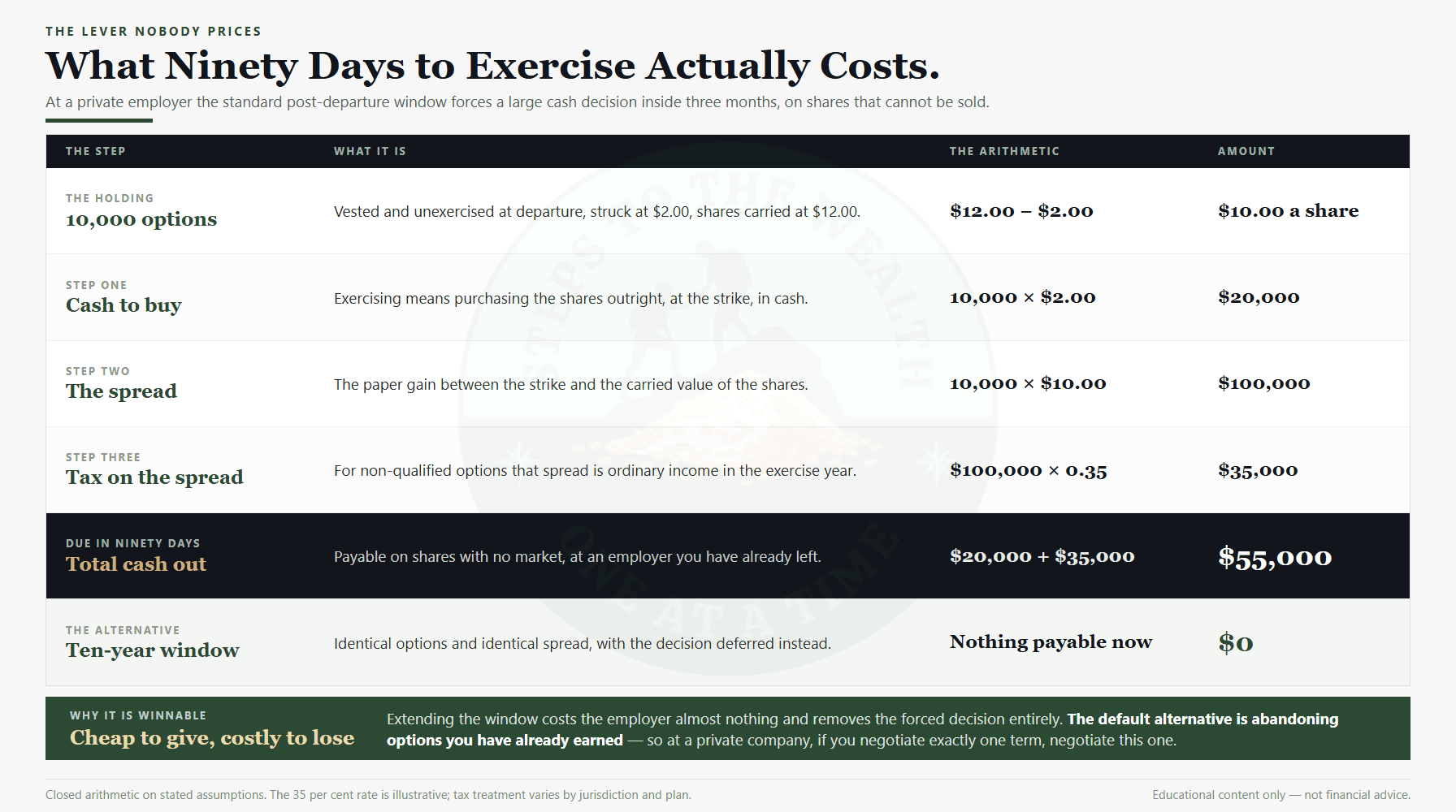
Suppose you hold 10,000 vested options at a $2.00 strike, and the current valuation puts the shares at $12.00. You leave. Under the standard 90-day rule you must decide inside three months whether to buy.
Buying costs 10,000 × $2.00 = $20,000 in cash. The spread is 10,000 × ($12.00 − $2.00) = $100,000, and for non-qualified options that spread is ordinary income in the year you exercise. At an illustrative 35 per cent marginal rate that is $100,000 × 0.35 = $35,000 of tax. So the exercise costs $55,000 in cash, this year, on shares you cannot sell, in a company you no longer work for, valued at a number nobody is obliged to honour.
The alternative under that rule is to walk away from options you already earned.
A ten-year post-departure window costs the company almost nothing and removes the entire problem: the decision moves to a point where there may actually be a market. If you are joining a private company and you negotiate exactly one term, negotiate this one.
Tax treatment here is jurisdiction-specific and plan-specific, and the 35 per cent above is an illustration rather than a rate that applies to you. The arithmetic of the cash requirement, though, does not vary: strike times quantity is due in the window, whatever your tax position.
What dilution and refresh grants do to the headline number
Two forces work on the grant after you sign, and both are invisible at offer stage.
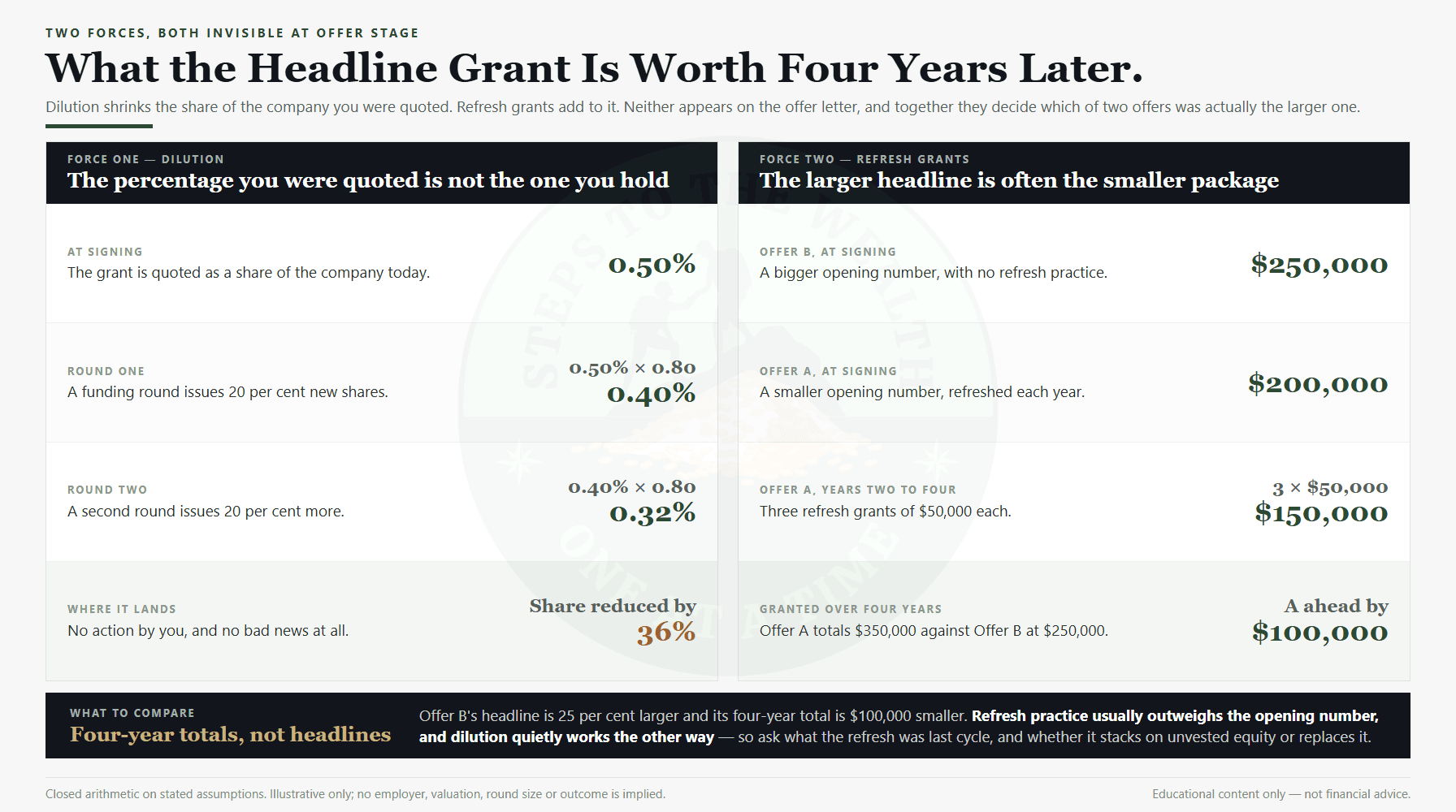
Dilution first. Suppose the grant represents 0.50 per cent of the company. Two subsequent rounds each issue 20 per cent new shares. Your position becomes 0.50% × 0.80 × 0.80 = 0.32% — a 36 per cent reduction in your share of the company, with no action by you and no bad news at all. Dilution is what a healthy financed company does. It just means the percentage you were quoted is not the percentage you will hold.
Refresh grants push the other way, and they push harder. Compare two offers. Company B grants $250,000 up front and has no refresh practice. Company A grants $200,000 up front and refreshes $50,000 a year in years two, three and four. B’s headline is 25 per cent larger. A’s four-year total is $200,000 + $150,000 = $350,000 against B’s $250,000 — $100,000 more, from the offer that looked smaller.
That is why the refresh question is the highest-value question at offer stage, and why it has to be asked precisely. Not “do you do refreshes” — everyone says yes. Ask what the typical refresh is as a percentage of the initial grant at this level, whether it stacks on unvested equity or replaces it, whether it is policy or discretionary, and what it was last cycle.
The information to gather before negotiating equity compensation
Six items. None of them requires inside information, and having them is the difference between a request and a case.
→ Stage and last round. What was raised, at what valuation, when. Public for most funded companies.
→ Dilution outlook. How many more rounds are likely before an exit, and what the company expects to issue.
→ The band at your level. Peers, recruiters and levels data. Approximate is fine; absent is not.
→ Refresh practice. The four questions above, asked directly.
→ Exit pathway. Listing, acquisition, or private indefinitely. This determines whether the exercise window matters at all.
→ Your alternatives. A real competing offer, or an honest assessment of what one would look like.
Preparation time is the cheapest input in this entire exercise, and it is the one people skip. Five to ten hours of it, against a package that runs for four years, is an unusually good trade — and the reason it gets skipped is the same reason people misprice everything else about their own time. That is the subject of what an hour actually costs, and it applies with unusual force here.
How to frame the ask so it lands
The framing does more work than the wording. Four phrasings that tend to survive contact with a compensation team:
→ “I am trying to understand how this compares to the band for this level.” An information request, which is much harder to refuse than a demand.
→ “Can you walk me through the refresh philosophy, so I can think about this across four years rather than year one?” This moves the conversation onto the axis where the money actually is.
→ “I would like to understand the dilution outlook so I can model what this grant might represent at exit.” Signals that you know what to ask, which changes how you are answered.
→ “I am not asking for a larger headline number. I would like to see whether there is flexibility on the cliff.” Narrow, cheap, and specific — the three properties that get a yes.
The last one matters most. A request the other side can grant without breaking a band is a request they can actually take to their approver. “More equity” is not that. “A six-month cliff” is.
When the equity number will not move at all
Sometimes the band is real and immovable. That is not the end of the negotiation; it just relocates it.
→ Sign-on cash. Usually the most flexible line in the whole offer, because it is a one-off and does not disturb the structure.
→ Base salary. Occasionally easier to move than equity, particularly when equity is policy-bound.
→ Level. A higher level carries a structurally higher band at every future review, which compounds in a way a one-time grant does not.
→ Terms on the fixed grant. When the amount cannot move, the clauses attached to it often still can. See the nine levers.
→ Review timing. A six-month review instead of a twelve-month one pulls the first refresh forward by half a year.
An offer that “cannot move” almost always has an adjacent dimension that can. Finding it is the job.
The one test to run before you sign
Everything above is preparation. This is the decision.
Would you take this job at this base and this sign-on if the equity turned out to be worth zero?
If yes, the equity is upside and you can negotiate it calmly, because you are not dependent on the answer. If no, you are being paid in a lottery ticket and calling it a salary, and the correct response is to fix the cash side or decline — not to talk yourself into a valuation.
The test works because it strips out the one variable nobody can forecast and leaves only the ones that are contractual. It is the same structural move as deciding what you can lose before deciding what you might make. Risk first, return second, in that order, every time.
Two supporting checks are worth running alongside it. What is the four-year total including refresh assumptions, not the year-one figure. And what happens to the household if this employer has a bad two years — a question that is easier to answer honestly with a partner in the room than alone, which is part of why household alignment is not a compatibility score but a set of agreed rules.
What to do with the equity after it vests
A negotiation won and then mishandled produces the same outcome as a negotiation lost, and this is where most of the damage in equity compensation actually happens.
Vested employer stock is a concentrated position in a single company that also pays your salary. If it reaches 40 per cent of your net worth and falls 50 per cent, your entire net worth falls 0.40 × 0.50 = 20 per cent in one move — and a 50 per cent loss requires a 100 per cent gain to recover, which is the arithmetic people forget until they need it. That is a single-company risk. The S&P 500 itself fell 57.00 per cent in the financial crisis and needed 132.56 per cent to get back, reclaiming its old high on 28 March 2013. An individual employer has no such floor.
Two habits handle it. First, stress the position rather than assume it: a portfolio stress test shows what a concentrated holding does to the whole, and a black swan replay runs it against conditions that actually happened rather than conditions you imagine. The 2008 sequence is documented in the S&P 500 crisis case study, and it is worth reading before deciding that a 30 per cent drawdown is survivable in theory.
Second, have a rule for the proceeds, written before the vest date. Sell a fixed proportion on each vest, or hold to a stated ceiling and trim above it — either is a rule; “decide when it vests” is not. What to do with the cash afterwards is its own decision, and the evidence on deploying it all at once against spreading it out is covered in lump sum versus dollar-cost averaging. You can model either path against your own numbers in the DCA simulator.
Two traps close this out. Cash that sits uninvested while you decide has a measurable cost, which is the subject of what waiting actually costs. And a raise or a large vest that quietly resets your standard of living converts a windfall into a fixed obligation, which is lifestyle creep against savings rate in its purest form. Both are more common after a good negotiation than after a bad one.
Where this fits in the wider plan
Equity is one input to a portfolio, not the portfolio. It is worth checking where the total actually stands against a benchmark rather than against a feeling, which is what retirement savings by age is for. And if a strong offer is arriving alongside a relocation, the housing decision that usually follows deserves the same treatment as the equity one — the reasoning is in why the payment is not the cost.
The written framework, the weekly reading and the tools sit behind one list.
Get the framework and the Sunday reading →
If that is not for you, no hard feelings — the nine levers above work perfectly well on their own, provided you decide which ones you are asking for before the call rather than during it.
Frequently asked questions
Is equity compensation actually negotiable?
Yes, though usually not in the way people attempt it. The headline grant is typically banded and moves the least, especially at larger employers. The terms attached to it — the vesting cliff, the post-departure exercise window, acceleration, grant timing and refresh treatment — move considerably more, because they cost the company far less than an increase in the grant itself. Negotiating equity compensation successfully usually means asking for the same amount with better terms.
What is the single highest-value thing to ask about?
At a private company, the post-departure exercise window. The standard 90-day rule can force a departing employee to fund the strike price and the resulting tax bill within three months, on shares with no market. On 10,000 options at a $2.00 strike that is $20,000 of cash before any tax at all. A ten-year window costs the employer very little and removes the problem entirely. At a listed company, the refresh policy is the higher-value question.
How much is a shorter vesting cliff worth?
It is exact arithmetic. On a $200,000 grant vesting monthly over four years, each month accrues $200,000 ÷ 48 = $4,166.67. Under a one-year cliff an employee leaving in month 11 gets nothing; under a six-month cliff the same departure yields 11 × $4,166.67 = $45,833.33. The grant is unchanged. The clause is the whole difference.
Should I compare offers on the headline equity number?
No, because refresh practice usually outweighs it. An offer of $200,000 with $50,000 refreshed in each of years two, three and four grants $350,000 over four years. An offer of $250,000 with no refresh grants $250,000, despite a headline that is 25 per cent larger. Compare four-year totals, then adjust for expected dilution and for the realistic exit pathway.
How much of my net worth should sit in employer stock?
There is no correct universal figure, but the concentration arithmetic is worth running before choosing one. At 40 per cent of net worth, a 50 per cent fall in the shares takes 20 per cent off the total, and recovering a 50 per cent loss requires a 100 per cent gain. The relevant point is that your salary and that holding depend on the same company, so the two risks arrive together rather than separately. Decide a ceiling and a selling rule before the vest date, not on it.
Does negotiating equity compensation risk the offer?
Asking informed questions about bands, dilution and refresh practice is normal at every level and is generally read as diligence rather than difficulty. The framing that causes friction is an unspecific demand for more. The framing that works is narrow and answerable: one named term, with a reason. A company that withdraws an offer over a question about the vesting cliff has told you something useful for free.
Educational content only — not financial advice, and not legal or tax advice. Equity compensation rules, tax treatment and plan terms vary by jurisdiction and by employer; the tax rate used above is illustrative only. Figures in this article are closed arithmetic on stated assumptions or cited historical data, and past performance does not indicate future results. Work with qualified professionals on any specific situation.