
Retail investing content has an entry problem. There is an endless supply of material on what to buy, how much to allocate, which asset is undervalued and which broker charges least. Ask the same sources when to take profits and the room goes quiet, or you get a number someone made up on a podcast — take 25% off at a double, sell half at a triple, trim 10% every time it runs.
None of those are rules. They are round numbers wearing a rule’s clothes.
This is an attempt at the honest version: what a sell decision is actually for, what it costs, and the four structural conditions that justify one. None of the four mention the price going up.
Why When To Take Profits Is the Least-Written-About Decision
An entry feels reversible. You buy, and if it goes against you, the story you tell yourself is that you are still early and the position is still building. Nothing is settled.
An exit settles it. The moment you sell, the outcome on that money stops being theoretical. You have converted an open position into a closed number, and that number is now a permanent line in your own record. Every excuse the entry allowed you is gone.
That asymmetry is the whole reason the exit side of investing is underwritten. It is not that nobody has thought about it. It is that the honest answer is uncomfortable, involves no drama, and cannot be turned into a chart with an arrow on it.
What Most Profit-Taking Actually Is
Before the rules, the counterweight. Most selling that gets called profit-taking is not a decision. It is discomfort finding a respectable name.
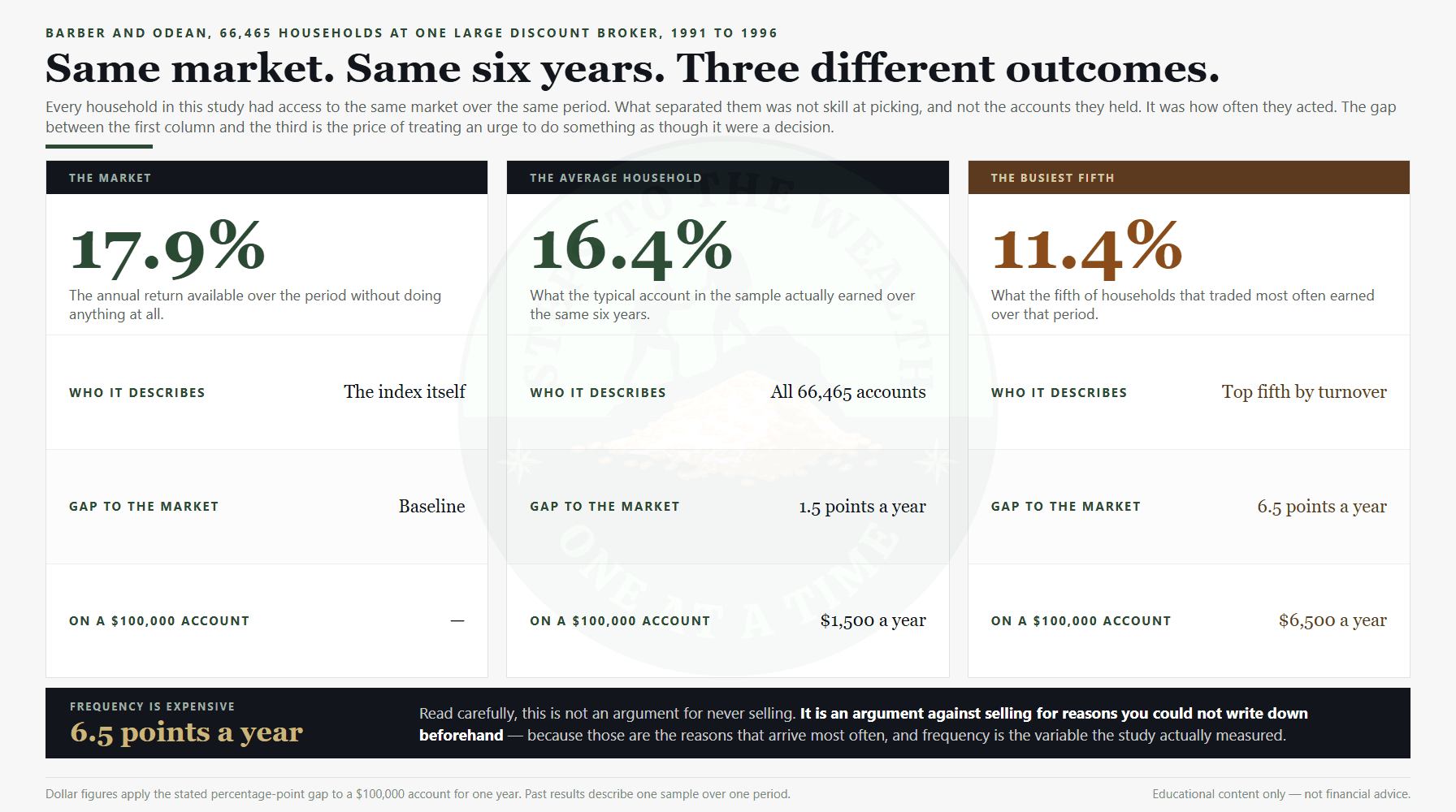
The best-known measurement of what that costs is Brad Barber and Terrance Odean’s study of 66,465 households at a large discount broker between 1991 and 1996. Over that window the market returned 17.9% a year. The average household in the sample earned 16.4%. The fifth of households that traded most earned 11.4%.
Read those three numbers in order. The average investor gave up 1.5 percentage points a year. The busiest fifth gave up 6.5. Same market, same period, same access. The only variable that moved was how often they acted. The full paper is worth reading in the original: Trading Is Hazardous to Your Wealth.
Note what the study does not say. It does not say selling is wrong. It says frequency is expensive. Those are different claims, and conflating them produces the opposite error — an investor who never sells anything and calls it discipline.
There is a second pattern underneath the frequency. Investors sell winners far more readily than losers, because closing a winner books a small win and closing a loser books an admission. The account gets steadily worse as a result: the positions that were working leave, and the positions that were not stay. If that mechanism is new to you, it sits alongside six others in our breakdown of the biases that quietly decide your outcome.
The Cost Is Not the Sale. It Is the Money That Stops Compounding
Here is the part that most profit-taking advice gets structurally wrong, in both directions.
Take a position worth $10,000 compounding at 7% a year. Left alone for ten years it becomes $19,672.
Now sell half at the start and let the proceeds sit in cash. The $5,000 still invested becomes $9,836. The $5,000 in cash is still $5,000. Total: $14,836. The sale cost $4,836, which is close to the entire amount you took off the table.
But run the third case. Sell the same half and put the proceeds straight into something else compounding at the same 7%. Ten years later you hold $9,836 in each, which is $19,672 — exactly the number the untouched position reached. The cost of the sale is zero.
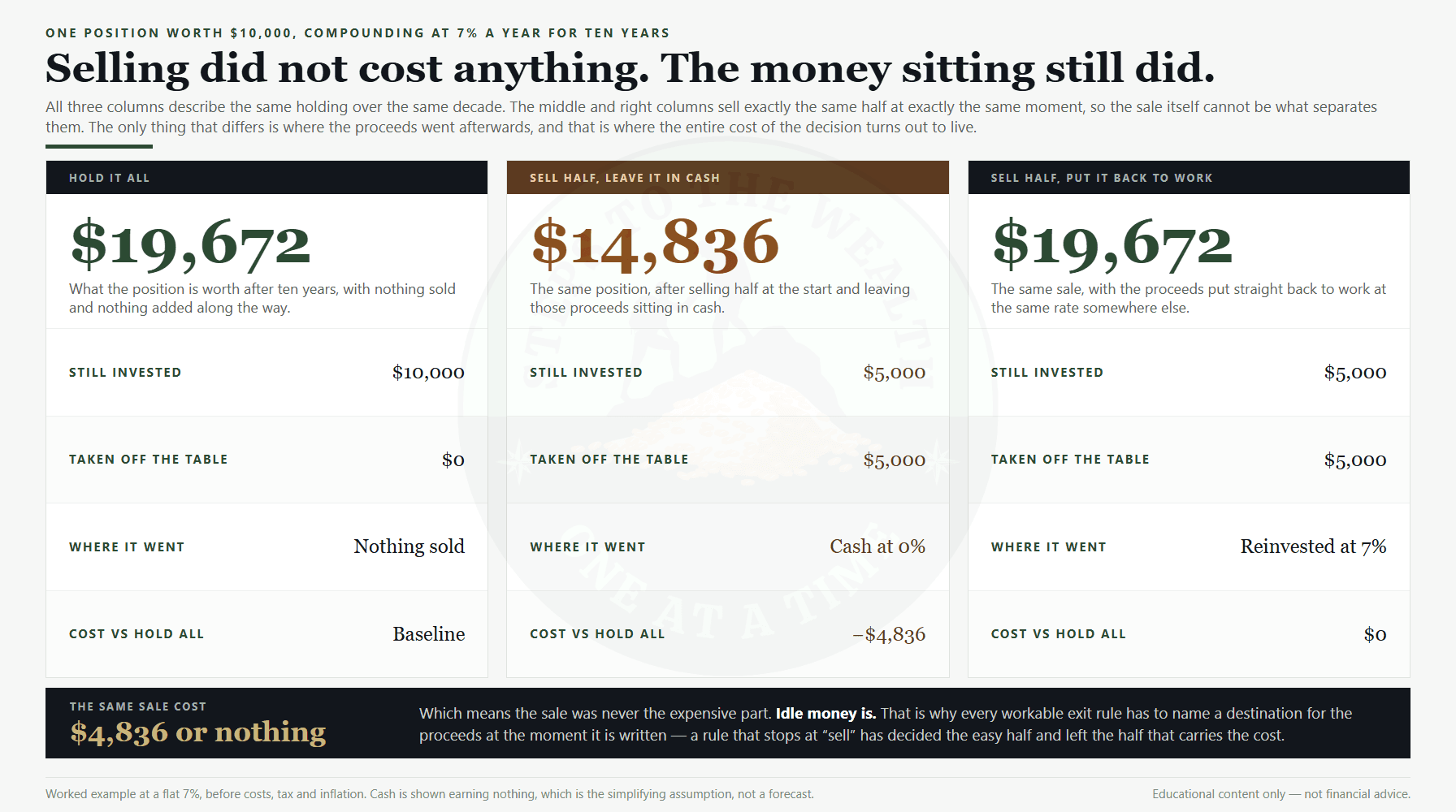
That is the actual mechanism, and it is worth stating plainly. Selling does not cost you anything. Money sitting still costs you. The sale is only the event that creates the opportunity to leave money sitting still.
This reframes the entire question. “Should I take profits?” is close to unanswerable in isolation. “Where does this money compound next, and is that better than where it is now?” is a question with an actual answer. Every rule below is a version of the second question.
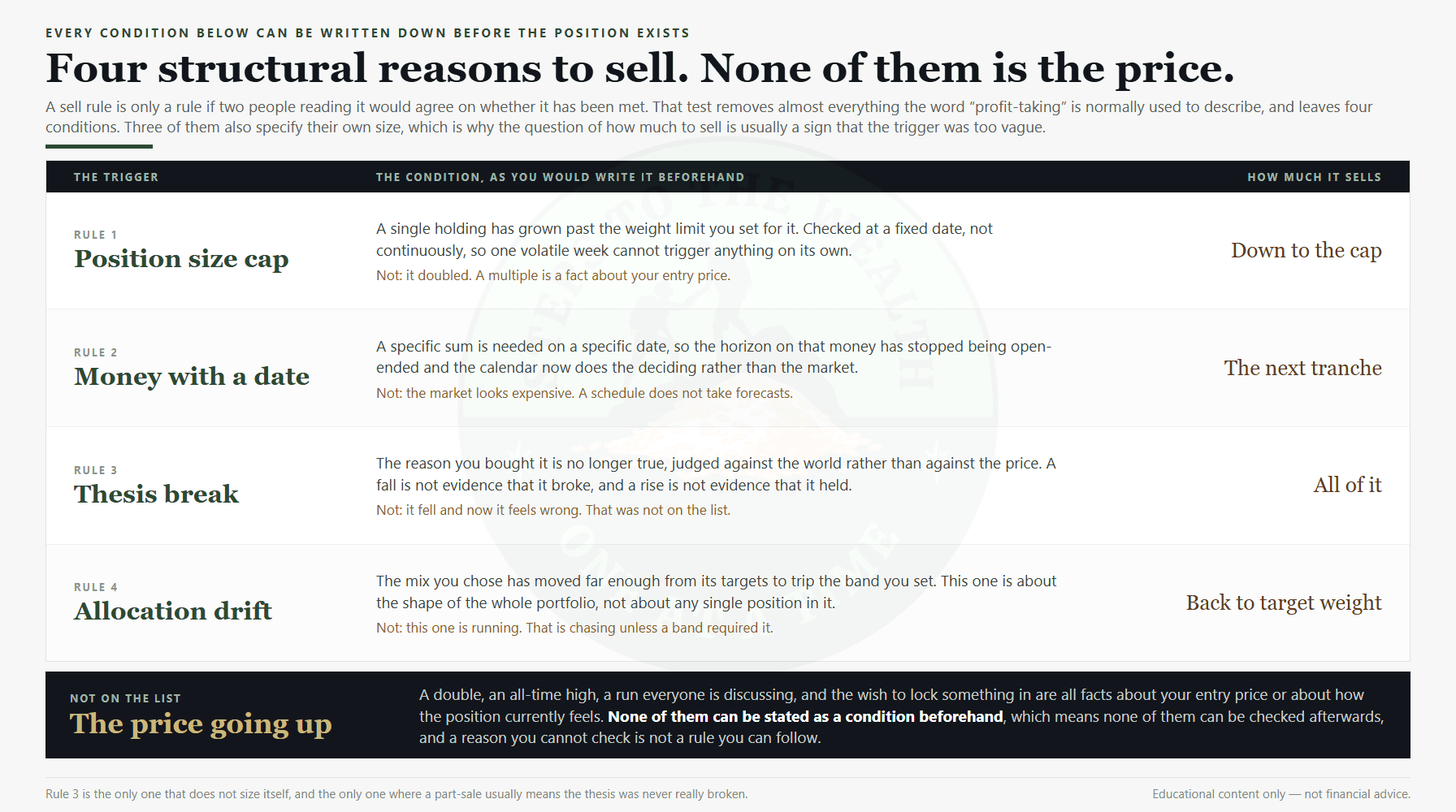
Rule 1: The Position Outgrew Its Own Size Limit
The first structural trigger has nothing to do with gains and everything to do with concentration. A position that wins for long enough stops being the position you sized. It becomes a different, larger bet that you never actually agreed to take.
Work it through. A $100,000 portfolio holds one name at 5%, so $5,000. Over some years that name triples to $15,000 while the other $95,000 grows 20% to $114,000. The portfolio is now worth $129,000, and the position is 11.63% of it.
You did not buy more. You did not raise your conviction. Your single-name exposure more than doubled anyway, purely as a side effect of being right. Bringing it back to a 5% cap means selling $8,550 of it.
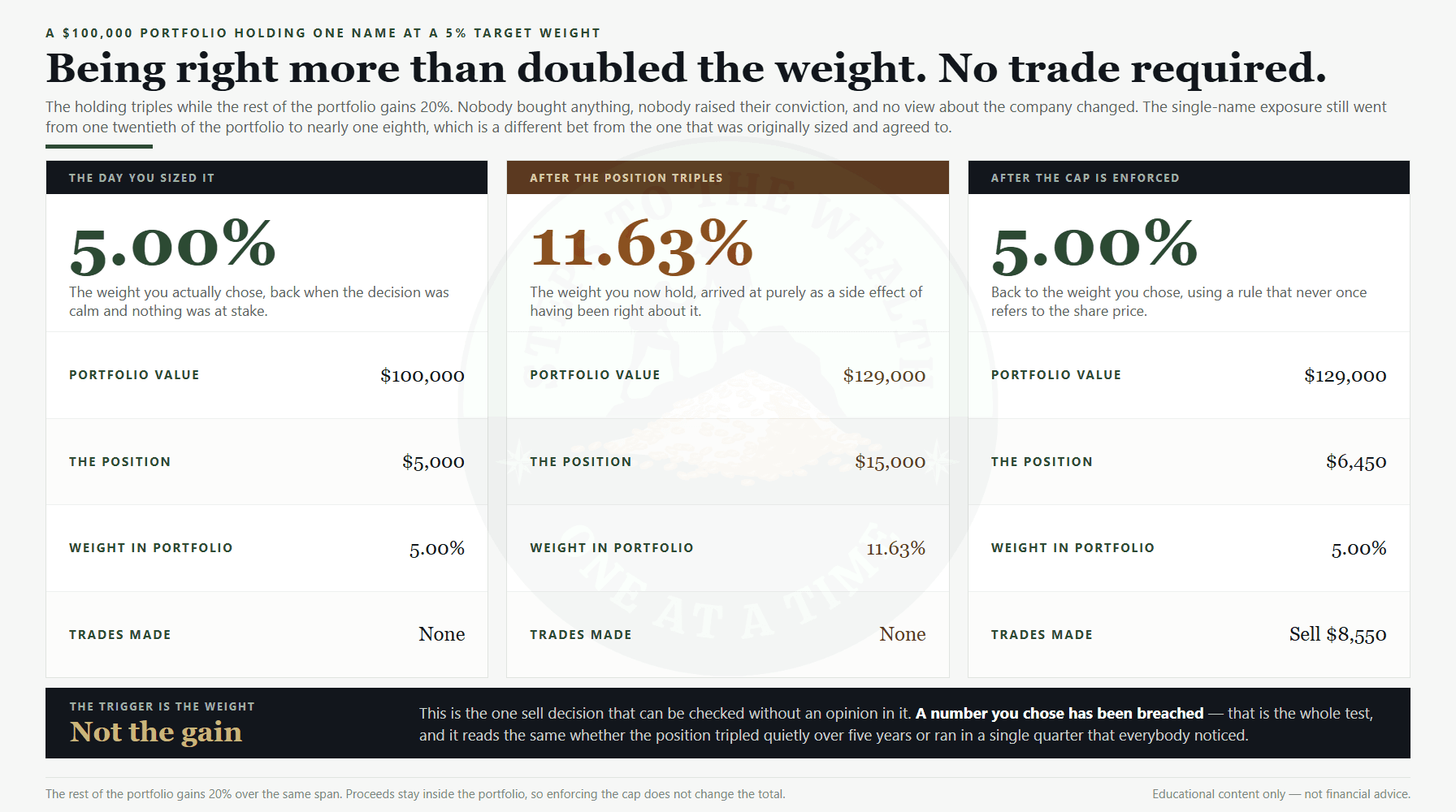
That is a sell decision that never once refers to the share price. It refers to a limit you set when you were calm, and to the arithmetic fact that the limit has been breached. If you have not set that limit yet, that is the prior piece of work: the sizing rules that decide how much any one idea can hurt you.
The honest caveat: a cap is a risk decision, not a return decision. Capping a winner will, on average, cost you return. You are buying a reduction in the worst case, and you pay for it in the expected case. Anyone who tells you a concentration cap is free has not priced it.
Rule 2: The Money Has a Date
The second trigger is the least glamorous and the most defensible. If a specific sum is needed on a specific date, the investment horizon for that sum is no longer open-ended, and it should stop being invested as though it were.
The risk here is not that the market falls. It is that the market falls at the wrong moment, and you have no time left to wait it out. A 30% drawdown eighteen years from your goal is noise. The same drawdown eighteen months out is the outcome. That is sequence-of-returns risk, and it is the one genuinely urgent reason to reduce exposure on a schedule.
Put a number on it. Suppose $60,000 is the deposit, and the date is three years out. If that money is fully in equities and the market falls 30% in the wrong year, it is $42,000 when you need it. You are $18,000 short, and the usual remedy — waiting for the recovery — is the one thing the date has taken away from you.
The rule that follows is mechanical: money with a date comes down the risk ladder as the date approaches, on a schedule you set in advance, regardless of what the market did that quarter. Thirty-six months out it can be fully invested. At twenty-four months, two thirds. At twelve months, one third. At the date, none. Four calendar entries, no forecasting, and every sale in the sequence is triggered by a date rather than a price.
Selling into strength is a pleasant version of this. Selling into weakness is the unpleasant version. Both are the same rule, and the rule only works if it applies in both. A glide path you suspend because the market looks cheap is not a glide path; it is a market call wearing one.
If your plan and your goal have quietly stopped matching, that gap is measurable before it becomes a problem: what a goal-plan mismatch looks like on paper.
Rule 3: The Reason You Bought It Is Gone
The third trigger is the only one that involves judgment, which is exactly why it needs to be written down in advance.
You bought for a reason. Perhaps a company held a structural advantage, or an asset filled a specific role in the portfolio, or a framework rated conditions favourably. Sell when that reason stops being true — not when the price disappoints you.
The distinction matters more than it sounds. A price falling is not evidence the thesis broke; markets reprice things constantly for reasons that have nothing to do with the original case. A price rising is not evidence the thesis is intact either. The thesis is a claim about the world, and it is checked against the world.
The failure mode is retrofitting. A position drops, it feels bad, and the mind obligingly produces a reason the thesis is broken — a reason that was not on the list when you bought. The defence is to have written the list. If the sell condition was not specific enough to write down beforehand, it is not a thesis break. It is discomfort with a vocabulary.
Rule 4: The Portfolio Drifted Off Its Targets
The fourth trigger is the most familiar and needs the least explanation here, because it already has its own treatment. When the allocation you chose has drifted away from its targets, selling some of what ran and buying some of what lagged returns the portfolio to the shape you decided on.
The important thing is what separates it from Rule 1. A concentration cap is about a single position becoming able to hurt you on its own. Rebalancing is about the whole allocation no longer being the allocation. You can be perfectly within every single-name cap and still be badly drifted overall, and you can hold a target-weight allocation with one position that has quietly become a solvency risk.
They also look nearly identical to a bad version of themselves. Moving money toward what is working is either mechanical discipline or performance chasing depending entirely on whether a rule required it — a distinction worked through in rebalancing versus chasing.
What Is Not on the List
Four triggers. Notice what did not make it.
- “It doubled.” A multiple is a fact about your entry price, not about the asset. The asset does not know what you paid, and nothing about its future depends on it.
- “It is at an all-time high.” Assets that compound spend most of their lives near all-time highs. That is what compounding looks like from the outside.
- “I want to lock in gains.” Locking in is a feeling about the account balance. The balance is not locked; it is transferred into a different asset, which now has its own risk and its own return.
- “It feels toppy.” Possibly true and completely unactionable. If it cannot be written as a condition beforehand, it cannot be checked afterwards.
- “Everyone is talking about it.” Sometimes a real signal. Never a rule, because there is no threshold at which it triggers.
Each of these can produce a sale that turns out well. That is the trap. A rule that works sometimes and cannot be specified is indistinguishable from a guess with a good week.
Write the Exit Before You Need It
All four rules share one property: every one of them can be written down before the position exists, and checked without consulting how you feel.
That is not a coincidence. It is the requirement. A sell rule written while a position is up is a rationalisation, and a sell rule written while a position is down is a capitulation. The only moment a sell rule can be honest is before there is anything at stake — which is the general case for deciding what you will do before the market gives you a reason to panic.
A workable exit rule needs three parts. The condition, specific enough that two people reading it would agree on whether it has been met. The size, so the answer is never a live decision about how much. And the destination, because a sale without one is the case above where the money stops compounding.
Written out, one looks like this: if any single position exceeds 10% of the portfolio at a quarter end, sell it back to 7% and add the proceeds to the core allocation the same week. Dull, checkable, no forecast anywhere in it.
How Much To Sell Is Already Answered
The question that usually follows — sell all of it, or a slice? — feels like the hard part. It is not, and the reason is a useful test of whether you have a real rule.
Three of the four triggers specify their own size automatically. A concentration breach sells down to the cap and not a share further. A date-driven glide sells the next tranche on the calendar. A drift correction sells back to target weight. In each case the size falls out of the condition, because the condition is defined as a distance from a number you already chose.
Rule 3 is the exception, and it is the one where partial selling does the most damage. If the reason you owned something is genuinely gone, a half-sale is not risk management. It is a hedge against your own judgment, and it leaves you holding a position you have already said you would not buy today. The honest sizes for a broken thesis are all of it, or none of it while you finish checking.
So if you find yourself agonising over how much, the useful reading is that the trigger was never specific enough. A rule that leaves the size open has not actually decided anything — it has moved the decision from the entry, where you were calm, to the exit, where you are not.
Where the Proceeds Go
The destination is the part that gets skipped, and it is where the entire cost of the sale is decided.
Cash is a legitimate destination. It is also a position with an expected cost, and holding it is a decision that has to be justified the same way any other holding is — the case is made in full in cash is a position, not the absence of one. The mistake is not choosing cash. The mistake is arriving in cash by default, with no view on how long it stays there, and discovering two years later that the answer was “indefinitely.”
There is also a case for not deploying at all, and it deserves the same respect as the rest: sometimes the honest reading is that nothing on offer is worth funding right now, which is a real position rather than a failure of nerve. That case is made in when not to invest more.
What matters is that the destination was chosen when the rule was written, not improvised on the day the money lands.
How To Tell Whether Your Exits Helped
An exit rule is a claim that can be checked, and almost nobody checks it.
The check is not whether the price kept rising after you sold. It usually did, at least for a while, and that fact is not evidence of anything. The check is whether the portfolio you actually held did better than the portfolio you would have held under the rule you are comparing against.
That is a return question with a real answer, and it needs a measure that accounts for money moving in and out at different times — which ordinary annualised return does not. The right instrument, and why the intuitive one misleads, is worked through in XIRR versus CAGR. If you want to see how an exit rule would have behaved across real market history before you commit to it, the DCA simulator replays plans against actual price data.
The Honest Limits of All of This
Three things this framework does not do, stated plainly.
It does not improve your returns on average. Three of the four rules are risk decisions, and risk decisions cost expected return by construction. What they buy is a narrower range of outcomes and a plan you can actually execute when the screen is red. If somebody offers you the same rules as a return enhancer, they are selling something.
It does not handle tax, which is not a footnote. A sale can be correct on every rule above and still be the wrong move this year for reasons that are entirely about your own circumstances and jurisdiction. That is a question for someone who knows your situation, and the rules here are silent on it by design.
It does not tell you the exact numbers. A 10% concentration cap is not a discovered constant; it is a choice about how much a single mistake is allowed to cost you. Someone with a stable income and a long horizon will pick a different number from someone drawing on the portfolio in three years. The framework is the part that transfers. The parameters are yours.
What it does do is convert the least-discussed decision in investing from a mood into something checkable. The question stops being whether it feels like the right time to sell, and becomes whether a condition you wrote down while calm has been met. That is a much smaller question, and unlike the original one, it has an answer.
Educational content only — not financial advice. Nothing here is a recommendation to buy or sell any specific asset. Tax treatment of any sale depends on your own circumstances and the jurisdiction in which you reside.