
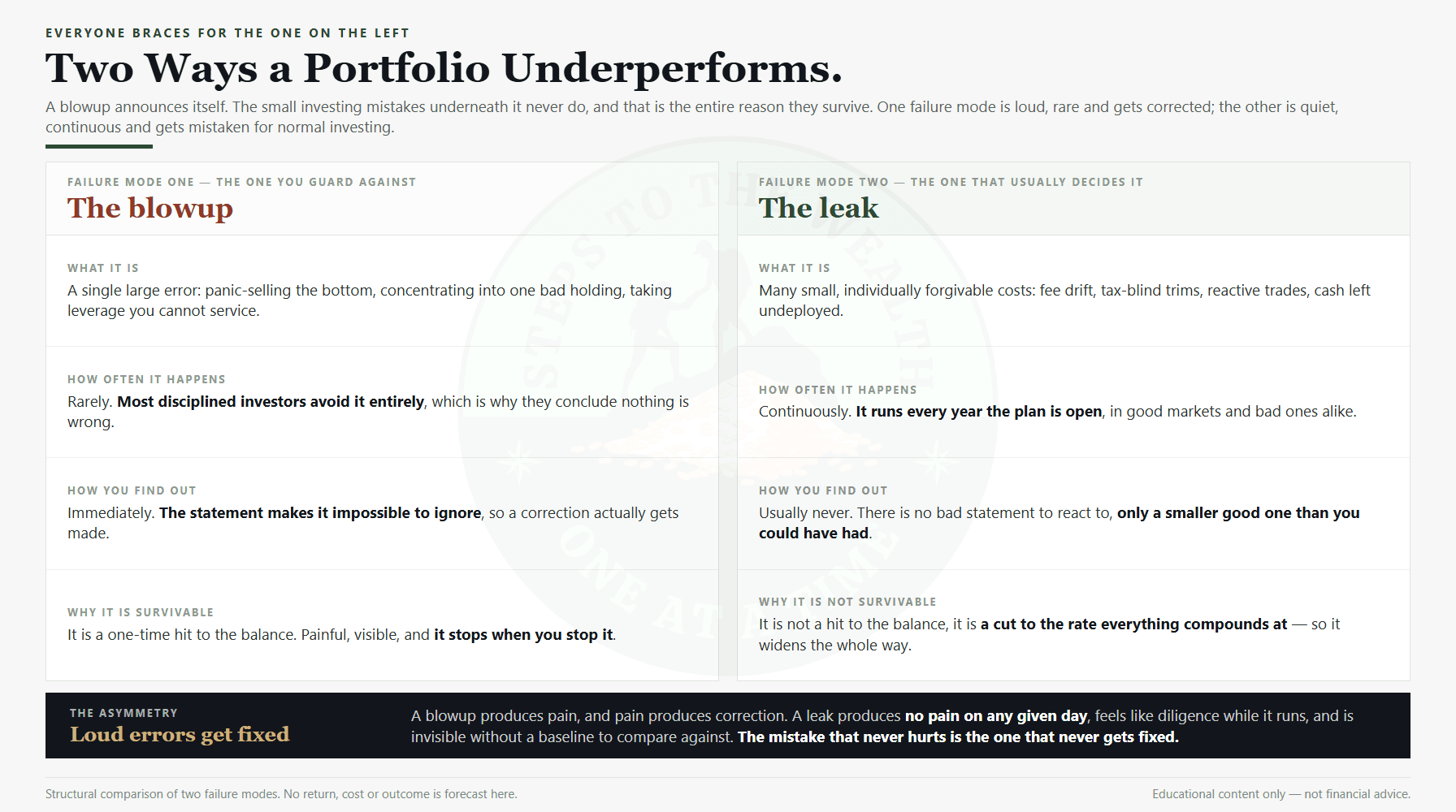
Small investing mistakes are the ones that never feel like mistakes: a fund priced half a point above its equivalent, a trim taken because the week felt uncomfortable, a deposit that sits in cash for eight months waiting for a better entry. Individually, each rounds to nothing. Collectively, repeated for thirty years, they decide the outcome more often than the disaster you actually spend your time guarding against.
Most working professionals are braced for the wrong failure. They picture investing going wrong as a single catastrophic event — the panic-sell at the bottom, the all-in bet on the wrong asset, the leveraged position that blows up. They guard against those, they mostly succeed, and they conclude they are doing fine.
Meanwhile the actual damage is happening a different way. Not in one explosion, but in a steady leak. And the same exponential arithmetic that turns small gains into wealth turns small drags into a fortune left on the table.
Educational content only. Not financial advice.
What counts as a small investing mistake?
A small investing mistake is any recurring cost or decision that lowers the rate your portfolio compounds at, without ever producing a loss large enough to demand a response. That definition has three parts, and all three have to be present.
It has to be recurring. A one-time error is a hit to the balance; you absorb it and move on. A leak reappears every quarter, every rebalance, every deposit.
It has to affect the rate, not the balance. This is the part that gets underestimated. A $2,000 error costs you $2,000 plus whatever that $2,000 would have earned. A half-point drag costs you a share of everything, forever, and the share grows with time.
And it has to be painless. If it hurt, you would fix it. The defining feature of the leak is that no single instance of it produces a bad day you could point at.
The asymmetry in that figure is the whole problem. A blowup produces pain, and pain produces correction. A leak produces no pain on any given day, feels like diligence while it runs, and is invisible unless you have a baseline to compare against. The mistake that never hurts is the mistake that never gets fixed.
Why a one-point leak is not a small number
The instinct to wave off a one percent annual cost comes from linear thinking. One percent sounds like one percent — a rounding error on a modest balance over a single year.
But a drag on an exponential process does not subtract a fixed amount. It lowers the rate at which everything compounds, and the gap widens the entire way. Here is what that looks like as closed arithmetic rather than as an argument.
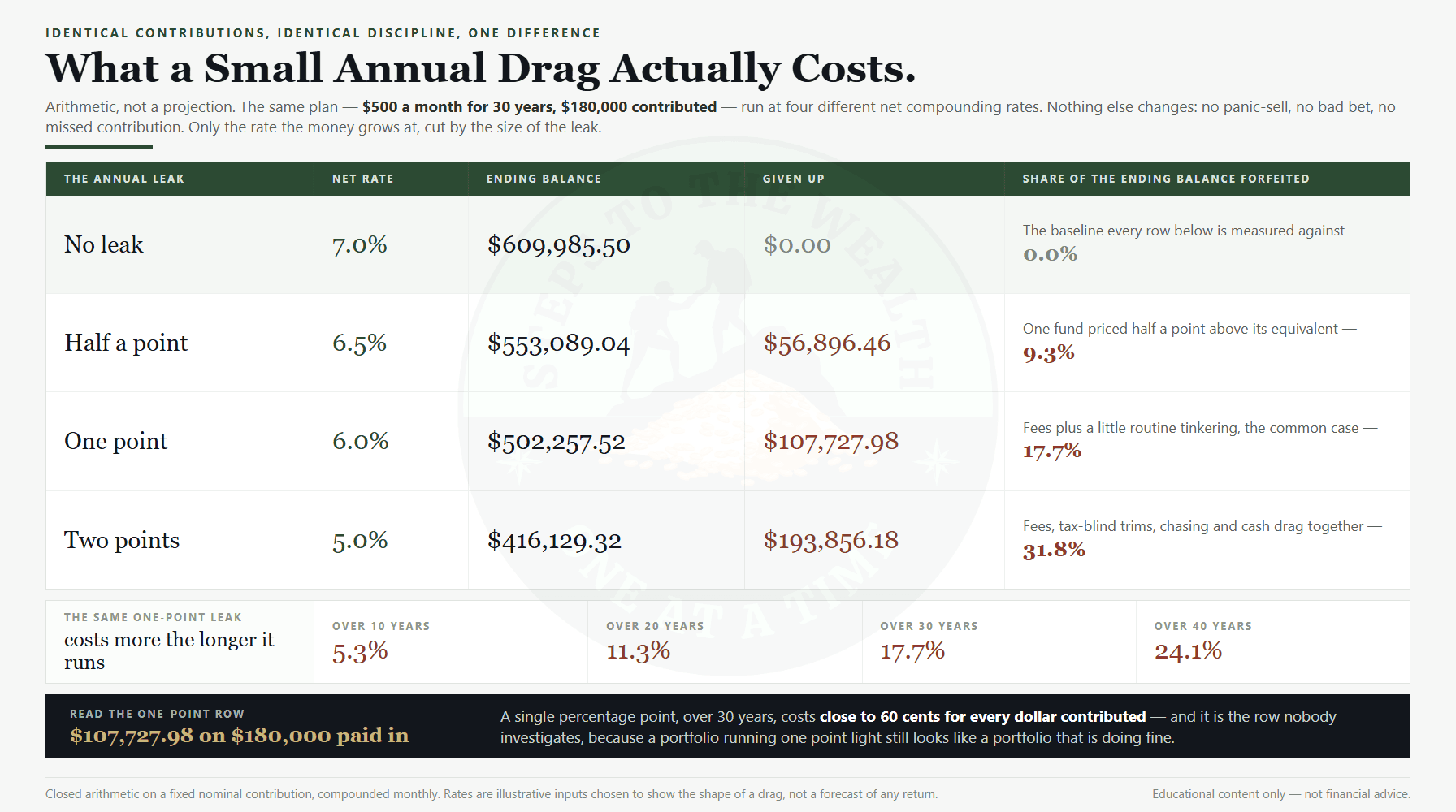
Take one plan and run it four ways. $500 a month for 30 years — 360 contributions, $180,000 of your own money in every version. Nothing else differs. No panic-sell, no bad bet, no missed deposit. The only variable is the rate the money actually compounds at after the leak has taken its cut.
At 7.0% the plan ends at $609,985.50. Give up half a point and it ends at $553,089.04, which is $56,896.46 forfeited, or 9.3% of the ending balance. Give up a full point and it ends at $502,257.52 — $107,727.98 gone, 17.7% of the total. Give up two points, which is what fees plus tax-blind trims plus cash drag plus mild chasing add up to in an inattentive year, and it ends at $416,129.32. That is $193,856.18 forfeited, or 31.8%: close to a third of the ending balance, surrendered without a single dramatic decision.
Sit with the one-point row for a second, because that is the realistic one. $107,727.98 is not far off 60 cents for every dollar you contributed. You paid in $180,000 and a single percentage point took more than half of that back out. And it is the row nobody investigates, because a portfolio running one point light does not look broken. It looks like a portfolio that is doing fine.
The rates above are illustrative inputs chosen to show the shape of a drag — they are not a forecast of what any portfolio will earn. What is not illustrative is the relationship between them, which is fixed arithmetic.
The leak gets more expensive the longer you hold it
There is a second effect buried in that figure, and it is the one that should change your priorities. The cost of a one-point leak is not a constant percentage. It grows with the horizon: 5.3% of the ending balance over 10 years, 11.3% over 20, 17.7% over 30, and 24.1% over 40.
This is the reverse of how people treat it. The young investor with the longest runway is the one most likely to shrug at a fee difference and most likely to tinker — and is precisely the investor for whom the leak is most expensive. The same erosion logic applies to assets that quietly lose value while you hold them, which is the subject of depreciation versus investing: slow, compounding, and easy to ignore right up until you total it.
It also mirrors the savings side of the ledger exactly. A small, permanent increase in spending works the same way a small, permanent drag on returns does — which is why lifestyle creep and your savings rate deserves the same arithmetic treatment. Both are recurring, both are painless, both compound.
The catalog of small leaks
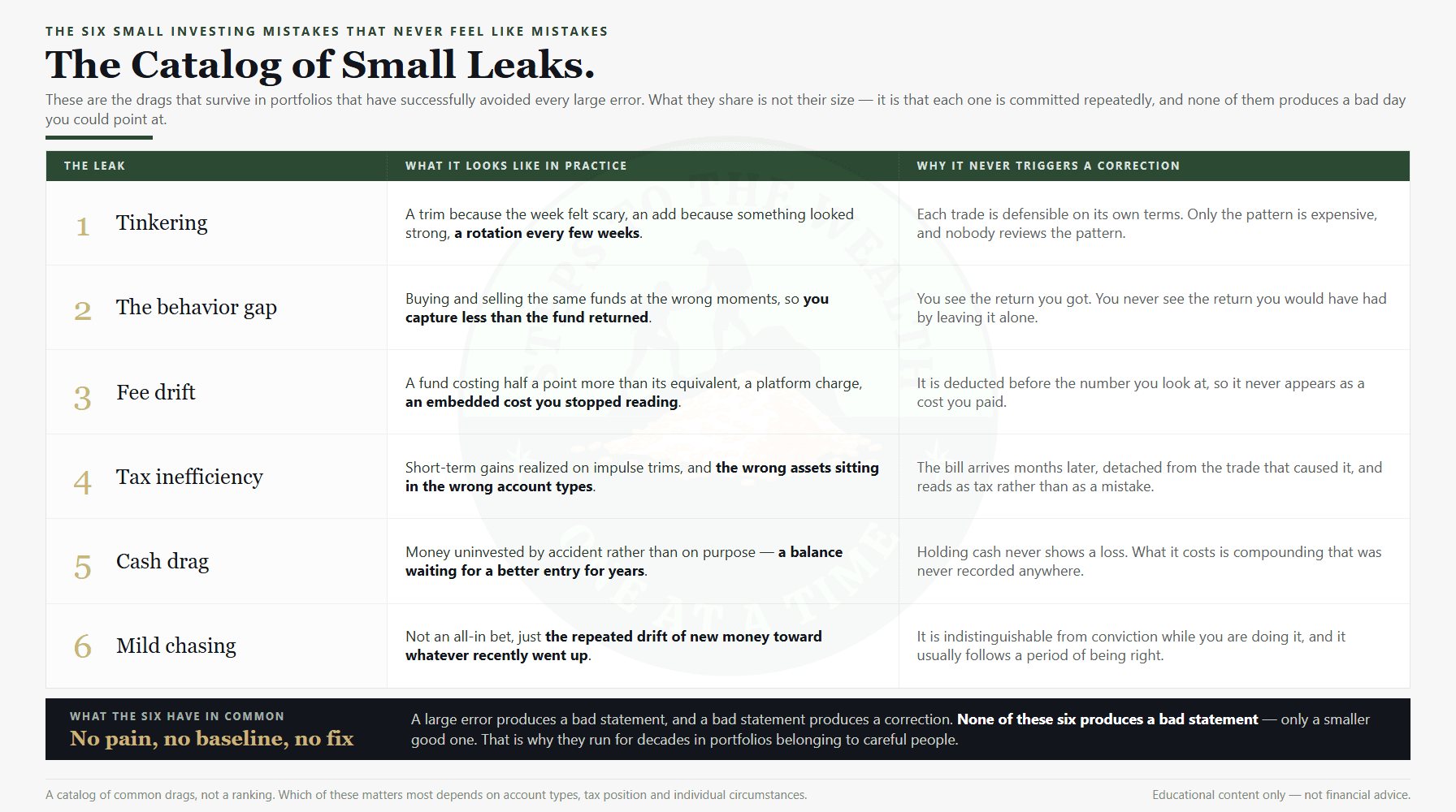
The leaks are easy to ignore precisely because none of them feels like a mistake in the moment. Here are the six that show up most often in the portfolios of people who have successfully avoided every large error.
1. Tinkering
The small reactive trade. A trim because the market felt scary this week, an add because an asset looked strong, a rotation because something else looked more interesting. Each trade carries cost, tax friction, and the risk of bad timing. Done occasionally, harmless. Done as a habit, it is a continuous tax on the portfolio. Each individual trade is defensible on its own terms — only the pattern is expensive, and nobody ever reviews the pattern.
2. The behavior gap
This is tinkering’s measurable result: you earn less than the funds you hold, because you move toward what has done well and away from what has done poorly. The fund returns one thing; the investor in the fund captures less. It is pure self-inflicted drag, and it is mostly invisible because people compare their returns to nothing at all.
3. Fee drift
A fund that costs half a point more than its equivalent. A platform fee. A product with an embedded cost you stopped noticing years ago. Any one of these is small; stacked and held for decades, they compound against you exactly like a negative return. Fees are deducted before the number you look at, so they never present themselves as a cost you paid. The habit of auditing recurring charges is the same one described in why you cancel the wrong subscription — people cancel the visible small charge and keep the invisible large one.
4. Tax inefficiency
Trimming winners in a taxable account and triggering short-term gains. Holding the wrong assets in the wrong account types. Realizing gains you had no need to realize. Each event is a one-time cost, but the habit of tax-blind trading turns it into an annual drag — often the single largest of the small leaks for a working professional in a high bracket. The bill arrives months later, detached from the trade that caused it, so it reads as tax rather than as a decision you made.
5. Cash drag
Money that sits undeployed not as deliberate dry powder but by accident — the deposit you forgot to invest, the balance “waiting for a better entry” that ends up waiting for years. Uninvested cash loses to inflation and misses the compounding it should have been doing. Holding cash never shows a loss on a statement, which is exactly why it survives; what it costs is compounding that was never recorded anywhere. This is the same forfeited-growth arithmetic as the cost of waiting, and it is closely related to the deployment question in lump sum versus dollar-cost averaging.
6. Mild chasing
Not the dramatic all-in, just the gentle, repeated drift of new money toward whatever recently went up. Each instance buys a little high. The pattern, repeated across cycles, is a steady performance leak — and it is indistinguishable from conviction while you are doing it, because it usually follows a stretch of being right. Several of the beliefs that license this behavior are taken apart in the myths about dollar-cost averaging.
No single item on this list will ruin you. That is exactly why they are dangerous. The big mistakes announce themselves and get corrected. The small ones blend into normal investing and run for thirty years.
What the research actually measured
The behavior gap is not a rhetorical device. It has been measured, and the measurement is uncomfortable.
Brad Barber and Terrance Odean studied 66,465 households at a large discount broker over 1991 to 1996. The market returned 17.9% annually across the period. The average household in the sample earned 16.4%. The fifth of households that traded most earned 11.4%.
Read those three numbers as two gaps. The average household gave up 1.5 percentage points a year to its own activity — that is the cost of ordinary, unremarkable participation. The busiest fifth gave up 6.5 points a year. Not to a crash, not to a bad market, not to one catastrophic decision. To trading. Their paper, Trading Is Hazardous to Your Wealth, is freely available and worth reading in the original.
Put that 1.5-point figure next to the arithmetic above. A drag of one point over thirty years cost $107,727.98 on our example plan. The average household in that study was running a leak half again as large as that, and there is no reason to think any of them regarded themselves as making mistakes.
The mechanism behind the gap is behavioral rather than technical, and it is fairly well mapped — Morningstar’s work on behavioral investor types is a reasonable starting point for recognising your own default. The useful conclusion is not that investors are stupid. It is that the cost of acting on a feeling is quantifiable, recurring, and much larger than it feels.
Why small mistakes are harder to fix than big ones
You would think small mistakes would be easy to fix, on the grounds that they are small. The opposite is true, for three reasons.
They do not hurt enough to trigger correction. A 40% drawdown forces a reckoning. A one percent annual leak produces no pain on any given day. There is no moment that demands you change anything, so you do not.
They feel like activity, and activity feels like responsibility. Tinkering, rotating, staying on top of it — these feel like the behavior of a serious investor. The leaks are disguised as diligence. Telling someone that their careful weekly management is the problem is a hard sell, because it asks them to be less active in order to do better.
They are invisible without a baseline. You can only see the behavior gap by comparing your actual returns to what you would have earned by doing nothing. Almost nobody runs that comparison. Without it you simply have “your returns,” with no sense of the better number you forfeited. This is the same blind spot that makes a portfolio feel diversified when it is not, which is why running an explicit portfolio stress test tends to be more informative than another review of last quarter’s performance.
No pain, feels virtuous, invisible. That combination is why frequent small mistakes survive in portfolios that have avoided every big one.
How a risk-first framework plugs the leaks
The fix for a leak is not more vigilance. More vigilance tends to produce more tinkering, because the vigilant investor is the one supplying the extra trades. The fix is structure that removes the opportunity for small mistakes in the first place.
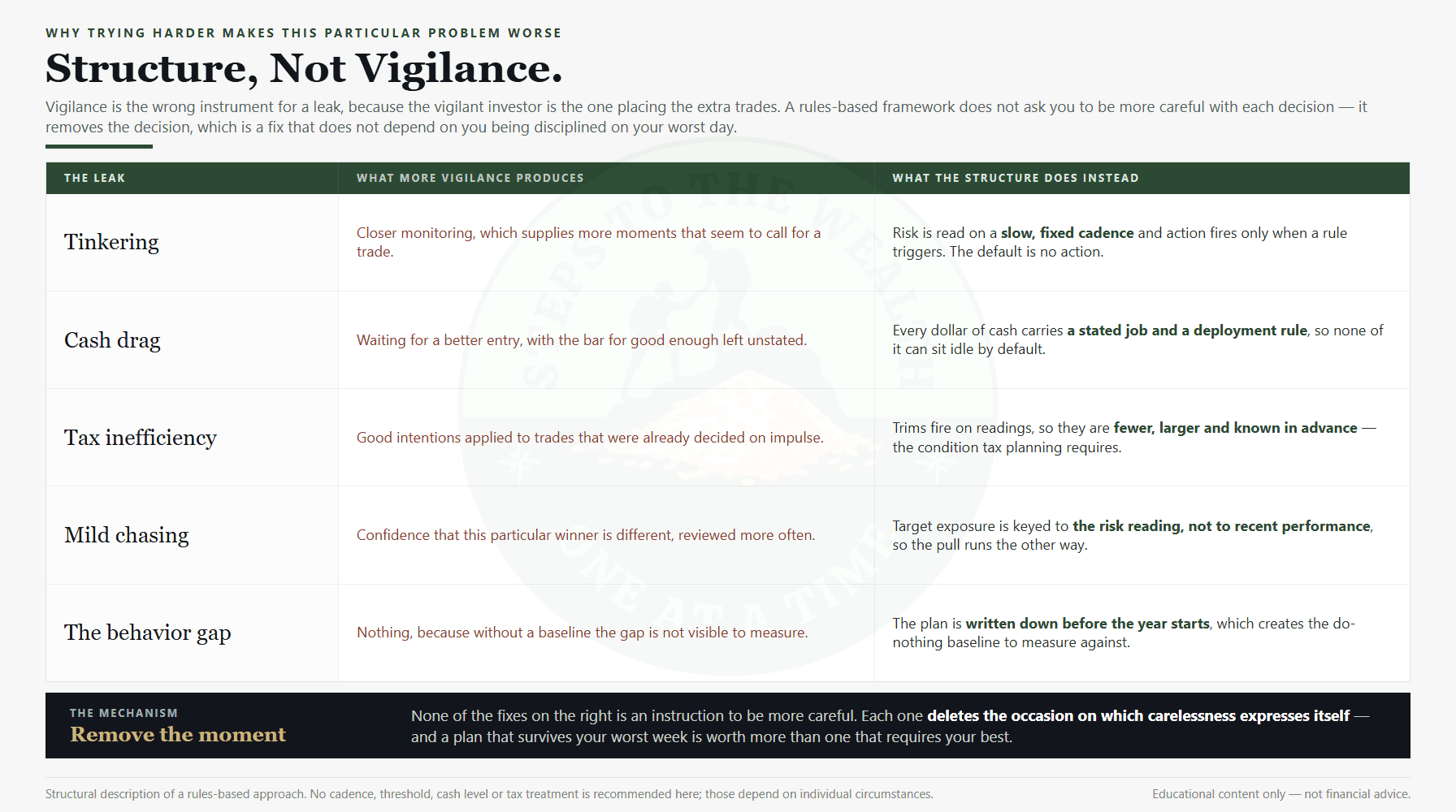
It replaces tinkering with cadence. A risk-first framework reads risk on a slow, regular rhythm and acts only when a rule fires — which is most often not at all. The default is no action. By making “do nothing” the structural default, it removes the steady stream of reactive trades that creates the behavior gap in the first place.
It makes deployment deliberate, which kills cash drag. Cash in the framework has a defined job: emergency buffer, near-term obligation, or risk-sized dry powder. There is no category for “money sitting around by accident.” When measured risk is low, the entry ladder deploys, and cash does not get forgotten into a multi-year slumber.
It converts trims into rules, which makes them tax-aware. Because trims fire on risk readings rather than on impulse, they happen less often and more predictably — and that predictability is the precondition for tax planning. You can let positions run for long-term treatment and size entries and exits in fewer, larger steps. Impulsive trading makes tax planning impossible; rules-based, infrequent trading makes it routine.
It sets exposure by risk, not by what is hot. Since target sizing is keyed to a risk reading, money does not drift toward recent winners on its own. The structural pull runs the other way — toward trimming the extended and adding to the depressed. General guidance on asset allocation from investor.gov makes the same structural point: the allocation decision is supposed to be made in advance, not renegotiated every time the market moves.
It creates the baseline that makes the gap visible. Because the plan is written down before the year starts, there is a do-nothing benchmark to measure your actual behavior against. That baseline is the only reason a behavior gap can be detected at all.
The framework does not plug the leaks by asking you to be more careful. It plugs them by deleting the moments where carelessness expresses itself. That is a more reliable fix than discipline, because it does not depend on you being disciplined on your worst day. For anyone fitting this around a job, the cadence question is covered in more detail in how to invest while working full time.
The mindset shift: stop hunting the edge, stop the bleed
The real reframe is about where you point your attention.
Most investors spend their effort on the selection question — which asset, which entry, which strategy will deliver the extra point of return. That effort is mostly wasted, because for the average participant the edge available from selection is small, unreliable, and competed away.
The leaks are the opposite: large, reliable, and entirely within your control. You cannot dependably add two points of return through better picks. You can dependably stop losing two points to fees, taxes, tinkering and cash drag. The expected value of plugging the leaks dwarfs the expected value of chasing the edge, and it requires no skill, no forecast and no information anybody else lacks.
There is an opportunity cost to time spent on the wrong question, too. Hours spent researching a marginally better holding are hours not spent auditing the fee schedule that is quietly taking a fixed percentage of everything, every year, regardless of which holding wins.
So the question that actually moves the needle is not “what should I buy?” It is “where is my portfolio quietly bleeding, and what structure stops it?” That is also the honest way to think about cost generally, in the same spirit as working out the true cost of a purchase rather than its sticker price.
What this is not
This is not an argument for total passivity, or for never adjusting anything. The framework itself acts: it deploys, it trims, it rebalances on risk signals. The point is not to do nothing. It is to stop doing the unstructured, frequent, small things that leak value, and to let structured action happen on a slow cadence instead.
It is also not a claim that plugging every leak guarantees a good outcome. Markets do what they do; a portfolio with zero leaks can still have a bad decade. What the arithmetic shows is narrower and more useful than a promise: for any given market outcome, the leak determines how much of it you actually keep.
And it is not personalized advice. Your fee situation, account types, tax bracket and appropriate cash levels are specific to you. Which leaks are worth plugging first depends on your circumstances, not on a generic ranking.
Frequently asked questions
What are the most common small investing mistakes?
The six that recur most often are tinkering, the behavior gap, fee drift, tax inefficiency, cash drag, and mild chasing of recent winners. They share one property: each is committed repeatedly, and none of them produces a loss visible enough to prompt a correction.
How much do small investing mistakes actually cost?
It depends entirely on the size of the drag and the length of the horizon. As closed arithmetic on a plan of $500 a month for 30 years, a one-point annual drag costs $107,727.98 — 17.7% of the ending balance — against a 7.0% baseline. In measured research, Barber and Odean found the average household in their sample trailing the market by 1.5 points a year, and the busiest fifth by 6.5 points.
Is a 1% fee really a big deal?
Yes, and the reason is structural rather than a matter of opinion. A fee is not a one-off deduction, it is a permanent reduction in the rate at which everything compounds, so its cost grows with the horizon: 5.3% of the ending balance over 10 years, 11.3% over 20, and 24.1% over 40 on the arithmetic above.
How do I find out whether I have a behavior gap?
Compare what your portfolio actually returned against what the same holdings would have returned had you left them alone for the year. That do-nothing baseline is the comparison almost nobody runs, and it is the only way the gap becomes visible. If you have never written the plan down in advance, there is no baseline to compare against — which is the first thing to fix.
Closing
The investor who avoids every catastrophe and still underperforms is not unlucky. They are leaking. A point here to fees, a point there to their own trading, a slice to taxes and idle cash — none of it dramatic, all of it compounding, year after year, against the same exponential arithmetic that was supposed to be working for them.
You do not fix a leak by watching the portfolio harder; that tends to spring new ones. You fix it with structure that makes doing nothing the default, deployment deliberate, trims rules-based, and exposure keyed to measured risk instead of to whatever just went up.
Guard against the blowup, by all means. But the outcome is usually decided by the leak. Find it, plug it, and let compounding run in the direction it was supposed to.
Educational content only. Not financial advice. Fees, tax treatment, account placement and appropriate cash levels vary by individual circumstance. The rates used in the arithmetic above are illustrative inputs, not forecasts. Work with a qualified financial professional to apply these frameworks to your specific situation.