
Educational content only. Not financial or tax advice.
Equity compensation risk starts before a single share vests
If part of your pay arrives as company stock, you are running a portfolio decision whether or not you have ever framed it as one. Most people never do. The shares appear, they sit there, and the decision gets made by not making it.
The reason this goes unexamined is that equity compensation is discussed almost entirely as a negotiation problem — how big a grant, what it is worth, how to ask for more. That is a real problem and it has its own piece. This one starts the day after the paperwork is signed.
Equity compensation risk is not a matter of opinion about your employer. It is four pieces of arithmetic, all of them closed, none of them long, and almost nobody runs them: what the concentration costs, what the vesting schedule is really worth, what a purchase discount actually returns, and how much leverage sits inside an option.
None of what follows depends on where you live. Tax does, entirely, and that is the one part this article deliberately refuses to guess at.
You are already all-in on this employer
Before any stock vests, look at what the company already accounts for.
Your salary comes from it. So does the pay rise you are expecting, the bonus you are counting on, and the reference that would get you your next role. If the company has a bad two years, all of those move together, in the same direction, at the same time.
That is a large exposure and it is not optional. It is the deal. What is optional is whether you stack a concentrated equity position on top of it.
The usual objection is that the shares were free. They were not. They were compensation, delivered in a form that happens to fluctuate. Treating them as a windfall rather than as pay is the single framing error that drives everything downstream of it.
The second objection is loyalty — that selling company stock says something about your confidence in the place. It does not. Your employer is not asking you to underwrite it with your savings, and it would not return the favour.
What the concentration actually costs
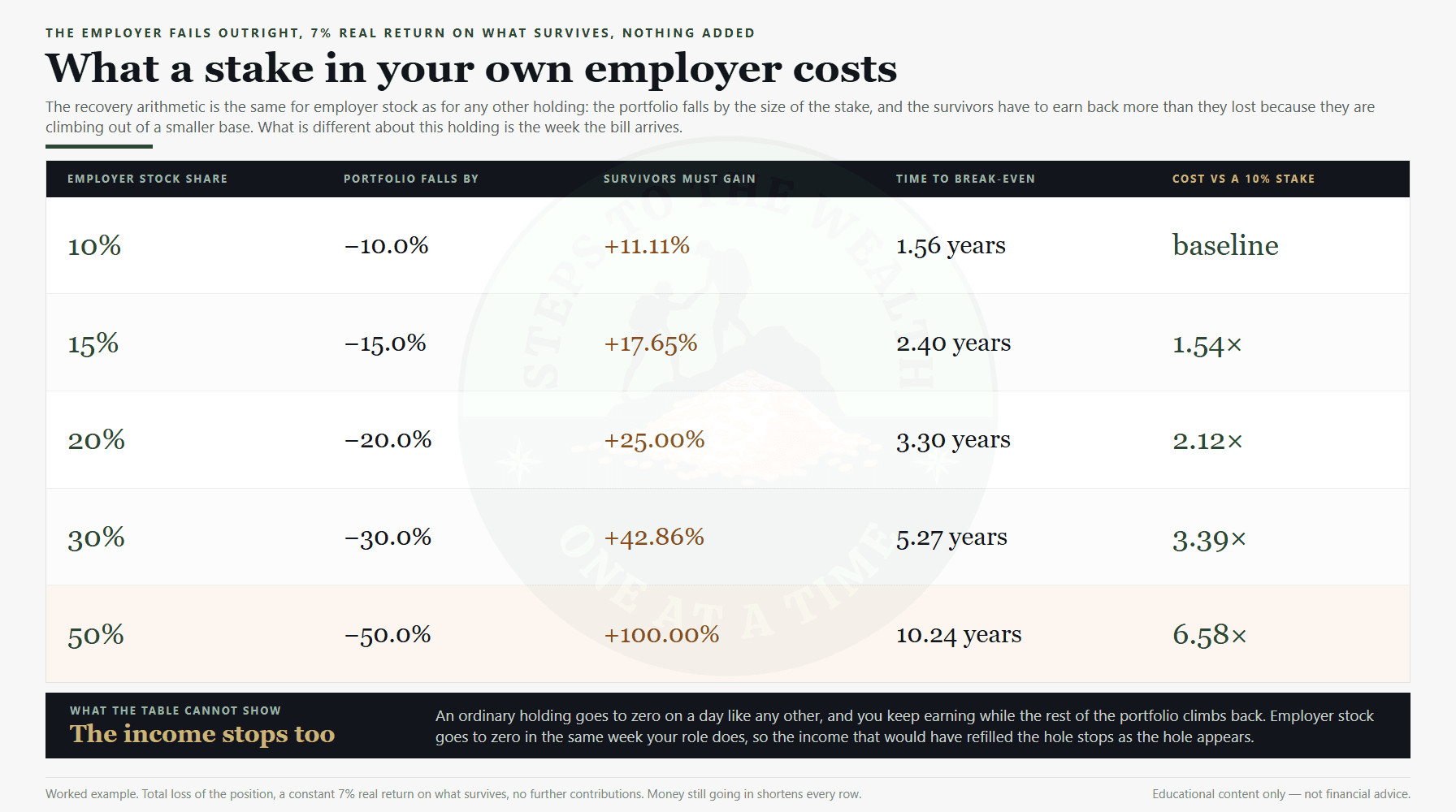
Put a number on it. If the company fails outright and your employer stock was 20% of your invested capital, the portfolio falls 20% and the survivors have to gain 25% to get back. At a long-run 7% real return that takes 3.30 years.
At 30% it takes 5.27 years. At 50%, the survivors have to double, which is 10.24 years. That arithmetic is not specific to employer stock — it is the same cost curve that governs every position cap you set.
What is specific to employer stock is when the bill arrives. A normal holding goes to zero on a day like any other, and you keep earning while the rest of the portfolio climbs back.
Employer stock goes to zero on the day you are also told your role is gone. The income that would have refilled the hole stops in the same week the hole appears. That is the part the recovery table does not show, and it is the whole reason this position deserves a tighter cap than its volatility alone would suggest.
A practical consequence: if you would cap a single unrelated company at 10% of your portfolio, your employer does not get 10% simply because you know it better. Knowing it better is not diversification. It is the opposite, and it is exactly the conviction-as-an-input mistake with a payslip attached.
The cliff is worth twelve months in a single day
Most vesting schedules run four years with a one-year cliff, then monthly. It is worth seeing what that shape does.
Leave in month eleven and you have 0%. Leave in month twelve and you have 25%. Every month after that adds 2.083 percentage points, steadily, until the end.
So the cliff day moves you 25 points in one day, and 25 divided by 2.083 is 12. The day you pass the cliff is worth exactly twelve months of ordinary vesting. Nothing else in the schedule comes close.
After that, the shape is flat. There is no second cliff, no acceleration, no reward for staying to a round number. Month 24 is worth the same 2.083 points as month 23 and month 47.
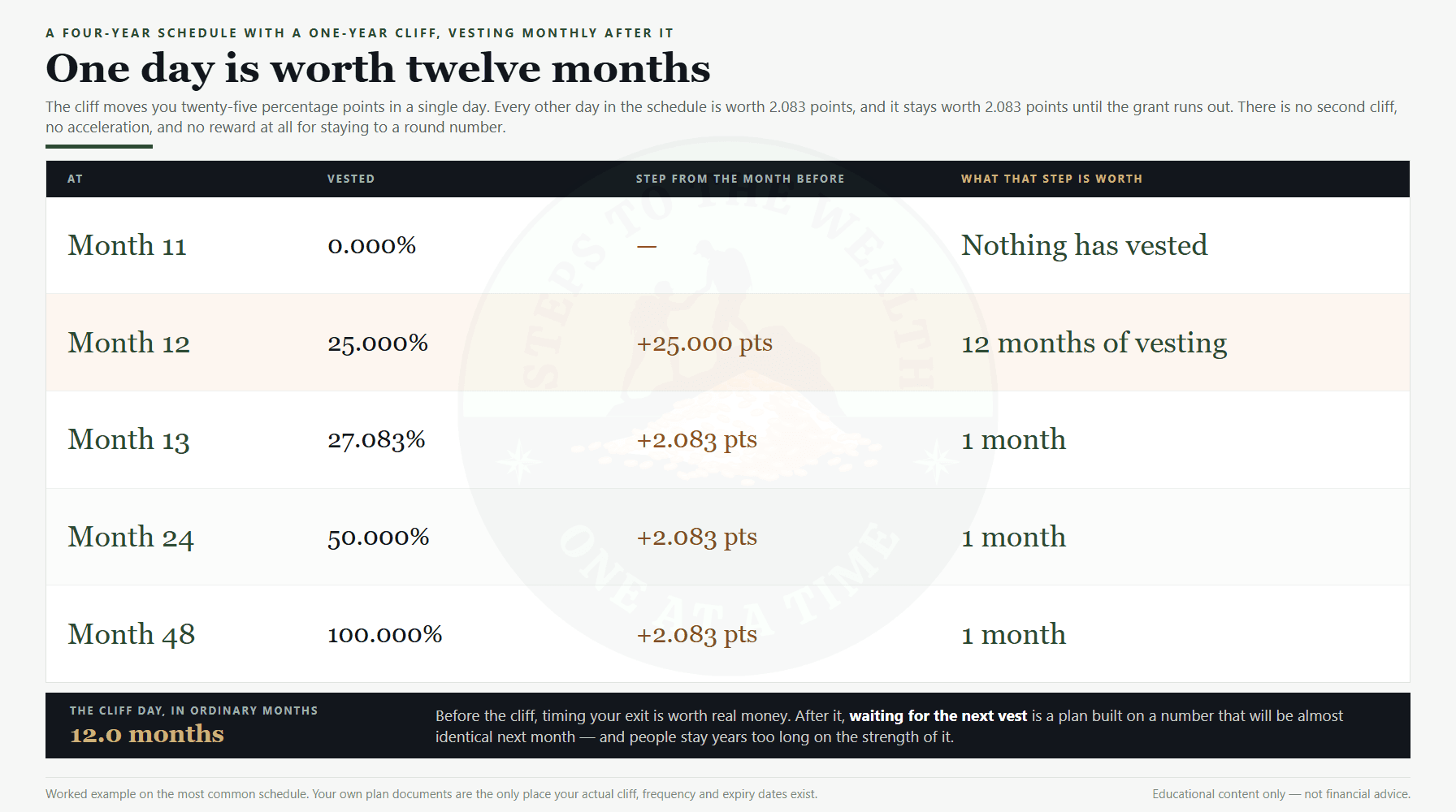
This matters for exactly one decision and no others: whether to leave near the cliff. Before it, the timing is worth real money. After it, “I should stay until my next vest” is a sentence about a number that will be almost identical next month.
People stay years too long in roles they have outgrown on the strength of a vesting argument that stopped being true in month thirteen. Check your own schedule before you use it as a reason.
Unvested equity is not net worth
The number in the grant letter is the number people quote to themselves, and it is the wrong one. Unvested equity is not an asset. It is a conditional claim, and the condition is that you stay.
Two things have to hold before an unvested unit becomes yours: you keep the job, and the company keeps existing in a form where the shares are worth something. Neither is certain, and both are correlated with the same thing — the health of the employer.
The practical error this causes is not optimism about the total. It is that people spend against it. A grant with three years left gets counted in a mortgage affordability calculation, or used to justify a car, or treated as a reason to hold less cash. All of those convert a conditional claim into an unconditional obligation, which is exactly the wrong direction.
The clean rule is to count only what has vested. Everything else is a reason to be optimistic, not a line in your net worth, and certainly not collateral. It is also why the concentration percentage in the section above should be computed on vested holdings alone — adding unvested units to the numerator makes the number look worse than it is and encourages the wrong fix.
The same discipline resolves an argument people have with themselves constantly, which is whether a large unvested balance justifies a thinner emergency reserve. It does not. The reserve exists precisely for the event that also cancels the unvested balance, which is the ordering problem in a different costume.
The discount is not the return
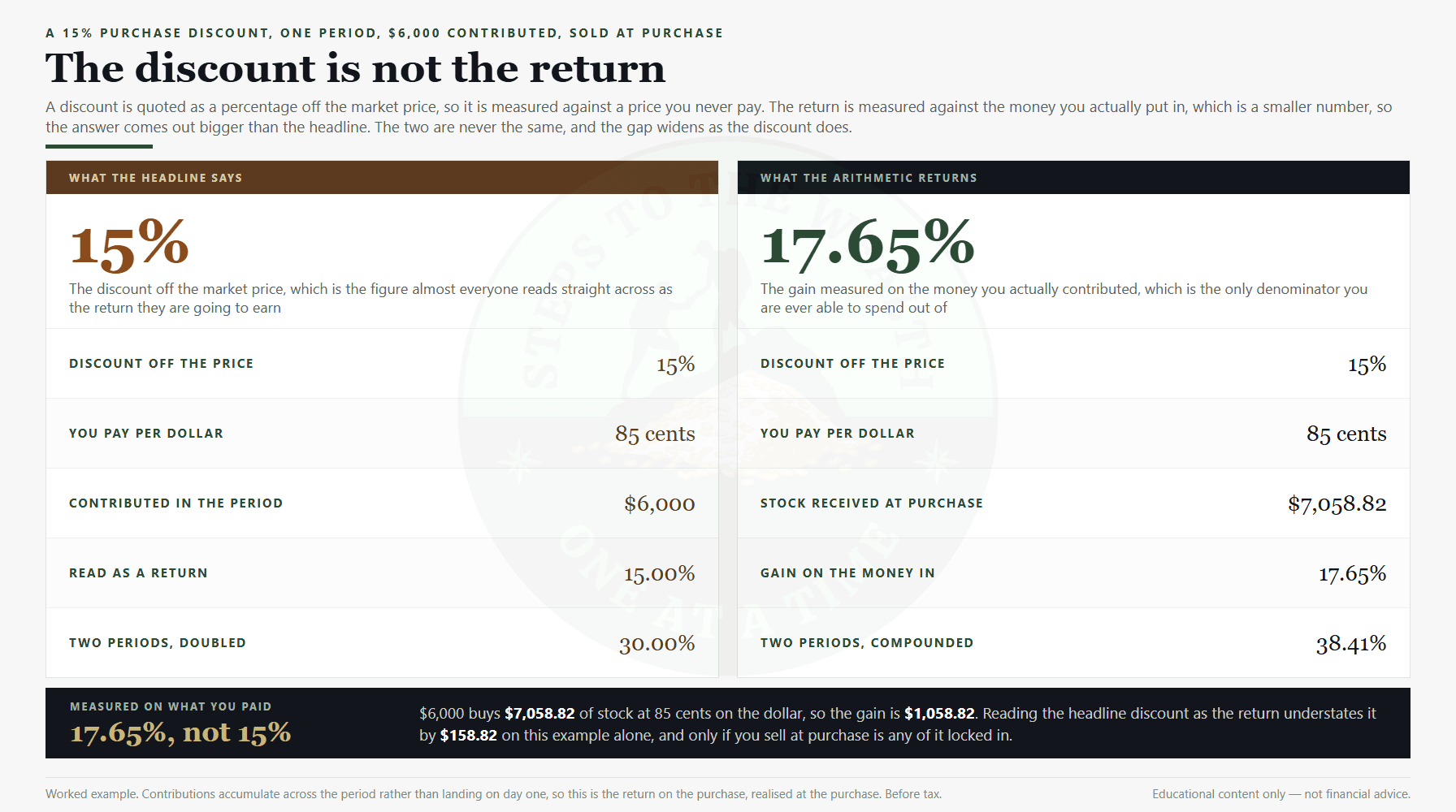
Many employers offer a plan that lets you buy company stock at a discount. The discount is usually quoted as a percentage off the market price, and almost everyone reads that percentage as the return. It is not.
A 15% discount means you pay 85 cents for a dollar of stock. Your gain is not 15 cents on the dollar. It is 15 cents on the 85 you actually put in, which is 17.65%.
Work it through. Contribute $6,000 over a purchase period and buy at 85% of price: you receive stock worth $7,058.82. The gain is $1,058.82 on $6,000, before any tax.
The gap widens as the discount does. A 20% discount is a 25.00% gain, not a 20% one. And where two purchase periods run in a year, compounding them gives 38.41% at a 15% discount, against the 30% you would get by doubling the headline.
Two honest qualifications. Contributions accumulate across the period rather than landing on day one, so the money is not deployed for the whole window — the figures above are the return on the purchase, realised at the purchase.
And the gain is only locked in if you sell at purchase. The moment you hold, you have converted a bounded, arithmetic gain into an unbounded bet on one company, and the concentration section above applies in full. “I got it at a discount” is the reason people give; it describes how the position was acquired, not whether it should be kept.
An option is leverage, and the leverage grows as the option shrinks
Options are the piece people misjudge most, because the gearing is invisible until it moves.
An option with a strike of $10 on a stock trading at $20 is worth $10 of intrinsic value. The stock has to fall a long way before that is in danger, and the option moves at 2.0 times the stock’s percentage.
The same option on the same stock at $12 is worth $2. Now it moves at 6.0 times. At $11 it is worth $1 and moves at 11.0 times. At $10.50 it is worth 50 cents and moves at 21.0 times.
The gearing is the price divided by the spread, so it climbs without limit as the stock approaches the strike. The option is most violently leveraged at precisely the moment it looks least valuable and least worth thinking about.
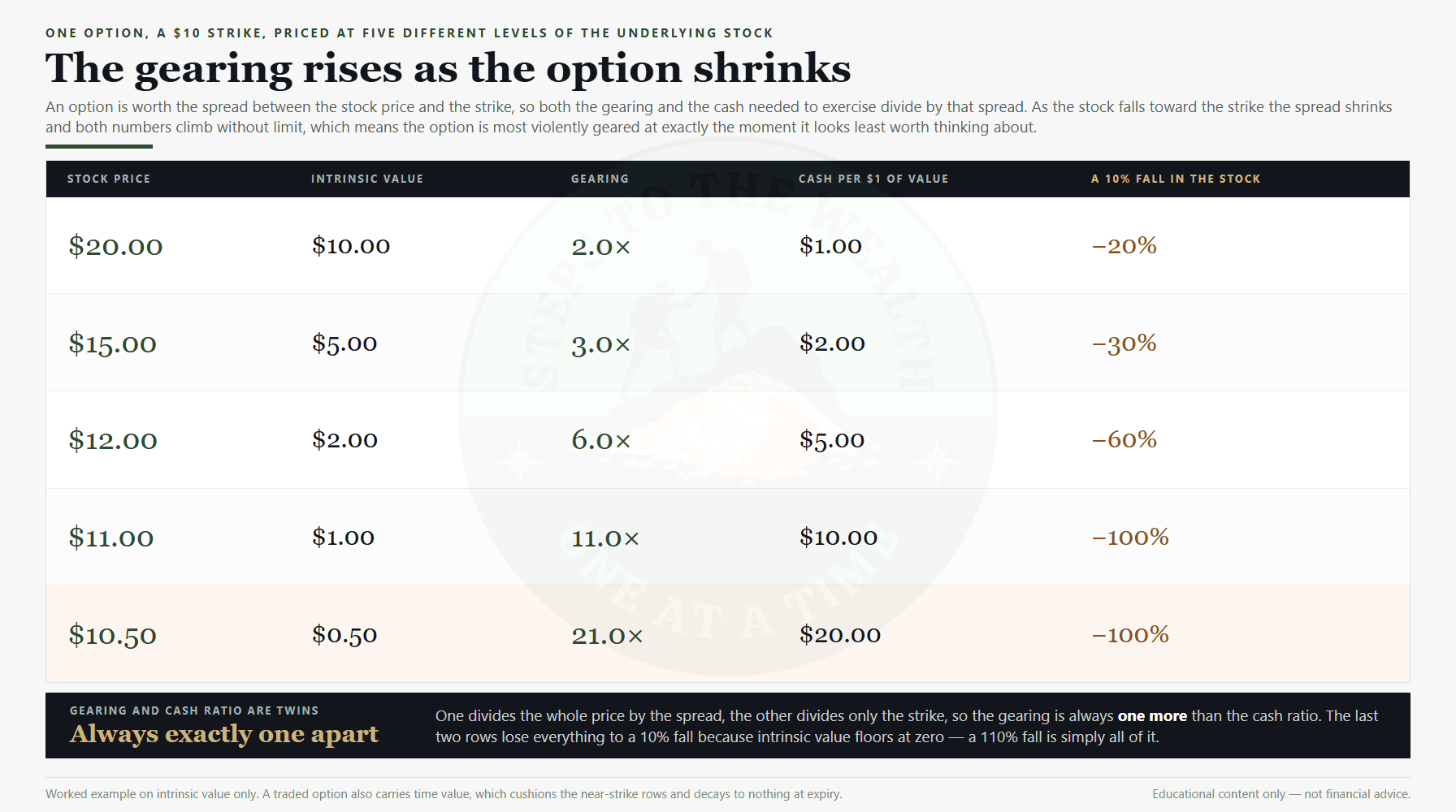
Run a 10% fall through it. From $20 the option loses 20%. From $15, 30%. From $12, 60%. From $11 or $10.50 it loses everything, because intrinsic value floors at zero and a 110% or 210% fall is simply all of it.
That floor is the real asymmetry. The upside gearing is unbounded and the downside gearing stops at total loss, which sounds favourable until you notice that total loss is reached by a 10% move in the underlying.
None of this is an argument against holding options. It is an argument against holding them without knowing the multiple, and against treating a paper spread as though it were money in an account. It is not money until it is sold, and the distinction between a price moving and a loss being permanent is the whole of the difference.
The exercise window is a cash problem, not a value problem
There is a second number hiding inside an option, and it is the one that catches people at the exit.
To collect the spread you have to pay the strike. On that $10 strike with the stock at $12, every unit is worth $2 and costs $10 to obtain. So capturing $2,000 of value requires $10,000 of cash on the table — five dollars out for every dollar of value in.
That ratio is the strike divided by the spread, and it moves the same way the gearing does. At $20 you lay out $1 per dollar of value. At $12 it is $5. At $11 it is $10, and at $10.50 it is $20. The two numbers are twins: the gearing is always exactly one more than the cash ratio, because one counts the whole price and the other counts only the strike.
Where this bites is on leaving. Most option grants stop being exercisable a fixed number of days after you stop working there, and that window is typically short. The clock starts on your last day, which is rarely a day you chose or a moment when you feel like writing a large cheque.
So the honest question for any option position is not what it is worth. It is whether you would have the cash available, at short notice, on a day you may not control — and whether you would still want to spend it that way once the job it came with had ended.
If the shares are not publicly traded, that question gets harder rather than easier. You cannot sell to fund the exercise, you cannot sell afterwards to enforce a cap, and the position stays exactly as large as it was until something happens that is not up to you. In that situation the only lever you actually hold is the decision not to exercise, so it is worth keeping.
The one test that resolves all three
There is a single question that settles the hold-or-sell decision for vested shares, discounted purchases and exercised options alike.
If the cash equivalent landed in your account instead, would you spend all of it on your employer’s stock?
Almost nobody says yes. Yet holding is that decision, made silently, repeated every vest.
The test works because it strips out the framing. It removes the sense that the shares are a gift, the sense that selling is disloyal, and the sense that a position you already hold is somehow different from one you would open today. It is the same position either way.
If the honest answer is “some of it, not all”, that is a real answer and it names a cap. Write the cap down, treat everything above it as proceeds, and let the written rule do the deciding on the day rather than your mood.
What to do with the proceeds
Selling is only half a decision. Cash sitting from a vest is still a position, and an undecided one.
The proceeds arrive as a lump, which puts you straight into the lump-sum against phased deployment question several times a year. Worth settling once, in advance, rather than re-arguing at every vest date.
Two things worth doing before the money goes anywhere else. If your emergency reserve is thin, a vest is the cheapest chance you will get to fill it, and the order of those two claims has its own arithmetic. And if the sale leaves your overall allocation off target, this is a free rebalance — you are deploying new money rather than selling something to buy something else.
After that it is ordinary capital and should be treated as ordinary capital. It is not “company money” that owes any loyalty to where it came from. The schedule you already run is the schedule this money joins.
What this article deliberately will not tell you
Tax. All of it, on purpose.
Equity compensation is one of the most jurisdiction-specific things in personal finance. When a grant is taxed, at what rate, whether exercising creates a liability before you have sold anything, whether holding longer changes the treatment, what any annual limits are — every one of those answers is set by the jurisdiction in which you live, and several of them can be large enough to reverse a decision the arithmetic above would otherwise settle.
Anything written for a general audience that names those rules is describing one country and quietly hoping you live in it. That is worse than saying nothing, because it reads as guidance.
So: the four calculations here are structural and travel anywhere. The tax layer sits on top of them and needs someone who knows your local rules and has read your actual plan documents. Those documents are also the only place your real vesting schedule, discount, look-back terms and expiry dates exist — not the summary slide from onboarding.
One further limitation worth stating. The recovery figures assume a steady real return and no new contributions, which understates the recovery for anyone still paying in and overstates it for anyone who has stopped. It is a ranking of concentrations against each other, not a forecast of your calendar.
Run your own numbers this week
This is an hour, once, and then a repeating calendar entry.
Step one. Find your grant documents. Note the vesting start date, the cliff, the vesting frequency, and for any options, the strike price and the expiry date. Expiry is the one people forget, and it is the one that is absolute.
Step two. Work out what percentage of your invested capital is currently in your employer, counting vested shares, purchased shares and any exercised options. Exclude anything unvested — you do not own it yet.
Step three. Multiply that percentage by a total loss and run the recovery: divide by what is left, and see how many years at 7% that gain takes. Then ask whether you could go that long without the income too, because in this specific case those two events are the same event.
Step four. If you are in a purchase plan, compute the real gain — the discount divided by what you actually pay, not the discount itself. It is larger than the number on the intranet page, which usually makes the case for participating up to the limit and selling at purchase.
Step five. For any options, calculate the gearing: current price divided by the spread. If that number surprises you, you were holding a position whose size you did not know.
Step six. Write down one cap and one standing instruction — what percentage of your portfolio your employer may occupy, and what happens automatically on each vest date. Then put the vest dates in the calendar so the decision is a diary entry rather than a judgement call made under pressure.
If the exercise shows the concentration is already well past where you would have put it deliberately, that is worth knowing and not worth panicking about. The gap between knowing and acting is the part that actually costs money, which is what The Operator’s Mindset is built around: fifteen lessons, $99 one-time.
Equity compensation is pay. The arithmetic that decides what to do with it is short, closed and indifferent to how well the company is doing this quarter. Run it once and the decision stops being a decision. For the wider question of how much of any portfolio belongs in equities at all, the regulator’s plain-language guide to asset allocation is a reasonable place to start.
Related reads
- Negotiating the grant in the first place
- What a position cap costs and what it buys
- What diversification actually removes
- The annual review that catches drift
- All the calculators, in one place
Educational content only — not financial or tax advice. All figures are worked examples: a constant 7% real return, no further contributions, and standard vesting and discount structures that your own plan documents may not match. Tax treatment of grants, purchases, exercises and sales is set by the jurisdiction in which you live and can change the answer materially. Past performance does not predict future results.