
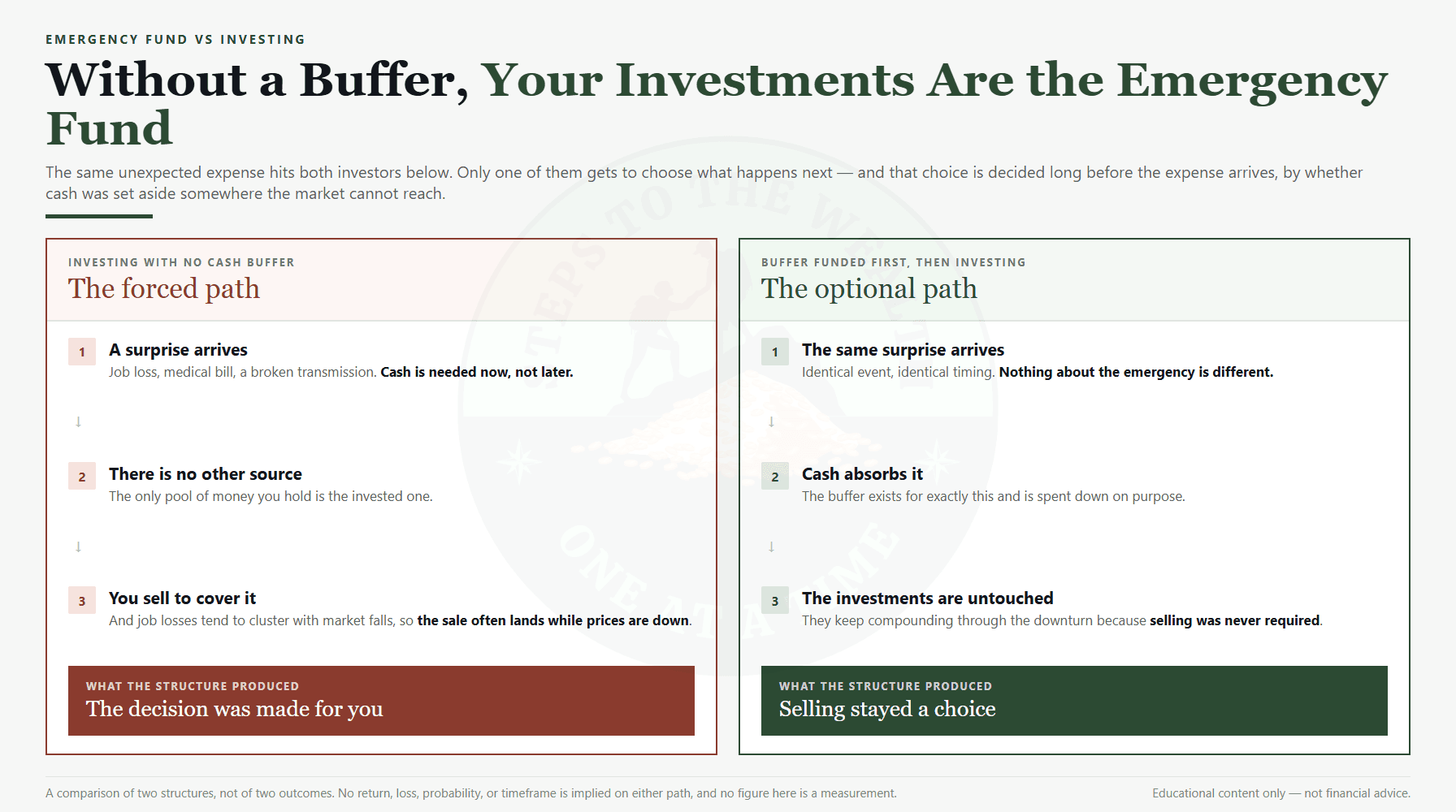
The emergency fund vs investing question has a clear answer that most people get backwards: the emergency fund comes first, because without it, your investments become your emergency fund — and they get sold at the worst possible time. This is not a motivational point about discipline. It is a structural one about risk. An investor with no cash buffer is forced to liquidate during exactly the conditions where selling does the most damage. The buffer is not the boring prerequisite to investing. It is part of the risk system itself.
Emergency fund vs investing — which should you do first?
Build your emergency fund first, then invest — because the fund is what protects your investments from being liquidated under pressure. The logic is a chain, and each link depends on the one before it. To build wealth, you have to let investments compound undisturbed. To leave them undisturbed, you cannot be forced to sell them for cash. To avoid being forced to sell, you need cash set aside somewhere else. That somewhere else is the emergency fund.
Skip this step and you have built a system with a fault line running straight through it. The moment life delivers a surprise — a job loss, a medical bill, a broken transmission — you sell investments to cover it. And life’s surprises have a way of clustering with market downturns: layoffs rise when markets fall. So you end up selling at a loss, at the bottom, locking in the exact outcome the whole system was supposed to prevent.
How much should your emergency fund be before you invest?
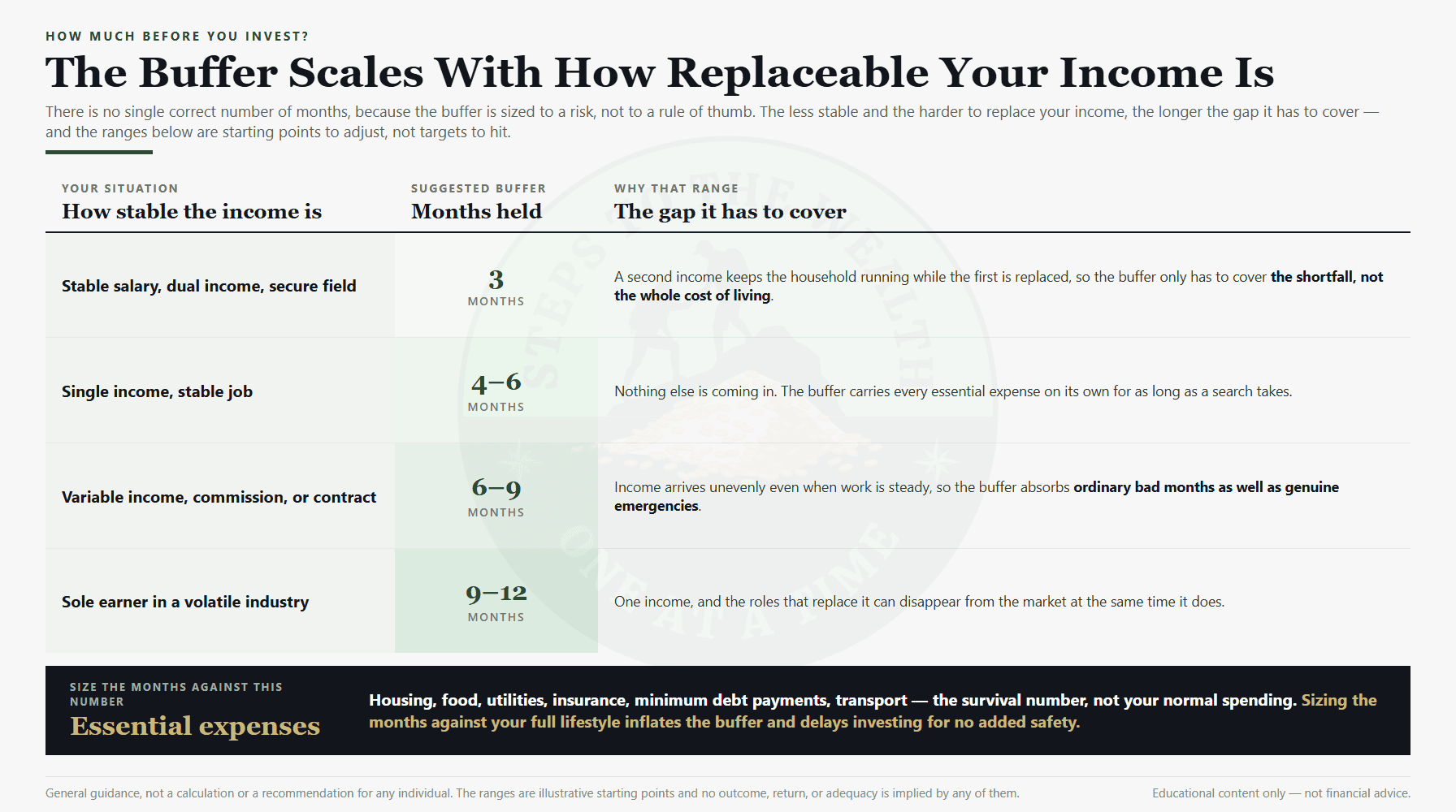
Most working professionals should hold three to six months of essential expenses in cash before investing meaningfully, with the exact figure depending on how stable and replaceable their income is. The number is not one-size-fits-all. It scales with the volatility of your situation.
| Your situation | Suggested buffer |
|---|---|
| Stable salary, dual income, secure field | 3 months of essential expenses |
| Single income, stable job | 4-6 months |
| Variable income, commission, or contract | 6-9 months |
| Sole earner in a volatile industry | 9-12 months |
“Essential expenses” means the real number — housing, food, utilities, insurance, minimum debt payments, transport — not your full lifestyle. The gap between those two figures is exactly what lifestyle creep widens over a career, which is why the survival number is worth calculating rather than estimating. The buffer is there to keep you afloat and un-forced, not to fund your normal spending indefinitely. Size it to the months you would realistically need to land on your feet, then stop. An oversized emergency fund has its own cost, which we will get to. Consumer-protection bodies publish practical starting points too — the CFPB’s essential guide to building an emergency fund covers the mechanics of getting one started.
Why does the emergency fund have to come first?
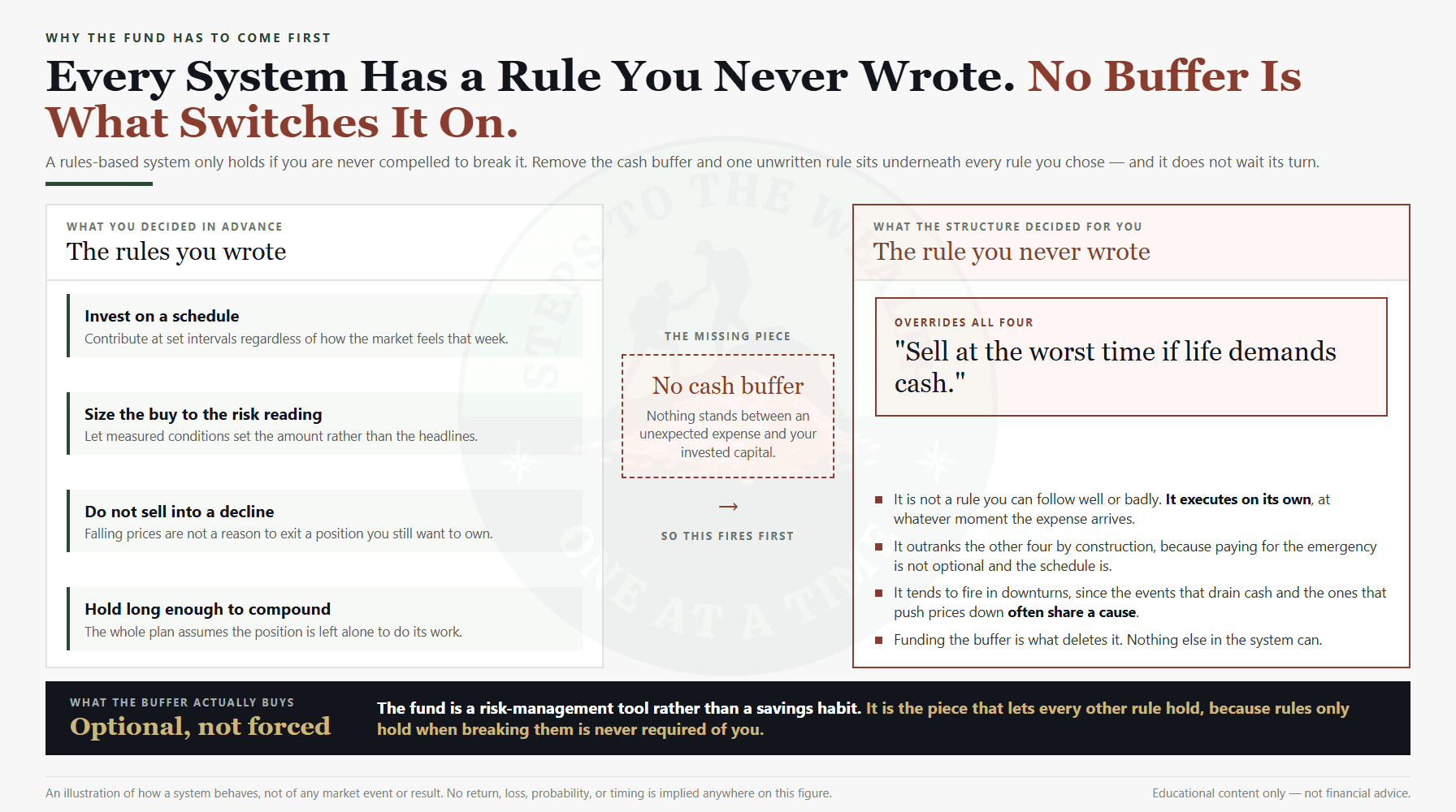
The emergency fund has to come first because it is what makes your investing decisions optional instead of forced, and forced selling is one of the most expensive mistakes in investing. Every good investing system depends on your ability to not sell when selling is a bad idea. Remove the cash buffer and you remove that ability. Your system now has a hidden rule you never wrote: “sell at the worst time if life demands cash.” That rule quietly overrides every other rule you set.
This is why the buffer is a risk-management tool, not a savings habit. It is the thing that lets a rules-based system actually function, because the rules only hold if you are never compelled to break them. An investor who might have to liquidate at any moment is not really running a system — they are running a system with an emergency exit that opens onto a cliff. This is what a risk-first approach fixes before it asks a single question about what to buy: the buffer is the first piece of risk management, not the thing you get to after it.
Should you ever invest before your emergency fund is full?
There is one common exception: capture a full employer retirement match before completing your emergency fund, because the match is an immediate, guaranteed return you will not get back if you skip it. If your employer matches contributions to a retirement account, that match is effectively free money with a return no market can promise. Passing it up to build cash faster usually costs more than it saves.
Outside of that, the order holds. A reasonable sequence for most working professionals:
- A starter buffer first — one month of essential expenses, built fast, so a small surprise does not derail you.
- Capture the full employer match — if one exists, contribute enough to get all of it. Do not leave guaranteed return on the table.
- Finish the emergency fund — bring the cash buffer up to your target months before investing beyond the match.
- Then invest systematically — with the buffer in place, you can run a rules-based system without a forced-selling fault line.
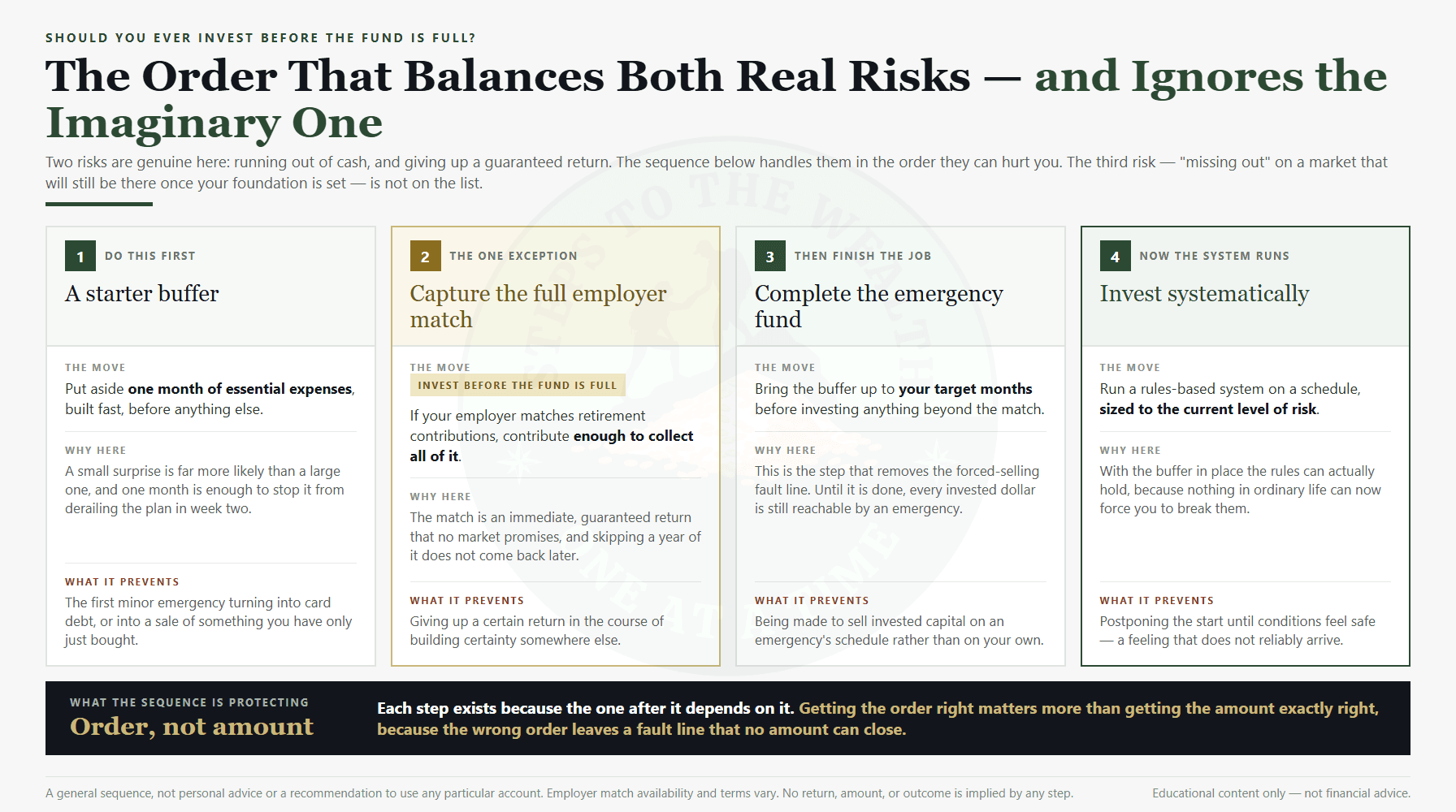
This sequence balances the two real risks: the risk of a cash emergency and the risk of forgoing guaranteed returns. It does not chase the third, imaginary risk — “missing out” on a market that will still be there once your foundation is set.
Where should the emergency fund actually sit?
An emergency fund belongs somewhere safe, liquid, and boring — a high-yield savings account or equivalent — not invested in the market, because its entire job is to be available and stable when you need it. The temptation is to “make it work harder” by investing it. That defeats the purpose. The moment your emergency fund is exposed to market risk, it can be down sharply precisely when the emergency and the downturn arrive together — the kind of simultaneous hit a portfolio stress test exists to expose.
Held in cash, the emergency fund is doing its job even when it looks like it is doing nothing. This is the same reframe that applies across the whole framework: cash is a position, and a deliberate one. The emergency fund is the most fundamental version of that idea — capital held on purpose, so the rest of your capital can stay invested through anything.
Can an emergency fund be too big?
Yes — an emergency fund can be too large, and an oversized one quietly costs you the returns that money would have earned invested. The buffer is insurance, and like any insurance, more coverage is not automatically better. Once you hold enough cash to weather a realistic emergency, additional cash beyond that is not buying more safety. It is sitting idle, losing ground to inflation, and forgoing the compounding it could have captured.
The failure mode here is real and common, especially among cautious professionals: the emergency fund grows into a comfort blanket, ten or twelve months becomes eighteen, and investing keeps getting postponed until conditions “feel safe.” Conditions never feel safe. That is the trap. The right move is to size the buffer to your situation, fund it, and then let the rules-based system take over — investing on a schedule, sized to risk, without waiting for a feeling that will not come. Right-sized, the emergency fund is the foundation. Oversized, it becomes the excuse.
What forced selling actually costs
The case for the buffer usually gets made with adjectives — risky, stressful, unwise. It is more convincing with arithmetic. Run the same emergency through two portfolios and the gap stops being a question of temperament.
Two investors hold identical portfolios that peaked at $60,000. A downturn takes both down 30%, to $42,000. In the middle of it, each meets the same $12,000 emergency: a redundancy, a medical bill, a roof.
The first investor has a funded buffer. The $12,000 comes out of cash. The portfolio is never touched and rides the drawdown at $42,000.
The second investor has no buffer, so the portfolio is the buffer. Raising $12,000 at the bottom leaves $30,000 invested.
Now let the market do nothing clever — just return to where it started. Climbing from $42,000 back to $60,000 is a 42.9% move. The first investor’s untouched $42,000 is worth $60,000 again. The second investor’s surviving $30,000 grows by that same 42.9% and lands at roughly $42,900.
So the two portfolios now sit about $17,100 apart, on the back of a $12,000 withdrawal. Only $12,000 of that gap is the emergency itself. The remaining $5,100 or so is the price of the timing: had the second investor raised the same $12,000 from cash before the drawdown and left the portfolio alone, they would be looking at $48,000 rather than $42,900.
That $5,100 is also the figure that keeps growing. Left invested for another twenty years at a 7% nominal illustration, it compounds to close to $20,000 — a five-figure hole opened by one forced sale on one bad afternoon. And the illustration is generous to the forced seller: it assumes a clean recovery to the prior peak, and it ignores the tax bill a liquidation can trigger, which arrives at the precise moment cash is scarce.
That is the whole argument in numbers. The buffer does not earn its keep by returning anything. It earns its keep by making sure the $12,000 problem stays a $12,000 problem.
Sizing the buffer to your volatility, not to a rule of thumb
Three to six months is a starting range, not an answer. The answer depends on how violently your own situation can move, and three inputs do most of the work:
- How replaceable is the income? Not what you earn — how long it realistically takes someone with your skills to be earning again in your market. A field that hires continuously is a different buffer from one that hires in twelve-week cycles.
- How many incomes hold the household up? A second income is itself a partial buffer. A sole earner has no such backstop and has to carry it in cash instead.
- How much of your outflow is fixed? The essentials you cannot renegotiate inside a month — mortgage, childcare, insurance, debt minimums — are the part of the budget that cannot flex when income stops. The higher that share, the less a spending cut can do for you, and the more months you need.
Two profiles show the spread. A dual-income household, both in fields that hire year-round, with fixed obligations around half of essential spending, sits comfortably at the bottom of the range — three months is a real buffer for them, because a job loss is a dented income rather than a stopped one. A sole earner in a cyclical industry, carrying a mortgage that eats most of the essentials number, belongs closer to nine or twelve. Same advice, different arithmetic, and the second household is not being timid by holding three times the cash.
The rule that matters more than the number: recalibrate on life events, never on market conditions. A new mortgage, a child, a move into a narrower field, a partner leaving work — those change the buffer. A falling market does not. Resizing the buffer because the headlines feel dangerous is market timing wearing a safety vest, and it cuts your investing exactly when the framework says to keep going.
The one claim that outranks both
There is a claim on your money that beats the buffer and the portfolio at the same time: high-interest debt. A card balance at 20% to 24% is a guaranteed negative return, compounding monthly, larger in magnitude than any expectation you can honestly hold for an equity market. Clearing it is the one place in personal finance where a certain double-digit return is genuinely available, and it is only available to the person carrying the balance.
So the sequence above holds for someone without that problem. If you do carry it, the balance slots in after the starter buffer and the employer match, and before finishing the fund. The starter month of cash still comes first, because paying a card to zero and then meeting a car repair with the same card leaves you where you began, minus the interest.
The other limitation is worth naming plainly, because a buffer often gets sold as more protection than it is. An emergency fund is a liquidity tool. It absorbs a $4,000 surprise. It does not absorb a $200,000 one. A serious illness, a long disability, a liability claim — those are insurance problems, and no realistic amount of cash substitutes for the cover. Health, disability and income protection sit alongside the buffer, not behind it. The fund stops an ordinary bad month from reaching your portfolio; insurance stops a catastrophic year from reaching everything else.
Once the foundation is set, let the system run
An emergency fund removes the forced-selling fault line. What comes next is a system for the investing itself — one that tells you how much to buy at the current level of risk, so you are never guessing or waiting for the market to feel safe.
Steps To The Wealth Weekly delivers a risk reading every Sunday, across five major assets, with the action each level calls for.
No predictions. No hype. Just the signal that runs the system once your foundation is in place.
Frequently asked questions
Should I build an emergency fund or invest first?
Build your emergency fund first. Without a cash buffer, your investments become your emergency fund and get sold under pressure — often at a loss during a downturn, since job losses tend to cluster with market falls. The one common exception is capturing a full employer retirement match before the fund is complete, because that match is a guaranteed return.
How much should I have in an emergency fund before investing?
Most working professionals should hold three to six months of essential expenses in cash, scaled to how stable their income is — closer to three months for secure dual-income households and closer to six to twelve for variable income or sole earners in volatile fields. “Essential expenses” means the real survival number, not your full lifestyle.
Should I invest my emergency fund to earn a return?
No. An emergency fund should sit somewhere safe and liquid, like a high-yield savings account, not in the market. Its job is to be stable and available exactly when you need it — and market exposure means it could be down sharply at the moment an emergency and a downturn arrive together.
Can an emergency fund be too big?
Yes. Once it covers a realistic emergency, extra cash beyond that stops buying safety and starts costing returns, losing ground to inflation and forgoing compounding. An oversized fund also becomes an excuse to keep postponing investing until conditions “feel safe” — a feeling that never reliably arrives.
Should I stop investing to rebuild my emergency fund if I use it?
Generally yes — if you draw the fund down, prioritize refilling it back to your target before resuming investing beyond any employer match. The buffer is what keeps your investing decisions optional rather than forced, so restoring it protects the rest of the system. The order of operations for the weeks in between — what to cut, what to stop and when the portfolio may be touched at all — is set out in investing after job loss.
Educational content only — not financial advice. Examples and figures are for illustration and do not predict future results.