
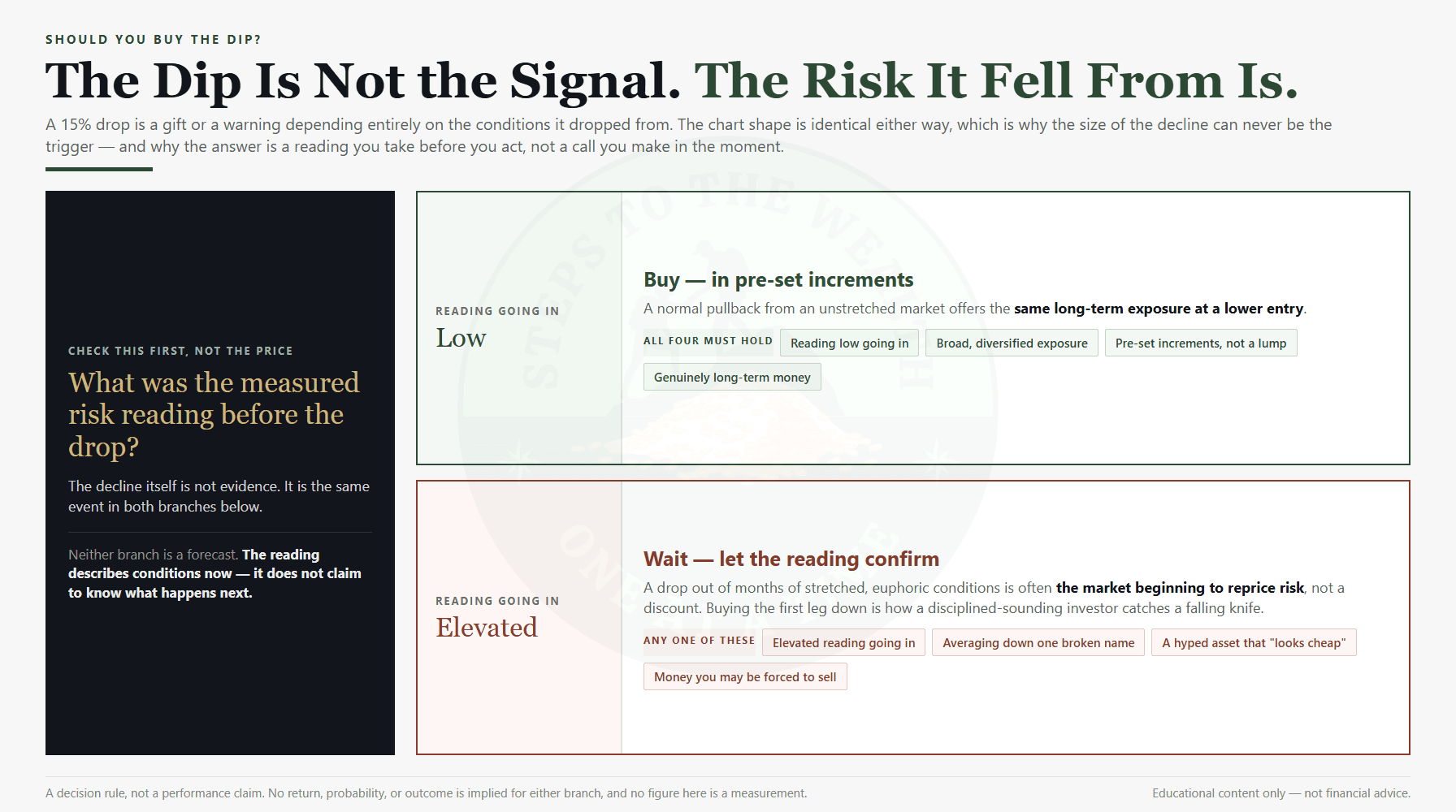
Whether you should buy the dip depends entirely on one thing most people never check: what the risk reading was before the dip. A drop from a low-risk, reasonably valued market is an opportunity — you are buying the same asset cheaper. A drop from a high-risk, overextended market is often just the first leg down of a larger unwind, and buying it is how disciplined-sounding investors catch a falling knife. “Buy the dip” is not a strategy. It is a reflex. The strategy is knowing which dips are worth buying, and that requires a signal, not a feeling.
Should you buy the dip?
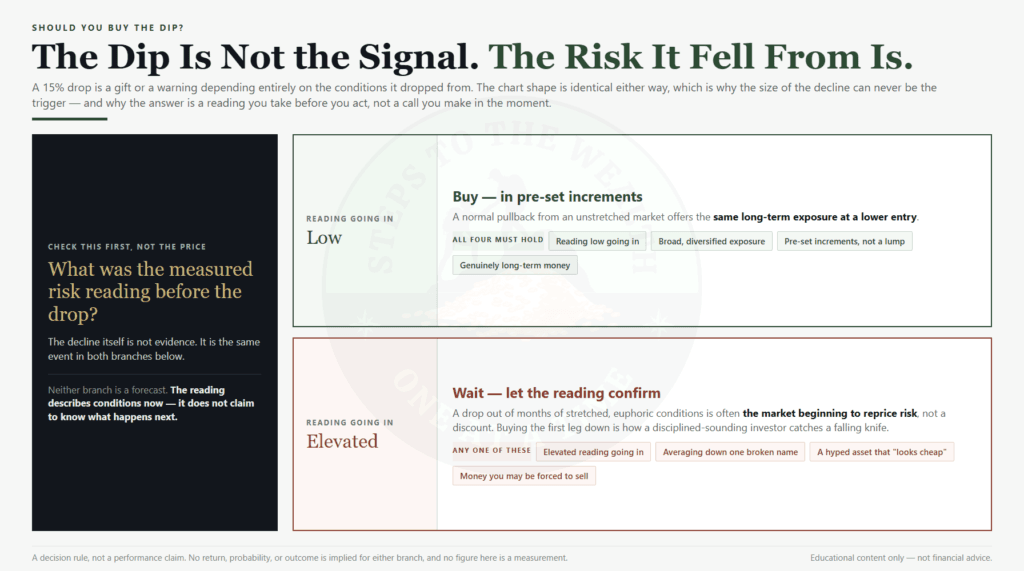
You should buy the dip when a measured risk reading is low and you are adding in pre-set increments to a diversified position — and you should not buy the dip when risk is elevated, when you are buying a single beaten-down asset on emotion, or when the money should not be at risk in the first place. The dip itself tells you almost nothing. A 15% drop can be a gift or a warning depending entirely on the conditions it dropped from.
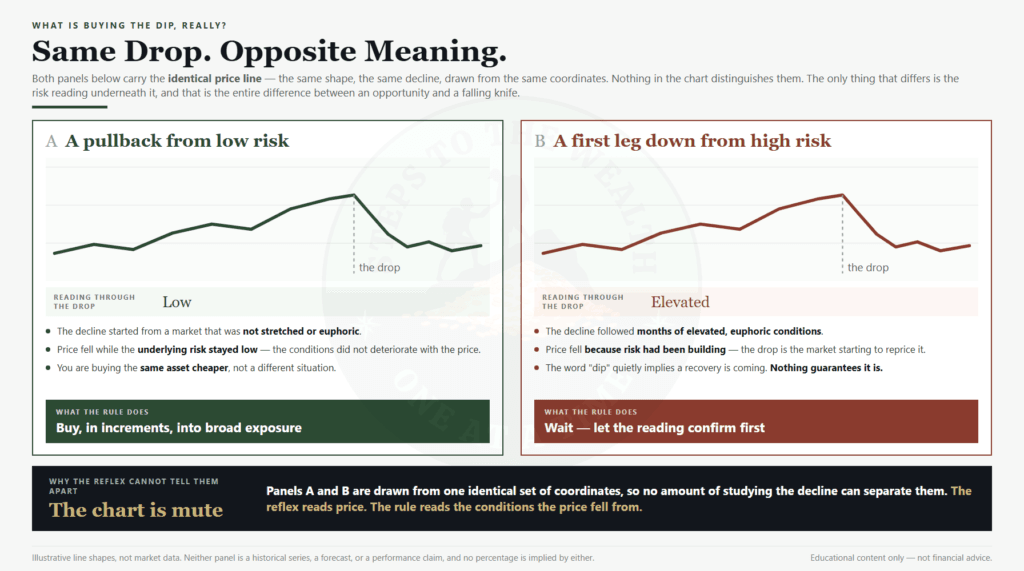
This is the core problem with the phrase. “Buy the dip” treats every decline as the same event — a discount to be seized. But markets do not fall for one reason. Sometimes price drops while the underlying risk stays low, and that is genuine opportunity. Sometimes price drops precisely because risk was building for months, and the decline is the market beginning to reprice that risk. Same chart shape. Opposite meaning. The reflex cannot tell them apart. A system can.
What is “buying the dip,” really?
Buying the dip means adding to an investment after its price has fallen, on the belief that the lower price represents better value and the asset will recover. In principle it is sound — buying more of something you already wanted to own, at a lower price, is the entire logic of dollar-cost averaging done deliberately.
The trouble is that in practice, “buy the dip” usually gets applied backwards. It becomes an excuse to chase whatever fell the hardest, to add to a losing single-stock bet to “lower the average,” or to deploy a lump of cash the moment the market flinches — all driven by the fear of missing the bounce. The instinct that started as disciplined value-buying turns into emotional catching. The word “dip” quietly implies the recovery is coming. Nothing guarantees it is.
When is buying the dip a good idea?
Buying the dip is a good idea when the broad market’s measured risk is low, the drop is a normal pullback rather than the start of a repricing, and you add gradually rather than all at once. Under those conditions, a dip is doing you a favor: it is offering the same long-term exposure at a lower entry, and the odds favor recovery over a reasonable horizon.
The conditions that make a dip worth buying:
- Risk was low going in. The decline started from a market that was not stretched or euphoric. A risk-first read on conditions through a drop is the clearest green light there is.
- You are buying broad exposure, not a single wounded name. Adding to a diversified position is averaging in. Averaging down on one collapsing stock is often just sunk cost wearing a strategy’s clothes.
- You add in increments. You buy 10% at a time as the drop deepens, not your whole reserve on day one — because you cannot know it is the bottom, and you do not need to. This is the same logic behind spreading an investment out rather than committing it in one lump.
- The money is genuinely long-term. It is not your emergency buffer, and you will not be forced to sell it at the worst moment.
When those line up, buying the dip stops being a gamble and becomes exactly what a risk-first system is built to do: lean in when the odds are in your favor. What that looked like through the 2020 crash is a useful reference point — not because that drop predicts the next one, but because it shows what continuing to buy through a decline actually does to a position.
When is buying the dip a trap?
Buying the dip is a trap when the drop comes from a high-risk, overextended market, when you are averaging down on a single broken asset, or when you are deploying money you cannot afford to have fall further. These are the situations where the reflex actively works against you, and they are far more common than the buy-the-dip crowd admits.
| Type of dip | What it looks like | Buy or wait |
|---|---|---|
| Pullback from low risk | Broad market dips while the risk reading stays low | Buy, in increments |
| First leg down from high risk | Market falls after months of elevated, euphoric conditions | Wait; let the reading confirm |
| Averaging down one broken name | Adding to a single stock only to lower your cost basis | Trap — this is sunk cost |
| Falling knife on leverage or hype | A hyped, overextended asset drops 30% and “looks cheap” | Trap — cheap can get cheaper |
| Panic-deploying your buffer | Throwing your emergency cash in to catch the bounce | Trap — you may be forced to sell |
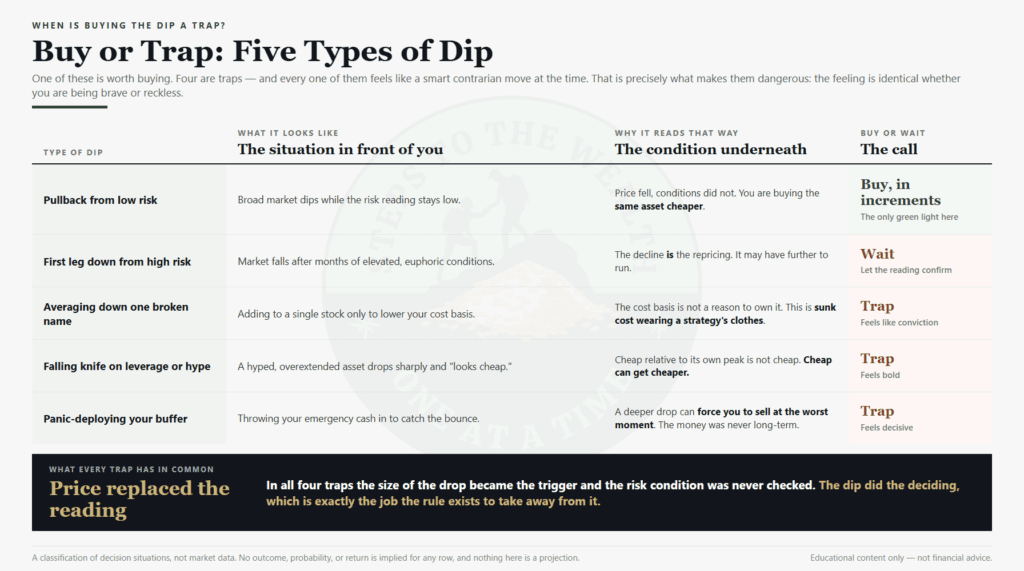
The middle column is where the discipline lives. Every trap in that table feels like a smart contrarian move in the moment. That is what makes them dangerous. Buying the most beaten-down, most hyped asset feels bold. Doubling down on a loser feels like conviction. Deploying every last dollar into a scary drop feels decisive. The feeling is identical whether you are being brave or reckless — which is exactly why you cannot rely on the feeling.
The arithmetic of averaging down
The single-stock trap in that table deserves its own numbers, because “lowering your average” sounds like risk management and behaves like the opposite.
Say you hold 100 shares bought at $50 — $5,000 committed. The price halves to $25 and the position is worth $2,500. The reflex says buy more here: another 100 shares at $25, for $2,500. You now hold 200 shares, $7,500 invested, at an average cost of $37.50.
Look at what that achieved. Your break-even price fell from $50 to $37.50, so the recovery you need is a 50% rise from here rather than a 100% one. That is a real improvement and it is why the move feels smart.
Now let the decline continue to $12.50, which is precisely the scenario the added money was exposed to. The doubled position is worth $2,500 against $7,500 committed — a $5,000 loss. Had you not added, you would hold $1,250 against $5,000 committed — a $3,750 loss. Averaging down improved your percentage (down 67% rather than 75%) and worsened your dollars by $1,250.
That is the trade nobody states out loud. Averaging down buys a better-looking percentage with real money, and it funds that purchase by increasing your exposure to a thesis that has already been wrong once. Doing it across a diversified position is ordinary systematic buying, because no single company can take the whole thing to zero. Doing it into one name is a concentrated bet placed at the moment the evidence turned against you.
The test is simple and uncomfortable: if you had no position in this asset today, would the rule you actually run tell you to open one at this price? If yes, adding is consistent. If the only reason to buy is that you already own it, that is not analysis. That is the sunk cost talking.
How do you buy the dip without guessing?
You buy the dip without guessing by tying the decision to a pre-set rule and a measured risk reading, so the drop only triggers buying when conditions actually support it. Guessing is what happens when “buy the dip” is your entire plan. A rule turns the reflex into a mechanism.
The mechanism has four parts:
- Check the risk reading first, not the price. The size of the drop is not the trigger. The risk level is. A low reading through a dip is a buy condition; a high reading is a wait condition.
- Pre-commit the increments. Decide in advance that you add, say, 10% of your reserve per defined step down — not a lump, not a guess about the bottom.
- Buy the market, not the wreckage. Direct dip-buying into broad, diversified exposure, not into whatever single asset fell hardest and looks most tempting.
- Review on a schedule. You act on your weekly review, not on the intraday adrenaline of watching a number fall in real time.
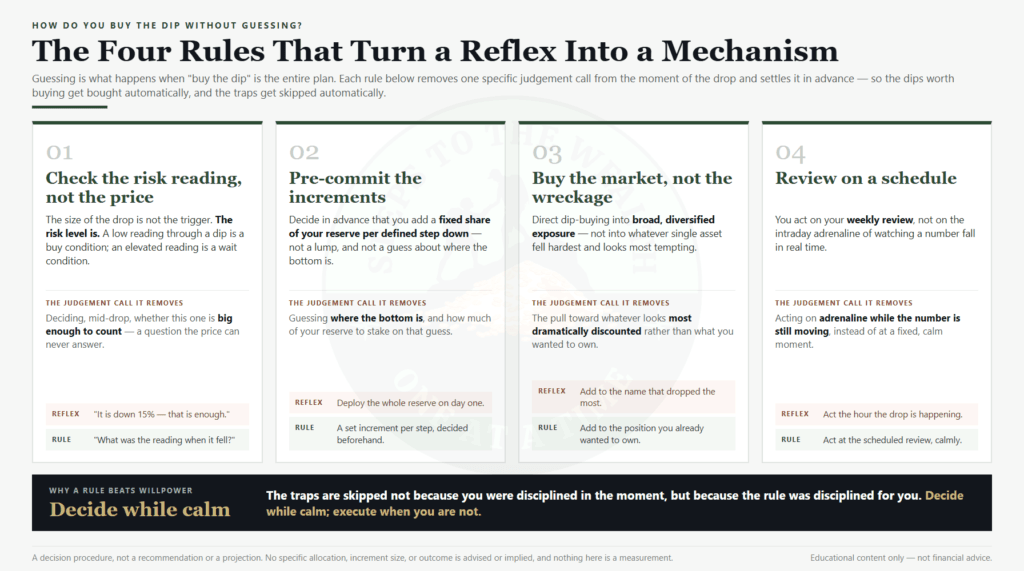
Run this and something useful happens: the dips worth buying get bought automatically, and the dips that are traps get skipped automatically — not because you were disciplined in the moment, but because the rule was disciplined for you. That is the entire premise of rules-based investing: decide while calm, execute when you are not.
What a 10% increment plan really does
“Add 10% at a time” sounds like a formality until you follow it through a real decline, so it is worth being concrete about what a ten-step ladder does and does not accomplish.
Suppose you set aside a deployment reserve and pre-decide to commit one tenth of it at each defined step down — every additional 3% the market falls, say — while the risk reading stays low. A shallow 6% pullback triggers two steps: 20% of the reserve deployed, 80% still in cash. A 15% correction triggers five. A full 30% bear market walks all ten steps in and leaves you fully deployed near the lows, which is exactly the outcome you would want and exactly the one no forecast can arrange for you.
Most of the time you will deploy two or three steps and the market will recover without you. That feels like failure. It is not — it is the ladder pricing your uncertainty correctly. You never needed to identify the bottom; you needed to guarantee that if a bottom arrived, you would still have capital when it did. Ten steps buy you that guarantee. One lump does not.
The mechanical version of this is just dollar-cost averaging pointed at a decline, and it is worth understanding on its own terms — the SEC’s investor education glossary keeps a plain-language entry on dollar-cost averaging for exactly that reason. The increment plan does not make you right about the market. It makes being wrong survivable and being right unnecessary to act.
What “wait” actually means when risk is high
Telling someone to wait through a high-risk decline is where most of this advice goes quietly wrong, because “wait” gets heard as “stop investing.” Those are different instructions and the gap between them is expensive.
Waiting means three specific things. Your scheduled contributions keep running exactly as they were — the base plan does not pause because a reading is elevated, since pausing is a market call and the whole point is to stop making those. What pauses is the extra deployment: the reserve stays in cash and the ladder does not start. And your review cadence stays weekly, so the moment conditions change you find out on a Sunday rather than three months late.
What waiting does not mean: it does not mean selling into the decline, it does not mean stockpiling more cash by cutting the base contribution, and it does not mean watching for a headline that declares the bottom. There is no bell. The reading turning over is the only signal you get, and it will arrive while the news is still bad, which is the part people find hardest to act on.
Done properly, waiting is an active position with a clear exit condition attached. That is what separates it from paralysis, which looks identical from the outside and has no exit condition at all.
Buying the dip vs catching a falling knife
The difference between buying the dip and catching a falling knife is not visible in the price — it is only visible in the risk conditions the drop came from, which is why you need a signal to tell them apart. A falling knife is a dip you bought when risk was high and the decline had further to run. A good dip-buy is the same action taken when risk was low. Identical move, opposite outcome, and the only thing that separated them was the reading you checked before you acted.
This is why “should you buy the dip” is the wrong question to ask in isolation. The right question is: what is the risk telling me, and what did I pre-decide to do at this level? Answer that, and the dip becomes just another data point your system already knows how to handle — not an adrenaline test you pass or fail on willpower. The market will keep offering dips. Your only job is to know, in advance and without emotion, which ones you buy.
Know which dips are worth buying
The instinct to buy the dip is right about half the time and expensive the other half. The thing that separates the two is not courage — it is a read on risk you check before you act.
Steps To The Wealth Weekly delivers that read every Sunday: a plain-English risk level across five major assets, with the action each level calls for — so a dip becomes a decision you already made, not a gamble you take in the moment.
No predictions. No hype. Just the signal that tells a real opportunity from a falling knife.
Frequently asked questions
Should you buy the dip?
Sometimes. A dip is worth buying when the market’s measured risk is low, the drop is a normal pullback, and you add in increments to broad exposure. It is a trap when risk is elevated, when you are averaging down on a single broken asset, or when you are deploying money you cannot afford to see fall further. The drop alone does not tell you which it is — the risk conditions do.
How do I know if a dip is a buying opportunity or a falling knife?
Check the risk reading the drop came from. A decline from a low-risk, reasonably valued market is usually opportunity. A decline from a high-risk, overextended market is often the first leg of a larger repricing — a falling knife. The price chart looks the same in both cases, which is why you need a measured signal rather than a gut call.
Is it smart to buy the dip on a single stock?
Usually not. Adding to a single beaten-down stock purely to lower your average cost is often sunk-cost behavior rather than strategy. Dip-buying is safest when it is directed into broad, diversified exposure, so no single company’s collapse can sink the position.
How much should I invest when buying a dip?
Add in pre-set increments rather than all at once — for example, a fixed 10% of your reserve per defined step down. You cannot reliably identify the bottom, and you do not need to. Buying gradually means no single decision has to be perfectly timed to work out.
Should I use my emergency fund to buy a big dip?
No. Money you might be forced to sell at the worst possible time should not be in the market at all. Buy dips only with genuinely long-term capital, kept separate from your emergency buffer, so a deeper drop never forces your hand.
Educational content only — not financial advice. Examples and historical figures are for illustration and do not predict future results.