
A contribution plan assumes an income. Every rule inside it — the monthly transfer, the risk-sized top-up, the rebalance — is written on the assumption that money keeps arriving. Then it stops, and none of the rules say what to do next.
Investing after job loss is not a smaller version of investing with a job. It is a different problem with a different objective. While you are earning, the objective is to accumulate. While you are not, the objective is to reach the other side with the portfolio intact and the plan restartable. Confusing the two is what turns a temporary income gap into permanent damage.
The emergency fund is the standard answer, and it is the right one — before the event. How big the buffer should be, and why it comes before investing at all, is settled in emergency fund vs investing. This article starts one step later, on the morning the income actually stops.
What follows is not advice about finding work faster. It is the sequence of financial decisions in the weeks after, and the one decision inside that sequence that quietly carries most of the money.
Investing after job loss: what actually changes
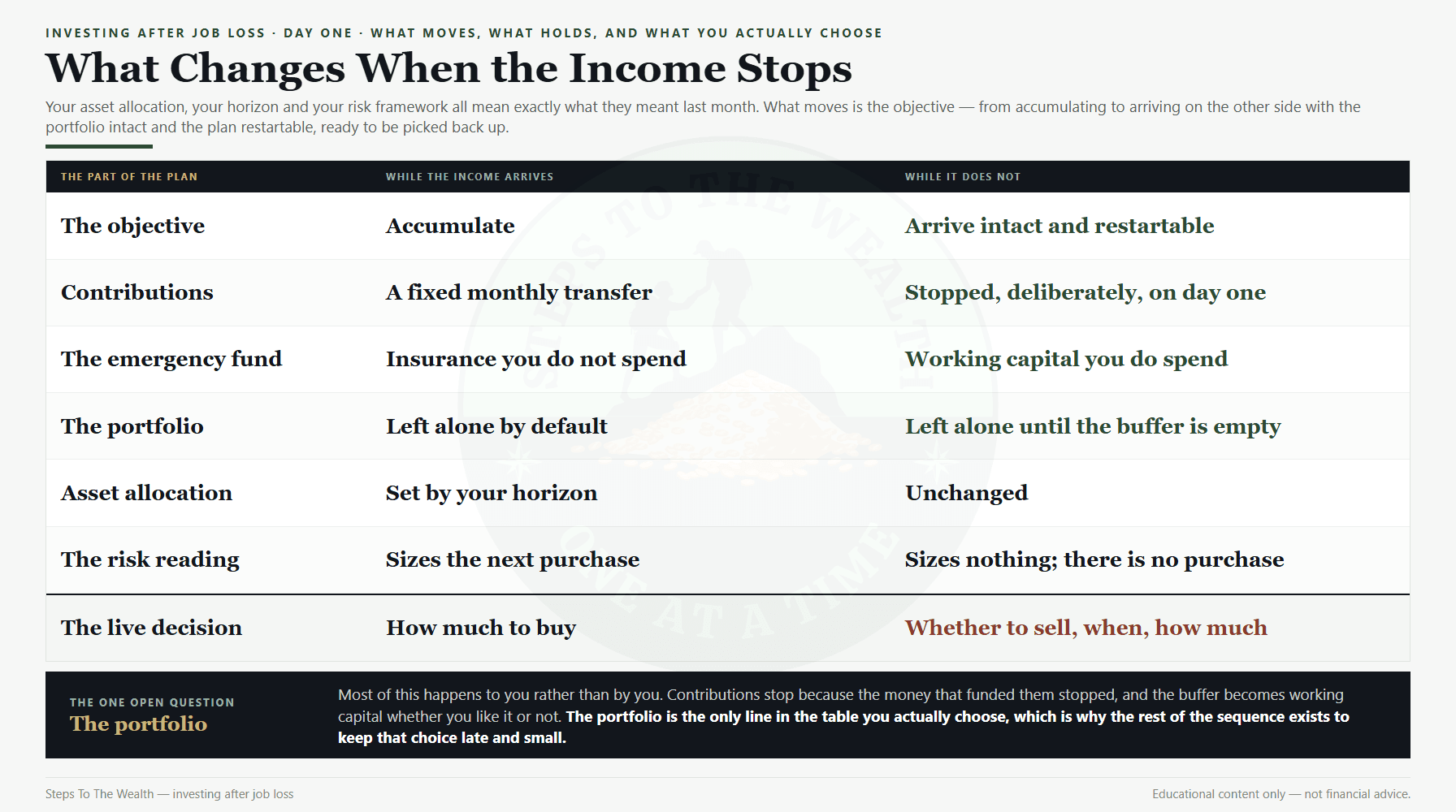
Three things change on the day the income stops, and only one of them is a decision.
Contributions stop on their own. This is not a choice you make and not a rule you break. A standing order funded by a salary that no longer arrives will either bounce or drain the buffer it was supposed to protect. Cancel it deliberately rather than letting it fail, but understand that the plan is not being abandoned here. It is being suspended by arithmetic.
The buffer changes job. Up to this point the emergency fund was insurance — capital held so that it would not have to be used. It is now working capital. That reframe matters, because people who have spent years building a buffer are strangely reluctant to spend it, and that reluctance pushes them toward the portfolio instead.
The portfolio becomes a decision. This is the only genuinely open question, and it is the one that carries money: whether you touch the invested capital, when, and how much. Everything else in this article exists to keep that decision as late and as small as possible.
Notice what is not on the list. Your asset allocation does not change. Your risk framework does not change. What the market is doing does not change anything either, and we will come back to why.
Your first number is runway, not months of expenses
The buffer is usually described in months: three months, six months, nine. That label is doing less work than it appears to. “Six months of expenses” is a number calculated against a life you are no longer living, because the first thing that happens after an income stops is that the outflow changes.
The number that matters now is runway: how many months the cash on hand actually covers at the spending level you are actually running. It is a division, not a rule of thumb, and it has to be recalculated on the first day rather than assumed.
Runway is not evenly distributed, and the driver is not the size of the buffer. It is the share of your outflow that is fixed — the mortgage or rent, childcare, insurance, debt minimums. That share cannot be renegotiated inside a month, so it sets a floor under how far spending can fall.
Three households make the point. Each looks similar on the standard label and behaves very differently once the income stops.
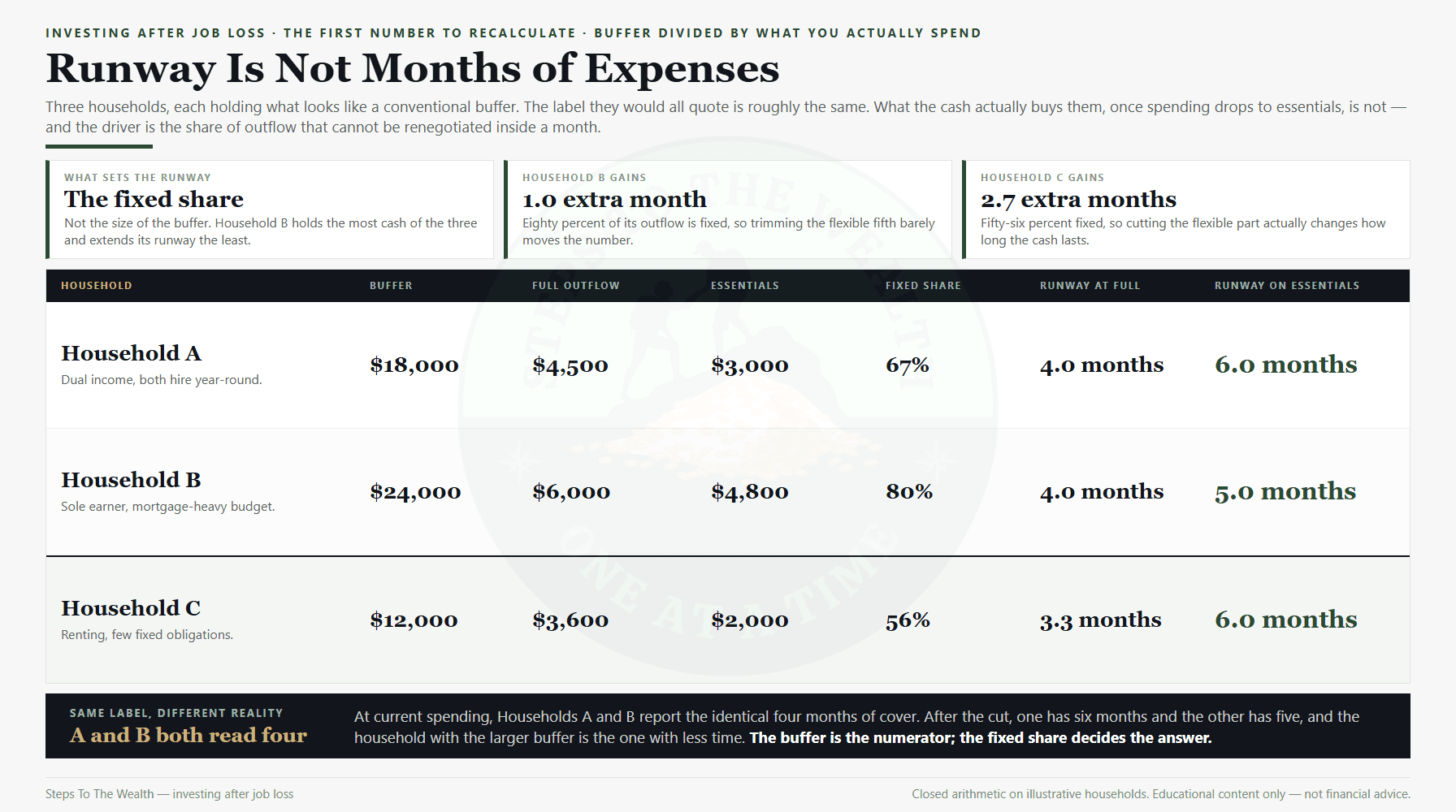
Households A and B look identical on the standard label: four months of cash at current spending. B holds the largest buffer of the three and gains the least from cutting, because eighty percent of its outflow is fixed and trimming the flexible fifth buys one extra month. C holds half the cash and buys nearly three. The buffer is the numerator; the fixed share decides the answer.
This is also the practical reason to know your essentials figure before you need it. The gap between full spending and essential spending is exactly the ground that lifestyle creep takes over a career, and it is invisible until it is the only lever you have left.
The order of operations when the income stops
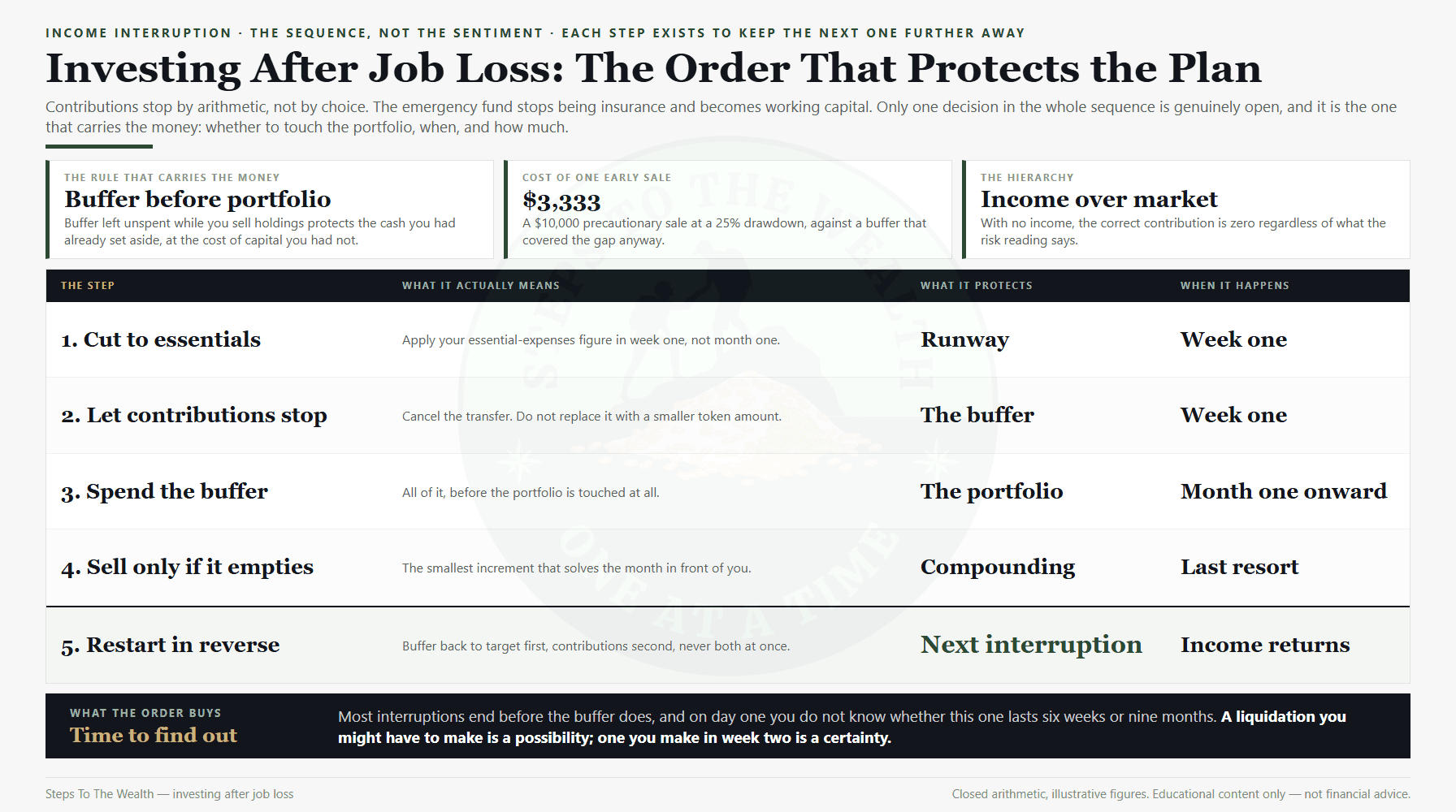
The order below is not a preference. Each step exists to keep the following step further away, and doing them out of sequence is what generates the avoidable losses.
- Cut to the essentials number. Not a vague intention to spend less — the actual figure, applied in the first week. Every month of delay costs you the difference in runway.
- Let the contributions stop. Cancel the transfer. Do not replace it with a smaller one to keep the habit alive. A token contribution funded from a finite buffer is a transfer from your runway to your portfolio at the worst possible moment.
- Spend the buffer. All of it, before the portfolio. This is the step people get wrong, and it has its own section below.
- If the buffer runs out, sell in the smallest increment that solves the month. Not a quarter of a year’s worth. Not a round number that feels safer. The month in front of you.
- Restart in reverse. Buffer first, contributions second, and not simultaneously.
Steps one and two are administrative. Step three is a discipline problem. Steps four and five are where the plan is either preserved or quietly rewritten, and both of them come later than most people act.
Why draining the buffer before selling is the whole discipline
There is a reflex that shows up in the first fortnight and it looks responsible. The reasoning goes: the situation is uncertain, so I should raise cash now, while I still can, rather than be forced into it later. Sell some holdings, sit on a larger pile, feel safer.
It is the wrong move, and the reason is structural rather than emotional. A liquidation you might have to make is a possibility. A liquidation you make in week two is a certainty. Selling early converts a risk into a realised loss in exchange for a feeling.
The buffer exists precisely so that the sale is unnecessary. Every dollar of it you leave unspent while selling investments is a decision to protect cash you had already set aside for this, at the expense of capital you had not.
There is a second reason, and it is about information. On day one you do not know whether the interruption lasts six weeks or nine months. Selling on day one prices in the worst case before you have any evidence for it. Spending the buffer buys you time to find out, and most interruptions end before the buffer does.
The framework already has a name for cash held on purpose. Cash is a position, and during an income interruption it is the position doing all the work. Holding it while liquidating the portfolio inverts the entire arrangement.
There is one honest exception, and it is narrow. If the interruption is known in advance to be long — a fixed-term redundancy notice, a planned unpaid period, a relocation with a stated start date — then the buffer is arithmetically insufficient and the only question is how to raise the shortfall. Selling in planned tranches across that period beats a single forced sale on the day the cash runs out. That is not a precautionary sale. It is a scheduled one, made against a known number rather than a fear.
Most interruptions are also partial rather than total. Reduced hours, one of two household incomes stopping, or contract work drying up while a retainer continues all leave some money arriving. The sequence is identical, with one change: the essentials figure is met from the remaining income first, and the buffer covers only the gap. That can stretch a six-month buffer well past a year, which is another reason not to price the worst case in week two.
What a precautionary sale actually costs
The argument above is more convincing with arithmetic than with adjectives, so here is the arithmetic. It is an illustration, not a forecast.
Two investors lose their income in the same month. Both hold a portfolio that peaked at $40,000 and is now down 25%, at $30,000. Both hold a $12,000 buffer, and both interruptions end at month seven having cost exactly $12,000 to live through. In both cases the buffer would have covered it.
The first investor spends the buffer and never touches the portfolio. The second sells $10,000 in week two to feel safe, covers the remaining $2,000 from the buffer, and finishes the interruption with $10,000 of cash still in the account.
Now let the market do nothing clever — simply return to where it started. Climbing from a 25% drawdown back to the prior peak is a 33.3% move. The first investor’s untouched holdings are worth $40,000 again. The second investor’s surviving $20,000 grows to $26,667, and with the leftover cash the total position is $36,667.

The precautionary sale cost $3,333, and it bought nothing at all, because the buffer was never exhausted. That figure also keeps growing: left invested for another twenty years at a 7% nominal illustration it compounds to roughly $12,899, and over ten years to about $6,557.
The illustration is generous to the seller in two ways worth naming. It assumes a clean recovery to the prior peak, which is not guaranteed and is exactly the assumption a flat decade breaks. And it ignores any tax a liquidation triggers, which arrives at the moment cash is scarcest.
The market reading does not get a vote while you have no income
This is the part that surprises people who run a rules-based system, so it is worth stating flatly: during an income interruption, the market reading does not change what you do.
A risk framework tells you how much to buy at the current level of risk. With no income, the answer to how much you should buy is zero regardless of what the reading says, because the money is not there. A low-risk reading does not create capital. Nor does a high-risk reading justify liquidating — you would be selling because you need to eat, not because risk is elevated, and those are different decisions that happen to use the same button.
Two failure modes follow from mixing them up. The first is buying into a low-risk reading with buffer money, on the argument that the opportunity is too good to miss. That converts your runway into an undated position and is the fastest way to turn an income problem into a solvency problem.
The second is dressing up a panic sale as a risk-management action. If the interruption had not happened, you would not be selling. The reading is not why you are at the screen.
The honest rule is a hierarchy: income state overrides market state. Knowing when not to invest more is a normal part of the framework; this is the version of it where the answer is fixed for the duration and no reading can move it.
Restarting: rebuild the buffer before you resume contributions
The income comes back, and the instinct is to restore everything at once — refill the buffer and restart the transfer in the same month, on the argument that you have lost ground and need to make it up.
Do it in sequence instead. Bring the buffer back to its target first, then restart contributions. The reason is the one that put the buffer first originally: until it is refilled you are running the system without its shock absorber, and a second interruption arriving in that window has nothing to land on except the portfolio. The period immediately after an interruption is not a period of low risk. It is often the opposite.
There is a specific version of this to avoid: treating the missed months as a debt owed to the portfolio and lump-summing them back the moment cash appears. The missed contributions are gone. They were the correct thing to skip. Deploying six months of contributions in one go, out of a buffer that is not yet whole, recreates the exact vulnerability you just spent six months surviving.
One nuance from the other half of the income story. If work returns in a lumpier form — contract, commission, freelance — the plan needs re-sizing rather than restarting, and that is a different exercise, covered in investing with variable income.
Recalibrate the buffer target as well. An interruption is a life event, and life events are the only legitimate reason to resize a buffer. If the one you had was thin, the honest response is a larger target, not a faster return to investing.
The mistakes that show up in the first fortnight
Five patterns account for most of the avoidable damage, and every one of them is a decision rather than a misfortune.
- Keeping the contribution running out of pride. The habit is not what compounds. The capital is.
- Selling early to feel in control. Covered above, and the most expensive item on the list.
- Cutting the wrong costs. Cancelling small recurring spending feels productive and moves the runway very little when the fixed share is high. The subscription you cancel is rarely the one that mattered.
- Reaching for credit before the buffer. A card balance at 20% to 24% is a guaranteed negative return, compounding while you are least able to service it. If a balance does build, clearing it outranks resuming contributions, as paying off debt or investing sets out.
- Deciding the whole strategy was wrong. An income interruption is not evidence about your asset allocation. It is evidence about your buffer.
The last one deserves a sentence more. Losing an income is genuinely stressful, and stress produces a search for something to fix. The portfolio is visible, adjustable and completely innocent. A rules-based system earns its keep here mainly by giving you nothing to fiddle with.
What this does not solve
A buffer and a sequence are liquidity tools. They handle an ordinary bad stretch. They do not handle every case, and pretending otherwise is the kind of overclaim this site exists to avoid.
A long interruption does real damage, and no ordering trick removes it. Twelve months without contributions is twelve months of missing capital, and the compounding on it is genuinely lost. The sequence above minimises the damage; it does not neutralise it.
A serious illness, a long disability or a liability claim is an insurance problem rather than a buffer problem. No realistic amount of cash substitutes for cover, and income protection sits alongside the emergency fund rather than behind it. The investor.gov guidance on asset allocation is a reasonable neutral starting point for the portfolio side of that split.
None of this addresses the tax or benefits treatment of an interruption, which is jurisdiction-specific and outside what a general article can honestly answer. And if the interruption is permanent rather than temporary — a career ending rather than pausing — the exercise is a plan rebuild, not a pause. That is a different piece of work.
Where this fits
The buffer decides whether an income interruption reaches your portfolio at all. The sequence decides how much of it gets through. Both are settled before the event, which is the entire reason to settle them now.
Once the income is back and the foundation is restored, the question returns to the ordinary one: how much to buy at the current level of risk. Steps To The Wealth Weekly delivers a risk reading every Sunday across five major assets, with the action each level calls for.
No predictions. No hype. Just the signal that runs the system once your foundation is back in place.
Frequently asked questions about investing after job loss
Should I stop investing after a job loss?
Yes — stop new contributions immediately, because they are funded by an income that is no longer arriving. Stopping contributions is not the same as selling. The plan survives a pause; it does not survive an unnecessary liquidation. Cancel the transfer deliberately rather than letting it drain the emergency fund.
Should I sell investments to cover expenses after losing my job?
Only after the emergency fund is exhausted, and then in the smallest increment that covers the month in front of you. Selling early to feel prepared converts a possible loss into a certain one. In the illustration above, a $10,000 precautionary sale during a 25% drawdown cost $3,333 and bought nothing, because the buffer covered the interruption anyway.
How long will my emergency fund actually last?
Divide the cash on hand by your essential monthly outflow, not by your normal spending. The answer depends far more on what share of your outflow is fixed than on the size of the buffer — a household at 80% fixed costs gains about one extra month from cutting, while one at 56% gains close to three.
Should I keep investing a small amount to maintain the habit?
No. A token contribution funded from a finite buffer moves money from your runway into your portfolio at the worst possible moment. The habit is not what compounds; the capital is. Resume the transfer once the income and the buffer are both restored.
Should I rebuild my emergency fund or restart investing first?
Rebuild the buffer first, then restart contributions, and not both at once. Until the fund is back at target you are running without a shock absorber, and a second interruption in that window has nothing to land on but the portfolio. Treat the interruption as a life event and check whether the target itself should be larger.
Should I invest my emergency fund if the market falls while I am out of work?
No. With no income the correct contribution is zero regardless of what the risk reading says, because a low reading does not create capital. Income state overrides market state. Deploying runway into an undated position is the fastest way to turn an income problem into a solvency problem.
Educational content only — not financial advice. Examples and figures are for illustration and do not predict future results.