
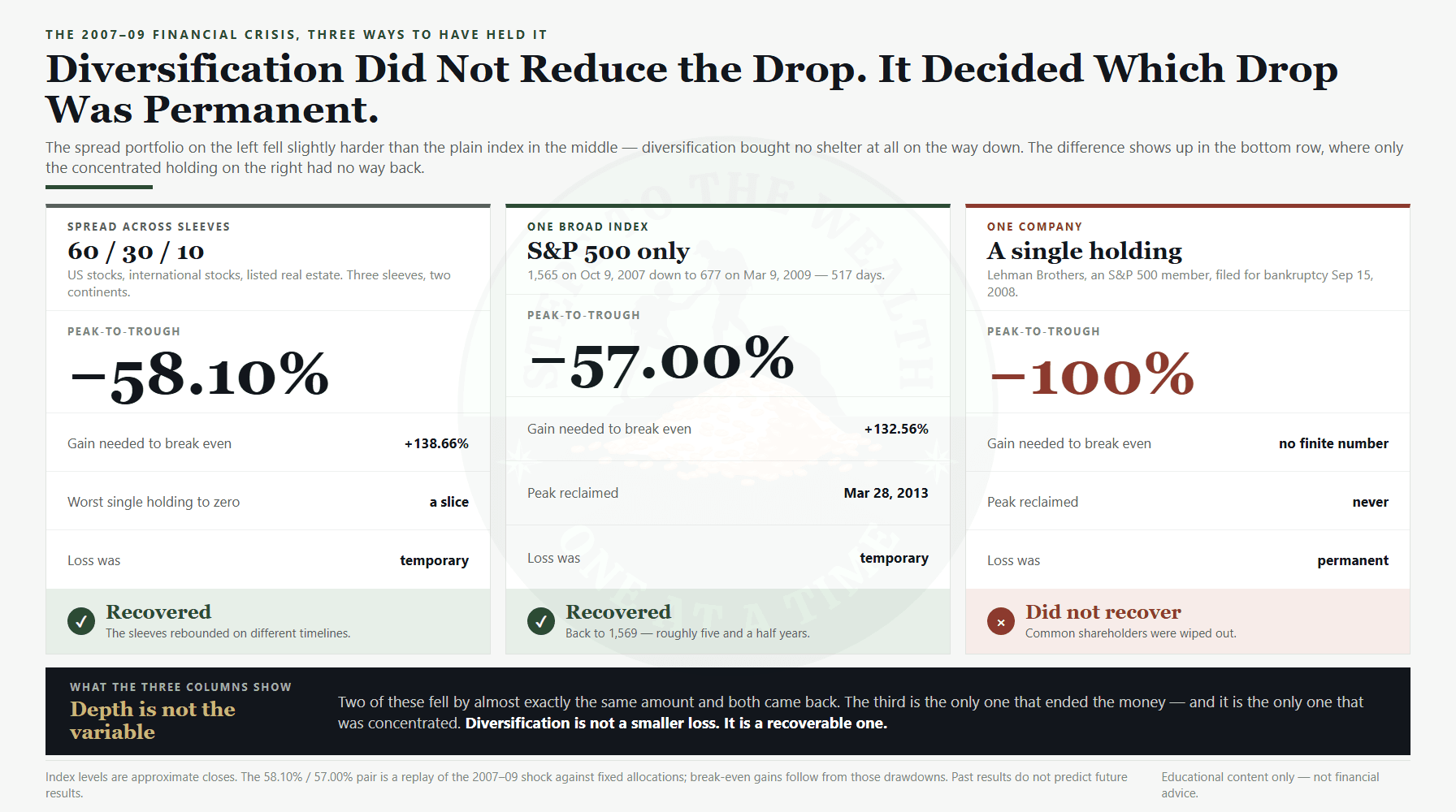
How diversification reduces risk is easy to state and easy to get wrong: it works by making sure no single loss can be fatal — not by making your portfolio stop falling. That one distinction is where most people misunderstand it. They expect a diversified portfolio to feel calm, to sidestep the drops, to smooth out the ride. It does not do that, and when a broad sell-off drags everything down together they conclude diversification failed. It did not fail. It was never designed to stop a drop. It was designed to stop a drop from being permanent.
The 2007–09 financial crisis makes the point better than any argument. Understanding exactly what diversification protects you from — and what it leaves completely untouched — is what turns it from a vague comfort into a precise risk tool.
What is diversification, really?
Diversification is spreading your money across investments that do not all lose value for the same reason at the same time, so that no single failure can take down the whole portfolio. That is the entire mechanism. It is not about owning more things for the sake of it. It is about owning things whose risks are not linked, so that when one is impaired, the others are not automatically impaired with it.
The word that matters is linked. Owning thirty technology stocks is not diversification. They rise and fall together, driven by the same rate decisions, the same demand cycle and the same sentiment, so you effectively own one bet thirty times. Owning assets that respond to genuinely different drivers — different sectors, different asset classes, different economies — is diversification, because a shock to one is not a shock to all. The goal is not quantity. It is independence. A handful of genuinely independent exposures protects you far more than a hundred versions of the same underlying position.
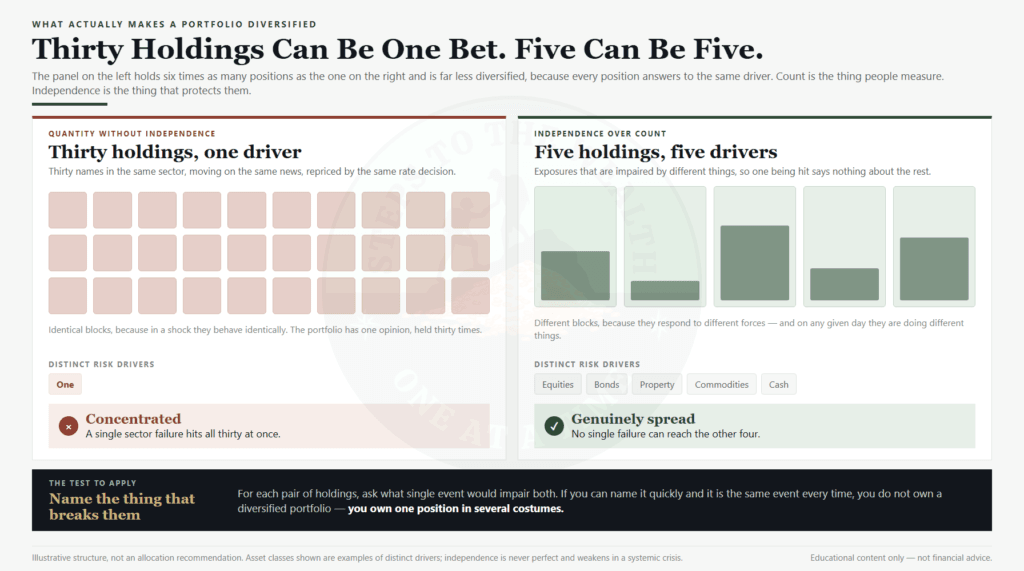
There is a simple test. Take any two holdings and ask what single event would impair both. If you can name it immediately, and it is the same event for every pair in the portfolio, you are not diversified — you own one position in several costumes. The regulator’s own framing of asset allocation and diversification rests on the same idea: the spread only works when the things you spread across behave differently.
How diversification reduces risk
Diversification reduces risk by lowering the chance that any one event causes permanent, unrecoverable loss. It converts a small number of large, concentrated dangers into a larger number of small, survivable ones. When your money sits in a single asset, that asset going to zero is catastrophic and final. When it sits across many independent assets, no single failure can end you. That is the specific risk diversification is built to kill: concentration risk, the danger that one bad outcome is fatal.
The 2007–09 crisis shows both halves of this at once. The S&P 500 peaked at approximately 1,565 on October 9, 2007 and bottomed at approximately 677 on March 9, 2009 — a drawdown of roughly 57% over 517 days. It was the deepest US equity bear market of the post-war era. It also came back: the previous peak was reclaimed on March 28, 2013, about five and a half years later. Painful, protracted, and in the end temporary.
Inside that same index sat Lehman Brothers, which filed for bankruptcy on September 15, 2008 with the S&P 500 at 1,193. Its common shareholders were wiped out. There was no March 2013 for them, and no gain large enough to undo it — a 100% loss cannot be recovered by any finite return. An investor who held Lehman as one slice of a broad index absorbed a slice. An investor who held Lehman instead of the index lost the account. Same crisis, same company, two completely different endings, and the only variable that differed was concentration.
This is why diversification is a defence against permanent loss specifically, and not against price movement. A concentrated bet and a spread portfolio can both fall hard in a rough year. But the concentrated investor is one fraud, one bankruptcy, one accounting scandal away from losing everything, while the diversified investor’s worst holding going to zero costs a slice, not the whole. The drop can look identical on the way down. The recoverability is completely different — and recoverability, not comfort, is the line between volatility and real risk. It is the same distinction that sits underneath a risk-first approach to investing: what actually threatens you is permanence.
What does diversification NOT protect you from?
Diversification does not protect you from broad market drops, from systemic crises where everything falls together, from ordinary volatility, from bad withdrawal timing, or from the sequence in which your returns arrive. It addresses concentration risk and leaves those five fully intact. Believing it covers everything is how people end up disappointed in exactly the week they expected it to save them.
| Diversification protects against | Diversification does NOT protect against |
|---|---|
| One company failing outright | A broad market falling together |
| One sector collapsing | A systemic crisis (2008, 2020) |
| A single fraud or accounting failure | General volatility and drawdowns |
| Over-concentration in one bet | Bad timing of your withdrawals |
| Permanent, unrecoverable loss | Sequence-of-returns risk |
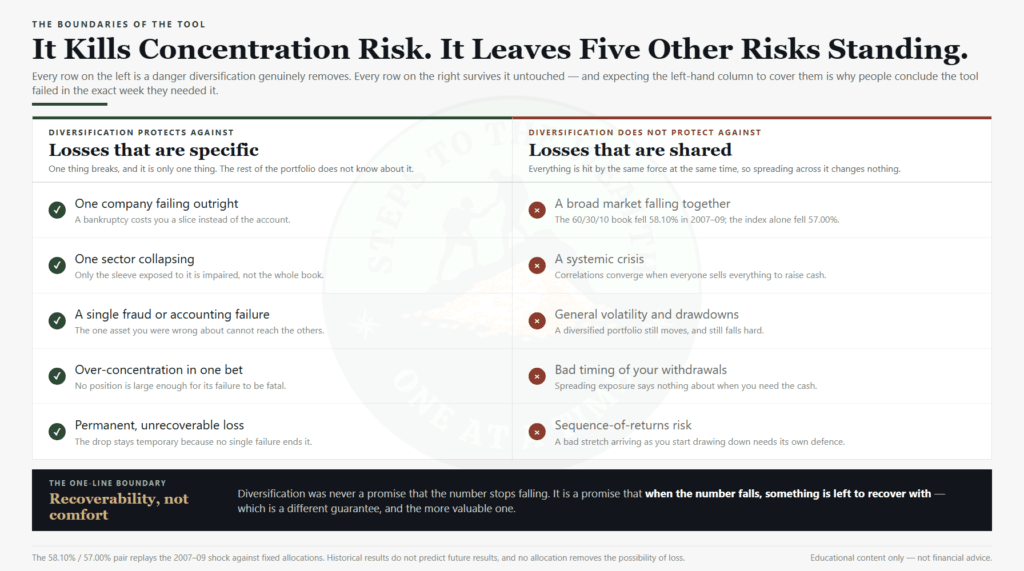
Two of those deserve emphasis, because they are where the disappointment actually happens.
First, spreading across asset classes does not reliably reduce the depth of a crisis drawdown. Run a portfolio of 60% US stocks, 30% international stocks and 10% listed real estate through the 2007–09 shock and it falls 58.10%. A portfolio holding nothing but the S&P 500 falls 57.00%. The spread version needed a 138.66% gain to get back to even; the single-index version needed 132.56%. By every ordinary use of the word that three-sleeve book was diversified, and it still cost 1.1 percentage points of extra loss.
In a genuine systemic crisis correlations converge — assets that normally move independently fall at once, because everyone is selling everything to raise cash. That is the uncomfortable result behind the portfolio stress test, and it is worth sitting with rather than arguing away.
Second, diversification says nothing about when your returns arrive relative to when you need the money. A spread portfolio can still hand you a bad stretch precisely as you begin drawing it down, which is the essence of sequence-of-returns risk. Spreading exposure does not change your withdrawal schedule, and the gap between a portfolio balance and a workable retirement position turns on timing as much as on total. That danger needs its own defences — a cash buffer, withdrawal flexibility — and no amount of extra holdings substitutes for them. Knowing the boundaries of the tool is what stops you over-trusting it.
How much diversification is enough?
Enough diversification is the point where adding another holding no longer meaningfully reduces your concentration risk. Past that, you are adding complexity, not protection. There is a real threshold, and the arithmetic of equal weights makes it visible: with N equally sized holdings, one going to zero costs you 1/N of the portfolio.
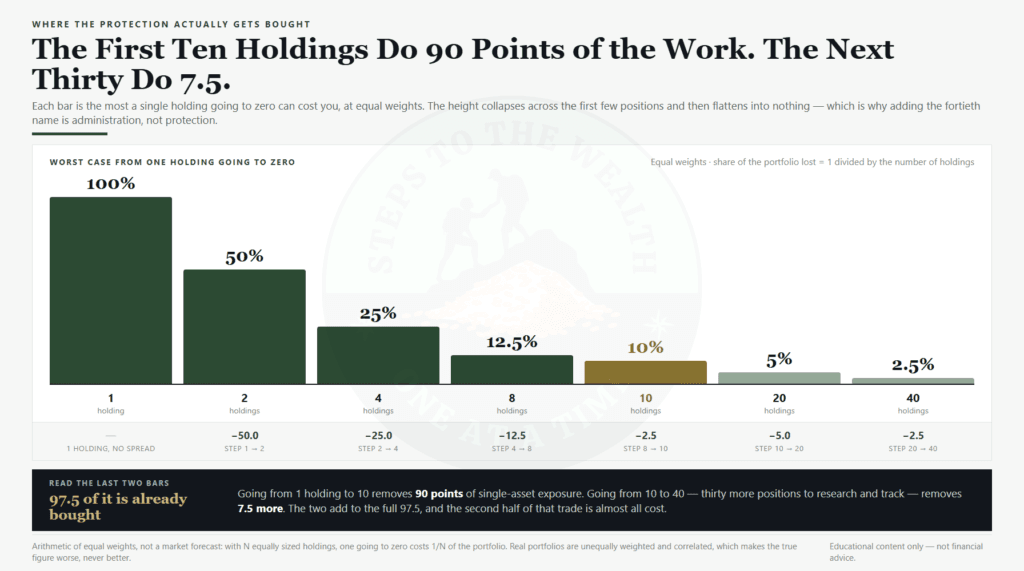
Read the ladder. One holding puts 100% of the portfolio at risk from a single failure. Two puts 50%. Four puts 25%. Eight puts 12.5%, and ten puts 10%. Going from one holding to ten therefore removes 90 points of single-asset exposure. Going from ten to forty — thirty more positions to research, monitor and rebalance — removes 7.5 more. Together those add to the full 97.5 points available, and almost all of the second half is cost rather than protection. Note also that this is the arithmetic best case: real portfolios are unequally weighted and correlated, which makes the true figure worse, never better.
Over-diversification has its own price. Spread across dozens of holdings you do not understand, you lose the ability to know what you actually own, your winners get diluted into irrelevance, and you manufacture the appearance of safety while quietly holding many correlated bets that move together anyway. A tighter, deliberately chosen set of genuinely independent exposures beats a sprawling pile of overlapping ones. That is the reasoning behind a focused, rules-based book — the DCA Simulator’s custom portfolio allows up to ten assets, which is enough for real independence without drowning the signal. The aim is coverage of your real risks, not a maximum count.
How does diversification fit a risk-first system?
In a risk-first system, diversification is the structural layer that makes every other rule survivable. It ensures that when your buying rules are wrong about a single asset, that error cannot end the portfolio. A rules-based approach still puts money into specific assets based on measured conditions, and it will still be wrong sometimes. Diversification is the backstop underneath those decisions: it caps the damage any one of them can do. The rules govern when and how much. Diversification governs how concentrated, so a bad call stays a setback instead of a catastrophe.
That is why it pairs naturally with the rest of the framework. A systematic contribution schedule tells you how to act without needing a forecast; diversification makes sure the structure absorbs the times the rule is wrong. Combined with a cash buffer that keeps you from being a forced seller — the difference between the investors who kept buying through the 2008 crash and the ones who capitulated near the bottom — and position sizing that never lets one asset dominate, diversification stops being a slogan and becomes a measurable defence.
It is not the thing that makes you money. It is one of the things that makes sure a single mistake never takes the money away.
A worked example: what one failure actually costs
The 1/N arithmetic above is easier to feel with money attached. Take $100,000 and let exactly one holding go to zero — a Lehman, a fraud, a business that simply stops working.
- One holding. You lose $100,000. There is no recovery figure, because no finite gain undoes a 100% loss.
- Ten equal holdings. You lose $10,000 and finish at $90,000. Getting back to even needs 100,000 ÷ 90,000 = a 11.1% gain — an ordinary year.
- Forty equal holdings. You lose $2,500 and finish at $97,500, needing a 2.56% gain to recover — an ordinary quarter.
The jump from catastrophic to routine happens between one holding and ten. The jump from 11.1% to 2.56% is real but small, and it costs you thirty more positions to research, monitor and rebalance. That is the diminishing return, priced.
Now the part the count hides. Suppose those ten holdings are all technology companies. No single failure can hurt you much — the 1/N maths still says 10% — but a sector-wide shock that takes 40% off every one of them takes your $100,000 to $60,000, and no amount of counting protected you. You held ten names and one risk.
That is why the honest question is never “how many holdings do I have.” It is “how many different ways can I lose.” Those numbers are usually far apart, and only the second one is diversification.
How to check whether you are actually diversified
Counting positions tells you almost nothing. Four checks tell you a great deal, and none of them takes longer than an afternoon.
- The shared-driver test. Take your holdings in pairs and name the single event that would impair both. If the answer comes instantly, and it is the same event across most pairs, you own one bet in several costumes.
- Look through your funds, not at them. Three different index funds can hold the same handful of mega-caps at the top of each. Owning three funds that each put 25% into the same ten companies is not three exposures. Check the top holdings of each and add up the fund overlap.
- Count your employer once, properly. If your salary, your company stock, your unvested options and your pension all depend on one firm, that firm is a far larger position than your brokerage screen shows — and it is the one that fails at the worst possible moment, when you also lose the income. This is the most commonly missed concentration there is, and no fund lineup fixes it.
- Check your currency and geography. A portfolio held entirely in one currency, in one economy, where you also live and earn, is concentrated on that economy whatever the ticker count says.
Run those four and the honest answer is often that a thirty-holding portfolio carries three or four genuinely independent risks. That is not a disaster. It is just a different number than the one people quote, and you cannot manage a risk you have not counted correctly.
What diversification costs
It is not free, and the case for it is stronger when the price is stated rather than skipped past.
The first cost is structural: diversification guarantees you own the losers. By design you hold the sectors having a bad decade alongside the ones having a good one, so your return is pulled toward the average. Anyone who has concentrated correctly will beat you, and you will have to watch them do it. The catch is that concentration is only visible as skill afterwards — the same choice that produced the outperformance produced the accounts that went to zero, and you cannot tell which you are holding in advance.
The second cost is operational. More holdings mean more rebalancing decisions, more transaction costs, more tax lots to track in a taxable account, and more chances to make a clerical mistake. Complexity is a real risk of its own, and a portfolio you cannot administer accurately is not safer for being larger.
The third is psychological, and it is the one that breaks people. A properly diversified portfolio always has something red in it. There will never be a week when everything is working, which means there is always a holding available to be second-guessed, and a permanent temptation to prune the laggard and concentrate into the winner — which is the exact move that undoes the protection.
Set against those three, what you buy is one specific thing: no single failure can end you. For an investor still accumulating, with decades ahead and no way to know which company is the next Lehman, that is a fair price. It is worth paying deliberately, knowing what it costs, rather than adopting it as a slogan and resenting it every quarter.
Diversification handles concentration. A risk reading handles the rest.
Spreading your bets protects you from any one of them failing. It does nothing to tell you when the broad market is stretched and when it is cheap — and that is the read a risk-first investor needs most.
Steps To The Wealth Weekly delivers a plain-English risk reading every Sunday across five major assets: the signal that tells you whether conditions are calm or dangerous, so your diversified portfolio is deployed with calibration, not just spread.
No predictions. No hype. Just a clear read on where risk actually sits, every week.
Frequently asked questions
How does diversification reduce risk?
Diversification reduces risk by spreading your money across investments that do not all fail for the same reason at once, so no single event can cause permanent, unrecoverable loss. It converts a few large, concentrated dangers into many small, survivable ones, killing concentration risk specifically. It does not reduce how far the portfolio falls in a broad sell-off.
Does diversification protect you in a market crash?
Only partially, and less than most people expect. In the 2007–09 crisis a 60/30/10 spread portfolio fell 58.10% while the S&P 500 alone fell 57.00% — the spread cost 1.1 percentage points rather than saving anything, because correlations converge when everyone sells to raise cash. What diversification does is protect the recovery and prevent any single holding’s failure from being fatal. It limits permanent damage, not the temporary decline.
Can you be too diversified?
Yes. With equal weights, ten holdings already cut the worst single-asset loss to 10% of the portfolio; going to forty only cuts it to 2.5%. Each addition past a handful of genuinely independent holdings removes less risk while adding complexity you cannot track. Over-diversification dilutes your winners, hides correlated bets behind the appearance of safety, and makes it hard to know what you actually own.
What is the difference between diversification and low volatility?
Diversification reduces the chance of permanent loss from a single failure; it does not make your portfolio stop moving. A diversified portfolio can still be highly volatile and still fall hard in a broad sell-off, as 2008 demonstrated. Volatility is price movement. Diversification targets recoverability, which is a different problem entirely.
Does diversification protect against sequence-of-returns risk?
No. Diversification addresses concentration, not timing. A diversified portfolio can still deliver a bad stretch of returns exactly when you begin withdrawing money, which is the essence of sequence-of-returns risk. That danger requires its own defences, such as a cash buffer and flexibility over how much you draw in a bad year.
Educational content only — not financial advice. Historical figures are approximate closes used for illustration and do not predict future results. Diversification does not eliminate the risk of loss.