
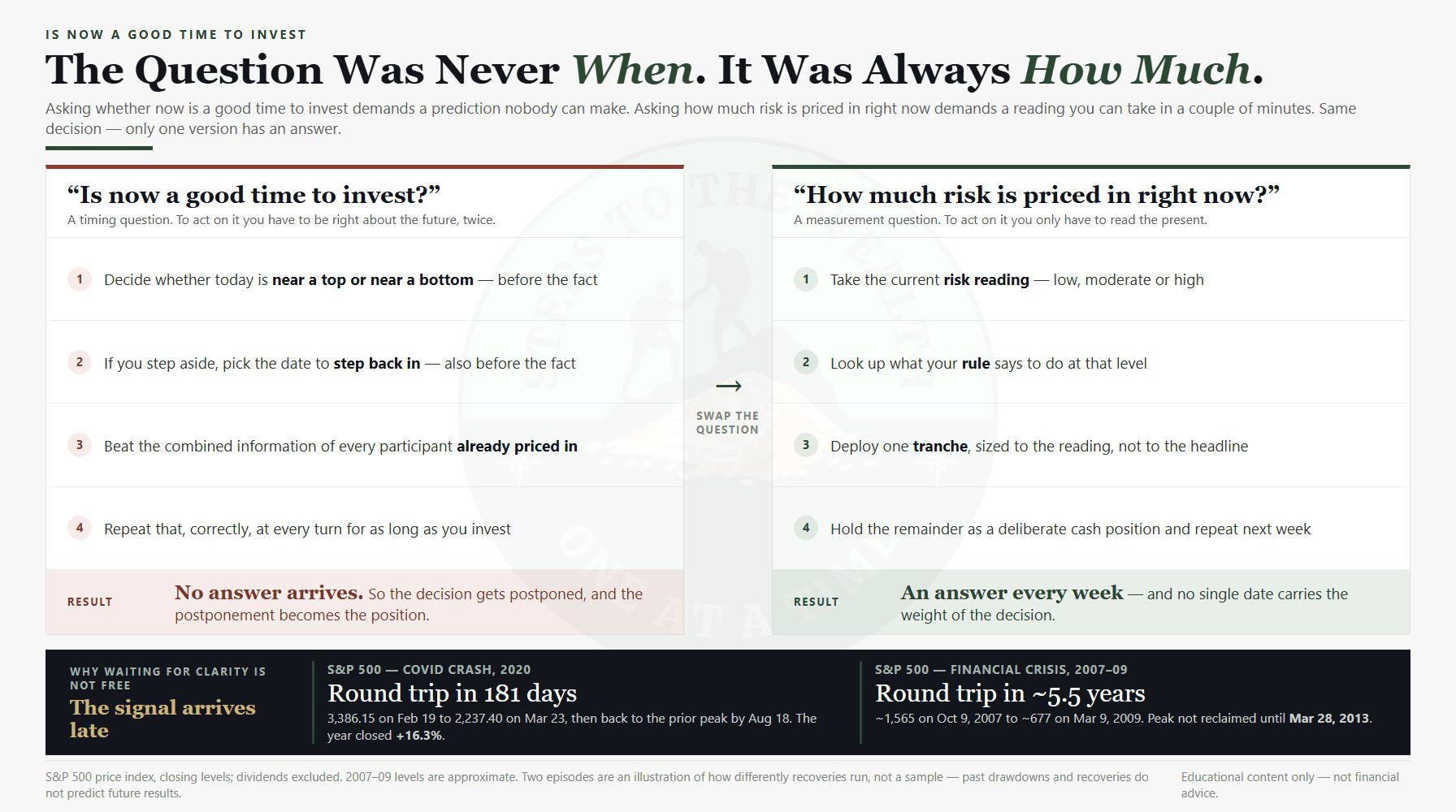
Is now a good time to invest? The honest answer is that nobody knows, and anyone who tells you otherwise is guessing with confidence. But the more useful answer is that you are asking the wrong question. “Is now a good time” assumes there is a right moment to catch and a wrong one to avoid — that investing is fundamentally about timing. It is not. The investors who build real wealth replaced that question years ago with a better one: given the risk in the market right now, how much should I be buying?
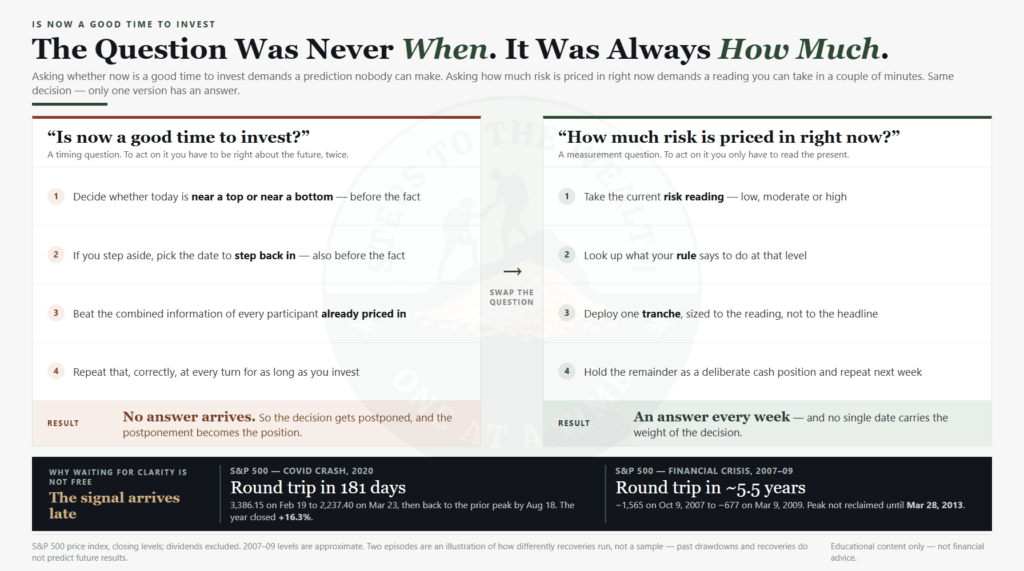
Is now a good time to invest — what is the real answer?
There is no single good or bad time to invest, because the right amount to invest depends on the level of risk in the market, not on a calendar date or a gut feeling. A market that looks “too high” can keep climbing for years. A market that looks “cheap” can keep falling. Price alone tells you almost nothing about what happens next, which is why trying to time your entry off how the market feels is a losing game played by most people, most of the time.
The real answer reframes the whole question. Instead of hunting for the perfect moment to go all-in, you size your buying to the risk environment: more when risk is low, less when it is high, always in increments. That way you are never betting everything on being right about one date — and you never have to be. If the thought of putting money in at all is what is stopping you, the same reframe is what makes it tractable: a risk-first framework turns an open-ended fear into a sizing decision you can actually make.
Why is market timing so hard?
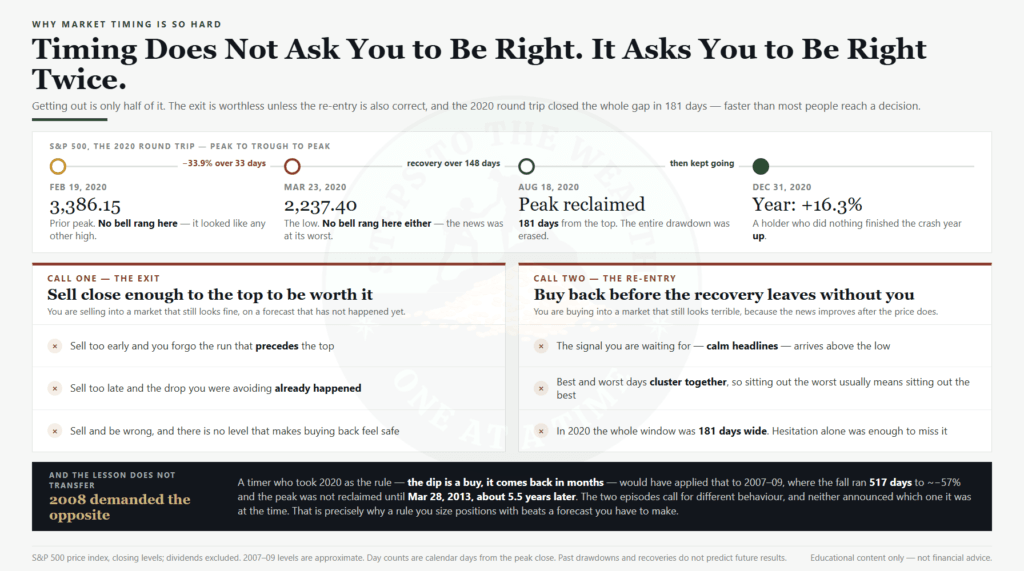
Market timing is hard because it requires you to be right twice — once on the way out and once on the way back in — and the best days and worst days cluster together in ways that punish anyone who steps aside. Miss the recovery because you were waiting for a clearer signal, and you can erase years of returns. The market does not ring a bell at the bottom.
The 2020 drawdown is the cleanest illustration of how narrow the window can be. The S&P 500 fell from 3,386.15 on 19 February 2020 to 2,237.40 on 23 March 2020 — a drop of 33.9% in 33 calendar days. It reclaimed that peak on 18 August, just 181 days after the top, and the year still closed up 16.3%. A timer had to sell near a peak that looked like any other high, then buy back into headlines that were still terrible, inside a window that closed in under six months. An investor who did nothing at all finished the crash year ahead.
And the lesson does not transfer. Anyone who took 2020 as the rule — the dip is a buy, it comes back in months — would have applied that to 2007 to 2009, where the fall ran roughly 517 calendar days from about 1,565 on 9 October 2007 to about 677 on 9 March 2009, and the peak was not reclaimed on price until 28 March 2013, about five and a half years later. The two episodes called for different behaviour, and neither announced which one it was at the time.
There is also the simple fact that the future is genuinely unknowable at the precision timing requires. You are not competing against ignorance; you are competing against the combined information of every participant already priced in. That is why the guru move — “I will tell you exactly when to buy” — is a tell, not a skill. Every cycle, someone calls a top or a bottom loudly enough to look prophetic once, then disappears when the next call is wrong. Meanwhile, the investors who ran a system through the same period are still standing.
What should you ask instead of “is now a good time”?
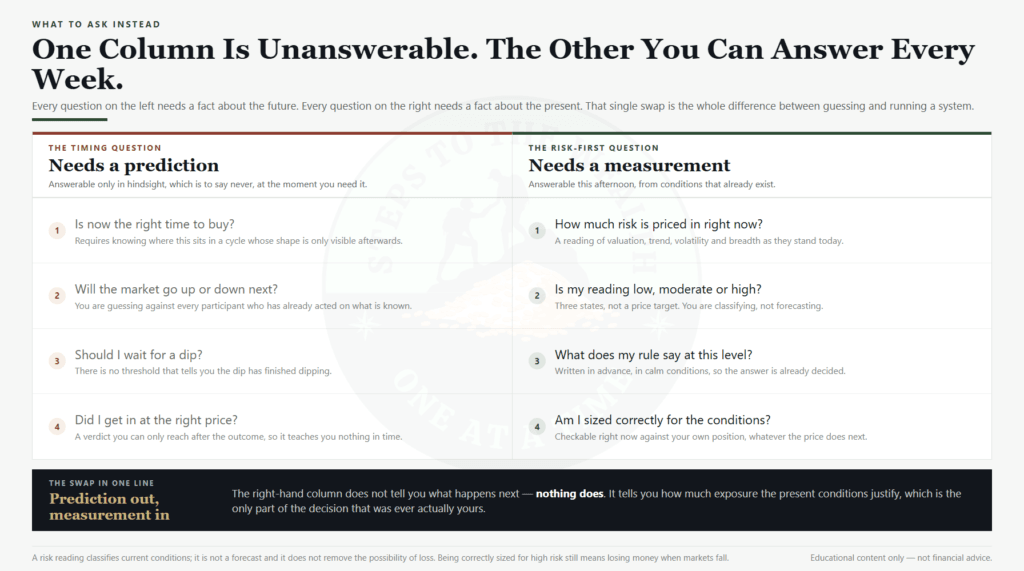
Instead of “is now a good time to invest,” ask “how much risk is the market carrying right now, and what does my rule say to do at that level?” This single swap moves the decision from prediction, which is impossible, to measurement, which is doable. You are no longer forecasting the future. You are reading the present and acting on a rule you set in advance, in calm conditions, before the pressure arrived.
| The timing question | The risk-first question |
|---|---|
| Is now the right time to buy? | How much risk is priced in right now? |
| Will the market go up or down next? | Is my risk reading low, moderate, or high? |
| Should I wait for a dip? | What does my rule say to do at this level? |
| Did I get in at the right price? | Am I sized correctly for the conditions? |
The left column is unanswerable. The right column you can answer every week in a couple of minutes. That is the entire difference between guessing and having a system. Note what the right-hand column does not do: it does not tell you what happens next, because nothing does. It tells you how much exposure the present conditions justify, which is the only part of the decision that was ever actually yours.
If I have money to invest now, what do I do with it?
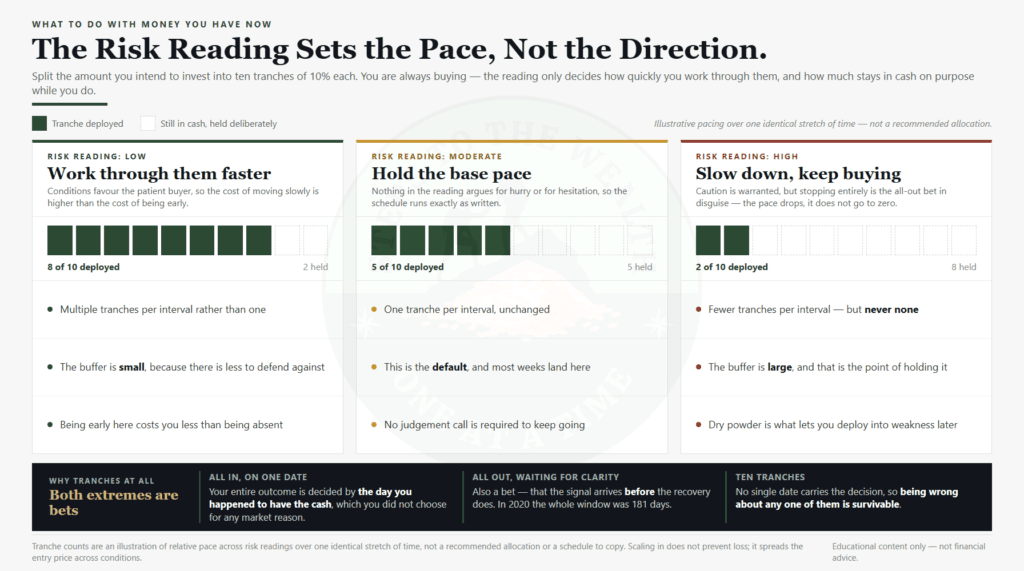
If you have money to invest today, the risk-first approach is to deploy it gradually in increments rather than all at once or not at all, letting the risk reading set the pace. All-in exposes you to the one date you happened to choose — a date you picked for personal reasons, not market ones. All-out, sitting in cash waiting for certainty, exposes you to missing the compounding you were trying to earn. Both are bets. The answer to both is the same: scale in.
- Read the current risk level. Low, moderate, or high. This sets your pace, not your direction.
- Deploy in tranches. Move in fixed increments — for example, 10% of your intended amount at a time — rather than committing everything to one moment. This is the same logic behind spreading a lump sum over time, with the risk reading added on top.
- Speed up when risk is low, slow down when it is high. Low-risk conditions favour the patient buyer; high-risk conditions favour caution. Let the reading, not the headline, set the tempo — and note that slowing down is not stopping.
- Keep the rest as a deliberate cash position. Uninvested capital held on purpose is not indecision. It is what lets you deploy into weakness later, when the prices you were hoping for actually arrive.
This removes the paralysis. You do not need to know if today is “the” day, because no single day carries the weight of the decision. You are spreading it across conditions instead. FINRA makes the same structural point about investing a fixed amount on a schedule: the value is in removing the entry-date decision, not in beating the market.
Does “time in the market beats timing the market” mean just buy now?
“Time in the market beats timing the market” is mostly true — staying invested through cycles usually outperforms jumping in and out — but it is not a licence to ignore risk entirely. The phrase is a correction to the timing obsession, not a replacement for judgement. It rightly says: do not sit in cash for years waiting for the perfect entry. It does not say: pour everything in at any price and never manage exposure. That distinction gets lost in most repetitions of it, which is how a sound principle becomes a slogan people misapply.
The risk-first framework holds both truths at once. Yes, be in the market — sitting out entirely is how you forgo the returns that compound. And yes, size that exposure to the risk on the table, so you are not fully loaded going into the conditions that produce the worst drawdowns. “Always invested, appropriately sized” is the synthesis. It captures the compounding without pretending risk does not exist. How that exposure is spread matters too: FINRA covers the mechanics of asset allocation and diversification, which decide how much any single position can hurt you regardless of when you bought it.
What does scaling in actually cost you?
Scaling in is insurance, and insurance has a premium. It is worth being honest about what that premium is, because the risk-first approach is not free, and anyone who tells you it is has skipped a step.
Here is the arithmetic, closed and simple. Say you have $24,000 to put to work and you deploy it in ten tranches of $2,400. After five tranches you have $12,000 invested and $12,000 still sitting in cash. If the market rises the whole way through that stretch, every tranche after the first buys fewer shares than the one before it, and the half still in cash earns nothing from the move. You end up with a higher average cost than a single purchase on day one would have given you. That is the cost, and it is real.
What you bought for that premium is the removal of one specific failure: the all-in purchase made the week before a drawdown nobody saw coming. Markets rise more often than they fall, so on the ordinary path the lump sum wins and the scale-in pays its premium for nothing. On the bad path — somebody puts an inheritance in at a peak and watches it halve — the scale-in is the reason they are still investing two years later instead of permanently out.
So the trade is not “which one earns more.” It is “which failure can you actually survive.” If a badly timed lump sum would end your investing life, the premium is cheap. If you would shrug and carry on, deploy faster. The risk reading tells you what conditions you are deploying into; your own tolerance tells you how much premium is worth paying for them.
When is the honest answer actually “not yet”?
Everything above is about the market. There is a second set of conditions where the answer to “is now a good time to invest” is genuinely no, and none of them have anything to do with the market at all. A risk reading cannot see them, because they are about you.
- The money has a job within three years. A house deposit, a wedding, a planned career break. Money with a near-term deadline should not be exposed to a drawdown it has no time to recover from. That is not caution; it is arithmetic about your horizon.
- You have no cash buffer. If a broken boiler forces you to sell, the market decides when you sell, not you. A forced seller at the wrong price is the one position no system can rescue. Build the buffer first.
- You are carrying debt that costs more than a market return plausibly earns. Clearing a balance that charges 19% a year is a guaranteed 19% return. Nothing in a risk reading beats a certain number that large.
- You could not hold the position through a 30% fall. If you know, honestly, that you would sell, then the size is wrong rather than the timing. Halve it until it is a position you could sit through.
None of these say never. They say the sequence matters: buffer, then debt, then exposure sized to what you can hold. Once those are in place the market question goes back to being what it always was — not “when,” but “how much.”
So — is now a good time to invest, or not?
Now is a good time to invest an amount appropriate to the current risk level, deployed gradually, as part of a system you will run for years — which is a very different statement from “now is a good time to go all-in.” That distinction is the whole point. The question was never binary. It was always “how much,” and the answer was always “it depends on the risk, and here is how to measure it.”
Stop waiting for a clear signal that never comes. Waiting is not the neutral, cost-free option it feels like — it is a position, and it has a price you pay quietly. The clarity you are looking for does not live in a perfect entry date. It lives in a rule that tells you what to do at every risk level, so you can act today without needing to be right about tomorrow.
Let the risk reading answer the question for you
“Is now a good time to invest” stops being an agonising guess the moment you have a risk reading to act on. It tells you, in plain terms, how much risk is priced in and what to do about it — build, hold, or ease off.
That reading is what Steps To The Wealth Weekly delivers every Sunday, across five major assets, with the action each risk level calls for.
No predictions. No hype. Just the number that answers “how much,” so you never have to guess “when.” If that is not for you, no hard feelings — the framework in this article works whether or not you ever hear from us again.
Frequently asked questions
Is now a good time to invest?
There is no single good or bad time to invest — the right amount depends on the risk in the market, not on the date. A better approach than trying to time a perfect entry is to size your buying to the current risk level and deploy gradually in increments, so no single moment carries the full weight of the decision.
Should I wait for a market dip before investing?
Waiting for a dip is a form of market timing, and it usually costs more than it saves. Markets that look “too high” often keep rising, and investors who sit in cash frequently watch the dip arrive from a level well above where they stopped buying. Scaling in gradually, guided by risk, avoids both the paralysis and the all-in gamble.
Does time in the market really beat timing the market?
Generally yes — staying invested through full cycles tends to outperform jumping in and out, because the best recovery days cluster with the worst and missing them is costly. But it is not a licence to ignore risk; the balanced approach is to stay invested while sizing your exposure to the current risk conditions.
What should I do with a lump sum I have right now?
Rather than investing it all at once or sitting on it, deploy it in tranches — for example 10% at a time — and let the risk reading set the pace, faster when risk is low and slower when it is high. This spreads the decision across conditions instead of betting it all on the day you happened to have the cash.
How do I know if the market is too risky to invest right now?
Judge it with a measured risk reading rather than a feeling. A market risk indicator blends valuation, trend, volatility, and breadth into one level, telling you whether conditions favour building positions or protecting capital — without requiring you to predict what price does next.
How fast do markets recover from a crash?
It varies enormously, which is exactly why timing the re-entry is so hard. The S&P 500 reclaimed its February 2020 peak on 18 August 2020, 181 days later. The October 2007 peak was not reclaimed on price until 28 March 2013, about five and a half years later. Neither episode signalled in advance which kind it would be.
Educational content only — not financial advice. Examples and historical figures are for illustration and do not predict future results.