
Almost every “is it worth it” conversation about a degree ends at the same comparison. The degree costs about $60,000 in tuition. People who hold one earn, the studies say, hundreds of thousands more across a career. Set one number against the other and the answer looks obvious. Therefore, go.
That comparison is wrong. Not slightly wrong, and not wrong in a random direction — wrong in a consistent one, always flattering the same answer.
This is not an article arguing that you should skip a degree. It is an article about a comparison that does not compare what people think it compares.
Asking is a degree worth it is really asking about return on investment, and the return depends on the whole cost rather than the tuition line. This piece works through that cost, including the years you do not earn.
Is a degree worth it? Tuition is not the cost
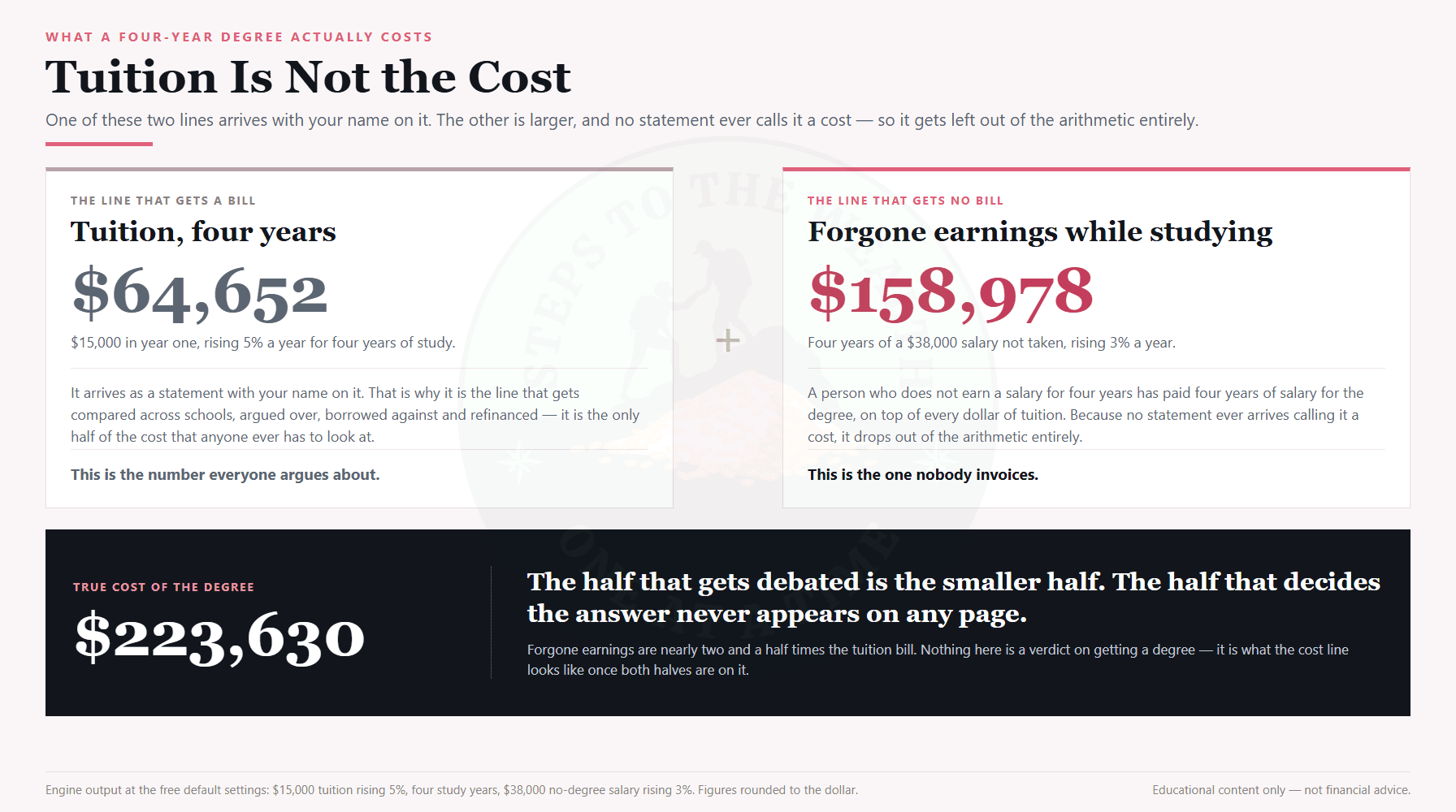
Tuition is one line in the cost of a degree. It is simply the line that gets a bill with your name on it.
There is a second line, and it is the larger one, and nobody sends an invoice for it: the years you spend studying are years you are not working. A person who does not earn a salary for four years has paid four years of salary for the degree, on top of every dollar of tuition. That cost is real, it is large, and because no statement ever arrives calling it a cost, it gets left out of the arithmetic entirely.
Here is the same degree — $15,000 a year in tuition, four years, against a job that would have paid $38,000 to start — with both lines included:
| Line | Amount | What it is |
|---|---|---|
| Tuition, four years, at 5% annual increases | $64,651.88 | The number everyone argues about |
| Forgone earnings during study | $158,977.83 | Four years of the salary you didn’t take |
| True cost of the degree | $223,629.70 | What it actually cost to get |
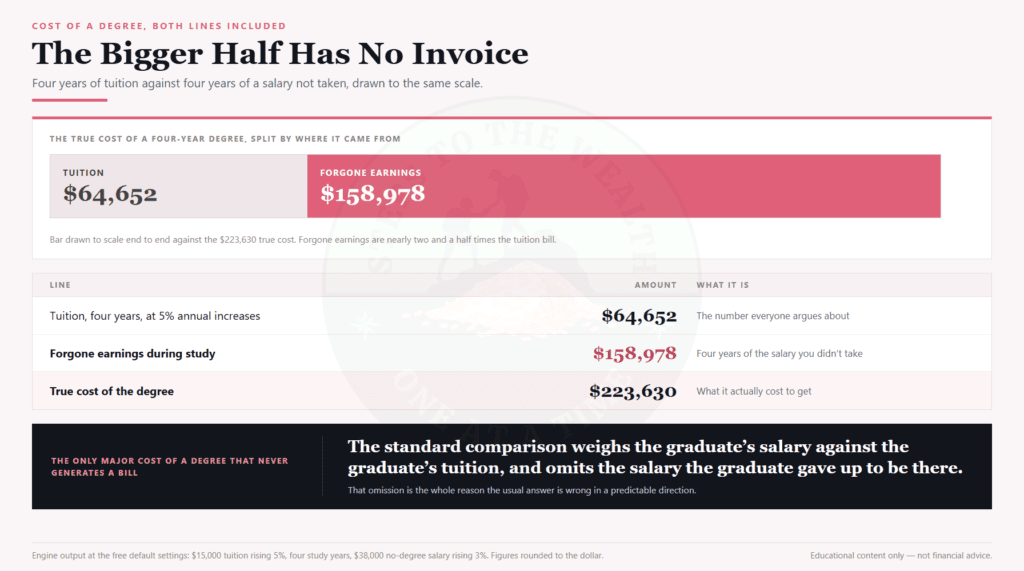
Read the true cost against the tuition. The forgone earnings are nearly two and a half times the tuition bill. The number people debate — is $15,000 a year too much, is the loan worth it — is the smaller half of the decision. The half that decides it is the one that never appears on any page.
This is the whole reason the standard comparison misleads. It weighs the salary a graduate earns against the tuition a graduate paid, and quietly omits the salary the graduate gave up to be there.
Twenty years later
So put both people on the same track and race them. One goes to school for four years, takes on the loan, then graduates into a $60,000 salary that grows a little faster over time. The other starts working at 18 on $38,000, invests the money the first person is spending on tuition, and invests every dollar of salary the first person isn’t earning yet. Both invest into the same market at the same return. Twenty years later, who has more?
On the settings the tool loads with, in today’s money:
| Net worth, degree path | $362,605 |
| Net worth, work-and-invest path | $509,922 |
| The degree path is behind by | $147,317 |
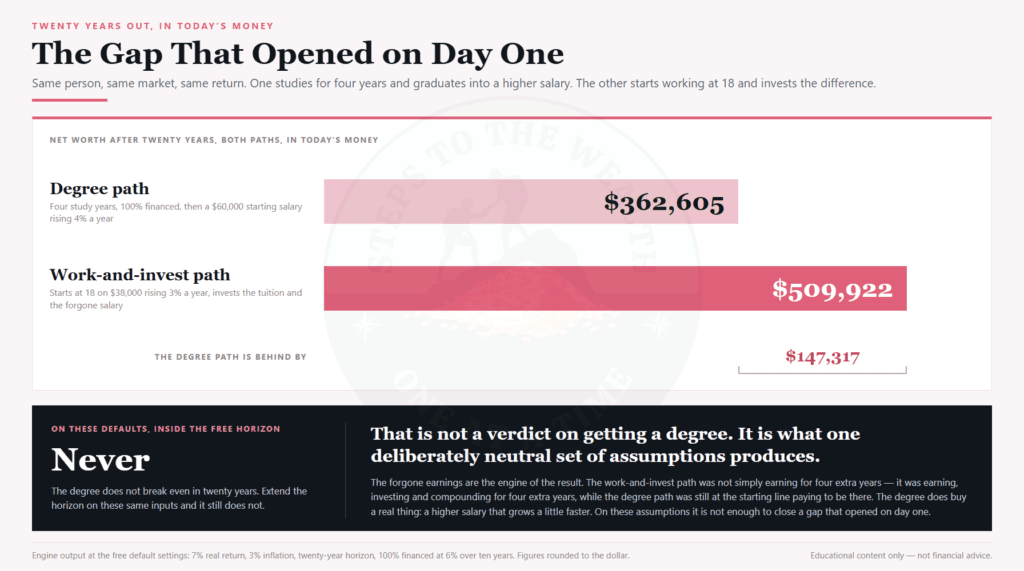
And the part I did not expect the first time I ran it: on those defaults, the degree never catches up. Not in twenty years. Extend the horizon and it still doesn’t.
That result deserves care, because it is the one people react to hardest, and the reaction usually assumes I am arguing something I am not. So: that is not a verdict on getting a degree. It is what a specific, deliberately neutral set of assumptions produces. Sit with it before you decide it is wrong — and then read the next two sections, because the reason it happens and the thing that overturns it are both more useful than the number itself.
Where the money went
Itemised, the degree path’s cost looks like this:
| Line | Amount |
|---|---|
| Forgone earnings, four years not working | $158,977.83 |
| Loan balance at graduation (100% financed, interest accrued through school) | $74,980.83 |
| Repaid at $832.44 a month for ten years | $99,892.80 |
| Of which interest | $24,911.97 |
| Tuition + interest actually paid | $89,563.85 |
The forgone earnings are the engine of the result. A loan you can argue about — refinance it, pay it down faster, win a scholarship and shrink it. The four years you didn’t earn are gone the moment they pass, and they were compounding for the other person the entire time. It is the same opportunity cost arithmetic that sits underneath any spending decision, applied to four years instead of one purchase. That is why the work-and-invest path is so far ahead at year twenty: it wasn’t just earning for four extra years. It was earning, and investing, and compounding, for four extra years, while the degree path was still at the starting line paying to be there.
The degree does buy a real thing: a higher salary that grows a little faster. That is not being hidden. It simply is not enough, on these assumptions, to close a gap that opened on day one and compounded for two decades.
“Never” is a refusal to forecast, not a prediction
The input doing the most work in that result is the graduate salary — set to $60,000, growing at 4% a year against the no-degree path’s 3%. That is a real premium. It is just a modest one, and it is entered honestly rather than assumed generously.
That matters, because generous is the industry default. The headline you have seen — “a degree is worth a million dollars over a lifetime” — is built by comparing the average degree-holder to the average person who never went. It is not comparing the same person on two paths. It quietly credits the degree with every difference between those two populations, including the ones that were there before anyone enrolled. That is a forecast of a large premium, entered on your behalf, and then handed back to you as if it were arithmetic.
For a calculator to tell you a degree pays off, someone has to have decided how much more the degree earns you. If the calculator decided it for you, you are reading their forecast, not your decision.
So the defaults here are deliberately modest, which is not a claim that degrees don’t pay. It is a claim that I do not know what your field pays, what your trajectory looks like, or whether you’d have earned $38,000 without the degree at all. You do. Those fields are right there. Put in the starting salary your degree actually leads to, and the raise trajectory you can defend out loud, and the tool will race your numbers instead of someone else’s.
That is the whole design philosophy: the tool will not smuggle in an assumption and hand it back to you as a result.
The lever with the most leverage
Now the useful part, which is not the headline number at all.
Same degree, same tuition and loan, one input moved at a time, over the twenty-year horizon:
| Graduate starting salary | Break-even |
|---|---|
| $60,000 (default) | Never |
| $63,000 | Never |
| $66,000 | Year 20 |
| $70,000 | Year 17 |
| $72,000 | Year 16 |
| $80,000 | Year 13 |
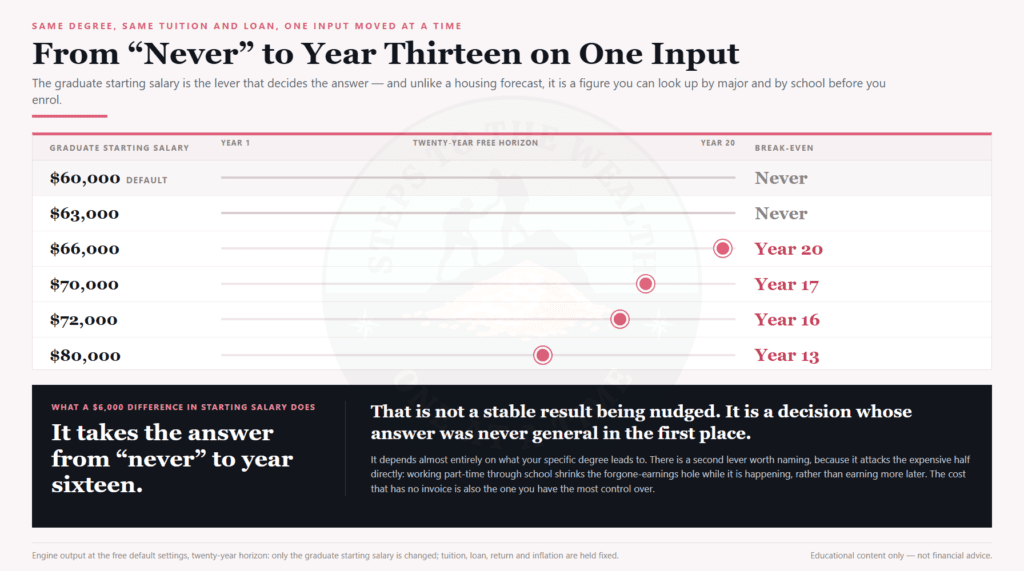
A $6,000 difference in starting salary takes the answer from “never” to “year sixteen.” That is not a stable result being nudged. That is a decision whose answer was never general in the first place — it depends almost entirely on what your specific degree leads to.
And unlike the housing version of this question, the biggest lever here is one you can actually look up. You cannot forecast what a metro’s real estate does over a decade. You can find out what your field pays a new graduate — the number is published, by major, by school, in more places than any other figure in this calculation. The lever that decides the answer is also the one you can check before you enrol.
There is a second lever worth naming, because it attacks the expensive half directly. Work part-time through school — say $20,000 a year — and the same degree breaks even in year sixteen, purely by shrinking the forgone-earnings hole rather than by earning more later. The cost that has no invoice is also the cost you have the most control over while it’s happening.
One honest limit on the free view: over twenty years, the starting salary drives the result and the growth rate barely moves it. That flips over a career. A one-point difference in how fast your salary climbs is worth more than the entire tuition bill over forty years — it just needs the forty years to show up. That longer race is what the paid horizon is for, and it is the input the lifetime-earnings headlines are really trading on.
Finishing is an assumption, not a given
Both paths in the model assume the degree gets finished, and finished on time. Neither of those is safe.
Start with the calendar. Four years is the nominal length, and a large share of students take five or six — a changed major, a failed prerequisite, a semester off, a required course that runs once a year and is full. A fifth year is not simply a fifth of the tuition added on. It is another year of tuition and another year of forgone earnings, and on these settings the forgone half of a year costs more than the tuition for it. The cost of a degree scales with the calendar, not with the credit hours.
Then the harder one. A meaningful share of people who enrol never graduate, and that outcome is not a smaller version of the degree path. It is the worst cell in the entire table. You pay the tuition, you pay the forgone earnings, you carry the loan, and you arrive in the labour market with the earnings profile of the no-degree path. The loan does not care whether there is a credential at the end of it, and in most jurisdictions it does not discharge.
The tool does not model that, and I am not going to bolt a completion probability onto it, because I would be inventing the number. What I will say is that it belongs in the decision as a risk rather than as a discount. If you are genuinely uncertain about finishing, then the question is a degree worth it is being asked at the wrong moment. Resolve the uncertainty first — part time, or at community-college prices — where the cost of finding out is a fraction of the cost of finding out in year three of a private four-year programme.
Tuition is negotiable. The other half is not.
Almost everything written about paying for a degree is aimed at the tuition line: scholarships, in-state rates, transferring credits in from a community college, an employer that funds study, a cheaper school with the same accreditation. All of that is real money and all of it is worth chasing.
It is also aimed at the smaller half. Take the default run to its limit and imagine tuition falls to zero — a full ride, every year, nothing borrowed. The $158,977.83 of forgone earnings does not move. It was never a function of what the school charged. It is a function of how long you are not working and what you would have been paid during that time, and no scholarship in existence touches it.
Which reframes what a good financial plan for a degree looks like. Chasing a cheaper school is worth doing and it is bounded. Compressing the timeline, working through it, or keeping some earnings alive while studying attacks the line that never gets an invoice, and that is the line where the arithmetic actually lives. The version most people run instinctively — pick the cheapest school, borrow the rest, study full time, graduate exactly as fast as the catalogue allows — optimises one half of the cost and leaves the other half untouched.
None of that changes the answer for somebody whose field genuinely requires the credential. It changes what the credential costs them, which is the only part of this that is under their control before they enrol.
The strongest objection to all of this
The best argument against everything above is not about salaries. It is this: the model prices a financial race, and a degree is often not optional in the first place.
That objection is correct, and it is the reason I will not tell you the tool proves a degree isn’t worth it. Some careers are simply closed without the credential — you cannot practise medicine, law, or licensed engineering by starting at 18 and investing the difference. For those paths the break-even year is beside the point; the degree is the gate, and the question is which degree, at what price, not whether. The tool measures the money. It cannot measure access, and it does not pretend to.
There is a second, quieter assumption doing work: the model has the no-degree path actually earn $38,000 from day one and actually invest the difference. Plenty of eighteen-year-olds will do neither. Strip out the earning or the discipline and the comparison collapses — the work path ends the two decades with neither a degree nor a portfolio.
I would rather state that plainly than pretend the model is stronger than it is. What the arithmetic gives you is the size of the financial gap the degree has to overcome, and the salary it has to reach to overcome it. Whether the degree is still worth it once you’ve seen that number is a decision only you can make — and now you’d be making it with both halves of the cost in front of you, instead of one.
What the tool does, and where it stops
The calculator runs both paths month by month — tuition, loan interest, forgone earnings, two salaries growing at their own rates, both portfolios compounding — and returns the year the degree pulls ahead, or tells you plainly that it doesn’t inside the horizon you set.
Free covers a twenty-year horizon, every assumption editable, results in today’s money, and a shareable link that reproduces your exact run. No account. And a specific privacy choice worth stating: the salary fields describe you, so they do not travel in a share link unless you tick a box to include them. Send someone your scenario and, by default, they see the structure and the rates — not what you earn.
The paid tier extends the horizon to fifty years, where the salary trajectory starts to dominate the way it does over a real career, and adds a sensitivity grid that moves starting salary and growth together so you can see the whole range of outcomes at once, plus scenario comparison and exports. Pro is $29, paid once — not a subscription and not a bundle. The checkout is here. If the free twenty-year answer already settled it, you do not need it.
Run your own numbers here: the Degree ROI calculator
Put in the tuition you’d actually pay, the salary your field actually starts at, and the raise trajectory you’d defend out loud. If the answer comes back “never,” that is information — it tells you the degree has to earn more, or cost less, than you assumed. If it comes back “year thirteen,” that is information too. Either way it is your forecast producing it, which is the only honest way this question has ever been answerable.
Educational content only — not financial advice.