
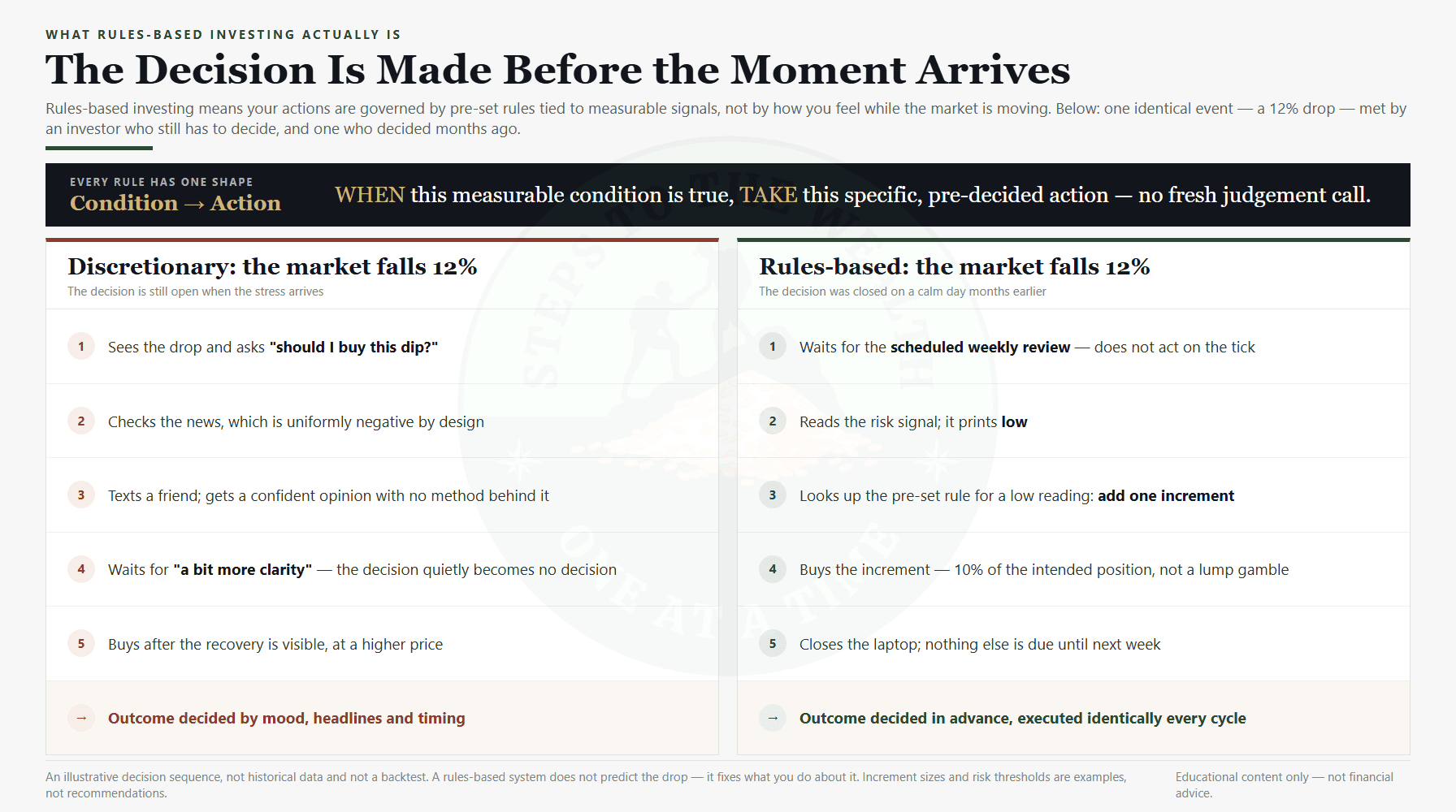
Rules-based investing is a way of managing money where your decisions are governed by pre-set rules tied to measurable signals, instead of by how you feel in the moment. You decide in advance what you will do at each level of risk — when to buy, how much, when to hold, when to scale back — and then you execute those decisions mechanically, without renegotiating them every time the market moves. That is the whole idea. Most investing failure comes from smart people making emotional decisions under stress. Rules-based investing is the structural fix.
What is rules-based investing, exactly?
Rules-based investing is a systematic approach where every action is triggered by a predefined rule rather than by discretion, emotion, or a fresh judgment call. Think of it as writing your investing decisions down while you are calm and clear-headed, then agreeing to follow them when you are not. The rules do the deciding; you do the executing.
A simple example makes it concrete. A discretionary investor looks at a falling market and asks, “Should I buy this dip?” — and then argues with themselves, checks the news, texts a friend, and often freezes. A rules-based investor looks at the same market, checks their risk reading, sees it is in the low zone, and buys the pre-decided increment. Same market, same information. One is negotiating with fear in real time. The other already made the decision on a day when fear was not in the room.
How does rules-based investing work?
Rules-based investing works by converting vague intentions into specific, measurable triggers and actions, so there is no gap where emotion can enter. Every rule has the same shape: when this measurable condition is true, take this specific action. The conditions are things you can actually read — a risk level, a price relative to a trend, a scheduled date. The actions are precise — buy this much, hold, scale out by this amount.
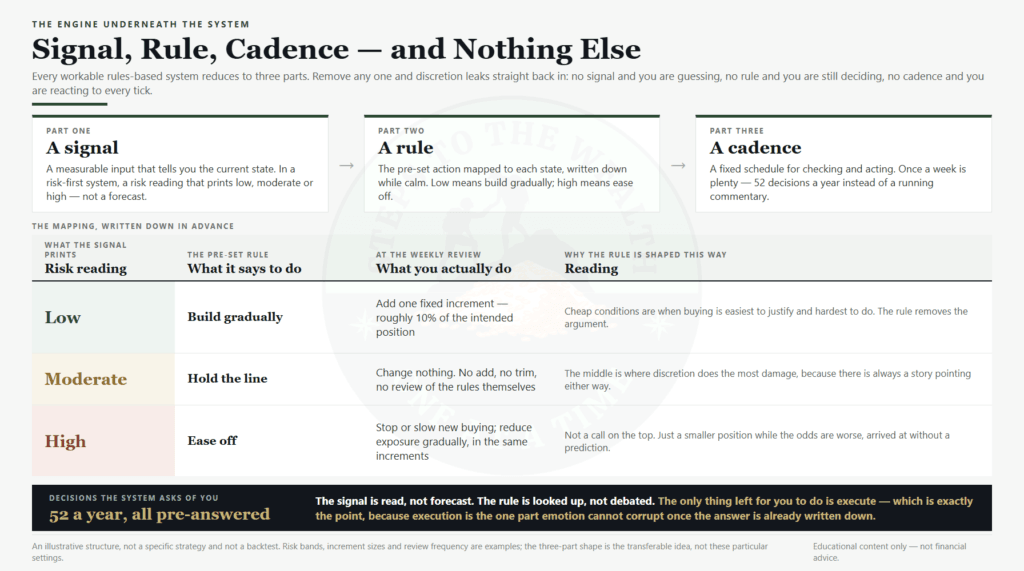
The engine underneath most good rules-based systems has three parts:
- A signal — a measurable input that tells you the current state. In a risk-first system, that is a risk reading printing low, moderate, or high.
- A rule — the pre-set action mapped to each state. Low risk means build gradually; high risk means ease off.
- A cadence — a fixed schedule for checking and acting, so you are not reacting to every tick. Once a week is plenty — 52 decisions a year instead of a running commentary.
Put those together and you get a machine that runs the same way every cycle, regardless of the headlines or your mood.
Why is rules-based investing better than gut-feel investing?
Rules-based investing outperforms gut-feel investing for most people because it removes the single largest source of error — emotional decisions made in the moment — not because it predicts markets better. This is the part worth being clear about. A rules-based system is not smarter than you. It does not know something the market does not. Its entire edge is behavioural: it stops you from doing the wrong thing at the worst time.
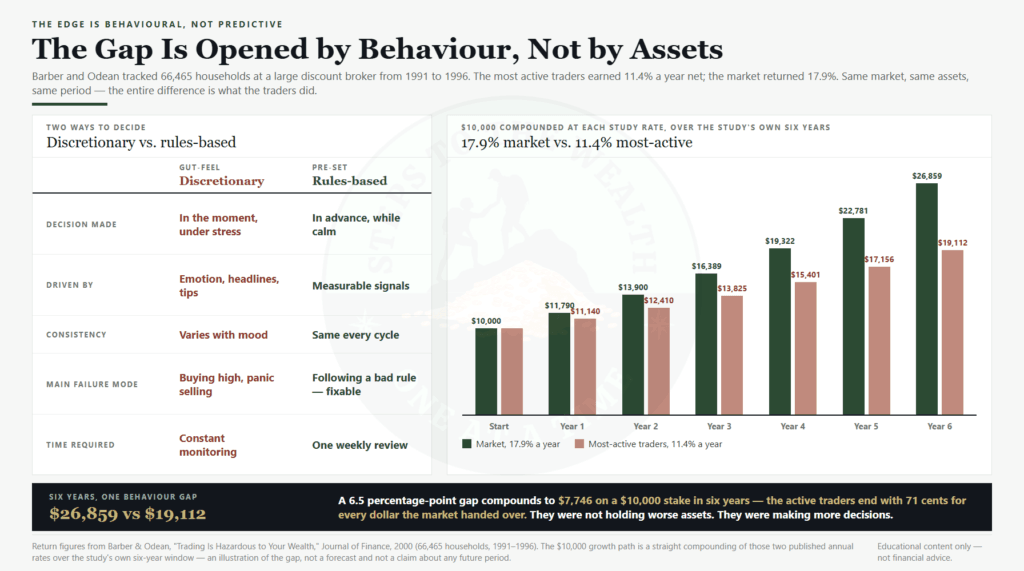
The evidence for how much that matters is stark. Barber and Odean tracked 66,465 households at a large discount broker from 1991 to 1996. The households that traded most earned an annual net return of 11.4%, while the market returned 17.9% over the same period. (Barber & Odean, Trading Is Hazardous to Your Wealth, Journal of Finance, 2000.) Same market, same assets, same six years. The gap was opened entirely by behaviour.
It is worth seeing what a 6.5 percentage-point behaviour gap actually does to money. Compound $10,000 at each of those two published rates across the study’s own six-year window and the market path ends at $26,859 while the most-active path ends at $19,112 — a difference of $7,746, or 71 cents returned for every dollar the market handed over. That is not a forecast, and it is not a claim about any future period. It is just the arithmetic of the gap those households actually produced, and the gap came from making more decisions, not from holding worse assets.
A rules-based system closes that gap by taking the discretion away. Most of what pushes people into extra decisions is folklore rather than analysis, which is why the myths around dollar-cost averaging are worth clearing out before you write a single rule.
| Discretionary (gut-feel) | Rules-based | |
|---|---|---|
| Decision made | In the moment, under stress | In advance, while calm |
| Driven by | Emotion, headlines, tips | Measurable signals |
| Consistency | Varies with mood | Same every cycle |
| Main failure mode | Buying high, panic selling | Following a bad rule (fixable) |
| Time required | Constant monitoring | A weekly review |
What does a rules-based investing system actually contain?
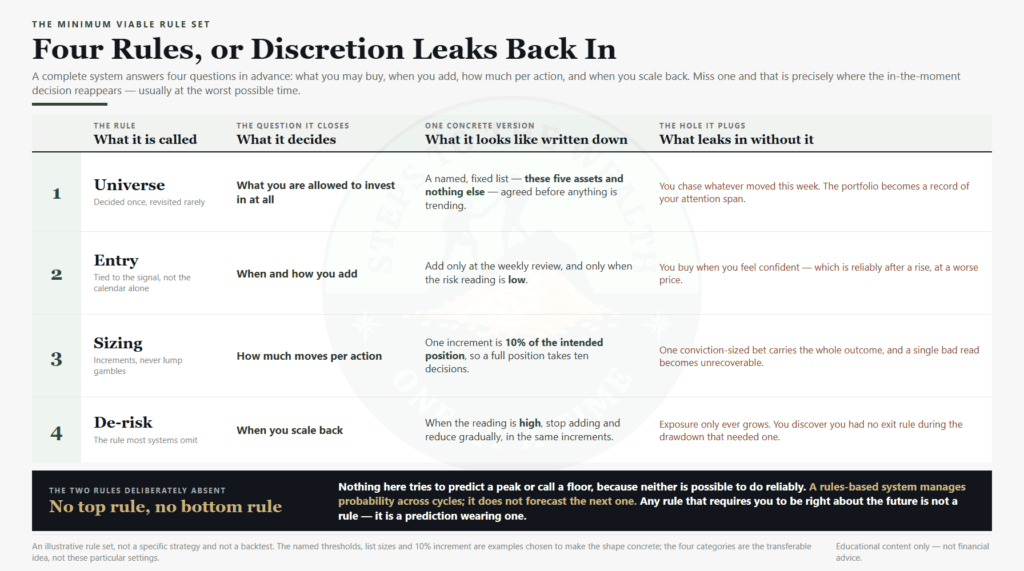
A complete rules-based investing system contains rules for four things: what to buy, when to buy, how much to buy, and when to reduce exposure. Miss any one of these and the system has a hole that discretion will leak through. Here is the minimum viable set.
- A universe rule — what you are allowed to invest in. A defined list, decided in advance, so you are not chasing whatever is trending this week.
- An entry rule — when and how you add. In a risk-first system, you buy gradually when the risk reading is low, in fixed increments.
- A sizing rule — how much per action. Increments, not lump gambles — for example, 10% at a time, so a full position takes ten decisions and no single one carries too much weight.
- An exit or de-risk rule — when you scale back. When risk is high, you slow or stop buying and reduce exposure gradually. Knowing what your holdings do in a drawdown — which is what a portfolio stress test is for — is as much a part of the system as knowing when to buy.
Notice there is no “predict the top” rule and no “call the bottom” rule. Those are not in the system because they are not possible. A rules-based system manages probability across cycles; it does not forecast the future. Any rule that requires you to be right about what happens next is not a rule — it is a prediction wearing one.
Is rules-based investing the same as passive investing?
No — rules-based investing is not the same as passive investing, though the two are often confused. Passive investing means buying a broad index and holding it regardless of conditions. That is one specific rule set — a perfectly valid one — but it is not the whole category. Rules-based investing is the broader idea: any system governed by predefined rules, whether that rule is “buy the index every month forever” or “adjust exposure based on a risk reading.”
The risk-first version sits between pure passive and active trading. It keeps the discipline and low-maintenance nature of passive investing, but it adds a rule that responds to risk — leaning in when conditions are favourable and easing off when they are not. It is still mechanical, still low-effort, still emotion-free. It just is not indifferent to whether the market is cheap or dangerously stretched. That matters most to people with no time to watch screens, which is the whole problem investing around a full-time job has to solve.
How do you start rules-based investing?
You start rules-based investing by writing down your rules for entry, sizing, and de-risking today — before you need them — and committing to a fixed weekly review to execute them. The barrier is almost never complexity. It is the willingness to hand the decision to a rule instead of keeping it for yourself, because keeping it feels like control. It is not control. It is exposure to your own worst moment.
A realistic first version fits on an index card: the assets you will hold, the risk levels that trigger buying versus easing off, the increment you move in, and the day of the week you review. That is a complete system. You refine it over time, but the discipline is available on day one. The investors who compound for decades are not running something exotic. They are running something boring, written down, and followed without exception.
How do you know a rule is actually a rule?
Most people who believe they invest by rules are actually running intentions. The difference is testable: a rule is written clearly enough that two people reading it on the same Sunday would take the same action. An intention leaves room to argue.
“Buy more when the market looks cheap” is an intention. Cheap against what? By how much? Bought with what? Handed to two investors, that sentence produces two different weeks — and handed to the same investor twice, it produces two different answers depending on the mood he is in.
“When the risk reading prints in the low zone at the Sunday review, buy one increment equal to 10% of the planned position” is a rule. It names a measurable trigger, a specific size, and a fixed moment. There is nothing left to decide, which is exactly the point — the decision was already made on a calm day.
Three properties separate the two, and a rule missing any one of them will quietly turn back into a judgment call:
- A measurable trigger. Something you can read off a screen and write in a log. If the trigger is a feeling about the news cycle, the rule is decoration.
- A specified size. “Buy some” is where discretion re-enters through the back door. Increments are the fix — the same amount every time the trigger fires.
- A fixed moment. A rule with no scheduled check runs whenever you happen to look, which means it runs when you are anxious. A cadence turns that into 52 scheduled decisions instead of a running commentary.
One more clause matters more than it looks: your rule set has to say what to do when nothing is triggered. Holding is an action, and if it is not written down as one, every quiet week becomes an open invitation to improvise. Most weeks are quiet weeks.
What a year inside the system actually looks like
The mechanical description makes this sound busier than it is. Take an illustrative year — not a forecast, just a shape — where the risk reading prints low for 18 of the 52 weekly reviews, moderate for 26, and high for 8.
On the 18 low weeks, the rule fires and you buy one increment. On the 26 moderate weeks, the rule says hold, so you read the number, write it down, and close the laptop. On the 8 high weeks, the de-risk rule fires and you ease off. Across the whole year that is 26 actions and 26 deliberate non-actions, each taking about the length of a coffee.
Two things fall out of that arithmetic. The first is that the system spends half its life doing nothing, and the doing-nothing is not laziness — it is the rule executing correctly. The second is that no single week carries much weight. Buying in increments means a full position takes many separate triggers, so being wrong about any one of them costs a fraction of a position rather than a position.
That is the trade the whole approach makes. You give up the chance to be brilliantly right on one call in exchange for never being catastrophically wrong on one call. Over a full cycle, that trade has been kinder to more portfolios than the alternative.
Where rules-based systems actually fail
They fail, and they fail in ways worth naming before you meet them. None of these are exotic. All four show up in the same place — after a stretch where the rules produced a worse outcome than doing something else would have.
Rule drift. The rules survive the first bad quarter and get “refined” during the second. Each individual edit sounds reasonable. Together they walk the system back to discretion, and you end up with gut-feel investing carrying paperwork.
Over-fitting to the last cycle. Rules built to have handled the most recent drawdown perfectly are rules built for a market that already happened. If a rule set has more conditions than you can justify from first principles, it is describing history rather than managing risk.
Too many rules. A system you cannot execute in ten minutes under stress is not a system. Complexity feels like rigour while you are designing it and feels like paralysis when it is time to act. Four solid rules beaten into a habit outperform fourteen elegant ones you abandon in March.
The one-time exception. The most expensive of the four, because it never announces itself as a policy change. It is always a special case — this news is different, this level is obviously wrong, just this once. There is no such thing as one exception. There is a first exception.
And the honest limitation, stated plainly: rules do not remove drawdowns and do not guarantee a better result than any given discretionary investor over any given stretch. In a market that runs straight up, someone who ignored risk entirely and held on will beat a system that scaled back at high readings, and they will say so loudly. The case for rules is not that they win every cycle. It is that they keep you solvent, invested and un-forced across all of them, which is the only condition under which compounding gets to do its work.
Get a rules-based system delivered to you
Building the rules is the easy part. Reading the risk every week — accurately, across multiple assets, without letting emotion creep in — is where most people drift back to gut-feel. That is the part worth outsourcing to a system.
Steps To The Wealth Weekly delivers the risk reading every Sunday, across five major assets, with the action each level calls for — the signal your rules run on.
No predictions. No hype. Just the input your rules-based system needs to run.
Frequently asked questions
What is rules-based investing?
Rules-based investing is an approach where your decisions are governed by predefined rules tied to measurable signals, rather than by emotion or in-the-moment judgment. You decide in advance what to do at each level of risk, then execute those decisions mechanically — which removes the emotional errors that drain most investors’ returns.
Is rules-based investing better than active trading?
For most people, yes — not because it predicts markets better, but because it removes the biggest source of error: emotional decisions made under stress. In Barber and Odean’s study of 66,465 households, the most active traders earned 11.4% a year against a market return of 17.9%. A consistent rule-based process closes that behaviour gap.
Is rules-based investing the same as passive index investing?
No. Passive index investing is one specific rule set within the broader category. Rules-based investing includes any system governed by predefined rules, including risk-first approaches that adjust exposure based on a measured risk reading rather than holding regardless of conditions.
What rules do I need for a rules-based system?
At minimum, four: a universe rule (what you can invest in), an entry rule (when and how you buy), a sizing rule (how much per action, usually in increments), and a de-risk rule (when you scale back). Notably, no rule tries to predict tops or bottoms, because that is not possible.
How do I start rules-based investing?
Write down your entry, sizing, and de-risk rules today, before you need them, and commit to a fixed weekly review to execute them. A complete first version fits on an index card — the assets you hold, the risk levels that trigger action, the increment you move in, and your review day.
Educational content only — not financial advice. Examples and historical figures are for illustration and do not predict future results.