
Time in the market beats timing the market for almost everyone who has ever tried both. Staying invested across full cycles captures the compounding that timing repeatedly interrupts, because the market’s largest single-day gains tend to cluster right next to its largest losses — so the act of jumping out to avoid the drop usually means missing the recovery too. That is the short answer. But it is not the whole answer, and the way the debate is usually framed hides the option that actually works for a busy professional: not choosing between the two extremes, but calibrating exposure to measured risk while never leaving the market entirely.
What does “time in the market vs timing the market” actually mean?
“Time in the market” means staying invested continuously and letting compounding do the work over years and decades, regardless of what the market is doing this month. “Timing the market” means trying to predict short-term moves — buying before rallies and selling before drops — to beat a simple buy-and-hold approach. The debate pits patience against prediction.
The reason it comes up constantly is that timing sounds obviously smart. If you could just sidestep the crashes and own the rallies, you would compound faster than anyone. Nobody argues with the goal. The problem is entirely in the execution: doing it requires being right twice — once on the way out and once on the way back in — and being right on timing, repeatedly, over decades, is something almost no one manages. Miss on either side and you are usually worse off than if you had done nothing.
Does timing the market work?
Timing the market does not work reliably for the overwhelming majority of investors, because it depends on correctly predicting short-term moves that are, by their nature, close to random. This is not a motivational statement. It is what shows up in the behavior of real accounts, repeatedly.
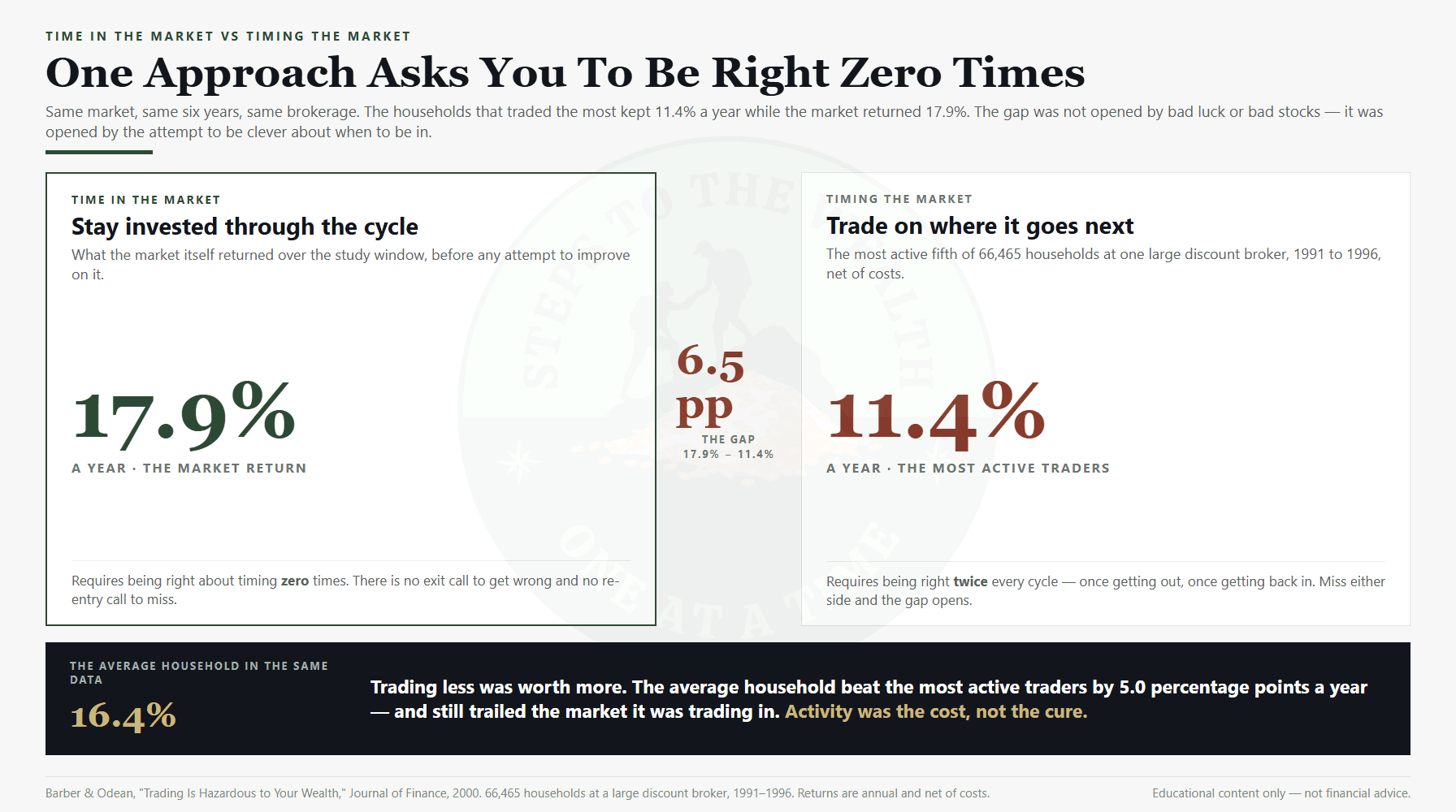
The most active, most confident traders — the people most committed to timing — tend to underperform a simple index by a wide margin. Barber and Odean studied 66,465 households at a large discount broker over 1991 to 1996. The households that traded the most earned 11.4% a year net of costs; the market returned 17.9% over the same window. That is a gap of 6.5 percentage points a year, in the same market, on the same calendar. (Barber & Odean, Trading Is Hazardous to Your Wealth, Journal of Finance, 2000.)
The honest detail most summaries leave out: the average household in that data earned 16.4% — better than the most active traders by 5.0 percentage points, and still short of the 17.9% market return. So this is not a story about heroic patience beating foolish activity. It is narrower and more useful than that: more trading made things worse, and less trading was not automatically enough. Being in the market was the thing that paid; being clever about when was the thing that cost.
Here is the part that makes timing so unforgiving. Every cycle, the same story: someone shows up certain they can see the top coming, sells, and then watches the market grind higher for another year — because being early is indistinguishable from being wrong, right up until it isn’t. Then, having missed the run, they buy back in near the peak out of frustration. Timing did not protect them. It just gave them two chances to be wrong instead of one.
Why does missing the best days cost so much?
Missing the market’s best days is so costly because those days are concentrated in short windows — often in the middle of the scariest downturns — so the price of avoiding a crash is usually forfeiting the recovery that follows it. You cannot cleanly separate the two. The good days and the bad days live in the same neighborhood.
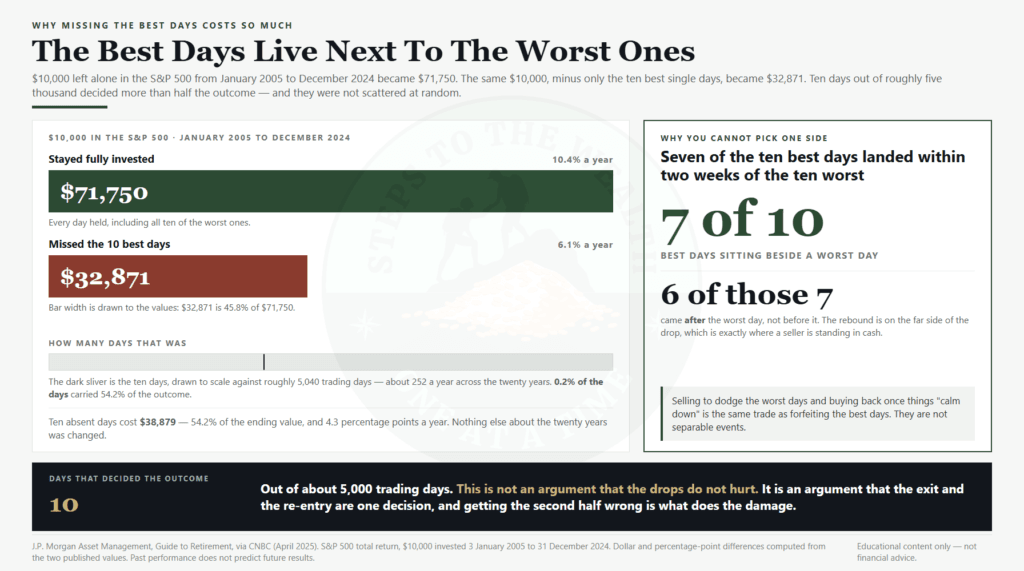
J.P. Morgan Asset Management’s Guide to Retirement puts a number on it. $10,000 put into the S&P 500 in January 2005 and left alone through December 2024 became $71,750 — a 10.4% annual return. The same $10,000, with only the ten best single days removed, became $32,871, or 6.1% a year. Ten days, out of roughly 5,040 trading days, cost $38,879 — 54.2% of the ending value. (J.P. Morgan Asset Management, Guide to Retirement, figures as reported by CNBC, April 2025.)
Note what that is and is not. The ending value more than doubled; the return went from 10.4% to 6.1%. Those are the same fact stated two ways, and the first sounds more dramatic than the second — which is exactly why it is worth stating both.
Now the part that makes timing unforgiving rather than merely difficult. Seven of those ten best days landed within two weeks of the ten worst days — and six of the seven came after a worst day, not before it. The rebound sits on the far side of the drop. That is precisely where an investor who sold to “wait for things to calm down” is standing in cash. The exit and the re-entry are not two independent decisions you can get half right; they are one decision, and the second half is the one that does the damage.
| Stayed fully invested | Sold to time the market | |
|---|---|---|
| Captures the best days | Yes, automatically | Only if timed back in perfectly |
| Avoids the worst days | No | Only if timed out perfectly |
| Requires being right | Never | Twice, every cycle |
| Typical real-world result | Market return | Well below market return |
| Emotional load | Low | Constant |
The table makes the asymmetry obvious. Staying invested asks you to be right zero times. Timing asks you to be right twice, forever. That is a losing trade on probability alone, before you even factor in taxes and fees.
Is risk-first investing just market timing in disguise?
No — risk-first investing is not market timing, because it never tries to predict a top or a bottom and it never leaves the market entirely. This distinction matters, and it is worth being precise about, because the honest objection to everything above is: “So you are telling me to do nothing and hold through every crash?” Not quite. There is a third option the timing debate ignores.
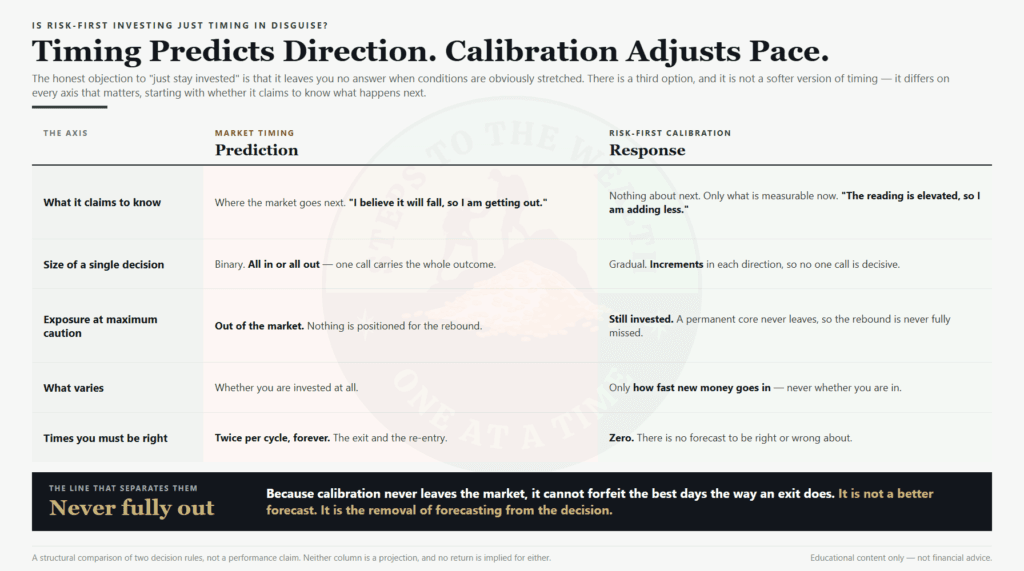
Market timing is prediction: I believe the market will fall, so I am getting out. Risk-first investing is calibration: the measured risk reading is elevated, so I am adding less and holding more cash — while staying invested. One is a forecast about the future. The other is a response to a present, measurable condition. Timing says “I know what happens next.” Risk-first says “I don’t know what happens next, so I size my exposure to how stretched conditions are right now.”
The practical differences are large:
- Timing is binary; risk-first is gradual. A timer is all-in or all-out. A systematic investor working full time scales instead — easing off in increments as risk rises, adding in increments as it falls. No single decision carries the whole outcome.
- Timing predicts; risk-first reacts to data. There is no “the crash is coming” call. There is only a measured risk reading coming in low, moderate, or elevated, and a pre-set action for each.
- Timing exits the market; risk-first stays in it. Even at high risk, you are rarely fully in cash. You are still positioned to capture the best days — you have simply reduced how much new capital you are committing at stretched prices.
That last point is what keeps risk-first on the right side of the data above. Because you never fully leave, you never fully miss the rebound. You keep your time in the market and add a rule that governs how much you deploy, not whether you are invested at all.
How do you get time in the market without buying blindly?
You get time in the market without buying blindly by staying continuously invested through a rule, while varying how aggressively you add based on a measured risk reading — so you are always in, but not always buying at the same pace. This is the resolution to the whole debate. You do not have to choose between “hold through everything” and “try to dodge the crashes.” You hold through everything and you dial your buying up or down mechanically.
Concretely, that looks like a system with three moving parts working together:
- A permanent core. Money that stays invested across every cycle. This is your time in the market, and it is never on the table for a timing call.
- A risk-governed deployment rule. New contributions go in faster when the risk reading is low and slower — or into cash — when it is high. This is calibration, not prediction. Knowing when to ease off is part of the same system as knowing when to lean in, which is also the honest answer to the lump sum versus DCA question: the argument is about pace, not about whether to be invested.
- A fixed cadence. You check once a week and act on the reading. Between reviews, you do nothing, which is what keeps emotion out of it.
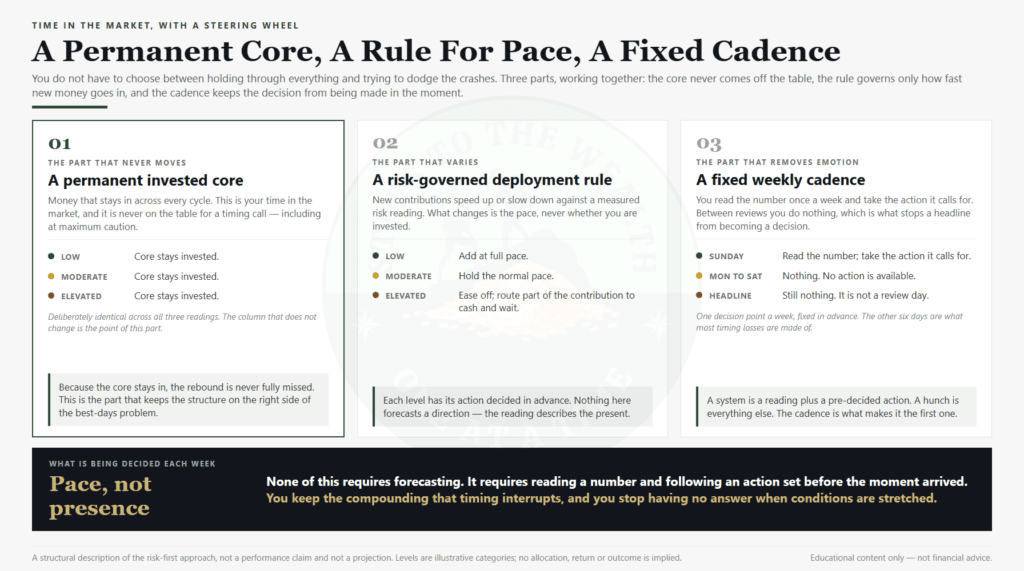
None of this requires forecasting. It requires reading a number and following a pre-decided action. That is the difference between a system and a hunch — and it is why the myths around dollar-cost averaging miss the point: the goal was never to buy blindly on a schedule, it was to stay invested while removing the emotional decisions.
What the “best days” statistic does not prove
The best-days figure gets quoted constantly, usually by somebody selling the idea that you should never look at your portfolio again. It is worth being straight about what it does and does not establish, because the version that gets repeated is stronger than the version the data supports.
What it establishes: the returns are extraordinarily concentrated, and they are concentrated in the worst weeks. Ten days out of roughly 5,040 — about 0.2% of the trading days in that twenty-year window — carried more than half the ending value. And those ten days sat inside the drawdowns, which is the part that matters, because a drawdown is exactly when an investor is most likely to be sitting in cash.
What it does not establish: that timing is impossible in principle. There is a mirror version of the same calculation that almost nobody quotes — the one where you miss the ten worst days instead of the ten best. Removing the ten largest single-day losses from a return series must, arithmetically, leave you ahead of the series that contained them. That is not a finding, it is subtraction, and an honest presentation should say so rather than hope the reader never runs the mirror.
The reason it is still not an argument for timing is that nobody has produced a method that reliably catches the second set without also catching the first. They are two weeks apart. Seven of the ten best days landed inside that window, and six of those seven came after a worst day. So the correct reading is narrower than “never sell”: the good days and the bad days are the same event seen from two sides, and no strategy has been demonstrated that separates them at the precision the trade requires. Keep the honest version of the claim. The overstated one collapses the first time a reader meets somebody who quotes the mirror figure back at them.
What does timing cost even when the call is right?
Everything above concerns whether the call is correct. There is a second cost that applies even when it is, and it is missing from almost every version of this debate.
Selling to sidestep a drop realises whatever gain the position was carrying. In a taxable account that is a bill, paid now, out of capital that would otherwise still be compounding. So the timer does not need to be right — they need to be right by enough to cover the tax, the spread, and the cost of getting back in. A call that is correct by a small margin is a losing trade once the friction is settled, which means the bar is not “did I see it coming” but “did I see it coming by a wide enough margin to pay for the privilege.”
Then there is the cost that never appears in a spreadsheet. Timing requires attention: a view on the market, held continuously, revised every time the news changes. For somebody with a full-time job that attention is the scarcest input they own, and the timing overlay spends it on the one part of the process the evidence says is least likely to pay. A permanent invested core costs nothing to maintain. The overlay costs the thing you cannot buy more of.
This is the practical reason the risk-first answer is a pace rule rather than an exit rule. A pace rule never realises a gain in order to express a view. It changes where the next contribution goes — which costs nothing, triggers nothing, and is reversible next week if the reading moves the other way.
What should a busy professional actually do?
A busy professional should default to maximizing time in the market — automatic, continuous investing — and add a simple risk rule only to govern the pace of new money, never to trigger a full exit. If you take nothing else from this: the winning move is not cleverness. It is showing up every cycle and refusing to make the two-sided timing bet that quietly drains most portfolios.
You do not need to watch charts. You do not need to predict the next move. You need to be invested, stay invested, and let a measured risk reading — not a headline, not a feeling — decide whether this is a month to add hard or a month to ease off and hold cash. That is time in the market with a steering wheel. It keeps the compounding that timing destroys, and it gives you the one thing pure buy-and-hold does not: a defined, unemotional answer for what to do when risk is clearly stretched.
Get the risk reading that governs the pace
Time in the market is the easy part to agree with. The hard part is knowing, week to week, whether to add aggressively or ease off — without turning it into a guessing game or a full-blown timing bet.
That is exactly what Steps To The Wealth Weekly delivers every Sunday: a plain-English risk reading across five major assets, with the action each level calls for.
No predictions. No hype. Just the signal that tells you how hard to lean in — while you stay in the market.
Frequently asked questions
Is time in the market better than timing the market?
For almost everyone, yes. Staying invested across full cycles captures compounding and the market’s best days, which tend to cluster right next to its worst days. Timing requires being right twice — on the way out and the way back in — which repeated studies of real accounts show almost no one manages consistently.
Why is timing the market so hard?
Because short-term moves are close to random, and the largest gains often occur within days of the largest losses, in the middle of downturns. To time successfully you must correctly predict both the exit and the re-entry, every cycle. Miss either side and you typically end up worse than if you had simply stayed invested.
How much does missing the best days cost?
On J.P. Morgan’s figures, $10,000 in the S&P 500 from January 2005 to December 2024 grew to $71,750 if left alone, and to $32,871 if only the ten best days were missed — a loss of $38,879, or 54.2% of the ending value. Annualised, that is 10.4% against 6.1%. Seven of those ten best days fell within two weeks of the ten worst days, and six of the seven came after a worst day, which is why selling during a crash so often means missing the recovery. These are historical figures, not a forecast.
Is risk-first investing the same as market timing?
No. Market timing predicts future moves and exits the market. Risk-first investing never predicts and never fully exits — it responds to a present, measurable risk reading by adjusting how much new money it deploys, in increments, while keeping a permanent invested core. It calibrates pace; it does not forecast direction.
What should I do instead of timing the market?
Stay continuously invested through an automatic rule, and use a measured risk reading only to govern the pace of new contributions — adding faster when risk is low, slower or into cash when risk is high. You keep your time in the market and add a mechanical steering rule, rather than making a two-sided prediction.
Educational content only — not financial advice. Examples and historical figures are for illustration and do not predict future results.