Crypto Max Pain · Pro

The front month shows you the week. The quarterlies show you where the money sits.

The free chart already solves max pain for every expiry inside thirty days, on three exchanges, in coin units. Pro is for the rest of the curve: the quarterlies and the year-end book, where the largest open interest is parked, and the table and exports that let you check the figure instead of quoting it.

One payment No subscription Educational content only — not financial advice

Thirty days of expiries is the loud part of the book, not the large part

The dailies and weeklies are where the headlines come from. The quarterlies are where the positions live. The free window shows you the first and hides the second, and it hides it honestly, with a lock rather than a blur.

01

The largest open interest sits past the free window

Crypto options books are concentrated in the quarterly and year-end expiries; the front-month figure that gets quoted every Friday is a fraction of what is actually open. A max pain reading that cannot see those expiries is a reading of the smallest part of the book.

02

A weekly's max pain resets every week

Whatever the front month says on Monday is a different book by the following Monday. The quarterlies accumulate positions for months and move slowly, which is exactly what makes them worth reading for someone who looks once a week rather than once an hour.

03

Where the book is concentrated is a different question from where one expiry's minimum is

Open interest by expiry, laid out across the whole curve, shows you which settlement dates carry the weight and which are noise. The free version draws that panel for the expiries you can open; Pro draws it for all of them, which is the version that answers the question.

04

A chart you cannot export is a chart you cannot check

If you want to run the arithmetic yourself, compare one exchange's book to the sum, or keep a record of what the book said before expiry, you need the strikes and the open interest as numbers rather than as bars.

What Pro actually adds

Five things. The free version keeps everything it already has — this is added on top, not unlocked from behind a blur.

PRO

Every listed expiry

The quarterlies and the year-end book, on Bitcoin, Ethereum, Solana and XRP, each solved the same way as the front month: the same exchanges, coin units, the full pain curve, the four tiles. The free version lists them and locks them; Pro opens them.

PRO

Open interest by expiry, across the whole curve

One column per settlement date, all the way out, so you can see where the book is concentrated and where it is thin. This is the panel that answers "which expiry matters", and on the free tier it can only show the near ones.

PRO

The per-strike table

Strike, calls, puts, total and the pain at that strike, for the expiry you have open, in a table you can read down rather than squint at. Useful precisely when the curve looks flat and you want to know how close the neighbouring strikes really are.

PRO

CSV export

Every expiry, every strike, calls and puts and pain, with the max pain row flagged, out to a spreadsheet. Run the sum yourself, compare it to one exchange's own figure, or keep a record of what the book said on a given date before it settled.

PRO

Chart image and PDF report

The chart as an image and the reading as a PDF, both named with the asset, the expiry and the time. For notes, for a record, or for showing someone the book rather than describing it.

PRO

Everything the free version has

Every expiry inside thirty days, the tiles, the pain curve, near-the-money and all-strikes views, light and dark, expand, copy link and share. None of it is taken away.

What it still will not do

Pro is more of the book and the numbers behind it. It is not a different kind of instrument, and none of the limits below are lifted by paying.

NO

It does not forecast

Max pain describes how the book is positioned on the day you read it. Price sometimes drifts toward it into an expiry and often ignores it entirely, on the quarterlies exactly as on the weeklies. Seeing the whole curve tells you more about the book. It tells you nothing more about next week.

NO

It does not compute the greeks

No gamma exposure, no implied volatility, no skew, no dealer positioning. Those need inputs the public open-interest feeds do not carry, and a panel that prints them anyway is printing a guess. Pro adds expiries, a table and exports. It does not add anything the free version would have had to invent.

NO

It does not change the sources

Deribit, Bybit and OKX, read every ten minutes, summed in coin units, on both tiers (XRP has no OKX book and is read from the other two). If one of them does not answer, its book is left out and named as missing, on both tiers. Paying does not add a venue or make them report faster.

NO

It does not tell you what to buy

No entry, no exit, no allocation, no threshold. This is background for a plan you already run. If you do not have that plan yet, the free tools and the weekly issue are a far better use of your time than this.

One purchase · no subscription

Buy the rest of the book, not a subscription.

Paid once. It does not renew, it is not bundled with anything, and it is not included in DCA Simulator Pro.

Expiries Every listed expiry: the quarterlies and the year-end book, on BTC, ETH, SOL and XRP
Curve Open interest by expiry across all of it
Table Strike, calls, puts, total and pain at every strike
Export CSV of every expiry and strike, chart image, PDF report
Paid once. Not a subscription, not a bundle. Or use the free version — it is the working tool

If the front month already answers your question, it answers it, and you should keep your money. The free chart is not a demonstration version — it solves every expiry inside thirty days on the same exchanges, with the same arithmetic. Educational content only — not financial advice. Max pain describes positioning; it predicts nothing. Nothing here is a recommendation to buy, sell or hold any asset or derivative.

01 — Where the book actually sits

The front month is the loud part. Crypto Max Pain Pro is for the large part.

Crypto options books are concentrated in the quarterly and year-end expiries. The free chart solves every expiry inside thirty days, which is where the headlines come from, and it locks the rest with a lock rather than a blur. This section is about what sits behind the lock.

A weekly’s max pain resets every week. Whatever the front month says on a Monday is a different book by the next Monday, because the positions are opened and closed inside that window. The quarterlies accumulate positions for months and move slowly, which is exactly what makes them worth reading for someone who looks once a week rather than once an hour. Crypto Max Pain Pro is that once-a-week reading of the slow book.

The largest open interest sits past the free window, so the front-month figure quoted every Friday is a fraction of what is actually open. A max pain reading that cannot see the quarterlies is a reading of the smallest part of the book. Crypto Max Pain Pro solves the quarterlies and the year-end expiry the same way the free chart solves the front month: three exchanges, coin units, the full pain curve and the four tiles.

Where the book is concentrated is a different question from where one expiry’s minimum is. The open-interest-by-expiry panel answers it, laid out across the whole curve so you can see which settlement dates carry the weight and which are noise. The free version draws that panel for the expiries you can open; Crypto Max Pain Pro draws it for all of them, which is the version that actually answers the question.

None of that is a forecast. Max pain describes how the book is positioned on the day you read it, on the quarterlies exactly as on the weeklies. The free chart page sets the arithmetic out in full, and nothing in Crypto Max Pain Pro changes it.

Open interest by expiry in the crypto max pain tool: the free expiries inside thirty days, and the later expiries Crypto Max Pain Pro opens
Open interest by expiry on 14 September 2026. Everything inside thirty days is free; the columns marked Pro are what Crypto Max Pain Pro opens.

02 — The arithmetic

One sum, every expiry. What Crypto Max Pain Pro adds is rows, not a different formula.

Max pain is a sum, on the free chart and in Crypto Max Pain Pro alike: for every strike, add up what every open call and put would be worth if the coin settled there, and take the strike with the lowest total. The free chart runs it inside thirty days. Here is what changes when the window opens.

Step one

Every listed expiry

The quarterlies and the year-end book, on Bitcoin, Ethereum, Solana and XRP, each solved from the same books: Deribit, Bybit and OKX (XRP has no OKX book and is read from the other two), converted to units of the coin before a single strike is added. The free version lists them and locks them; Crypto Max Pain Pro opens them.

Step two

Open interest across the curve

One column per settlement date, all the way out. It is the panel that answers which expiry matters, and on the free tier it can only show the near ones. In Crypto Max Pain Pro it shows where the weight is parked.

Step three

The per-strike table

Strike, calls, puts, total and the pain at that strike, for the expiry you have open, in a Crypto Max Pain Pro table you read down. It matters most when the curve looks flat and you want to know how close the neighbouring strikes really are.

Step four

CSV, image and PDF

Every expiry, every strike, calls and puts and pain, with the max pain row flagged, out to a spreadsheet. The chart as an image and the reading as a PDF, each named with the asset, the expiry and the time, so a reading can be kept and checked after the book has settled.

What is the same on both tiers

The sources, the units and the refresh. The same exchanges, read every ten minutes, summed in coin units. If one venue does not answer, its book is left out and named as missing under the chart, on both tiers, and Crypto Max Pain Pro does not add a venue or make them report faster.

The refusals too. No gamma exposure, no implied volatility, no skew, no dealer positioning — those need inputs the public open-interest feeds do not carry, and a panel that printed them would be printing a guess. Crypto Max Pain Pro adds expiries, a table and exports. It adds nothing the free version would have had to invent.

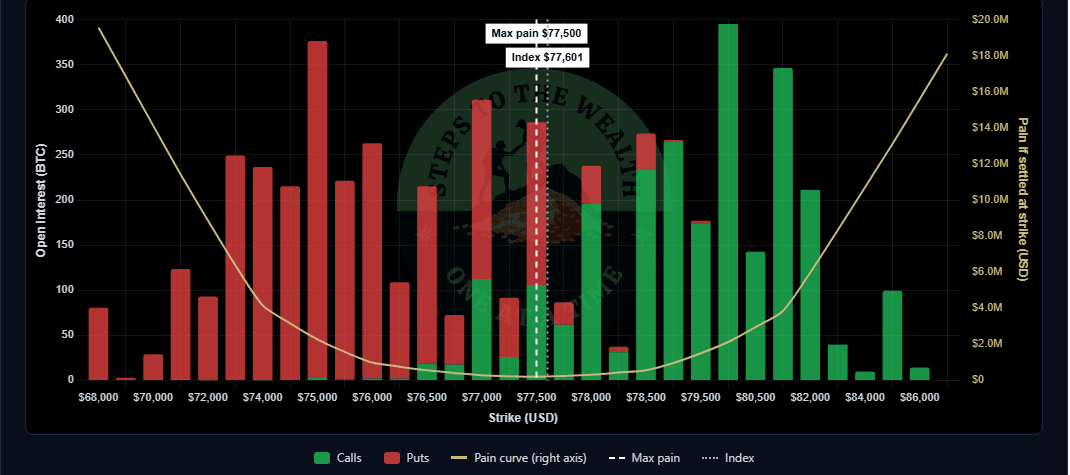
The crypto max pain chart: calls and puts by strike with the pain curve and the index price, the same chart Crypto Max Pain Pro draws for every expiry
The front-month chart, free. Crypto Max Pain Pro draws the same chart, with the same arithmetic, for the quarterlies and the year-end book.

03 — Who this is for

A reading for people who hold the coin and want the whole book, once a week.

Most people who look at max pain will never write an option, and the free chart is enough for most of them. Crypto Max Pain Pro is for a narrower group, and it is worth being clear about who.

It fits if

  • You hold or accumulate Bitcoin, Ethereum, Solana or XRP and want to know where the large money is positioned into the quarterly and year-end settlements, not just this Friday’s.
  • You look once a week and want the slow book Crypto Max Pain Pro opens, which barely moves between looks, rather than the front month, which resets between them.
  • You want the numbers rather than the bars: the per-strike table and the CSV, so you can run the sum yourself or compare one venue’s figure to the combined one.
  • You want a dated record. A Crypto Max Pain Pro PDF named with the asset, the expiry and the time is a reading you can hold against what happened at settlement.

It does not fit if

  • You want a price target. Crypto Max Pain Pro describes a book; it does not say where price goes, on any expiry, and the page says so at every tier.
  • You trade options intraday. The Crypto Max Pain Pro book refreshes every ten minutes, which is a reading and not a tape, and paying does not change that.
  • You need the greeks. Gamma, implied volatility, skew and dealer flow are not computed on either tier, and nothing that looks like them is.
  • The front month already answers your question. Then it answers it, and you should keep the $49. The free chart is the working tool; the other free tools cover most of what sits around it.
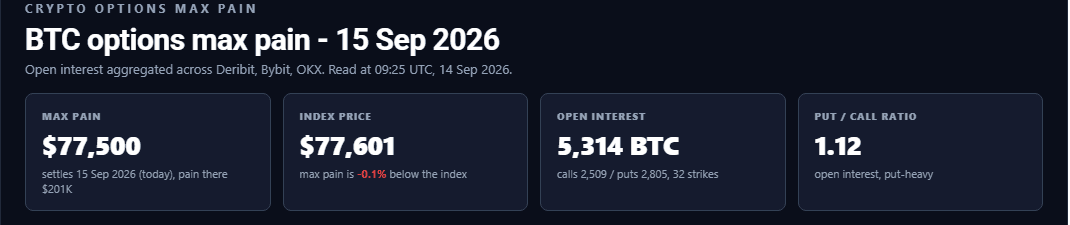
The four crypto max pain tiles: max pain strike, index price, open interest and put-call ratio, which Crypto Max Pain Pro fills for every listed expiry
The four tiles for one expiry. Crypto Max Pain Pro fills them for every listed settlement date, and adds the per-strike table underneath.

04 — Questions

What people ask before they buy Crypto Max Pain Pro.

Answered against what the tool actually does, not against what would be convenient to claim.

What does Crypto Max Pain Pro add to the free chart?

Five things, on top of everything the free version keeps: every listed expiry beyond thirty days (the quarterlies and the year-end book) on Bitcoin, Ethereum, Solana and XRP; open interest by expiry across the whole curve; the per-strike table; CSV export of every expiry and strike; and the chart as an image and the reading as a PDF, each dated.

The arithmetic, the exchanges, the coin-unit conversion and the ten-minute refresh are identical. Crypto Max Pain Pro opens more of the book; it does not measure it differently.

How much is Crypto Max Pain Pro, and is it part of DCA Simulator Pro?

$49, paid once. It does not renew, it is not bundled with anything, and it is not included in DCA Simulator Pro — if you already subscribe to that, this is a separate purchase, and that is worth knowing before you click rather than at the checkout.

If the front month already answers your question, keep the $49. The free chart solves every expiry inside thirty days on the same exchanges with the same arithmetic.

Does Crypto Max Pain Pro forecast where price settles?

No. Max pain describes how the book is positioned on the day you read it. Price sometimes drifts toward it into an expiry and often ignores it entirely, on the quarterlies exactly as on the weeklies. Seeing the whole curve tells you more about the book and nothing more about next week.

A large stack of open interest at one strike can be a hedge as easily as a bet, and no tier of the chart can tell the two apart.

Why does the free version stop at thirty days?

Because the dailies, the weeklies and the front monthly are the part of the book people quote, and solving them fully for free means nobody has to buy Crypto Max Pain Pro to check a headline. The lock on the later expiries is enforced on the server — a free session is never sent their figures — rather than drawn over the chart.

Nothing is taken away from the free version to make room for Pro. The tiles, the pain curve, near-the-money and all-strikes views, copy link and share stay free.

Which exchanges and coins does Crypto Max Pain Pro cover?

Deribit, Bybit and OKX, for Bitcoin, Ethereum, Solana and XRP, on both tiers. Solana’s and XRP’s options on Deribit live in its USDC-settled book and are read from there; OKX lists no XRP options, so XRP is read from Deribit and Bybit. If an exchange does not answer, its book is left out and named as missing under the chart.

Paying does not add a venue. What it adds is every expiry those venues list, rather than the ones inside thirty days.

Is Crypto Max Pain Pro financial advice?

No. It is a description of how an options book is positioned, drawn from public open-interest feeds, and it carries no recommendation to buy, sell or hold any asset or derivative. It knows nothing about your situation.

Everything on this page is educational. The crypto heatmap and global net liquidity sit beside it as context, and the weekly newsletter is where a plan lives. Educational content only — not financial advice.