
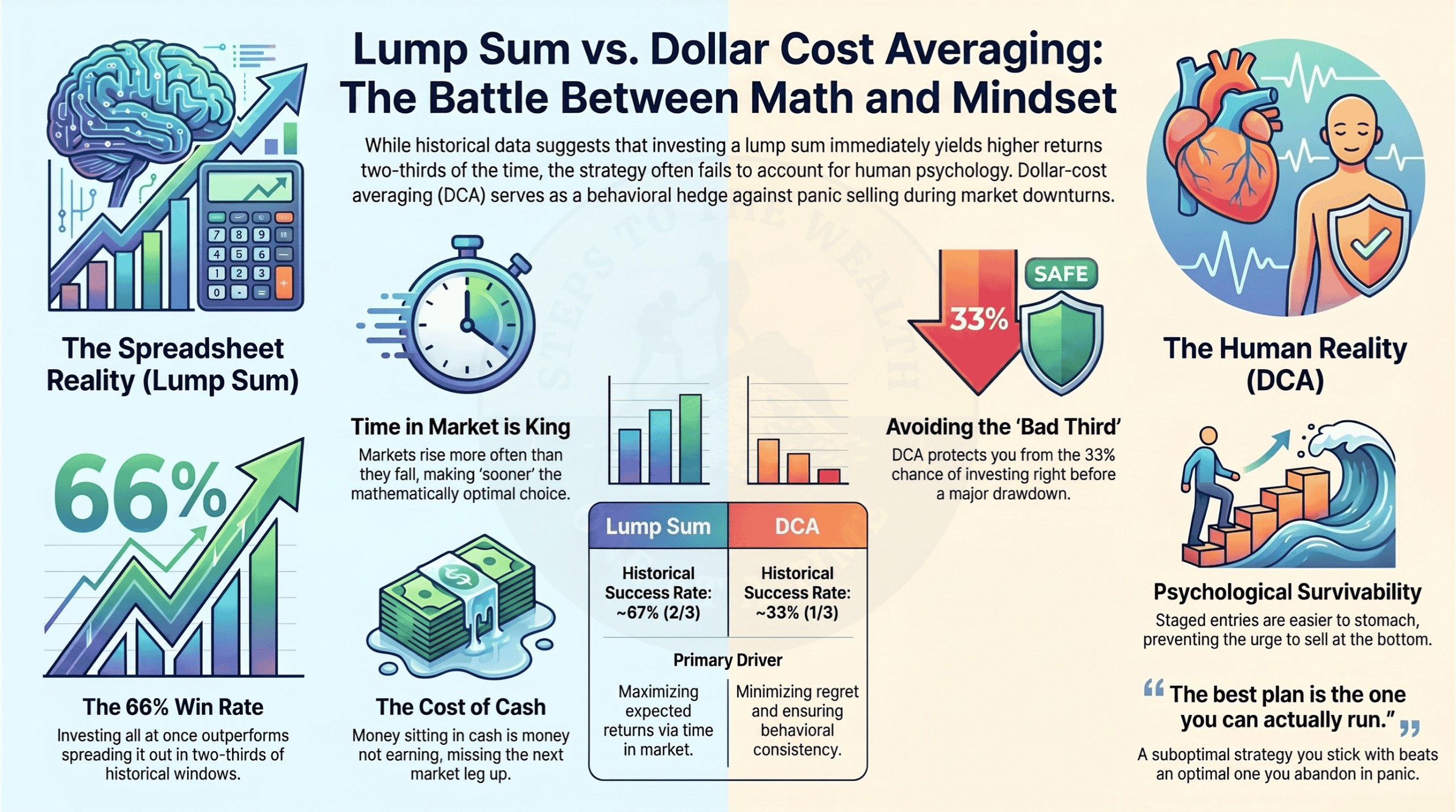
You just came into a chunk of money. A bonus, an inheritance, an RSU vest, the proceeds of a sale. Now you are stuck on a question that feels like it should have a clean answer: do you invest it all at once, or spread it out over months?
Search it and you will get a confident reply — “studies show lump sum beats DCA about two-thirds of the time.” That is true. It is also one of the most misused facts in personal finance, because it answers a math question while you are actually facing a behaviour-and-risk question.
Here is what the data really says about lump sum vs DCA, where it stops being relevant, and how to make the decision for your actual situation instead of an average one.
Educational content only. Not financial advice.
First, a definitions cleanup
A surprising amount of confusion here comes from people arguing about two different things.
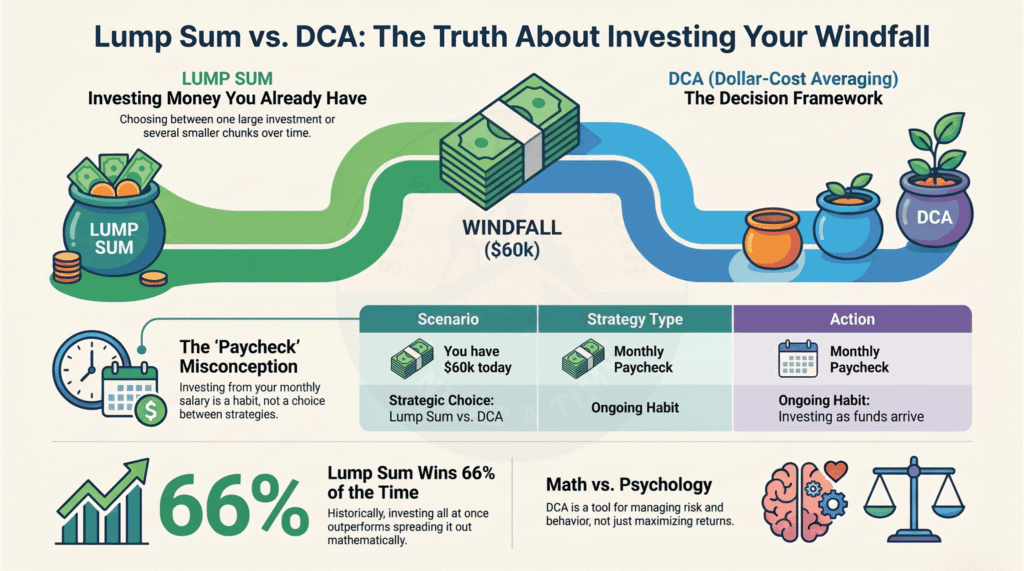
Lump sum vs DCA is a question about deploying money you already have. You are holding $60,000 today. Do you invest it all now, or in twelve $5,000 chunks?
DCA as an ongoing habit is a question about money you do not have yet — investing each paycheck as it arrives. If your wealth is built from monthly income, you are dollar-cost averaging by definition, because the money shows up gradually. There is no lump to deploy.
This article is about the first one: you have a lump, and you are deciding how fast to put it to work. If your real situation is “invest every paycheck,” that is not even a choice — it is a scheduling problem, and a fixed schedule is where most busy investors quietly lose ground.
Lump sum vs DCA: what the data actually shows
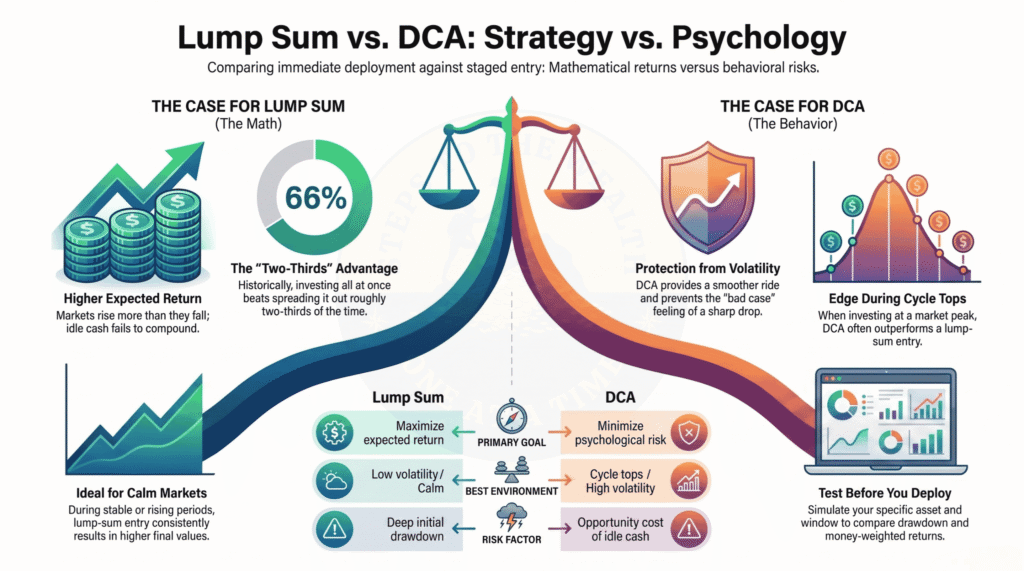
The widely-cited finding is real: across long historical windows, investing a lump sum all at once has outperformed spreading it out roughly two-thirds of the time, and on average by a few percent.
The logic is simple and hard to argue with. Markets rise more often than they fall. Time in the market is the dominant driver of long-run returns. Money sitting in cash waiting to be deployed is, on average, money not earning. So getting fully invested sooner usually wins, because “sooner” usually means “before the next leg up.”
If your only goal is to maximise expected return and you could guarantee you would behave like a spreadsheet, the math says: invest the lump, now.
Where the data stops being relevant
Two things quietly break the clean conclusion.
You are not an average, and you only get one outcome. “Two-thirds of the time” means one-third of the time lump sum loses to DCA — sometimes badly, if you happen to deploy everything the week before a 40% drawdown. The averages describe a thousand parallel histories. You live in exactly one. If yours is the bad third, “but it was the right call on average” is cold comfort while you watch a year of savings evaporate in a month.
The math assumes you will not panic. You might. The entire lump-sum edge depends on you staying invested through whatever comes next. If deploying everything at once and then watching it drop 30% would make you sell at the bottom, the optimal-on-paper move just produced the worst possible real outcome. DCA’s quiet advantage is not in the return column — it is that smaller, staged entries are psychologically survivable, so you are more likely to still be invested when it matters. A worse strategy you stick with beats a better one you abandon.
This is the same theme that runs through everything we write: the best plan is the one you can actually run, not the one that wins the backtest.
The honest decision framework
Forget the average. Ask these instead.
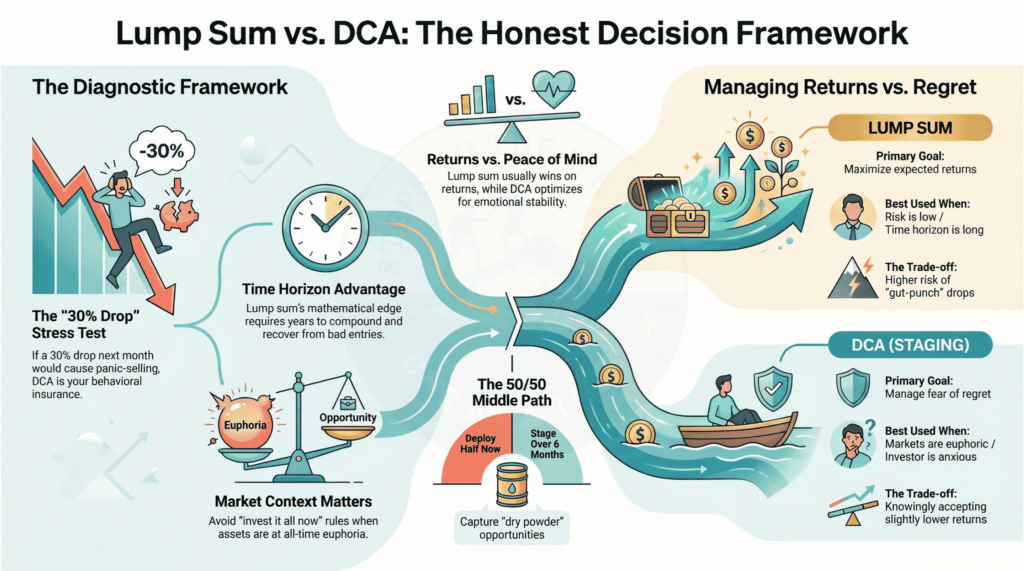
How would you feel if you invested the whole lump tomorrow and it dropped 30% next month? If the honest answer is “I would hold, it is a long-term position” — lump sum is probably right for you, and the data is on your side. If the honest answer is “I would panic and sell” — that feeling is the real risk, and staging the money in is cheap insurance against your own behaviour.
Is this money you can leave alone for years? Lump sum’s edge compounds with time horizon. If you will need the money in three years, the “markets rise over time” assumption is doing a lot less work, and a single bad entry has less time to recover.
What does the asset’s risk look like right now? Deploying a lump into a calm, fairly-valued market is a very different decision from deploying it into something that just ran up 200% and is sitting at all-time euphoria. The lump-sum studies average across all conditions; you are deploying into one specific condition. This is the entire premise of a risk-first approach — the price you are buying at is information, and a fixed “invest it all now” rule throws that information away.
Can you split the difference? You do not have to pick a corner. A common middle path: deploy a meaningful chunk now (so you are not sitting entirely in cash betting on a drop that may never come), and stage the rest over a few months. You capture most of the “time in market” benefit while keeping enough dry powder that a near-term crash becomes an opportunity instead of a gut-punch. A risk-first version goes further — deploy faster when risk is low, slower when risk is high — but even a simple “half now, half over six months” beats freezing.
If you do stage it, over how long? This is the question the research never answers for you, because it is not a math question either. The trade-off is mechanical: the longer your staging window, the more behavioural protection you buy and the more expected return you give up, because more of your money spends more time in cash.
Short windows barely differ from a lump. Very long windows stop being a deployment plan and become a permanent cash allocation you never chose on purpose.
The practical test is not “what is optimal” but “what is short enough that I will actually finish it.” A plan you abandon halfway leaves you in the worst position of all — partly invested, still holding cash, and now making the decision under stress rather than in advance. Write the schedule down, including the dates, before you deploy the first tranche.
The decision nobody admits they are making
Here is the uncomfortable part. Most people stuck on lump sum vs DCA are not optimising return at all. They are managing the fear of regret — specifically, the fear of investing everything and then watching it fall.
That fear is legitimate, and DCA is a reasonable tool for it. But name it for what it is. If you are choosing DCA over lump sum, you are knowingly accepting a slightly lower expected return in exchange for a smoother ride and a lower chance of a behavioural disaster. That is often a smart trade. It is only a mistake when you tell yourself you are doing it for the returns — because on returns, the lump usually wins, and pretending otherwise leads to muddled decisions later.
Decide on purpose. Are you buying expected return, or are you buying the ability to sleep and stay invested? Both are valid. They are just different purchases.
Test your actual decision before you make it
The averages are about everyone. You care about your lump, your asset, and the window you are actually deploying into.
The DCA Simulator lets you run a real lump-sum entry against a staged DCA of the same money on the same asset and compare them side by side — final value, drawdown, time underwater, and money-weighted return. Run it through a calm period and the lump usually wins. Run it starting at a cycle top and watch DCA pull ahead. Seeing both outcomes on the asset you actually hold does more for the decision than any “two-thirds of the time” statistic — and it tells you, specifically, how bad the bad case would have felt.
What the two-thirds figure is actually measuring
Before leaning on the statistic, it is worth knowing what produced it, because it is a good deal less general than the way it gets quoted.
Any study of lump sum vs DCA has to make three choices before it can produce a number at all, and every one of them moves the result.
The staging window. Comparing a lump against money spread over three months and comparing it against money spread over two years are different experiments. The longer the window, the more often the lump wins, because more of the money spends more of the period out of the market. Quote a single percentage and you have hidden a window length inside it.
The asset mix. The lump’s advantage comes from the asset drifting upward while the cash waits its turn. A higher expected return widens the gap; a more conservative mix narrows it. The headline figure belongs to whatever mix the study ran, which is unlikely to be yours.
The market and the period. Long histories of broad developed-market indices are the usual input, because that is where clean data exists. A single asset, a shorter history, or a market that spent a decade going sideways produces a different split, and none of those are exotic situations.
None of that makes the finding wrong. It makes it a description of a specific experiment rather than a law about your $60,000. The direction is robust — over long horizons, in markets that rose, getting invested sooner has usually won. The precise fraction is not robust, and the fraction is the part everybody repeats.
Idle cash is not zero
One line in the standard argument deserves a correction, and it is one used above: money sitting in cash is money not earning.
That is true when short-term rates are near zero, which happened to be the condition through much of the period in which the two-thirds statistic became popular. It is not a permanent fact about cash. When short rates are meaningful, money awaiting deployment earns something real, and the cost of staging falls accordingly.
This does not reverse the conclusion. The expected return on equities over a long horizon is higher than cash — that is the entire reason anyone holds equities — and staging still gives up part of it. But the size of what you give up moves with the rate environment. It is smaller when cash is paid well than when it is not, and nobody quoting the statistic mentions which of those two worlds they are quoting from.
The practical consequence is narrow. If you are going to stage, do not leave the undeployed portion in a current account earning nothing. Hold it somewhere that pays the going short rate. That is not a clever strategy, it is housekeeping, and it recovers a meaningful slice of what staging costs you.
Two smaller frictions worth naming, both real. Staging means several transactions rather than one, which matters if your platform charges per trade. And in a taxable account it creates several cost bases instead of one — not a cost exactly, but an administrative fact that arrives later, when you sell.
Regret runs in both directions
Everything above treats one fear: deploy the lump, watch it fall. That is the fear the whole DCA case is built on, and it is a real one.
There is a second fear, and it breaks more plans than the first does.
You decide to stage over twelve months. Three months in, the market is up, and every tranche you have not yet deployed is buying at a higher price than the one before it. The plan is working exactly as designed — you accepted this outcome the day you chose it — and it feels like losing. So you abandon the schedule and deploy the remainder at once, which means you have now done the thing you were avoiding, at the worst prices in the sequence, on an impulse.
That is the true failure mode of staging, and it is more common than panic-selling a lump, because it does not require anything dramatic to happen. It only requires the market to do the thing it usually does.
The defence is the same as the defence against the other fear, and it has to be built before you start. Write the schedule down with dates and amounts. Decide in advance what you will do if the market is up 15% mid-plan and what you will do if it is down 15%, and then treat both as already settled rather than as questions to reopen.
If you cannot honestly commit to finishing a twelve-month schedule, pick a three-month one you will finish. A short plan completed beats a long plan abandoned, and both beat the version where lump sum vs DCA is still an open question eight months after the money landed.
Equal tranches are a default, not a decision
Almost everybody who stages splits the money into equal instalments, because it is the obvious shape and it requires no thought at all. It is worth about a minute of thought.
An equal split treats every month in the window as identical, which is the same averaging assumption the two-thirds statistic makes, and you have just spent this article learning why that assumption is doing more work than it looks like it is doing.
Front-loading — a larger first tranche, smaller ones behind it — sits closer to a lump, gives up less expected return, and still leaves something in reserve for a drop. Back-loading does the opposite. It is also the version most people drift into by accident, one hesitated tranche at a time, without ever deciding to.
None of the three is correct in general. What matters is that you picked one deliberately, wrote it down, and can tell afterwards whether you followed it. A plan you cannot audit against is not a plan, it is an intention.
The takeaway
On pure expected return, investing a lump sum all at once usually beats spreading it out — markets rise more than they fall, and idle cash does not compound. That is real, and if you can deploy and then leave it alone, the data is on your side.
But you get one outcome, not the average of a thousand, and the whole edge evaporates if a sharp drop would make you sell. DCA buys you a smoother ride and protection from your own behaviour at the cost of a little expected return. Decide which one you are actually buying, weigh the risk of the market you are deploying into — not the average market — and if you are torn, splitting the difference is a perfectly respectable answer.
Run your lump against a staged plan
Open the DCA Simulator → and compare investing your lump all at once vs staging it in, on the asset and window you are actually facing. See the drawdown and the money-weighted return for each, side by side.
Want the risk-first deployment system on one page? Grab the free Dynamic DCA Blueprint.
Educational content only — not financial advice. Research findings and simulated outcomes are illustrative, describe historical or hypothetical results, and do not predict future performance. Nothing here is a recommendation about any specific asset, amount, or allocation. Past performance does not predict future results.