
If you are scared to invest, the standard advice is to start small and think long-term. It is fine advice. It is also not an answer to the question you are actually asking.
The question underneath “I’m scared to invest” is not how do I feel braver? It is how do I know I am not about to put my savings into the market at the worst possible time? That is a system problem, not a psychology problem. And you can solve system problems. You have been solving them your whole career. You just have not been given one for this.
This piece is the system. Not a pep talk. A framework that makes the fear smaller by making the decisions you are afraid of stop being yours to make in the moment.
Educational content only. Not financial advice. All investing involves risk, including the potential loss of principal.
Why “start small, stay long” fails when you are scared to invest
Here is why the standard advice keeps failing the people who need it most.
“Start small and stay long” assumes the fear is irrational. It is not. The fear is reading the market correctly. It is noticing that buying at the wrong time really does produce bad outcomes, and that nobody hands you a way to tell the difference in advance.
Two examples, both checked against the price record rather than repeated from memory.
Someone who bought the S&P 500 at its 2000 peak did get back to break-even — in May 2007, roughly seven years later. Then the financial crisis took all of it back, and the index did not stand durably above the 2000 level again until March 2013. Thirteen years, two full round trips, and nothing to show for the first one. That is not a story about patience being rewarded. It is a story about entry price mattering.
Someone who bought Bitcoin at its November 2021 high of about $68,790 watched it fall to roughly $15,600 by 21 November 2022. That is a decline of 77% in a little over a year. Two years after the peak it was still down about 45%. Those are not imaginary risks. Those are outcomes that happened to real people who followed the “just start investing” advice from someone who did not have to live with the consequences.
So when a creator tells you “do not worry, just start” — they are asking you to trust luck. They are telling you that timing does not matter. It does. Not for sophisticated forecasting reasons. For basic risk-asymmetry reasons. Buying an expensive asset is meaningfully different from buying a cheap one. Your nervous system is correctly flagging this. The advice industry is not.
The fear is not a character defect. It is an unmet information need. You do not need to push through it. You need something that answers it.
What the fear is actually protecting you from (and what it isn’t)
There are two different fears that get lumped together when people say they are scared to invest, and untangling them is the first real step.
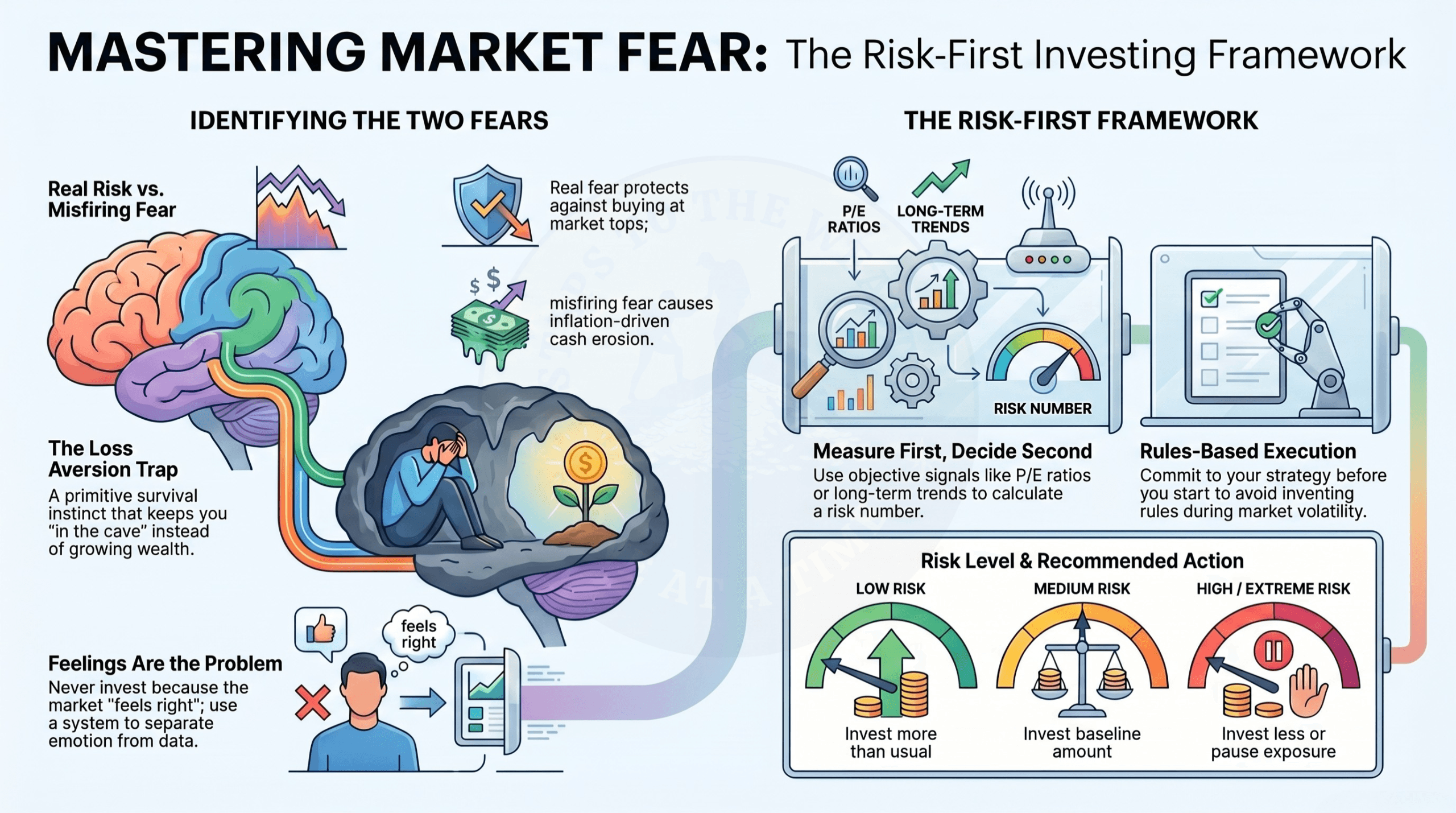
The first fear is real. It is the fear of buying at a market top, watching your money shrink for years, and losing savings you worked hard to build. That fear is pointing at an actual risk. People do lose money to bad timing — the S&P and Bitcoin numbers above are what that looks like with the dates attached. A disciplined system addresses this directly.
The second fear is misfiring. It is the general feeling that “the stock market is scary” or “something bad could happen.” This one is less about risk and more about loss aversion, which is a survival instinct doing its job poorly. Loss aversion made sense when losing a meal could mean starving. Applied to long-horizon investing, it keeps you in cash while inflation quietly erodes what you have.
You need to feel the first fear. Respect it. Build around it. The whole point of a risk-first system is to take that fear seriously instead of dismissing it.
You do not need to feel the second fear. It is not telling you anything useful. It is telling you to stay in the cave.
The trick is that most people cannot tell which fear they are feeling in a given moment. That is what the system is for. The system separates the two, responds to the first, and helps you ignore the second.
The risk-first framework in two minutes
Here is the short version of what replaces “just start investing.”
You measure risk first. You decide what to do second.
Every asset has a measurable risk level — not a feeling about it, a measurement of it. For the S&P 500, that is things like price-to-earnings relative to its own history, market breadth, and sentiment extremes. For Bitcoin, it is on-chain signals and distance from the long-term trend. The specifics are not the point. The point is that the number exists and anyone can read it.
Then you follow rules based on what the number says.
- When risk is low, you invest more than usual. These are the moments most people are too scared to buy, which is exactly why they are the moments worth buying.
- When risk is medium, you invest your baseline amount. You are in neutral territory.
- When risk is high, you invest less. Possibly much less.
- When risk is extreme, you pause. You may even start reducing exposure.
The rule underneath all of it: you never invest because the market “feels right.” Feelings are the problem the system exists to solve. You invest because the risk reading said to, and you sit out because the risk reading said to.
That is the framework. It is not complicated. The hard part is committing to it before you start, rather than inventing it in the middle of a drawdown.
It is also worth being clear about what this is not. It is not a prediction. The risk reading does not tell you what happens next week. It tells you whether you are being paid to take the risk you are about to take, and it scales your position accordingly. If you want to see how position sizing plays out against real history rather than taking anyone’s word for it, the lump sum versus DCA comparison runs both approaches through actual market data.
How the system kills the fear
Here is what actually changes when you operate this way.
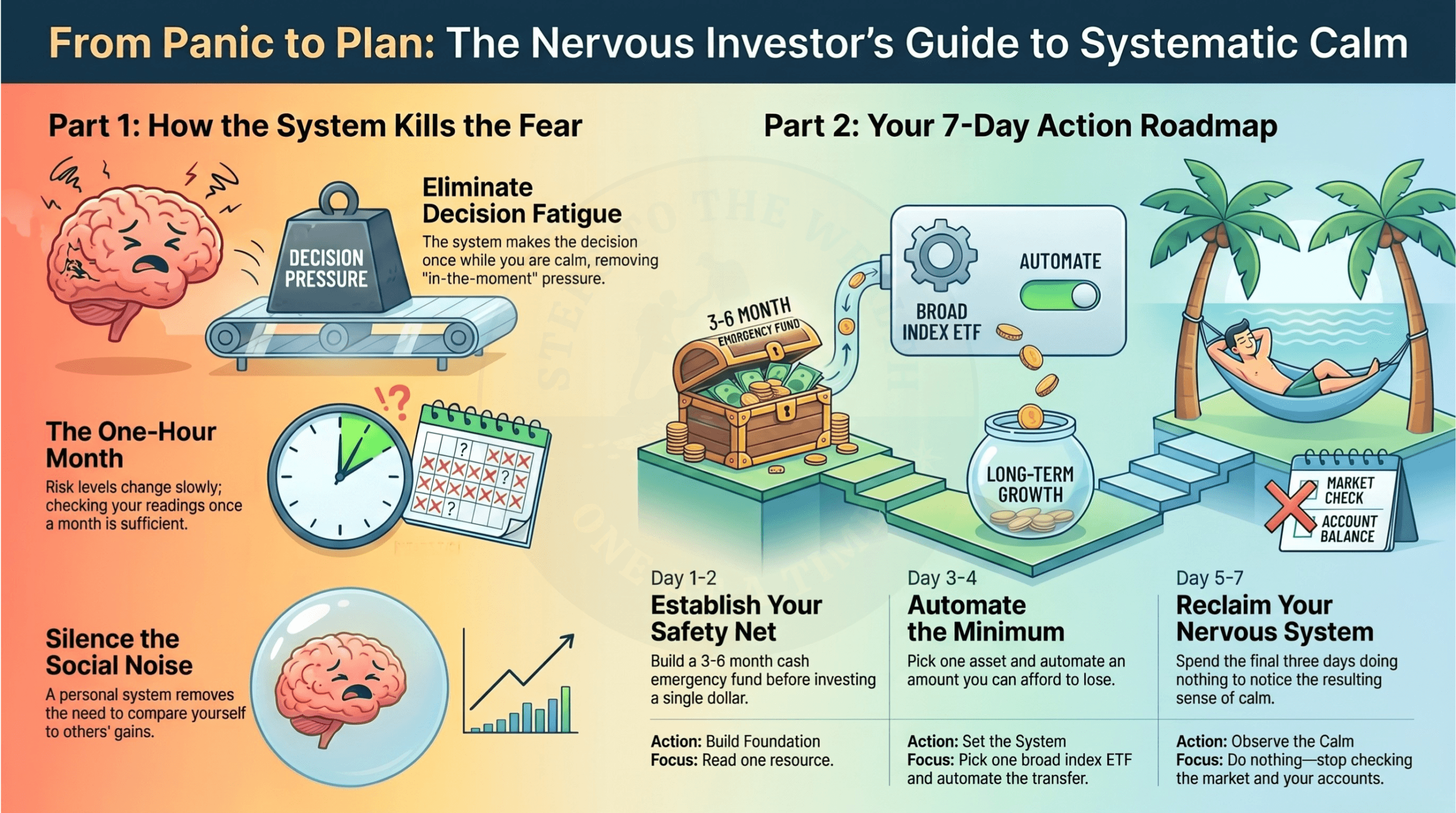
You stop deciding. The hardest part of investing is not the investing. It is the deciding. “Should I buy now?” “What if it drops after I buy?” “What if I miss the dip?” All of those are decisions you have to make, repeatedly, with incomplete information, while the market moves against you. The system makes the decision once — in writing, when you are calm — and then removes it from you in the moment.
You stop watching. Risk levels change slowly. A reading might stay Medium for six months. Once a month is enough to check it. That is an hour of your month. You do not have to watch the market. You just have to show up for the hour.
You stop comparing. Most of the pain in investing is not the market itself. It is the comparison — to the friend who bought crypto at the right time, to the colleague who sold before the crash, to the creator who always seems to have been right. A system removes the basis for comparison. Your system does not care what anyone else did. It cares about your rules and the current reading.
You stop justifying. When the system says wait, you wait. You do not have to talk yourself into it. You do not have to defend it at a dinner party. The system is the answer. If someone pushes, you say “I have a framework, and the framework says wait.” You would be amazed how much quieter your internal monologue gets when you have that line available.
The fear does not vanish. It gets smaller. It moves from paralyzing to background hum, and you find you can function around it, which is all you needed in the first place.
A first-week action plan for the nervous investor
You do not need a month of research. You need seven days, and most of the time is spent not doing things.
Day 1: Read one thing, then stop
Pick one foundational resource that explains the risk-first approach. Not ten. Ten will make you more confused, not less. Read it end to end. Close the tab. Do not go looking for a second opinion yet. The whole problem you are trying to solve is “too many voices.” Do not add more voices to it today.
Day 2: Build your emergency fund if it is not already built
Before you invest a single dollar, you need three to six months of essential expenses in cash. Not stocks. Not bonds. Cash, in a high-yield savings account. The SEC’s investor education site makes the same point in its save and invest basics: the emergency reserve comes before the market, not after it.
This is the single most overlooked piece of advice in investing content, and it is the one that matters most for a nervous person. The emergency fund is what lets you hold your investments through a drawdown without panic-selling. If you do not have it, your investments are your emergency fund, and every market dip becomes a financial emergency. That is the scariest way to invest. Fix this first.
Day 3: Pick your first asset and your frequency
Do not pick five. Pick one.
A broad index ETF is the most common starting point for a reason: it is diversified, it is cheap, and it tracks a long-term uptrend even through cycles. Whether that is an S&P 500 fund, a total-market fund, or a global-diversified fund depends on your situation. Any of them is defensible.
Then pick a frequency. Monthly is fine. Bi-weekly is fine. The frequency matters far less than committing to one and leaving it alone.
Day 4: Automate the smallest amount you can live with losing
This part matters. Not the amount you think you should invest. The amount you could lose in full and still be okay. For most nervous first-timers that is much less than they would assume. It might be $100. It might be $50. Start there.
Automate the transfer from your checking account to your brokerage. Automate the purchase itself if your platform allows it. The automation is what removes your finger from the trigger.
Days 5 to 7: Notice what happens to your nervous system
Here is the exercise. For three days, do nothing. Do not check the market. Do not look at your account. Do not read investing content. Just notice how you feel.
Most nervous first-timers report something unexpected: a small, specific sense of calm. Not the motivational kind. A quiet version. The kind that comes from having a plan for something that was previously unstructured.
That calm is the point. It is the early return on operating with a system. Keep it. Guard it. It is what protects you from the next headline cycle.
What to do when the fear comes back anyway
It will. Probably within weeks.
A headline will hit. A market will drop 3% in a day. A friend will tell you they just sold everything. Your portfolio will be down on a Tuesday for no obvious reason. The fear will whisper that this time is different, that the system is not working, that you need to do something.
Here is what to do instead.
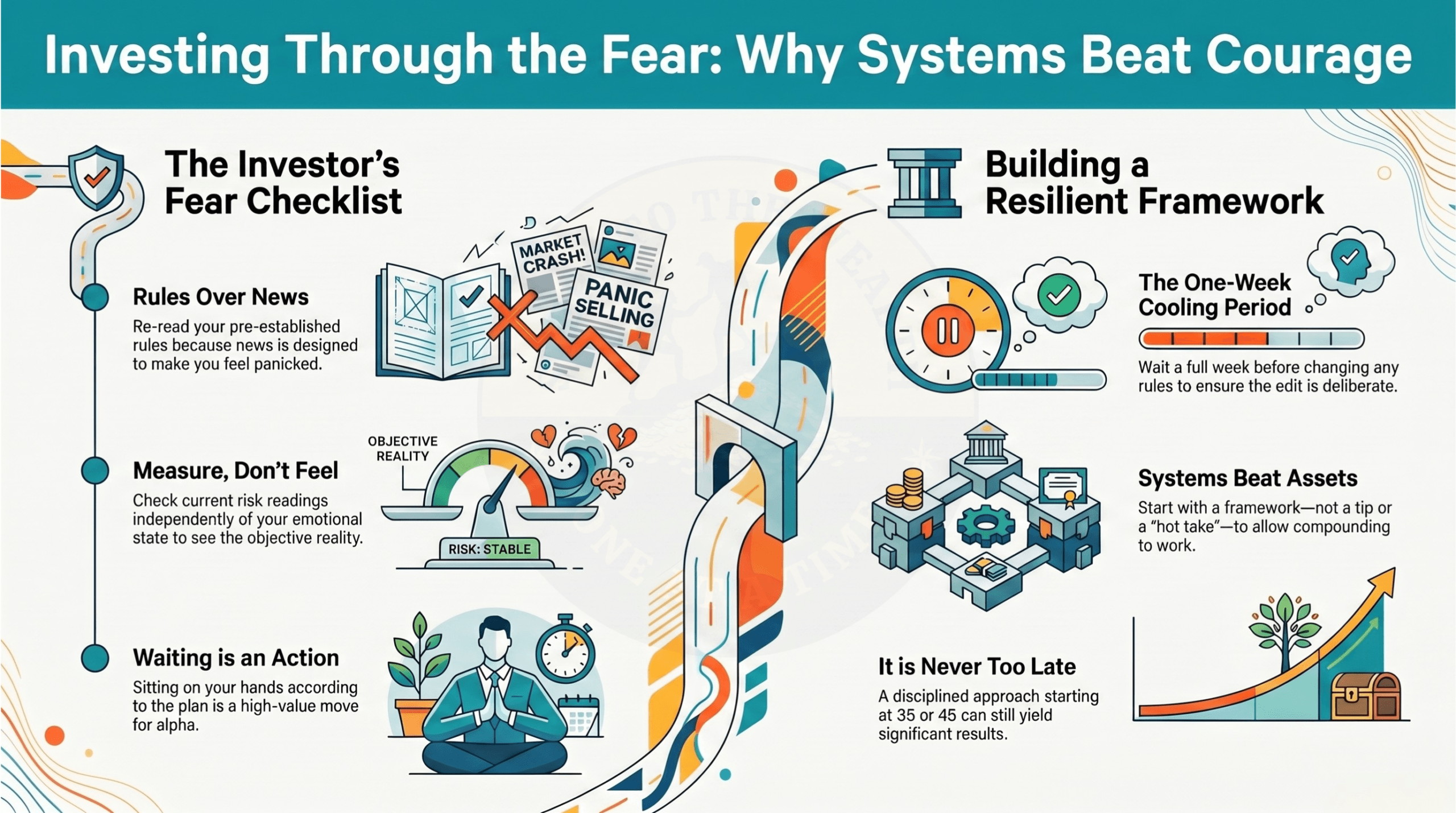
Re-read your rules, not the news. The rules were written when you were calm. The news is written to make you not calm. Pick the better source.
Measure, do not feel. Ask what the current risk reading is, not what the market “feels like.” The reading exists independently of your emotional state. Go and look at it.
Accept that waiting is an action. The hardest part of operating a system is the moments when it says do nothing, and doing nothing feels like weakness. It is not. Doing nothing according to the plan is one of the highest-value moves a long-horizon investor makes. The persistent gap between what funds return and what fund investors actually earn comes largely from people moving in and out at the wrong moments — not from picking the wrong fund.
If you genuinely need to adjust, wait a week. If after a full week of not panicking you still think a rule needs changing, make the change deliberately, write down why, and test it at your quarterly review. Emergency edits to a system usually turn out worse than the thing you were trying to escape.
If you want to see what a real drawdown does to a disciplined plan before you have to live through one, the 2008 financial crisis walk-through runs the numbers month by month, including the part where it looks like the plan is failing.
What this system cannot do
Anything that only tells you what it is good at is selling you something. So here is the other half.
It will not call the top. A risk reading is not a forecast. When risk goes high, the market can keep rising for a year, and you will be sitting there investing less while everyone else looks brilliant. That is the cost of the system, and you should know the price before you buy it.
It will not make you the best-performing investor you know. Sizing down at high risk means giving up some of the top of every cycle. What you get in return is a smaller hole at the bottom and, more importantly, a plan you can still follow when the hole is being dug. Most people do not underperform because their strategy was wrong. They underperform because they stopped executing it.
It will not protect you from a correlated crash. When everything falls together, diversification does much less than the brochure implies — which is the whole argument in why diversification is not protection. What a risk-first approach changes is how much you had deployed when it happened.
It will not remove the discomfort. It converts an unbounded fear into a bounded one. “I might lose everything at the worst possible moment” becomes “I am 40% deployed, my rules say hold, and I have six months of expenses in cash.” Both are uncomfortable. Only one of them is answerable.
If that list makes the system less appealing, that is a fair reaction, and this may not be for you. No hard feelings. It is better to find that out now than three months into a drawdown.
You are not alone, and you are not late
Two more things, because they come up every time.
You are not alone in being scared to start. Most working professionals over 30 feel some version of this. Plenty of them have not started, or started and then stopped in a panic, or have been sitting in cash for years because “the market seems overvalued.” They are not stupid and they are not failing. They just have not been given a framework that accounts for the fear instead of dismissing it.
You are not late either. The math of compounding is more forgiving than the internet makes it sound. A disciplined investor starting at 35 with a systematic approach generally does fine. Starting at 45 is workable if the system is sound and the saving rate is honest. If you want the arithmetic rather than the reassurance, the retirement-savings-by-age breakdown shows what each starting point actually requires. The people who struggle most are the ones who never started, or who started and abandoned the system three months in. You still have time to be in neither group.
What matters most is not when you start. It is what you start with. Start with a system — not an asset, not a tip, not a hot take — and the rest compounds on its own.
The Dynamic DCA Blueprint is free, and it puts the framework on a single page you can keep in front of you. If this article named something you have been feeling but could not articulate, the Blueprint is the next step. You can get it at stepstothewealth.com/newsletter. It comes with the Sunday email, which applies the framework to what the market is actually doing, in plain language, with no predictions.
A system is what you needed. Not more courage.
Frequently asked questions
Is it normal to be scared to invest?
Yes. Most people feel some version of it, especially working professionals who worked hard for the money they would be putting at risk. The fear is not a defect; it is pointing at a real risk — bad timing — that standard “just start investing” advice tends to ignore. A risk-first system addresses the fear directly by giving you measurable rules for when to invest and when to wait.
What is the safest way to start investing when you are afraid?
Start with three things: build an emergency fund first (three to six months of expenses in cash), automate a small monthly contribution into a broad index fund, and commit to a rules-based framework instead of reacting to the news. The combination of a cash buffer, automation, and written rules removes most of the decision points where fear does its damage.
How do I know it is a good time to invest?
This is the wrong question, and asking it is what keeps most nervous investors stuck. The right question is “what is the measurable risk level right now, and what do my rules say to do at that level?” You answer the risk question with data — valuation, breadth, sentiment, or on-chain signals depending on the asset. Then your rules tell you how much to deploy. That replaces an impossible forecasting question with a tractable operational one.
What happens if I lose money after I finally start?
If you are using a diversified index approach with a long horizon, short-term losses are normal and are not a signal to stop. The worst mistake a new investor makes is abandoning the system after the first drawdown, because that is exactly when the next decade of return is being set up. The emergency fund, built before you start investing, is what keeps a temporary drawdown from becoming a forced sale.
How much should I invest as a beginner?
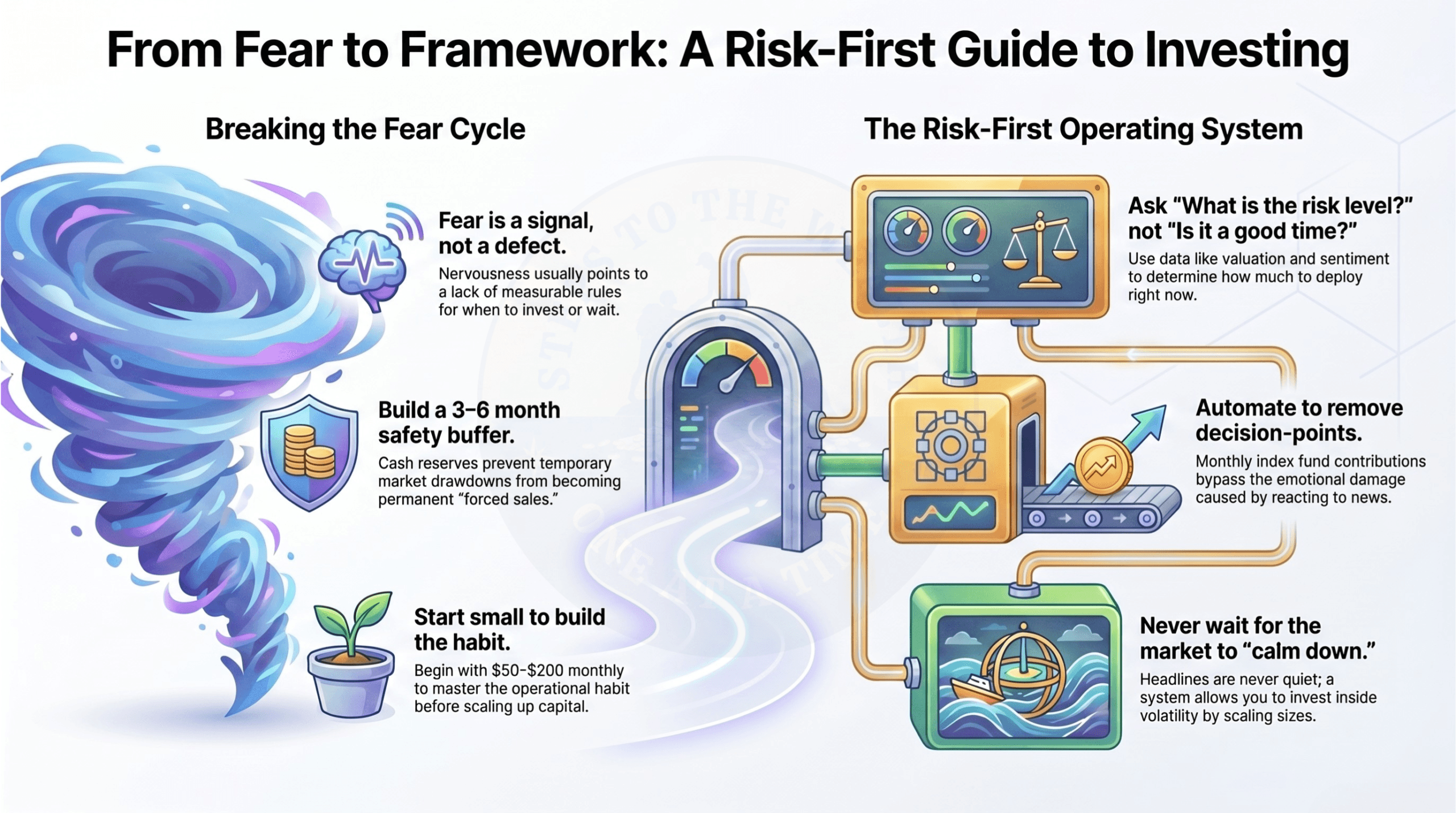
Start with the smallest amount you could lose in full and still be okay, which is often much less than you would assume. For many first-timers that is $50 to $200 a month, automated. The point of starting small is not the amount; it is building the operational habit. You can always scale up. You cannot easily recover from panicking and quitting after starting too big.
Should I wait until the market calms down to start?
Almost always no. Markets calm down in hindsight, not in real time. There is never a moment when headlines are quiet, nobody is predicting a crash, and everyone agrees it is a good time to invest. Waiting for that moment is indistinguishable from never investing. A risk-first system lets you start inside volatility by scaling position size to the risk reading: more at low risk, less at high, paused at extreme.
Does a risk-first system mean market timing?
No, and the distinction matters. Market timing tries to predict what happens next and moves all-in or all-out on that prediction. A risk-first system makes no prediction. It reads a current, measurable condition and adjusts how much you deploy at the margin, while you stay invested. You are changing the size of the next contribution, not betting the portfolio on a forecast.
Educational content only. Not financial advice. All investing involves risk, including the potential loss of principal. Past performance does not indicate future results. Do your own research and consult a qualified professional before making investment decisions.