
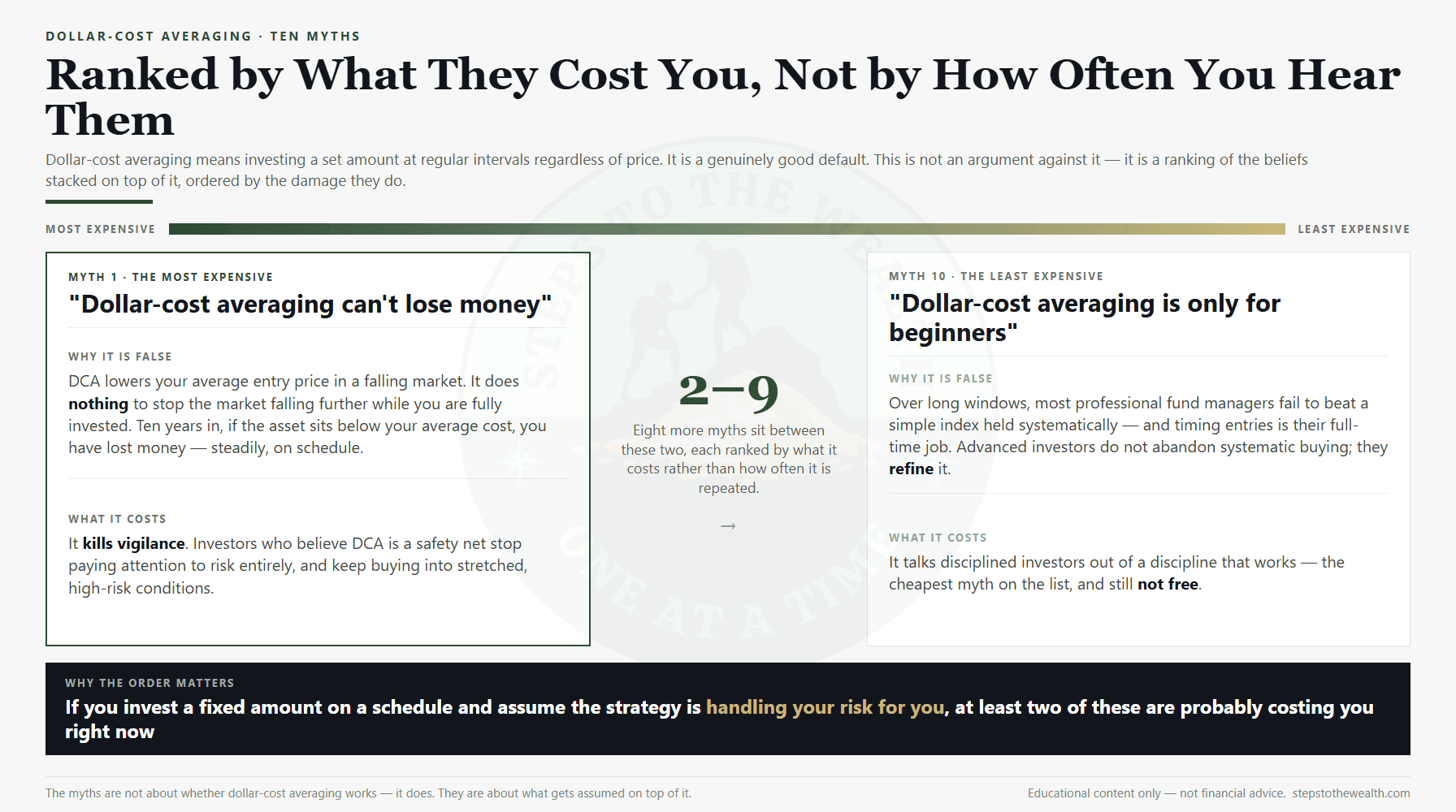
Dollar-cost averaging myths are not equally expensive. Some cost you a little peace of mind. Others quietly drain years of returns or leave you exposed at exactly the wrong moment. This is a ranked list — most costly first — of the misconceptions that do real damage to real portfolios. If you invest a fixed amount on a schedule and assume the strategy is handling your risk for you, at least two of these are probably costing you right now.
Dollar-cost averaging, for the record, means investing a set amount at regular intervals regardless of price. It is a genuinely good default. The myths below are not about whether DCA works — it does — but about the false beliefs stacked on top of it that turn a solid strategy into a blind one.
Myth 1: Dollar-cost averaging can’t lose money
The most expensive dollar-cost averaging myth is the belief that spreading purchases over time protects you from loss. It does not. DCA lowers your average entry price in a falling market; it does nothing to stop the market from falling further while you are fully invested. If you dollar-cost average into an asset for ten years and it is lower at the end than your average cost, you have lost money — steadily, on schedule.
This myth costs the most because it kills vigilance. Investors who believe DCA is a safety net stop paying attention to risk entirely. They keep buying into stretched, high-risk conditions because “averaging always works out.” Sometimes it does. In a prolonged bear market or a single asset that never recovers, it does not. Run the numbers on a real one — what DCA into Bitcoin through the 2021-2022 crash actually did — and the discipline holds up while the account balance still goes red for a long time. DCA is a contribution discipline. It is not a risk discipline. Confusing the two is the costliest mistake on this list.
Myth 2: Fixed-amount DCA manages your risk
The second-costliest myth is believing that because your contribution is automated, your risk is managed. A fixed monthly buy treats a cheap, low-risk market and an expensive, high-risk market exactly the same. It buys the same dollar amount at the top of a bubble as it does at the bottom of a crash. That is not risk management. That is risk indifference.
The two get confused because they look identical from the outside. Both are automatic. Both run without you thinking about them. But automation is about whether you act. Risk management is about how much you commit when you do. A standing order handles the first and is completely silent on the second.
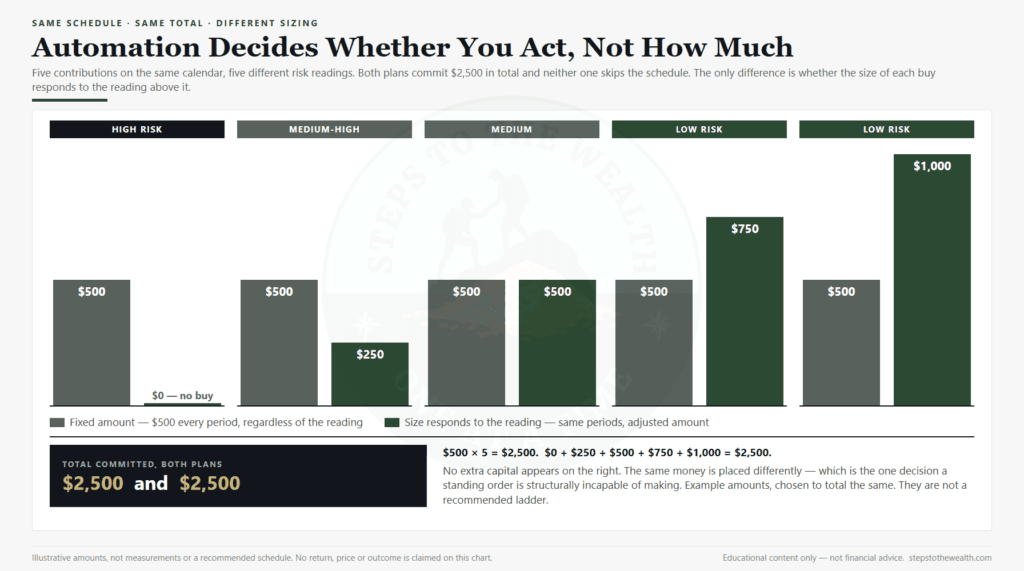
The fix is not to abandon DCA — it is to make it responsive. When the risk reading is low, you lean in and buy more. When risk is high, you slow down or step back. Same schedule, adjusted size. That is the entire difference between fixed and dynamic dollar-cost averaging, and it is where most of the money in this article is sitting.
Myth 3: Varying your size is just market timing in disguise
This one is ranked third because it is the objection that blocks the fix for the myth above. Tell someone their fixed contribution ignores risk and the reply is usually: “if I adjust based on conditions, isn’t that just market timing?”
It conflates two very different things.
Market timing means predicting where prices go next. The classic version: “I think this drops, so I’ll sell and buy back lower.” The failure mode is being wrong about the prediction — and you find out you were wrong after the money has moved.
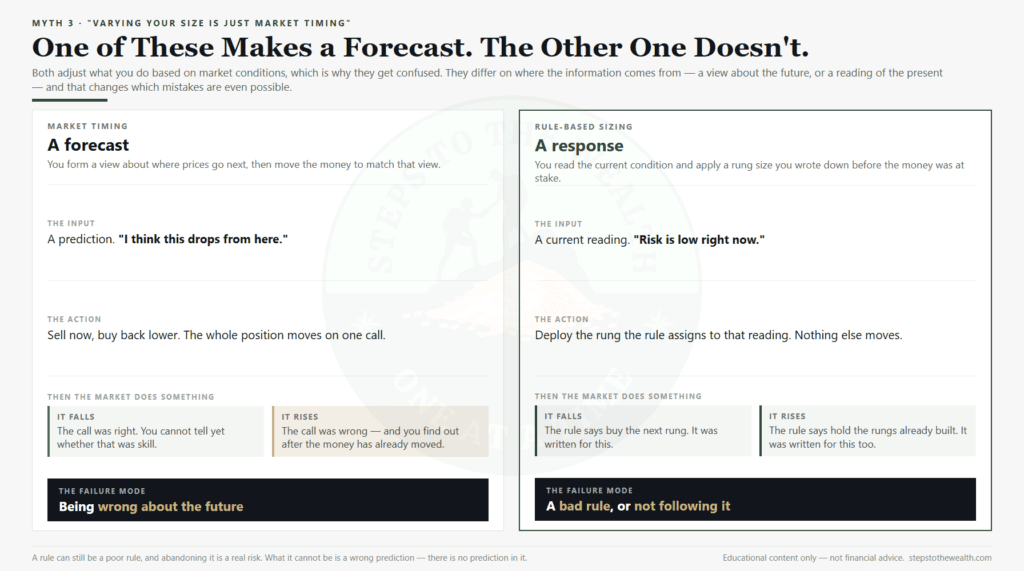
Varying your rung size predicts nothing. It reads current conditions and applies a rule you wrote in advance. At a low risk reading, deploy a larger rung. At an elevated reading, pause. If the market falls further after you buy, the rule says buy the next rung. If it rises instead, the rule says hold what you have built. The rule never forecasts. It responds.
That distinction is not semantic. It changes which mistakes are even possible. There is no prediction in a rule-based ladder, so there is no prediction to be wrong about — the rule executes the same way regardless of which direction the market goes next. What you are on the hook for is the quality of the rule and whether you actually follow it. That is a real risk. It is just not the same risk as calling a top.
Myth 4: Once you’ve bought in, you’re done
The implicit framing is that DCA is the buying phase, and after that you hold and wait. For some assets, that is structurally fine — a broad index inside a long-horizon retirement account genuinely does not need you to touch it.
For everything else, “buy and hold forever” quietly turns into “give it all back and start over.” Single positions, crypto, growth stocks and sector bets all go through drawdowns deep enough that a paper gain accumulated over three years can disappear in three months. If you never harvest anything, the only thing you ever own is the round trip.
The symmetrical version of a DCA plan has an exit ladder that mirrors the entry ladder. As risk readings climb, you trim in rungs — not all at once, not on a call about the top, just the same mechanical stepping you used on the way in. Some capital comes off the table, and it sits ready for the next favorable window.
This costs a lot precisely because it feels like discipline. Holding through everything sounds like the mature choice, and it is the correct choice for the index in your pension. Applied indiscriminately to volatile positions, it is not patience. It is the absence of a plan for the second half of the cycle.
Myth 5: You should DCA into any single stock the same way you DCA into an index
Averaging into a single stock and averaging into a broad index carry completely different risks, and treating them identically is an expensive error. An index is a portfolio of hundreds of companies that survives the failure of any one of them. A single stock can go to zero and stay there — and no amount of averaging down saves you from a company that is genuinely broken.
Dollar-cost averaging works because, historically, broad markets recover. That logic does not automatically transfer to an individual name. Averaging into a declining single stock can just be throwing more money at a losing position — the difference between disciplined investing and a sunk-cost reflex wearing a strategy’s clothing. Know which one you are doing.
The structural fix is not to avoid single positions. It is to cap them: decide in advance the most capital any one position is ever allowed to absorb, and let the ladder run inside that ceiling. Concentration is what turns a bad position into a portfolio event. If you have never checked how your allocation behaves when one holding breaks, the portfolio stress test shows you the shape of it.
Myth 6: Lump-sum investing always beats dollar-cost averaging
There is a myth in the other direction, popular with the technically-minded: that since markets rise more often than they fall, lump-sum investing mathematically beats DCA every time, so DCA is irrational. The math is right about the average. It is wrong about the human — and it is often answering a question you were never asked.
Lump-sum does win on average, because time in the market usually pays — Vanguard’s research on cost averaging is the standard reference for that finding. But “on average” hides the outcome that actually breaks people: putting everything in right before a deep drop and never contributing again out of fear. DCA is partly a returns strategy and partly a behavioral one — it keeps you investing through fear instead of freezing. A strategy you can actually execute beats an optimal one you abandon.
There is also a framing problem underneath the comparison. Lump-sum-versus-DCA assumes you are holding a large pile of cash and deciding how fast to deploy it. Most working professionals are not in that situation. They are deploying income as it arrives — a paycheck every two weeks, not a windfall.
In that case the choice is not “lump sum or spread it out.” It is “invest the money as it lands, or sit on it hoping for a better entry.” The research finding is real, and it simply does not apply to the decision most people are actually making. The honest comparison, for the case where you do have the pile, lives in lump sum vs. DCA — and the answer depends on your capital and your temperament, not on a spreadsheet alone.
Myth 7: You should stop DCA when the market is high
The instinct to pause contributions because “the market feels too high” is one of the more seductive myths, because it sounds like prudence. In practice it is market timing in disguise, and it usually backfires. “Too high” markets have a long history of going higher, and investors who sit in cash waiting for a pullback frequently watch the pullback arrive from a level well above where they stopped buying.
There is a real version of this idea — scaling back when a measured risk reading is elevated, not when the market merely feels expensive. The distinction is everything, and it is the same distinction as myth 3: one is a rule tied to data, the other is a feeling tied to a headline. Only one of them survives contact with a real cycle. If you have ever bought near a top or frozen near a bottom, you already know which one your gut prefers.
Myth 8: Dollar-cost averaging caps your upside
The assumption behind this one: lump-sum captures the full move, while DCA only gets a fraction of it because part of your capital goes in at higher prices. Ranked eighth because it is expensive in a narrow way — it talks people out of starting at all, on a premise that only holds in one specific world.
That world is the one where the market goes straight up from the moment you begin. There, yes, every later purchase is a worse purchase, and spreading them out costs you. Add any meaningful drawdown inside the deployment window and the arithmetic changes, because some of those later purchases land at lower prices than your first one.
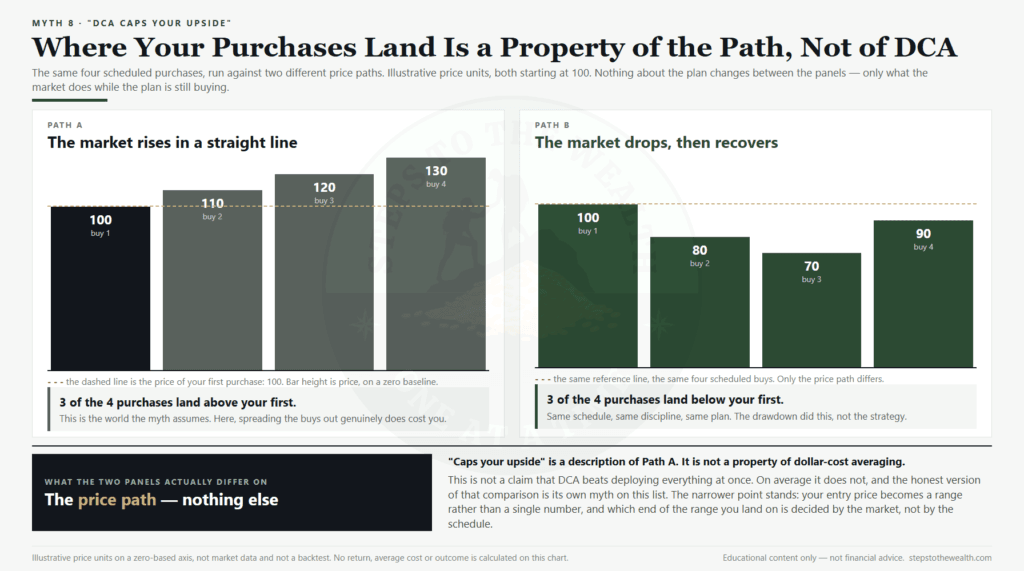
Real market history is full of those drawdowns. Indices give up 20-40% with some regularity, and individual assets and crypto do far worse. DCA into the S&P 500 through the 2008 financial crisis is the clean illustration: the contributions made during the decline are the ones that carried the recovery.
Be precise about what this does and does not say. It does not say DCA beats lump-sum — myth 6 above is the honest version of that comparison, and the average still favors deploying early. What it says is narrower and more useful: “caps your upside” is not a property of DCA. It is a property of one price path. Your entry price becomes a distribution rather than a single number, and whether that distribution helps or hurts depends on what the market does while you are still buying.
Myth 9: The frequency of your DCA matters a lot
Many investors agonize over whether to buy weekly, monthly, or quarterly, believing the choice materially changes their returns. Over long horizons, it barely moves the needle. The difference between weekly and monthly contributions on the same total capital is measured in fractions of a percent — noise next to the decisions that actually matter.
This myth is expensive not in dollars but in attention. Time spent optimizing frequency is time not spent on the things that do matter: your total savings rate, whether your buying responds to risk, and whether you keep going for decades. Pick a frequency you will stick to and move on. The calendar is not where the money is made.
Myth 10: Dollar-cost averaging is only for beginners
The final myth is that DCA is a training-wheels strategy you graduate from once you get sophisticated. The framing is that real investors time their entries, and systematic buying is what you do until you learn how.
The evidence points the other way. The long-running scorecards that measure active fund managers against their benchmarks tell a consistent story: over long windows, the large majority of them fail to beat a simple index held systematically. These are people whose entire job is getting entries right. They have better data, faster execution and more analyst hours than any retail investor will ever have, and most of them still lose to a mechanical approach over a decade.
If full-time professionals cannot reliably time entries, the working professional with thirty minutes a week is not about to either. That is not an insult. It is a structural fact about how hard the problem is, and the correct response to a problem that hard is to stop trying to solve it by hand.
So the graduation runs in the opposite direction. Automating your contributions removes the single biggest source of error in investing — the human making emotional decisions in the moment. The most disciplined investors do not abandon systematic buying as they get more advanced. They refine it, layering a risk-based overlay on top so the size adjusts, while the underlying discipline stays automatic. Sophistication is not doing more complicated things by hand. It is building a system reliable enough that you can walk away and let it run. Ranked last here because it costs the least in dollars — but it is the myth most likely to talk a good investor out of a good strategy.
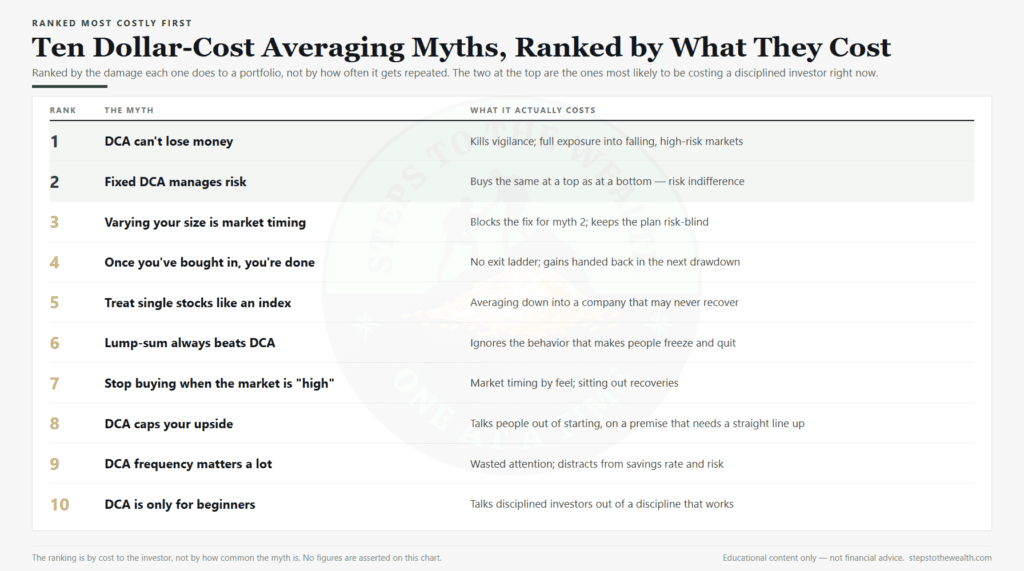
Dollar-cost averaging myths, ranked at a glance
| Rank | Myth | What it actually costs |
|---|---|---|
| 1 | DCA can’t lose money | Kills vigilance; full exposure into falling, high-risk markets |
| 2 | Fixed DCA manages risk | Buys the same at a top as at a bottom — risk indifference |
| 3 | Varying your size is market timing | Blocks the fix for myth 2; keeps the plan risk-blind |
| 4 | Once you’ve bought in, you’re done | No exit ladder; gains handed back in the next drawdown |
| 5 | Treat single stocks like an index | Averaging down into a company that may never recover |
| 6 | Lump-sum always beats DCA | Ignores the behavior that makes people freeze and quit |
| 7 | Stop buying when the market is “high” | Market timing by feel; sitting out recoveries |
| 8 | DCA caps your upside | Talks people out of starting, on a premise that needs a straight line up |
| 9 | DCA frequency matters a lot | Wasted attention; distracts from savings rate and risk |
| 10 | DCA is only for beginners | Talks disciplined investors out of a discipline that works |
Turn blind DCA into risk-based DCA
Most of these myths share one root: treating dollar-cost averaging as a set-and-forget habit instead of a system that responds to risk. The fix is a weekly risk reading that tells you when to lean in and when to ease off — same schedule, adjusted size.
That reading is what Steps To The Wealth Weekly delivers every Sunday, across five major assets, with the action each risk level calls for.
No predictions. No hype. Just the number that turns fixed DCA into dynamic DCA.
Frequently asked questions
Can you lose money with dollar-cost averaging?
Yes. Dollar-cost averaging lowers your average purchase price in a falling market, but it does not prevent losses if the asset keeps declining or never recovers. DCA is a contribution discipline, not a guarantee against loss — the belief that it can’t lose is the most expensive myth about the strategy.
Is adjusting how much you invest based on risk the same as market timing?
No. Market timing means predicting where prices go next, and its failure mode is being wrong about the prediction. Adjusting your contribution size based on a current risk reading applies a rule written in advance — it responds to conditions rather than forecasting them, so there is no prediction to be wrong about.
Is dollar-cost averaging better than investing a lump sum?
On average, lump-sum investing tends to outperform because markets rise more often than they fall. But DCA is also a behavioral strategy — it keeps you investing through fear instead of freezing after a big drop. And if you are deploying a paycheck rather than a lump of cash, the comparison does not apply to your situation at all.
Does dollar-cost averaging limit how much you can make?
Only if the market rises in a straight line for the whole time you are buying. Once there is a drawdown inside your deployment window, some contributions land at lower prices. DCA turns your entry price into a range rather than a single number — that is not a cap, though it does mean the average still favors deploying early when you already hold the full amount.
Do I ever stop dollar-cost averaging and just hold?
For a broad index in a long-horizon retirement account, holding is structurally fine. For volatile single positions, buy-and-hold-forever means riding every drawdown down with no mechanism for harvesting gains — which is why a complete plan has an exit ladder that trims in steps as risk rises, mirroring the entry ladder.
Does it matter if I dollar-cost average weekly or monthly?
Over long horizons, the frequency makes very little difference — often a fraction of a percent. Your total savings rate, whether your buying responds to risk, and whether you keep going for decades matter far more than the calendar interval you choose.
Should I stop dollar-cost averaging when the market is high?
Not based on a feeling that the market is “too high” — that is market timing in disguise and usually backfires. Scaling back based on a measured, elevated risk reading is different: one is a rule tied to data, the other is a reaction to a headline.
Is dollar-cost averaging only for beginners?
No. Over long windows, most professional fund managers fail to beat a simple index held systematically — and timing entries is their full-time job. Advanced investors do not abandon systematic buying; they refine it, adding a risk-based overlay that adjusts the size while keeping the discipline automatic.
Educational content only — not financial advice. Examples and historical figures are for illustration and do not predict future results.