
Somewhere in a banking app is a standing order you set up years ago. It moves the same number into the same fund on the same day of every month, and it has been doing it faithfully since the day you created it. That reliability is the entire point. It is also the problem.
The number has not moved. Your income has. The plan you built when you earned one salary is still being funded at the rate that salary could afford, and nothing in the system will ever tell you otherwise. A standing order has no opinion about whether it is still the right size. It only knows how to repeat.
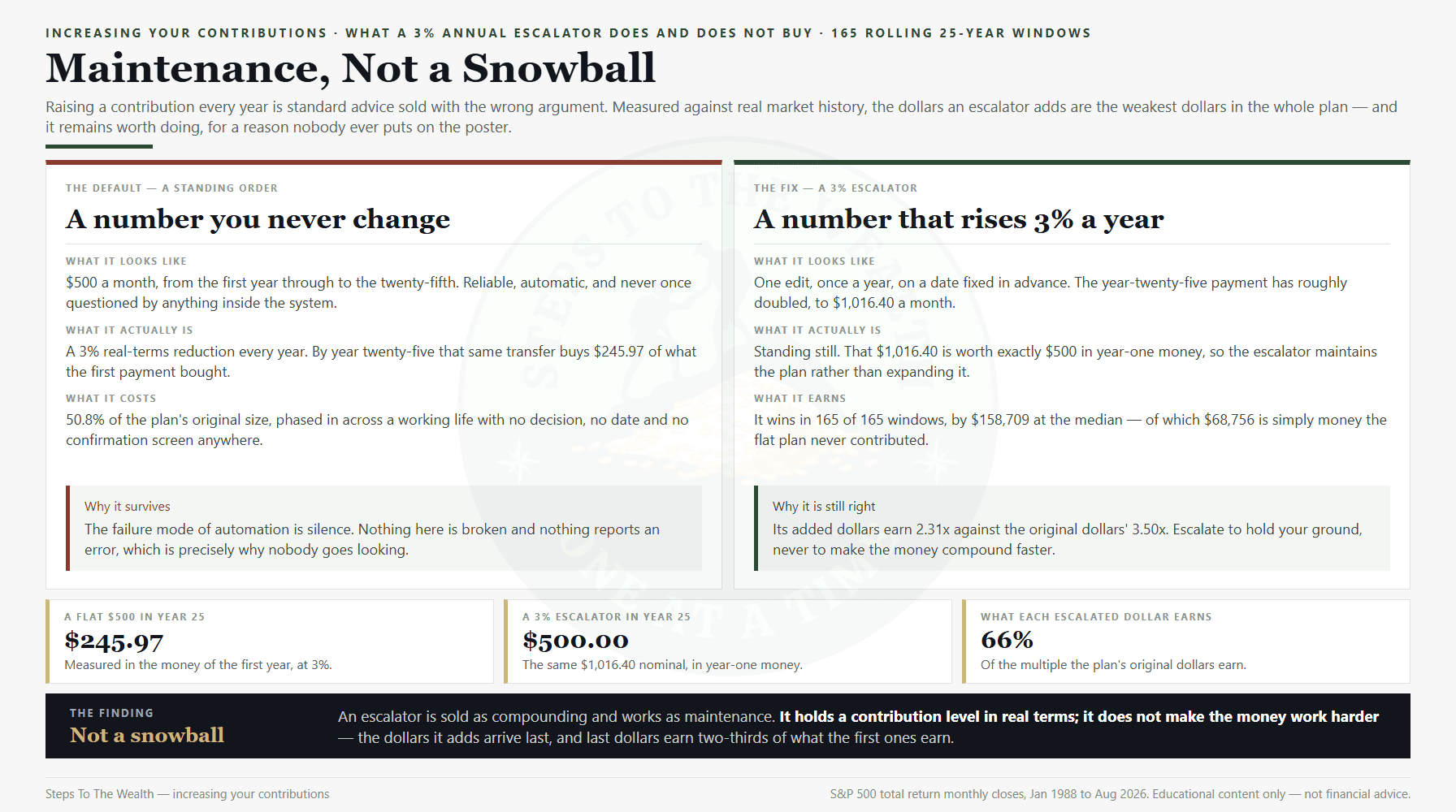
Increasing your contributions on a schedule — a fixed percentage, once a year, without a decision — is the standard fix, and it is usually sold with the wrong argument. The pitch is compounding: raise the amount, and the extra money snowballs. That argument is not quite false, but it is close enough to false to be worth dismantling, because the dollars an escalator adds are the weakest dollars in the entire plan.
This article prices the escalator against real market data, on identical money and then on the money people actually contribute. The result is not the one the pitch implies, and the honest reason to escalate turns out to be a different reason entirely.
Educational content only. Not financial advice.
A flat contribution is not a flat commitment
Start with what a fixed number does on its own, before any market is involved. A contribution of $500 a month is a promise to hand over a certain amount of purchasing power. The dollars stay the same. The purchasing power does not.
At 3% inflation, the $500 you send in year ten buys what $383.21 bought in year one. In year twenty it buys $285.14 worth. By year twenty-five it buys $245.97 worth — 49.2% of what the original payment was worth. You did not decide to halve your contribution. You decided nothing at all, which is exactly how it happened.
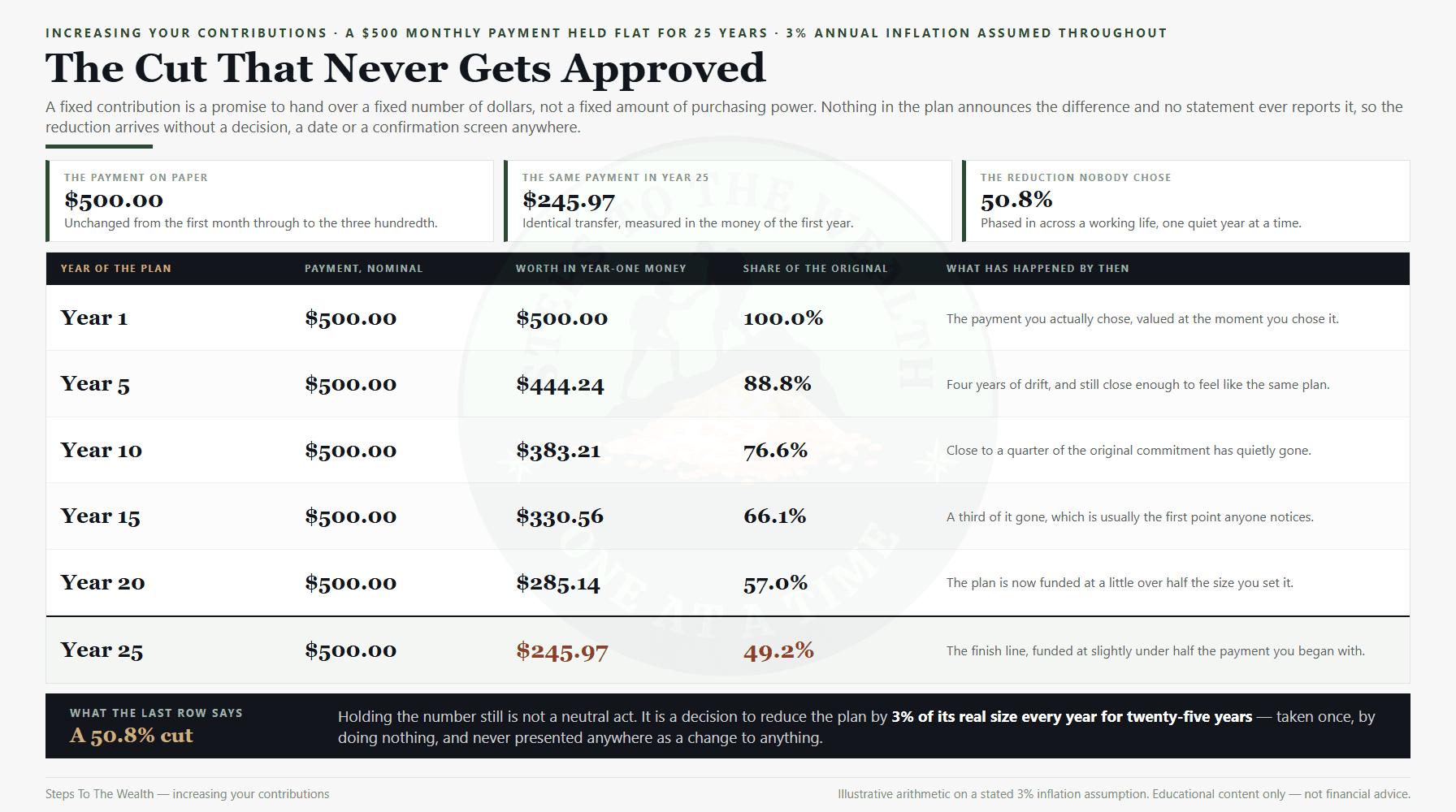
Read that as a schedule of cuts, because that is what it is. A flat plan phases in a 51% reduction over a working life and never once presents it as a change. There is no notification, no confirmation screen, no moment where you approve it. The only event is the absence of an event.
The mirror image is just as clean. A payment that rises 3% a year is not rising at all in the sense that matters — it is standing still. On a 3% escalator, the year-twenty-five payment of $1,016.40 is worth exactly $500 in year-one money. Doubling the nominal number over twenty-five years buys you the right to keep making the same contribution you started with.
That reframing matters before any arithmetic, because it decides what the escalator is for. It is not an upgrade to the plan. It is the maintenance the plan needs to stay the size you originally chose. Anything above 3% is the actual upgrade, and it should be argued for separately.
Increasing your contributions: the experiment that removes money from the question
The obvious comparison — a rising plan against a flat one — is contaminated, because the rising plan contributes more money. Of course it ends with more. Asking whether it wins is asking whether $218,755 beats $150,000, and that question answers itself without any market data.
The question worth asking is narrower and much more interesting. Holding the money identical, does the shape of the schedule matter? Three plans, each paying in exactly $150,000 over twenty-five years, differing only in how that money is distributed across the decades:
- Falling. Start at $703.53 a month and reduce the payment by 3% every year. The year-twenty-five payment is $338.69.
- Flat. $500.00 a month, unchanged for three hundred months.
- Rising. Start at $342.85 a month and raise the payment by 3% every year. The year-twenty-five payment is $696.94.
Every plan buys the same fund on the same dates. Every plan ends on the same day. The three totals are identical to the cent. Any difference in the ending balance is therefore purely a question of when each dollar arrived, never how many dollars there were.
The test ran on S&P 500 total return monthly closes across 165 rolling twenty-five-year windows, the first starting January 1988 and the last ending August 2026. A rolling window is the honest way to run this: it prevents a single lucky or unlucky start date from deciding the answer, and it lets the result be stated as a count of windows rather than as an average nobody experienced.
The shape decides a quarter of the outcome
The three plans do not land anywhere near each other.
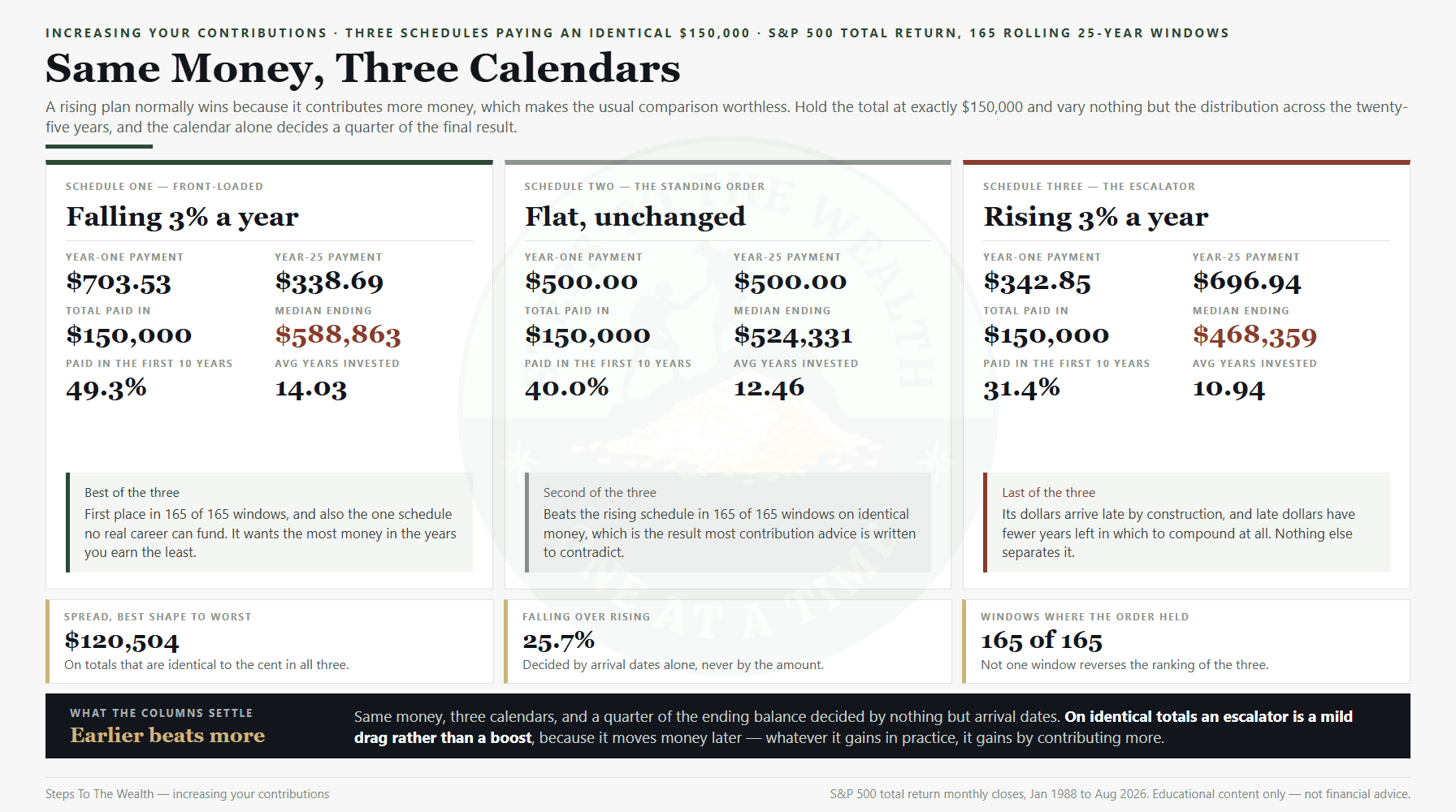
The falling schedule finishes at a median of $588,863. The flat schedule finishes at $524,331. The rising schedule finishes at $468,359. That is a spread of $120,504 on identical money — 25.7% between the best shape and the worst, decided entirely by the calendar.
And the ordering is not a quirk of the median. Falling beat flat in 165 of 165 windows. Flat beat rising in 165 of 165 windows. Across thirty-eight years of history containing two of the worst drawdowns on record, there is not one twenty-five-year window in which the ranking reverses.
This is not a probabilistic edge. It is the mechanical consequence of compounding: a dollar contributed in year one has twenty-five years to work, and a dollar contributed in year twenty-five has none. The figure puts a number on it: averaged across every dollar contributed, the falling plan keeps its money invested for 14.03 years, the flat plan for 12.46, and the rising plan for 10.94. That one number is the entire ranking.
Which produces the genuinely uncomfortable finding. The shape that wins is the shape nobody can run. The falling plan requires a twenty-five-year-old to find $703.53 a month and permits a fifty-year-old to pay $338.69. Real income does the opposite. Careers pay least at the start, when the compounding is worth most, and most at the end, when it is worth least. The optimal schedule and the affordable schedule point in opposite directions across an entire working life.
That is not a reason to attempt the falling plan. It is a reason to stop believing that an escalator is where the compounding comes from. Measured against a flat plan on the same money, escalating is a mild drag on the ending balance, not a boost. The flat schedule beat the rising one by 12.0%.
What the extra dollars actually earn
So why does anyone escalate? Because in practice you are not holding the money constant. You are comparing $500 a month flat against $500 a month rising 3%, and the second one contributes more.
Over twenty-five years, the flat plan pays in $150,000 and the escalating plan pays in $218,756 — an extra $68,756. The median ending balances are $524,331 and $683,040, a gap of $158,709. The escalating plan wins in 165 of 165 windows, which is what you would expect from a plan that contributes 46% more money.
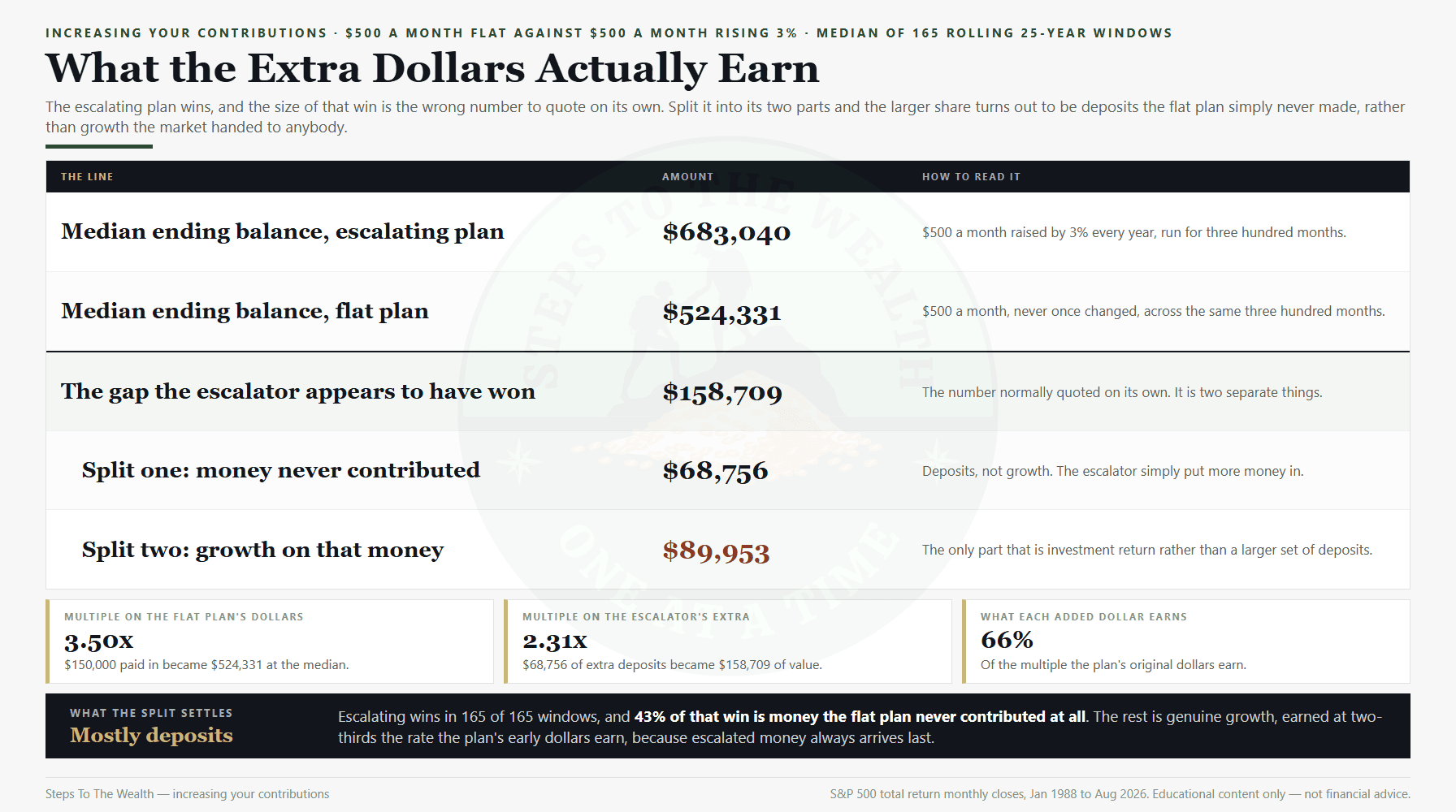
Now split that gap, because a single number here would mislead. Of the $158,709, exactly $68,756 is money the flat plan never contributed. That part is not investment growth. It is deposits. Only the remaining $89,953 is what those extra deposits grew into on top of themselves.
Which lets you price the escalated dollars properly. The flat plan turned $150,000 into $524,331, a multiple of 3.50x. The escalator’s extra dollars turned $68,756 into $158,709, a multiple of 2.31x. Every dollar the escalator adds earns 66% of the multiple that the plan’s original dollars earn.
That is the honest headline, and it is a third of the way down from where the usual pitch puts it. Escalated dollars arrive late by construction — the year-twenty increment has five years to work, not twenty-five — so they compound less than every dollar you contributed before them. Any compound interest calculator will show the same shape: the term, not the deposit, is what the multiple is made of. The escalator is not a lever on returns. It is a lever on deposits that happens to be attached to a plan that grows.
The real reason to escalate anyway
All of which leaves the practical case intact, but built on completely different ground. Three reasons survive the arithmetic, and none of them is compounding.
It stops the plan shrinking. This is the first section’s point, and it is the strongest one. A flat contribution held for twenty-five years is a contribution that ends at 49.2% of its original size in real terms. A 3% escalator does not grow the plan; it holds it still. If you would not accept a letter announcing that your monthly investment was being cut in half over the next two decades, you should not accept the flat number that produces the identical result silently.
It captures raises before they become spending. The gap between what you earn and what you contribute is where the whole thing lives, and that gap closes on its own every time income rises and the standing order does not. Lifestyle creep is the behavioural half of this: the raise lands, the baseline absorbs it, and the savings rate quietly falls even though the dollars saved went up. An escalator set in advance is the mechanical half, and it works precisely because it does not require a decision at the moment the money arrives.
It removes a recurring judgement call. An annual “should I raise it, and by how much?” is a decision you will make twenty-five times, badly, under whatever conditions happen to obtain that year. A rule set once is made once, in calm. This is the same logic that makes rules-based investing work at all: the value is not that the rule is optimal, it is that the rule survives the year in which you would not have chosen it.
Notice what is missing from that list. Nothing about beating the market, nothing about a snowball, nothing about the extra money working harder than the original money. It demonstrably works less hard. The case for escalating is a case about maintaining a commitment, and it holds up perfectly well without the exaggeration.
Setting an escalator that actually survives
The rule needs to be specific enough to execute without you. Four decisions make it one.
Pick the rate against a purpose, not a feeling. Roughly 3% a year holds the contribution flat in real terms — that is maintenance. Above that is genuine expansion of the plan and should be justified by something real, usually a step change in income rather than an ambition. Below 3% is a managed decline, which is a legitimate choice if you know you are making it.
Define it as a percentage of income where you can. A contribution expressed as a share of what you earn escalates on its own, without an annual step, and it tracks your actual capacity rather than an assumed inflation rate. A fixed dollar amount needs the annual step precisely because it has no relationship to your income at all.
Fix the date before you need it. One date, once a year, ideally the month your pay changes. An escalator with no scheduled date becomes an escalator you perform when you remember, which is an escalator you perform for three years. If you already run an investor calendar, this belongs in the annual session, next to the other structural decisions rather than among the fast ones.
Set the floor, not the ceiling. The failure mode is an escalator you eventually cannot pay, which ends with the whole standing order cancelled rather than reduced. Size the starting payment so that twenty-five years of 3% is survivable on a pessimistic income path, and treat anything above it as a separate, discretionary top-up. A plan you can keep at 80% of its intended size beats a plan you abandon at year eight, and the arithmetic above says exactly how much those early years were worth.
If your income does not arrive in equal monthly pieces, the escalator is a different job and the sizing question comes first — that case is worked through separately in investing with variable income, which prices the same money paid on different calendars within a single year.
The honest limits of this result
Four things this measurement does not establish, stated plainly.
It is one index over one history. Every window comes from S&P 500 total return data between January 1988 and August 2026 — a period that contains two severe drawdowns but also a strong long-run upward drift. The 165 windows overlap heavily and are not 165 independent experiments. The shape ranking is mechanical enough that it would survive a different sample; the specific multiples are not.
The 3.50x and 2.31x are medians, not promises. Across the 165 windows the flat plan ended anywhere between $419,536 and $902,334 on the same $150,000. That is the actual spread of outcomes, and it is far wider than the difference between any two contribution shapes. Which sequence of returns you happen to get matters more than which schedule you choose — a point worked through in sequence of returns risk.
The inflation rate is an assumption. 3% is a round working figure, not a forecast, and every “real terms” number here inherits it. Run the same logic at 2% and the flat plan’s twenty-five-year erosion is to 61%, not 49.2%. The direction never changes; only the size does. If you are converting between nominal and real anywhere in your own plan, the conversion itself has a trap in it, covered in inflation vs nominal returns.
A rising plan being a drag on the ending balance does not make it wrong. It makes the compounding argument wrong. Given a real income that starts low and rises, an escalator is the closest achievable approximation to a schedule you cannot run, and it contributes more money than the alternative. Both things are true at once, and only the second one shows up in the ending balance.
It is also worth checking the plan against the target rather than against itself. An escalator that keeps a contribution flat in real terms still leaves you short if the target was always out of reach — the arithmetic of that mismatch is the subject of goal plan mismatch, and it is a different failure from the one on this page.
Frequently asked questions
Should I be increasing my contributions every year?
If you want the plan to keep the size you originally chose, yes — roughly 3% a year holds a fixed contribution flat in real terms, and doing nothing produces a 51% real-terms cut over twenty-five years. Just do not expect the increase to transform the ending balance through compounding. On the measurement above, the added dollars earn 66% of the multiple your original dollars earn, because they arrive late.
Is it better to contribute more now or increase later?
More now, decisively and by a large margin. On identical total money, a falling schedule beat a flat one in 165 of 165 windows and a flat one beat a rising one in 165 of 165 windows, a spread of $120,504 between best and worst. Early dollars have more years to work. If you have the capacity to front-load, the arithmetic strongly favours it — the constraint is almost always income, not information.
What percentage should I increase my contribution by?
Roughly 3% keeps the contribution level in real terms at a 3% inflation assumption. Anything above that expands the plan and should be tied to a real change in income rather than to an aspiration. Anything below it is a slow reduction, which is a defensible choice as long as it is a choice.
Does a percentage of income work better than a fixed increase?
Usually, for a reason that has nothing to do with returns. A percentage escalates automatically with your actual capacity and never needs an annual step, so it cannot be forgotten. A fixed dollar amount has no relationship to your income and therefore needs the manual increase precisely because nothing else will move it.
What if I cannot afford to increase it this year?
Then hold it and restart the escalator next year, rather than cancelling the standing order. The measurement above says the early years carry disproportionate weight, so protecting continuity is worth more than protecting the escalation schedule. A paused increase costs you a fraction of a plan; an abandoned plan costs you all of it.
Does increasing contributions beat investing a lump sum?
They answer different questions. An escalator is about the size of a recurring commitment over decades; a lump sum is about deploying money you already hold. If you have a sum sitting in cash right now, that is a separate decision with its own arithmetic, covered in lump sum vs DCA.
The check worth running this week
Open the standing order and look at two things: the number, and the date you set it. If the date is more than two years old and the number has not changed, you are running a plan that has been quietly reduced every year since, by an amount nobody ever showed you.
The fix is one edit and one calendar entry. Raise the amount by roughly 3%, and write down the month you will do it again. That is the entire mechanism — and if you want to see what the change is worth on your own numbers rather than the ones modelled here, the DCA simulator takes a contribution and a horizon and shows the path.
Just be honest with yourself about what the edit buys. It is not a snowball. It is the difference between a plan that stays the size you chose and a plan that halves itself while you watch it run perfectly.
Educational content only — not financial advice. Historical figures are illustrative and do not predict future results.