
There has never been more investing content available. Channels with millions of subscribers, newsletters with excellent typography, threads, courses, communities, signal services. If access to information decided returns, retail investors would be having their best decade on record.
They are not. So the interesting question about investing education is not whether there is enough of it. It is why so much of it can be consumed for years without changing anything, and the answer is not that the people making it are stupid or dishonest. It is that almost none of it is paid by your outcome.
What follows is the arithmetic of that, and a filter you can apply to any source — including this one.
Investing Education Has an Incentive Problem, Not a Quality Problem
Most critiques of financial content argue that it is wrong. That is the weaker claim and it is easy to dismiss, because plenty of it is factually fine.
The stronger claim is structural. Almost all of it is funded by attention, and attention is not the same thing as your result. A piece can be accurate, well-researched, generous with its detail, and still be optimised for something that has nothing to do with whether you end up wealthier.
You do not need to assume bad faith anywhere for this to hold. You only need to look at how the money moves.
How the Content Actually Gets Paid
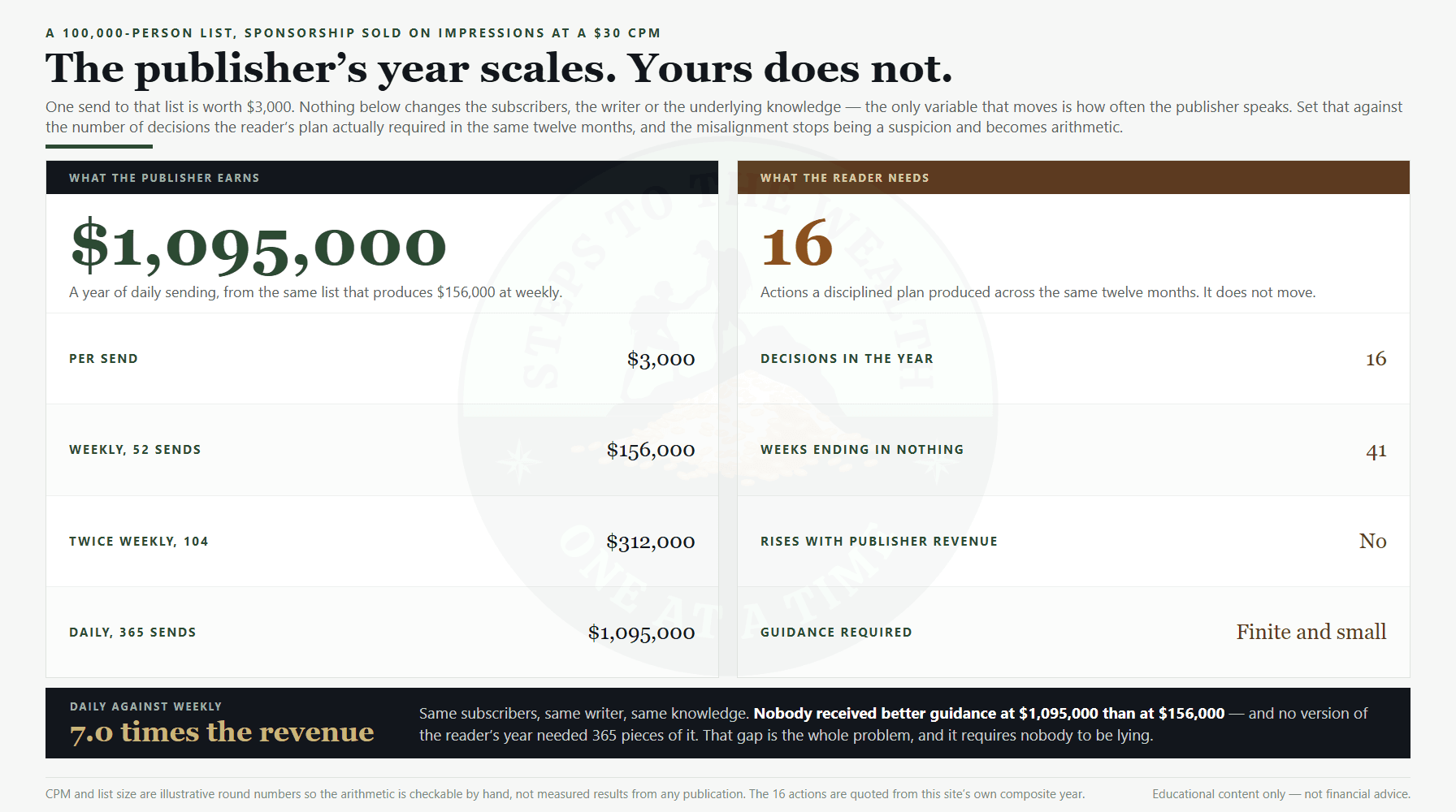
Take a newsletter with 100,000 subscribers monetised the ordinary way, through sponsorship sold on impressions. At a $30 CPM, one send to that list is worth $3,000.
Publish weekly and that is 52 sends, or $156,000 a year. Publish twice a week and it is $312,000. Publish daily and it is 365 sends, or $1,095,000 — 7.0 times the weekly figure, from exactly the same list, the same subscribers and the same underlying knowledge.
Nothing about the readers changed in those three scenarios. Nobody got better advice at $1,095,000 than at $156,000. The only variable that moved was how often the publisher spoke.
Now put the reader’s side next to it. In the composite year worked through in what an average investing year actually contains, a disciplined plan produced 16 actions across twelve months. That number does not rise when the publisher’s revenue does. There is no version of the reader’s year that needs 365 pieces of guidance.
That gap is the whole problem, and it does not require anybody to be lying.
What Frequency Funding Optimises For
Once revenue scales with frequency, three things follow automatically.
There must always be something to say. A publisher who tells you honestly that this week contained nothing worth acting on has produced a piece nobody shares and an inventory slot worth less than the last one. Do that consistently and the business shrinks. The commercially rational move is to find something in every week, whether or not the week contained it.
Novelty beats repetition. The correct advice for most people barely changes year to year, which makes it terrible content. You cannot build an audience on a message that was complete the first time you said it, so the incentive is to keep finding new framings, new indicators, new regimes — motion that reads as insight.
Certainty outperforms calibration. “This is likely, and here is what would make me wrong” is a weaker hook than a clean call. Calibrated language costs attention, so the market selects for confidence, and confidence is cheap to produce because it costs nothing to be wrong in public at scale.
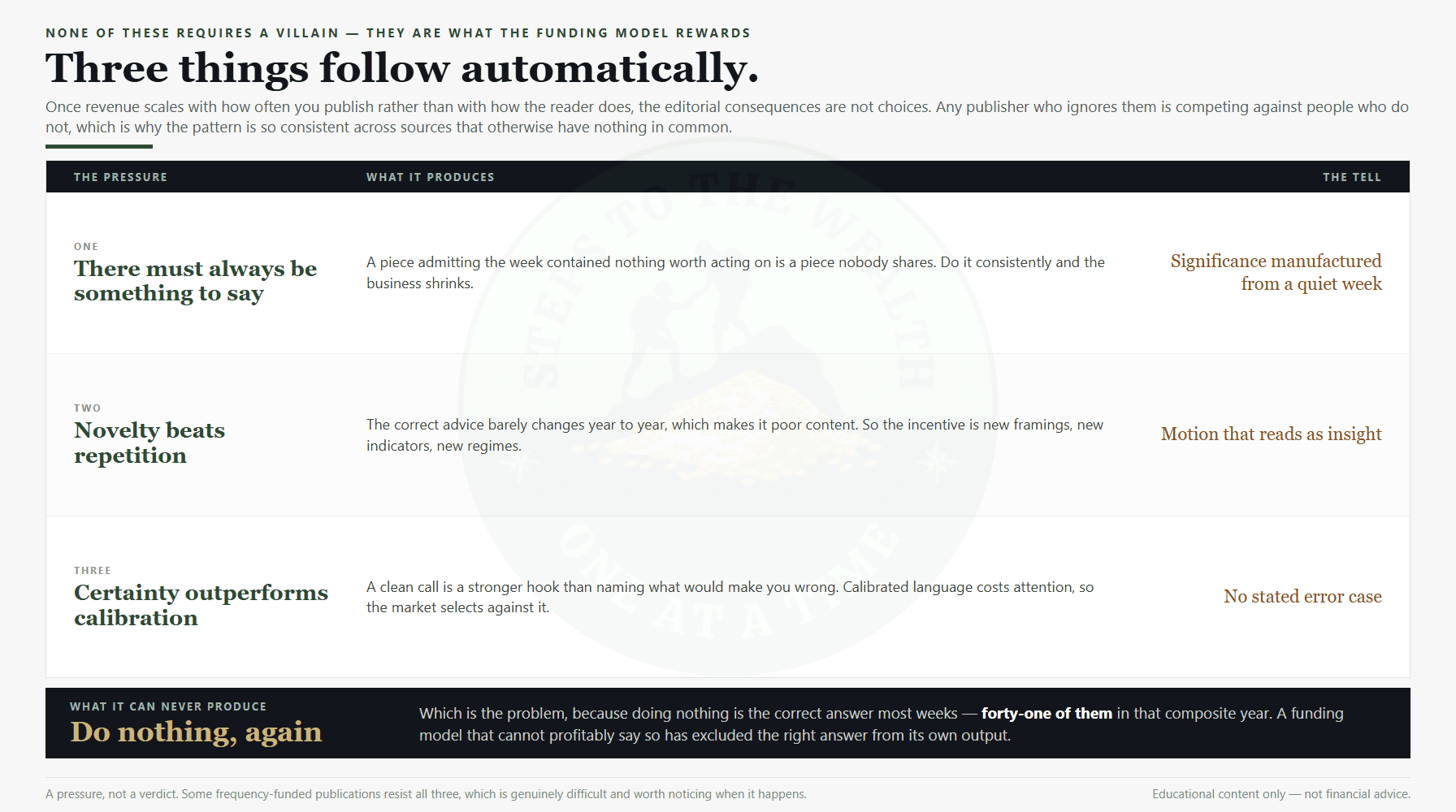
None of those three requires a villain. They are what the funding model rewards, and any publisher who ignores them is competing against people who do not.
What This Kind of Content Structurally Cannot Give You
Some things are simply not producible under those incentives, no matter how good the writer is.
It cannot tell you to do nothing, repeatedly. Which is a problem, because doing nothing is the correct answer most weeks — forty-one of them, in that composite year.
It cannot know your circumstances. Every real decision depends on your income stability, your horizon, what else the money has to fund, and what size of loss would change your behaviour. Broadcast content cannot condition on any of that, so it defaults to the generic, and generic advice fails precisely where it matters.
It cannot be held to account. Almost nobody publishes a running record of their own calls, which means the feedback loop that would correct bad guidance does not exist. The same voice can be wrong all year and start January with an identical audience.
It cannot make you act differently. This is the one that stings, because it is the whole point. Consumption feels like progress and is not: reading about position sizing is not sizing a position, and the gap between the two is where years go.
Every Funding Model Has a Bias, Including Ours
Identifying the impression-funded bias is only useful if you apply the same scrutiny to the alternatives, because there is no neutral model. There are only different distortions.
Impression-funded content is biased toward frequency and emotional pull, for the arithmetic reasons above. Its characteristic failure is manufacturing significance out of a quiet week.
Affiliate-funded content is biased toward whatever pays on signup. If a piece consistently concludes that you need a new broker, a new platform or a new account type, the conclusion arrived before the analysis did. Its characteristic failure is a recommendation that is fine in isolation and suspiciously well-monetised.
Subscription-funded content, which is the model here, is biased toward making you feel the subscription was worth it. That sounds benign and is not entirely: it creates pressure to produce something impressive on a schedule, which is the same frequency problem wearing better clothes. Its characteristic failure is over-elaboration — a simple answer dressed up, because a simple answer feels like poor value.
Product-funded content, also the model here, is biased toward framing problems that the product happens to solve. Its characteristic failure is a genuine insight that arrives with a suspiciously convenient tool attached.
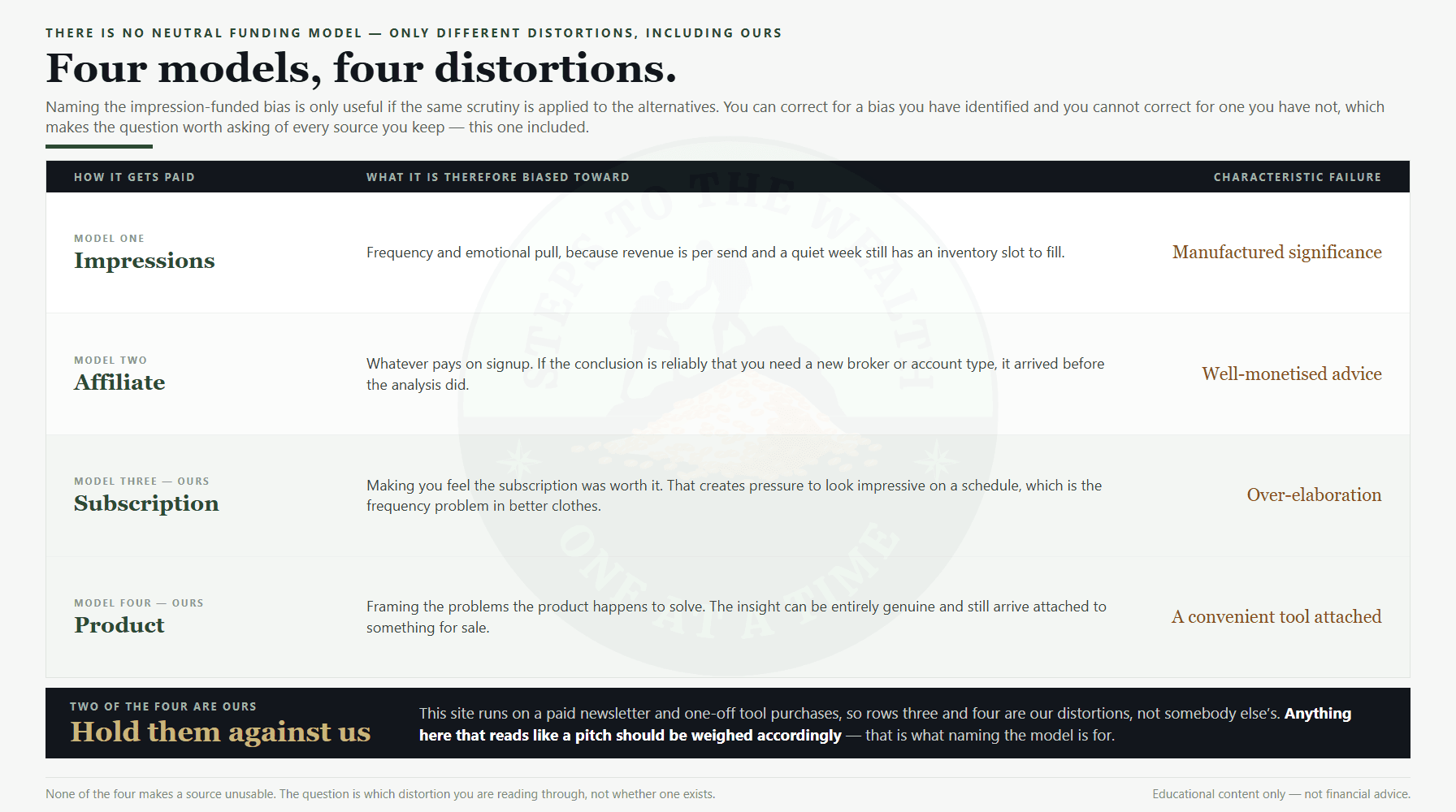
None of these makes a source unusable. What matters is knowing which distortion you are reading through, because you can correct for a bias you have named and you cannot correct for one you have not.
Why “Educational” Is the Wrong Word for Most of It
Education implies a curriculum with an end. You learn the thing, you can do the thing, and you stop needing the teacher.
Most investing content is built on the opposite premise. It is designed to be consumed indefinitely, and a reader who genuinely finished would be a reader who churned. The business needs you subscribed, not competent.
You can spot the difference by asking what success looks like for the publisher. If success is you knowing enough to stop reading, that is education. If success is you reading forever, it is entertainment with a financial theme — which is a legitimate product, but it should be labelled honestly, and it should not be where a decision comes from.
The Loudest Voices Are Selected, Not Chosen
There is a second mechanism operating alongside the funding one, and it needs no incentives at all.
Attention accrues to whoever was most recently right, and being most recently right is substantially luck at any given moment. A commentator who made a bold call that landed acquires an audience; one who made an equally bold call that missed does not. Nobody arranged this. It is what happens when a large number of people make confident predictions and the audience remembers the ones that worked.
The result is a visible layer of commentary systematically biased toward boldness, because calibrated voices rarely produce the dramatic hit that generates an audience in the first place. You are not seeing the best forecasters. You are seeing the ones whose last forecast worked.
This is why a track record matters far more than a reputation, and why the absence of one is such a strong signal. A reputation is built from remembered hits. A record includes the misses by construction, which is exactly why so few people publish one.
It also explains a pattern most people have noticed without naming: the confident voice from two years ago who is no longer around. They were not exposed as frauds. Their call simply stopped working, the audience moved to whoever was right more recently, and the cycle restarted with a new name.
A Filter You Can Apply to Any Source
Five questions. They take a minute, they work on anybody, and they do not require you to judge whether the content is correct.
- How does this get paid? Sponsorship, affiliate links, a paid tier, a product it funnels into, or nothing. Not disqualifying — every model has a bias, including subscriptions — but you cannot weigh the bias you have not identified.
- How often does it publish, and does the schedule fit the subject? A daily publication has committed to filling 365 slots a year, for a decision that arises sixteen times. Those are different units and the gap is not a subtraction — it is a mismatch between what the schedule demands and what the subject supplies.
- Does it ever say nothing happened? A source that has never published the equivalent of “this week did not matter” is telling you what it is.
- Can you find its record? Not the wins — the whole list. Absence of a record is not proof of a bad one, but it does mean the claim cannot be checked, which is the same thing operationally.
- Does it show the arithmetic? A number you can reproduce is a number you can argue with. A conclusion without the working asks you to trust rather than to check, which is the posture the whole industry depends on.
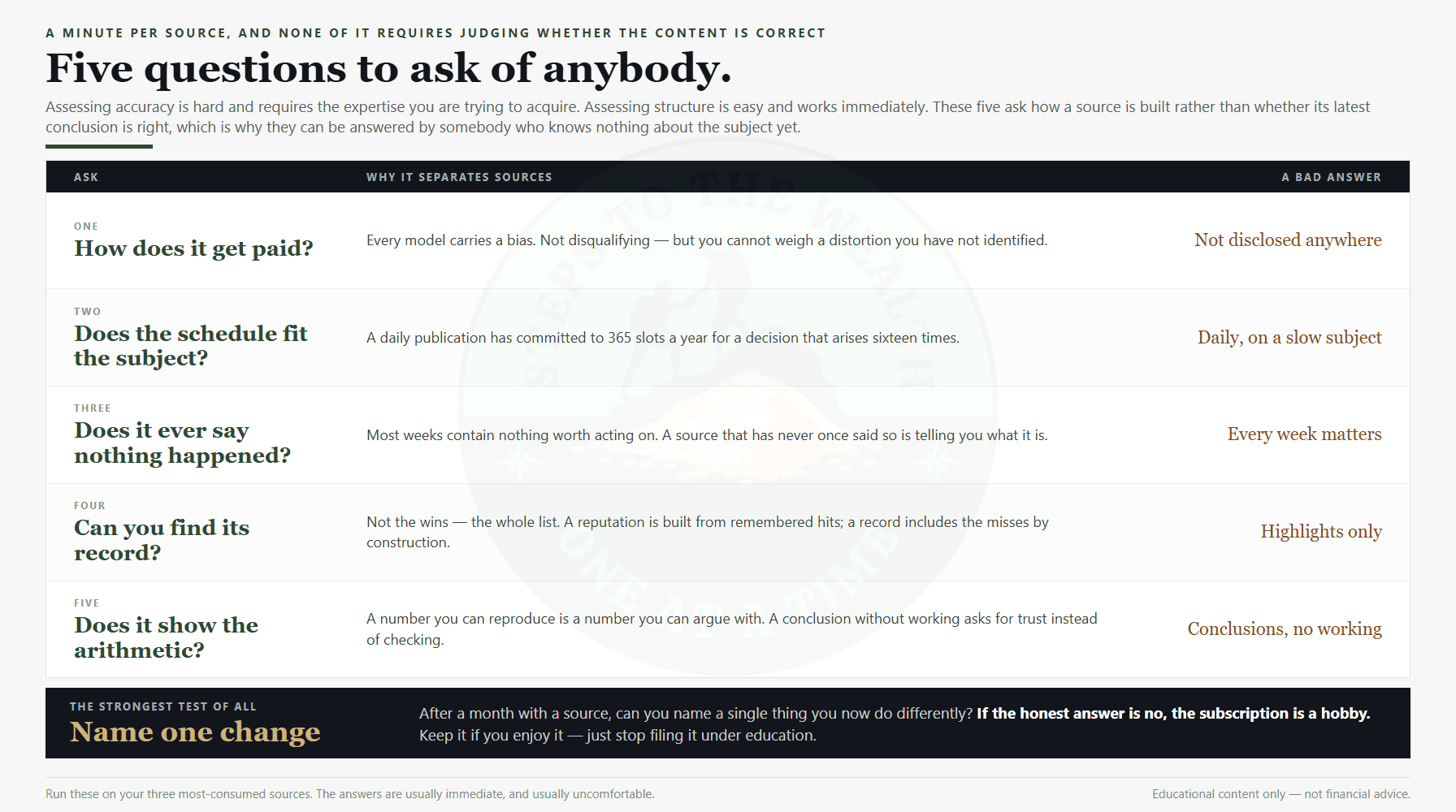
Run those on your three most-consumed sources. The answers are usually immediate, and usually uncomfortable.
Applying It to This Site
It would be dishonest to run that filter and exempt ourselves, so here are the answers.
This site is funded by a paid newsletter and by one-off tool purchases. That biases us toward material that makes the tools look worth buying, which is a real bias and worth holding against anything here that reads like a pitch.
It publishes irregularly rather than daily, which is deliberate and also commercially worse. It routinely says nothing has changed, because most of the time nothing has. Every figure carries its working, so you can check it rather than take it, and where a number is illustrative it says so.
What we do not have is a public record of calls, for the straightforward reason that we do not make calls. That is a genuine limitation of the filter as applied here, and pretending otherwise would fail question four.
The place to hold us to it is question five, which is the one we can actually be checked on. Every figure on this site is published with the working next to it — the inputs, the operation and the result — specifically so a reader who suspects the conclusion can reproduce the number and find out. Where a figure is illustrative rather than measured, as the CPM arithmetic above is, it says so in the same paragraph rather than in a footnote nobody reads.
That is not a claim to be unbiased. It is a claim to be checkable, which is a weaker and more useful property. An unbiased source is something you have to take on trust; a checkable one you do not, and the second is the only kind worth building when the reader has no way to audit your motives.
The uncomfortable corollary is that the same standard applies to this article. Its central claim is an arithmetic one about how frequency-funded revenue scales, and every number in it is above, in full, with the assumptions named. If the argument is wrong, it is wrong somewhere you can point at.
What Actually Changes Behaviour
If broadcast content cannot do it, something has to.
Written rules do, because they move the decision from the moment of stress to a moment of calm — the case for which is rules-based investing. A bounded review does, because it caps how often you can act at all rather than relying on restraint, as in the 15-minute Sunday review.
Counting does, more than anything else on this list. Knowing your own action count for the last twelve months tells you more about your likely returns than any amount of reading, which is the argument in investing versus trading. And understanding your own failure modes beats consuming more content about markets, which is what the biases that quietly decide your outcome is for.
The common thread is that all four are things you build once and then run, rather than things you consume. For allocation basics from a source with no commercial interest at all, the SEC investor education material is a reasonable place to start and it is not trying to sell you anything.
Why This Costs a Working Professional More
The incentive problem is general. The bill for it is not evenly shared, and it lands hardest on exactly the people this site is written for.
Somebody with a demanding job has one genuinely scarce input, and it is not capital — capital arrives every month whether or not they pay attention. It is hours. Every hour spent consuming market commentary is an hour not spent on the thing that actually moves their number at this stage, which is usually earning more or removing a leak. The arithmetic of that trade is set out in the opportunity cost of time.
Frequency-funded content is designed to consume exactly that input. It arrives daily, it is engineered to feel urgent, and it produces the sensation of diligence — which is the specific trap for somebody whose professional instincts reward diligence everywhere else.
There is a second cost on top of the hours. Consumption raises the felt need to act, and acting is where the money actually leaks. So the reader pays twice: once in time, and once in whatever the extra activity cost them.
The alternative is not ignorance. It is a bounded input budget attached to a plan that runs without supervision, which is the whole design in how to invest while working full time. A plan that needs daily monitoring is not a plan for somebody with a job. It is a second job with worse pay.
How To Read Anything From Here
Not a boycott. A change in posture.
Treat content as raw material rather than instruction. The useful output of reading is a rule you added, a number you checked, or a question you can now answer — not a feeling of having kept up.
Set a consumption budget the way you would set a position size. If your plan needs sixteen decisions a year, the amount of input required to support those decisions is finite and small, and everything past it is entertainment. That is fine, as long as you know which one you are doing at the time.
And apply the strongest test there is: after a month with a source, can you name one thing you do differently? If the honest answer is no, the subscription is a hobby. Keep it if you enjoy it. Just stop filing it under education.
What To Do With the Sources You Keep
The point of the filter is not to unsubscribe from everything. It is to change what you take from each thing.
Separate input from instruction. A piece of content is allowed to give you a question, a mechanism or a number to check. It is not allowed to give you a decision, because it does not know your circumstances and is not accountable for the outcome. That boundary does most of the work on its own.
Read for mechanisms, not conclusions. A conclusion expires the moment conditions change. A mechanism — why a residual claim amplifies a decline, why frequency costs money, why volatility and risk are different — keeps working, and it lets you reach your own conclusion next time without the source.
Delay acting on anything you read by a week. Almost nothing genuinely requires action within a week, and the ideas that survive seven days without losing their urgency are a meaningfully better set than the ones that do not. This single habit removes most of the damage that content does, without requiring you to judge quality at all.
Keep a note of what you changed. Not what you read — what you changed. Over a year that list is short, and its shortness is the honest measure of how much of your consumption was doing anything. It also tells you which sources earned their place, which no amount of introspection will.
The Honest Limits
Three caveats.
The CPM figures are illustrative. A $30 CPM and a 100,000-person list are round numbers chosen so the arithmetic is checkable by hand; real rates vary enormously by niche and by list quality. What does not vary is the structure — impression-funded revenue rises with frequency, and the reader’s decision count does not.
Not all frequency-funded content is bad. Some daily publications are excellent, honest about uncertainty, and worth the time. The filter identifies a pressure, not a verdict, and a good publisher resisting that pressure is doing something genuinely difficult.
And this article is itself content, produced by a site with its own commercial interest. It should be read with exactly the scepticism it recommends, which is why every number in it is shown with its working rather than asserted. The filter is not a way to decide who to trust. It is a way to stop needing to.
Educational content only — not financial advice. The revenue figures above are illustrative round numbers, not measured results from any publication, and nothing here is a recommendation to buy or sell any specific asset.