
Should you reinvest dividends automatically, or take them as cash? It is a small recurring setting that compounds into a large difference, and almost every answer you will read starts from a belief that is factually wrong.
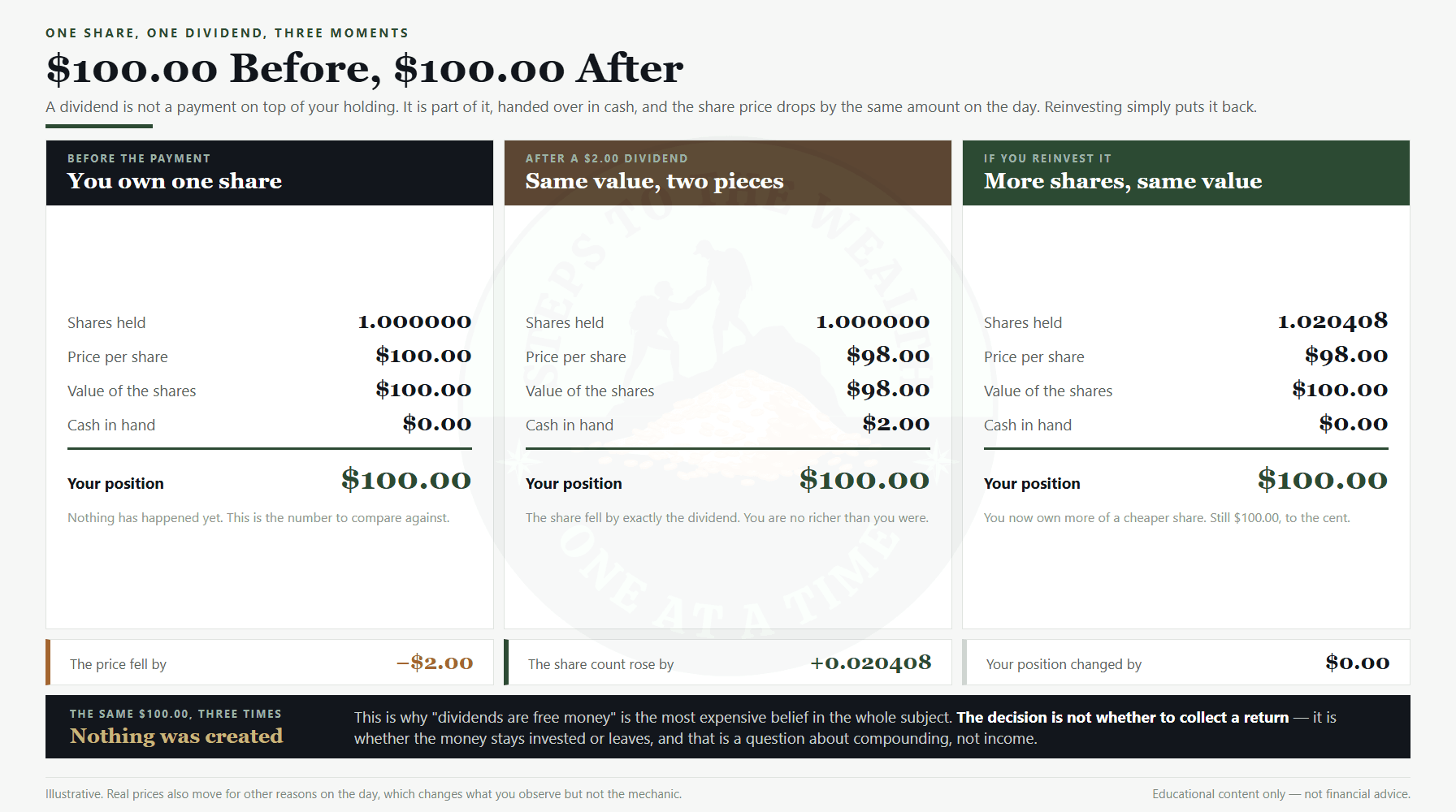
So before the arithmetic, the mechanic. A dividend is not a payment on top of your holding. It is part of your holding, handed to you in cash, and the share price drops by the same amount on the day it is paid. Nothing is created. Once that is clear, the decision stops being about income and becomes what it actually is: a question about whether this money stays invested.
Throughout, the assumption is the one used across this site: a total return of 7% after inflation, which for this article is split into 5% price growth and a 2% yield. Both numbers are stated so you can change them.
Educational content only. Not financial advice.
The mechanic almost nobody states
You own one share worth $100.00. The company pays a $2.00 dividend. On the day it goes ex-dividend, the share is worth $98.00 and you hold $2.00 in cash. Your position is $100.00, exactly as it was.
Reinvest that $2.00 at $98.00 and you buy 0.020408 of a share. You now hold 1.020408 shares at $98.00, which is $100.00. Still nothing created.
That is the entire mechanic, and it disposes of the most common reason people give for liking dividends. A dividend is not a yield on top of your holding, in the way interest sits on top of a deposit. It is a transfer from one pocket to another, and the only question it raises is which pocket you want it in.
Real share prices move for many reasons on the day, so you will rarely observe a clean $2.00 drop. That changes what you can see; it does not change what happened.
Should you reinvest dividends? What the arithmetic says
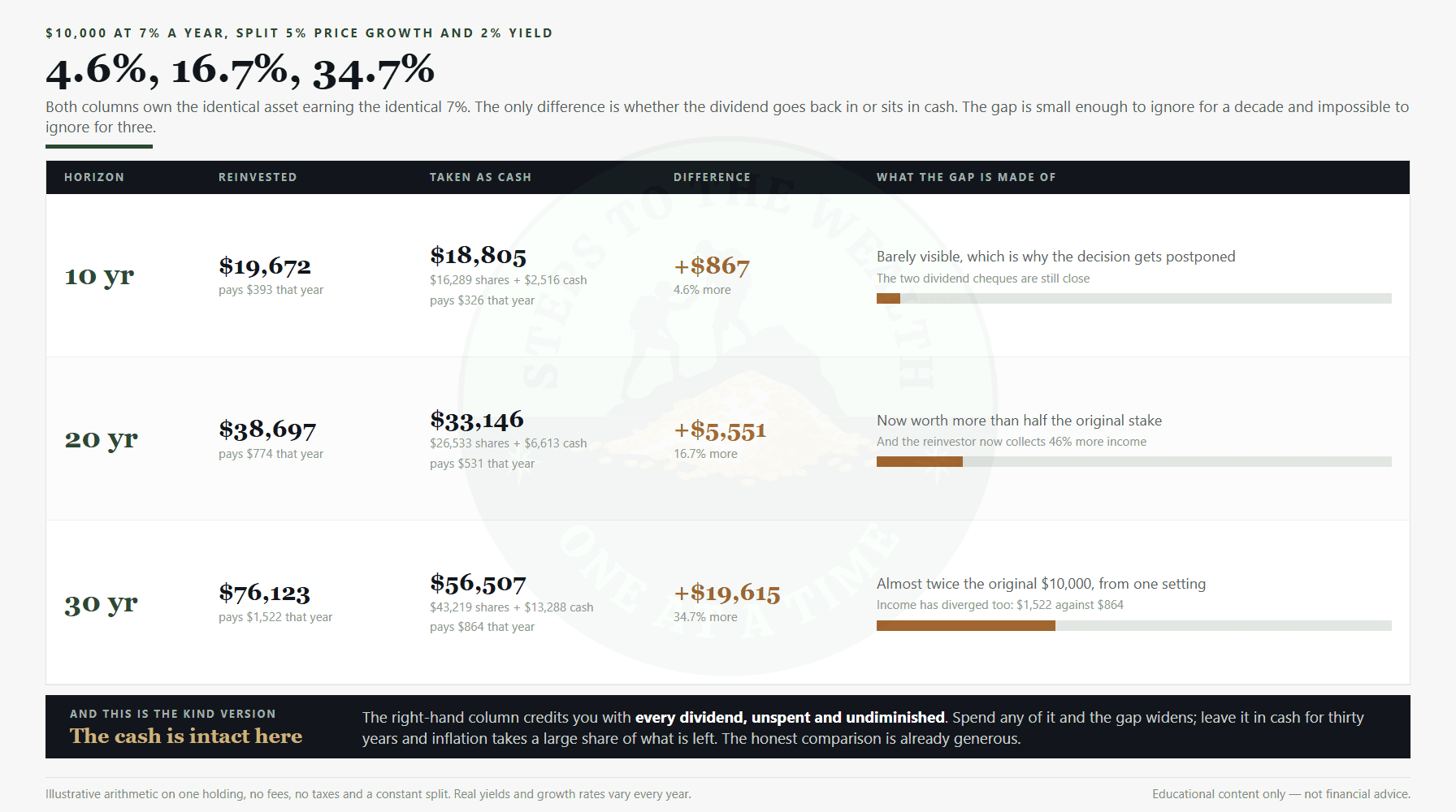
Take $10,000 in a holding returning 7% a year, made up of 5% price growth and a 2% yield. Compare two people who own exactly the same thing, one reinvesting and one collecting the cash and keeping it.
- After 10 years: $19,672 reinvested against $18,805 — $16,289 of shares plus $2,516 of cash. A gap of $867, or 4.6%.
- After 20 years: $38,697 against $33,146. A gap of $5,551, or 16.7%.
- After 30 years: $76,123 against $56,507. A gap of $19,615, or 34.7% — nearly twice the original stake, from one setting.
Two things are worth noticing about that sequence. The first is that the ten-year gap is small enough to be invisible, which is exactly why the decision gets postponed for a decade at a time. The second is that the comparison is deliberately generous: the cash column credits you with every dividend, unspent and undiminished. Spend any of it and the gap widens. Leave it in cash for thirty years and inflation removes a large part of what remains — a cost worth understanding properly in inflation against nominal returns, because cash sitting idle is where the real-versus-nominal distinction does the most damage.
There is a second divergence hiding inside the same numbers, and it matters most to the people who care about dividends in the first place. By year thirty the reinvestor’s holding pays $1,522 in dividends that year. The cash-taker’s pays $864. The person who reinvested for three decades ends up with substantially more income, not just more capital — which is the opposite of how the choice is usually framed.
The higher the yield, the more the setting matters
The 2% yield above is a modelling choice, and the obvious question is what happens at a different one. The answer is sharper than most people expect, and it runs in the direction that catches income investors out.
Hold the total return fixed at 7% and vary only the split. Over thirty years on $10,000, the reinvesting column is $76,123 in every case — it does not care how the return arrives. The cash column changes a great deal:
- 1% yield: $65,341, so reinvesting is 16.5% ahead.
- 2% yield: $56,507 — 34.7% ahead.
- 4% yield: $43,303 — 75.8% ahead.
- 6% yield: $34,349 — 121.6% ahead, more than double.
The reason is structural. A higher yield with the same total return means less price growth, so a larger share of your return is being handed to you in cash each year and taken out of the compounding engine. At a 6% yield, only 1% a year is left compounding inside the holding, and the ending share value is $13,478 against $57,435 in the 1% case.
This has a consequence worth stating plainly, because it inverts the usual advice. The higher the yield of what you own, the more damage taking the cash does — and high-yield holdings are exactly what people buy when they want to live off dividends. The strategy most associated with collecting income is the one where collecting the income costs the most.
It also means the reinvestment setting deserves more attention on an income-oriented portfolio than on a growth-oriented one, which is the reverse of how most people allocate their attention. If your holdings yield very little, the decision is close to a rounding error for a decade. If they yield a lot, it is the single largest structural choice you are making, and it is being made by a checkbox.
Where this sits in the wider plan depends on how much you have. At a small balance almost none of this matters next to your savings rate; at a large one it is one of the few remaining levers you control, which is the point of the stages of wealth building. The same logic that governs whether idle money should be working at all is set out in what waiting actually costs.
Four beliefs the mechanic disposes of
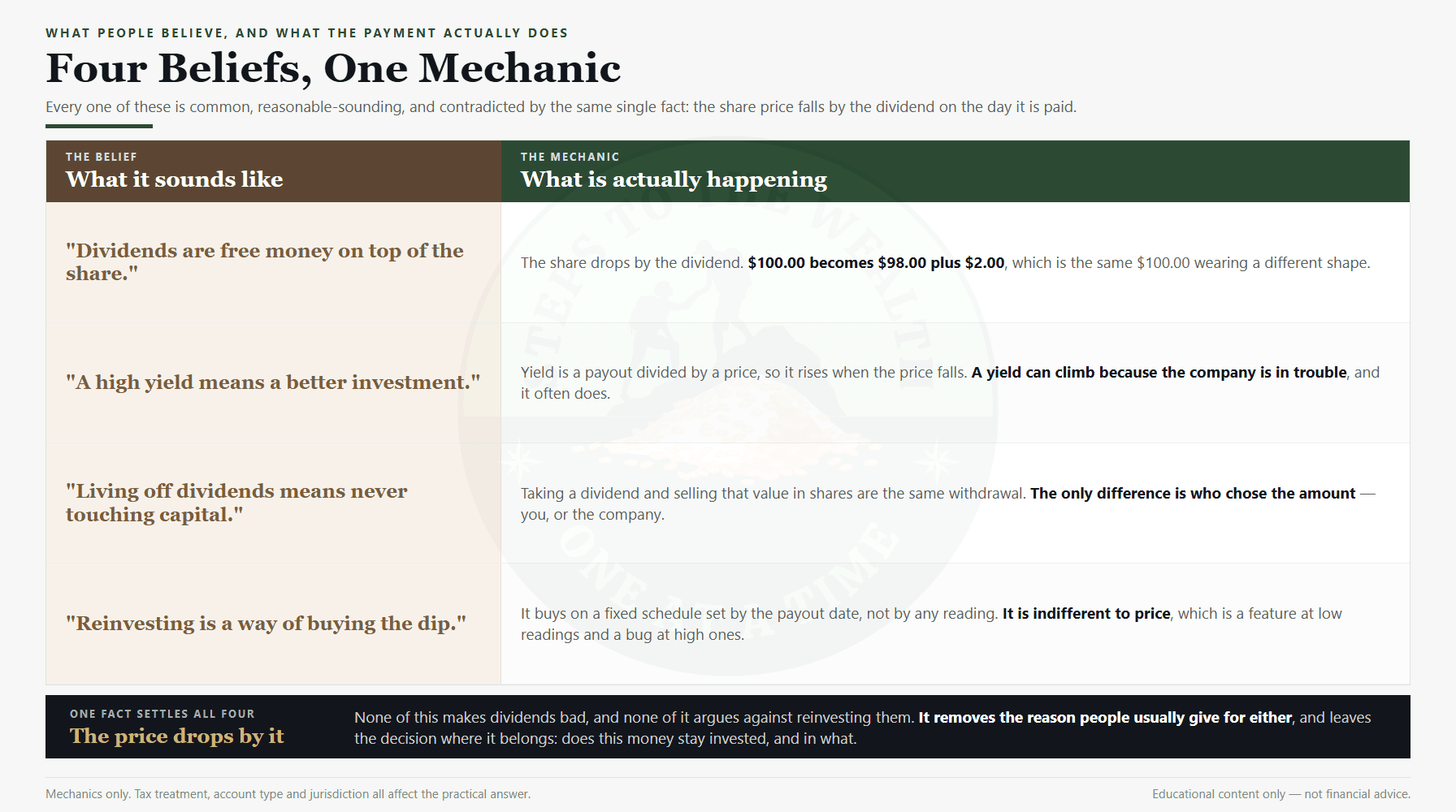
“Dividends are free money on top of the share.” The share drops by the dividend. $100.00 becomes $98.00 plus $2.00, which is the same $100.00 wearing a different shape.
“A high yield means a better investment.” Yield is a payout divided by a price, so it rises when the price falls. A yield can climb because the company is in trouble, and it often does. Screening for the highest yields is, mechanically, screening partly for the assets the market has marked down hardest.
“Living off dividends means never touching capital.” Taking a dividend and selling the same value in shares are the same withdrawal. The only difference is who chose the amount — you, or the company. A company that cuts its dividend has just made a withdrawal decision on your behalf, at the worst possible time.
“Reinvesting is a way of buying the dip.” It buys on a schedule set by the payout date, not by any reading. It is indifferent to price, which is a feature when the reading is low and a bug when it is high. Being indifferent to price is precisely what a dynamic DCA strategy exists to stop doing.
None of this makes dividends bad, and none of it argues against reinvesting them. It removes the reasons people usually give for either, and leaves the decision where it belongs.
When reinvesting is the right default
For most people accumulating, most of the time, automatic reinvestment is the correct setting, and the argument for it is behavioural before it is mathematical. It is also one of the few settings that survives a plan having to fit around a full-time job, because it needs no attention at all.
It removes a recurring decision. Every dividend that lands as cash is a small invitation to do something — and small invitations, repeated quarterly for decades, are how portfolios drift. Automation is the cheapest way to make sure the money goes back to work without a debate each time.
It also solves a problem specific to small amounts. A $47 dividend is an awkward sum: too small to make a satisfying trade, large enough to feel like it should be doing something. In practice it sits in cash for months. Automatic reinvestment buys the fractional share and moves on.
And it is a defence against a real behavioural trap. Dividend cash spends far more easily than a share does, because withdrawing it never feels like selling. It is the same withdrawal — the mechanic above makes that unambiguous — but it does not feel like one, and that gap between the accounting and the feeling is where the money goes. The whole point of a rules-based approach is to remove decisions that get made emotionally, and this is one of them.
Five situations where you should switch it off
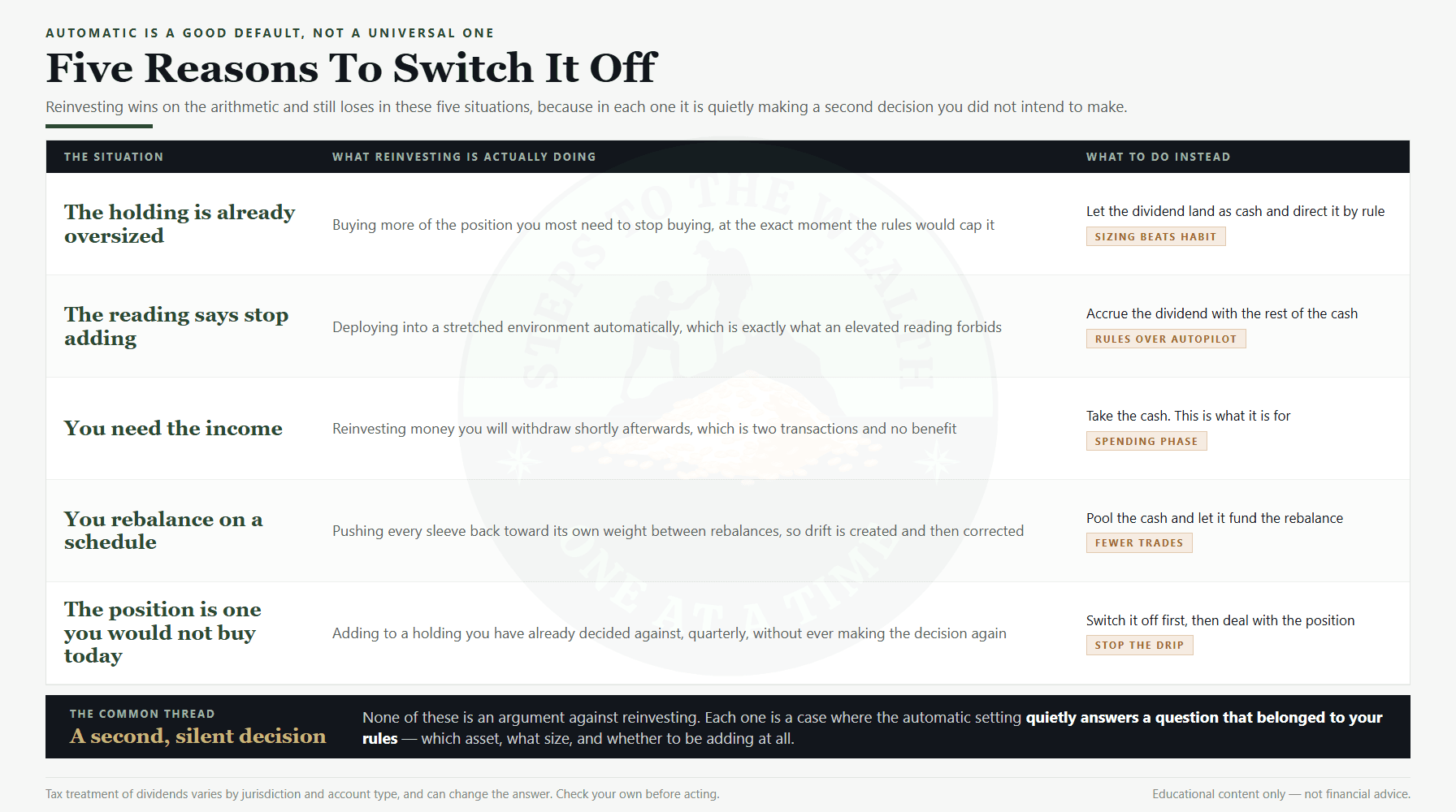
Automatic is a good default, not a universal one. In these five cases it is quietly making a second decision you did not intend to make.
The holding is already oversized. Reinvesting buys more of the position you most need to stop buying, at the exact moment a sizing rule would cap it. Let the dividend land as cash and direct it by rule instead. Position size is a decision; a payout date is not.
The reading says stop adding. If your framework has told you conditions are stretched and new money should accrue as cash, an automatic reinvestment overrides that four times a year without asking. This is the one that most directly contradicts a risk-first framework, and it is invisible because it happens by default.
You need the income. If you are drawing down rather than paying in, reinvesting money you will withdraw a fortnight later is two transactions and no benefit. Take the cash. This is what it is for.
You rebalance on a schedule. Reinvesting each holding into itself pushes every sleeve back toward its own weight between rebalances, creating drift you then pay to correct. Pooling the cash and letting it fund the next rebalance does the same job with fewer trades.
The position is one you would not buy today. Automatic reinvestment adds to a holding you have already decided against, quarterly, without ever making the decision again. Switch it off first, then deal with the position properly.
The common thread is that none of these is an argument against reinvesting. Each is a case where an automatic setting answers a question — which asset, what size, whether to be adding at all — that your rules were supposed to answer.
The account it sits in changes the answer
One practical point that is easy to get backwards: in a taxable account, a dividend is generally a taxable event when it is paid, whether or not you reinvest it. Reinvesting does not defer anything. You are taxed on money you never saw, and the reinvested amount becomes new cost basis you will need to have recorded years later.
That is not an argument against reinvesting. It is an argument for knowing which account you are doing it in, and for keeping records if the account is taxable. In a sheltered account the question is purely about compounding and the arithmetic above applies cleanly.
Specifics vary considerably by jurisdiction, account type and your own circumstances, and this is the point in the article where general guidance stops being useful. The regulator’s plain guide to asset allocation is a reasonable place to start on the broader structure; the tax detail needs someone who knows your situation.
What the 34.7% figure does not mean
An honest reading of that gap needs four caveats, because the number is easy to over-claim.
It is not evidence that dividend-paying assets are better. The comparison holds the asset constant. Both columns own the same thing. It says nothing about whether to prefer high-yield holdings, and the yield-screening trap above suggests some caution there.
It assumes a constant 2% yield and 5% growth for thirty years. Neither is stable in reality. Yields move, payouts get cut, and the split between growth and income varies by asset and by decade. The shape of the result is robust; the exact figures are not.
It ignores fees and taxes entirely. In a taxable account the reinvesting column would be paying tax along the way, which narrows the gap. It does not close it, because the tax is due whether or not you reinvest.
And it says nothing about whether you can hold on. Reinvesting for thirty years requires being invested for thirty years, through everything that happens in between, including a full market cycle or three. That is a behavioural question, not an arithmetic one, and it is the one that actually decides outcomes — as the measured behaviour gap in Barber and Odean’s study of 66,465 households makes clear: the market returned 17.9% a year while the busiest fifth of traders earned 11.4%.
Frequently asked questions
Should you reinvest dividends automatically?
If you are accumulating, hold the position deliberately, and have no rule currently telling you to stop adding, then yes — automatic reinvestment is the sensible default. It removes a recurring decision and keeps the money working. Switch it off in the five situations above, all of which are cases where the automation is overriding a decision you already made.
Is a DRIP better than buying more shares manually?
Mechanically they are the same purchase. The difference is friction and consistency: automatic happens whether or not you are paying attention, manual gives you the chance to direct the money by rule. Choose automatic if your risk is forgetting, and manual if your risk is buying the wrong thing.
Do I pay tax on reinvested dividends?
In a taxable account, generally yes — the dividend is usually taxable when paid, and reinvesting does not defer that. In a sheltered account the question typically does not arise. The specifics depend on your jurisdiction and account type, so check yours rather than assuming.
How much difference does reinvesting actually make?
On the assumptions here — $10,000, 7% total return, a 2% yield — it is 4.6% after ten years, 16.7% after twenty and 34.7% after thirty. The gap starts negligible and compounds, which is why it is so easy to defer the decision and so expensive to defer it for long.
Should I stop reinvesting when the market looks expensive?
That is the one case where the answer depends on whether you have a rule or an opinion. If your framework produces a reading and the reading says stop adding, then yes, and reinvestment should stop with every other purchase. If it is a feeling about valuations, you are switching from a rule to a forecast, which is the change most likely to cost you.
What if my broker does not offer fractional shares?
Then the dividend sits as cash until it is large enough to buy a whole share, which quietly converts an automatic setting into an irregular manual one. On a small holding that can mean months of idle cash at a time, and the compounding case above assumes the money goes back in promptly. It is worth checking what your provider actually does with a payment too small to buy a share, because “reinvestment enabled” and “reinvested” are not always the same thing.
What should I do with dividends I take as cash?
Give them a job before they arrive. Cash with no assigned purpose gets spent or sits idle, and both outcomes are worse than reinvesting. Fund the next rebalance, top up an underweight sleeve, or hold it deliberately as dry powder — but decide which, in advance.
The setting is small, the habit is not
A dividend is part of your holding handed to you in cash, and the share price falls to match. That single fact settles most of the arguments people have about dividends, in both directions.
What is left is a genuine decision: does this money stay invested? For someone accumulating, the answer is usually yes, and the compounding case is strong enough that the setting is worth checking today rather than at some point in the next decade — 4.6% over ten years, 34.7% over thirty. For someone drawing down, or holding an oversized position, or reading elevated risk, the answer is no, and the automation should be switched off deliberately rather than left running by default.
Either way, make it a decision rather than a setting you inherited. That is the whole distinction between running a portfolio and being run by one, and it shows up in what an ordinary year actually contains.
If you want the weekly reading and the reasoning behind it, that is what the newsletter is for.
Educational content only. Not financial advice. All figures are illustrative arithmetic at a stated 7% total return after inflation, split 5% growth and 2% yield, with no fees or taxes modelled. Tax treatment of dividends varies by jurisdiction and account type, and individual circumstances differ.