
How much to invest in bitcoin per month is usually answered with a rule of thumb: 1% of income, 5% of income, or whatever you would not miss. Those numbers are easy to say and hard to defend, because none of them is connected to the thing that decides whether you keep the plan running. That thing is how far bitcoin can fall while you hold it.
Bitcoin has completed four bear markets on the daily closes in our data. The shallowest took 76.6% off the price. The deepest took 92.7%. A monthly amount chosen without those numbers is not really a plan. It is a quiet bet that the next fall will be gentler than every one so far.
So this piece treats the monthly number as the output of a short sizing rule rather than as a starting point. Three steps: set a cap on how much of your portfolio bitcoin may become, turn the cap into a monthly amount, then let the current risk level scale that amount up or down. After that comes the record: what a fixed $100 a month actually did across 110 different start dates, on real closing prices.
The Short Answer: How Much to Invest in Bitcoin per Month Is an Output
There is no single right figure. There is a right method, and it produces a figure that is specific to you.
Step one: decide the largest share of your total portfolio you would let bitcoin become, sized so that an 85% fall in the price would cost you an amount you can sit through without selling. Step two: apply that same share to what you invest each month. At a 5% cap and $1,500 a month invested in total, the bitcoin slice is $75. Step three: treat that $75 as a base, buying more of it when risk is low and none of it when risk is elevated or high.
That is the whole answer. The rest of this article shows the arithmetic behind each step, what it does not cover, and what the historical record says about the alternative most people actually use: a flat amount every month, and hope.
Step 1: Start From the Cap, Not the Paycheck
The usual question starts from income: what can I afford each month? That is the right question for your budget and the wrong question for your risk. An amount you can afford to contribute says nothing about the size of the position it builds, and it is the position, not the contribution, that does the damage when the price falls.
Start from the ceiling instead. A cap is the most of your total portfolio that bitcoin is allowed to become. It is the same idea as the caps in our position sizing rules, applied to one unusually volatile holding. Once the cap exists, the monthly amount follows from it. Without one, the monthly amount quietly compounds into a position size you never chose. The SEC’s investor site has a plain guide to asset allocation that frames the same idea for a whole portfolio.
To set a cap you need a stress number, and bitcoin supplies its own. On the daily closes behind our dashboard, Coin Metrics community data before September 2014 and Yahoo Finance after it, the four completed bear markets were these:
- 2011: 92.7%, from the 8 June peak to the 18 November low, 163 days.
- 2013 to 2015: 84.3%, from 4 December 2013 to 14 January 2015, 406 days.
- 2017 to 2018: 83.4%, from 16 December 2017 to 15 December 2018, 364 days.
- 2021 to 2022: 76.6%, from 8 November 2021 to 21 November 2022, 378 days.
The current cycle peaked at a close of $124,753 on 6 October 2025. By the 30 June 2026 low it was 53.1% down, and on 14 November 2026 it closed at $64,128, still 48.6% below that peak. Whether this fall is finished is not something this article, or anyone else, can tell you.
This piece uses 85% as the stress. It is worse than three of the four completed falls and milder than 2011, which happened when bitcoin was a far smaller and stranger market. You can choose your own number. The method does not change.
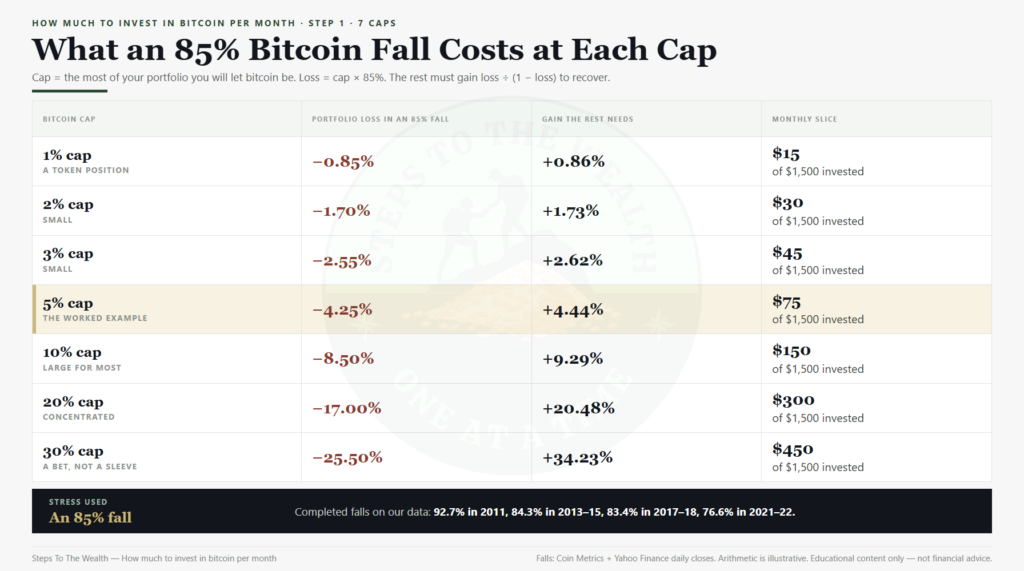
The arithmetic is two lines. The portfolio loss is the cap times 85%. The rest of the portfolio then has to gain the loss divided by one minus the loss to get back to where it started. At a 5% cap, an 85% fall costs 4.25% of the portfolio and needs a 4.44% gain to recover. At a 30% cap, it costs 25.5% and needs 34.23%.
The test for the right cap is not whether the number feels bold enough. It is whether you could watch that loss happen to your total portfolio, over a year or more, and not sell. A loss you cannot sit through tends to get realised near the bottom, which turns a temporary fall into a permanent one. That is the most expensive thing a bitcoin holder can do, and it is a sizing failure before it is a nerve failure.
Step 2: Turn the Cap Into a Monthly Number
Once the cap is set, the monthly figure is plain multiplication. Take what you invest in total each month, across every account, and apply the cap to it.
A worked example. Suppose you invest $1,500 a month in total and you settled on a 5% cap. The bitcoin slice is 5% of $1,500, which is $75 a month. The other $1,425 goes wherever the rest of your plan sends it. If you invest $800 a month, the same cap gives $40. If you invest $3,000, it gives $150. The figure moves with your plan, not with the headlines.
That is the answer to the question most people actually type. How much to invest in bitcoin per month comes down to your cap multiplied by your total monthly investing, then adjusted by the risk level in step three. It is a number you can derive in under a minute and defend in one sentence.
Three details keep it honest.
First, the cap is a ceiling, not an opening order. If bitcoin rallies hard, a slice bought at $75 a month can grow well above 5% of the portfolio on price alone. When it crosses the cap, new bitcoin buys stop, and if it drifts far enough you trim it back on a date set in advance. Our position sizing rules cover that drift in detail, including why the trim has to be slightly larger than the gap.
Second, the cap applies to the whole portfolio, not to each account. Bitcoin on an exchange, a bitcoin fund inside a retirement account and coins in cold storage all count toward the same ceiling. So does any other crypto you hold that tends to fall with bitcoin in a crash.
Third, the monthly slice only holds the share steady if bitcoin moves in line with everything else, and it never does. In practice the share drifts above the cap in strong years and well below it after a crash. Check the actual share once a year, against actual balances, rather than assuming the monthly arithmetic is keeping it in place.
Step 3: Let Risk Scale the Amount
A fixed $75 every month is a reasonable plan. It is also a plan that buys exactly as much at a cycle top as it does after an 80% fall. The third step changes that without changing how much money you commit over a year.
In the Dynamic DCA framework, the monthly base is multiplied by the current risk reading. Low risk buys twice the base, using cash carried in from the expensive months. Moderate risk buys the base. Elevated risk buys nothing, and the contribution waits as cash. High risk buys nothing, and the existing position is reduced in set steps. The full mechanics, including why this is not market timing, are in our dynamic DCA strategy guide.
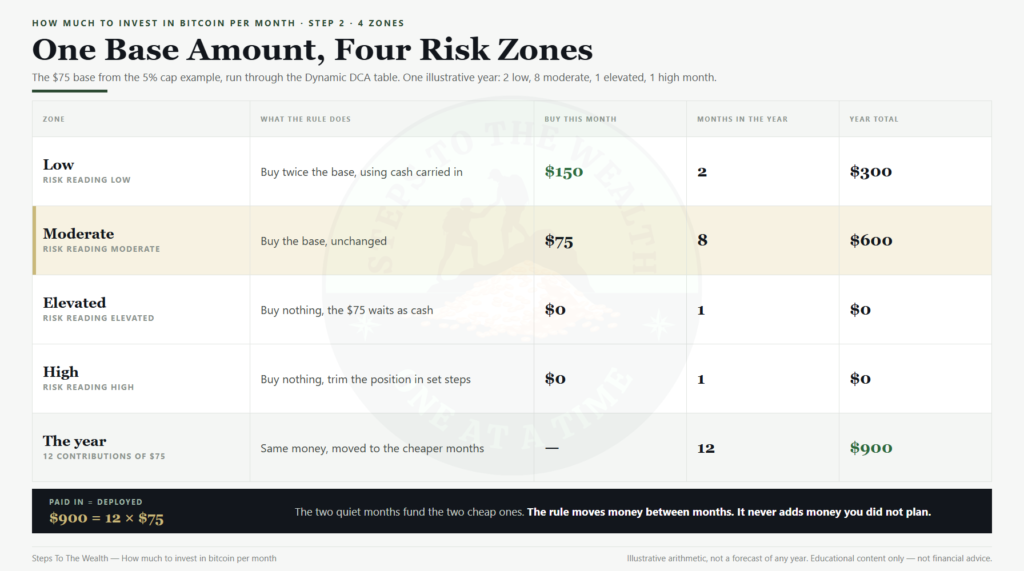
Run the $75 base through one illustrative year with two low months, eight moderate, one elevated and one high. The two low months buy $150 each, which is $300. The eight moderate months buy $75 each, which is $600. The elevated and high months buy nothing, and their $150 waits as cash until the low months spend it. Total deployed: $900. Total contributed: twelve times $75, which is also $900.
Nothing extra was invested. The rule moved $150 out of the two most expensive months and into the two cheapest. That is the whole mechanism, and it is why the base can stay boringly affordable. The risk reading changes where the money lands, not how much of it you commit.
It has a real cost. If the reading stays elevated for a long time, the cash keeps waiting and does not compound while it waits. A plan that pauses for a long stretch can lag a flat plan that never paused. That is why the table needs an upper limit on how much cash it will hold, written down before you need it.
It also does not replace the cap. A low reading is a reason to buy more of your slice, never a reason to raise the ceiling. The cap is what limits the damage when a low reading is followed by another fall, which does happen.
What a Fixed $100 a Month Actually Did
Most people who invest in bitcoin monthly use the simplest plan available: the same amount on the same day, every month, with no adjustments. So it is worth seeing what that plan actually did on real prices, rather than on a chart chosen to look good.
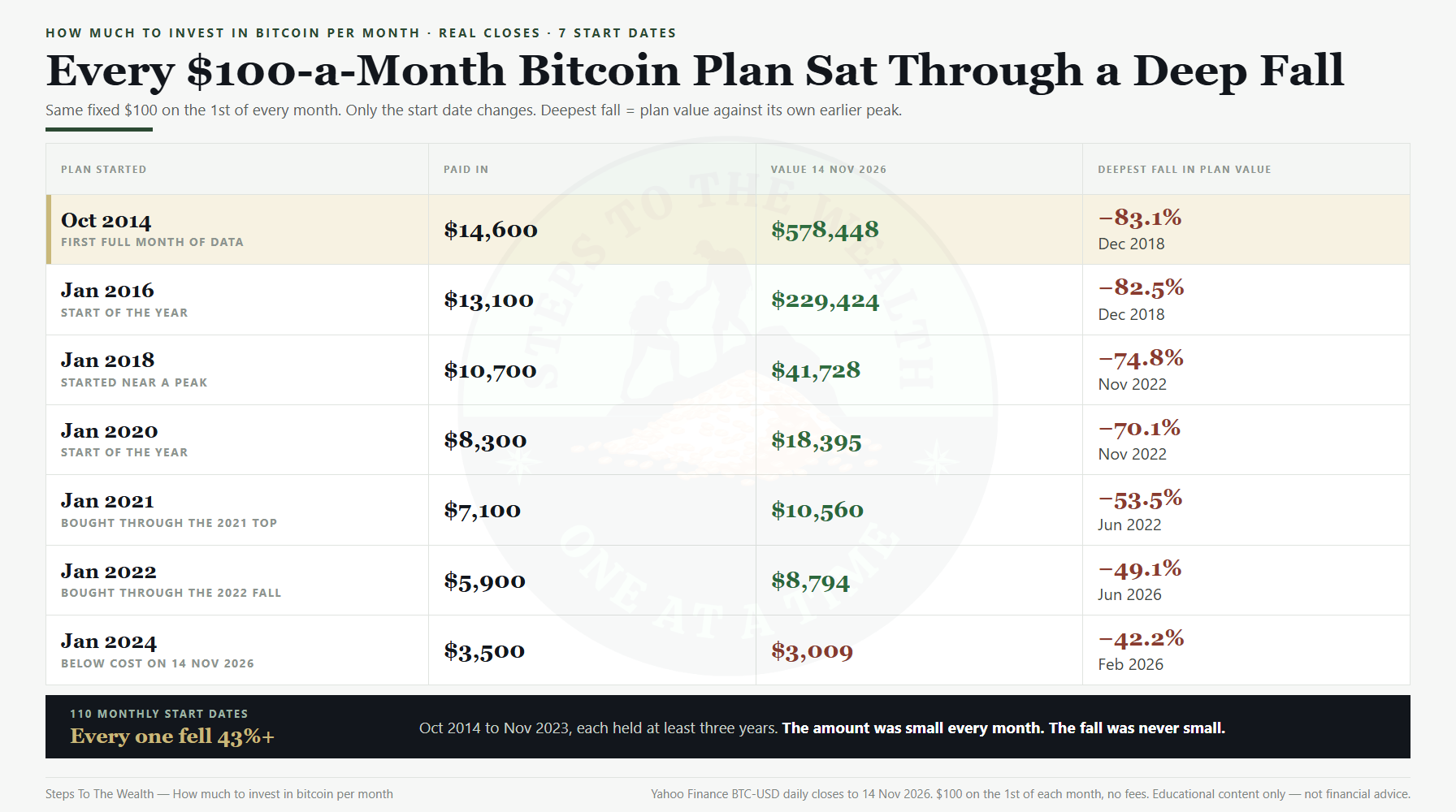
The test is simple. $100 bought on the first day of every month at that day’s Yahoo Finance BTC-USD close, with no fees, valued at the 14 November 2026 close of $64,128. Run from seven different start dates, it produces this.
| Plan started | Paid in | Value on 14 Nov 2026 | Deepest fall in plan value |
|---|---|---|---|
| Oct 2014 | $14,600 | $578,448 | −83.1% |
| Jan 2016 | $13,100 | $229,424 | −82.5% |
| Jan 2018 | $10,700 | $41,728 | −74.8% |
| Jan 2020 | $8,300 | $18,395 | −70.1% |
| Jan 2021 | $7,100 | $10,560 | −53.5% |
| Jan 2022 | $5,900 | $8,794 | −49.1% |
| Jan 2024 | $3,500 | $3,009 | −42.2% |
Every one of those plans is ahead today except the one started in January 2024. Every one of them also had to sit through a fall of more than 40% in its own value, and the four started before 2021 each fell more than 70%. The $100 never changed. The position it built did.
Seven start dates can be cherry-picked, so the next test removes the choice. Every monthly start from October 2014 to November 2023 was run to the same end date: 110 plans in all, each held for at least three years.
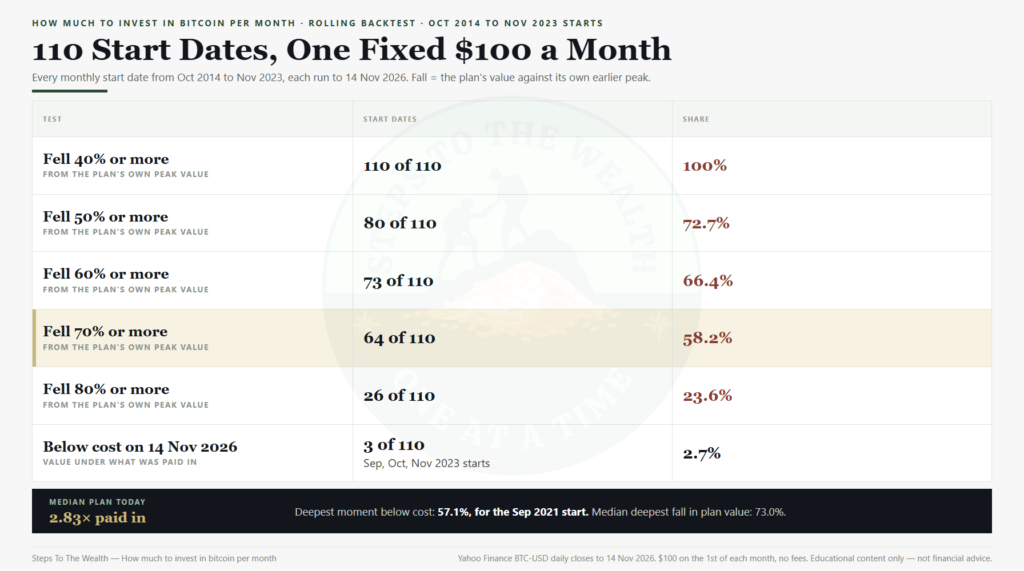
All 110 saw the plan’s value fall at least 40% from an earlier peak, and the mildest worst fall was 43.3%. Eighty fell by half or more. Sixty-four fell by 70% or more. The median plan’s deepest fall was 73.0%. At the end, the median plan was worth 2.83 times what had been paid in, and three plans, those started in September, October and November 2023, were below cost.
The worst moment below cost belonged to the plan started in September 2021, two months before the last cycle top. At its low it was worth 57.1% less than the money paid into it. That was a $100 monthly habit, not a lump sum at the top, and at its worst it was still more than half underwater. For the full account of that period, see what DCA through the 2021 to 2022 bitcoin crash did.
Two honest readings come out of this. The first is that a small fixed amount, held for years, has so far been a forgiving way to own bitcoin: most plans ended well ahead of what went in. The second is that the forgiveness usually required sitting through a fall of more than half. The amount felt small every month. The drawdown on the position was not small. That is exactly why step one sizes the position, not the payment.
None of this predicts the next ten years. These are past prices for one asset that went through extraordinary adoption, and the early start dates benefit from a rise that may never repeat. Read the table as a record of how deep the falls were on the way, not as an estimate of future returns.
Is $100 a Month in Bitcoin Enough?
Enough for what is the real question. In dollar terms, $100 a month is $1,200 a year, and a position built that way stays modest unless the price does something extraordinary. If the goal is a meaningful share of your net worth, $100 may be too small. If the goal is a capped satellite next to a diversified core, it may be exactly right, or even too much.
The cap answers it. At a 5% cap, $100 a month is the right slice for someone investing $2,000 a month in total. Someone investing $600 a month would get $30 at the same cap, and $100 would put them on course for a bitcoin share of about 16.7%, which is a different risk profile entirely. The same $100 is conservative for one person and aggressive for another.
What Percentage of Your Income Should Go to Bitcoin?
Percent-of-income rules are popular because income is the number people know. The problem is that they skip a step. Income sets how much you can invest in total. The cap sets how much of that total goes to bitcoin. Multiply the two and you get the share of income, as an output rather than an input.
For example, with $6,000 of monthly take-home pay, a 20% savings rate and a 5% bitcoin cap, the chain runs from $6,000 to $1,200 invested to $60 of bitcoin, which is 1% of income. Raise the cap to 10% and it becomes 2%. That is one reason published rules of thumb cluster around 1% to 5% of income: they are the result of a cap most people never state out loud.
If you start from a percentage of income and skip the cap, nothing stops a strong year from turning a 2% habit into a 25% position. If you start from the cap, the percentage of income takes care of itself.
When the Right Amount Is Zero
There are situations where the correct monthly figure is nothing at all, and saying so is part of a risk-first answer.
- High-interest debt. A credit card charging 20% or more is a guaranteed cost that few investments reliably beat. Clearing it first is usually the better trade, and how to weigh the two is covered in pay off debt or invest.
- No emergency fund. If a job loss or a large repair would force you to sell, any volatile position is sized to be sold at the worst time. Build the cash buffer first; the order of operations is in emergency fund vs investing.
- Money you need within a few years. A house deposit or tuition due in three years cannot ride out a 400-day fall of 80%. That money belongs somewhere boring.
- A cap you cannot honestly hold. If you already know an 85% fall on even a 1% cap would make you sell, the right cap is zero. That is a legitimate answer, not a failure.
If any of those applies, the most useful thing you can do for a future bitcoin position is to fix the foundation first. If none of them applies and you still prefer not to own bitcoin, that is also a sound decision. No hard feelings.
What This Arithmetic Leaves Out
The method is deliberately simple, and that comes with limits worth stating plainly.
Fees and spreads. The backtest assumes none. Small purchases are where fees bite, and the kind of fee matters more than the schedule. Our weekly vs monthly DCA test found a median gap of 1.16% between weekly and monthly bitcoin buying, while a flat $1 fee on daily buys cost 9.13% of ending value. Check what your platform charges per purchase before choosing a frequency.
Taxes. Each purchase creates a tax lot with its own cost basis, and trimming a position may be a taxable event. The treatment depends on the jurisdiction in which you reside.
Custody and platform risk. A price fall is not the only way to lose a bitcoin position. Exchange failures and lost keys have wiped out holdings that no price chart shows. The cap limits that damage too, which is one more argument for having one.
The data window. Yahoo’s BTC-USD history starts in September 2014, so the fixed-plan test cannot include the earlier, wilder years. The period it covers also includes a rise that may not repeat. A plan that only works if bitcoin repeats its first decade is not a plan.
The calendar. Some people try to improve on monthly buying by picking the month. We tested that separately in the best month to buy bitcoin, and the pattern did not hold up out of sample.
Test Your Own Number Before You Commit
You can run your own monthly amount against real bitcoin history with the free DCA simulator: pick a start date, an amount and a schedule, and see the drawdowns your plan would have lived through. It is a better way to calibrate a cap than any rule of thumb, because it shows the fall in dollars you recognise. For the comparison with an index fund on the same schedule, see DCA into the S&P 500 vs bitcoin.
If you would rather have the risk reading than build it yourself, the free Sunday email sends it every week for five major assets, along with the Dynamic DCA Blueprint when you sign up. It tells you which row of the table the market currently sits in. If you came here looking for a bigger number, this is not that, and no hard feelings.
Frequently Asked Questions
How much should I invest in bitcoin each month?
Enough that bitcoin stays within a cap you have set as a share of your total portfolio, sized so that an 85% fall would not make you sell. In practice, multiply your total monthly investing by your cap. At a 5% cap and $1,500 a month invested, that is $75.
Is $100 a month in bitcoin worth it?
Across 110 start dates from October 2014 to November 2023, a fixed $100 a month was worth a median of 2.83 times the money paid in by 14 November 2026, and 3 plans were below cost. Every plan also fell at least 43% along the way. Whether $100 is right for you depends on what share of your total investing it represents.
What percentage of my income should go to bitcoin?
Work it out rather than pick it. Your savings rate multiplied by your bitcoin cap gives the share of income. A 20% savings rate and a 5% cap comes to 1% of income.
Should the monthly amount change when prices fall?
Under a risk-based rule, yes, but by a table written in advance, not by feel. Low readings buy more of the same base; elevated and high readings buy nothing. The cap stays fixed either way.
Is it better to buy bitcoin weekly or monthly?
The schedule matters far less than the size of the position and the fee per purchase. In our test the median gap between weekly and monthly bitcoin buying was 1.16%. Pick the frequency your platform charges least for, match it to your pay cycle, and leave it alone.
Educational content only — not financial advice. Nothing here is a recommendation to buy or sell any specific security or asset. Backtests use historical prices and do not predict future results. Prices are Yahoo Finance BTC-USD daily closes, with Coin Metrics community data for the years before Yahoo’s history begins. Fees, taxes and available account types depend on your platform and the jurisdiction in which you reside.