
Two investors open their accounts on the same Sunday. Both move money between holdings. Both feel like they are being responsible and active. One is quietly improving their odds. The other is quietly destroying them.
From the outside the two actions look almost identical — money flows out of one position and into another. The difference is direction relative to what just happened. Rebalancing moves money away from what went up. Chasing moves money toward it. One sells high. The other buys high and, eventually, sells late.
Most working professionals cannot reliably tell which one they are doing in the moment, because both feel like prudent portfolio management. That confusion is expensive. This article is about telling rebalancing vs chasing apart — and about why a risk-first framework does the disciplined version for you, so you do not have to win the argument with yourself every Sunday.
Educational content only. Not financial advice.
What rebalancing actually is
Rebalancing is the act of returning your portfolio to its intended proportions after the market has pushed them out of shape.
Say you decided your target is a particular mix across a handful of assets. Time passes. One asset rips higher and now takes up far more of the portfolio than you intended. Another lags and shrinks below its target. Your portfolio no longer reflects the allocation you chose — the market chose it for you, by rewarding the winner. That drift is the thing being corrected, and it is why regulators describe rebalancing as ordinary maintenance of an asset allocation rather than a market call.
Rebalancing trims the winner back to its target weight and tops up the laggard back to its. Mechanically, that means selling some of what went up and buying some of what went down.
Notice what that requires emotionally. You are selling the asset everyone is excited about and buying the one everyone has given up on. Rebalancing is a contrarian act dressed up as bookkeeping. It feels slightly wrong every single time you do it — which is exactly why it works. It is a structural way to sell high and buy low without having to predict anything. You are not forecasting which asset will do better next. You are refusing to let any winner quietly take over your risk profile.
What chasing actually is
Chasing is the opposite move wearing similar clothes.
Chasing is moving money toward whatever has performed best recently, because recent performance feels like evidence. The asset that tripled looks smart. The one that lagged looks broken. So you sell the laggard and pile into the winner — adding to the position the market has already bid up, at the worst possible average price.
The engine underneath chasing is recency bias: the tendency to assume the recent past will continue. Recent winners feel safe. Recent losers feel dangerous. So you concentrate into strength right as it gets expensive and abandon weakness right as it gets cheap. The 2021–2022 bitcoin cycle is the version of this most people watched in real time: the loudest case for adding arrived at the top, and the quietest case for adding arrived at the bottom.
Here is the cruel part. Chasing also involves selling something and buying something else. It uses the same mechanical motion as rebalancing. If you are judging your behaviour by “am I actively managing my portfolio?” the two are indistinguishable. The only reliable difference is direction. Rebalancing sells the winner. Chasing buys it.
The tell that separates rebalancing vs chasing
Here is the single question that separates the two, every time:
Am I moving money toward what just went up, or away from it?
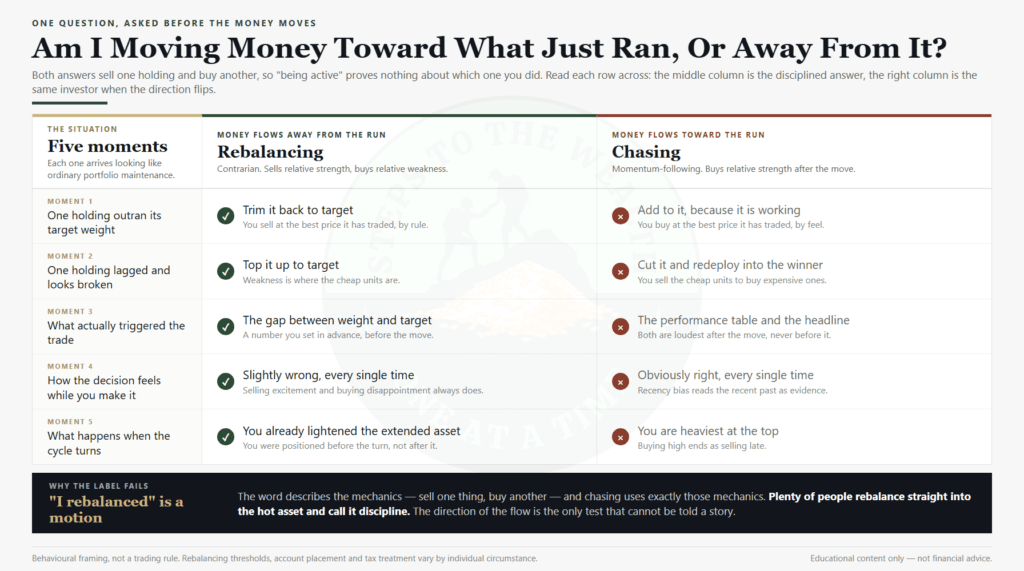
If you are trimming the thing that ran and adding to the thing that lagged, you are rebalancing. You are selling relative strength and buying relative weakness. Contrarian. Disciplined.
If you are adding to the thing that ran because it “has momentum” or “is clearly the winner,” you are chasing. You are buying relative strength after the move. Momentum-following. Emotional.
This is why “I rebalanced my portfolio” is not automatically a virtuous sentence. Plenty of people rebalance straight into the hot asset and call it discipline. The label is not the test. The direction of the flow is the test.
The deeper reason rebalancing wins over time is that asset returns tend to mean-revert across cycles. Extreme winners eventually cool; extreme laggards eventually recover. Rebalancing systematically positions you on the right side of that reversion — lightening up on the extended asset, accumulating the depressed one — without requiring you to call the turn. Chasing positions you on the wrong side of the same reversion, every time.
The same $12,000, pointed two ways
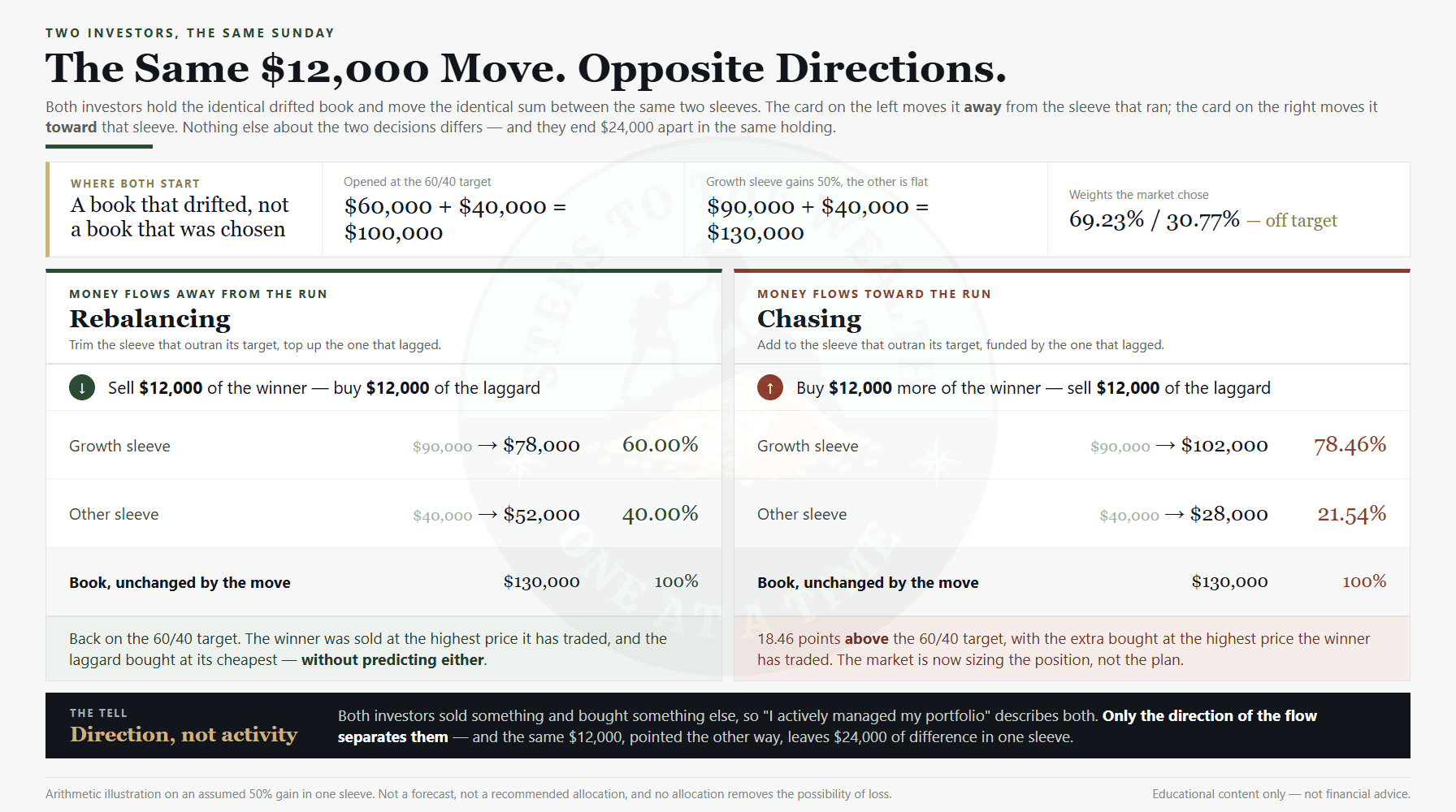
The gap is easier to see with arithmetic than with adjectives. Take a book opened at a 60/40 target: $60,000 + $40,000 = $100,000. Time passes. The growth sleeve gains 50% and the other sleeve is flat, so the book is now $90,000 + $40,000 = $130,000. Nobody decided anything, and yet the weights are now 69.23% / 30.77%. The market re-sized the portfolio while you were at work.
Now two investors each move $12,000 between those same two sleeves.
- Away from the run. Sell $12,000 of the winner, buy $12,000 of the laggard. The sleeves become $78,000 and $52,000 — exactly 60.00% / 40.00%. Back on target, having sold the winner at the highest price it has traded and bought the laggard at its cheapest, without predicting either.
- Toward the run. Buy $12,000 more of the winner, funded by selling $12,000 of the laggard. The sleeves become $102,000 and $28,000 — 78.46% / 21.54%. That is 18.46 points above target, with the extra bought at the highest price the winner has traded.
Same book. Same $12,000. Same number of trades. The two decisions end $24,000 apart in a single holding, and only one of them was chosen by a plan. That is the whole argument for rebalancing vs chasing in one line of arithmetic. It is an illustration, not a forecast — but the mechanics do not change with the numbers you put in.
Why working professionals chase without noticing
Almost nobody sets out to chase. They back into it, usually through one of four doors.
The performance-table door. You look at a list of your holdings sorted by return. The eye goes straight to the top. The bottom looks like a mistake to be corrected. The natural “fix” — sell the bottom, add to the top — is chasing, presented to you by the way the data is displayed.
The news door. The asset that has run is also the asset in the headlines, the one your colleagues are talking about, the one with the exciting narrative. The story makes adding to it feel informed rather than impulsive. But the story is loudest precisely after the move, which is exactly when adding is most expensive.
The frequency door. The more often you look, the more often you feel you should act, and the easiest action to justify is moving toward strength. High-frequency attention plus recency bias reliably produces chasing. This is one of the reasons a system built for a full-time job deliberately limits how often a decision is even on the table.
The conviction door. Sometimes chasing disguises itself as conviction — “I am adding to my winner because I believe in it.” Belief is fine. But if your position size in that asset is drifting upward purely because the price went up, that is not conviction expressing itself through sizing. That is the market sizing your position for you.
In every case the investor believes they are being thoughtful. The structure of the situation is doing the chasing for them.
How a risk-first framework makes rebalancing automatic
The hard part of rebalancing is not knowing you should. It is doing it when every instinct says to do the opposite. A risk-first framework solves that by taking the decision out of the moment and tying it to risk readings instead of price excitement.
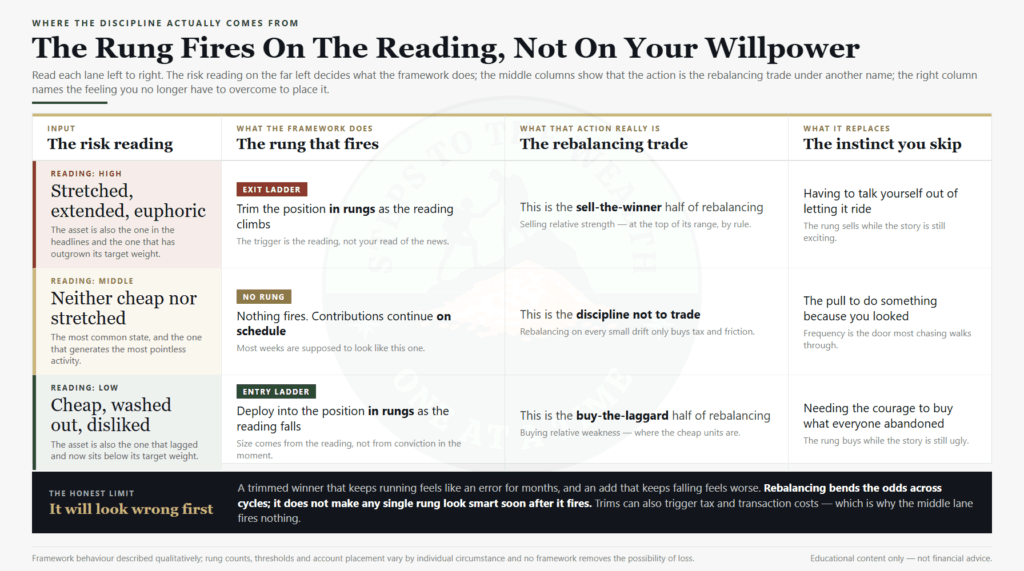
The exit ladder is rebalancing with a trigger. When an asset’s risk reading climbs to high — stretched, euphoric, extended — the framework trims it in rungs. That is the rebalancing trim, fired by a risk signal rather than by your willingness to overcome the urge to let it ride. You are selling strength because the framework says risk is high, which conveniently is also when the asset is overweight in your portfolio. The discipline you would otherwise have to summon is built into the rung.
The entry ladder is rebalancing’s other half. When an asset’s reading drops to low — cheap, washed out, disliked — the framework deploys into it. That is the buy-the-laggard side of rebalancing, again fired by a risk signal instead of by courage. You add to weakness because risk is low, not because you have talked yourself into being brave. The 2008 sequence is the standing example of what that half is worth when it is followed through the ugly part.
Risk-based sizing prevents the drift that creates chasing. Because target exposure is keyed to each asset’s risk reading rather than to its recent return, a winner cannot quietly balloon into an oversized position just because it went up. The framework keeps wanting to trim it as its risk climbs. The structural pressure runs against concentration into strength — the exact opposite of chasing’s pull.
The result is that the framework rebalances for you, on the contrarian side, mechanically. You do not have to win the Sunday-morning argument between “trim the winner” and “let it ride.” The reading decides, and the reading is not swayed by the headline or the performance table. That is the same reason a mechanical contribution schedule works at all — a point covered in the myths around dollar-cost averaging and in the lump-sum comparison, and one that FINRA describes in the same mechanical terms.
How often should you rebalance?
“Whenever it drifts” is not a rule, it is a licence to act on a feeling. Two rules are, and both work. What matters is that you pick one in advance, while you are calm.
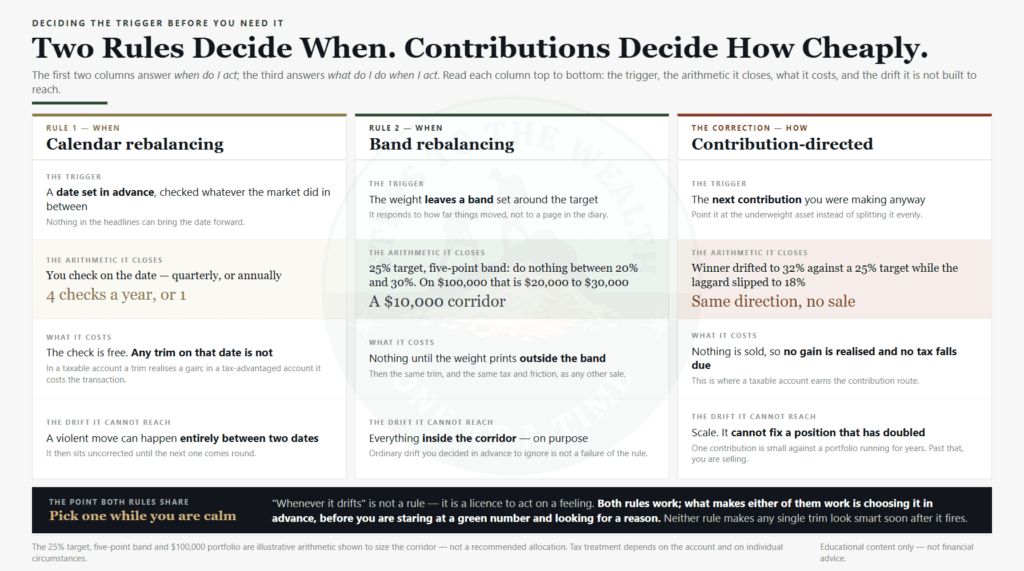
Calendar rebalancing sets a date — quarterly, or annually — and you check on that date whether the weights have moved, regardless of what the market has been doing in between. Its virtue is that the trigger is completely immune to the narrative; nothing in the headlines can bring the date forward. Its weakness is that a violent move can happen entirely between two dates and sit there uncorrected until the next one.
Band rebalancing sets a tolerance around each target and only acts when the weight leaves the band. Closed arithmetic: a 25% target with a five-point band means you do nothing while the holding sits between 20% and 30%, and you act the moment it prints outside that. On a $100,000 portfolio that is a position worth $20,000 to $30,000 — a $10,000 corridor of ordinary drift you have decided in advance to ignore.
Bands tend to suit a risk-first approach better, because they respond to how far things have actually moved rather than to a page in the diary. But the honest point is the one both rules share: they pre-commit you. Whichever you pick, the decision about whether to act was made before you were staring at a green number and looking for a reason.
The cheapest rebalance is the one where you never sell
If you are still contributing every month — and most working professionals are — you already hold a rebalancing tool that costs nothing and triggers no tax: point the new money at the underweight asset instead of splitting it evenly across the portfolio.
Say the winner has drifted to 32% against a 25% target while the laggard has slipped to 18%. Selling the winner realises a gain and pays the friction. Directing this month’s contribution entirely into the laggard moves the weights the same way, in the same direction, without selling anything at all. It is slower — a single contribution is small against a portfolio that has been running for years — but it is free, and slow is not a problem when the drift is ordinary rather than extreme.
The honest limit is scale. Contribution-directed rebalancing can hold a portfolio in shape while drift is modest; it cannot fix a position that has doubled and now dominates everything around it. At that point you are selling, and the tax bill is part of the cost of having been right. Use contributions for the routine correction and reserve the actual trim for the drift contributions cannot reach.
Where the assets sit matters here too. Inside a tax-advantaged account a trim costs nothing but the transaction, so the calculation is simpler and the band rule can run exactly as written. In a taxable account every trim has a bill attached, which is precisely where the contribution route earns its keep. Same portfolio, same targets, two different cheapest paths — worth knowing which one you are on before you set the band.
The honest limits
Rebalancing is not free or infinitely good, and pretending otherwise is its own trap.
It has costs. Every trim can trigger taxes in a taxable account and incur transaction friction. Rebalancing too often — reacting to every small drift — racks up those costs for little benefit. A deliberately slow cadence exists partly to keep rebalancing from degenerating into over-trading. Discipline includes the discipline to not act most weeks.
It can be wrong in the short run. Trimming a winner that then keeps running feels like a mistake for months. Adding to a laggard that keeps falling feels worse. Rebalancing improves odds across cycles; it does not guarantee that any single trim or add looks smart soon after. If you cannot tolerate looking wrong in the short run, you will abandon rebalancing right when it matters.
It assumes your targets were sound to begin with. Rebalancing returns you to your intended allocation. If that allocation was itself a chase — if you “targeted” a heavy weight in the hot asset because it was hot — then disciplined rebalancing just keeps restoring a bad bet. It is worth stress-testing the target itself before trusting the machinery that maintains it.
What this is not
This is not an argument that momentum never works, or that every move toward a strong asset is a sin. Momentum is a real phenomenon over some horizons. The point is narrower: for most working professionals, unstructured moves toward recent winners are chasing, and chasing reliably buys high. If you want momentum exposure, it should be a deliberate, sized, rules-based decision — not a Sunday-night impulse triggered by a performance table. What that deliberate version actually demands is set out in factor investing, where the holding period the arithmetic asks for is the part almost nobody prices.
And it is not personalised advice. Your appropriate targets, rebalancing thresholds, account placement and tax treatment depend on your situation, not on a generic rule.
The one question to ask before you move money
Rebalancing and chasing use the same motion — sell something, buy something else — which is why so many investors do the destructive one while believing they are doing the disciplined one. The only reliable test is direction. Money flowing away from what just ran is rebalancing. Money flowing toward it is chasing.
Rebalancing is selling high and buying low, structurally, without prediction. Chasing is buying high and, sooner or later, selling late. One bends the odds in your favour across cycles. The other bends them against you, every cycle.
The reason a risk-first framework matters here is not that it has a secret. It is that it fires the contrarian trade — trim the extended, add to the depressed — on a risk signal, so you do not have to overcome your own instincts in the moment those instincts are strongest.
Ask the one question before you move money: am I going toward what just went up, or away from it? Then let the framework, not the headline, decide.
Educational content only. Not financial advice. Rebalancing decisions, thresholds, account placement and tax treatment vary by individual circumstance. Work with a qualified financial professional to apply these frameworks to your specific situation.