
If you have recently taken a meaningful financial loss — a position that dropped 60% or more, a concentrated bet that did not work, a sector exposure that imploded, a crypto cycle that went the wrong way — this article is written for you specifically.
Most investing content treats big losses as something to prevent. The content on sizing positions correctly. The content on why concentration is dangerous. The content on staying disciplined. All of it assumes you are reading before the loss happened.
You are reading after. The framework still works, but it has to start from where you actually are, not from where you should have been. What follows is the structural approach to recovering from a big loss: absorbing it, calibrating what to learn from it, and rebuilding the practice from your current position. It is not motivation, and it is not an instruction to shake it off and try again.
First, the arithmetic nobody wants to look at
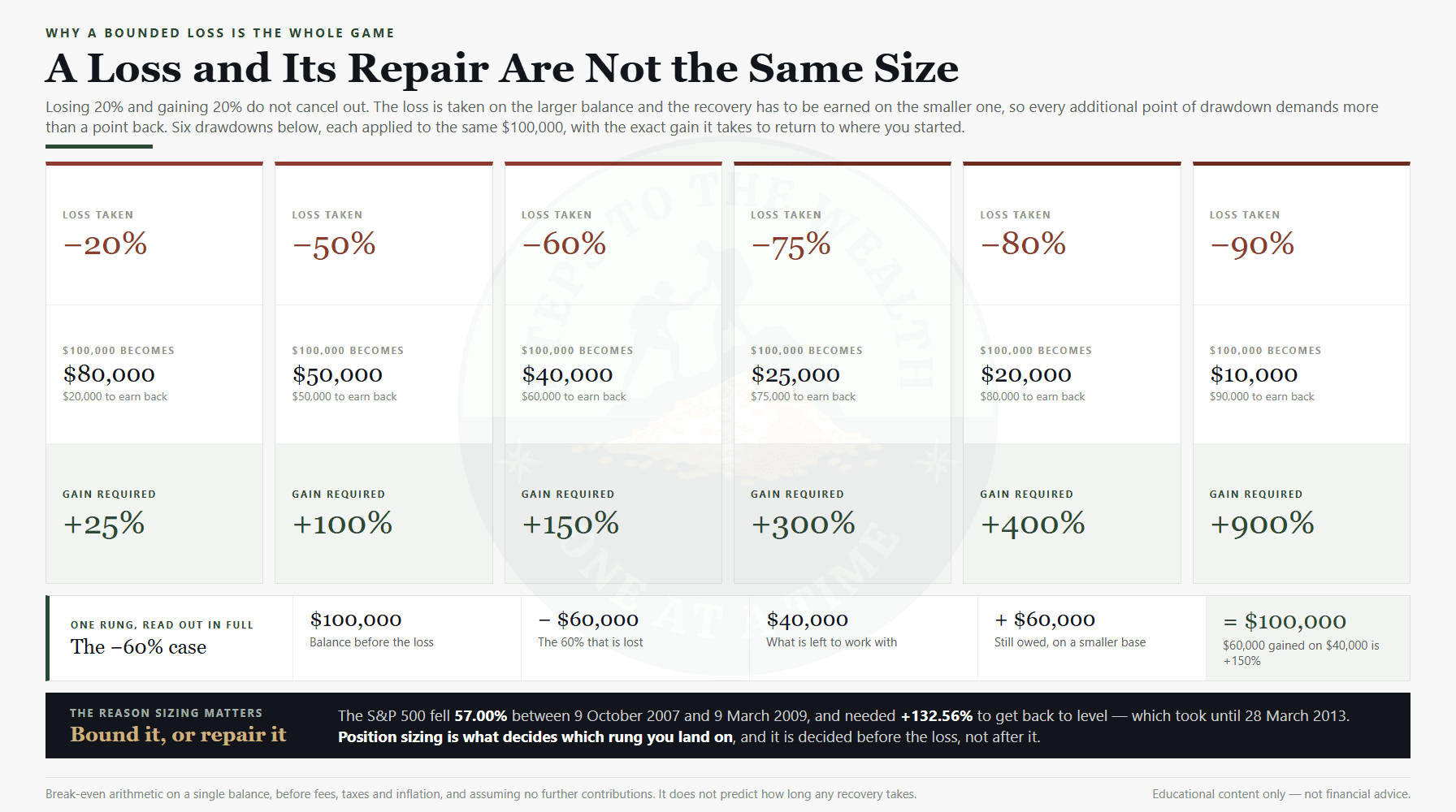
A loss and its repair are not the same size. That sounds obvious and it is routinely underestimated, because the loss is taken on the larger balance and the recovery has to be earned on the smaller one. Losing 20% and then gaining 20% does not return you to where you started.
Applied to the same $100,000, the ladder is unforgiving. A 20% loss leaves $80,000 and needs a 25% gain. A 50% loss leaves $50,000 and needs 100%. A 60% loss leaves $40,000 and needs 150%. At 75% you are left with $25,000 and need 300%. At 90% you hold $10,000 and need 900% simply to get back to level — not to make progress, just to return to the starting line.
This is not a market forecast. It is closed arithmetic, and it is the entire reason position sizing matters more than selection. For a real reference point, the S&P 500 during the 2008 financial crisis fell 57.00% between 9 October 2007 and 9 March 2009, and needed a gain of 132.56% to return to level. That did not happen until 28 March 2013.
Recovery periods vary enormously, and a deep drawdown does not always mean a long one. The COVID crash of 2020 took 33.9% off the index in 33 days and was fully reclaimed on 18 August 2020 — 181 days from peak to recovery, of which 148 were spent climbing back. The point is not that recoveries are fast or slow. It is that the size of the hole determines how much has to go right, and you choose the size of the hole in advance.
Contributions repair the balance, not the position
There is a second arithmetic running alongside the recovery ladder, and it is the one most working professionals actually live through. You are not a static pool of capital waiting on a return. You are still earning, and still contributing.
Take the same $100,000 account after a 50% loss: $50,000 left, needing 100% on returns alone to get back to level. Now add $1,500 a month of ongoing contributions at a 7% annual return. The balance crosses $100,000 again in roughly 26 months — but $39,000 of that is new savings you put in, not recovered capital. The damaged position is nowhere near whole. Your salary closed the gap.
That distinction is worth holding onto, because the statement will not make it for you. A restored balance feels like vindication, and it is easy to read as evidence that the thesis was fine and the sizing was fine. It is evidence of neither. If you re-size the next position off that signal, you have learned the wrong thing from a number that only looks like recovery.
The practical fix is to track two figures separately: total capital contributed, and total return earned on it. A contribution-driven recovery is worth having — it is exactly why the Stage 1 rule about restarting paused contributions is not optional — but it says nothing at all about the decision that produced the loss.
Three honest acknowledgments before the framework
The loss happened, and the first move is not to wish it had not. Most working professionals spend the first 30 to 90 days after a big loss running some version of the same loop. What if I had sized smaller. What if I had taken profits earlier. What if I had never entered. That loop is normal, and past a certain point it is unproductive. Move through the regret rather than around it — the analysis it produces is sometimes useful — but do not still be inside it in two years.
Big losses do not automatically produce wisdom. The idea that every loss is a lesson is romanticised. Some losses produce structural lessons that improve decision-making for decades. Others just produce losses. Which one you get depends almost entirely on what you do in the next 30 to 90 days. The same loss can become a recalibration that improves the next thirty years, or it can become evidence for the wrong conclusion: that you should never take risk again, or that you simply need to be more careful next time without changing anything underneath.
You are not the first person this has happened to. That is not comforting in the moment, but it is structurally true. Essentially every working professional who has built meaningful wealth across multiple market cycles has taken at least one big loss, and often several. The defining variable is not whether the loss happened. It is how the recovery is run.
The four-stage recovery framework
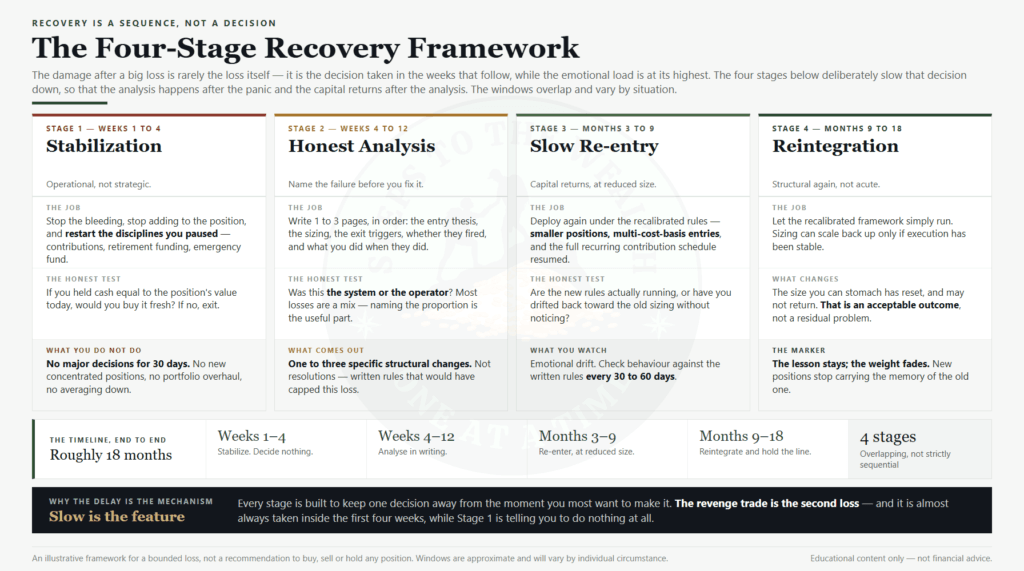
The framework runs across roughly 12 to 18 months following a meaningful loss. The stages overlap and the timeline varies by situation, but the order does not change. Every stage exists to keep one decision away from the moment you most want to make it, because the second loss is almost always the revenge trade, and it is almost always taken inside the first four weeks.
Stage 1 — Stabilization (weeks 1 to 4)
The job in the first month is operational, not strategic.
Stop the bleeding, if there is any left to stop. If the position is still open and still declining, the question is whether to hold or exit now. The honest test: if you held cash equal to the position’s current value, would you buy this position fresh today? If no, exit now, and let the remaining capital deploy elsewhere. Cutting a losing position late is still better than holding it through further decline. If yes, hold — but only if the conviction is structural rather than hopeful. Most answers of yes immediately after a big loss are rationalisations. Sit with it for a few days before acting.
Stop adding to it. No additional capital flows into that position until the Stage 2 review is complete. The instinct after a big loss is often to average down. That is structurally dangerous: the thesis that produced the loss may still be wrong, and adding capital to a wrong thesis compounds it.
Restart the disciplines you paused. If you stopped other contributions, retirement funding or emergency fund maintenance during the loss event, resume them now. The rest of the wealth-building machine still works, and a paused contribution schedule is how one position’s failure cascades into a wider operational failure.
Decide nothing big for 30 days. No new concentrated positions. No attempts to make it back on the next trade. No portfolio overhaul driven by the emotional weight of the loss. Stabilization first, strategy after.
Stage 2 — Honest analysis (weeks 4 to 12)
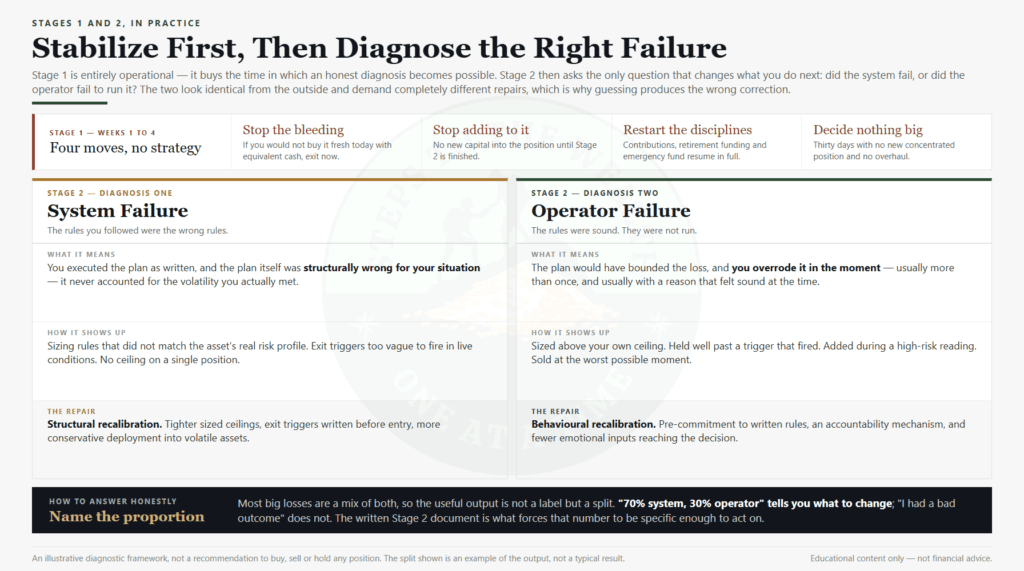
After the first month, the strategic review starts, and it turns on one question: was this a failure of the system or of the operator?
System failure means the strategy you ran was structurally wrong for your situation. The framework did not account for the volatility you actually met. The sizing rules were not appropriate for the asset’s real risk profile. The exit triggers were not defined clearly enough to fire in live conditions.
Operator failure means the system was reasonable and you did not execute it. You sized above your own ceiling. You held past a trigger that fired. You added during a high-risk reading. You sold at the worst possible moment.
Both produce big losses and they demand completely different repairs. System failures need structural recalibration: tighter sized ceilings, exit triggers written before entry, more conservative deployment into volatile assets. Operator failures need behavioural recalibration: pre-commitment to written rules, an accountability mechanism, and fewer emotional inputs reaching the decision.
Most big losses are a mix. The honest analysis names the proportion, because a split is actionable and a verdict is not. Saying it was 70% system and 30% operator tells you what to change. Saying you had a bad outcome does not.
Document the failure in writing. Sit down and write one to three pages, in chronological order, with the specific decisions and the reasoning behind each. What was the entry thesis? How did you size the position, and was there a ceiling? What were the exit triggers? Did they fire, and what did you do when they did? What did you do as the position continued past them?
The writing forces specificity. Most people carry a vague memory of the loss event that resolves to nothing more useful than a feeling that they should have known better. The written record produces something you can act on.
Name one to three structural changes. From the analysis, identify the specific rules that would have prevented the loss or capped it at a smaller magnitude — a smaller sized ceiling on that category of asset, exit triggers written before the position opens, multi-cost-basis entry rather than a single lump sum, a pre-committed maximum drawdown beyond which the position closes regardless of thesis, or an independent review of any high-conviction position before it is sized large. Those changes are the recalibration, and they are what carries forward.
Stage 3 — Slow re-entry (months 3 to 9)
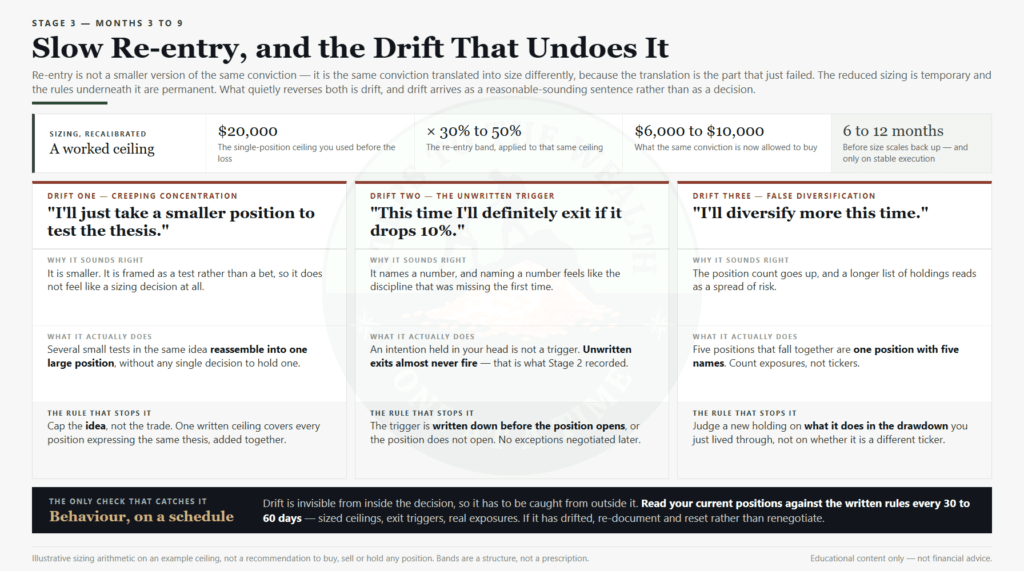
Once the analysis is done, capital starts deploying again, slowly, under the recalibrated rules. The principle is smaller positions, more disciplined sizing, and multi-cost-basis entries.
In practice that means the same conviction now translates into a much smaller position — roughly 30% to 50% of what you would have sized before. If your pre-loss single-position ceiling was $20,000, re-entry sizing is $6,000 to $10,000. Not because the conviction is necessarily wrong, but because the recent loss is direct evidence that your conviction-to-sizing translation needed recalibration. Over the following 6 to 12 months, sizing can scale back up if the recalibrated approach produces stable execution. The reduced size is temporary; the rules underneath it are permanent.
Resume the deployment system in full at the same time. Whatever recurring contributions and framework execution you were running before, restart them. The mistake to avoid is abandoning an entire investing practice because one element of it failed. If the risk needs addressing, address the risk — running the portfolio through a stress test is a more useful response than stepping away from the market altogether. If the whole idea of deploying again is what feels impossible, the risk-first framework is built for exactly that starting point.
The first 9 to 12 months after a big loss are when emotional drift is most likely to quietly compromise the new rules. Drift does not arrive as a decision. It arrives as a reasonable-sounding sentence:
- “I will just take a smaller position to test the thesis.” Several small tests in the same idea reassemble into one large position, without any single decision to hold one. Cap the idea, not the trade.
- “This time I will definitely exit if it drops 10%.” An intention held in your head is not a trigger, and unwritten exits almost never fire. That is usually what the Stage 2 document already recorded.
- “I will diversify more this time.” Five positions that fall together are one position with five names. Count exposures, not tickers — FINRA’s primer on asset allocation and diversification is a useful check on what actually qualifies.
The recalibration only works if the new rules actually run, which means checking your behaviour against the written rules every 30 to 60 days rather than trusting your sense of whether you are following them.
Stage 4 — Reintegration (months 9 to 18)
Roughly a year after the loss event, recovery starts to feel structural rather than acute.
The position size you can stomach has reset, and the pre-loss comfort may not return for years, or ever. That is structurally fine. The recalibrated rules produce better long-term outcomes than the pre-loss rules did anyway.
The framework is also now informed by the loss. The rules you use after a big loss are usually meaningfully better than the ones you used before, because the sized ceilings and exit triggers have been calibrated by lived experience of what happens when one element fails. There is a compounding effect worth naming: working professionals who recover well from a major loss often produce better long-term outcomes than those who never took one, because a loss-recalibrated framework is more conservative in precisely the right places.
The emotional weight fades too. By month 12 to 18 the specific loss is less acute. The lesson stays; the visceral memory softens, and new positions stop carrying the weight of the old one.
Recalibration and retreat look identical for about a year
The common failure on the far side of a big loss is not a second big loss. It is a permanently reduced position size, held for a decade, on the unexamined belief that caution has become the strategy.
Stage 3 sizing and a quiet withdrawal from risk produce the same account for the first 6 to 12 months, which is why the difference is so easy to miss. They separate on one question: is the smaller size attached to a written rule with a stated scale-up condition, or is it attached to how you feel about the market this month? A recalibration reads “30% to 50% of prior sizing until the recalibrated rules run clean for two consecutive quarters, then step back up.” A retreat reads “smaller, for now” and never sets a date to revisit it.
The cost of the second one never appears on a statement. Capital held out of the market for ten years is not destroyed, so nothing shows up as a loss — it is simply a return that was never earned, and there is no line item for that. It is a real cost regardless, and it is usually larger than the loss that caused it.
None of which means retreat is always wrong. If the honest Stage 2 analysis concluded that you cannot execute a written rule under live stress, then a permanently smaller allocation to self-directed positions is the correct answer, with the rest running on a mechanical, automated schedule that does not ask you to decide anything. That is a legitimate structural conclusion. The requirement is only that it be a decision you made and wrote down, rather than a drift you never noticed.
What this framework does not fix
Losses that wipe out essentially all liquid assets. The framework above assumes a loss that was meaningful but bounded — typically 20% to 50% of investable capital. Catastrophic losses require support beyond the scope of an article. If you are in that situation, get help.
Losses driven by fraud or theft. These are different from market-driven losses. Recovery has both the investing components described here and a separate legal and restorative component that this framework does not address.
Losses that compound with concurrent life events. Job loss, divorce, a health crisis or a death in the family exceed the scope of an investing-only framework. The human cost comes first, and the investing recovery proceeds at a slower pace.
One thing to do this week
If the loss is recent: run Stage 1. Stabilize, restart the disciplines you paused, and make no major decisions for 30 days.
If you are one to three months past it: block two hours and write the Stage 2 document. Force specificity, then name the one to three structural changes that come out of it.
If you are six to twelve months past it: you are in Stage 3 or moving into Stage 4, and the work is honest evaluation. Pull your current positions. Check the sized ceilings. Check the exit triggers. Confirm the recalibration is still durable, and if it has drifted, re-document and reset rather than renegotiate.
If you have never taken a meaningful loss: the framework still applies, preemptively. Sizing rules calibrated in advance are what determine that when a meaningful loss eventually arrives — statistically, it will — it is bounded at a level you can recover from in 12 to 18 months rather than 5 to 10 years. Which rung of that ladder you land on is decided before the loss, not after it.
Educational content only — not financial or psychological advice. Big financial losses can have significant emotional impacts that exceed the scope of an investing framework. If you are experiencing severe emotional distress, please reach out to a qualified mental health professional. For guidance specific to your circumstances, consult a qualified financial advisor.