
A margin of safety in investing is the room you build into a plan so that being wrong costs you a setback instead of the account.
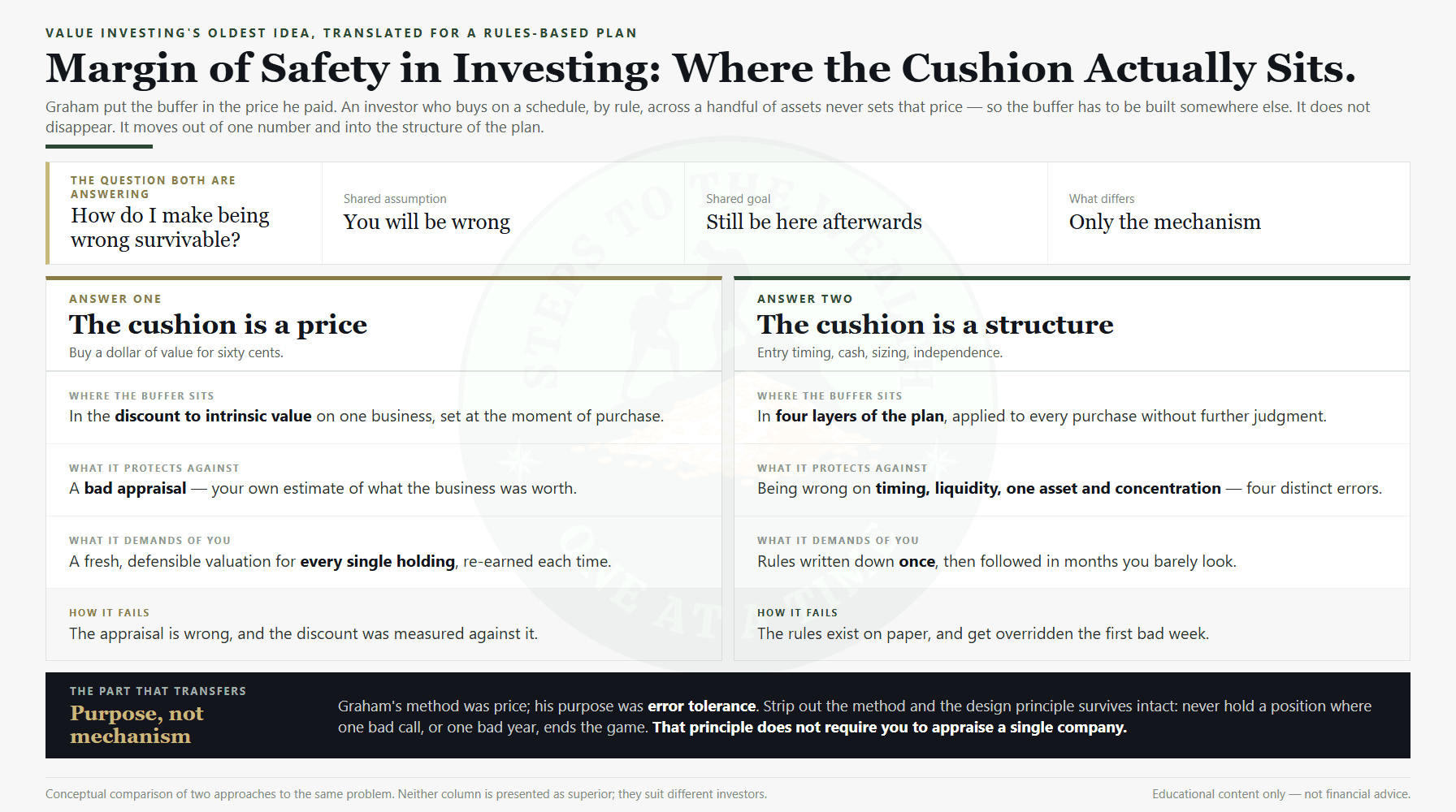
The phrase comes from value investing, where it means buying a dollar of value for sixty cents. The forty-cent gap is the protection — against a bad appraisal, a bad quarter, or plain bad luck. It is a sound idea. It is also an idea built for someone who sits down with an annual report and forms a private opinion about what a business is worth.
Most people reading this do not do that. They have a job. They invest on a schedule, across a handful of assets, by rules set in advance precisely so they do not have to form a private opinion every Tuesday. So the fair question is whether the margin of safety survives that translation, or whether it is something only stock-pickers get to have.
It survives. It just moves. Out of the price of one business, and into the structure of the plan: when you buy, how much cash you keep back, how large any single position is allowed to get, and how independent your holdings actually are.
What is a margin of safety in investing?
A margin of safety in investing is the buffer between what has to go right for your plan to work and what has to go right for it to merely survive. It is the space that lets you be wrong and still recover.
Benjamin Graham built the term around price. If a business was worth $10 a share, you tried to buy near $6, so that even if the estimate was too generous you had a cushion before the mistake cost you anything permanent. The goal was never to maximise the upside. It was to make an error survivable, because errors were assumed.
That assumption is the part that transfers. The mechanism Graham used was price; the purpose was error tolerance. Strip out the method and you are left with a design principle: never put yourself in a position where one bad call, or one bad year, ends the game.
Which means the useful question is not “how do I avoid being wrong.” You will be wrong. The useful question is “what does being wrong cost me, and can I still be here afterwards.”
The value investor’s cushion is a price. Yours has to be a structure.
If you do not appraise individual businesses, your cushion cannot come from “I bought this below what it is worth.” A systematic investor buys on a rule, not on a valuation judgment, so the protection has to be built somewhere other than the entry price of one company.
It gets built into four places: when you buy, how much dry powder you keep, how large any one position is, and how independent your holdings are. The value investor concentrates safety into a single number — the discount to intrinsic value. The systematic investor distributes it across the design of the plan.
| Value investor’s margin of safety | Systematic investor’s margin of safety |
|---|---|
| Buy well below intrinsic value | Buy when measured risk is low, not stretched |
| The cushion sits in the entry price | The cushion sits in cash held back for later |
| Protection per individual stock | Protection from sizing — no single bet can sink you |
| Requires appraising each business | Requires no company-level judgment |
| One decision, deeply researched | One repeatable rule, applied every time |
Neither column is better in the abstract. They are two answers to the same question: how do I make being wrong survivable. The value investor answers with price. The systematic investor answers with structure — which happens to be the only one of the two you can actually run around a full-time job.
There is a second, quieter advantage to the structural version. A price-based cushion has to be re-earned on every purchase, one company at a time, and it depends on an appraisal you might get wrong. A structural cushion is set once and then applies to every purchase you make afterwards, without further judgment. It does not get tired. That matters more than it sounds, because the failure mode for a working investor is almost never a bad analysis. It is skipping the analysis in a busy month.
How to build a margin of safety into a systematic plan
You build it in layers, and each layer buffers a different way the plan can be wrong. None of them is sufficient alone. Stacked, they are what let you keep investing through the stretches that make other people quit.
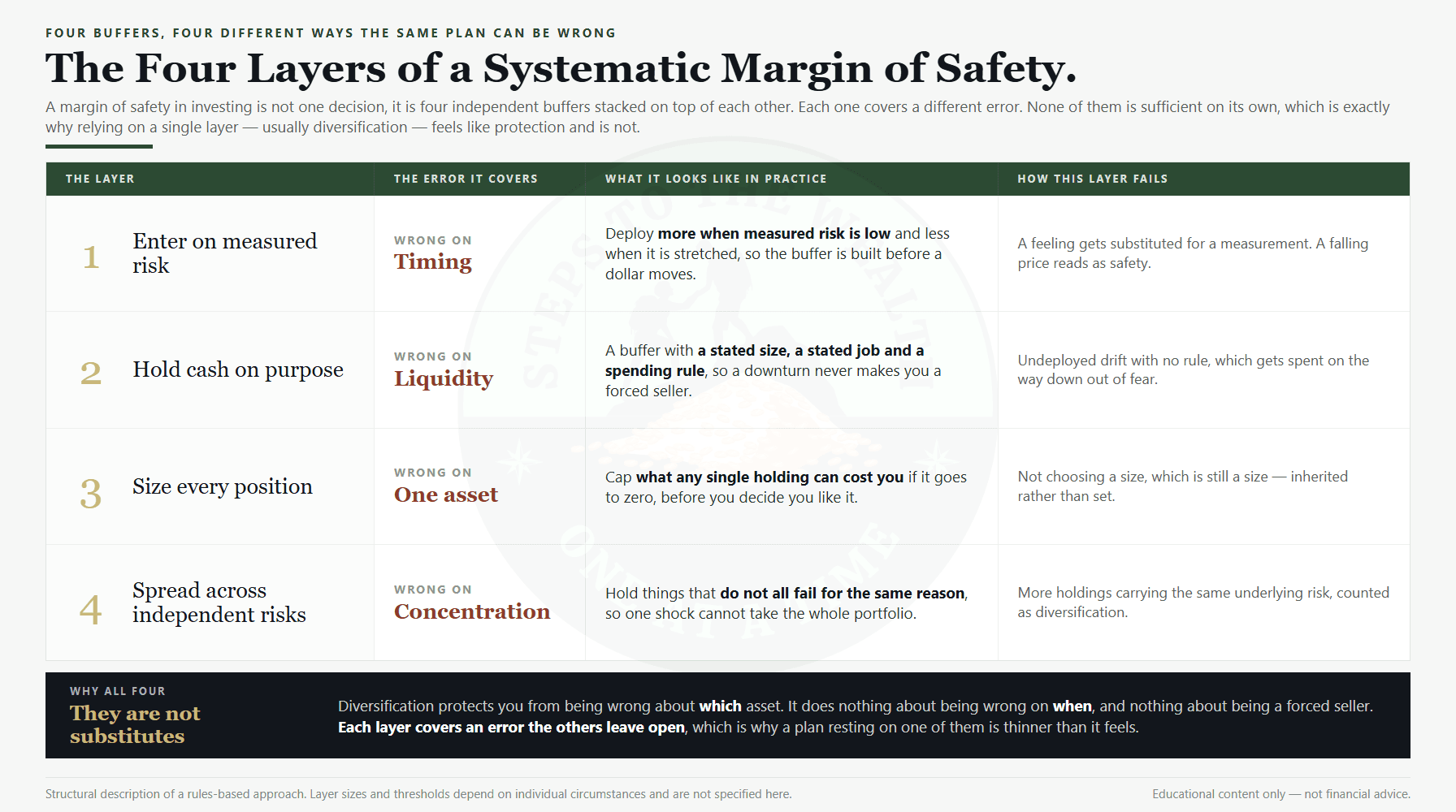
First, enter on measured risk, not on price alone. The cheapest structural cushion available to you is simply not deploying heavily when conditions are stretched. That requires a way to tell stretched from calm that is not your mood, which is the entire argument for a risk-first framework over a returns-first one. Buying more when measured risk is low and less when it is high bakes a buffer into the timing of the plan itself, before a single dollar moves.
This is also where most people quietly substitute a feeling for a measurement. A falling price feels like lower risk and a rising one feels like safety, and both readings are backwards often enough to be expensive. The staging question — all at once or spread out — is worth understanding on its own terms, and the honest answer in lump sum versus dollar-cost averaging is that they optimise for different things: one for expected return, the other for the size of the mistake you can make.
Second, hold cash on purpose. An investor with no dry powder is one bad month away from being a forced seller, and a forced sale at the bottom is exactly how a temporary loss becomes a permanent one. A deliberate cash buffer is the margin of safety in its most literal form. It is the reason a downturn is an opportunity to one person and an emergency to another, with the same portfolio and the same headlines.
Note the word deliberate. Cash that is there because you have not got round to investing it is not a buffer, it is drift. A buffer has a stated size, a stated job, and a rule for when it gets spent. The difference shows up under stress: drift gets spent on the way down out of fear, a buffer gets spent on the way down by design.
Third, size positions so that no single one can end you. A margin of safety at the portfolio level means capping what any one asset can cost you if it goes to zero. Sizing is the quiet lever that decides whether a bad call is a scratch or a wound, and it operates whether or not you thought about it. Choosing not to size is still sizing, just badly.
The practical version is a small, deliberate set of holdings you can actually keep track of. The Steps To The Wealth approach favours a custom portfolio of up to ten assets, staged and sized so that no single one, and no single year, can force your hand.
Fourth, spread across genuinely independent risks. Owning things that do not all fail for the same reason means one shock cannot take the whole portfolio. That is diversification doing its real job — not smoothing the ride, but making a single failure survivable. The US Securities and Exchange Commission’s investor education arm puts the same point plainly in its guidance on asset allocation and diversification: the purpose is to limit what any one holding can do to the whole.
Four layers, four errors covered: wrong on timing, wrong on liquidity, wrong on one asset, wrong on concentration. That is what a margin of safety looks like when it is engineered into a system instead of priced into a single trade.
How big should the buffer be?
Big enough that a normal bad outcome is survivable, small enough that you are still meaningfully invested. The tension between those two sentences is the whole decision.
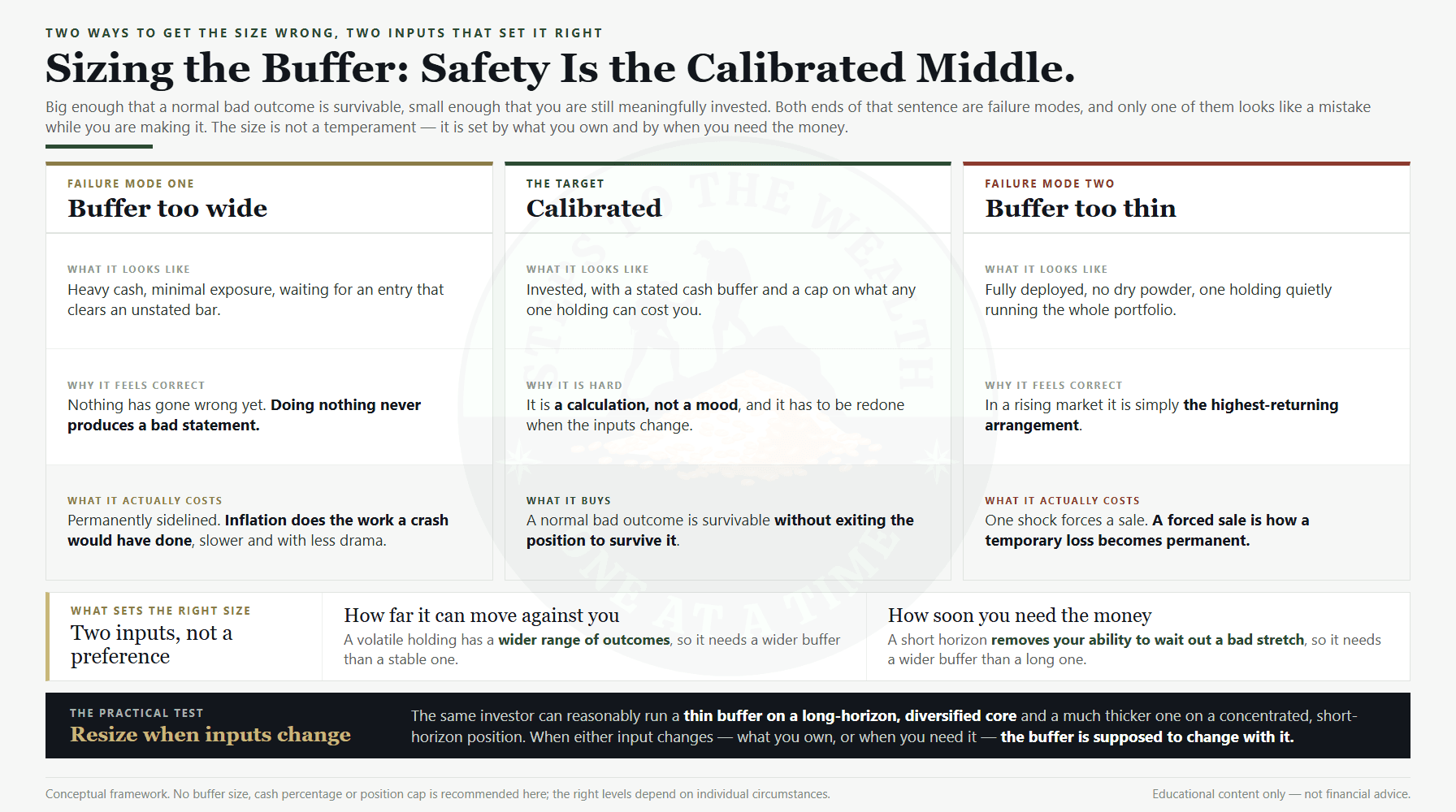
Push it too far and you are permanently on the sideline, holding so much cash and so little exposure that inflation quietly does to you what a crash would have done, only slower and with less drama. Leave it too thin and one shock does lasting damage. Neither extreme is safety. Safety is the calibrated middle, and calibration is a calculation, not a temperament.
The right size is not one number. It scales with two things. The first is how far a given asset can move against you: a volatile holding needs a wider buffer than a stable one, because the range of outcomes is simply larger.
The second is how soon you need the money. Capital you need in three years needs a wider buffer than capital you will not touch for twenty, because a short horizon removes your ability to wait out a bad stretch. Anyone mapping contributions against a target date will recognise the same variable at work in how savings benchmarks change by age: the horizon is doing most of the work.
This is why the same investor can reasonably run a thin buffer on a long-horizon, diversified core and a much thicker one on a concentrated, short-horizon position. The buffer is not a personality trait. It is a function of what you own and when you need it, and it should change when either of those changes.
Why the buffer matters more than the upside
The case for building a cushion does not rest on caution as a virtue. It rests on arithmetic, and the arithmetic is not symmetrical.
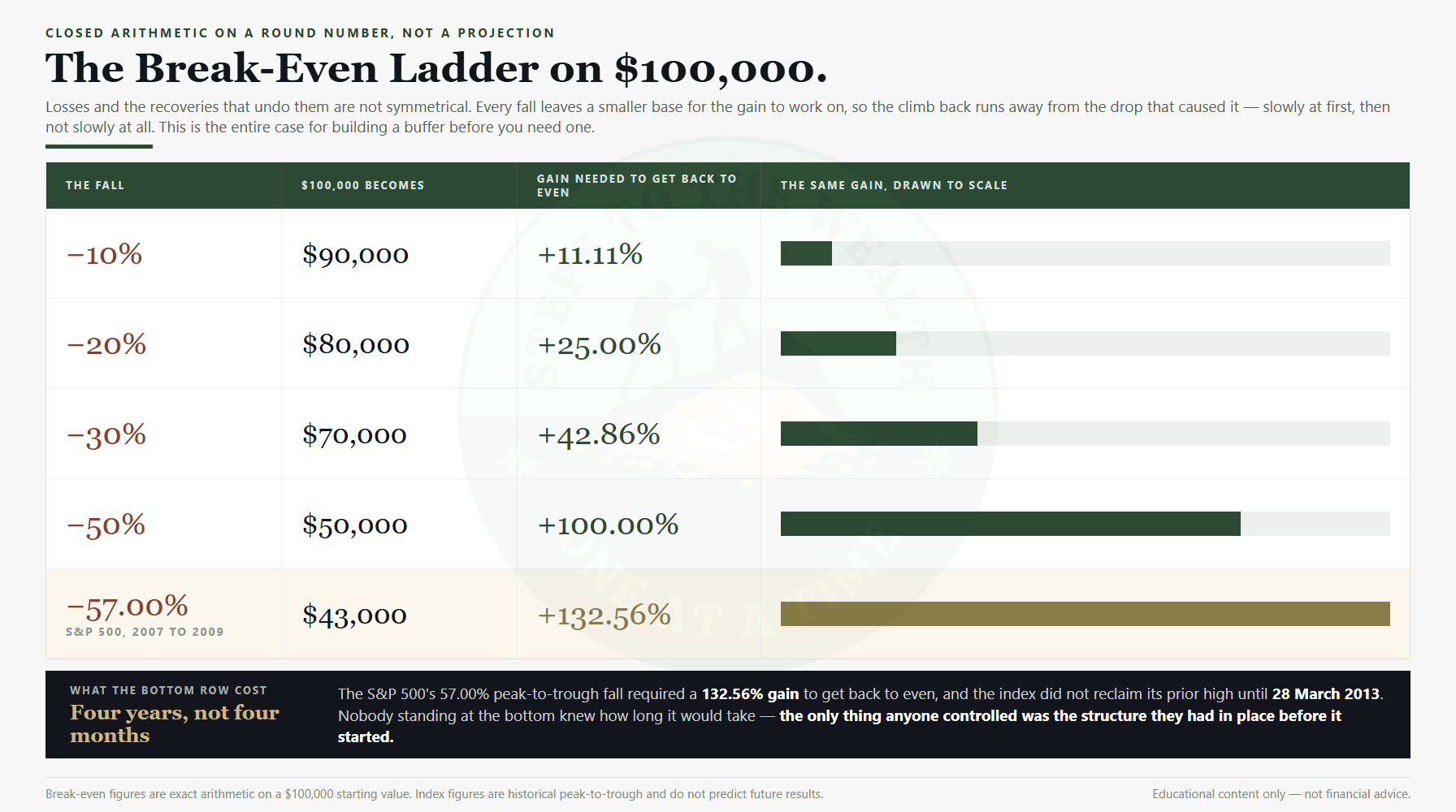
Take $100,000. A 20% fall leaves $80,000, and getting back to even needs $20,000 on a smaller base — a 25% gain. A 50% fall leaves $50,000 and needs a 100% gain. The required recovery grows faster than the loss that caused it, and it keeps accelerating: by the time the hole is deep, the climb out is far steeper than the fall in.
That is not a hypothetical. The S&P 500 fell 57.00% peak to trough in the global financial crisis, which required a 132.56% gain to get back to even, and the index did not reclaim its prior high until 28 March 2013. The full arithmetic and the behaviour around it is worked through in the 2008 financial crisis case study.
The COVID crash ran the same play at a completely different speed: 33.9% down in 33 days, and back to the prior high 181 days after the peak, on 18 August 2020, as set out in the 2020 COVID crash study.
Two things follow from that pair. The first is that a buffer is what keeps a drawdown from converting into a sale, and a sale is what converts a paper loss into a permanent one. The second is that you cannot know in advance which kind of decline you are in. Nobody standing in March 2020 knew it was a 33-day event rather than a 2008 event, and the structure you had in place before it started was the only thing you actually controlled.
Three things a margin of safety is not
It is not diversification by itself. Owning more things is one layer of the buffer, not the buffer. In a broad enough sell-off, correlations converge and a spread portfolio falls with everything else. A 60/30/10 mix fell 58.10% over 2007 to 2009 against 57.00% for the S&P 500 alone. The diversified version was not the safer one on that measure, which is worth sitting with before treating a spread of holdings as protection. The mechanics of why are set out in the portfolio stress test.
Diversification protects you from being wrong about which asset. It does nothing about being wrong on when, or about being a forced seller. Those need different layers, which is the entire point of stacking four rather than relying on one.
It is not a forecast. A buffer does not require you to predict anything. That is its main practical advantage. Buying when measured risk is low is not a claim that prices will rise; it is a statement about the conditions you are entering under. If your safety depends on a call being right, it is not a margin of safety, it is a position.
It is not the same as feeling careful. Plenty of investors describe themselves as cautious and hold no cash, run no sizing rule, and check the portfolio daily. Caution that is not written down as a number does not survive contact with a bad month. Several of the more expensive investing habits look like prudence from the inside — more of them are catalogued in common dollar-cost averaging myths — and the test for every one of them is the same: is there a rule, or is there a mood.
Where this fits in a risk-first system
A margin of safety is what risk-first means at the level of a single decision. You settle how much you can afford to be wrong before you settle how much you hope to make.
That ordering is not a stylistic preference. It is the only order that works, because the downside constrains everything downstream of it: how much you can deploy, how concentrated you can be, how long you can wait. Decide the upside first and the downside becomes whatever is left over, which is how people end up in positions they cannot hold. This is the same logic that governs the whole approach to investing while working full time, where the scarcest resource is attention and the plan has to survive months where you barely look at it.
It is also why a systematic investor can stay steady when others cannot. When the cushion is already built — bought at low measured risk, cash held back, nothing sized large enough to ruin you — a drawdown is something the structure anticipated. You are not hoping the market cooperates. You built a plan that survives it not cooperating.
That is the difference between a margin of safety and a good mood. One holds when the market turns. The other evaporates at exactly the moment you need it.
One thing to do this week
Pick your largest single holding and write down two numbers: what percentage of the portfolio it is, and what happens to the total if it falls 50%. If the second number makes you want to close the tab, the position is not sized, it is inherited. That is the whole audit, and it takes about four minutes.
Then write down what your cash buffer is for and when it gets spent. Not the amount — the rule. If you cannot state the rule in one sentence, you are holding drift, and drift gets spent at the wrong end of a decline.
A margin of safety protects you from being wrong. A risk reading tells you when you need it most.
Structure lets you survive being wrong. The buffer works best when you widen it before conditions get dangerous, and that means knowing, in plain terms, whether risk is calm or stretched right now.
Steps To The Wealth Weekly delivers a plain-English risk reading every Sunday across five major assets — the signal that tells you when to lean in and when to hold back, so the buffer is sized to conditions instead of guessed.
No predictions. No hype. Just a clear read on where risk actually sits, every week. If that is not what you are looking for, no hard feelings.
Frequently asked questions
What is a margin of safety in investing?
A margin of safety in investing is the buffer built into a plan so that being wrong — about an asset, a price or the timing — costs you a setback rather than the account. It originated in value investing as buying below intrinsic value, but the underlying purpose is error tolerance: assume you will make mistakes, and structure the portfolio so that no single one is fatal.
How does a margin of safety work if you do not pick individual stocks?
It shifts from the entry price of one company to the structure of the whole plan. Instead of “I bought it cheap,” the cushion comes from buying when measured risk is low, holding cash so you are never a forced seller, sizing positions so none can sink you, and spreading across independent assets. The mechanism changes; the purpose — surviving being wrong — does not.
How big should a margin of safety be?
Big enough that a normal bad outcome is survivable, small enough that you are still invested. It scales with how far the asset can move against you and how soon you need the money. A volatile holding or a short horizon calls for a wider buffer; a stable holding or a long horizon allows a thinner one. Too much leaves you permanently sidelined; too little leaves you exposed.
Is holding cash a margin of safety?
Yes, and it may be the most literal form of one. A deliberate cash buffer is what stops a downturn from turning you into a forced seller, which is how a temporary loss becomes a permanent one. It also gives you the option to buy when others are selling. The word that matters is deliberate: cash with a stated size and a stated spending rule is a buffer, cash you simply have not deployed is not.
Is a margin of safety the same as diversification?
No. Diversification is one layer of it, not the whole thing. It protects you from being wrong about a single asset and does nothing about timing or liquidity. A 60/30/10 mix fell 58.10% over 2007 to 2009 against 57.00% for the S&P 500 alone, which is a useful reminder that spreading holdings is not the same as being protected.
Does a margin of safety reduce my returns?
It changes the shape of them. Holding cash and capping position sizes will cost you something in the strongest stretches, and that cost is real. What it buys is a much lower chance of the outcome that actually destroys long-run results: being forced to sell near a low, or being out of the market entirely after a loss you could not absorb. Whether that trade is worth it depends on your horizon and on how much drawdown you can hold without acting.
Educational content only — not financial advice. Historical figures are stated as of the dates shown and are illustrative of how losses and recoveries behave, not forecasts or expected returns. Position sizing, cash levels and asset choices depend on your individual circumstances. Consult a suitably qualified professional before acting.