
Educational content only. Not financial advice.
Optionality vs retirement is a different number, not a different mood
Most working professionals carry one endgame in their head: retire. Save enough that you never have to work again, endure the years in between, collect at the end.
The usual objection to that plan is psychological — that people who stop entirely tend to drift. That objection is real, but it is soft, and soft arguments do not change behaviour.
The harder version is that optionality vs retirement is a difference in the number. They are the same piece of arithmetic run on two different inputs, and the gap between the answers is large enough to move the date by the better part of a decade.
Optionality is the point where work becomes a choice: enough capital that walking away would not sink you, whether or not you ever walk. Retirement, as normally defined, is the point where your capital funds the life you live now, indefinitely, with no further income.
Both are a capital target. Both come from the same formula. Only the spending figure you feed in changes. That is the whole product, and it is why the two numbers can be compared honestly rather than argued about.
The two numbers, and the arithmetic behind both
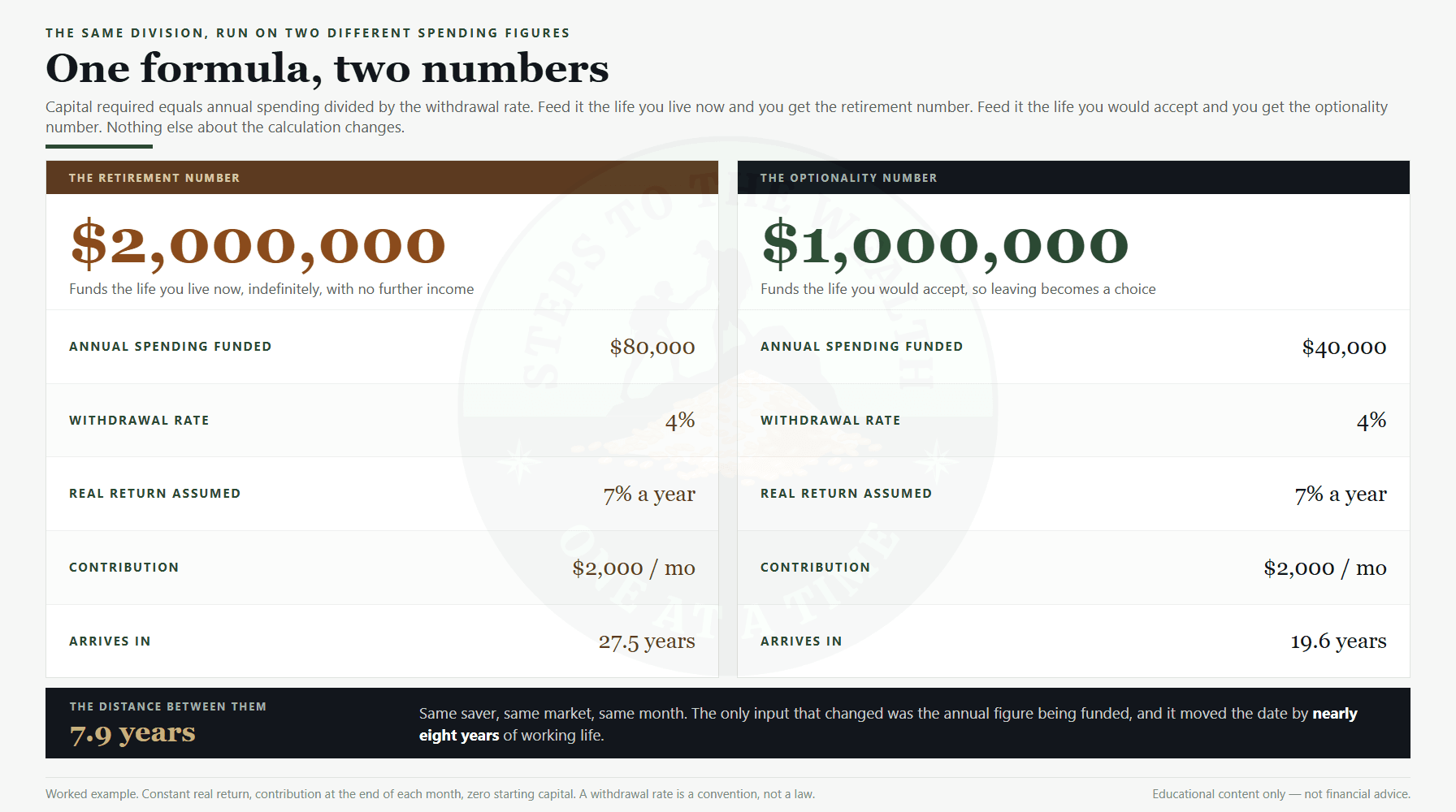
Take a professional spending $80,000 a year. At a 4% withdrawal rate, funding that indefinitely takes $2,000,000. That is the retirement number, and it is the one most people are aiming at, usually without having worked it out.
Now ask a different question. Not what your life costs, but what the version of your life you would genuinely accept costs. Not comfortable — acceptable. Housing, food, healthcare, some basic recreation. For most working professionals that lands somewhere between 40% and 60% of current spend.
Call it $40,000. At the same 4% withdrawal rate, funding that indefinitely takes $1,000,000.
Same formula, same withdrawal rate, same assumptions. One input changed, and the target halved.
The second number is not the number that lets you keep your current life without working. It is the number that means you would be fine if you walked away, which is a different and much cheaper thing. It is also the number that actually governs your freedom of movement, because the moment you could survive leaving is the moment leaving becomes negotiable.
You can run both against your own figures in the Optionality Tracker, which is built around exactly this comparison.
Halving the target buys about eight years
A halved target is worth stating in time rather than money, because time is what you are actually buying.
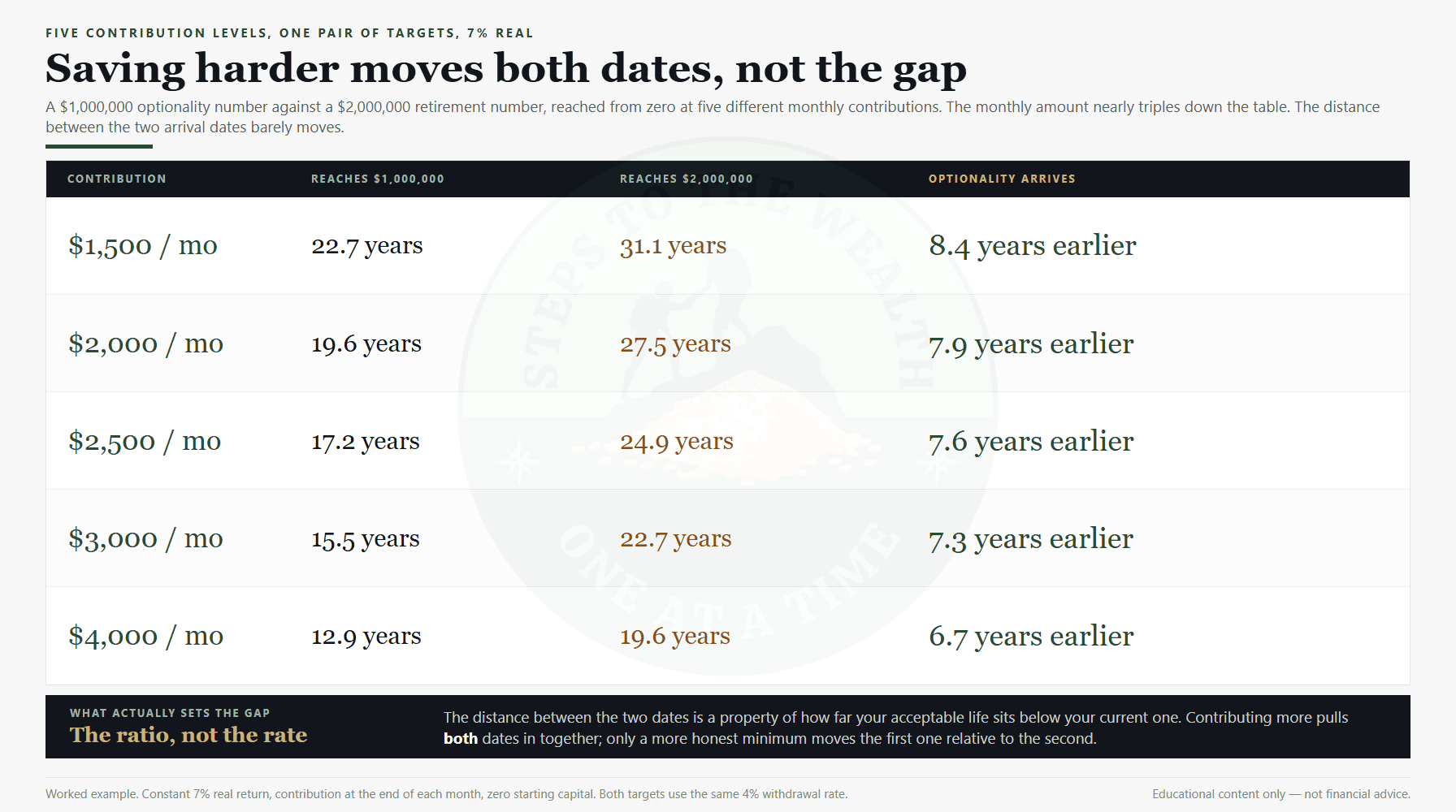
Take someone contributing $2,000 a month at 7% a year after inflation, starting from nothing. The $1,000,000 optionality number arrives in 19.6 years. The $2,000,000 retirement number arrives in 27.5 years. The difference is 7.9 years.
The interesting part is what happens when you change the contribution. At $1,500 a month the gap is 8.4 years. At $4,000 a month it is 6.7 years. Across a range where the monthly amount nearly triples, the gap moves by less than two years.
That stability is the useful finding. Saving harder pulls both dates in, roughly together. It does not close the distance between them, because the distance is a property of the ratio between the two targets, not of your savings rate. The only thing that moves it much is the ratio itself — that is, how far your acceptable life sits below your current one.
So there are two levers, and they do different jobs. Contributing more moves both dates earlier. Being honest about your minimum moves the first date earlier relative to the second. Most people work only the first lever, and never look at the second at all.
What the second lever is actually worth
Since the ratio between the two targets is what sets the gap, it is worth pricing that lever directly rather than leaving it as a principle.
Hold everything else still: $80,000 of current spend, $2,000 a month, 7% real. The retirement number arrives in 27.5 years in every row below. Only the definition of an acceptable life changes.
If your minimum is 70% of current spend, the optionality number is $1,400,000 and it arrives 4.2 years early. At 60% it is $1,200,000, six years early. At 50% it is $1,000,000, eight years early. At 40% it is $800,000, and it arrives 10.3 years early.
The span between the top and bottom of that table is more than six years of working life, and it is decided entirely by a number you write down about yourself. No market return, no contribution rate and no product is involved.
Two cautions come with that, and they pull in opposite directions. The first is obvious: a minimum you set unrealistically low buys you a date you will not accept when you get there, and re-raising it later moves the date back out. The second is less obvious: most people set the figure by imagining their current life with things removed, which anchors it far too high. The honest version is not your life minus luxuries. It is the cheapest arrangement you would still consider a good life, which for many people is a different arrangement rather than a thinner one.
The number is a judgement about yourself, not a calculation, and it is the highest-leverage judgement in the whole exercise.
Why the retirement framing survives anyway
If the smaller number is reachable so much sooner, the obvious question is why almost nobody aims at it.
Partly it is that nobody sells it. There is an industry attached to the retirement number, and none attached to the optionality number. Products, projections and annual statements are all denominated in the larger figure.
Partly it is that the smaller number requires an uncomfortable admission. To calculate it you have to write down the life you would accept, which means conceding that a cheaper version of your life exists and is survivable. That is a harder sentence to write than it looks.
And partly it is that the retirement number is the only one anyone ever quotes, so it becomes the number, the way a list price becomes the price. It is worth noticing that the standard age-based savings benchmarks are all built on the same assumption, which is why they mislead as often as they help.
None of that makes the retirement number wrong. It makes it one number out of two, presented as though it were the only one.
The ladder, and why its rungs are not one scale
The two headline numbers sit at the top of a longer ladder, and the ladder contains a trap worth understanding before you read your own position on it.
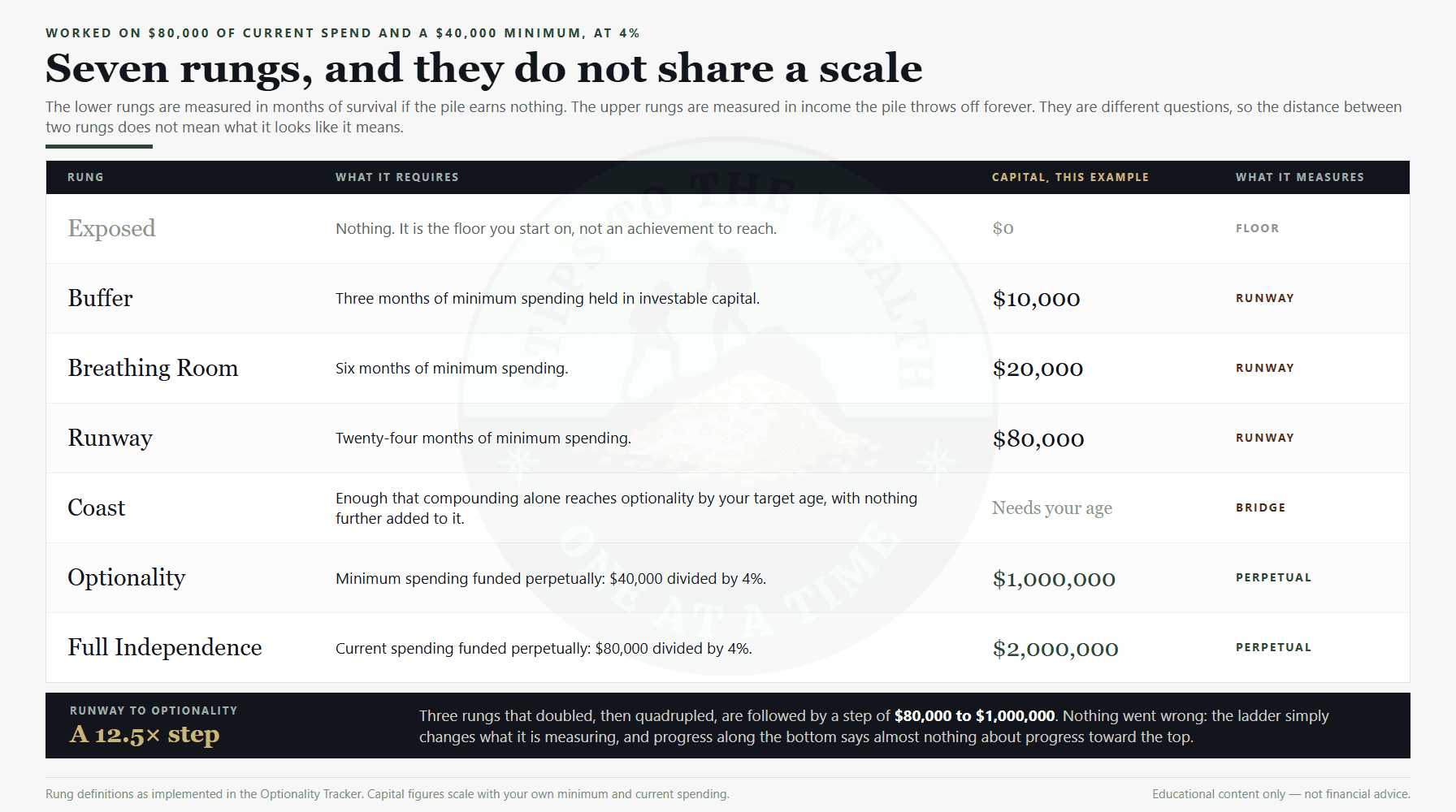
On the same $80,000 / $40,000 example, at 4%, the rungs are these. Buffer is three months of minimum spend: $10,000. Breathing Room is six months: $20,000. Runway is twenty-four months: $80,000. Optionality is $1,000,000. Full Independence is $2,000,000. Below all of them is Exposed, which is a floor rather than an achievement.
Look at the step from Runway to Optionality. It is $80,000 to $1,000,000 — a 12.5-times jump, immediately after three rungs that were only doubling and then quadrupling.
That discontinuity is not a design flaw. It is the two halves of the ladder measuring different things. The first rungs are runway: how many months the pile lasts if you spend it down and it earns nothing. The top rungs are perpetual: what the capital pays out each year without ever being exhausted. Between them sits Coast, which is neither — it is the capital that would reach your optionality number on compounding alone if you never added another dollar, so it depends on how many years you have.
The practical consequence: progress along the bottom of the ladder tells you almost nothing about progress toward the top. Someone with two years of minimum expenses banked has done something genuinely valuable and is still 8% of the way to optionality. Both statements are true, and reading the rungs as one continuous scale makes the second one invisible.
Coast is the rung worth knowing about, because it is the one people are most often standing on without realising. It asks whether the capital you already hold would reach your optionality number on its own, compounding untouched, by the age you had in mind. If the answer is yes, every further contribution is buying an earlier date rather than the outcome itself — which is a genuinely different situation to be in, and one you cannot detect from your balance alone.
What the 4% withdrawal rate is actually promising
Every number above is a division by 4%, so the whole argument depends on what that figure means.
It is a convention, not a law, and it comes with conditions. It was derived from a particular market history over a particular retirement length, and it assumes you keep the money invested rather than parked in cash — which means it also assumes a particular approach to asset allocation. Change the horizon, the allocation or the country and the honest number changes with it.
The condition that matters most is the order in which returns arrive. A portfolio being drawn down does not care about the average return over thirty years; it cares intensely about the first few. A bad opening sequence removes capital that is never there to recover, which is a different risk from volatility and is not captured by any single withdrawal percentage.
Use 4% as a common yardstick for comparing two targets, which is what it is doing here, and treat the result as a structural comparison rather than a promise about your own drawdown. Both numbers move together if you change the rate, so the gap between them survives the disagreement.
Where the 7% comes from
The same applies to the return assumption, and it is worth being specific because most articles are not.
The 7% real used above is a house convention rounded from a measured figure: roughly 10.02% a year nominal for a broad equity index with dividends over 1928 to 2025, against roughly 3.07% a year inflation, which compounds out to 6.74% real. Seven is the rounded, friendlier neighbour of that.
Two things follow. It rests on one market’s history over one long window, so it is not automatically your basis. And it is a long-run average that no individual decade delivered smoothly, so it describes the shape of accumulation rather than forecasting yours. If you want a lower figure, use one — both dates move later together, and the eight-year gap barely moves.
What you should not do is use a different rate on each side of the comparison. That is the single easiest way to make the answer say whatever you already believed, and it is worth understanding where real and nominal figures separate before choosing either.
What the calculator leaves out on purpose
Two exclusions are worth knowing about, because both are deliberate and both change the answer.
The first is the home you live in. It does not count as invested capital, because it throws off no withdrawable income. Counting it would tell you that you have optionality you cannot actually spend without moving out, which is the opposite of what the number is for.
The second is time. The tool tells you where you stand today — which rung, and what each one requires — and deliberately does not tell you when you arrive, whether you could already stop contributing, or which single change buys the most years. Those all need your age, and an arrival age attached to a rung is a much more personal disclosure than a capital figure on its own.
There is a third limitation that no calculator can fix. Your minimum acceptable spend is an estimate of your own future tolerance, made in a year when you are not tested. Most people set it too low the first time. If the number feels heroic when you write it down, it probably is.
Both numbers also assume your minimum holds steady in real terms for the rest of your life, which is the assumption most likely to be wrong. Health costs tend to rise with age rather than fall. Dependants arrive and eventually leave. The version of an acceptable life you would sign off on at 35 is not obviously the one you would accept at 70. Treat the optionality number as a figure to recalculate every few years, not a finish line to be crossed once.
Keep the accounts, change the goal
None of this is an argument against retirement planning infrastructure.
Tax-advantaged accounts, employer contributions where they exist, and the compounding those wrappers protect are structurally valuable whatever your endgame is. Sheltered compounding over decades beats the equivalent taxable accumulation, and that is true whether you intend to stop at 65 or make work optional at 50. Which wrappers exist, what they allow and when you can draw on them are set by the jurisdiction in which you live, and no article can tell you yours.
The distinction is between the vehicle and the destination. Use the accounts. Capture the match. Take the shelter. Just do not mistake the vehicle for the goal, because the goal determines the number you are aiming at, and the number determines how long you spend aiming.
What changes under the optionality frame is not the account you use. It is what you do with the years you just discovered you had.
What people actually do after optionality
The frame earns its keep at the moment you reach the smaller number, because what happens next is not what the word retirement implies.
Some people carry on with the same work under different conditions. Same role, same desk, but with the ability to leave, to negotiate harder, to take a month off, to decline the assignment that was never really optional before. Nothing visible changes. The relationship to the work does.
Some shift to work they would have chosen anyway: a smaller-paying role with better fit, a venture, deep involvement in something local, creative work that never pays properly. The income drops and the fit improves, which is a trade you can only make once the floor is funded.
Some take a genuine break — six months, two years — and then re-engage with something the break helped clarify.
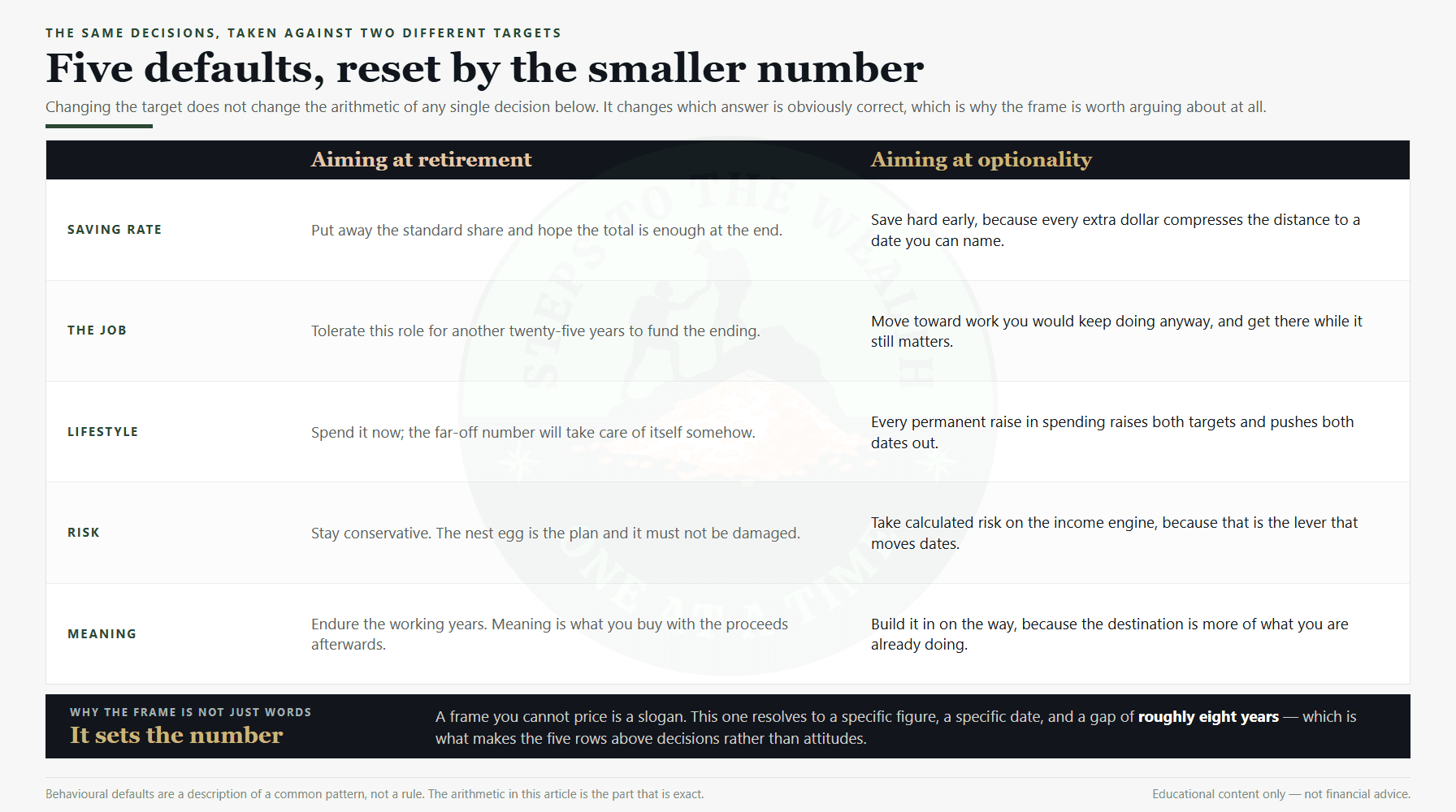
What almost nobody does is stop permanently at the first opportunity. That matters, because it means the retirement number was pricing an outcome most people do not actually choose when it becomes available. Aiming at a target you would decline on arrival is an expensive way to spend a decade.
Run your own number this week
This one is short, and the arithmetic is not the hard part.
Step one. Write down what your life costs for a year. The real figure, from statements, not the one you would quote to a colleague.
Step two. Write down what the version you would accept costs. Housing, food, healthcare, some recreation. Below the level where you would genuinely be miserable, not below the level where you would be irritated. If you have no idea, 50% of the first figure is the usual starting point.
Step three. Divide both by 0.04. Those are your two numbers. The gap between them is the part of your working life that is currently being spent on the difference between comfortable and acceptable.
Step four. Find where your invested capital sits on the ladder, excluding the home you live in. Expect the bottom rungs to be closer than you thought and the top ones further, and do not read the distance between them as a single scale.
Step five. Pick one change and check what it moves. More contribution moves both dates. A more honest minimum moves the first one relative to the second. Those are different jobs, and knowing which one you are doing is most of the value here.
If the answer is that the smaller number is closer than you assumed, the constraint stops being arithmetic and becomes the person running the plan, which is what The Operator’s Mindset is for — fifteen lessons, $99 one-time. If your two numbers disagree with the plan you are currently running, that gap has its own arithmetic, and it is worth pricing before anything else.
Retirement asks when you can stop. Optionality asks when you could. The second question is cheaper to answer, arrives about eight years sooner, and is the one almost everybody actually meant.
Related reads
- When your goal and your plan are not the same future
- The first $10k, $100k and $1m are different games
- Lifestyle creep and the savings rate
- Emergency fund versus investing
- All the calculators, in one place
Educational content only — not financial or retirement-planning advice. All figures are worked examples: a constant real return, a constant withdrawal rate and a contribution at the end of each month. Real markets deliver none of those smoothly. Withdrawal rates, account wrappers and tax treatment are set by the jurisdiction in which you live. Past performance does not predict future results.