
If you bought a share of a company yesterday, what exactly did you buy?
Most people would answer “a stock”. That is the name of the wrapper, not the contents. Ask the same question about a bond or about Bitcoin and the answers get vaguer still, which is a problem, because what you actually own determines how the thing behaves when markets go against you — and behaviour under stress is where most of the damage gets done.
This is the plain-language version. Not simplified to the point of being wrong, and no jargon that is not immediately unpacked.
What You Actually Own Is a Residual Claim
A share is a unit of ownership in a company. That much most people know. The part that gets skipped is what the ownership is a claim on, and in what order.
A company has assets: buildings, inventory, cash, equipment, patents. It also has obligations: loans, bonds it has issued, suppliers awaiting payment, wages owed. Those obligations get paid first. Every one of them.
What is left after everybody else has been satisfied belongs to the shareholders. That is why equity is called a residual claim. You are not first in the queue. You are last, and your ownership is a claim on whatever survives the queue.
This is not a technicality. It is the single fact that explains most of how a share behaves, and once you have it, a great deal of market behaviour stops looking arbitrary.
Why Equity Moves More Than the Business Does
Being last in the queue has an arithmetic consequence that surprises people the first time they see it worked through.
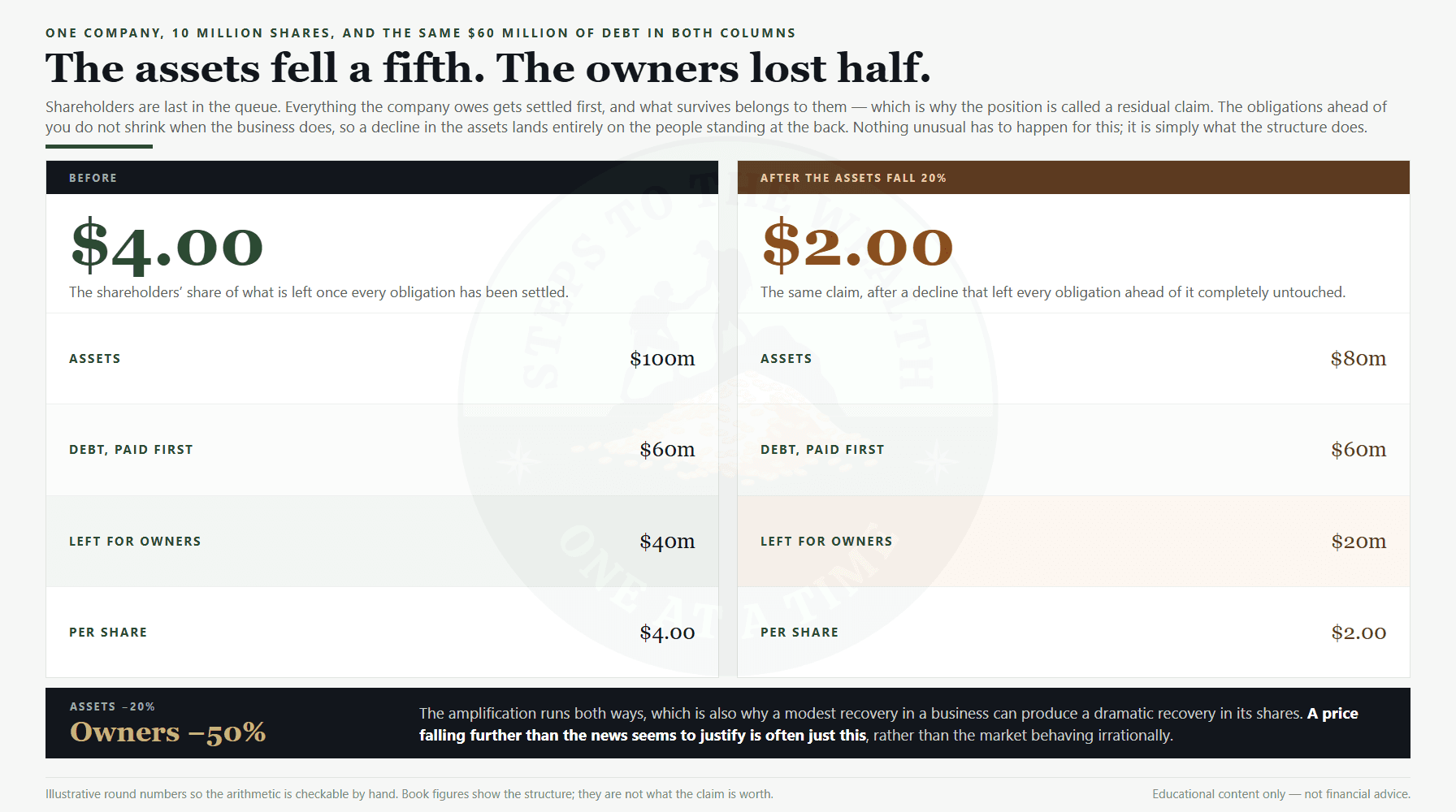
Take a company with $100 million of assets and $60 million of debt. The shareholders own the difference: $40 million. Split across 10 million shares, that is $4.00 of underlying value per share.
Now suppose the assets lose a fifth of their value, falling to $80 million. The debt does not shrink to match — lenders are owed what they are owed. So the shareholders now own $80 million minus $60 million, which is $20 million, or $2.00 a share.
The assets fell 20%. The shareholders’ stake fell 50%.
Nothing unusual happened. No fraud, no crisis, no irrational market. A one-fifth decline in the underlying business cut the owners’ position in half, purely because the obligations ahead of them stayed fixed while the asset base moved. That amplification runs in both directions: the same structure is why a modest recovery in the business can produce a dramatic recovery in the share.
So when you watch a share price fall further and faster than the news seems to justify, this is frequently what you are looking at. It is not the market being hysterical. It is what a residual claim does.
The Balance Sheet Is Not the Value
One correction before going further, because the arithmetic above can leave the wrong impression.
The $4.00 a share in that example is what the accounts say the owners would have if everything were sold at its recorded value and every debt settled today. That is a useful number for understanding the structure. It is not what the claim is worth.
A residual claim is a claim on a business that keeps operating, and an operating business generates cash it did not have yesterday. What you own is a share of all the cash the company will produce from here, for as long as it keeps producing it. That is why profitable companies trade far above the value of their furniture, and why unprofitable ones can trade below it.
This is also why the claim is hard to price. The assets on a balance sheet can be counted. Future earnings cannot — they can only be estimated, and reasonable people estimate them very differently. The structure explains how your claim behaves. It does not tell you what to pay for it, and anyone presenting a tidy calculation as though it settled that question is selling something.
What the Queue Looks Like When It Actually Matters
The ordering is abstract right up until a company fails, at which point it becomes the only thing that matters.
Return to the same business: $100 million of assets, $60 million of debt, $40 million belonging to shareholders. Now suppose it deteriorates badly and the assets are worth $50 million.
The lenders are owed $60 million and there is $50 million available. They recover 83.3% of what they are owed — a real loss of about 16.7%, and a painful one. The shareholders are behind them in the queue, and the queue has run out. Their claim is worth nothing.
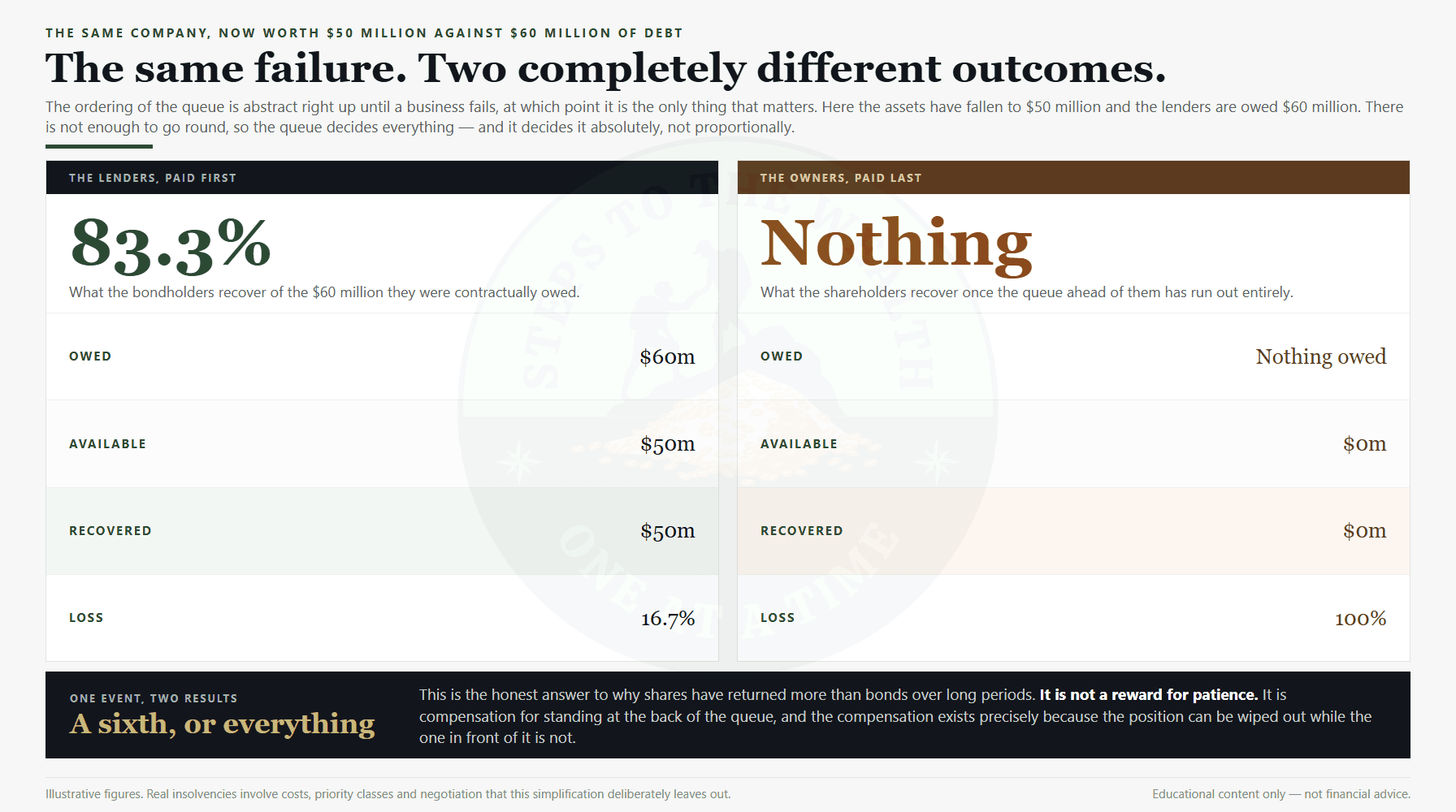
Read the two numbers together. The same event cost the lenders roughly a sixth of their money and cost the owners all of it. That is not a difference in how risky the two instruments felt. It is the queue doing exactly what it is designed to do.
This is the honest answer to why shares return more than bonds over long periods. It is not a reward for patience or a bonus for being clever. It is compensation for standing at the back, and the compensation exists because the position genuinely can be wiped out. An investment case that treats the higher historical return as free is quietly ignoring the reason it is there.
The Ticker Is Not the Thing
A ticker is a label for a queue position in a specific company. It is not the asset, any more than a licence plate is a car.
That sounds pedantic until you notice how much retail investing behaviour treats the ticker as the thing itself — watching the symbol, reacting to the symbol, forming a view about the symbol. The ticker has no earnings, no debts, no employees and no competitors. The company behind it has all four, and every one of them changes what your residual claim is worth.
The practical version of this is a question worth asking before any purchase: if the quoted price disappeared for five years, would I still want to own this? For a share in a business you understand, that question has an answer. For a ticker you bought because it was moving, it usually does not.
What Ownership Does and Does Not Entitle You To
Owning shares gives you a specific and quite short list of rights. It is worth being precise about it, because the gap between what people assume and what is actually true is where disappointment lives.
What you get. A claim on the residual assets described above. A share of any profits the company chooses to distribute as dividends. A vote, in most cases, on matters put to shareholders. And the right to sell your stake to somebody else at whatever price they will pay.
What you do not get. Any entitlement to a dividend — distributions are a decision the company makes, not an obligation it owes you, and what to do with them when they arrive is its own question, covered in whether to reinvest dividends. Any claim on specific assets; you cannot turn up and ask for your share of the warehouse. Any meaningful influence, unless your holding is very large. And no guarantee whatsoever that the price you can sell at bears any relationship to the value you calculated.
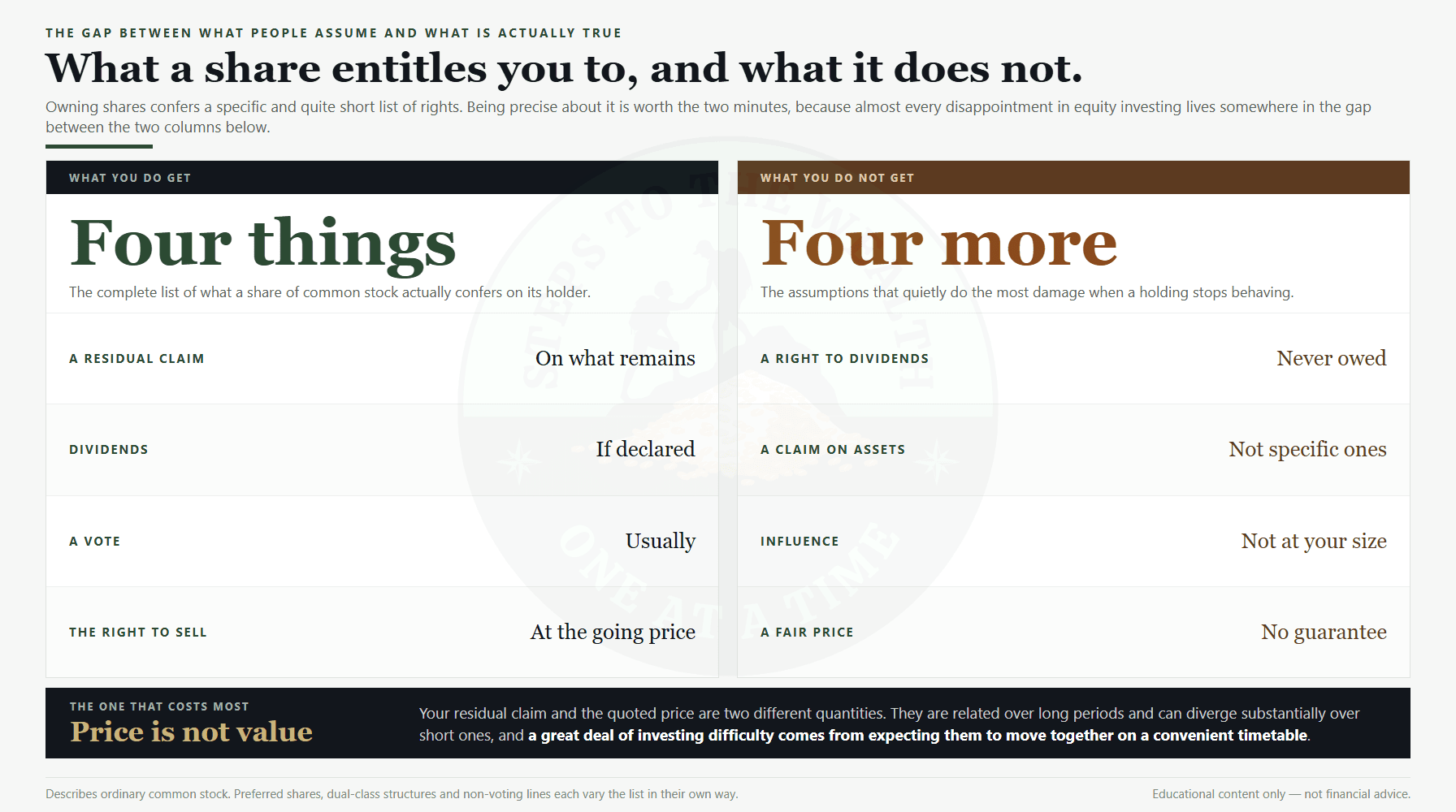
That last one deserves emphasis. Your residual claim and the market price are two different quantities. They are related over long periods and can diverge substantially over short ones, and a great deal of investing difficulty comes from expecting them to move together on a convenient timetable.
A Bond Is a Contract, Not a Share
A bond is a fundamentally different instrument, and the difference is not one of risk level. It is one of kind.
When you buy a bond you are lending. In exchange the borrower contractually owes you a stated stream of interest payments and the return of the principal at a stated date. You are not an owner. You are one of the creditors who sits ahead of the shareholders in the queue described above.
That contract is the source of both the safety and the ceiling. If the company prospers spectacularly, your return does not improve; you get the contracted payments and nothing more. If it struggles, you get paid before the owners do. You have traded upside for priority.
The common error is treating that priority as though it meant the price cannot fall. It can, and does, because the value of a fixed stream of payments changes when prevailing interest rates change. Our breakdown of bonds for working professionals prices exactly that: a one-percentage-point rise in yields took a worked example from $744.09 to $675.56, a fall of 9.21%, on the asset everybody calls the safe part of the portfolio.
Bitcoin Is Neither, and That Is the Point
Bitcoin is not a residual claim and it is not a contract. Nobody owes you anything. There are no assets behind it, no earnings, no coupon, and no counterparty with an obligation to you.
What you own is a cryptographically enforced entry in a distributed ledger, together with the exclusive ability to transfer it. That is a real and genuinely novel form of property, and describing it plainly is not a criticism.
But it does mean the source of any return is different in kind. A share can appreciate because the business earns more. A bond pays because a borrower is contractually bound. Bitcoin’s price rises when more people want to hold it than to sell it, and there is no internal mechanism generating value independently of that. The risk-first way to think about sizing an asset with those properties is worked through in the S&P 500 versus Bitcoin comparison.
Where the Return Actually Comes From
Strip everything else away and the three assets differ on one axis that matters more than any other: the mechanism that produces your return.
With a share, the mechanism is internal. A company can generate cash without anyone buying your shares. That cash accrues to the residual claim whether or not the market is paying attention this quarter.
With a bond, the mechanism is contractual. Somebody has promised to pay, and the strength of your position rests on their ability and willingness to honour it.
With Bitcoin, the mechanism is external. Your return comes from what the next holder will pay. That is not automatically a criticism — scarce assets have been valued this way for a long time — but it is a materially different proposition from owning something that produces cash on its own.
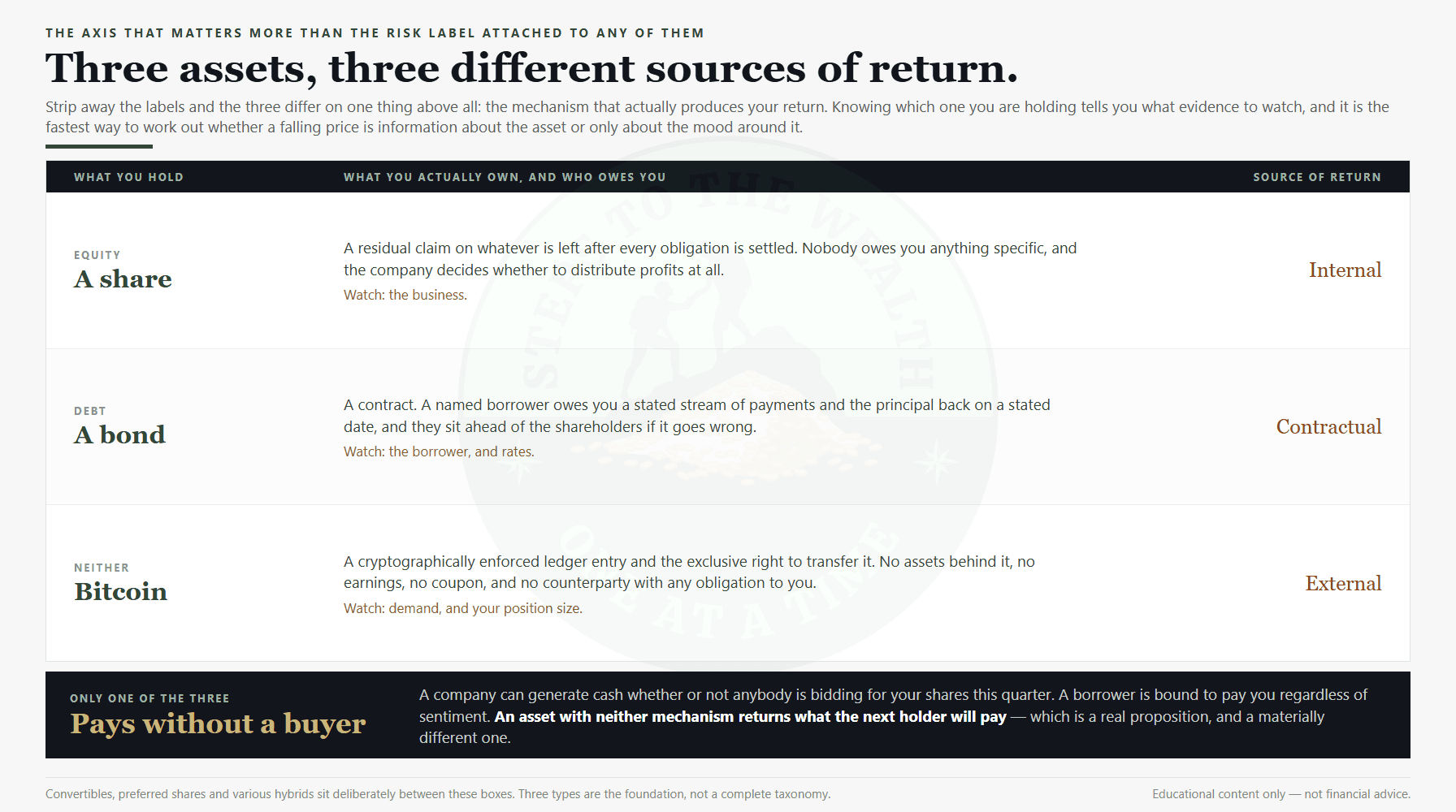
Knowing which of the three you are holding tells you what evidence to watch. For internal mechanisms, watch the business. For contractual ones, watch the borrower and the rate environment. For external ones, accept that you are largely watching demand, and size the position accordingly.
What You Own When You Buy a Fund
Most people reading this do not hold individual shares. They hold an index fund, which adds a layer worth understanding, because the answer to what you own changes shape.
When you buy a fund you own units in the fund. The fund owns the shares. Your claim is on the fund’s holdings, and those holdings are themselves residual claims on hundreds or thousands of businesses. Two layers, not one.
That second layer changes the failure modes in a useful direction. A single company can go to zero and take your entire stake with it. A fund holding hundreds of companies cannot, because the failures are diluted by everything else it holds — which is the structural point behind diversification rather than a claim that funds cannot fall. They fall constantly. What they do not do is go to zero because one business did.
It also means the questions change. Asking “what is ahead of me in the queue” is not useful for a broad fund; you own a slice of thousands of different queues. The useful questions become what the fund actually holds, what it charges, and how it behaves when everything it holds falls together. General guidance on matching that mix to your circumstances is set out in the non-commercial SEC investor education material on asset allocation.
One thing does not change. The underlying assets are still residual claims, so the amplification described earlier still applies — it is simply spread across many companies instead of concentrated in one. A fund is a different container, not a different asset.
Why This Changes What You Do in a Drawdown
Here is the payoff, and it is behavioural rather than analytical.
When a holding falls sharply, the useful question is not “how far has it dropped”. It is “has the thing I actually own changed”. Those questions have different answers far more often than people expect.
If you own a residual claim on a business that is still earning, still selling and still solvent, a falling price means the same claim is now available more cheaply. If the business itself has deteriorated — if the queue ahead of you got longer or the assets behind you got smaller — that is a different situation entirely and deserves a different response.
An investor who has never articulated what they own cannot tell those two apart, so every decline feels identical and every decline feels like a reason to sell. That is precisely the mechanism that turns temporary declines into permanent losses, and it is why deciding your response in advance beats improvising one, as set out in rules-based investing.
It is also why price and value can separate so far and for so long. A residual claim is a claim on a future that nobody can observe directly, so the market is pricing an estimate rather than a fact. The gap between the two is the whole subject of a margin of safety, and the reason a falling quote is information about sentiment before it is information about the business is set out in volatility is not risk.
The Scale of What You Own
One more thing worth internalising, because it recalibrates a lot of anxiety.
Buy 100 shares in a company that has one billion shares outstanding and you own 0.00001% of it. Your holding will not influence its strategy, its hiring or its pricing. You are a passenger, and the honest version of equity investing accepts that.
That fact cuts two ways. It means your opinion about what management should do is, operationally, irrelevant. It also means you are not required to have one. You are buying a small slice of a system that runs whether or not you are watching, which is the entire appeal for somebody with a demanding job and no desire to become a full-time analyst.
It also explains why diversification is a structural decision and not a lack of conviction. Owning a fraction of many businesses rather than a fraction of one changes what a single failure can do to you, which is the argument made properly in how diversification reduces risk.
How To Check You Actually Understand a Holding
A short test, and it is harder than it sounds. For anything you own or are about to buy, answer these without looking anything up.
- Who owes you what? For a bond there is a specific answer. For a share the answer is nobody, and your claim is on what remains. For a commodity or a crypto asset the answer is nobody at all, in any sense.
- Where does the return come from? Internal, contractual, or external, as above. If you cannot say, you have not finished your homework.
- What is ahead of you in the queue? For equity, all the debt. A business with very little debt and one carrying a great deal are different propositions even in the same industry.
- What would make this permanently worth less? Not temporarily cheaper — permanently impaired. If the only answer you can produce is “the price falls”, you are describing the quote and not the asset.
Most people can answer these for a savings account and not for a holding representing a serious portion of their net worth. That asymmetry is worth fixing, and it takes an afternoon rather than a qualification.
The Honest Limits of This Framing
Three caveats, because a clean mental model can be taken too far.
Understanding what you own does not tell you what it is worth. Valuation is a separate discipline, it is genuinely difficult, and being clear about the nature of a claim is the first step rather than the last. Nothing here helps you decide whether a given price is a good one.
The categories are cleaner in an article than in reality. Convertible bonds, preferred shares and various hybrids sit deliberately between the boxes, and plenty of instruments are constructed precisely to blur the line. The three types described here are the foundation, not a complete taxonomy.
And understanding does not confer immunity. Knowing exactly what a residual claim is will not make a 50% decline pleasant, and investors with a perfectly accurate mental model still sell at the bottom. What the model buys you is the ability to tell a fall in price from a fall in value — which does not guarantee good behaviour, but it does make good behaviour possible. Without it you are guessing, and a decline is simply frightening rather than informative.
Start with the queue. Everything else about how these assets behave follows from where you stand in it.
Educational content only — not financial advice. The figures used above are illustrative round numbers chosen so the arithmetic is checkable by hand, and nothing here is a recommendation to buy or sell any specific asset.