
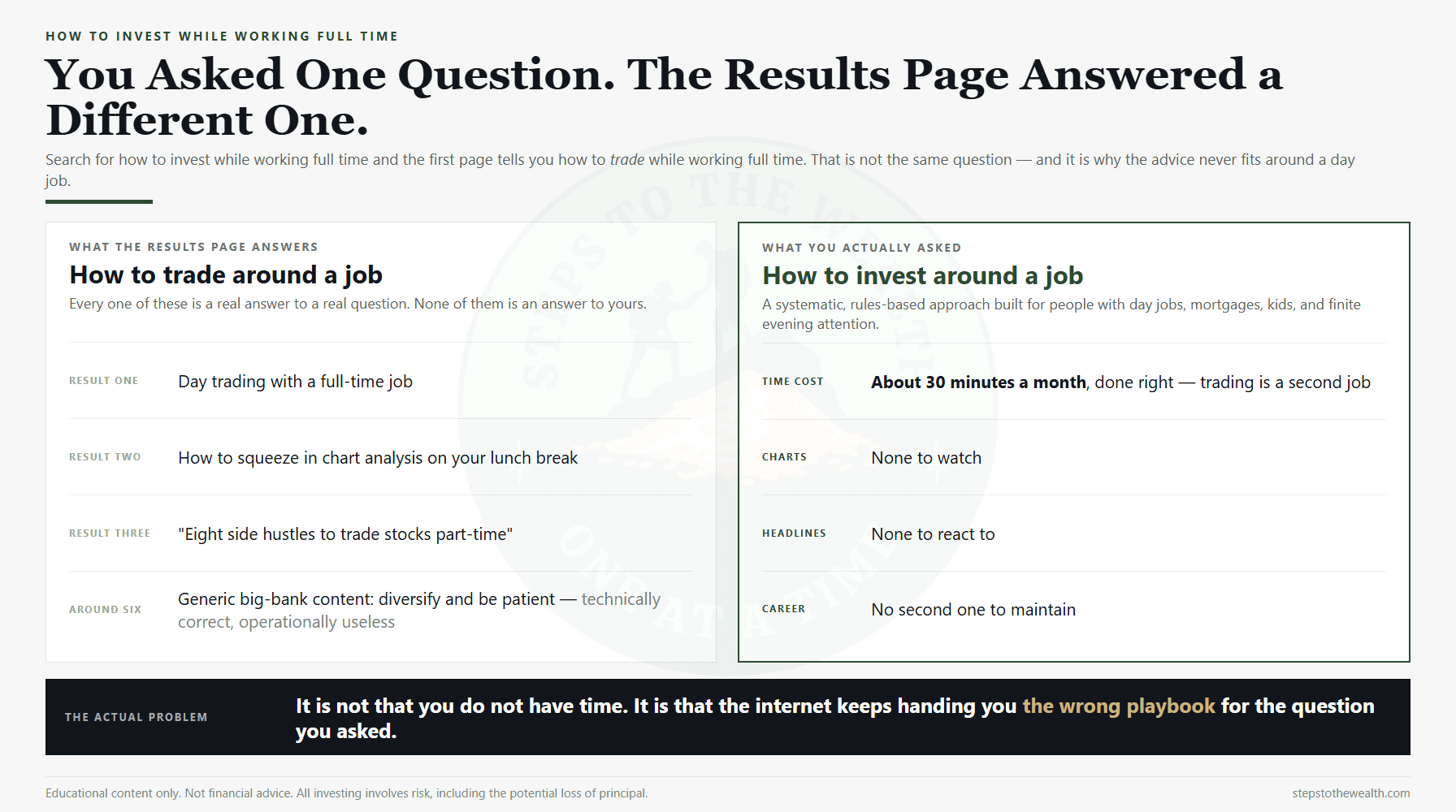
If you search for how to invest while working full time, every result on the first page tells you the same thing: how to trade while working full time.
That is not the same question.
Trading is a second job. Investing — done right — takes about 30 minutes a month. The problem is not that you do not have time. The problem is that the internet keeps giving you the wrong playbook for the question you actually asked.
This is the right playbook. A systematic, rules-based approach built for people with day jobs, mortgages, kids, and a finite amount of evening attention. No charts to watch. No headlines to react to. No second career to maintain. Just a system that does the work in the background while you go live your life.
Educational content only. Not financial advice. All investing involves risk, including the potential loss of principal.
The real problem is not time — it is the wrong playbook
Here is what you found when you searched for this.
Result one: day trading with a full-time job. Result two: how to squeeze in chart analysis on your lunch break. Result three: “eight side hustles to trade stocks part-time.” Somewhere around result six you will hit generic big-bank content telling you to diversify and be patient, which is technically correct but operationally useless.
The entire results page has conflated investing with trading. They are not the same thing. And if you have been losing hours trying to square the advice with your actual life, it is because the advice was never built for your life in the first place.
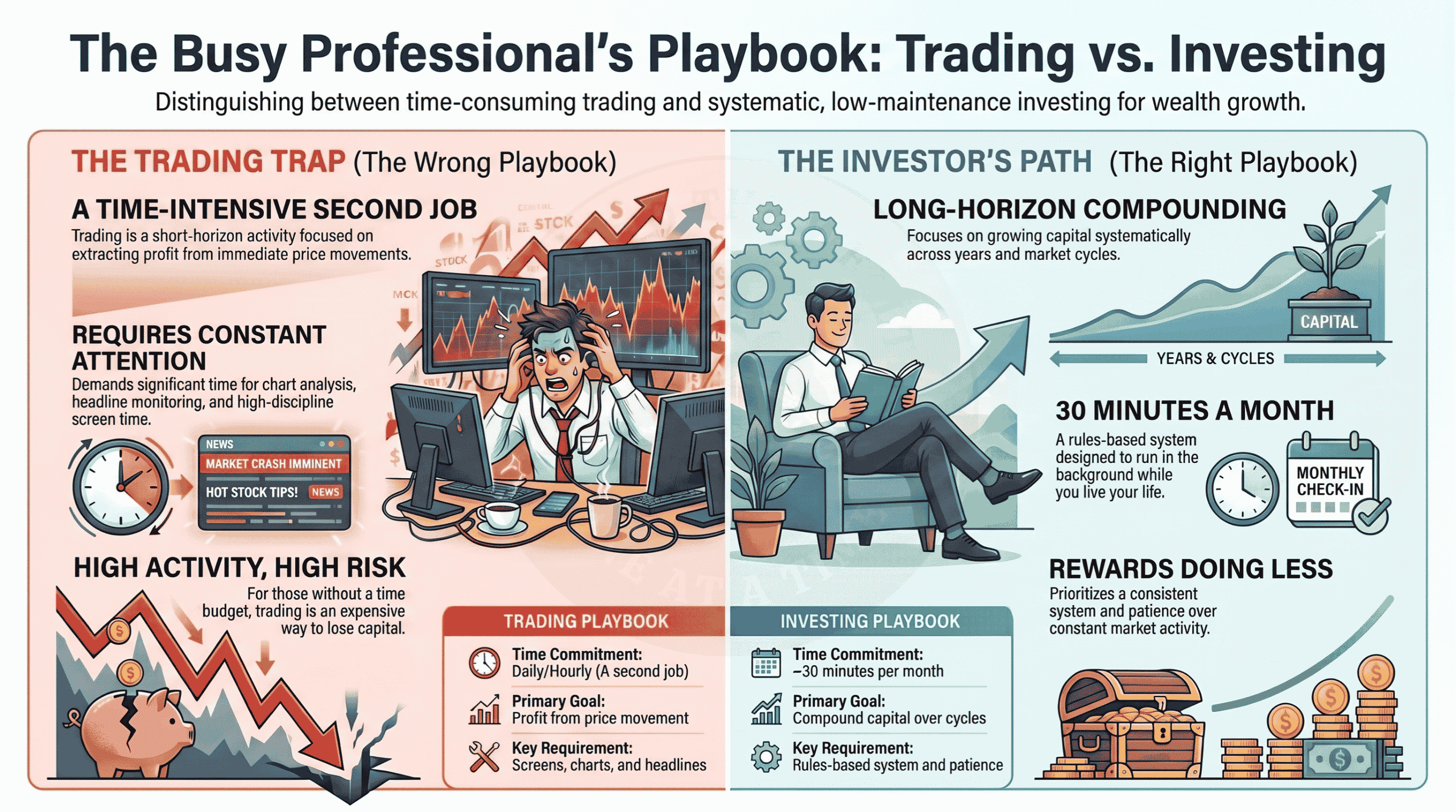
Trading is a short-horizon activity that extracts profit from price movement. It requires screens, discipline, and time you do not have. Done well it can work. Done without the time budget to do it well, it is a slow, expensive way to learn that you should not have been doing it.
Investing is a long-horizon activity that compounds capital across years and cycles. It rewards patience over activity. It rewards a system over a screen. And — critically for busy professionals — it rewards doing less more often than it rewards doing more.
Once you see this distinction, most of the “investing with a full-time job” advice stops making sense. Because most of that advice is actually trading advice, and it was pointing you at the wrong job the whole time.
What a systematic investing schedule actually looks like
Here is what a working investor’s calendar looks like when the system is doing the work.
Weekly: 15 minutes, tops. Glance at the market. Note where current risk levels are reading. Do nothing else. No trades. No reactions. The glance is a hygiene check, not a decision point.
Monthly: 30 minutes. Run your monthly allocation. Check your risk reading, compare it to your rules, execute the buy (or the hold, or the pause) your framework tells you to. That is it.
Quarterly: 90 minutes. Review the system itself. Are your rules still working? Has your income changed? Do any position sizes need adjusting? Note: you review the system, not the individual trades. The trades already happened. The system is what you iterate.
Annually: a half-day. Audit the whole year. Tax-advantaged account contributions topped up. Tax loss harvesting if relevant. Rebalance across asset classes if your allocation has drifted. Update your written rules if the year revealed a gap.
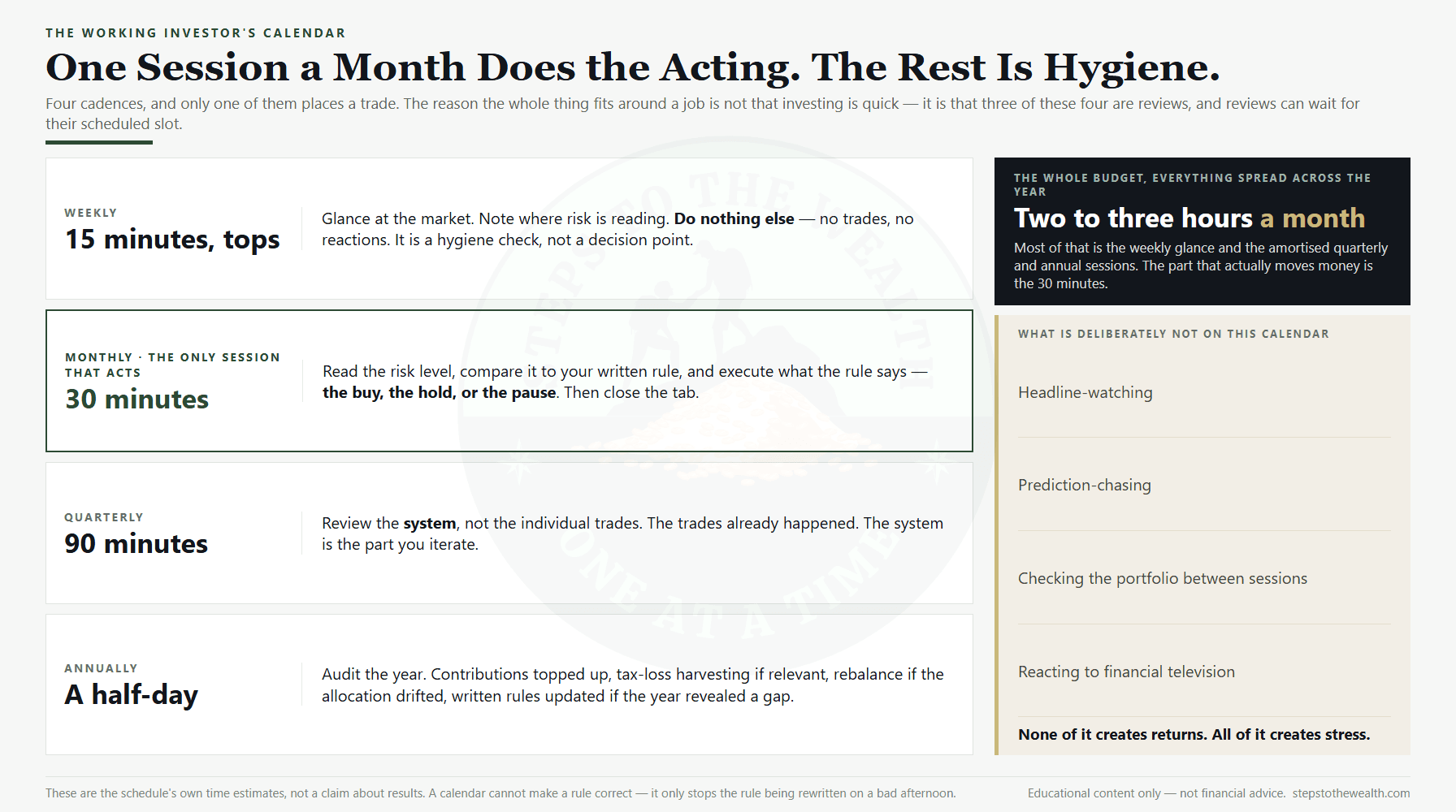
That is the entire time budget. Two to three hours a month once the quarterly and annual sessions are spread across it, front-loaded into one focused 30-minute monthly session. Less than the time most people spend doomscrolling on a single Sunday afternoon.
What is missing from this schedule? Headline-watching. Prediction-chasing. Checking your portfolio between sessions. Reacting to financial television. None of that creates returns. All of it creates stress.
The core discovery of being a working investor is that most of the gap between people who get rich slowly and people who do not is not IQ or information. It is whether they were willing to sit on their hands between scheduled sessions.
The three questions that replace “what should I buy?”
“What should I buy?” is the wrong question.
It is the question the entire content economy around investing is built to answer, which is the first clue that it is the wrong question. When everyone is selling you the same answer, and the buyers keep losing money, the question is probably broken.
Here are the three questions that actually drive returns. A systematic investor answers these — in this order — once a month. The “what to buy” question falls out of the answers, instead of driving them.
Question 1: What is my current risk level?
Not “what is the market doing,” which is a news question. “What is the risk reading on my chosen assets today.”
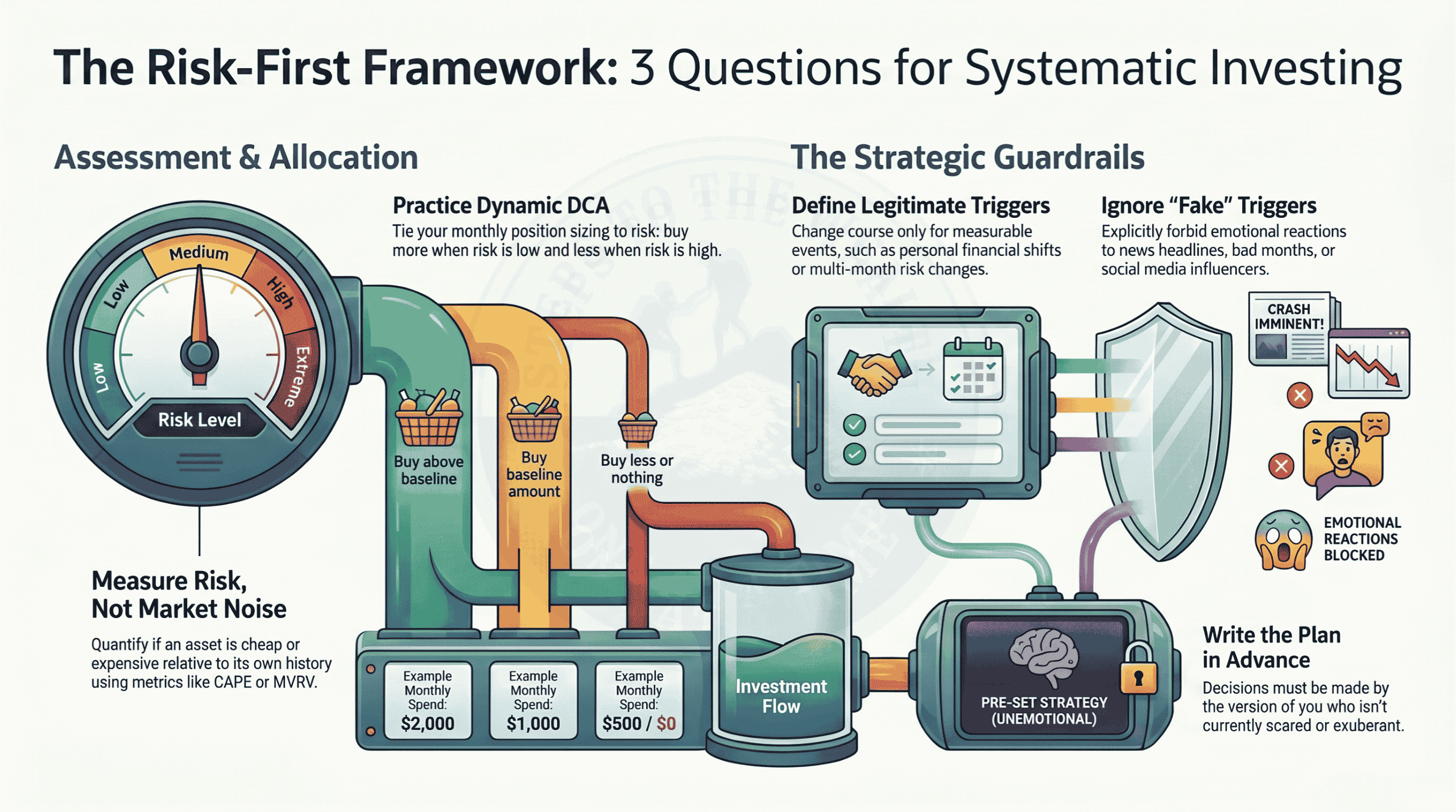
Every asset has a measurable risk level. For equities, there are valuation measures (CAPE, price-to-earnings), breadth measures (how many stocks are participating), and sentiment measures (how exuberant or fearful the market is right now). For Bitcoin, there are on-chain measures (reserve risk, MVRV) and technical measures (distance from long-term trend). For any asset, there is a quantifiable answer to “is this cheap, fair, or expensive right now — relative to its own history.”
The answer to that question is the single most important input into any monthly investment decision. It is also the answer the internet is worst at giving you, because it does not generate views.
This is the core of the risk-first approach, and it is what separates it from everything else in the results page. The short version: before you decide what to do, you find out what risk level you are operating at.
Question 2: How much am I allocating this month?
Once you know your current risk level, the allocation question becomes rules-based instead of gut-based.
The strategy is dynamic DCA: dollar-cost averaging with position sizing tied to the risk reading. At low risk, you buy more than your baseline. At medium risk, you buy your baseline. At high risk, you buy less — or nothing. At extreme high risk, you may even reduce exposure.
Example: if your baseline monthly allocation is $1,000, dynamic DCA might look like $2,000 at low risk, $1,000 at medium, $500 at high, and $0 at extreme high.
This sounds simple because it is. The hard part is not inventing it — the hard part is having the discipline to follow it when the news cycle is screaming in the opposite direction of what the rules say. Which is why it has to be written down before the cycle starts, not during.
Dynamic DCA is the core strategy inside the system, and the honest way to judge it is against the cycles that actually hurt. We have run it through three of them in detail: the 2008 financial crisis, the COVID crash of 2020, and the 2021-22 Bitcoin drawdown. Read those before you decide whether a rules-based approach suits you — they include the stretches where it felt worst, not only the parts where it worked.
Question 3: What is the trigger for changing course?
The third question is the one most retail investors never write down, which is why they get shaken out at the worst moments.
Before you deploy a single dollar, you decide — in writing — what event would make you change your plan. Not “I feel worried.” An actual, measurable event.
Examples of legitimate triggers:
- A shift in the risk reading across a specified number of consecutive months
- A change in your personal financial situation (job loss, new obligation, major expense)
- A strategic decision to rebalance based on performance of specific asset classes
Examples of fake triggers, which you are not allowed to use:
- A single bad month
- A news headline
- A friend, coworker, or video creator telling you the world is ending or the world is starting
- “I have a bad feeling about this”
Writing the trigger down in advance is what transforms you from a market-watcher into a system-operator. When the inevitable rough stretch happens — and it will — you do not have to make a judgment call in the moment. You check your written rules. If the rules say hold, you hold. If the rules say trigger, you trigger. The decision was already made by the version of you who was not scared.
A 30-minute-a-month implementation plan
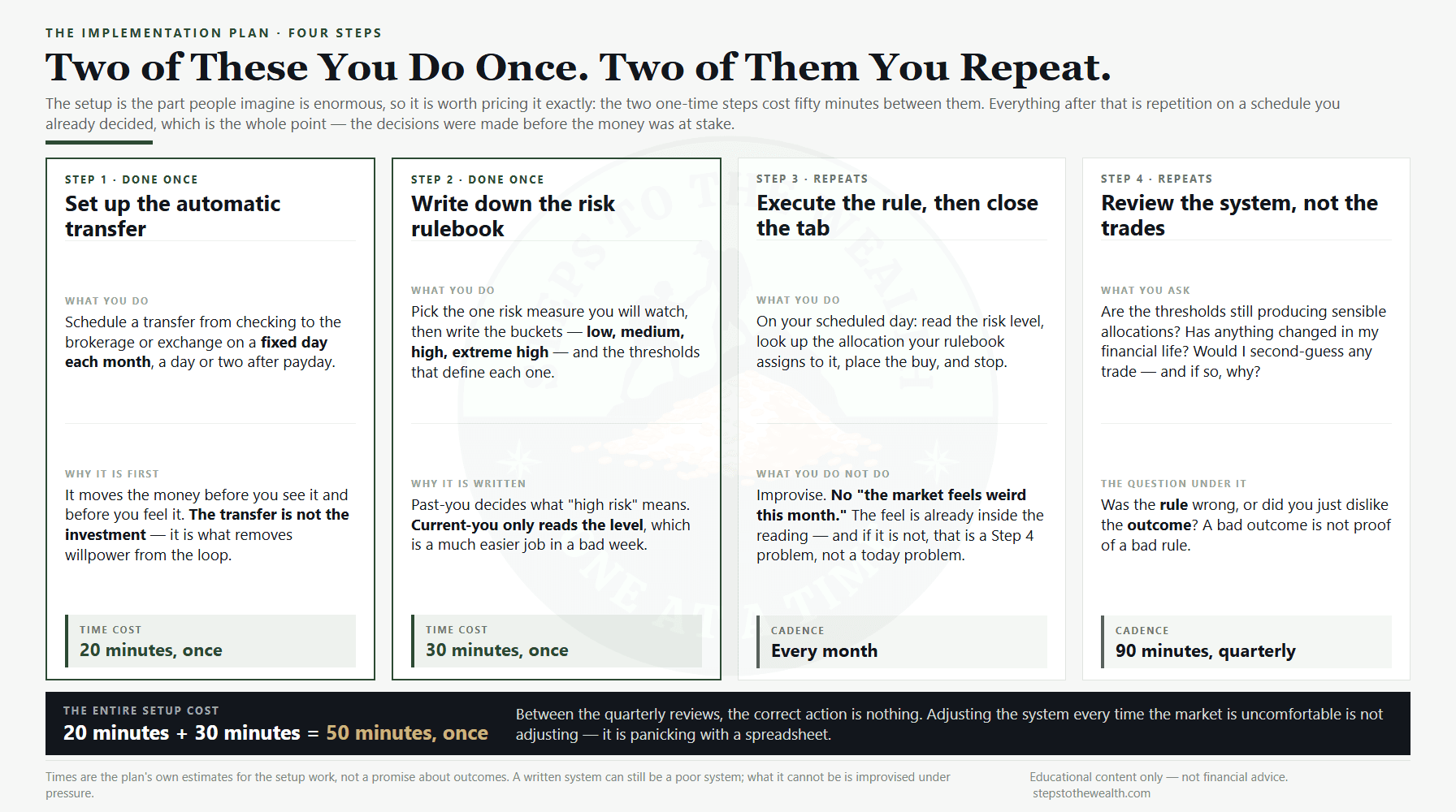
Here is the actual, executable version. Four steps. Do them once, then repeat step three every month and step four every quarter.
Step 1: Set up automatic transfers (one-time, 20 minutes)
From your primary checking account, schedule an automatic transfer to your brokerage or exchange on a fixed day each month — ideally a day or two after payday. This moves the money before you see it and before you feel it. The transfer is not the investment. The transfer is what makes the investment possible without requiring willpower each month.
Amount: start with whatever you can consistently sustain. 10% of take-home is a common baseline for working professionals. If 10% feels like too much, start with 5%. If it feels like too little, start with 15%. The number matters less than the consistency.
Step 2: Define your risk metric (one-time, 30 minutes)
Pick the measure you are going to watch. For an S&P 500 investor, something like a composite of CAPE plus breadth plus sentiment. For a Bitcoin investor, a published risk metric (reserve risk, distance from long-term trend, or similar). For a diversified investor across multiple assets, one risk reading per asset class.
You watch this number — and only this number — once a month.
Write down your risk level buckets (low / medium / high / extreme high) and the numerical thresholds that define them. This is your rulebook. Tape it to your desk if you have to. The point is that you do not get to decide what “high risk” means in the heat of the moment — past-you already decided, and current-you just reads the level.
Step 3: Follow your DCA rules (monthly, 15–30 minutes)
Once a month, on your scheduled day:
- Check your risk reading (5 minutes)
- Look up your allocation rule for that risk level (30 seconds — it is on the written rulebook)
- Place the buy in your brokerage or exchange (5 minutes)
- Close the tab and go live your life
If the rule says buy $2,000 worth of an S&P 500 fund, you buy $2,000 worth of an S&P 500 fund. No improvising. No “but the market feels weird this month.” The feel is already priced into the risk reading. If it is not, the risk reading is your problem to refine at quarterly review, not to override in the moment.
Step 4: Review quarterly, do not touch between reviews (quarterly, 90 minutes)
Once every three months, sit down with your rules. Ask:
- Are the risk thresholds still producing sensible allocations?
- Has anything changed in my financial life that changes my baseline amount?
- Are there any trades I would second-guess, and if so, is it because the rule was wrong or because I did not like the outcome?
The distinction in that last question matters more than anything else. A bad outcome is not proof of a bad rule. Sometimes rules produce bad outcomes in a given quarter and great outcomes over a decade. You only change a rule when you can prove — with data, not with feelings — that the rule itself is miscalibrated.
Between quarterly reviews: hands off. The worst thing a working investor can do is “adjust” their system every time the market makes them uncomfortable. That is not adjusting. That is panicking with a spreadsheet.
The mindset shift: from market-watcher to system-operator
This is where most people get stuck, so it is worth being explicit about it.
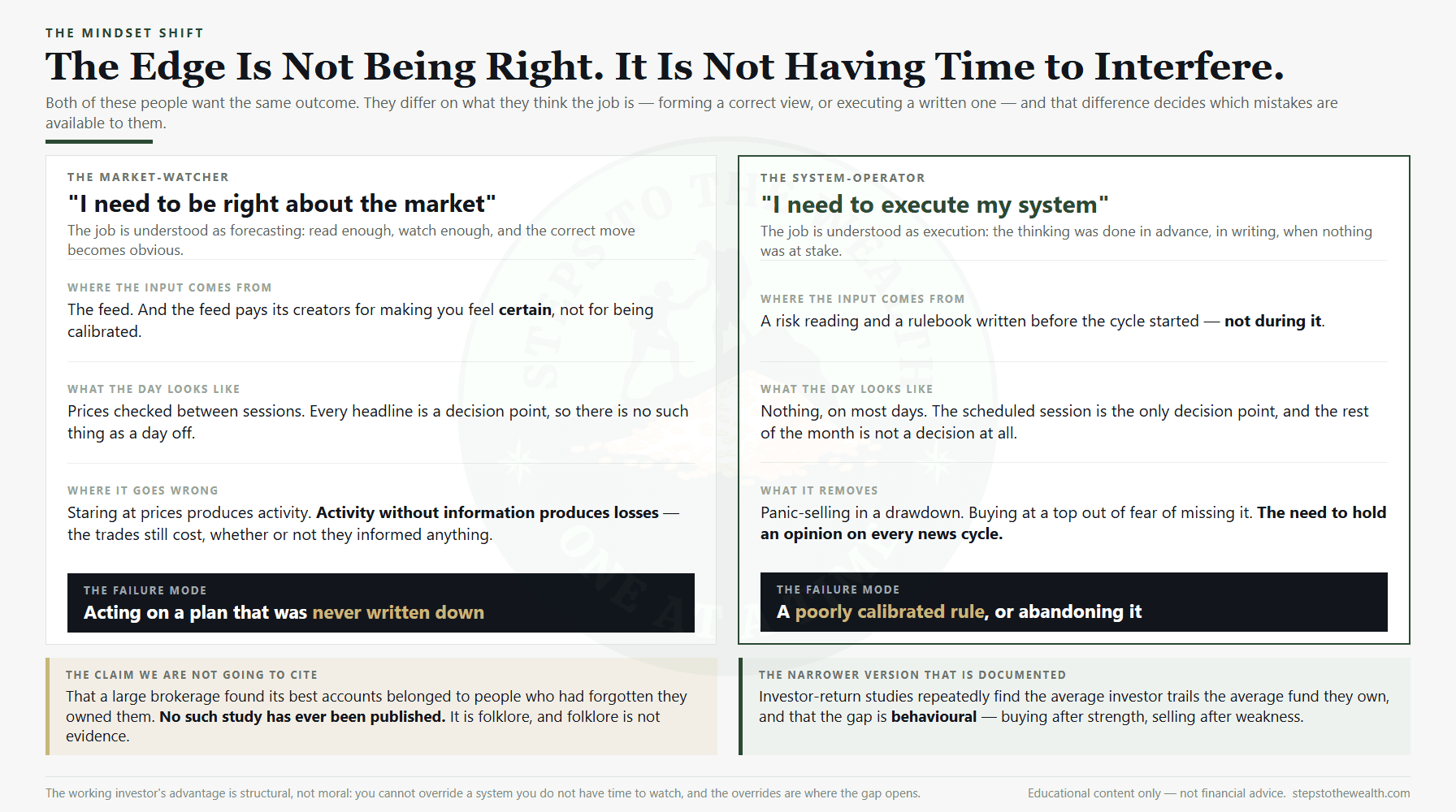
The mindset shift is moving from “I need to be right about the market” to “I need my system to be right about the market, and I need to execute my system.”
Market-watchers lose. They lose because markets are specifically designed to be harder to forecast than most retail participants expect. They lose because the content ecosystem rewards the creators who make them feel certain, not the ones who are actually calibrated. They lose because staring at prices every day produces activity, and activity without information produces losses.
System-operators win over long horizons — not because their system is magic, but because their system removes the specific behavior that was the problem. It removes panic-selling in drawdowns. It removes fear-of-missing-out buying at tops. It removes the need to have an opinion about every news cycle. What is left is a process that compounds quietly.
There is a widely repeated claim that a large brokerage once found its best-performing accounts belonged to people who had forgotten they owned them. We are not going to cite it, because no such study has ever actually been published — it is investing folklore, and folklore is not evidence. What is documented, repeatedly, in investor-return studies is the narrower version: the average investor tends to underperform the average fund they own, and the gap is behavioural. It comes from buying after strength and selling after weakness. Every override you do not make is a gap you do not open.
A working professional with a system is structurally advantaged over a hyper-engaged retail trader, for one very simple reason: the working professional does not have time to override their system. The overrides are where most money is lost. You cannot override what you do not have time to watch.
Use this. It is not a weakness. It is the competitive edge.
Common traps busy professionals fall into
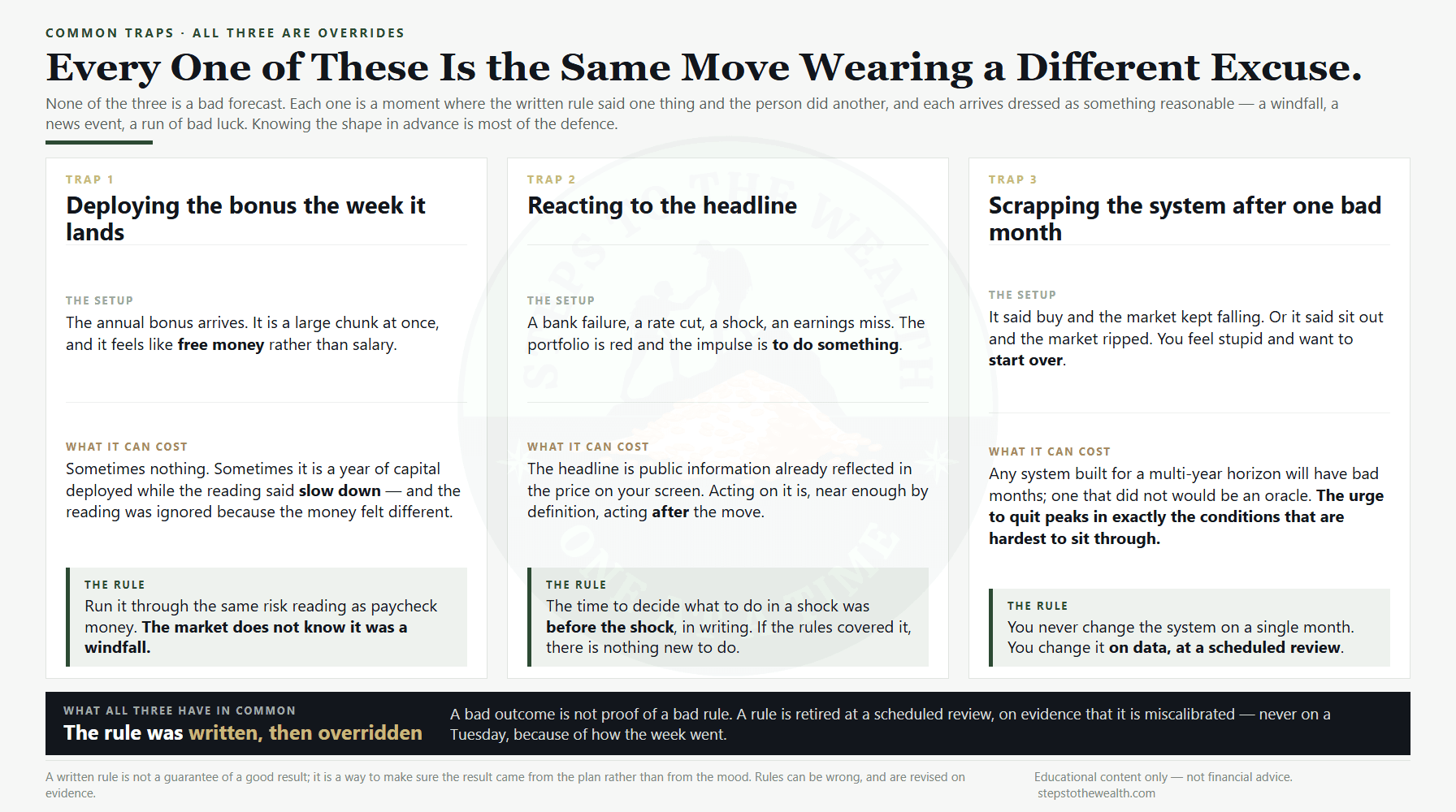
Three of them show up over and over. Watch for each one.
Trap 1: Lump-summing bonuses at the wrong time
Your annual bonus hits. It is a large chunk of money. The temptation is to dump it into the market the same week.
Sometimes that is fine. Sometimes that is deploying a year’s worth of capital at peak risk, and you will be staring at a deep drawdown six months later while the system that was saying “risk is high right now, slow down” got ignored because the bonus felt like free money.
The rule: treat bonus money the same way you treat paycheck money. Run it through the risk reading. Deploy it according to the same rules. If risk is high, park part of it and DCA in over months. If risk is low, deploy aggressively. The money does not care whether it arrived as salary or as a windfall. The market does not care either.
Trap 2: Reacting to headlines
A headline hits about a bank failure, a rate cut, a geopolitical shock, an earnings miss. Your portfolio is red. Your impulse is to do something.
The impulse is the trap. The headline is public information that is already reflected in the price you see. Acting on it is, almost definitionally, acting after the market has already moved on the news. The time to have decided what to do in a shock was before the shock, when you wrote down your rules.
If your rules already accounted for “what do I do in a drawdown” (and they should), you do not need to do anything new. If your rules did not account for it, that is a rules-refinement issue for the next quarterly review, not an excuse to panic-sell this Tuesday.
Trap 3: Abandoning the system after one bad month
Your system had a bad month. Maybe it told you to buy and the market kept falling. Maybe it told you to sit out and the market ripped higher. You feel stupid. You are tempted to scrap the whole thing.
This is the single most expensive mistake a new system-operator can make.
Any system built for a multi-year horizon will have bad months. If it did not, it would be a market-timing oracle, which does not exist. The point of the system is that it works across many cycles — not that it wins every month. The month you abandon it is often the month before it starts being right again. The emotional peak to quit a system tends to arrive in exactly the market conditions that are hardest to sit through.
The rule: you do not change the system based on a single month. Ever. You change it based on data, at scheduled reviews.
Your next step
If this is the first time investing has sounded like a solved problem instead of a confusing one, the framework is the piece to take with you.
The Dynamic DCA Blueprint is a free one-page reference card that puts the system described above in front of you — risk readings, dynamic DCA rules, written triggers, and the monthly playbook — on a single sheet you can keep beside the desk. It is built for someone with a day job and 30 minutes a month, not for a day trader with three monitors.
Get it at stepstothewealth.com/newsletter. It comes with the weekly newsletter, which applies the framework to what the market is actually doing, in real time, with no predictions.
If you want to see what the “sit on your hands” part is actually worth in money, the time-value calculator prices the delay directly: it shows what a decision postponed by a year costs at the far end of the horizon.
The long game looks like this: you spend one weekend setting up a system, you commit to 30 minutes a month, and you check on it in five years. That is what investing while working full time actually looks like when the playbook is the right one.
Frequently asked questions about how to invest while working full time
Can you invest while working full time?
Yes. A disciplined, systematic investor needs roughly 30 minutes a month — not 30 hours a week. The confusion comes from conflating investing (long-horizon, rules-based, automated) with trading (short-horizon, active, screen-dependent). Investing is fully compatible with a demanding day job. Trading usually is not.
How much time does it really take to invest properly?
For a rules-based systematic investor: about 15 minutes weekly, 30 minutes monthly, 90 minutes quarterly, and a half-day annually. That is two to three hours a month once the quarterly and annual sessions are spread across it. The largest single piece is the weekly glance; the monthly session is the short one that actually places the trade. Everything in between is hands-off.
How is investing different from trading?
Trading extracts profit from short-term price moves — days, hours, or minutes — and requires active attention. Investing compounds capital across years and cycles by deploying into long-term assets and holding through volatility. The two disciplines use different tools, different time budgets, and different mental models. Advice for one is not advice for the other.
How much should I invest from each paycheck?
A common baseline for working professionals is 10% of take-home pay. If that is too much to sustain, start at 5%. If it feels too little, go to 15%. The consistency matters more than the amount — an investor who commits 5% for a decade will usually end up ahead of an investor who commits 15% for three months and then stops. Whatever the number, automate it.
What is the best strategy for busy professionals?
A risk-weighted, rules-based dynamic DCA approach. Buy more when measurable market risk is low, less when it is high, and pause when it is extreme. Automate transfers, follow written rules, and review the system quarterly. This removes the two biggest return-killers in retail investing: emotional decisions and active overtrading.
Do I need a financial advisor?
Not necessarily. A low-cost advisor can help if your tax, estate, or retirement situation is complex. But for the core problem of how to deploy monthly savings into long-term assets, a documented, rules-based system is usually sufficient — and avoids advisory fees that compound against you over decades. If you do use an advisor, ask them to describe their framework in writing. Many cannot, which is itself useful information. Check their registration and disciplinary history first — in the United States that is a free public lookup on the SEC’s Investment Adviser Public Disclosure database.
Educational content only. Not financial advice. All investing involves risk, including the potential loss of principal. Past performance does not indicate future results. Do your own research and consult a qualified professional before making investment decisions.