
Almost nobody describes themselves as a trader. Ask around and you will hear long-term, buy and hold, in it for the decade. Then look at what the same person actually did over the last twelve months and the account tells a different story.
The useful framing of investing vs trading is not a question of intent, temperament or how you would describe yourself at a dinner party. It is a question of what your account did. And there is a version of this that is worse than either one done properly, which is what most people are actually running.
Investing vs Trading Is Decided by Your Account, Not Your Intent
Both are legitimate. A trader is trying to profit from price movement over short horizons. They accept transaction costs, spreads and tax friction because they believe they have an edge that pays for those things. An investor is trying to own a productive asset for long enough that its economics show up in the price, and does very little in between.
Neither is nobler than the other. They are different activities, with different skills, different tooling and different definitions of a good year.
What is not legitimate is running one and calling it the other, because the two demand opposite behaviour at exactly the same moments. And the label you choose has no bearing on which one you are doing. Your action count decides that, and it is the one number almost nobody has looked up.
What a Disciplined Year Actually Contains
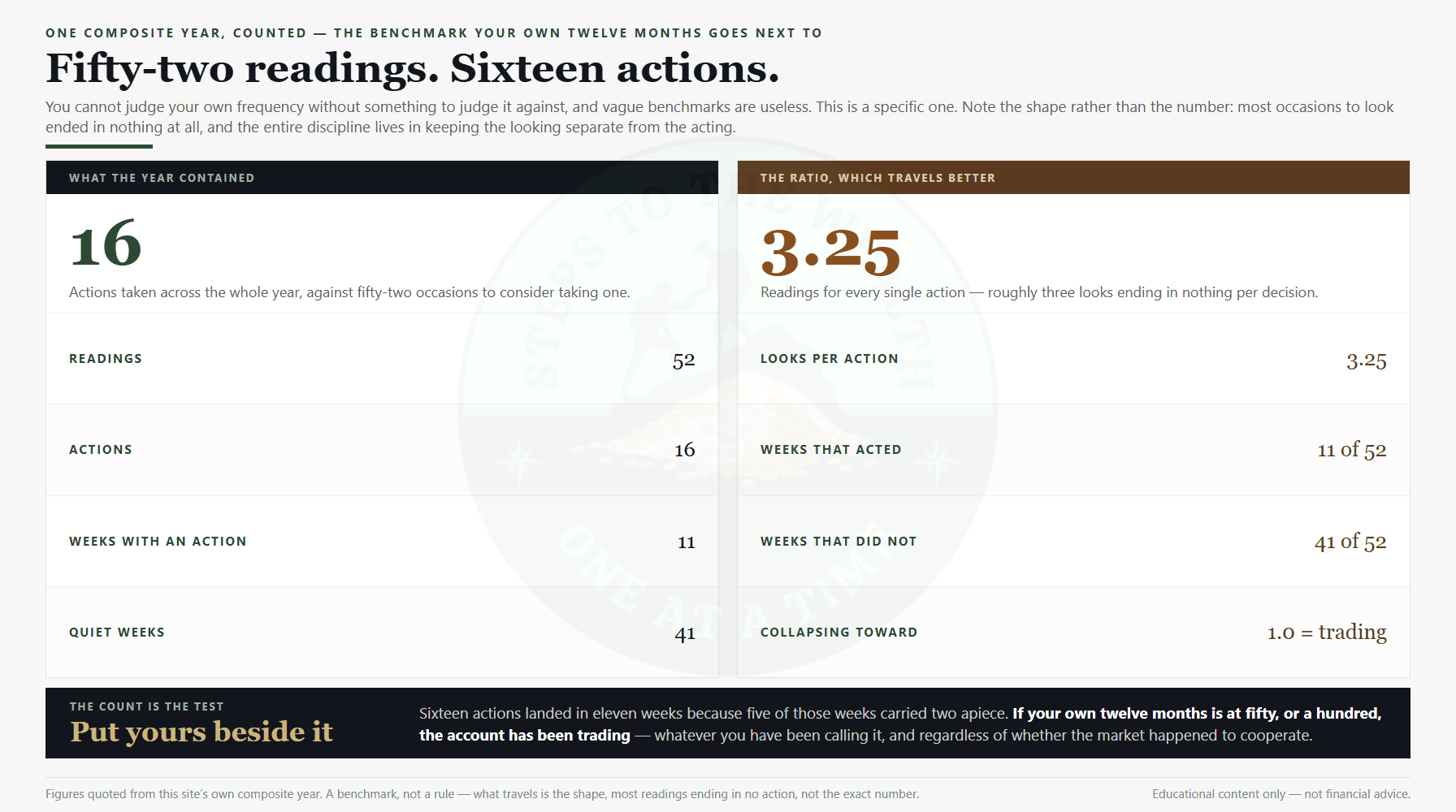
You cannot judge your own frequency without a benchmark, and vague ones are useless. Here is a specific one, taken from the composite year worked through in what an average investing year actually contains.
That year contained 52 readings and 16 actions. The actions landed in 11 weeks, because five of those weeks carried two apiece. The remaining 41 weeks ended with the same conclusion: read the level, confirm nothing had crossed a threshold, write down hold, close the laptop.
Sit with the shape of that rather than the number. Fifty-two occasions to look. Forty-one of them ending in nothing. The looking is not the acting, and the entire discipline is in keeping those two things separate.
Now answer the question honestly. Over your last twelve months, how many times did you actually transact? Not check — transact. Most people have never counted, and the counting is uncomfortable precisely because the answer is usually a multiple of sixteen rather than a number near it.
The Ratio Matters More Than the Count
A raw number is easy to argue with. A ratio is harder, and it is the more diagnostic of the two.
That composite year contained 52 readings and 16 actions. That is 3.25 readings for every action — roughly three looks that ended in nothing for every one that ended in a decision. The looking is not the problem. The looking is the job. What matters is how often looking converts into doing.
Run the same ratio on yourself. If you check most days and transact monthly, your ratio is high and the frequency is probably fine. If you check most days and transact most weeks, the ratio has collapsed toward one-to-one, and that is the signature of the hybrid: every look has become a decision point.
A collapsing ratio is also the earliest warning available, because it moves before the action count does. Someone drifting from investing into trading checks more first and acts more second. By the time the annual count looks alarming, the habit has been in place for months.
This is also why a bounded review works as a structural fix rather than a willpower one. It does not ask you to resist acting. It reduces the number of occasions on which acting is even available.
The Hybrid Is Worse Than Either One Done Properly
This is the part that matters, and it is why the middle is not a safe compromise.
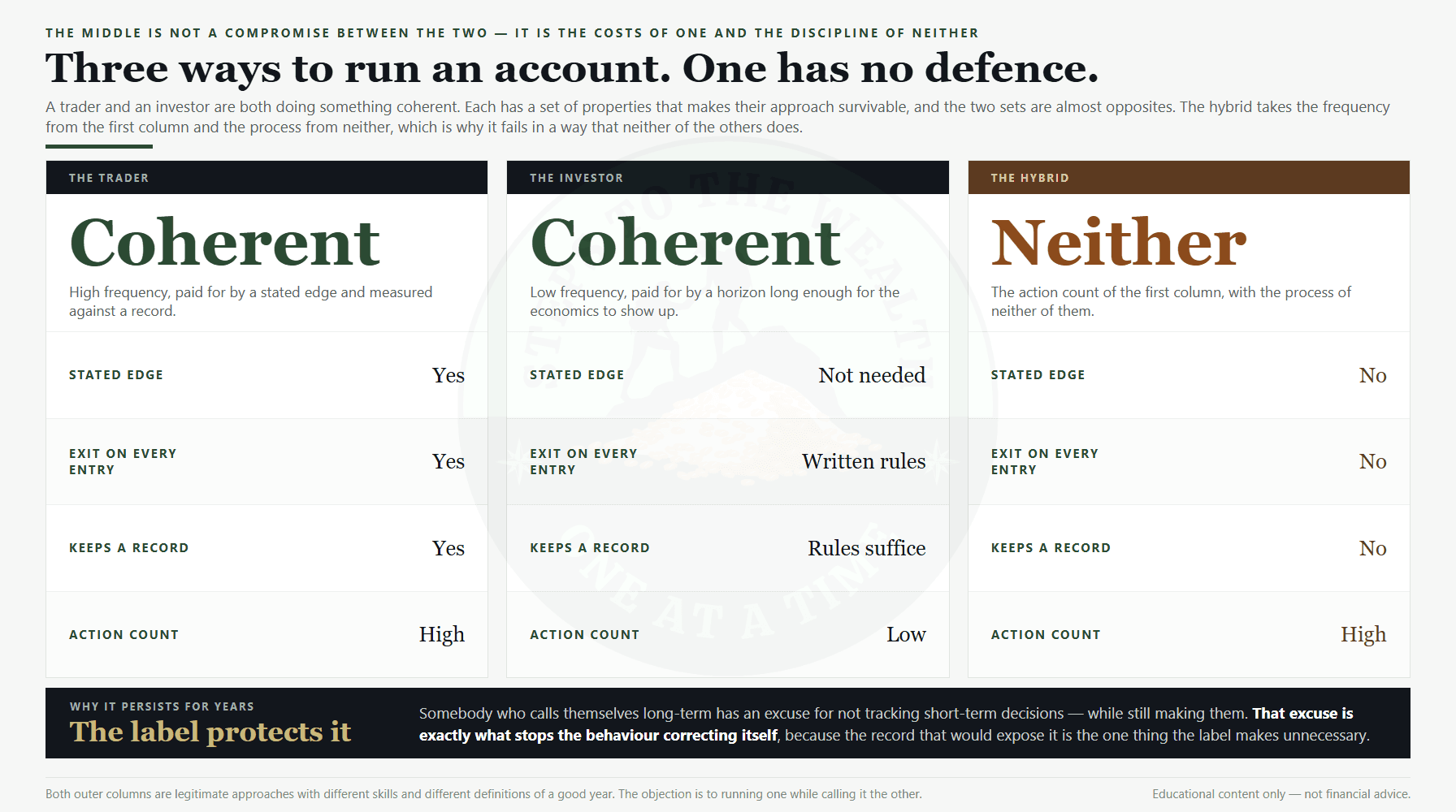
A trader who is actually trading has a set of things that make the frequency survivable. An edge they can articulate. Position sizing tied to that edge. A predefined exit on every entry. A record that tells them whether the edge is real. They pay the costs of frequency knowingly, and they measure whether the payment was worth it.
An investor who is actually investing has a different set. A horizon long enough for the economics to matter. A thesis that is checked against the world rather than the price. And, critically, a default of doing nothing, which is what allows compounding to happen at all.
The hybrid has the trader’s action count and the investor’s absence of process. They transact like someone with an edge, without having one. They pay every cost of frequency and receive none of the discipline that is supposed to justify those costs. And because they still describe themselves as long-term, they never apply the trader’s one redeeming habit — keeping score honestly enough to notice it is not working.
That is not a compromise between two approaches. It is the cost structure of one and the accountability of neither.
What the Frequency Actually Costs
The best-known measurement is Brad Barber and Terrance Odean’s study of 66,465 households at a large discount broker between 1991 and 1996.
Over that window the market returned 17.9% a year. The average household earned 16.4%. The fifth that traded most earned 11.4%. Same market, same period, same access — the only variable that moved was how often they acted. The busiest fifth gave up 6.5 percentage points a year. You can read the paper yourself: Trading Is Hazardous to Your Wealth.
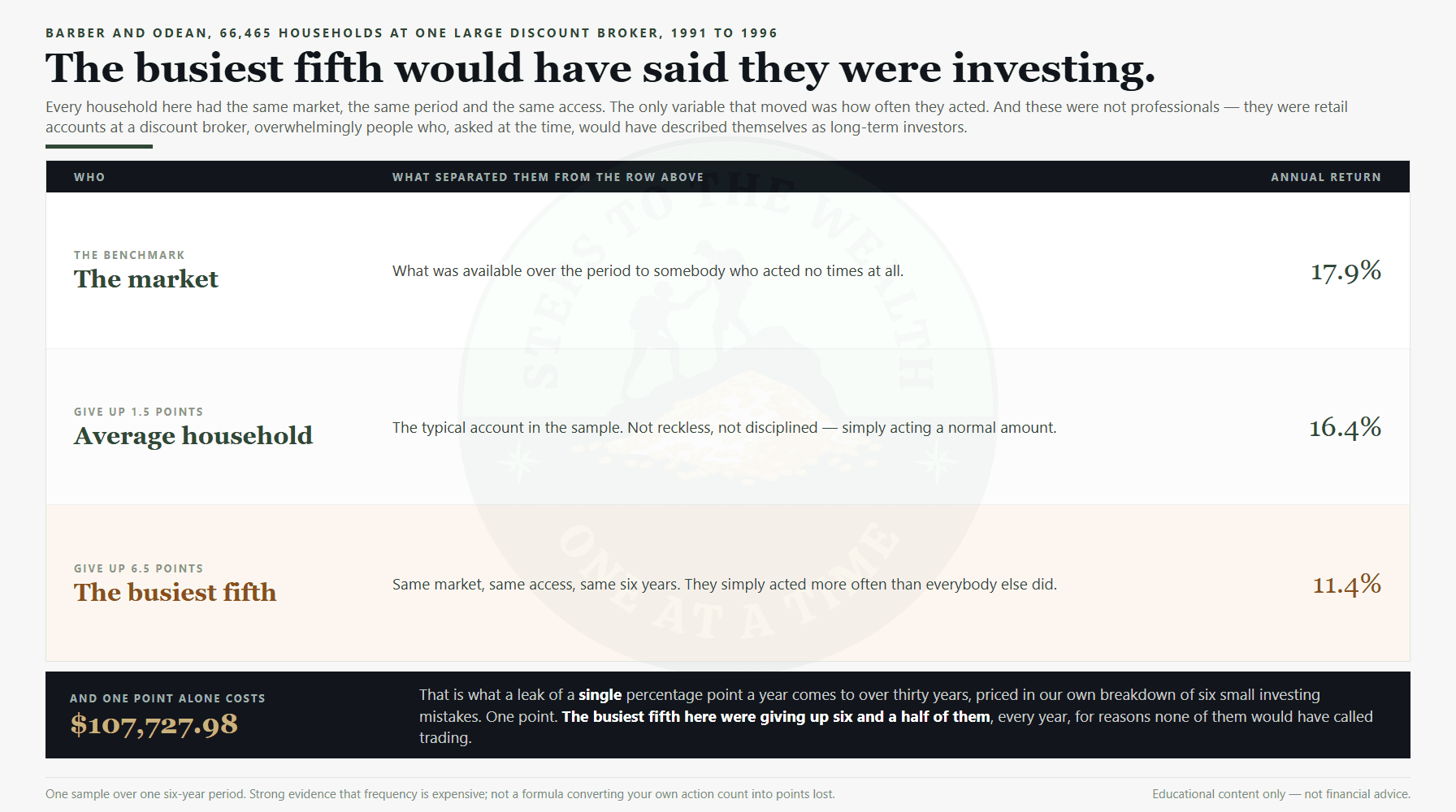
Here is the part that makes it a hybrid problem rather than a trader problem. That busiest fifth were not professionals. They were retail accounts at a discount broker — overwhelmingly people who, asked at the time, would have said they were investing.
And a much smaller drag still does real damage. Our own breakdown of six small investing mistakes prices a leak of a single point a year at $107,727.98 over thirty years. One point. The busiest fifth in that study were giving up six and a half.
The Costs You Do Not See on the Statement
Commission-free trading removed the most visible cost of frequency and left the rest in place.
The spread is still paid on every round trip — you buy fractionally above and sell fractionally below, and neither shows as a line item. Frequency also changes the tax character of your gains in most jurisdictions, generally not in your favour, and that treatment depends entirely on where you live and what wrapper you hold the asset in.
The largest cost is the one no statement records: the compounding that did not happen because the position was not held. A holding sold and re-entered is a holding that stopped compounding in between, and if the proceeds sat in cash while you decided what to do next, the gap is real money whether or not the re-entry was at a better price.
None of this makes trading illegitimate. It makes trading expensive, which is precisely why a trader needs an edge that pays for it — and why paying those costs without one is the specific failure this article is about.
Why Intelligent People End Up Here
It is not stupidity, and it is not greed. It is the interaction of two ordinary things.
The first is that the tooling is built for frequency. A brokerage app opens on a screen of moving numbers, not on your time horizon. It costs nothing to trade and takes four seconds. Nothing in the interface has any interest in your forty-one quiet weeks.
The second is that doing nothing feels like neglect. Every other domain a competent professional operates in rewards attention and effort. Investing is close to the only one where the correct action, most of the time, is to have looked and then done nothing — and that runs against every instinct that made you good at your job. The pull to act is strongest exactly when acting is most expensive, which is the mechanism worked through in the biases that quietly decide your outcome.
Put those together and the drift is almost automatic. Nobody decides to become a hybrid. They check a bit more often, act on one of the checks, and the frequency ratchets from there.
Four Tells, and None of Them Are About Returns
You can diagnose this without knowing whether you are up or down, which is what makes the test useful.
- You cannot state your edge in one sentence. A trader can: this pattern, this timeframe, this expectancy. If you transact often and cannot finish the sentence, the frequency has no justification behind it.
- Your entries have no predefined exit. A trade without an exit is not a trade, it is a position you will close when it becomes uncomfortable. What a written exit looks like is set out in when to take profits.
- You could not reconstruct last year’s decisions. Not the outcomes — the reasons. If there is no record of why, there is nothing to learn from and no way to tell a good process from a lucky one.
- Checking has become continuous. Frequency of looking predicts frequency of acting. A fixed, bounded review is the structural fix, and one version of it is the 15-minute Sunday review.
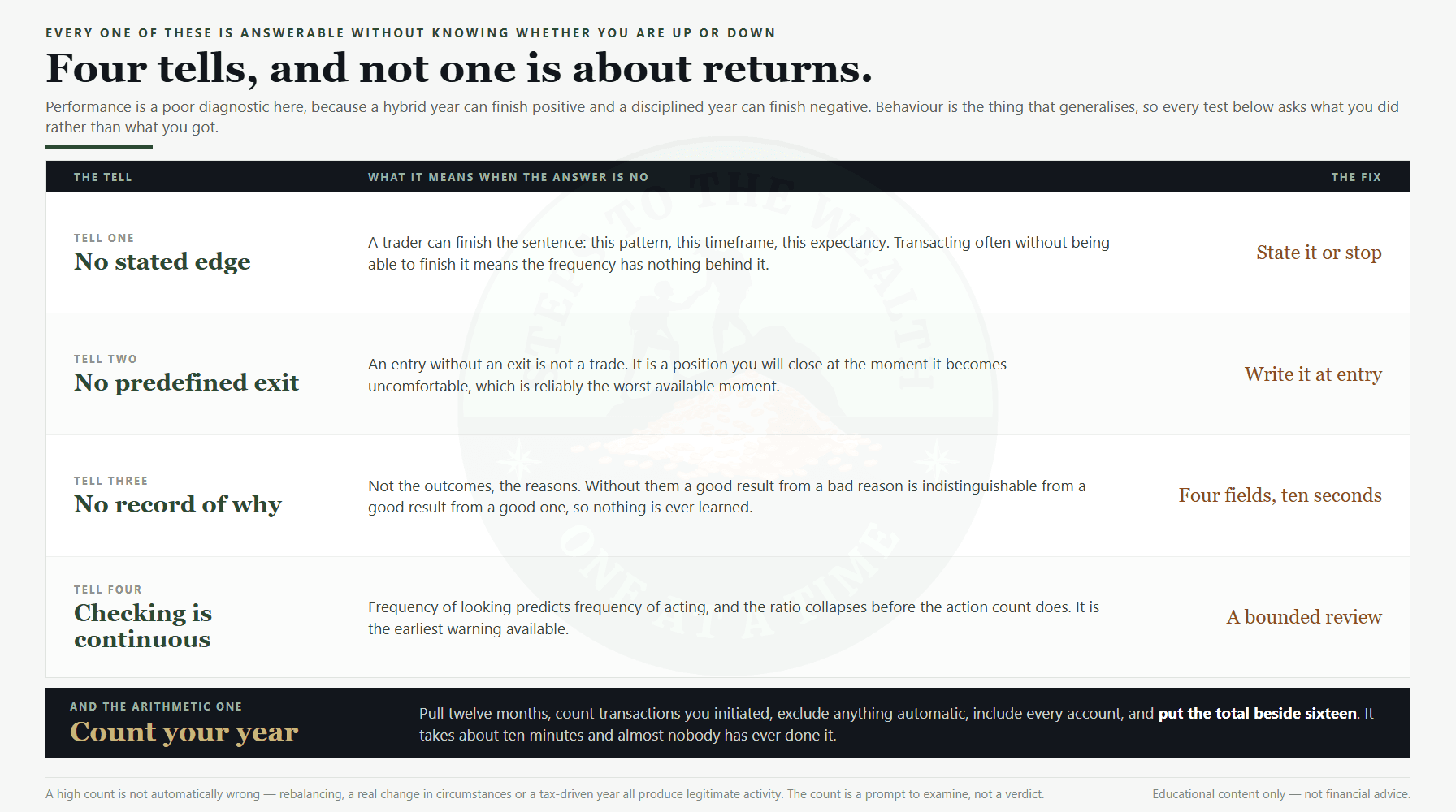
Notice that none of these asks how you did. Performance is a terrible diagnostic here, because a hybrid year can end up positive and a disciplined year can end up negative. The behaviour is what generalises.
What Keeping Score Actually Means
The tell that separates a trader from a hybrid most reliably is not frequency. It is whether a record exists.
Traders who last keep one, because without it there is no way to distinguish an edge from a run of luck, and a run of luck is indistinguishable from skill for an embarrassingly long time. The record is what makes the activity self-correcting.
It does not need to be elaborate. Per decision: the date, what you did, the reason in one sentence written before the outcome was known, and what would have to happen for the reason to be wrong. Four fields. Ten seconds.
The value is not in any single row. It is that after a year you can read your own reasons back and see whether they were reasons or moods — and that is a question no amount of staring at a performance figure will answer, because a good outcome from a bad reason looks identical to a good outcome from a good one.
Most hybrids have never kept such a record, and the reason is uncomfortable: the label protects them from needing one. Someone who calls themselves a long-term investor has an excuse for not tracking short-term decisions, while still making them. The protection is exactly what stops the behaviour correcting itself, which is why the hybrid state is so stable and can persist for years.
“But I Am Doing Fine”
This is the objection that actually stops people, so it deserves a straight answer rather than a lecture.
You might be doing fine. Some hybrids are up, and being up is genuinely pleasant. The problem is that being up over a year or two carries almost no information about whether the activity caused it, and that is not a rhetorical dodge — it is a sampling problem.
A market that rose will lift an account that traded badly and an account that did nothing. Both look like success from the inside, and the one that traded will tend to credit the trading. To separate the two you would need to know what the same money would have done untouched, and almost nobody computes that comparison because it is the one number that can make the last twelve months feel wasted.
That comparison is the only honest test, and it is not hard: what did you actually end with, against what the same contributions left alone would have ended with? The measure that handles money arriving at different times is worked through in XIRR versus CAGR, and running a plan against real history is what the DCA simulator exists for.
There is also a survivorship problem inside your own head. You remember the trade that worked more vividly than the four that quietly did not, because the one that worked came with a story and the others came with nothing. A record fixes this and nothing else does.
So the honest position is not that you are doing badly. It is that you do not currently know, you have not built the thing that would tell you, and the activity carries a cost whether or not it is working.
Pick One, and Make the Choice Explicit
The fix is not to feel guilty about trading. It is to stop doing both at once, in the same account, without deciding which one you are doing.
If you want to trade, trade properly: a stated edge, a size rule, an exit on every entry, and a record you actually keep. Accept that it is a second job with a real failure rate, and size it so failing does not touch the rest of your plan.
If you want to invest, invest properly: write the rules before you need them, set a bounded review, and let the forty-one quiet weeks be quiet. The general case for deciding in advance is in rules-based investing, and the practical version for someone with a demanding job is how to invest while working full time.
The one structure that reliably works if you want both is separation: a core that is genuinely left alone, and a deliberately capped sleeve where the activity happens, sized so that being wrong in it is survivable. That is a sizing decision rather than a temperament one, and it is set out in the position sizing rules.
The Count Is the Whole Test
If you take one thing from this, make it the arithmetic rather than the argument.
Open your statements. Count the transactions over the last twelve months, ignoring scheduled contributions, which are not decisions. Put that number next to sixteen.
If you are near it, the frequency is not your problem and you can go and look at something else. If you are at fifty, or a hundred, then whatever you have been calling it, the account has been trading — and the honest question stops being whether the market cooperated and becomes whether you have an edge that pays for all that activity.
Most people, asked that directly, already know the answer. The count just makes it impossible to keep not asking.
How To Run the Count Properly
Ten minutes, and the specifics matter because a sloppy count produces a comforting answer.
Pull twelve months, not this year. A calendar year starting in January will usually miss the episode you most need to see, because drift clusters around market stress rather than around the date.
Count transactions, not logins. Every buy and every sell you initiated is one action.
Exclude anything automatic. A standing monthly contribution is not a decision; it is the absence of one, which is the entire point of automating it. Same for automatic dividend reinvestment. If you did not choose it that month, it does not count.
Include the ones you would rather not. The small position you opened and closed inside a fortnight counts. The switch between two nearly identical funds counts. The purchase you made and reversed a week later counts twice — those are two decisions, and the reversal is the more informative of the two.
Count across every account. Frequency spread over three platforms is still frequency, and splitting the activity is one of the commonest ways people avoid noticing it.
Then put the total next to sixteen and look at it. That is the whole exercise. It takes longer to describe than to do, and almost nobody has ever done it.
The Honest Limits
Three caveats, because a clean test can be over-applied.
Sixteen is a benchmark, not a rule. It came from one composite year built around a specific framework, and a different plan honestly run could sit meaningfully above or below it. What travels is the shape — most readings ending in no action — not the exact figure.
A high count is not automatically wrong. Rebalancing across many holdings, a genuine change in circumstances, or a tax-driven year can all produce legitimate activity. The count is a prompt to examine, not a verdict.
And the Barber and Odean figures describe one sample over one six-year period. They are strong evidence that frequency is expensive; they are not a formula that converts your own action count into a number of points lost.
The test earns its place anyway, because it is checkable, it costs ten minutes, and unlike almost every other question in investing it has an answer that does not depend on what the market does next.
Educational content only — not financial advice. Nothing here is a recommendation to buy or sell any specific asset, or to adopt either approach.