
Most advice on investing for software engineers reads like a shopping list: open these accounts, buy these index funds, take the full employer match. None of it is wrong. It just skips the part engineers are actually good at, which is building a system that runs without supervision and fails in predictable ways.
This article treats your finances the way you would treat a service you are responsible for in production. There is a spec, with inputs and outputs. There are six rules that do the work. There is one known bug, specific to people paid partly in their employer’s stock, and a test case for it built from real 2021 to 2022 price data. And there is a fifteen-minute weekly review, after which you close the tab.
No stock picks, no predictions and nothing that depends on which country you live in. Tax-advantaged accounts are mentioned generically, because the right ones differ by jurisdiction. The structure is the same everywhere.
Why Engineers Over-Engineer Their Portfolios
Engineers are trained to optimise. Give one a portfolio and the instinct is to find the variable with the most decimal places and tune it: the expense ratio to the hundredth of a percent, the perfect split between three nearly identical index funds, a factor tilt someone recommended on a forum. These are real variables. They are also the small ones.
The large variables are boring and mostly behavioural. How much of each paycheck gets invested. Whether that happens automatically or depends on remembering. How much of your net worth sits in one company. Whether you hold your plan through a 25% drawdown or rewrite it halfway down. A tidy fund allocation cannot rescue a plan that fails on any of those.
There is a second failure mode engineers are especially prone to: building the system and then refusing to let it run. You would never deploy a service and then log into production every hour to tweak the config by hand. Yet checking a brokerage app several times a day and adjusting positions on the news is exactly that. Every manual intervention is an untested code path.
The fix is the one you would apply at work. Define the spec, keep the rules few and explicit, automate the happy path and schedule the review. Our piece on rules-based investing covers the general case for written rules over in-the-moment judgment. What follows is the version tuned for someone with a tech salary and equity compensation.
Investing for Software Engineers, Written as a Spec
Every system has inputs, rules and outputs. Here is the minimal version for a salaried engineer.
Inputs. Four numbers you already have or can get in ten minutes: your monthly take-home pay, your monthly essential expenses, your equity schedule (what vests, when, and how much), and a market risk reading for the assets you hold. The risk reading is the only input that changes week to week, and it is the one most people quietly replace with headlines.
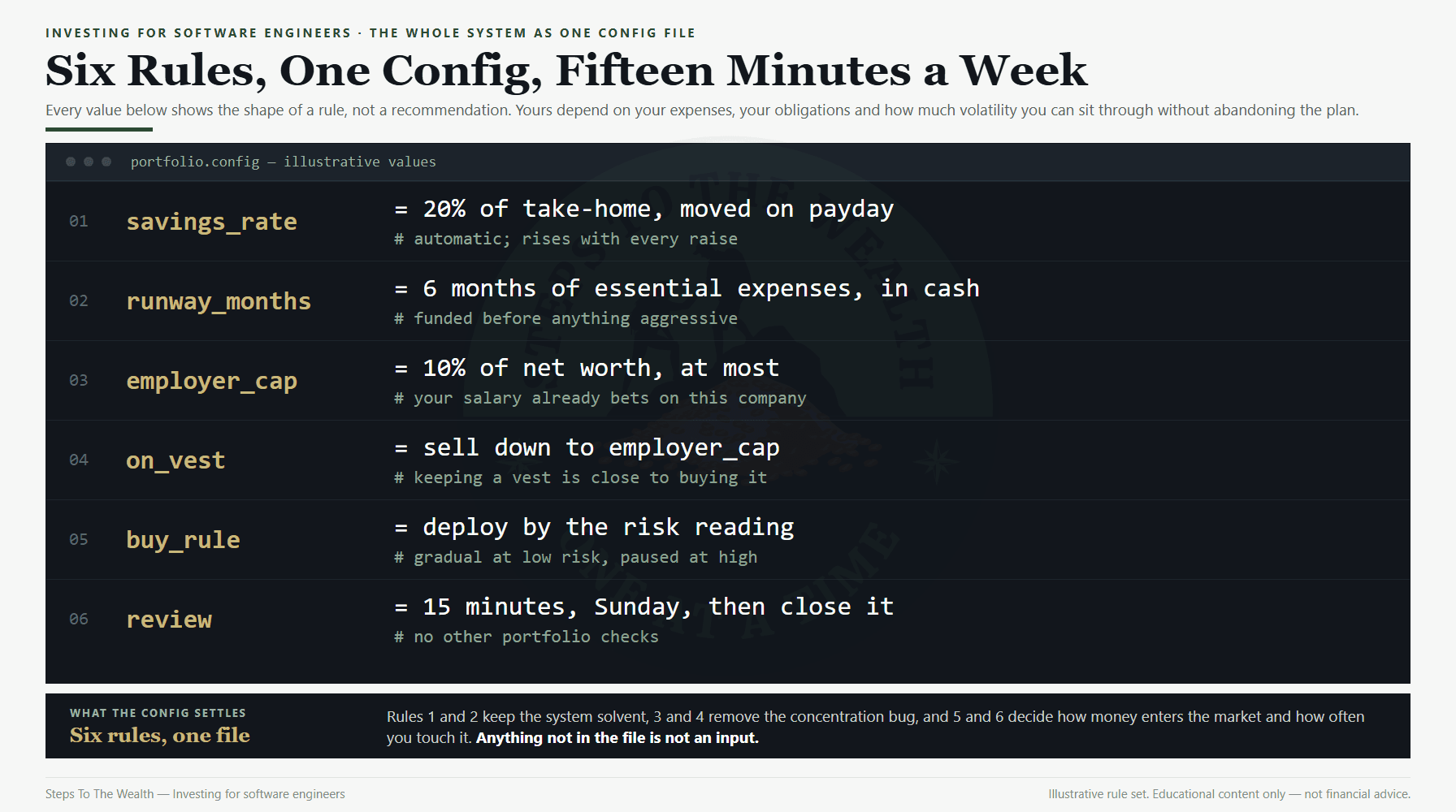
Rules. Six of them. The values in brackets are illustrations that show the shape of each rule, not recommendations. Yours depend on your expenses, your obligations and how much volatility you can sit through without abandoning the plan.
- Savings rate. A fixed share of every paycheck (say 20% of take-home) moves to your investment accounts on payday, automatically. It rises with every raise and never falls because of one expensive month. Our guide to increasing your contributions covers how to step it up.
- Runway. A cash reserve covering a set number of months of essential expenses (say six) is funded before any aggressive investing starts.
- Employer cap. Your employer’s stock never exceeds a set share of your net worth (say 10%).
- Vest rule. On every vest, sell down to the cap. The proceeds go into the plan the same week.
- Buy rule. New money deploys according to the risk reading: gradually when measured risk is low, paused when it is high.
- Review. Fifteen minutes on Sunday. No other portfolio checks.
Outputs. Three things, and only three: a contribution that lands every payday, a sell order queued for every vest date, and one weekly decision from the buy rule, which is buy, hold or trim. If the system is producing anything else, such as a trade you made because of a headline, it is running code you did not write.
Notice what is not in the spec: which individual stocks to own, where the market goes next, or what anyone on social media thinks about either. Those are not inputs. A system that accepts them as inputs gets rewritten every time the news changes, and a system that is rewritten every month is not a system.
The order of the rules is deliberate. Rules 1 and 2 make the system solvent. Rules 3 and 4 remove the single largest risk most engineers carry without noticing. Rules 5 and 6 decide how money enters the market and how often you are allowed to touch it. Skip the first four and the last two barely matter.
The Concentration Bug: RSUs, Options and One Employer
Here is the bug. If you work at a public tech company, or a private one that pays in equity, a large part of your financial life already depends on one company: your salary, your bonus, your unvested stock and any shares you kept from past vests. Many engineers then add to that exposure by holding every vest, buying through the employee stock purchase plan and keeping those shares too.
That stacks two exposures on one point of failure. Your human capital, meaning your future paychecks, is a bet on your employer. Your financial capital, if it is mostly employer stock, is the same bet. In a normal year the correlation does not show. In a bad year it is the whole story, because the conditions that sink a share price are often the same ones that trigger layoffs.
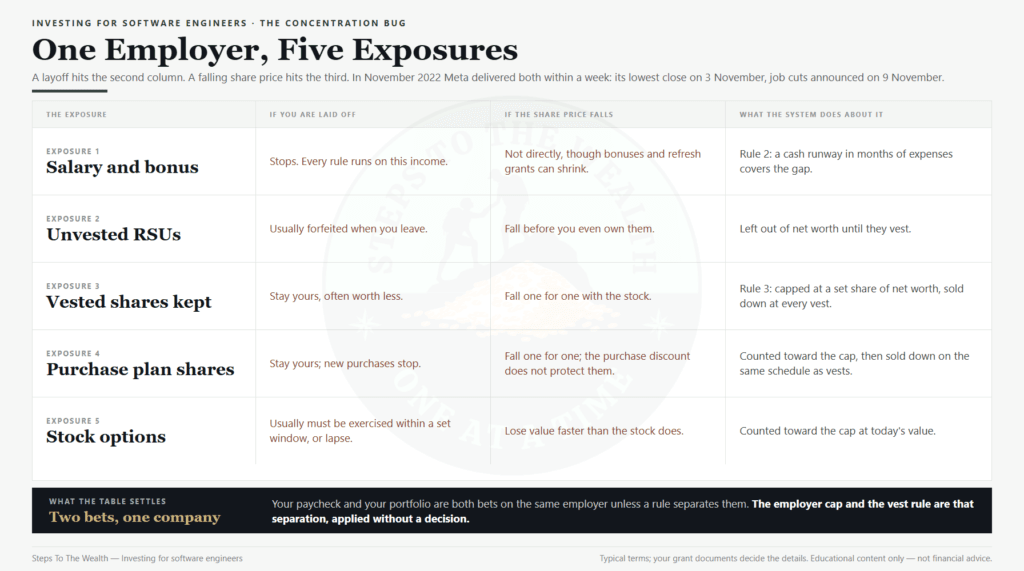
This is not hypothetical, and it did not take a fraud or a bankruptcy to show up. We took daily closing prices from Yahoo Finance for eight large tech employers and the S&P 500, found each one’s highest close in 2021 to 2022, and measured the fall to the lowest close after it. The companies were chosen because they are well-known employers of engineers, not at random, and not as a forecast of anything.
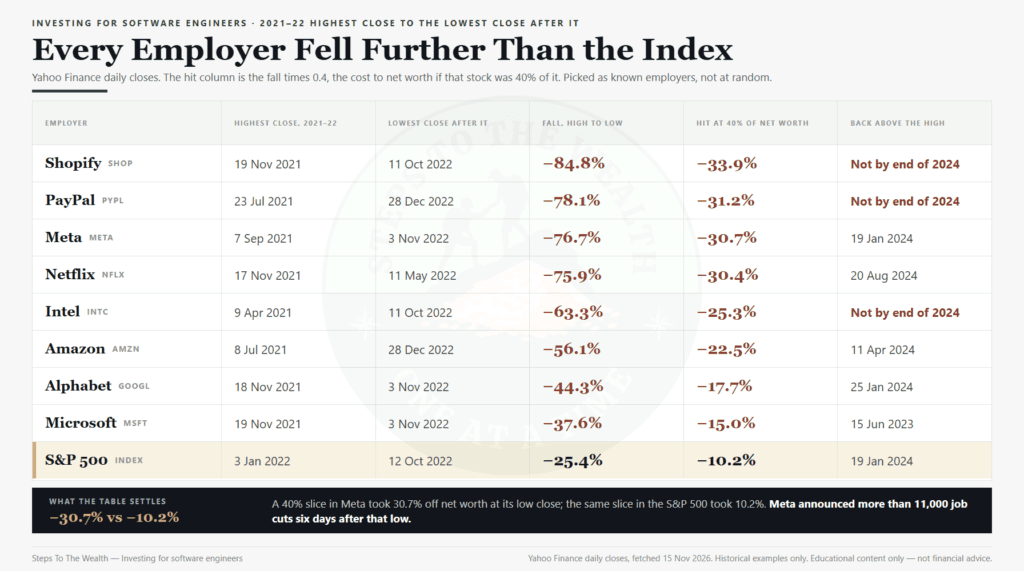
The results: Shopify fell 84.8% from its high close, PayPal 78.1%, Meta 76.7%, Netflix 75.9% and Intel 63.3%. Amazon fell 56.1%, Alphabet 44.3% and Microsoft 37.6%. The S&P 500 fell 25.4% from its own high close on 3 January 2022. Every one of the eight fell further than the index.
Now the arithmetic. If 40% of your net worth sat in your employer’s stock, a 76.7% fall in that stock takes 30.7% off your net worth on its own, before anything else in the portfolio moves. The same 40% in the index would have cost 10.2% from that slice. The gap between those two numbers is the price of concentration, and it is paid on top of whatever the rest of the market does.
The timing makes it worse. Meta’s lowest close in that stretch came on 3 November 2022. Six days later, on 9 November, the company announced it would cut more than 11,000 jobs, about 13% of its workforce, as NPR reported at the time. An engineer laid off that week who held mostly company stock lost the paycheck and most of the savings in the same month, and would have had to sell near the low to cover expenses.
Recovery is not guaranteed either. Meta closed back above its 2021 high on 19 January 2024, more than two years after the peak. Shopify, PayPal and Intel had still not regained their 2021 high closes by the end of 2024. Waiting it out only works if you can afford to wait, and only if the company comes back at all.
The fix is rules 3 and 4. A cap keeps the employer slice small enough that a bad year is survivable, and the vest rule enforces the cap without a decision. The usual objection is “but I believe in the company.” The test is simple: if your employer paid that vest in cash, would you spend all of it buying their stock? Most people would not, and holding a vested share is close to the same decision.
The reason is tax. In many jurisdictions, restricted stock units are taxed as income on the vest date, at that day’s price. Keeping the shares is then economically similar to receiving cash and buying the stock at that price. Treatment differs between countries and between grant types, so check how yours works before you build the rule around it.
Options and stock purchase plans add their own wrinkles: exercise windows, purchase discounts, and leverage that grows as an option nears its strike. Those mechanics are covered in our guide to equity compensation risk, and how to value an offer in the first place is in negotiating equity compensation. For the system, they all route through the same rule: count them toward the cap, and sell down when you are able to.
Layoff-Proofing: Emergency Fund Before Aggressive Investing
Rule 2 exists because the concentration bug has a second symptom. Even with a perfectly diversified portfolio, a layoff during a market drawdown forces the worst possible trade: selling assets after they have fallen, to pay rent. A cash reserve breaks that link. It is not an investment and is not meant to earn much. It is the buffer that lets every other rule keep running.
Sizing it is closed arithmetic. Take your monthly essential expenses, not your income, and multiply by the number of months you want to be able to go without a paycheck. At $6,000 a month of essential spending, three months is $18,000, six months is $36,000 and nine months is $54,000. Which multiple fits depends on how quickly someone with your skills gets rehired in a weak market, whether there is a second income in the household, and how many people depend on yours.
Tech salaries make this easy to underfund. The pay is high, so the runway feels unnecessary. But high pay tends to come with high fixed costs, and tech employers tend to cut staff in the same downturns that hit their share prices, as Meta did in November 2022. The question is not whether you could find work. It is whether you could find it before the reserve runs out.
Fund the runway first, then start the aggressive part of the plan. If you are weighing the two right now, our emergency fund vs investing breakdown walks through the sequencing. One practical note: sell-on-vest proceeds are a natural source for building the reserve, because they convert concentrated risk into the one asset that does not fall with your employer.
Automate the Boring Path, Then Review for 15 Minutes
The happy path should require no decisions at all. Payroll deposits the paycheck. A standing transfer moves the savings share to the investment account the same day. Tax-advantaged accounts, whichever ones your jurisdiction offers, get funded first, through payroll where possible. An automatic purchase invests the core contribution into a broad, low-cost fund. Vest dates go into your calendar with the sell order prepared in advance.
Once that is in place, your involvement drops to one scheduled session a week. Everything above runs without you. The session exists to catch exceptions: a transfer that failed, an allocation that drifted out of its band, a vest coming up, a change in the risk reading. Our walkthrough of how to invest while working full time covers the one-time setup step by step.
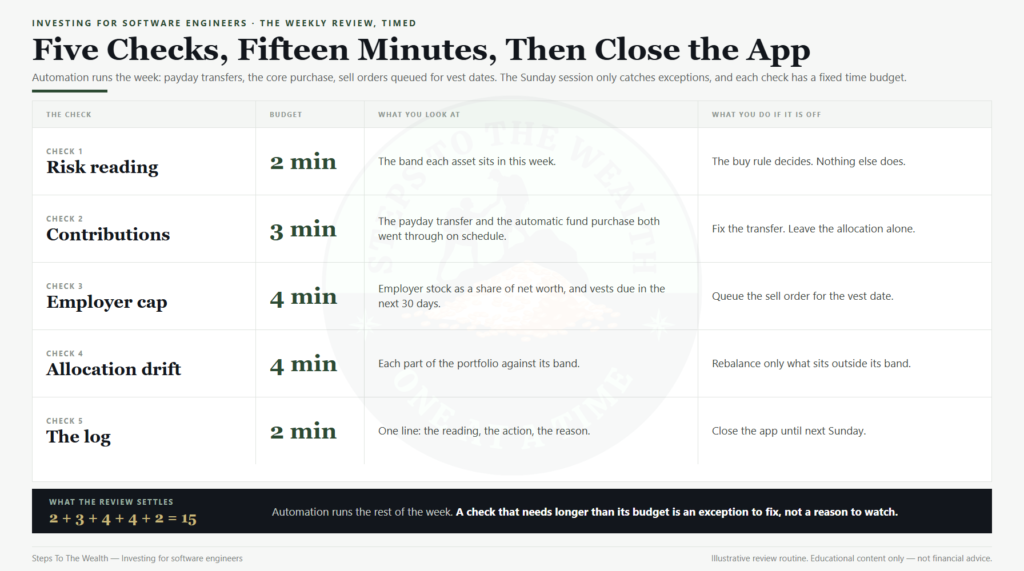
The review is five checks with a fixed time budget. Read the risk reading (two minutes). Confirm the contributions landed (three minutes). Check employer stock against the cap and look ahead to vests in the next 30 days (four minutes). Check each part of the allocation against its band (four minutes). Write one line in a log: the reading, the action, the reason (two minutes). That is fifteen minutes. Then you close the app until next Sunday.
The log matters more than it looks. It is your audit trail. When you are tempted to override the system, the log shows what the system did last time and how that turned out. The full version of this ritual is in the 15-minute Sunday investing review.
The buy rule is where the risk reading earns its place. Plain dollar-cost averaging invests the same amount whatever the market does. A dynamic DCA strategy varies the amount by the reading: more when measured risk is low, less or nothing when it is high, and a staged exit when it is very high. It stays mechanical. The reading changes the output; you do not.
Test the Plan Before You Run It
You would not ship code without running it against test cases. A contribution plan deserves the same treatment, and its test cases already exist: they are the historical drawdowns. How would your monthly contribution have done if you had started at the 2021 peak? Through the 2022 bear market? Would you actually have kept contributing while the balance fell?
The third question is the one that matters. A backtest helps because it puts concrete numbers on a drawdown before you live through one. Watching a plan’s balance fall 25% on a chart is far easier than watching it happen to your own account, but it is still useful rehearsal, and it shows whether your contribution size is one you could keep paying through it.
Our free DCA Simulator replays a dollar-cost averaging plan on any of 250 crypto assets, between dates you choose. Stocks, indexes, ETFs and commodities are in DCA Simulator Pro. Either way, treat the result as a test case, not a forecast. It shows how the plan behaved on one historical path. A plan tuned to win one backtest is overfitted, the same way a model tuned to one dataset is.
Failure Modes to Test For
Most plans do not fail on returns. They fail on a handful of predictable bugs, and each one has a matching rule.
Lifestyle creep. A raise arrives, spending rises to meet it, and the savings rate quietly falls as a share of income. Setting the contribution as a percentage rather than a fixed amount makes it scale automatically. Raising the percentage at each raise is the upgrade.
The one-vest exception. The stock has been going up, so you hold this vest and sell the next one. Then the next one too. A cap with exceptions is not a cap. If you truly want more exposure to the company, raise the cap in writing during a calm week and accept the risk that comes with it, rather than drifting there one vest at a time.
Counting unvested equity as net worth. Unvested stock is a conditional future payment that disappears if you leave or are let go. Plans that count it end up under-saving, because the balance looks larger than it is. Count only what you own today.
Refactoring every quarter. Changing the allocation every few months because a different fund did better last quarter is performance chasing with extra steps. Change the plan on a schedule, such as once a year, and only for a reason you can write in one sentence that does not mention recent returns.
Pausing contributions in a drawdown. This is the costliest bug, because it stops buying exactly when prices are lowest. If the runway is funded, rule 1 keeps running regardless of the headlines. The weekly log helps here too: it is harder to switch off a system when you can see it has done its job through the last three bad months.
What This System Cannot Do
An honest spec lists its limits. This one has several.
It cannot predict tops or bottoms. The risk reading measures conditions; it does not know the future. Some weeks it will pause buying right before a rally, and some weeks it will keep buying into a further fall. The rule is followed anyway, because the alternative is your own judgment on a bad day.
It cannot replace tax advice. Equity compensation is where tax treatment gets complicated fastest: vest-date income, holding periods, option exercise rules and stock purchase plan conditions. All of it differs by jurisdiction. The vest rule says sell down to the cap; a tax professional should tell you the cheapest way to do it.
It cannot make concentration safe. A cap lowers the damage from one company’s bad year; it does not remove it. And it cannot rescue a plan you abandon. Every rule here assumes you keep running it through the bad months, which is the only time it is really tested.
Finally, it will not make you rich quickly. This is background wealth-building: slow, structural and deliberately unexciting. If you want something faster, this is not it, and that is a reasonable choice to make.
Ship the First Version This Week
You do not need the whole system on day one. Ship a minimal version and iterate. This week: write down your monthly essential expenses and your current runway in months. List every vest date for the next twelve months and work out what share of your net worth your employer’s stock represents today. Set up one automatic transfer on payday, even a small one.
Next week, write the six rules on one page with your own numbers in the brackets, and put a recurring fifteen-minute block on your calendar for Sunday. That page is the spec. Everything after that is maintenance.
If you want the risk reading without building it yourself, the free Sunday email sends it every week for five major assets, along with the Dynamic DCA Blueprint when you sign up. If you would rather start by finding the weak spots in how you invest today, the Operator’s Audit is a short quiz that does exactly that. If neither fits, no hard feelings. The six rules work on their own.
For a broader introduction to how allocation across asset classes works, the SEC’s investor guide to asset allocation is a clear, neutral starting point.
FAQ
How should a software engineer start investing?
Start with the order of operations, not the fund choice. Build a cash reserve of several months of essential expenses, automate a fixed share of every paycheck into broad, low-cost funds, and cap how much of your net worth sits in your employer’s stock. Fund selection matters far less than those three.
What should I do with RSUs when they vest?
Ask whether you would buy that much of your employer’s stock with the same amount of cash. If not, sell down to your cap on the vest date and move the proceeds into the plan. In many jurisdictions the vest is already taxed as income, so holding the shares is close to buying them. Check your local rules.
How much of my net worth should be in my employer’s stock?
There is no universal number, but it should be small enough that a 75% fall would not change your life. In 2021 to 2022, Meta, Netflix, PayPal and Shopify each fell more than 75% from their high closes. At a 10% cap, a fall that size costs about 7.5% of net worth.
Should I build an emergency fund first given layoffs?
Yes. Layoffs tend to arrive during downturns, which is when selling investments to cover expenses does the most damage. A reserve sized in months of essential expenses lets the rest of the plan keep running while you look for work.
Can I automate all of this?
Almost all of it. Contributions, account funding and the core fund purchase can run on autopilot, and vest-date sales can often be scheduled in advance. What stays manual is a fifteen-minute weekly review to read the risk reading, check the cap and log one decision.
Educational content only — not financial advice. Nothing here is a recommendation to buy or sell any specific security. The companies named are used as historical examples only. Past price behaviour does not predict future results. Tax treatment of equity compensation depends on your own circumstances and the jurisdiction in which you reside.