
Every recurring investing plan ends at the same small screen: an amount, a fund, and a button. Somewhere on that screen sits a dropdown most people set once and never look at again. It offers a trade that executes immediately at whatever price the market is showing, or a trade that executes only at a price you name. Named-price sounds strictly better. Name a good number, pay less, keep the difference.
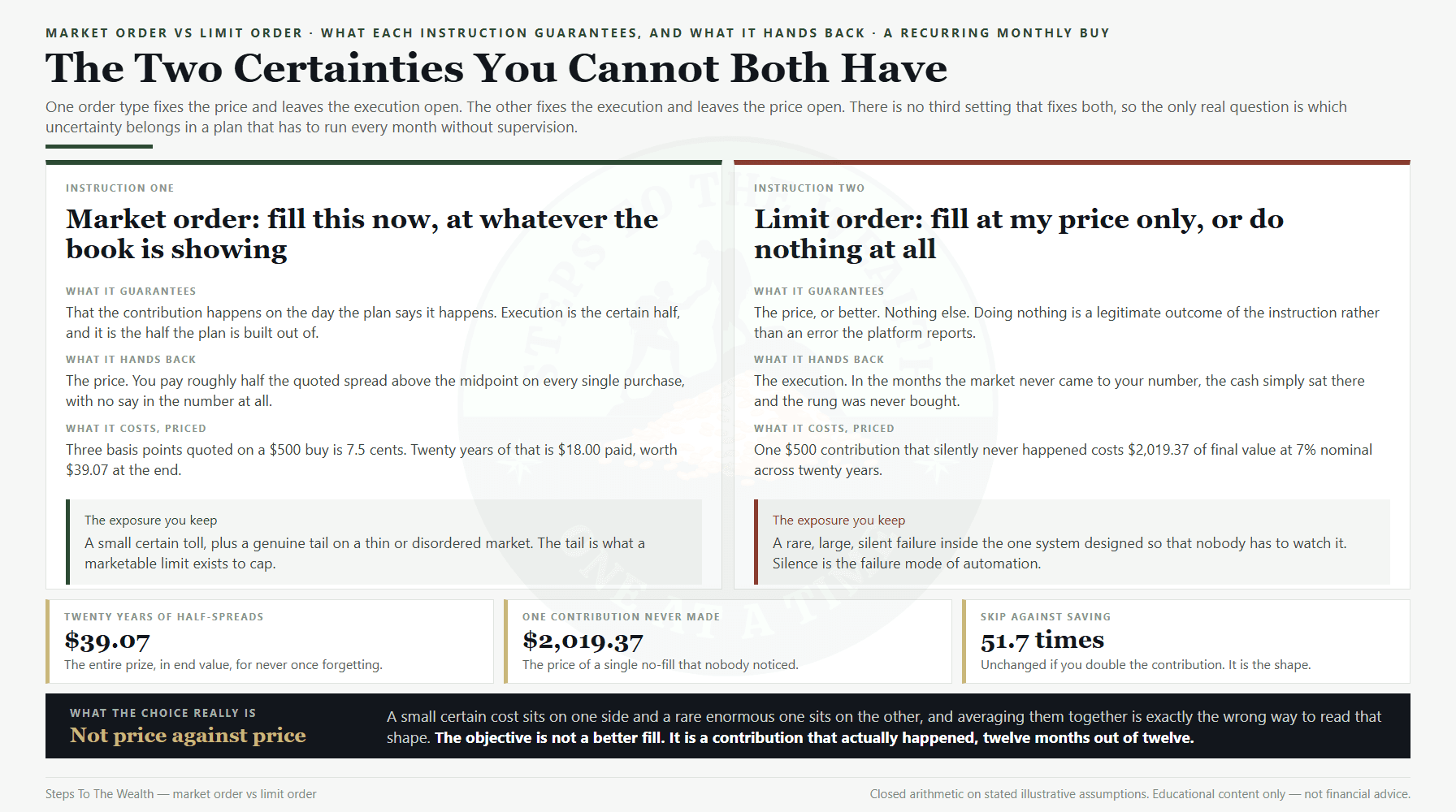
Market order vs limit order is not a choice between a worse price and a better one. It is a choice between two kinds of certainty, and only one of them is available at a time. A market order buys the certainty that the trade happens and surrenders certainty about the price. A limit order buys certainty about the price and surrenders the certainty that the trade happens at all. Every argument about which one is better is an argument about which uncertainty you would rather hold.
For a monthly contribution into a liquid fund, that trade is wildly one-sided, and it is closed arithmetic rather than opinion. The price uncertainty a market order hands you is worth a few cents a month. The execution uncertainty a limit order hands you is worth an entire contribution.
This article prices both sides on the same stated assumptions, and then says plainly where a limit order does earn its place — because it does, under conditions specific enough to write down.
Educational content only. Not financial advice.
What each order type actually instructs
Strip the labels off and there are two instructions. A market order says: fill this now, at whatever the book shows. A limit order says: fill this only at my price or better, and if that price never appears, do nothing. The regulator’s own description is exactly this blunt — a market order guarantees execution but not price, and a limit order guarantees price but not execution.
That second clause is the whole article. Do nothing is a legitimate outcome of a limit order. It is not an error state, it is not a failed transaction, and on most platforms it is not a notification. The order simply sits, expires at the close, and the month passes with the cash still in the account.
The price you give up on a market order is not the whole spread either. Quotes come in pairs: a bid, where the market will buy from you, and an ask, where it will sell to you. The midpoint between them is the closest thing to a fair price. Buying at the ask means paying roughly half the quoted spread above that midpoint. Half the spread is the real toll, not the whole one, and on a large broad-market fund it is measured in hundredths of a percent.
So the two instructions carry two different costs. One is small, certain, and paid every month. The other is zero almost every month and occasionally equal to a whole contribution. Averages are not how you should think about that shape.
What the spread actually costs a monthly buy
Put numbers on the certain side first, because it is the side people worry about. Take a $500 monthly contribution into a large, liquid index fund quoting a 0.03% spread — three basis points, an ordinary figure for a fund of that kind. Check your own; a thin fund can quote ten times that.
Half of three basis points is 0.015%. On $500 that is 7.5 cents a purchase, or 90 cents a year. Over twenty years of unbroken monthly buying you hand the market $18.00 in crossing costs. Invest the pennies you would have saved, at 7% nominal compounded monthly alongside everything else, and the entire twenty-year saving is worth $39.07 at the end.
Thirty-nine dollars. That is the prize a limit order is placed to win, on the assumptions above, over two decades of never once forgetting. It is a real number and it is not zero, which is why the figure below prices it across four spread levels instead of asserting one.
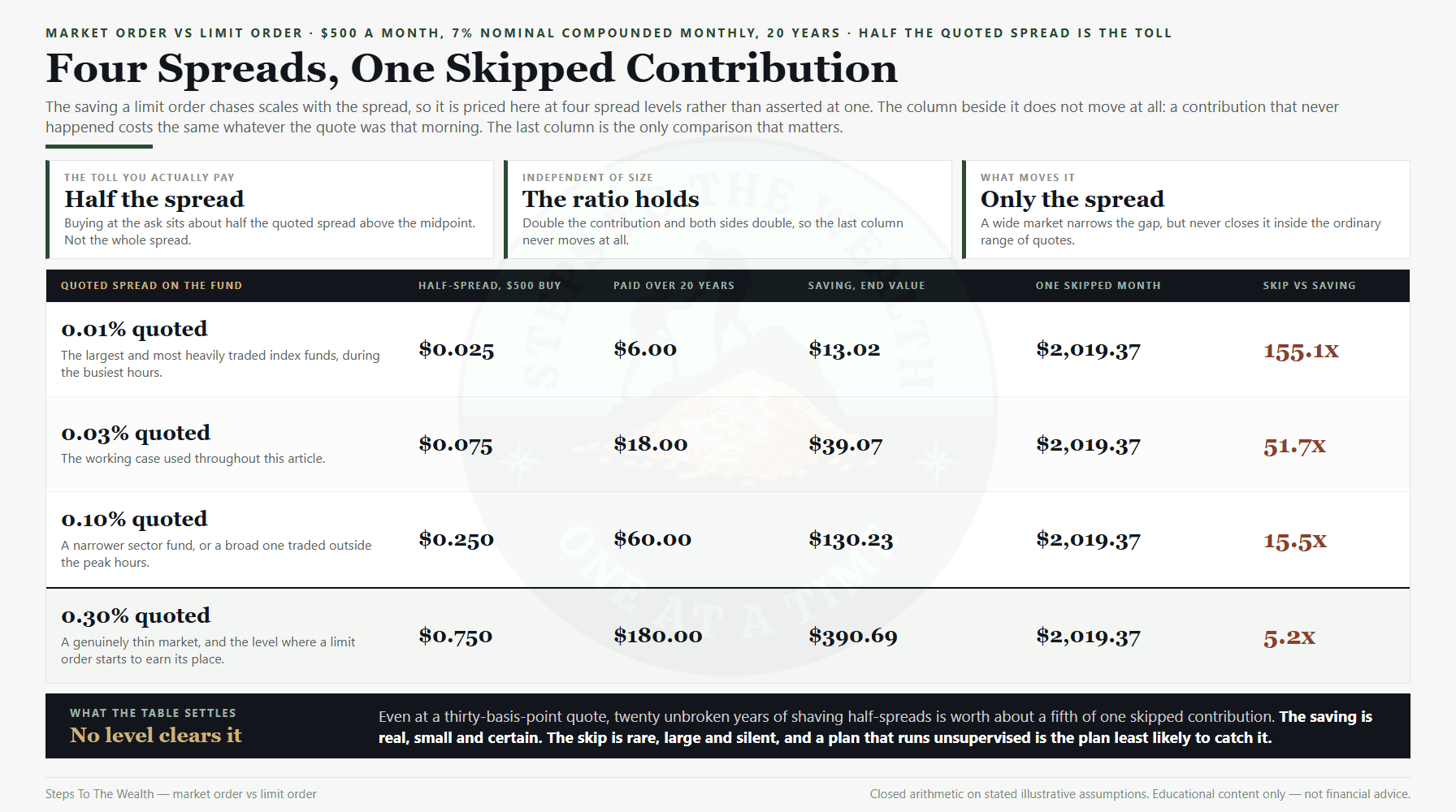
The pattern is worth reading carefully. At a one-basis-point spread the saving is almost nothing. At thirty basis points — a genuinely wide market, not an index fund — twenty years of half-spreads is worth $390.69, which is real money. The spread is not fictional, and a wide one deserves respect. What the spread is not, at any level in that table, is the largest number on the page.
Market order vs limit order: the arithmetic that decides it
Now price the other side. A limit order that never fills does not cost you a spread. It costs you the contribution, and the contribution is the thing the entire plan is built out of.
One $500 contribution skipped at the start of a twenty-year plan, compounding at 7% nominal, is $2,019.37 of final value that does not exist. Set that beside the $39.07 the same plan saved by shaving half-spreads for two hundred and forty months. The skipped month is 51.7 times the entire saving.
The ratio has a property worth noticing: it does not depend on how much you invest. Double the contribution and both numbers double. The 51.7 is a statement about the shape of the trade, not about the size of your account. It moves only with the spread — 155.1 times at one basis point, 15.5 times at ten, and still 5.2 times at a fat thirty-basis-point quote. There is no spread level in the ordinary range at which one silent skip is a good trade.
Be fair to the other side of this. A limit order that does not fill on Monday and gets noticed on Tuesday costs approximately nothing — you buy a day later, at a price that is as likely to be lower as higher. The $2,019.37 is not the price of a no-fill. It is the price of a no-fill nobody sees, in a plan built specifically so that it does not need supervision.
That is the actual risk, and it is a structural one rather than a market one. The whole appeal of a mechanical plan is that it runs while you are at work, which is the same property that lets a non-execution pass unnoticed for a month. The failure mode of an automated system is silence, and the arithmetic says one silence undoes fifty years of cleverness.
The three ways a limit order fails a plan
Non-execution is only the first of them, and the other two are quieter. Each breaks a different part of a rules-based plan, and none of the three announces itself.
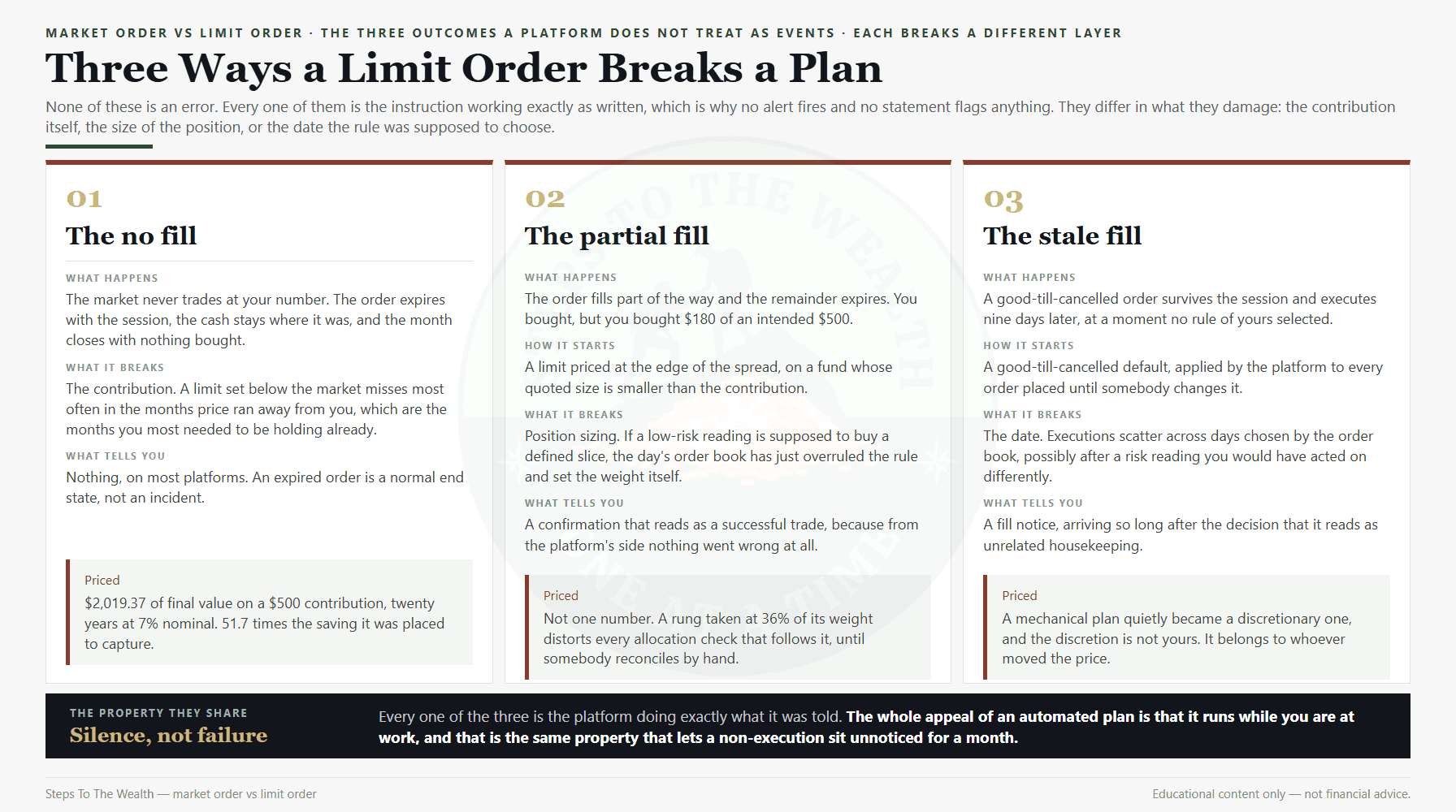
The no fill is the one already priced. The market never trades at your number, the order expires with the session, and the contribution stays in cash. If you set your limit below the market to catch a better entry, this happens most often in exactly the months the market ran away from you — which is to say, the months you most needed to already be holding.
The partial fill is subtler and worse for anyone sizing positions by rule. Your $500 order fills $180 of the way and the rest expires. You did not skip the month; you took a rung at 36% of its intended weight. If your framework says a low-risk reading buys a defined slice, a partial fill has quietly overridden your position sizing rules with the day’s order book. Nothing in the account will flag it, because from the platform’s point of view nothing went wrong.
The stale fill belongs to good-till-cancelled orders. The order survives the session and fills nine days later, at a moment no rule of yours selected, possibly after a risk reading you would have acted on differently. A plan whose executions are scattered across dates chosen by the market is no longer rules-based investing. It is discretion with extra steps, and the discretion belongs to the order book.
Where a limit order genuinely earns its place
None of this makes the limit order a mistake. It makes it a tool with conditions, and the conditions are checkable in about a minute before you press anything.
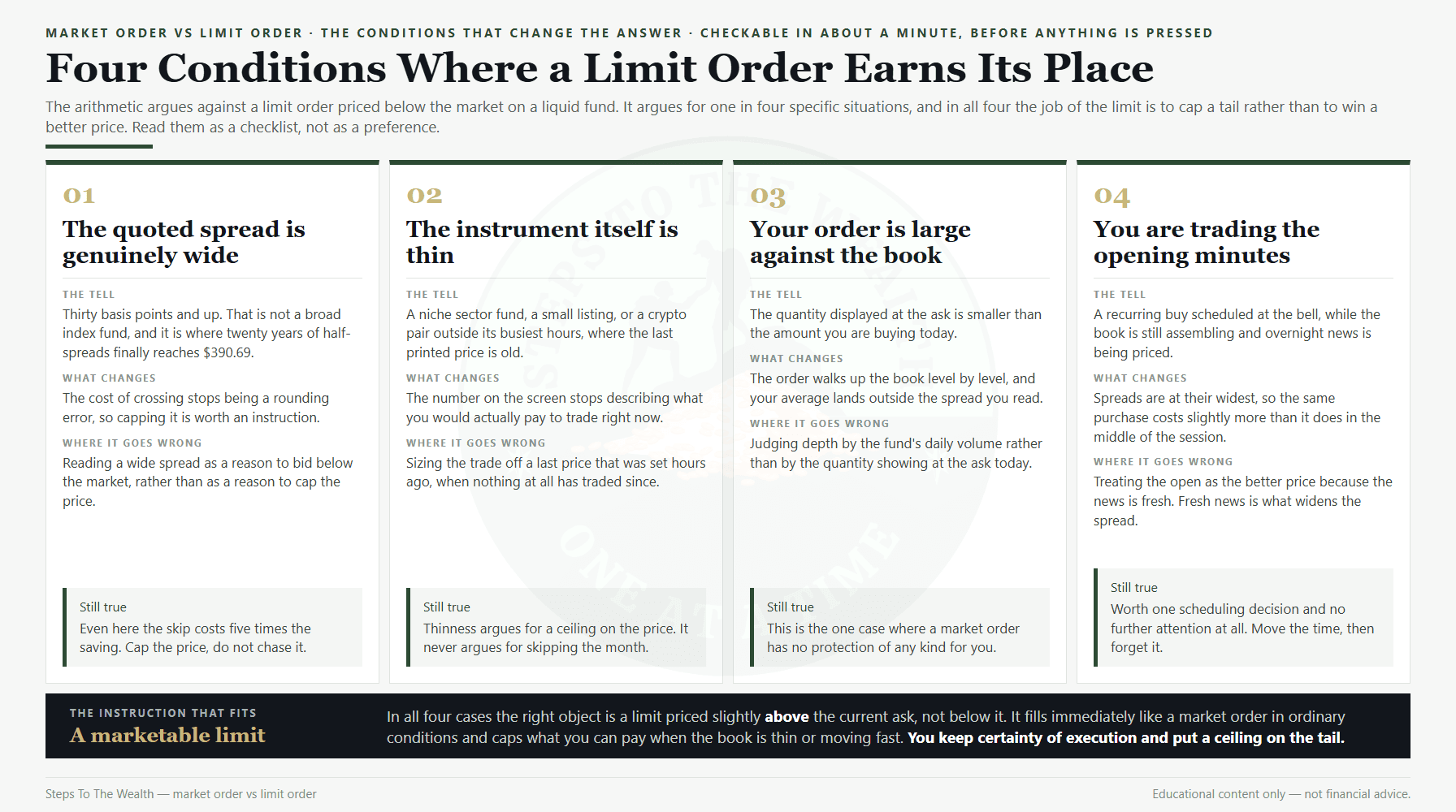
The first condition is a genuinely wide quoted spread. Thirty basis points is not an index fund, it is a thin one, and there the arithmetic above starts to matter in both directions. The second is a thin instrument generally — a niche sector fund, a small listing, a crypto pair outside its busiest hours — where the price shown last traded some time ago and means less than it looks like it means.
The third is size relative to what the market is displaying. A contribution that is large next to the quantity quoted at the ask will walk up the book, taking each successive price level, and the average you pay can land well outside the spread you read. Nothing about a market order protects you there.
The fourth is timing inside the session. Spreads are at their widest in the first minutes after the open, when the book is still assembling and the previous night’s news is being priced. A recurring buy scheduled for the middle of a session costs less to execute than the identical buy at the opening bell, and this is the only execution decision in the whole article with a repeatable direction to it. It is also worth roughly a rounding error, which is exactly why it should be set once and forgotten rather than optimised.
When those conditions are present, the instruction that fits is not a limit below the market. It is a marketable limit: a limit set slightly above the current ask. It fills immediately like a market order in normal conditions, and it caps what you can pay if something bizarre is happening to the book. You keep the certainty of execution and you cap the tail. That is a guardrail, and a guardrail is a different object from a price-improvement attempt.
The execution decision that is really a timing decision
A buy limit set below the current market has a familiar shape once you name it honestly. It is an instruction to buy only if the price comes to you, and to do nothing otherwise. That is buying the dip, executed in miniature, twelve times a year, without ever being written down as a strategy.
It inherits the same problem. The dip you are waiting for arrives some months and not others, and the months it does not arrive are the months the market rose without you. Over a long enough run, an entry rule that only executes on weakness systematically under-executes during strength, which is where a large share of a long-horizon return actually comes from. The point of time in the market versus timing the market is not that timing is immoral. It is that non-participation has a price, and the price is paid in the good months.
There is a second, quieter cost. A limit price is a number you have to choose, twelve times a year, in front of a live chart. That is a decision reintroduced into a system whose entire purpose was to remove decisions. The myths around dollar-cost averaging mostly turn on this: people assume the mechanical version leaves value on the table, when in practice the discretionary version leaks more through the decisions it forces you to keep making.
Where this sits in a risk-first system
Keep the layers separate, because conflating them is how execution starts making portfolio decisions. The risk reading decides whether you are buying and how much. The plan decides when. The order type decides only how the instruction reaches the exchange. It is plumbing, and plumbing should not have opinions.
When a limit price starts encoding a view — “I will only buy if it comes back 2%” — an execution setting has been promoted into a second, hidden timing layer that no rule authorised and no review will catch. If you have a view about price, put it in the framework where it can be measured against a market risk indicator and reviewed. Do not smuggle it into a dropdown.
This is also why the execution question ranks where it does among costs. Half a basis point sits far below the fund’s annual charge in the hidden cost of investment fees, and below the gap between a fund and its index in index fund tracking error. Those are annual, compounding, and paid on the whole balance. The spread is one-off, paid on the new money only. Attention should be allocated in that order, and almost nobody does it that way, because the spread is the number visible at the moment of buying.
The check worth doing this week
Open your broker and find the recurring instruction, not the last trade. Answer three things about it. Is it a market order or a limit? If it is a limit, what happens on a month it does not fill — does anything at all tell you? And of your last twelve scheduled buys, did twelve execute?
That last count is the one that matters. Twelve of twelve and the setting is doing no harm whatever it says. Eleven of twelve, and you have just found a leak worth more than every fee decision you made this year, hiding inside a dropdown you set once. It is the same class of leak as most small investing mistakes: individually trivial, structurally expensive, and invisible until somebody counts.
If the plan is automated end to end — a standing transfer and a scheduled purchase, the arrangement described in how to invest while working full time — then in most cases the order type was chosen for you, and it was a market order. That is the right default for a liquid fund, and it is worth confirming rather than assuming.
Frequently asked questions
Should I use a market order or a limit order for my monthly investment?
For an ordinary contribution into a large, liquid fund, a market order is the default that matches the plan’s purpose: it guarantees the contribution happens. The alternative worth considering is a marketable limit — set slightly above the ask — which fills like a market order while capping the price in a disordered market. A limit set below the market is a timing decision wearing an execution label.
Does the bid-ask spread matter if I invest every month?
It matters more than for a single lump sum, because you cross it on every contribution rather than once. It is still small in absolute terms on a liquid fund: on the assumptions here, 7.5 cents per $500 purchase, $39.07 of end value over twenty years. Compare that with the fund’s annual charge, which is paid on the entire balance every year.
What happens if my limit order does not fill?
Usually nothing visible. The order expires at the close of the session, the cash stays in the account, and most platforms do not treat it as an event worth telling you about. That is the mechanic behind the whole argument: the failure is silent, and a plan designed to run unsupervised is precisely the plan least likely to notice.
Is a market order risky in a volatile market?
It carries a real tail. In a fast or disordered market the price you get can be well away from the last quote you saw, and a market order accepts that by construction. The proportionate answer is not a limit below the market, which trades one risk for a worse one. It is a marketable limit, which keeps execution near-certain and puts a ceiling on the price.
What is a marketable limit order?
A limit order priced at or slightly above the current ask for a buy. Because the market is already trading at or below your limit, it executes immediately in ordinary conditions, so it behaves like a market order. The difference only shows up when the book is thin or moving fast, at which point the limit stops you paying an absurd price.
Should I avoid buying at the market open?
Spreads are widest in the first minutes of a session, so an identical purchase generally costs slightly more at the opening bell than mid-session. It is a small, repeatable effect worth one scheduling decision and no further attention. Moving your recurring buy an hour later is a set-once fix, not something to monitor.
Does any of this apply to fractional share plans?
Often it does not, and that is a feature. Many recurring plans that buy fractional amounts do not offer an order type at all — they aggregate contributions and execute them at a set time. You lose the choice and, with it, the ability to break your own plan with a price you invented on a Sunday evening.
The short version
Market order vs limit order, for a recurring plan, is not a contest between prices. It is a contest between a small certain cost and a rare enormous one. Crossing half a spread on a liquid fund costs about $39 of end value across twenty years. One contribution that silently never happened costs $2,019.37, on the same assumptions. Nothing in the ordinary range of spreads makes that a trade worth taking.
Use the limit order where it functions as a guardrail rather than a bargain: wide spreads, thin instruments, size against the displayed book, and the chaos of the open. Everywhere else, the objective is not a better price. It is a contribution that actually happened, every single month, without needing you to be watching. Certainty of execution is not the boring option. It is the one the plan is made of, and it is the one volatility is not risk keeps pointing at from the other direction.
The weekly risk readings and the framework behind them go out in the Steps To The Wealth newsletter — the reading, the decision it triggers, and nothing else.
Educational content only. Not financial advice. All figures are illustrative arithmetic on stated assumptions: a $500 monthly contribution, quoted spreads as labelled, 7% nominal returns compounded monthly, no fees, taxes or fractional-share effects modelled.