

Every risk questionnaire you have ever filled in asks a version of the same question. How would you feel if your portfolio fell 20%? Would you sell, hold, or buy more? You answer on a calm afternoon, the form scores it, and an allocation comes out the other end.
The form asked what you could stomach. It never asked what you could survive. Those are two different quantities, they are measured in completely different ways, and only one of them can be computed.
Risk tolerance vs risk capacity is the distinction that decides how much of your money belongs in a volatile asset. Tolerance is a preference — how much loss you are willing to sit through. Capacity is arithmetic — how much loss your structure can absorb before something forces you to sell. One is a feeling you report about yourself. The other is a number you can work out in fifteen minutes with a calculator and your own bank balance.
Most investors have never computed the second one. They have an opinion about the first one and treat it as the answer to both. This article shows how to calculate capacity, how to measure tolerance from evidence rather than self-report, and what to do in the ordinary case where the two numbers disagree.
Educational content only. Not financial advice.
Risk tolerance vs risk capacity: the two questions a questionnaire collapses into one
Start with the definitions, because the whole argument depends on keeping them apart.
Risk capacity is the amount of loss your financial structure can take without forcing you to act. It is set by things with dates and dollar amounts attached: the money you have committed to spend and when, how stable your income is, how much cash sits outside the market, and how long the rest can be left alone. Capacity is objective in the sense that matters — two people can disagree about it, and one of them is wrong.
Risk tolerance is the amount of loss you are willing to hold through. It is a behavioural property, not a financial one. It lives in what you actually did the last time a position of yours fell hard, not in what you predicted you would do on a form.
The failure mode is not that people confuse the words. It is that the questionnaire produces one number and everyone treats it as both. A form that scores you "moderate" has measured your self-image on a calm day and then quietly used it to size an allocation that only capacity can legitimately size. The SEC’s investor education primer on asset allocation is careful to name both horizon and comfort as separate inputs; most consumer questionnaires are not.
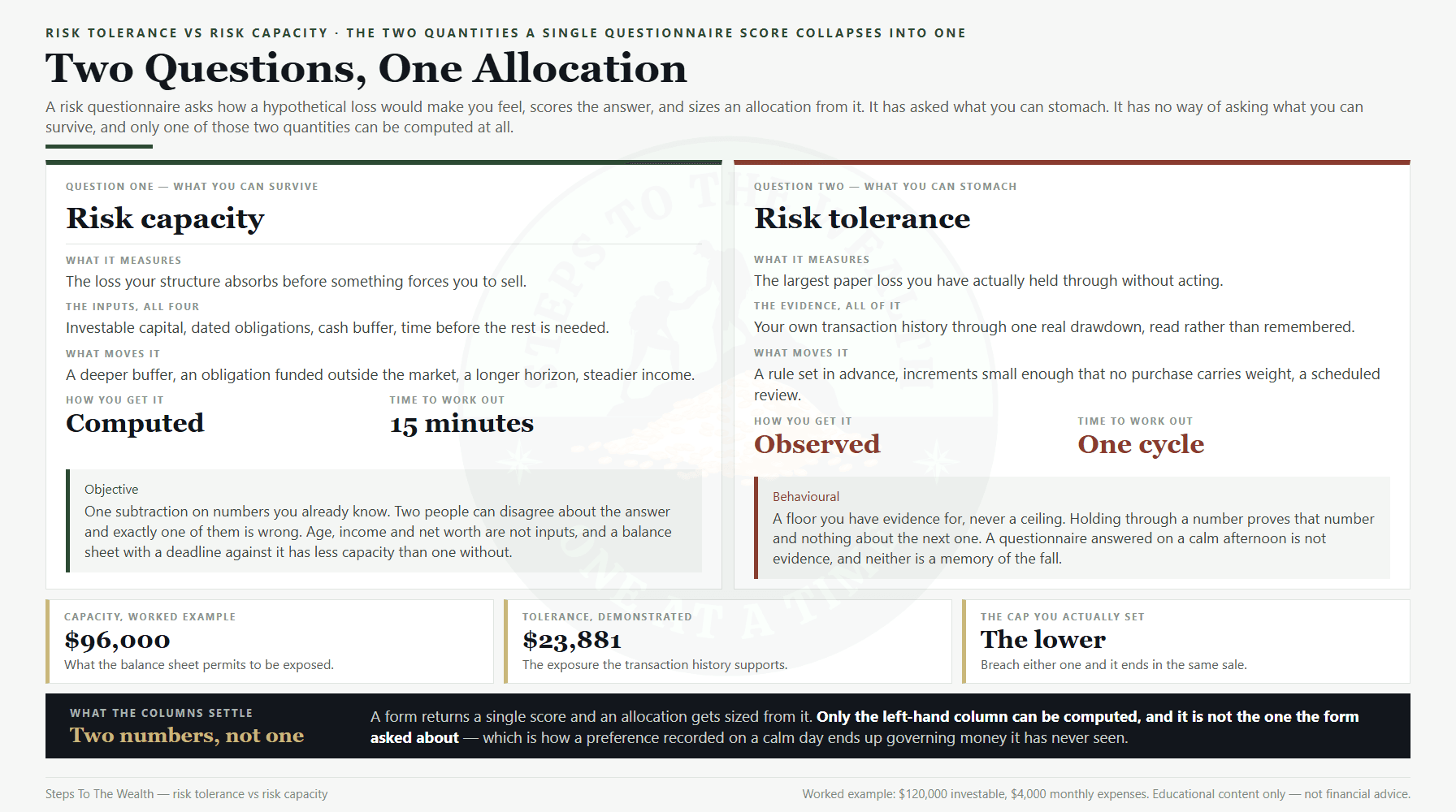
Read down the two columns and notice which one you have ever actually filled in. Capacity has four inputs, all of which you already know. Tolerance has one source of evidence, and it is a source most people have never opened.
There is a third quantity that gets folded into both and belongs to neither: how much risk you need to take to reach a goal. That one is a planning question, and it has no authority over the other two. A plan that requires more exposure than your capacity permits is not a reason to raise the exposure. It is a reason to fix the plan.
Risk capacity is arithmetic, and almost nobody computes it
Capacity is a subtraction. Take everything you could invest, remove the money that is already spoken for, and what remains is the money a drawdown cannot reach.
Four inputs, in the order they bind:
- Total investable capital. Everything you could put to work, including the cash currently sitting idle. This is the starting figure, not the answer.
- Dated obligations. Any sum with a date attached inside your horizon — a deposit, a tuition bill, a planned replacement of something expensive. Money with a deadline is not investable capital, whatever the account it sits in. This is precisely the trap that short-horizon money walks into.
- Cash buffer. The months of expenses held outside the market so an emergency never makes you a seller. Six months is the common baseline; twelve is the honest number when income is variable or commission-based. The buffer is the reason an emergency fund comes before investing rather than alongside it.
- Time before the remainder is needed. Not a preference — a date. This one does not change the subtraction, but it decides which historical drawdown you should be stress-testing against.
What is left after the first three is your exposed capital: the amount that can fall a long way without a single forced decision. Everything else in the account is already committed, and pretending otherwise does not make it available.
Notice what is not in that list. Your age is not an input, except through the horizon. Your income is not an input, except through its stability. Your net worth is not an input at all — a large balance sheet with a dated obligation against it has less capacity than a small one with none. And your confidence is nowhere in the arithmetic, which is the point.
Three investors, the same $120,000, and three different caps
Run the subtraction on three people who look identical on any form. Each has $120,000 of investable capital and $4,000 a month of expenses. Their capacity is not close to identical.
Investor A has a $30,000 house deposit due in eighteen months and stable salaried income, so a six-month buffer of $24,000. Exposed capital: $120,000 − $30,000 − $24,000 = $66,000, or 55.0% of capital.
Investor B has no dated obligations and the same stable income, so the same six-month buffer. Exposed capital: $120,000 − $24,000 = $96,000, or 80.0% of capital.
Investor C earns variable income and holds a twelve-month buffer of $48,000, plus a $15,000 vehicle replacement expected inside two years. Exposed capital: $120,000 − $48,000 − $15,000 = $57,000, or 47.5% of capital.
Now put a real drawdown through all three. The S&P 500 fell 56.78% from its 2007 peak to the March 2009 low and did not reclaim that peak on price alone until 28 March 2013. Apply that fall to the exposed capital of each investor and read the paper losses.
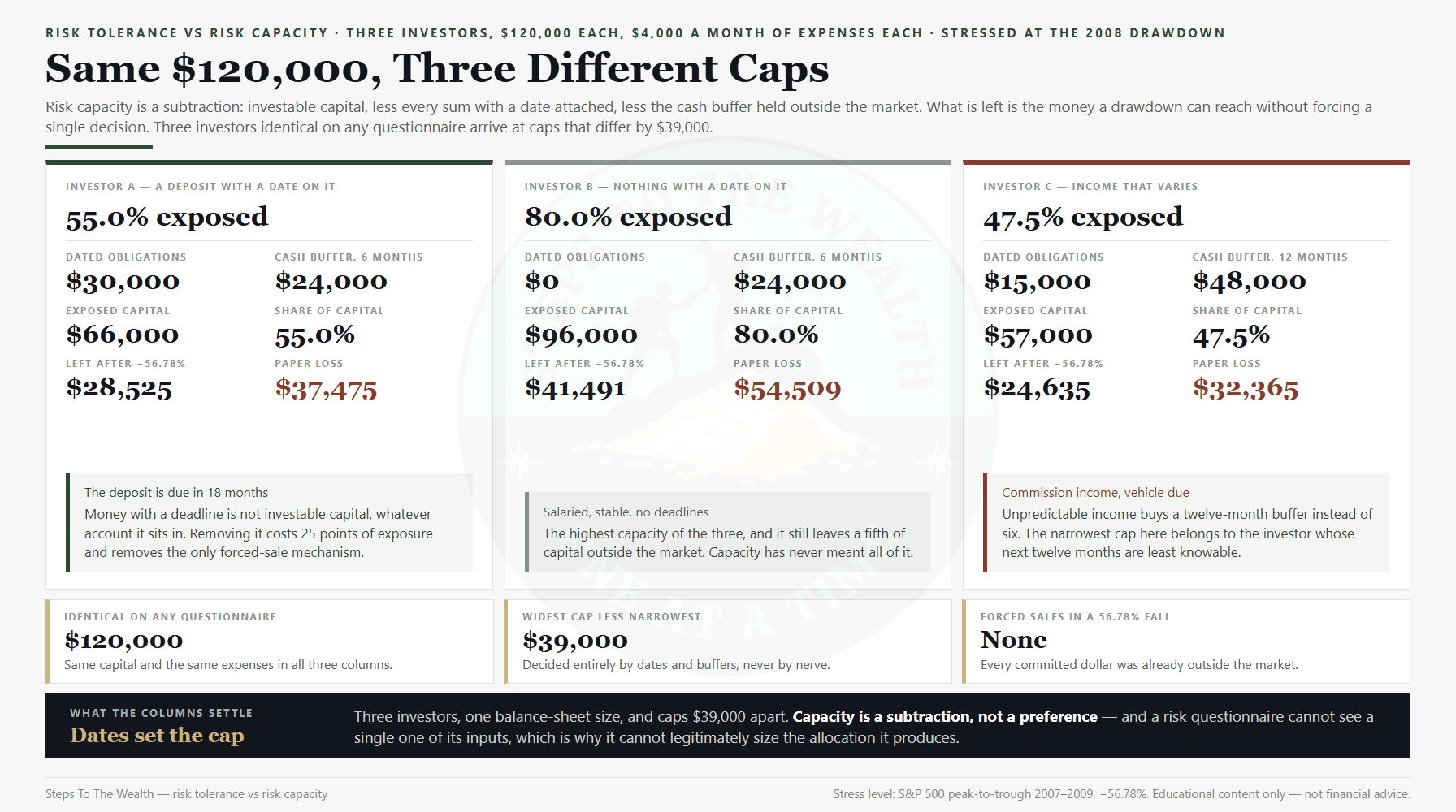
A ends the fall with $28,525 of the $66,000 still showing, a paper loss of $37,475. B ends with $41,491 of $96,000, a paper loss of $54,509. C ends with $24,635 of $57,000, a paper loss of $32,365. Every one of those is a paper loss and none of them is a realised one, because in all three cases the deposit, the buffer and the vehicle money were never in the market to begin with.
That is what capacity buys. Not a smaller fall — the market fell the same amount for all three — but the absence of any mechanism that turns the fall into a sale. It is the same structural point that separates volatility from risk, expressed as a number you can actually set.
One honest note on the stress level. A 56.78% fall is the deepest broad-equity drawdown of the modern era, not a forecast, and the next one will have a different depth and a different recovery path. It is used here because a capacity calculation that only survives an average year is not a capacity calculation. Test against the bad case, not the likely one.
Risk tolerance is evidence, not a preference
Capacity you compute. Tolerance you can only observe, and the observation has to come from a period when money was genuinely moving.
Here is the measurement, and it is deliberately narrow. Your demonstrated tolerance is the largest paper loss you have held through without acting. Not the largest you believe you could hold. Not the number a form assigned you. The largest one that actually happened, in dollars, with your money.
Work it out from your own records. Find the worst quarter you have lived through as an investor, open the transaction history rather than your memory of it, and read what the balance did and what you did. If you held $40,000 through the COVID crash of 2020 — a fall of 33.9% in 33 days, back to the prior peak in 181 days — the position bottomed near $26,440 and you sat through a paper loss of $13,560. That is a measurement. It is the only tolerance figure you own.
Three things make this harder than it sounds, and all three are worth naming.
The first is that memory is not evidence. Ask almost anybody what they did in March 2020 and you get a story assembled afterwards to fit how the market resolved. The statement remembers accurately and you do not, which is why identifying your investor type from behaviour beats identifying it from self-description.
The second is that percentages do not measure tolerance. Nobody has ever panicked at a percentage. People panic at a dollar figure, and the same 30% means something different on $8,000 and on $300,000. If you have never lived through a drawdown large enough to test you, the closest available substitute is to run your actual allocation through a historical crash and read the number at the bottom in dollars.
The third is that a demonstrated figure is a floor, not a ceiling. Holding through $13,560 proves you can hold through $13,560. It does not prove you cannot hold through $40,000, and it does not prove you can. Treat it as the largest amount you have evidence for, and let the evidence accumulate.
When the two disagree, the lower number binds
Take the investor from the paragraph above and give them Investor B’s balance sheet. Capacity says $96,000 can be exposed. Demonstrated tolerance says they have held through a $13,560 paper loss and no more.
Those two numbers are not compatible. At the 2008 drawdown of 56.78%, $96,000 of exposure produces a paper loss of $54,509 — four times anything this investor has ever sat through. The capacity calculation is correct and it is also irrelevant, because a structure that permits a loss the owner will sell into does not prevent the sale.
So invert the arithmetic and solve for the exposure that keeps the loss inside the evidence. At a 56.78% fall, holding the paper loss at or below $13,560 means exposure of $13,560 ÷ 0.5678 = $23,881.
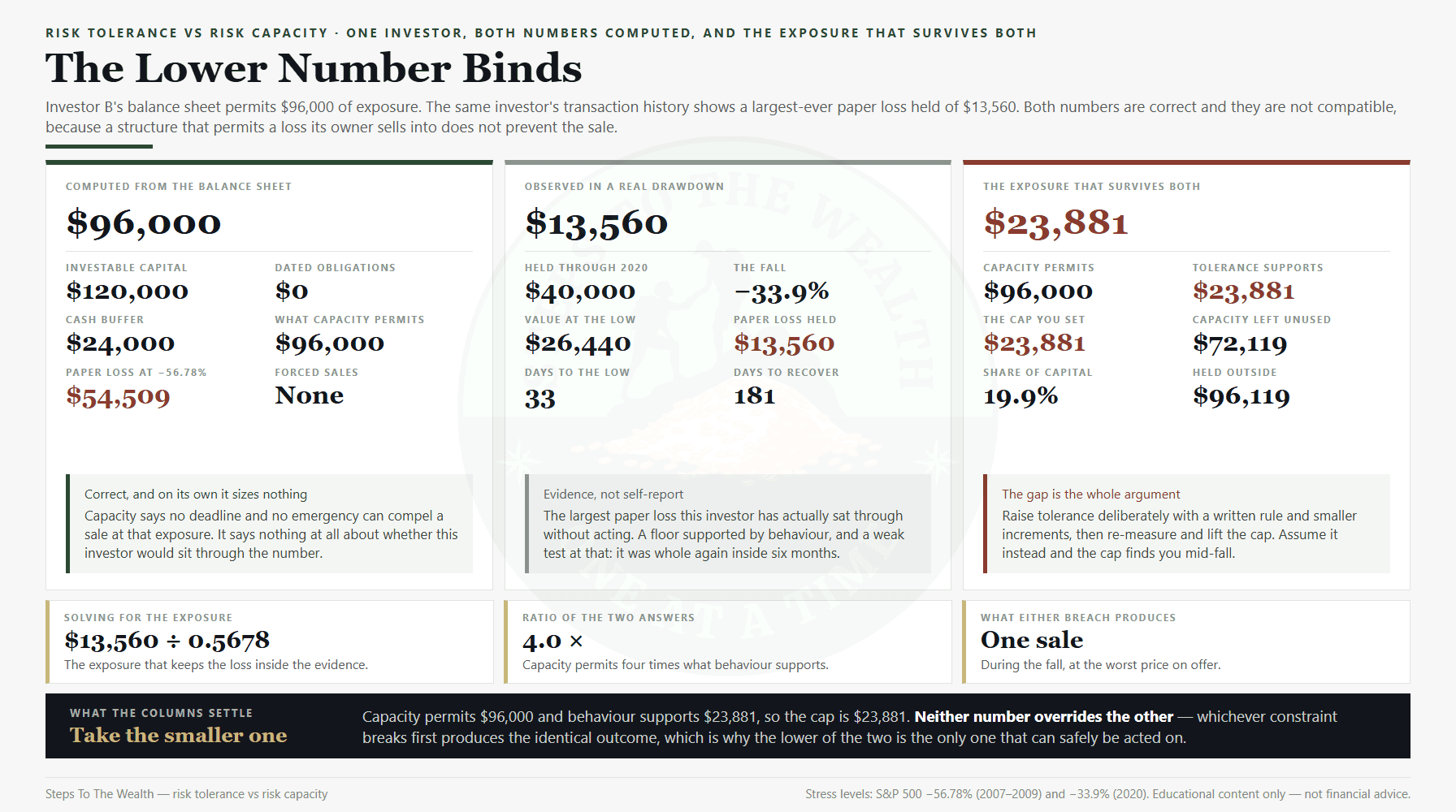
Capacity permits $96,000. Tolerance supports $23,881. The number you set is the lower one, and the gap between them is not a rounding error — it is the whole argument. Four cases fall out of it, and each has a different correct response.
- Capacity high, tolerance low. The common case, and the one above. You are structurally safe and behaviourally untested. Size to tolerance, then raise it deliberately rather than assuming it.
- Capacity low, tolerance high. The dangerous case. Willingness cannot pay a deposit that comes due mid-drawdown. No amount of conviction moves this one; only the balance sheet does.
- Both low. The starting position for most people, and it is a fine place to start. Build the buffer first, expose a small amount, and let both numbers grow.
- Both high. Rare, and it is the case that most needs a written rule, because nothing external will stop you.
The reason the lower number binds is mechanical rather than moral. Whichever constraint you breach first produces the same outcome — a sale during the fall — and a sale during the fall is how a temporary drop becomes a permanent one. This is also why the question "what is my risk capacity" is answered as a portfolio-level cap and then implemented one position at a time through position sizing rules. The cap decides how much is exposed. Sizing decides how the exposure is distributed.
What actually raises each one
Both numbers move. They move for entirely different reasons, and confusing the levers is how people spend a year working on the wrong one.
Capacity rises structurally. Add months to the buffer. Remove a dated obligation by funding it outside the market. Extend the horizon, which is often just a matter of admitting that the money was never needed on the date you had assigned it. Stabilise the income. Each of those changes the subtraction, and the new exposed-capital figure is available immediately — there is no waiting period on arithmetic. The reason cash held deliberately is a position rather than a failure to invest is that it is doing this job.
Tolerance rises procedurally. Not through resolve, which depletes exactly when it is needed, but through the removal of the decision. A rule set in advance, an increment small enough that no single purchase carries weight, and a scheduled review instead of a running one. That is the machinery behind a risk-first approach for a nervous investor, and it works by making the frightening moment a non-event rather than by making you braver during it.
There is an asymmetry worth being explicit about. Capacity can be raised in a week by moving money. Tolerance takes a cycle to raise and can only be verified in a drawdown, which means you cannot schedule the test. Plan on the assumption that your tolerance is whatever the evidence says today, and treat any improvement as something to be confirmed later rather than assumed now.
One more input changes both at once, and it is the one nobody enjoys hearing. Capacity is a function of the balance sheet, so anything that grows the balance sheet relative to the obligations against it grows capacity. A larger buffer, a smaller committed sum, a longer runway. None of that is a portfolio decision.
Where this framework breaks down
Three honest limits, because a two-number model gets treated as more precise than it is.
Capacity is only as good as your list of obligations. The subtraction is exact; the inputs are not. The obligation people forget is the undated one — a parent who may need support, a roof that will eventually need replacing, a job that is stable until it is not. That is why capacity should be recomputed when circumstances change rather than annually out of habit, and why an income interruption rewrites the number the day it happens rather than at the next review.
Demonstrated tolerance has a sample size of however many drawdowns you have lived through. For most working investors that is one or two, and one of them may have recovered so quickly that it never tested anything. A 33-day fall that was whole again in 181 days is a weaker test than a 517-day fall that took five and a half years to reclaim. Weight the evidence by how long it lasted, not only by how deep it went.
Neither number survives contact with drawdown. Once you are drawing capital down rather than adding to it, the arithmetic changes shape entirely, because each withdrawal during a fall removes units that never participate in the recovery. That is sequence-of-returns risk, and it is a genuinely different problem from the one this article solves. The accumulator’s cap does not transfer to someone living off the portfolio.
What survives all three limits is the ordering. Compute capacity, measure tolerance, take the lower, and revisit both when something real changes. It is a worse model than the one a spreadsheet with thirty inputs would give you, and a much better one than a questionnaire answered on a calm afternoon.
Set the cap before the market sets it for you
Every investor has a risk cap. The only question is whether you set it deliberately in advance or discover it during a fall, at the worst possible price, in the form of a sale you did not plan to make.
The work is genuinely small. One subtraction gives you capacity. One honest look at your own transaction history gives you tolerance. The lower of the two is your cap, and everything after that is a rule you follow rather than a decision you make.
Steps To The Wealth Weekly delivers a plain-English risk reading every Sunday across five major assets — so the question of whether to add, hold or ease off is answered by a measurement rather than by how the week felt.
No predictions. No hype. Just the reading, and the rule you set before you needed it.
Frequently asked questions
What is the difference between risk tolerance and risk capacity?
Risk tolerance is how much loss you are willing to hold through; risk capacity is how much loss your financial structure can absorb without forcing you to sell. Tolerance is behavioural and can only be observed from what you actually did in a real drawdown. Capacity is arithmetic — investable capital minus dated obligations minus your cash buffer — and can be computed in fifteen minutes.
Which matters more, risk tolerance or risk capacity?
Neither overrides the other. Whichever is lower sets your exposure, because breaching either one produces the same outcome: selling during a fall. A high capacity does not help if you will sell at the bottom, and a high tolerance does not help if a dated obligation comes due mid-drawdown.
How do I calculate my risk capacity?
Take your total investable capital, subtract every sum with a date attached inside your horizon, then subtract the cash buffer you hold outside the market — six months of expenses on stable income, twelve when income is variable. What remains is your exposed capital: the amount a drawdown can reach without forcing any decision.
How do I measure my risk tolerance if I have never been through a crash?
You cannot measure it directly, so use the closest substitute: run your actual allocation through a historical drawdown and read the loss as a dollar figure rather than a percentage. Write down what you would have done in month nine. That written answer is weaker evidence than behaviour, and much stronger evidence than a questionnaire.
Does a risk tolerance questionnaire tell me my risk capacity?
No. A questionnaire asks how you expect to feel about a hypothetical loss, which is a self-reported preference measured on a calm day. It has no access to your dated obligations, your buffer or your income stability, which are the only things that determine capacity.
Should I invest more when my risk capacity is high?
Only up to whichever of the two numbers is lower. A high capacity tells you a larger exposure would not force a sale; it does not tell you that you would hold through the resulting paper loss. Size to your demonstrated tolerance, raise it deliberately through rules and smaller increments, and let capacity set the ceiling rather than the target.