
The trade I almost made is not on any statement. There is no line item for the position I talked myself out of at 11pm on a Tuesday, no entry in the tax report, no row in the portfolio. It cost nothing and it earned nothing. And it is one of the most consequential decisions I made that year.
The trades that shape a record are not only the ones you make. They are also the ones you nearly made and did not. Over a decade the refusals matter at least as much as the entries, and they are harder, because nobody congratulates you for them. There is no dopamine in a position that never existed.
I want to walk you through one. Not a clean, heroic story where I spotted the danger and calmly stepped aside. A real one, where I had the order screen open and had already decided the size. I am telling it because the mechanism that stopped me is the entire point, and it was not willpower.
It was the framework. And it worked precisely because, in the moment, I disagreed with it.
Educational content only. Not financial advice.
The trade I almost made, seen from the inside
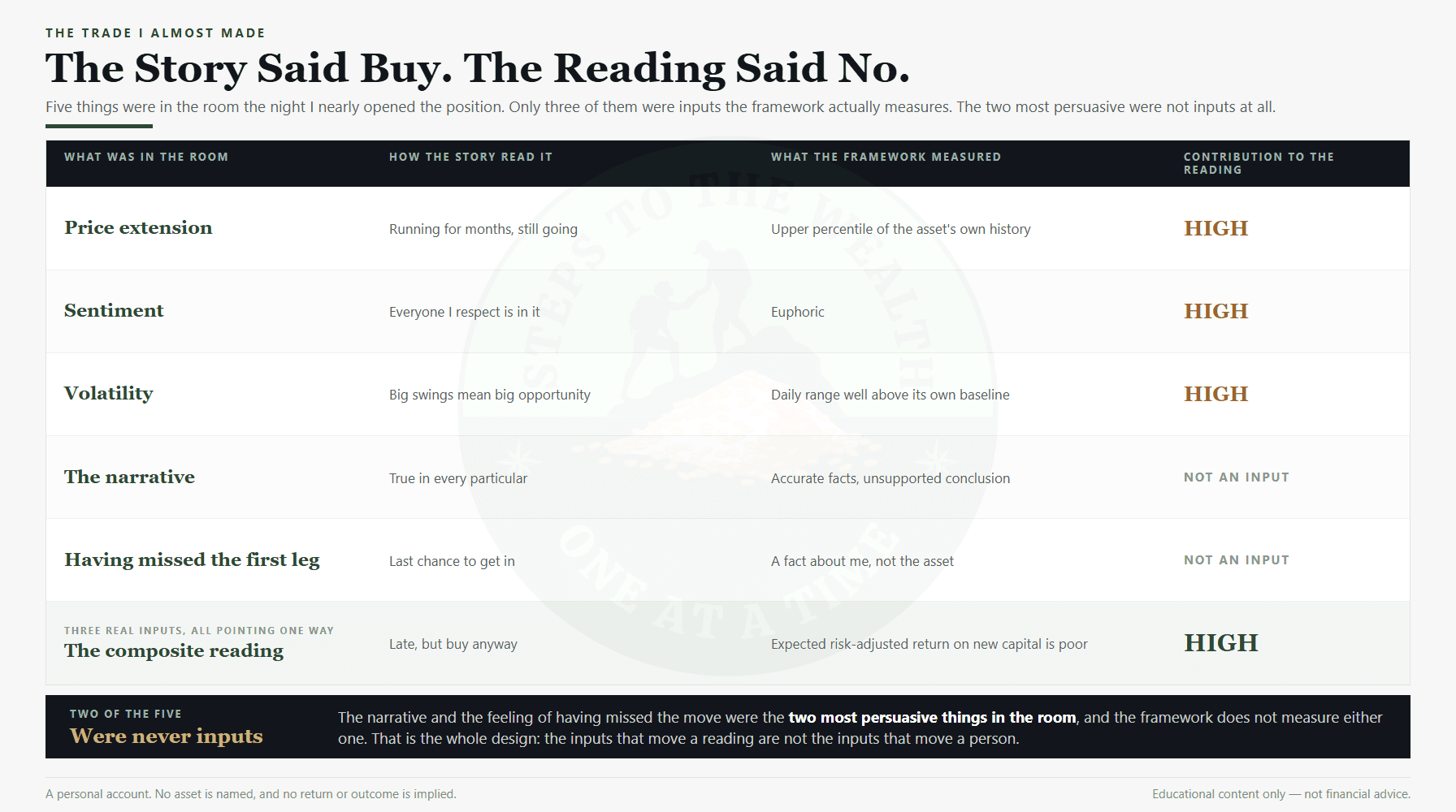
There was an asset. I am keeping it generic on purpose, because the ticker does not matter and naming it invites you to check whether I was right, which is exactly the wrong way to read this. It had been running for months. Up a great deal. The kind of move that generates its own gravity.
Everyone I respected was in it. My feed was wall-to-wall with it. People who had been quiet for years were posting screenshots. And there was a clean, compelling story for why it would keep going — a story that was true in its particulars.
That is what made it dangerous. The narrative was not nonsense. The best traps are built entirely out of accurate facts, arranged to point at a conclusion the facts do not support. Nothing in the story was a lie. The lie was in what the story implied about the next twelve months.
And I had missed the early part of the move. That was the hook — the specific, acidic feeling of having watched something triple while I sat on my hands, and now facing a choice: enter late, or watch it run further without me. If you have felt that, you know it is not really about money. It is about having been wrong in public, inside your own head.
I did the arithmetic on a position. Sized it against the portfolio. Opened the screen. I was going to buy.
What the framework was actually saying
Here is the problem. The reading on that asset was HIGH.
Not ambiguous. Not medium with a couple of yellow flags. HIGH. Price extension sat in the upper percentile of the asset’s own history. Sentiment was euphoric. Daily range was running well above its own baseline. Three inputs, all pointing the same way. The composite output of the risk-first framework was unambiguous: the expected risk-adjusted return on new capital here is poor. If anything, this was an asset the exit ladder should have been trimming, not one the entry ladder should have been buying.
So I was staring at a HIGH reading while preparing to make a large entry. The framework and I were pointed in exactly opposite directions, and I was the one holding the mouse.
This is worth sitting with, because it is the only situation in which a framework has any value at all. When the reading agrees with you, the framework is decoration. You would have done the same thing anyway. The framework only ever earns its keep in the minutes when it tells you something you do not want to hear, and the whole design question is whether it can survive that moment. There is a narrower case where the reading itself is at fault rather than unwelcome, and it is far rarer than it feels — a distorted input is a different problem from a reading you simply dislike.
Three justifications, and what each one actually was
I had my justifications ready. I always do. They arrive pre-packaged, fully formed, which should itself be the warning — a reason you did not have to work for is usually a rationalisation wearing a reason’s clothes. Mine were the standard three.
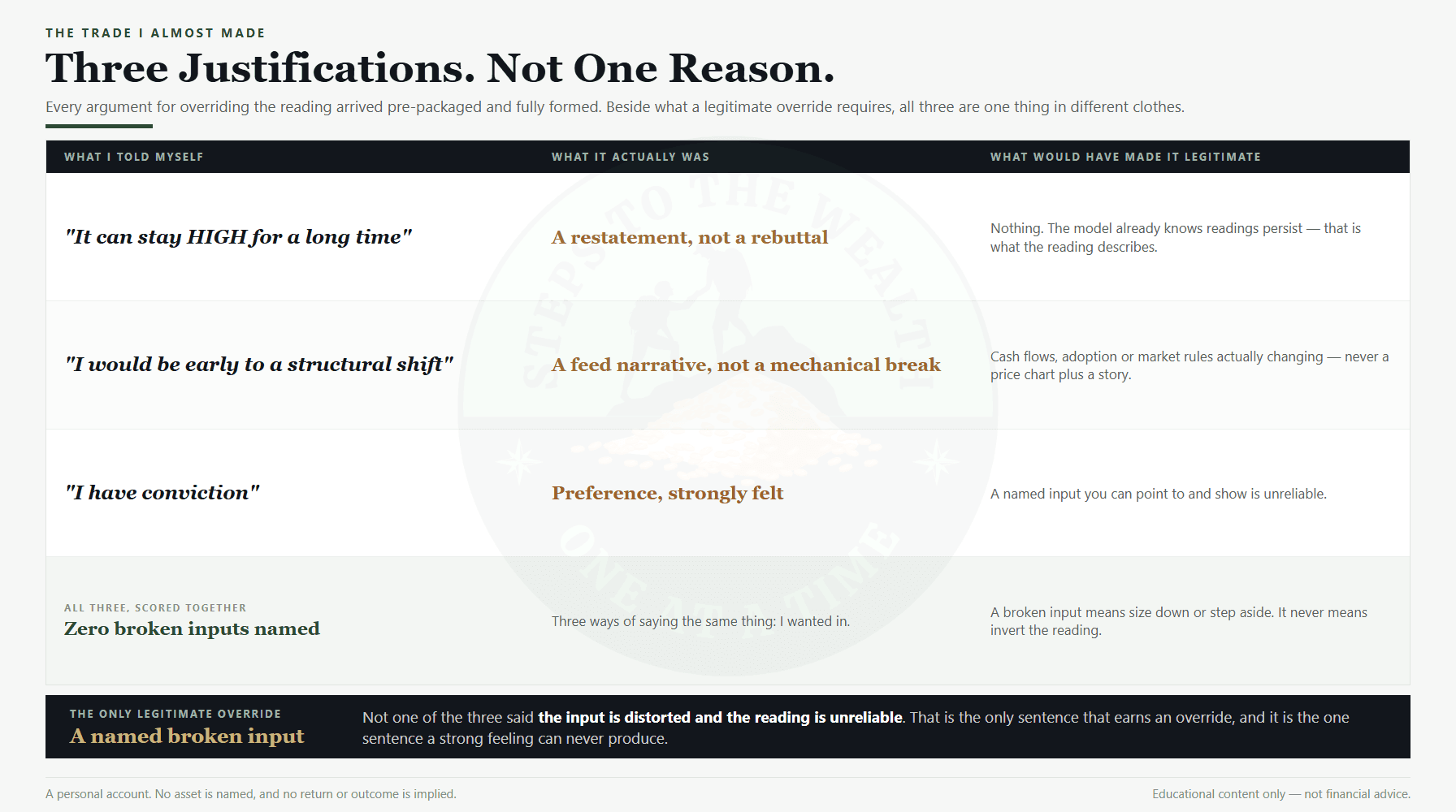
“The reading is HIGH but the trend can stay HIGH for a long time”
True. Also exactly what gets said at every top, by everyone, right up to the last one. But look at the structure of the argument: the framework already knows readings can persist. That is not new information arriving from outside the model. It is a restatement of the thing the reading is describing.
A HIGH reading has never claimed to be a timing signal. It does not say the asset falls next week. It says that capital deployed at this level carries a worse payoff distribution than capital deployed at a lower one. “It can stay high” is not a rebuttal to that. It is a description of the same fact, delivered in a more comfortable tone.
“I would be early to a structural shift, not late to a trade”
The genuine version of this exists. Structural breaks are real, and when one happens the historical distribution genuinely stops applying. But a real structural break shows up in the underlying mechanics — in cash flows, in adoption, in the rules of the market itself. It does not show up as a price chart plus a good story.
What I had was a narrative I had absorbed from a feed over several weeks, which felt like independent analysis because I had encountered it from many directions. That is not confirmation. That is one idea reaching me through twenty doors. The timing myths that cost people the most all share this shape: recency dressed as insight.
“I have conviction”
Conviction that runs opposite the reading is not conviction. It is preference. And the entire reason I built a framework in the first place was to stop making decisions on preference, because my preferences are reliably worst exactly when they feel strongest.
Notice what is missing from all three. Not one of them was “the input is distorted and the reading is unreliable.” That would have been a legitimate reason to size down or step aside from the model. I did not have it. I had a strong feeling and a good story, which is the precise circumstance the framework exists to override.
The rule that actually stopped me
What stopped me was not discipline in the willpower sense. I do not have unusual willpower. At 11pm, staring at an asset that has tripled, nobody does. Willpower is the wrong material to build a process out of, because it is at its weakest exactly when the process is under most load.
What stopped me was a rule I had written down when I was calm, months earlier, about a situation I could not yet see: I do not open a position in the same session I decide to open it. Size it, write it down, sleep, and execute the next day only if it still makes sense after re-reading the framework cold.
That rule has no intelligence in it. It does not know anything about the asset. It is a piece of mechanical friction, and the entire reason it works is that it was set by a version of me who was not under pressure and could not be argued with at 11pm. You cannot negotiate with a rule that is not in the room.
So I did not buy. I wrote down the size I was tempted by, closed the screen, and went to bed annoyed about it. That is what the process actually feels like from the inside. Not serenity. Irritation.
The next morning I re-read the reading with the chemistry drained out, and the picture was obvious in the way obvious things only become obvious once you are no longer inside them. I was about to make a large entry into a HIGH reading, on a story absorbed from a feed, driven by the pain of having missed the first leg. No input distortion. No structural break. Just me, wanting in.
I did not make the trade.
What happened next, and why it does not matter the way you think
You want to know what the asset did. Of course you do. So let me be careful here, because the lesson runs opposite to what the answer tempts you to conclude.
The asset ran further for a while. Then it gave most of it back. Had I bought where I nearly bought, I would have sat through a violent round trip and most likely sold somewhere on the way down, which is the standard sequence: late entry, panic exit, and a loss that gets explained afterwards as bad luck.
But here is the part that matters: the outcome is not why the decision was right.
If that asset had kept running and never looked back, the decision would still have been right. Following a HIGH reading into a large entry would have been wrong even if it had paid, because the expected value of the action was poor regardless of how that single instance resolved. You can make a bad decision and get a good outcome. That is the most dangerous thing that can happen to an investor, because it teaches you to repeat the bad decision with more size.
The framework is not trying to win individual trades. It is trying to keep every decision tied to expected risk-adjusted return, so that across hundreds of decisions the arithmetic works out. Judging my refusal by the fact that the asset later fell is exactly the same error as judging it by whether the asset later rose. Both hand the verdict to one sample.
This is the discipline that separates process from superstition, and it is genuinely unnatural. Every instinct you have wants to score the decision on the outcome. Markets are one of the few domains where doing that reliably makes you worse.
The asymmetry that makes one override so expensive
Here is the arithmetic that turns “do not trade against the reading” from a suggestion into a rule.
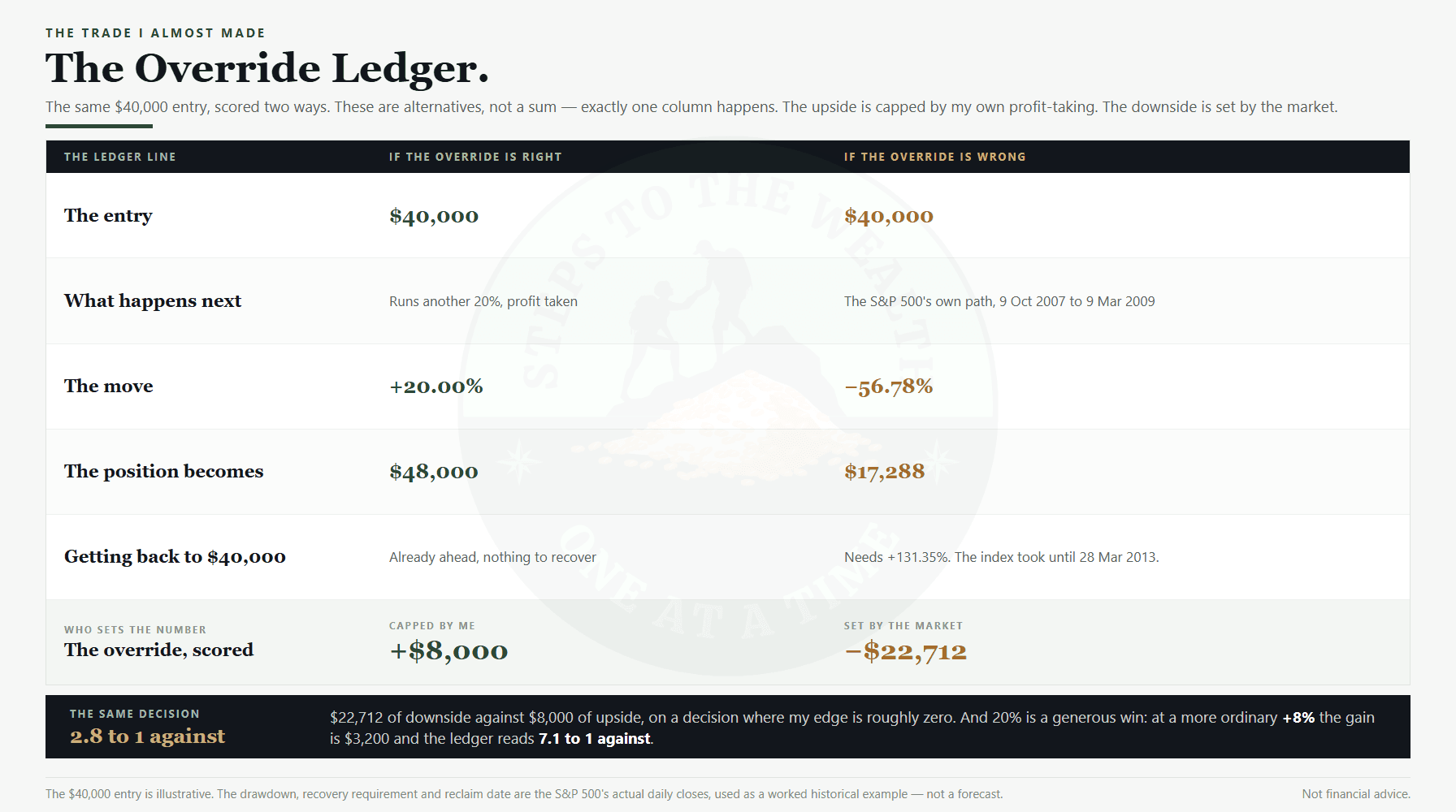
Take the position I was sizing and call it $40,000, which is roughly what it was as a share of the portfolio. Score the override both ways.
When I override the reading and I am right, I gain a bounded amount. Say the asset runs another 20% and I take the profit: +$8,000. It is capped, and it is capped by me, because I am the one who decides when to sell into strength.
When I override the reading and I am wrong, the ceiling comes off. Apply the actual peak-to-trough path the S&P 500 took from 9 October 2007 to 9 March 2009 — −56.78% — to that same entry, and $40,000 becomes $17,288. Getting back to even from there requires +131.35%, and the index itself did not reclaim its old high until 28 March 2013, five and a half years after the peak. That is a broad-index drawdown, on the diversified end of the spectrum. A single extended asset can do considerably worse.
So the ledger reads $8,000 against $22,712. 2.8 to 1 against, on a decision where my edge over the market is approximately zero. And 20% is a generous win. At a more ordinary +8%, the gain is $3,200 and the ratio is 7.1 to 1 against.
Small bounded upside, large unbounded downside, no edge. That is a negative expected-value bet even if I am right more often than I am wrong. So the rule cannot be “override carefully.” It has to be “do not override on preference at all,” because the one that gets through erases several that worked.
If you want to see this shape rather than read about it, the DCA simulator will run an entry through real drawdown paths, and the Black Swan tool replays actual historical crashes across a portfolio rather than forecasting new ones. The recovery arithmetic is the part people consistently underestimate: a 2008-scale drawdown needs more than a doubling to get back to flat, while a 2020-scale one took 33 days down and 181 days round trip. Same direction, completely different demands on your behaviour.
What the data says about the trades you do not make
My story is one anecdote and should carry the weight of one anecdote. So here is the population-level version, because it points the same way and it is not a story at all.
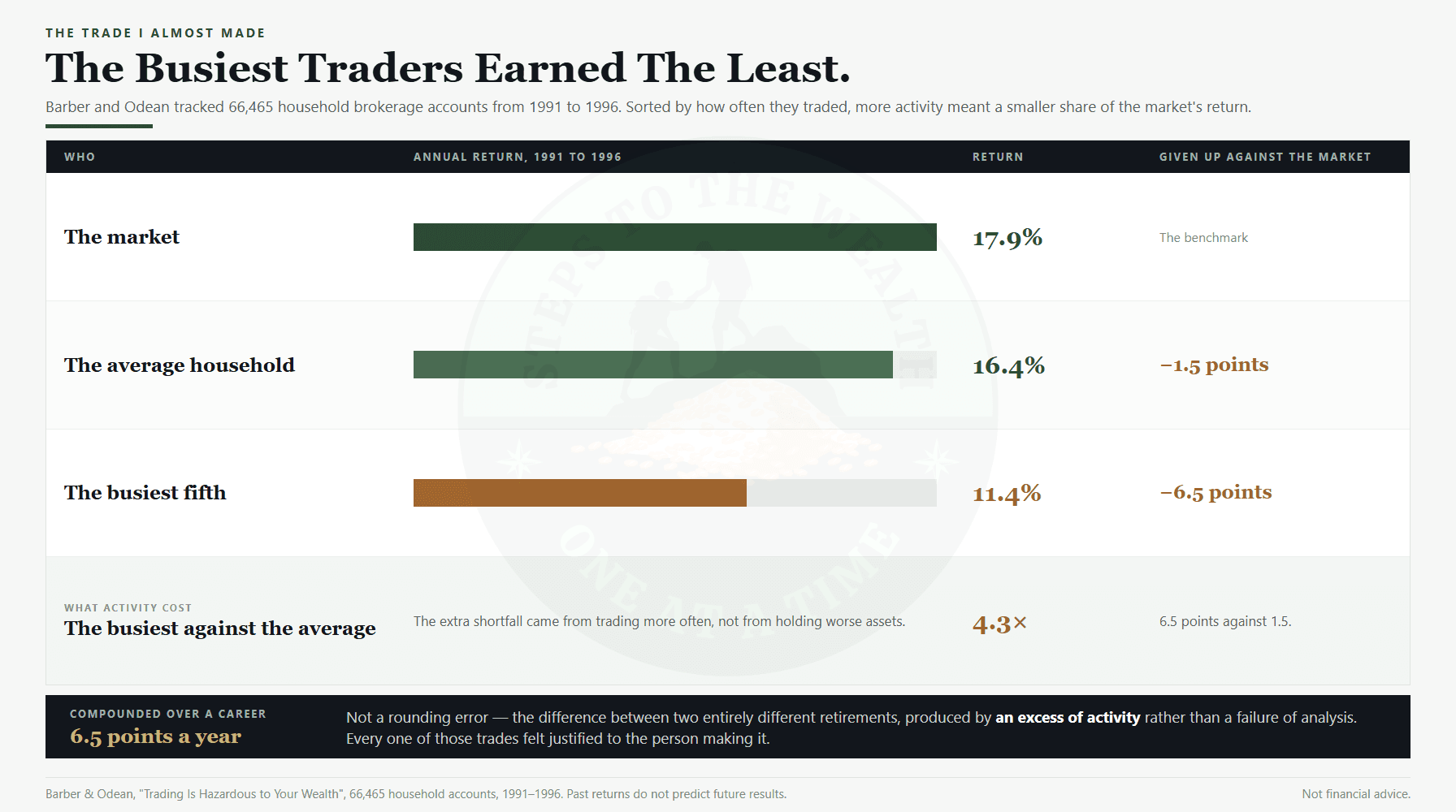
Brad Barber and Terrance Odean studied 66,465 household brokerage accounts over 1991 to 1996, in work published as Trading Is Hazardous to Your Wealth. The market returned 17.9% annually over that window. The average household earned 16.4%. The fifth that traded most actively earned 11.4%.
Read the two gaps separately, because they say different things. The average household gave up 1.5 percentage points — call that the ordinary cost of participating. The busiest fifth gave up 6.5 percentage points, more than four times as much, and they gave it up by doing more. Not by picking worse assets. By acting more often.
Compounded over a working life, 6.5 points a year is not a rounding error. It is the difference between two entirely different retirements, produced not by a failure of analysis but by an excess of activity. Every one of those trades felt justified to the person making it. That is the uncomfortable part. Conviction is not a signal, and it does not become one by being strongly felt.
If you want the vocabulary for which flavour of this you personally run, Morningstar’s work on the four behavioural investor types is a reasonable place to start. Knowing your default failure mode will not stop you feeling the pull. It will tell you which rule to write down before you feel it.
When overriding the reading is legitimate
I want to be honest about the limits here, because a rule presented as absolute gets discarded the first time reality does not fit it.
There are cases where stepping outside the reading is correct. The reading depends on inputs, and inputs break. If a price series is stale, if a corporate action has scrambled the history, if the asset is thin enough that the extension figure is measuring nothing — then the reading is not information and should not be treated as such. The right response is to size down or step aside, not to invert it. A broken instrument does not tell you to do the opposite of what it reads.
There are also decisions the framework does not have jurisdiction over. Whether the money should be in the market at all is upstream of any reading, and belongs with asset allocation and your own liquidity needs. Whether your portfolio survives a stress test is a structural question, not a timing one.
And there is a real cost on the other side of the ledger, which I am not going to pretend away. Sitting out has a price. The cost of waiting is genuine and compounds, and time out of the market is the most expensive thing most cautious investors ever buy. Refusing one extended entry is not the same as holding cash indefinitely and calling it discipline.
The distinction is narrow but it is clean. Declining a specific entry because the reading on that asset is poor is the framework working. Declining to invest at all because markets feel frightening is a different decision wearing the same clothes, and it is the one that quietly costs the most. If deploying capital you already hold is the actual question, that is a separate problem with its own arithmetic. The framework routes capital between assets and across time. It does not tell you to sit in cash and wait for comfort.
How to build the pause into your own process
You will get your version of this night. An asset everyone is in, a true-enough story, the acid of having missed the first leg, the order screen open. Willpower will not reliably save you, because the pull arrives precisely when your willpower is lowest. Structure will.
Four things, none of them clever, all of them written down in advance:
- Put time between the decision and the execution. One session minimum. Size it, write it down, sleep, re-read cold. Most of what dies overnight deserved to.
- Write the reading down before you write the justification. Record what the framework says first, in its own words, then record what you want to do. Seeing the two next to each other on one page removes the ambiguity you would otherwise exploit.
- Require the override to name a broken input. Not a feeling, not a thesis, not a chart. A specific input you can point to and say why it is unreliable. If you cannot name one, you do not have an override. You have a preference.
- Keep a log of the trades you did not make. Size, date, reading, and what the asset did afterwards. Not to score yourself — to see over years that the refusals were mostly right, which is the only evidence that will still convince you at 11pm.
The last one matters more than it sounds. Your entries leave a record automatically. Your refusals leave nothing, so they get no representation in your memory of how you invest, and a mechanism you cannot see is a mechanism you will eventually stop trusting. Writing them down gives the no’s a statement of their own.
This is the same logic that governs the whole structure, not just the entries. Trimming a winner that still feels invincible, deciding whether an option is worth keeping open, holding a contribution schedule through a drawdown — each is the same question in different clothing: is this action consistent with the current reading? When the honest answer is no, the action does not happen, however good the story is.
What this actually costs
Two things, and I would rather name them than have you discover them.
It costs upside. Some of the trades you refuse will run without you, and you will watch them do it. That is not a flaw in the framework, it is the price of the framework, and any system that never misses a winner is a system with no risk discipline in it at all. You are buying a narrower distribution, and the right tail is part of what you pay with.
It also costs the feeling of being decisive, which is worth more to most people than they admit. A mechanical process makes you feel less like an investor and more like an administrator. That feeling is the point. Most of the damage in a portfolio is done by someone trying to feel like an investor, at speed, at night. The operator’s job is to be boring on purpose, and to have a system that runs while you work instead of a set of decisions you make while tired.
What it buys is that your worst decisions get capped. Not eliminated. Capped. Over a thirty-year horizon of background wealth-building funded by an ordinary savings rate, capping the worst decisions does more work than improving the best ones, because the drawdowns are what break the compounding chain. And it is far cheaper to cap them with a rule than with a lesson bought at the top of a cycle.
What to take from this
The trade I almost made is the clearest evidence I have that the framework does something, precisely because I disagreed with it at the time and it held anyway. A system you only follow when you agree with it is not a system. It is a preference with better paperwork.
Two things will save you on your version of that night. A rule that puts time between the decision and the execution, written when you were calm. And the discipline to judge the decision by the reading rather than by what the asset did next.
The best trade I made that year was the one I did not make. It is not on any statement. It shows up only as a drawdown that never happened, which is the least satisfying form a win can take and one of the most valuable.
Count your no’s. They are part of the record too.
If you want the framework itself rather than the story about it, the newsletter is where the readings and the rules get worked through, and The Operator’s Mindset is the longer treatment of why the override feels so reasonable in the moment. For running the numbers on your own entries, DCA Simulator Pro handles the drawdown and recovery arithmetic without you having to trust an anecdote.
Educational content only. Not financial advice. This is a personal account shared to illustrate framework discipline, not a recommendation about any asset. The $40,000 entry is illustrative; the −56.78% drawdown, the +131.35% recovery requirement and the 28 March 2013 reclaim date are the S&P 500’s actual daily closes from 9 October 2007 to 9 March 2009 and are used here as a worked historical example, not a forecast. Your decisions depend on your own circumstances — work with a qualified financial professional before acting.